 Limitations of sight

   There are basically 2 types of limitations of sight
    a) Blind spot
    b) Optical illusion

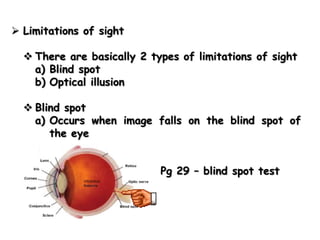
   Blind spot
    a) Occurs when image falls on the blind spot of
       the eye


                            Pg 29 – blind spot test
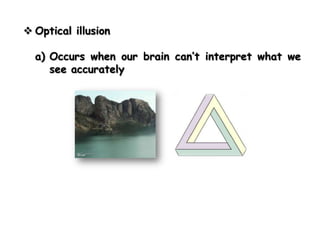
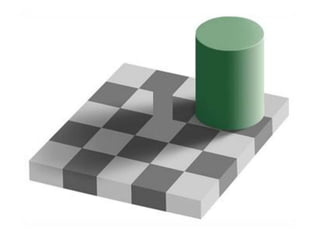
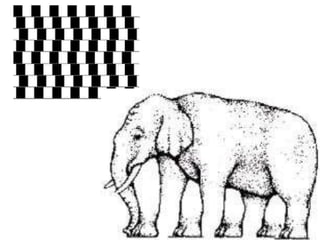
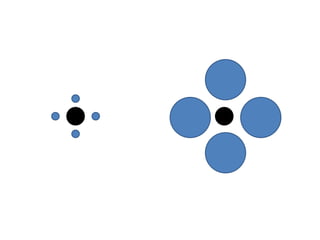
 Optical illusion

  a) Occurs when our brain can’t interpret what we
     see accurately
 Monocular and Stereoscopic Vision

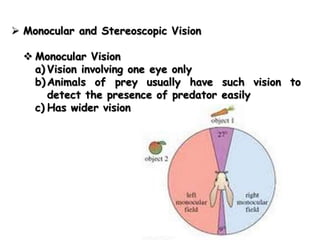
   Monocular Vision
    a) Vision involving one eye only
    b) Animals of prey usually have such vision to
       detect the presence of predator easily
    c) Has wider vision
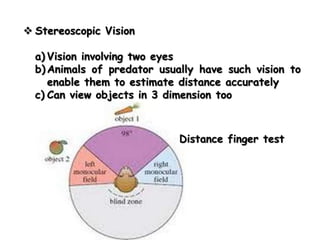
 Stereoscopic Vision

  a) Vision involving two eyes
  b) Animals of predator usually have such vision to
     enable them to estimate distance accurately
  c) Can view objects in 3 dimension too


                             Distance finger test
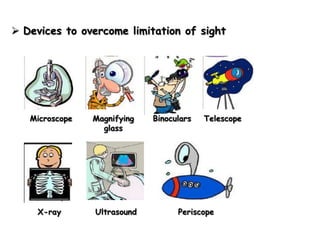
 Devices to overcome limitation of sight


   Microscope   Magnifying   Binoculars   Telescope
                  glass


     X-ray      Ultrasound         Periscope
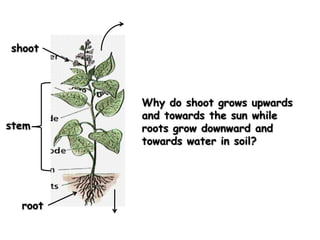
shoot


         Why do shoot grows upwards
         and towards the sun while
stem     roots grow downward and
         towards water in soil?


  root
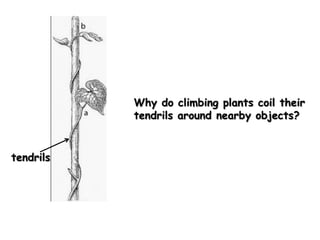
Why do climbing plants coil their
           tendrils around nearby objects?


tendrils
 Tropic responses

   Tropic responses are responses by plants towards
    stimulus and is dependent on the direction of
    stimulus.

   4 types of tropic responses:
    a) Phototropism (light)
    b) Geotropism (gravity)
    c) Hydrptropism (water)
    d) Thigmotropism (touch)
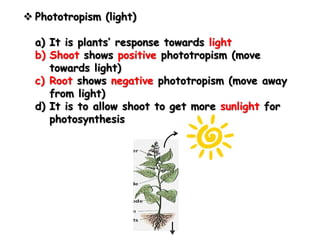
 Phototropism (light)

  a) It is plants’ response towards light
  b) Shoot shows positive phototropism (move
     towards light)
  c) Root shows negative phototropism (move away
     from light)
  d) It is to allow shoot to get more sunlight for
     photosynthesis
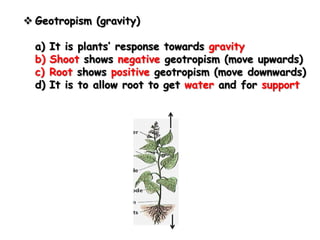
 Geotropism (gravity)

  a)   It is plants’ response towards gravity
  b)   Shoot shows negative geotropism (move upwards)
  c)   Root shows positive geotropism (move downwards)
  d)   It is to allow root to get water and for support
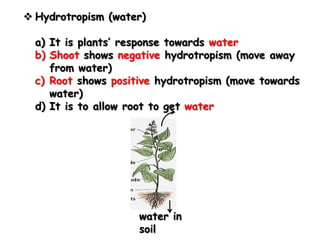
 Hydrotropism (water)

  a) It is plants’ response towards water
  b) Shoot shows negative hydrotropism (move away
     from water)
  c) Root shows positive hydrotropism (move towards
     water)
  d) It is to allow root to get water


                     water in
                     soil
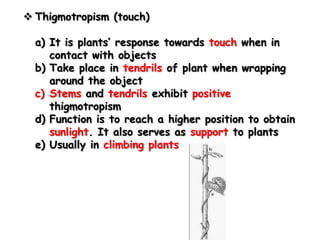
 Thigmotropism (touch)

  a) It is plants’ response towards touch when in
     contact with objects
  b) Take place in tendrils of plant when wrapping
     around the object
  c) Stems and tendrils exhibit positive
     thigmotropism
  d) Function is to reach a higher position to obtain
     sunlight. It also serves as support to plants
  e) Usually in climbing plants
 Nastic movements

   Nastic movements are responses by plants towards
    stimulus and is not dependent on the direction of
    stimulus.

   There are many stimuli that can cause nastic
    movements such as light (photonasty), touch
    (thigmonasty), temperature (thermonasty) etc.


    http://www.youtube.com/   http://www.youtube.com/
    watch?v=ymnLpQNyI6g       watch?v=0V7_YT_RDh0
     Venus flytrap             Oxalis nastic
                               movement
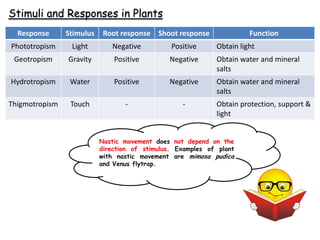
Stimuli and Responses in Plants
  Response      Stimulus    Root response Shoot response               Function
Phototropism     Light        Negative          Positive     Obtain light
 Geotropism     Gravity        Positive        Negative      Obtain water and mineral
                                                             salts
Hydrotropism     Water         Positive        Negative      Obtain water and mineral
                                                             salts
Thigmotropism    Touch            -                -         Obtain protection, support &
                                                             light


                           Nastic movement does not depend on the
                           direction of stimulus. Examples of plant
                           with nastic movement are mimosa pudica
                           and Venus flytrap.

Chap 1.8 and 9

  • 2.
     Limitations ofsight  There are basically 2 types of limitations of sight a) Blind spot b) Optical illusion  Blind spot a) Occurs when image falls on the blind spot of the eye Pg 29 – blind spot test
  • 3.
     Optical illusion a) Occurs when our brain can’t interpret what we see accurately
  • 8.
     Monocular andStereoscopic Vision  Monocular Vision a) Vision involving one eye only b) Animals of prey usually have such vision to detect the presence of predator easily c) Has wider vision
  • 9.
     Stereoscopic Vision a) Vision involving two eyes b) Animals of predator usually have such vision to enable them to estimate distance accurately c) Can view objects in 3 dimension too Distance finger test
  • 10.
     Devices toovercome limitation of sight Microscope Magnifying Binoculars Telescope glass X-ray Ultrasound Periscope
  • 12.
    shoot Why do shoot grows upwards and towards the sun while stem roots grow downward and towards water in soil? root
  • 13.
    Why do climbingplants coil their tendrils around nearby objects? tendrils
  • 14.
     Tropic responses  Tropic responses are responses by plants towards stimulus and is dependent on the direction of stimulus.  4 types of tropic responses: a) Phototropism (light) b) Geotropism (gravity) c) Hydrptropism (water) d) Thigmotropism (touch)
  • 15.
     Phototropism (light) a) It is plants’ response towards light b) Shoot shows positive phototropism (move towards light) c) Root shows negative phototropism (move away from light) d) It is to allow shoot to get more sunlight for photosynthesis
  • 16.
     Geotropism (gravity) a) It is plants’ response towards gravity b) Shoot shows negative geotropism (move upwards) c) Root shows positive geotropism (move downwards) d) It is to allow root to get water and for support
  • 17.
     Hydrotropism (water) a) It is plants’ response towards water b) Shoot shows negative hydrotropism (move away from water) c) Root shows positive hydrotropism (move towards water) d) It is to allow root to get water water in soil
  • 18.
     Thigmotropism (touch) a) It is plants’ response towards touch when in contact with objects b) Take place in tendrils of plant when wrapping around the object c) Stems and tendrils exhibit positive thigmotropism d) Function is to reach a higher position to obtain sunlight. It also serves as support to plants e) Usually in climbing plants
  • 19.
     Nastic movements  Nastic movements are responses by plants towards stimulus and is not dependent on the direction of stimulus.  There are many stimuli that can cause nastic movements such as light (photonasty), touch (thigmonasty), temperature (thermonasty) etc. http://www.youtube.com/ http://www.youtube.com/ watch?v=ymnLpQNyI6g watch?v=0V7_YT_RDh0 Venus flytrap Oxalis nastic movement
  • 20.
    Stimuli and Responsesin Plants Response Stimulus Root response Shoot response Function Phototropism Light Negative Positive Obtain light Geotropism Gravity Positive Negative Obtain water and mineral salts Hydrotropism Water Positive Negative Obtain water and mineral salts Thigmotropism Touch - - Obtain protection, support & light Nastic movement does not depend on the direction of stimulus. Examples of plant with nastic movement are mimosa pudica and Venus flytrap.