Chapter 14 
Mass Spectroscopy
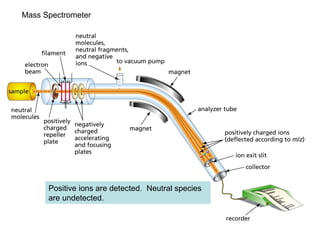
Mass Spectrometer 
Positive ions are detected. Neutral species 
are undetected.
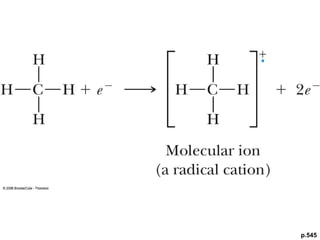
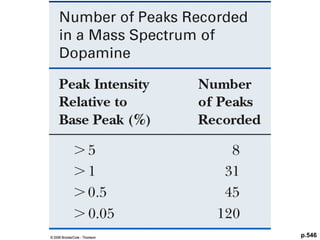
p.545
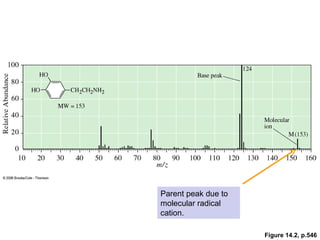
Figure 14.2, p.546 
Parent peak due to 
molecular radical 
cation.
Detecting nitrogen, N 
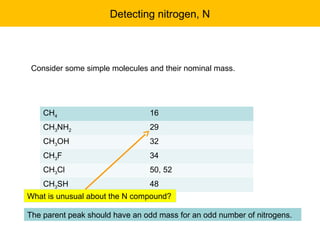
Consider some simple molecules and their nominal mass. 
CH4 16 
CH3NH2 29 
CH3OH 32 
CH3F 34 
CH3Cl 50, 52 
CH3SH 48 
What is unusual about the N compound? 
The parent peak should have an odd mass for an odd number of nitrogens.
p.546
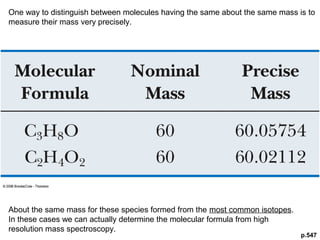
One way to distinguish between molecules having the same about the same mass is to 
measure their mass very precisely. 
p.547 
About the same mass for these species formed from the most common isotopes. 
In these cases we can actually determine the molecular formula from high 
resolution mass spectroscopy.
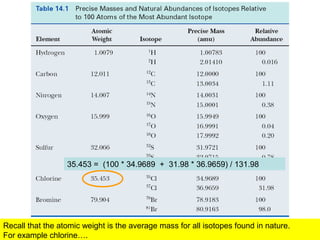
Recall that the atomic weight is the average mass for all isotopes found in nature. 
For example chlorine…. 
Table 14.1, p.548 
35.453 = (100 * 34.9689 + 31.98 * 36.9659) / 131.98
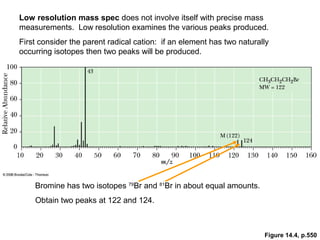
Low resolution mass spec does not involve itself with precise mass 
measurements. Low resolution examines the various peaks produced. 
First consider the parent radical cation: if an element has two naturally 
occurring isotopes then two peaks will be produced. 
Figure 14.4, p.550 
Bromine has two isotopes 79Br and 81Br in about equal amounts. 
Obtain two peaks at 122 and 124.
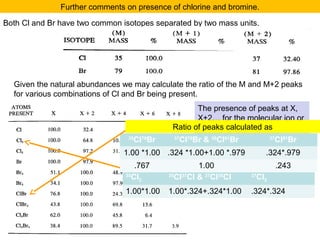
Further comments on presence of chlorine and bromine. 
Both Cl and Br have two common isotopes separated by two mass units. 
Given the natural abundances we may calculate the ratio of the M and M+2 peaks 
for various combinations of Cl and Br being present. 
The presence of peaks at X, 
X+2… for the molecular ion or 
fragment hopefully with close 
to the expected ratio is taken 
as indication of Cl or Br. 
Ratio of peaks calculated as 
35Cl79Br 37Cl79Br & 35Cl81Br 37Cl81Br 
1.00 *1.00 .324 *1.00+1.00 *.979 .324*.979 
.767 Ratio of 1.00 peaks calculated as 
.243 
35Cl2 
35Cl37Cl & 37Cl35Cl 37Cl2 
1.00*1.00 1.00*.324+.324*1.00 .324*.324
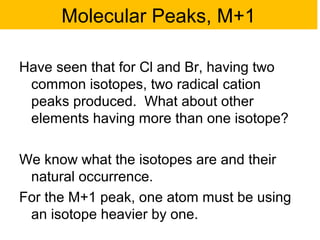
Molecular Peaks, M+1 
Have seen that for Cl and Br, having two 
common isotopes, two radical cation 
peaks produced. What about other 
elements having more than one isotope? 
We know what the isotopes are and their 
natural occurrence. 
For the M+1 peak, one atom must be using 
an isotope heavier by one.
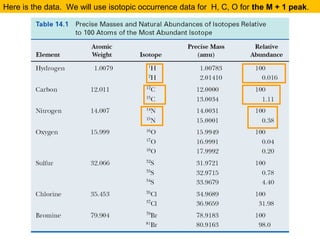
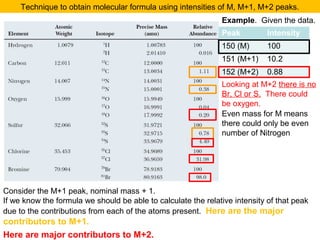
Here is the data. We will use isotopic occurrence data for H, C, O for the M + 1 peak.
The M+2 peak 
Recap: The M+1 peak has contributions from one atom being a heavier isotope 
by 1. 
The M+2 peak can have contributions from 
•One atom being a heavier isotope by 2. 
•Two atoms being heavier by 1 each.
M+2 peak, contributions from one atom and two atoms. 
Recap: 
The M+1 peak has contributions from one atom being a heavier isotope by 1. 
(M+1)/M = ca. 1.1% * no. of C atoms + 0.36% * no. of N atoms 
The M+2 peak can have contributions from two sources 
•One atom being a heavier isotope by 2. Mainly O (excluding S, Cl and Br) 
•Two atoms being heavier by 1 each. Mainly C atoms. 
(M+2)/M = ca. (0.20% * no. of O atoms) + (1.1 * no. of C atoms)2/200% 
Example 1: C5H5N 
[(A + 1)+]/[A+] = 5 x 1.1% + 1 x 0.36% = 
5.9% 
[(A + 2)+]/[A+] = 5.52/200 % = 0.15% 
Example 2: C7H5O 
[(A + 1)+]/[A+] = 7 x 1.1% = 7.7% 
[(A + 2)+]/[A+] = 7.72/200 % + 0.20% = 0.50%
Technique to obtain molecular formula using intensities of M, M+1, M+2 peaks. 
Example. Given the data. 
Peak Intensity 
150 (M) 100 
151 (M+1) 10.2 
152 (M+2) 0.88 
Looking at M+2 there is no 
Br, Cl or S. There could 
be oxygen. 
Even mass for M means 
there could only be even 
number of Nitrogen 
Consider the M+1 peak, nominal mass + 1. 
If we know the formula we should be able to calculate the relative intensity of that peak 
due to the contributions from each of the atoms present. Here are the major 
contributors to M+1. 
Here are major contributors to M+2.
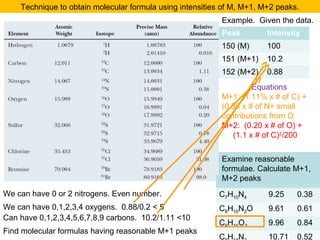
Technique to obtain molecular formula using intensities of M, M+1, M+2 peaks. 
Example. Given the data. 
Peak Intensity 
150 (M) 100 
151 (M+1) 10.2 
152 (M+2) 0.88 
Equations 
M+1: (1.11% x # of C) + 
(0.38 x # of N+ small 
contributions from O 
M+2: (0.20 x # of O) + 
(1.1 x # of C)2/200 
We can have 0 or 2 nitrogens. Even number. 
We can have 0,1,2,3,4 oxygens. 0.88/0.2 < 5 
Can have 0,1,2,3,4,5,6,7,8,9 carbons. 10.2/1.11 <10 
Find molecular formulas having reasonable M+1 peaks 
Examine reasonable 
formulae. Calculate M+1, 
M+2 peaks 
M+1 M+2 
C7H10N4 9.25 0.38 
C8H10N2O 9.61 0.61 
C9H10O2 9.96 0.84 
C9H14N2 10.71 0.52
Return to Fragmentation of Molecular Radical Cation, M+ 
First distinguish between some species 
•Radical/cation produced by ejection of electron from structure. It contains all the 
atoms of the original molecule just minus one electron. Example C4H10 
+. 
•Carbocation which is not a radical, is electron deficient and is a fragment of a 
stable molecule. Example C4H9 
+ 
•Radical is not charged and is a fragment of a stable molecule. Example C4H9 
. 
The highly energetic radical/cation can undergo fragmentation.
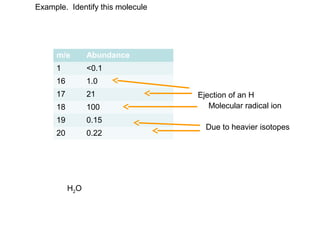
Example. Identify this molecule 
m/e Abundance 
1 <0.1 
16 1.0 
17 21 
18 100 
19 0.15 
20 0.22 
Ejection of an H 
Molecular radical ion 
Due to heavier isotopes 
H2O
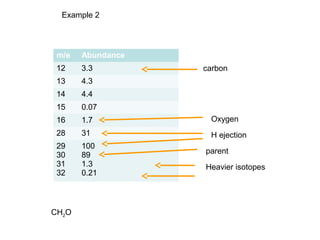
Example 2 
m/e Abundance 
12 3.3 
13 4.3 
14 4.4 
15 0.07 
16 1.7 
28 31 
29 
100 
30 
89 
31 
1.3 
32 
0.21 
carbon 
Oxygen 
H ejection 
parent 
Heavier isotopes 
CH2O
p.550 
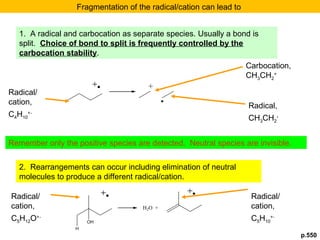
Fragmentation of the radical/cation can lead to 
1. A radical and carbocation as separate species. Usually a bond is 
split. Choice of bond to split is frequently controlled by the 
carbocation stability. 
Remember only the positive species are detected. Neutral species are invisible. 
2. Rearrangements can occur including elimination of neutral 
molecules to produce a different radical/cation. 
OH 
H2O + 
H 
. 
Carbocation, 
CHCH+ 
32 
Radical/ 
cation, 
CH+. 
410 
Radical, 
CH3CH2 
. 
Radical/ 
cation, 
C5H12O+. 
Radical/ 
cation, 
CH+. 
510
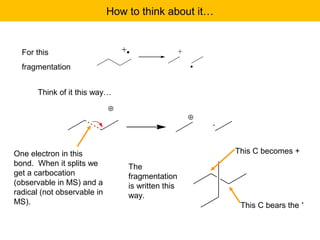
How to think about it… 
For this 
. fragmentation 
Think of it this way… 
One electron in this 
bond. When it splits we 
get a carbocation 
(observable in MS) and a 
radical (not observable in 
MS). 
The 
fragmentation 
is written this 
way. 
This C becomes + 
This C bears the .
p.551 
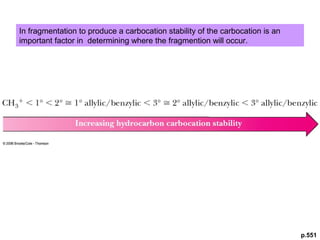
In fragmentation to produce a carbocation stability of the carbocation is an 
important factor in determining where the fragmention will occur.
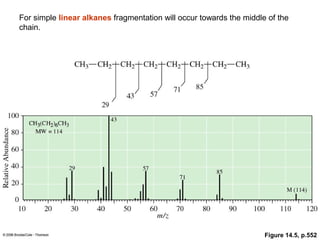
For simple linear alkanes fragmentation will occur towards the middle of the 
chain. 
Figure 14.5, p.552
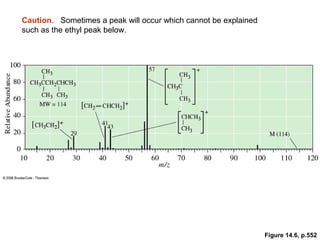
Figure 14.6, p.552 
Caution. Sometimes a peak will occur which cannot be explained 
such as the ethyl peak below.
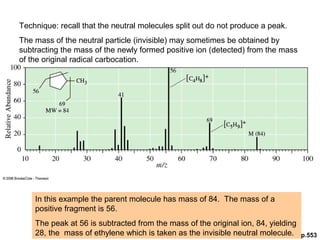
Technique: recall that the neutral molecules split out do not produce a peak. 
The mass of the neutral particle (invisible) may sometimes be obtained by 
subtracting the mass of the newly formed positive ion (detected) from the mass 
of the original radical carbocation. 
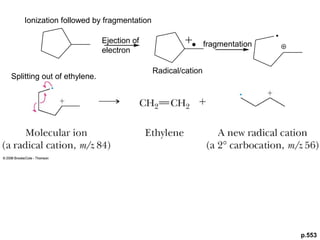
In this example the parent molecule has mass of 84. The mass of a 
positive fragment is 56. 
The peak at 56 is subtracted from the mass of the original ion, 84, yielding 
28, the mass of ethylene which is taken as the invisible neutral molecule. 
Figure 14.7, p.553
p.553 
. Ionization followed by fragmentation 
Splitting out of ethylene. 
Ejection of 
electron 
Radical/cation 
fragmentation
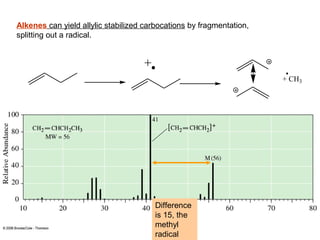
Alkenes can yield allylic stabilized carbocations by fragmentation, 
splitting out a radical. 
. 
+ CH3 
Difference 
is 15, the 
methyl 
radical
p.555 
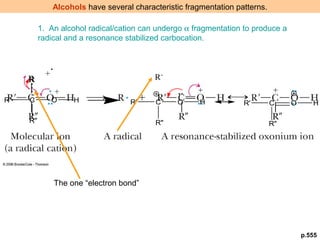
Alcohols have several characteristic fragmentation patterns. 
1. An alcohol radical/cation can undergo a fragmentation to produce a 
radical and a resonance stabilized carbocation. 
R 
C 
R' 
R" 
+. 
O H 
R. 
R' C 
R" 
O H R' C 
R" 
O H 
The one “electron bond”
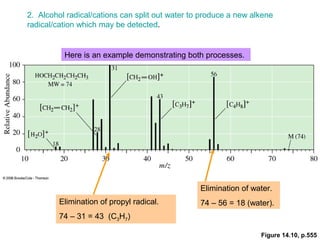
2. Alcohol radical/cations can split out water to produce a new alkene 
radical/cation which may be detected. 
Elimination of water. 
Elimination of propyl radical. 74 – 56 = 18 (water). 
74 – 31 = 43 (C3H7) 
Figure 14.10, p.555 
Here is an example demonstrating both processes.
Aldehydes and Ketones 
Several characteristics reactions the radical/cations 
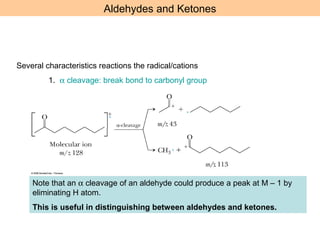
1. a cleavage: break bond to carbonyl group 
Note that an a cleavage of an aldehyde could produce a peak at M – 1 by 
eliminating H atom. 
This is useful in distinguishing between aldehydes and ketones.
p.557 
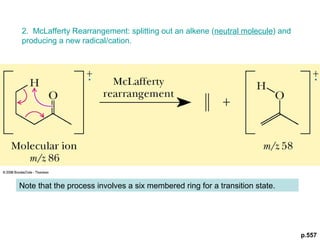
2. McLafferty Rearrangement: splitting out an alkene (neutral molecule) and 
producing a new radical/cation. 
Note that the process involves a six membered ring for a transition state.
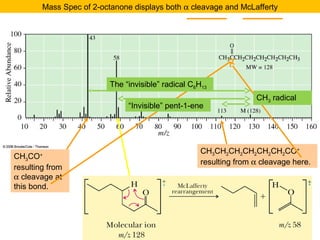
Mass Spec of 2-octanone displays both a cleavage and McLafferty 
CH3CO+ 
resulting from 
a cleavage at 
this bond. 
The “invisible” radical C6H13 
CH3 radical 
“Invisible” pent-1-ene 
CH3CH2CH2CH2CH2CH2CO+ 
resulting from a cleavage here.
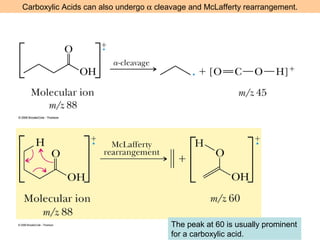
Carboxylic Acids can also undergo a cleavage and McLafferty rearrangement. 
The peak at 60 is usually prominent 
for a carboxylic acid.
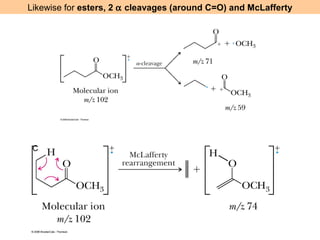
Likewise for esters, 2 a cleavages (around C=O) and McLafferty 
C
p.559 
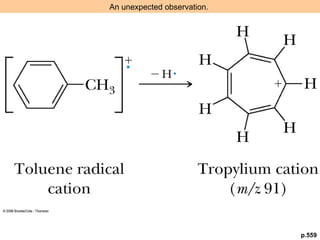
An unexpected observation.
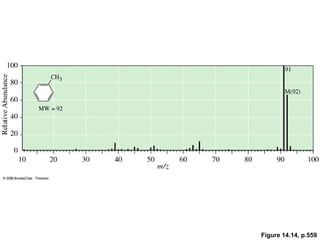
Figure 14.14, p.559
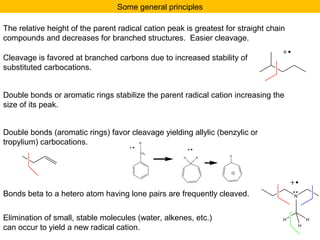
Some general principles 
The relative height of the parent radical cation peak is greatest for straight chain 
compounds and decreases for branched structures. Easier cleavage. 
Cleavage is favored at branched carbons due to increased stability of 
substituted carbocations. 
Double bonds or aromatic rings stabilize the parent radical cation increasing the 
size of its peak. 
Double bonds (aromatic rings) favor cleavage yielding allylic (benzylic or 
tropylium) carbocations. 
R 
CH2 
H R H 
Bonds beta to a hetero atom having lone pairs are frequently cleaved. N 
Elimination of small, stable molecules (water, alkenes, etc.) H 
H 
can occur to yield a new radical cation. 
H
Example 
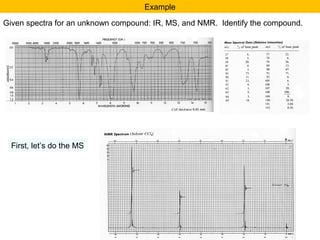
Given spectra for an unknown compound: IR, MS, and NMR. Identify the compound. 
First, let’s do the MS
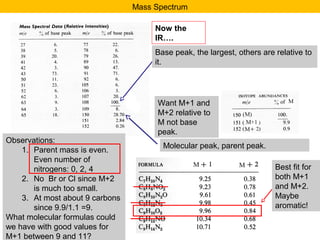
Mass Spectrum 
Base peak, the largest, others are relative to 
it. 
Want M+1 and 
M+2 relative to 
M not base 
peak. 
Molecular peak, parent peak. 
Observations: 
1. Parent mass is even. 
Even number of 
nitrogens: 0, 2, 4 
2. No Br or Cl since M+2 
is much too small. 
3. At most about 9 carbons 
since 9.9/1.1 =9. 
What molecular formulas could 
we have with good values for 
M+1 between 9 and 11? 
Best fit for 
both M+1 
and M+2. 
Maybe 
aromatic! 
Now the 
IR….
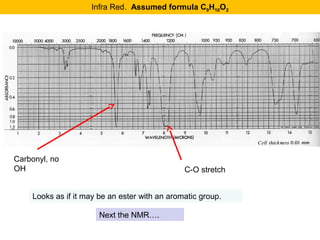
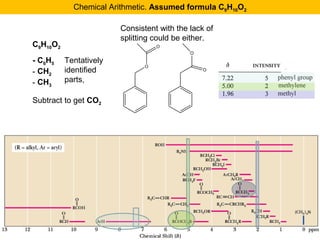
Infra Red. Assumed formula C9H10O2 
Carbonyl, no 
OH C-O stretch 
Looks as if it may be an ester with an aromatic group. 
Next the NMR….
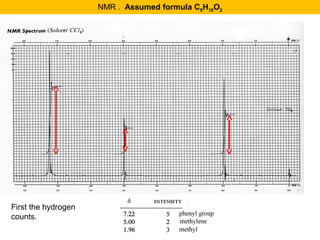
NMR . Assumed formula C9H10O2 
First the hydrogen 
counts.
Chemical Arithmetic. Assumed formula C9H10O2 
C9H10O2 
- C6H5 
- CH2 
- CH3 
Subtract to get CO2 
Consistent with the lack of 
splitting could be either. 
O 
O 
O 
O 
Tentatively 
identified 
parts,

Chap 14 mass spec

  • 1.
    Chapter 14 MassSpectroscopy
  • 2.
    Mass Spectrometer Positiveions are detected. Neutral species are undetected.
  • 3.
  • 4.
    Figure 14.2, p.546 Parent peak due to molecular radical cation.
  • 5.
    Detecting nitrogen, N Consider some simple molecules and their nominal mass. CH4 16 CH3NH2 29 CH3OH 32 CH3F 34 CH3Cl 50, 52 CH3SH 48 What is unusual about the N compound? The parent peak should have an odd mass for an odd number of nitrogens.
  • 6.
  • 7.
    One way todistinguish between molecules having the same about the same mass is to measure their mass very precisely. p.547 About the same mass for these species formed from the most common isotopes. In these cases we can actually determine the molecular formula from high resolution mass spectroscopy.
  • 8.
    Recall that theatomic weight is the average mass for all isotopes found in nature. For example chlorine…. Table 14.1, p.548 35.453 = (100 * 34.9689 + 31.98 * 36.9659) / 131.98
  • 9.
    Low resolution massspec does not involve itself with precise mass measurements. Low resolution examines the various peaks produced. First consider the parent radical cation: if an element has two naturally occurring isotopes then two peaks will be produced. Figure 14.4, p.550 Bromine has two isotopes 79Br and 81Br in about equal amounts. Obtain two peaks at 122 and 124.
  • 10.
    Further comments onpresence of chlorine and bromine. Both Cl and Br have two common isotopes separated by two mass units. Given the natural abundances we may calculate the ratio of the M and M+2 peaks for various combinations of Cl and Br being present. The presence of peaks at X, X+2… for the molecular ion or fragment hopefully with close to the expected ratio is taken as indication of Cl or Br. Ratio of peaks calculated as 35Cl79Br 37Cl79Br & 35Cl81Br 37Cl81Br 1.00 *1.00 .324 *1.00+1.00 *.979 .324*.979 .767 Ratio of 1.00 peaks calculated as .243 35Cl2 35Cl37Cl & 37Cl35Cl 37Cl2 1.00*1.00 1.00*.324+.324*1.00 .324*.324
  • 11.
    Molecular Peaks, M+1 Have seen that for Cl and Br, having two common isotopes, two radical cation peaks produced. What about other elements having more than one isotope? We know what the isotopes are and their natural occurrence. For the M+1 peak, one atom must be using an isotope heavier by one.
  • 12.
    Here is thedata. We will use isotopic occurrence data for H, C, O for the M + 1 peak.
  • 13.
    The M+2 peak Recap: The M+1 peak has contributions from one atom being a heavier isotope by 1. The M+2 peak can have contributions from •One atom being a heavier isotope by 2. •Two atoms being heavier by 1 each.
  • 14.
    M+2 peak, contributionsfrom one atom and two atoms. Recap: The M+1 peak has contributions from one atom being a heavier isotope by 1. (M+1)/M = ca. 1.1% * no. of C atoms + 0.36% * no. of N atoms The M+2 peak can have contributions from two sources •One atom being a heavier isotope by 2. Mainly O (excluding S, Cl and Br) •Two atoms being heavier by 1 each. Mainly C atoms. (M+2)/M = ca. (0.20% * no. of O atoms) + (1.1 * no. of C atoms)2/200% Example 1: C5H5N [(A + 1)+]/[A+] = 5 x 1.1% + 1 x 0.36% = 5.9% [(A + 2)+]/[A+] = 5.52/200 % = 0.15% Example 2: C7H5O [(A + 1)+]/[A+] = 7 x 1.1% = 7.7% [(A + 2)+]/[A+] = 7.72/200 % + 0.20% = 0.50%
  • 15.
    Technique to obtainmolecular formula using intensities of M, M+1, M+2 peaks. Example. Given the data. Peak Intensity 150 (M) 100 151 (M+1) 10.2 152 (M+2) 0.88 Looking at M+2 there is no Br, Cl or S. There could be oxygen. Even mass for M means there could only be even number of Nitrogen Consider the M+1 peak, nominal mass + 1. If we know the formula we should be able to calculate the relative intensity of that peak due to the contributions from each of the atoms present. Here are the major contributors to M+1. Here are major contributors to M+2.
  • 16.
    Technique to obtainmolecular formula using intensities of M, M+1, M+2 peaks. Example. Given the data. Peak Intensity 150 (M) 100 151 (M+1) 10.2 152 (M+2) 0.88 Equations M+1: (1.11% x # of C) + (0.38 x # of N+ small contributions from O M+2: (0.20 x # of O) + (1.1 x # of C)2/200 We can have 0 or 2 nitrogens. Even number. We can have 0,1,2,3,4 oxygens. 0.88/0.2 < 5 Can have 0,1,2,3,4,5,6,7,8,9 carbons. 10.2/1.11 <10 Find molecular formulas having reasonable M+1 peaks Examine reasonable formulae. Calculate M+1, M+2 peaks M+1 M+2 C7H10N4 9.25 0.38 C8H10N2O 9.61 0.61 C9H10O2 9.96 0.84 C9H14N2 10.71 0.52
  • 17.
    Return to Fragmentationof Molecular Radical Cation, M+ First distinguish between some species •Radical/cation produced by ejection of electron from structure. It contains all the atoms of the original molecule just minus one electron. Example C4H10 +. •Carbocation which is not a radical, is electron deficient and is a fragment of a stable molecule. Example C4H9 + •Radical is not charged and is a fragment of a stable molecule. Example C4H9 . The highly energetic radical/cation can undergo fragmentation.
  • 18.
    Example. Identify thismolecule m/e Abundance 1 <0.1 16 1.0 17 21 18 100 19 0.15 20 0.22 Ejection of an H Molecular radical ion Due to heavier isotopes H2O
  • 19.
    Example 2 m/eAbundance 12 3.3 13 4.3 14 4.4 15 0.07 16 1.7 28 31 29 100 30 89 31 1.3 32 0.21 carbon Oxygen H ejection parent Heavier isotopes CH2O
  • 20.
    p.550 Fragmentation ofthe radical/cation can lead to 1. A radical and carbocation as separate species. Usually a bond is split. Choice of bond to split is frequently controlled by the carbocation stability. Remember only the positive species are detected. Neutral species are invisible. 2. Rearrangements can occur including elimination of neutral molecules to produce a different radical/cation. OH H2O + H . Carbocation, CHCH+ 32 Radical/ cation, CH+. 410 Radical, CH3CH2 . Radical/ cation, C5H12O+. Radical/ cation, CH+. 510
  • 21.
    How to thinkabout it… For this . fragmentation Think of it this way… One electron in this bond. When it splits we get a carbocation (observable in MS) and a radical (not observable in MS). The fragmentation is written this way. This C becomes + This C bears the .
  • 22.
    p.551 In fragmentationto produce a carbocation stability of the carbocation is an important factor in determining where the fragmention will occur.
  • 23.
    For simple linearalkanes fragmentation will occur towards the middle of the chain. Figure 14.5, p.552
  • 24.
    Figure 14.6, p.552 Caution. Sometimes a peak will occur which cannot be explained such as the ethyl peak below.
  • 25.
    Technique: recall thatthe neutral molecules split out do not produce a peak. The mass of the neutral particle (invisible) may sometimes be obtained by subtracting the mass of the newly formed positive ion (detected) from the mass of the original radical carbocation. In this example the parent molecule has mass of 84. The mass of a positive fragment is 56. The peak at 56 is subtracted from the mass of the original ion, 84, yielding 28, the mass of ethylene which is taken as the invisible neutral molecule. Figure 14.7, p.553
  • 26.
    p.553 . Ionizationfollowed by fragmentation Splitting out of ethylene. Ejection of electron Radical/cation fragmentation
  • 27.
    Alkenes can yieldallylic stabilized carbocations by fragmentation, splitting out a radical. . + CH3 Difference is 15, the methyl radical
  • 28.
    p.555 Alcohols haveseveral characteristic fragmentation patterns. 1. An alcohol radical/cation can undergo a fragmentation to produce a radical and a resonance stabilized carbocation. R C R' R" +. O H R. R' C R" O H R' C R" O H The one “electron bond”
  • 29.
    2. Alcohol radical/cationscan split out water to produce a new alkene radical/cation which may be detected. Elimination of water. Elimination of propyl radical. 74 – 56 = 18 (water). 74 – 31 = 43 (C3H7) Figure 14.10, p.555 Here is an example demonstrating both processes.
  • 30.
    Aldehydes and Ketones Several characteristics reactions the radical/cations 1. a cleavage: break bond to carbonyl group Note that an a cleavage of an aldehyde could produce a peak at M – 1 by eliminating H atom. This is useful in distinguishing between aldehydes and ketones.
  • 31.
    p.557 2. McLaffertyRearrangement: splitting out an alkene (neutral molecule) and producing a new radical/cation. Note that the process involves a six membered ring for a transition state.
  • 32.
    Mass Spec of2-octanone displays both a cleavage and McLafferty CH3CO+ resulting from a cleavage at this bond. The “invisible” radical C6H13 CH3 radical “Invisible” pent-1-ene CH3CH2CH2CH2CH2CH2CO+ resulting from a cleavage here.
  • 33.
    Carboxylic Acids canalso undergo a cleavage and McLafferty rearrangement. The peak at 60 is usually prominent for a carboxylic acid.
  • 34.
    Likewise for esters,2 a cleavages (around C=O) and McLafferty C
  • 35.
    p.559 An unexpectedobservation.
  • 36.
  • 37.
    Some general principles The relative height of the parent radical cation peak is greatest for straight chain compounds and decreases for branched structures. Easier cleavage. Cleavage is favored at branched carbons due to increased stability of substituted carbocations. Double bonds or aromatic rings stabilize the parent radical cation increasing the size of its peak. Double bonds (aromatic rings) favor cleavage yielding allylic (benzylic or tropylium) carbocations. R CH2 H R H Bonds beta to a hetero atom having lone pairs are frequently cleaved. N Elimination of small, stable molecules (water, alkenes, etc.) H H can occur to yield a new radical cation. H
  • 38.
    Example Given spectrafor an unknown compound: IR, MS, and NMR. Identify the compound. First, let’s do the MS
  • 39.
    Mass Spectrum Basepeak, the largest, others are relative to it. Want M+1 and M+2 relative to M not base peak. Molecular peak, parent peak. Observations: 1. Parent mass is even. Even number of nitrogens: 0, 2, 4 2. No Br or Cl since M+2 is much too small. 3. At most about 9 carbons since 9.9/1.1 =9. What molecular formulas could we have with good values for M+1 between 9 and 11? Best fit for both M+1 and M+2. Maybe aromatic! Now the IR….
  • 40.
    Infra Red. Assumedformula C9H10O2 Carbonyl, no OH C-O stretch Looks as if it may be an ester with an aromatic group. Next the NMR….
  • 41.
    NMR . Assumedformula C9H10O2 First the hydrogen counts.
  • 42.
    Chemical Arithmetic. Assumedformula C9H10O2 C9H10O2 - C6H5 - CH2 - CH3 Subtract to get CO2 Consistent with the lack of splitting could be either. O O O O Tentatively identified parts,

Editor's Notes

  • #3 Figure 14.1 Schematic diagram of an electron ionization mass spectrometer (EI MS).
  • #5 Figure 14.2 A partial mass spectrum of dopamine showing all peaks with intensity equal to or greater than 0.5% of the base peak.
  • #10 Figure 14.4 Mass spectrum of 1-bromopropane.
  • #25 Figure 14.5 Mass spectrum of octane.
  • #26 Figure 14.6 Mass spectrum of 2,2,4- trimethylpentane. The peak for the molecular ion is of such low intensity that it does not appear in this spectrum.
  • #27 Figure 14.7 Mass spectrum of methylcyclopentane.
  • #29 Figure 14.8 Mass spectrum of 1-butene.
  • #32 Figure 14.10 Mass spectrum of 1-butanol.
  • #35 Figure 14.11 Mass spectrum of 2-octanone. Ions of m/z 43 and 113 result from -cleavage. The ion at m/z 58 results from McLafferty rearrangement.
  • #39 Figure 14.14 Mass spectrum of toluene. Prominent are the intense molecular ion peak at m/z 92 and the tropylium cation at m/z 91.