Mass Spectrometry Fragmentation Pattern
Sr.
NO
TYPE OF
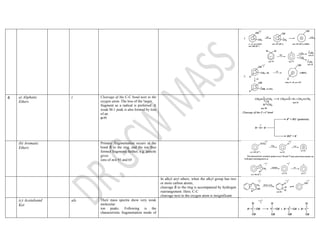
functional
Group
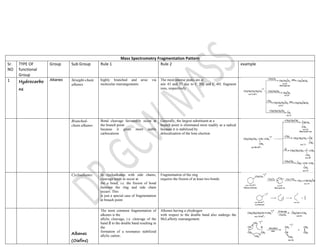
Group Sub Group Rule 1 Rule 2 example
1 Hydrocarbo
ns
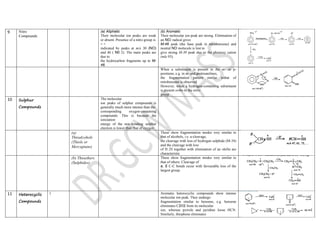
Alkanes Straight-chain
alkanes
highly branched and arise via
molecular rearrangements
The most intense peaks are at
mle 43 and 57 due to C 3Hj and C 4H; fragment
ions, respectively
Branched-
chain alkanes
Bond cleavage favourably occur at
the branch point
because it gives more stable
carbocations
Generally, the largest substituent at a
branch point is eliminated most readily as a radical
because it is stabilized by
delocalization of the lone electron
Cycloalkanes. In cycloalkanes with side chains,
cleavage tends to occur at
the a bond, i.e. the fission of bond
between the ring and side chain
occurs. This
is just a special case of fragmentation
at brauch point.
Fragmentation of the ring
requires the fission of at least two bonds.
Alkenes
(Oiefins)
The most common fragmentation of
alkenes is the
allylic cleavage, i.e. cleavage of the
band ß to the double band resulting in
the
formation of a resonance stabilized
allylic cation:.
Alkenes having a yhydrogen
with respect to the double band also undergo the
McLafferty rearrangement.
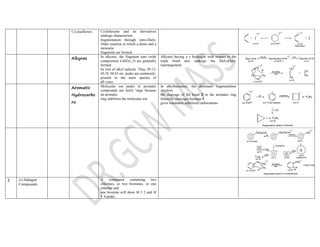
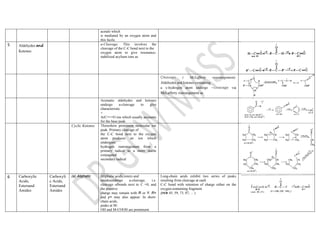
Cycloalkenes. Cyclohexene and its derivatives
undergo characteristic
fragmentation through retro-Diels-
Alder reaction in which a diene and a
monoene
fragments are formed.
Alkynes In alkynes, the fragment ions (with
composition CnH2n_3) are generally
formed
by loss of alkyl radicals. Thus, M-15,
M-29, M-43 etc. peaks are commonly
present in the mass spectra of
all<ynes.
Alkynes having a y hydrogen with respect to the
triple bond also undergo the McLafferty
rearrangement
Aromatic
Hydrocarbo
ns
Molecular ion peaks in aromatic
compounds are fairly !arge because
an aromatic
ring stabilizes the molecular ion.
In alkylbenzenes, the dominant fragmentation
involves
the cleavage of the bond ß to the aromatic ring
(benzylic cleavage) because it
gives resonance stabilized carbocations
2 (ii) Halogen
Compounds
A compound containing two
chlorines, or two bromines, or one
chlorine and
one bromine will show M + 2 and M
+ 4 peaks.
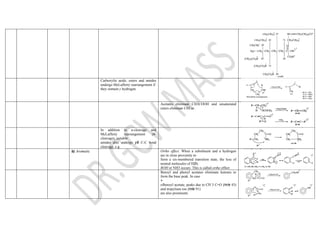
(a) Alkyl
Halides
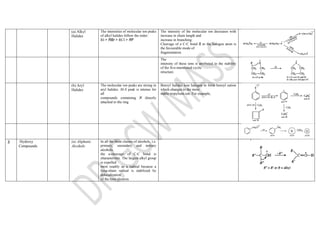
The intensities of molecular ion peaks
of alkyl halides follow the order:
RI > RBr > RCI > RF
The intensity of the molecular ion decreases with
increase in chain length and
increase in branching.
Cleavage of a C-C bond ß to the halogen atom is
the favourable mode of
fragmentation.
The
intensity of these ions is attributed to the stability
of the five-membered cyclic
structure.
(b) Aryl
Halides
The molecular ion peaks are strong in
aryl halides. M-X peak is intense for
all
compounds containing X directly
attached to the ring
Benzyl halides lose halogen to form benzyl eation
whieh ehanges to the more
stable tropylium ion. For example,
3 Hydroxy
Compounds
(a) Aliphatic
Alcohols
In all the three classes of aleohols, i.e.
primary, seeondary and tertiary
alcohols,
the a-eleavage of C-C bond is
eharaeteristie. The largest alkyl group
is expelled
most readily as a radieal because a
Iong-ehain radieal is stabilized by
delocalization
of the lone eleetron
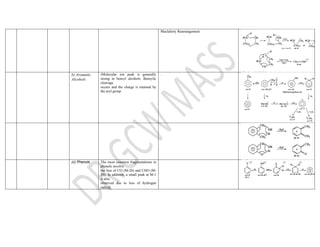
Maclaferty Rearrangement
b) Aromatic
Alcohols
(Molecular ion peak is generally
strong in benzyl alcohols. Benzylic
cleavage
occurs and the charge is retained by
the aryl group
.
(c) Phenols The most common fragmentations in
phenols involve
the loss of CO (M-28) and CHO (M-
29). In addition, a small peak at M-1
is also
observed due to loss of hydrogen
radical.
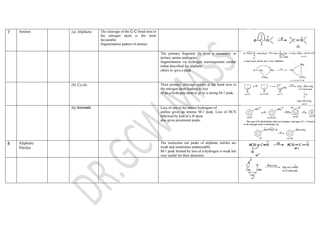
4 a) Aliphatic
Ethers
( Cleavage of the C-C bond next to the
oxygen atom. The loss of the !arger
fragment as a radical is preferred. A
weak M-1 peak is also formed by loss
of an
a-H
(b) Aromatic
Ethers
Primary fragmentation occurs at the
bond ß to the ring, and the ion thus
formed fragments further, e.g. anisole
gives
ions of m/e 93 and 65
In alkyl aryl ethers, when the alkyl group has two
or more carbon atoms,
cleavage ß to the ring is accompanied by hydrogen
rearrangement. Here, C-C
cleavage next to the oxygen atom is insignificant
(c) Acetalsand
Ket
als Their mass spectra show very weak
molecular
ion peaks. Following is the
characteristic fragmentation mode of
acetals which
is mediated by an oxygen atom and
this facile.
5 Aldehydes and
Ketones
a-Cleavage. This involves the
cleavage of the C-C bond next to the
oxygen atom to give resonance-
stabilized acylium ions as
Cleavage ( McLafferty rearrangement).
Aldehydes and ketones containing
a y-hydrogen atom undergo ~cleavage via
McLafferty rearrangement as
Aromatic aldehydes and ketones
undergo a-cleavage to give
characteristic
+
ArC===O ion which usually accounts
for the base peak.
Cyclic Ketones Theseshow prominent molecular ion
peak. Primary cleavage of
the C-C bond next to the oxygen
atom produces an ion which
undergoes
hydrogen rearrangement from a
primary radical to a more stable
conjugated
secondary radical
6 Carboxylic
Acids,
Estersand
Amides
Carboxyli
c Acids,
Estersand
Amides
(a) Aliphatic Aliphatic acids, esters and
amidesundergo a-cleavage, i.e.
cleavage ofbonds next to C =0, and
the positive
charge may remain with R or Y. R+
and y+ may also appear. In short-
chain acids,
peaks at M-
OH and M-COOH are prominent.
Long-ehain aeids exhibit two series of peaks
resulting from cleavage at eaeh
C-C bond with retention of eharge either on the
oxygen-eontaining fragment
(m/e 45, 59, 73, 87, ... )
Carboxylie aeids, esters and amides
undergo MeLafferty rearrangement if
they eontain y hydrogen.
Acetates eliminate CH3COOH and unsaturated
esters eliminate C02 as
In addition to a-cleavage and
McLafferty rearrangement (ß-
cleavage), suitable
amides also undergo y8 C-C bond
cleavage, e.g.
b) Aromatic Ortho effect. When a substituent and a hydrogen
are in close proximity to
form a six-membered transition state, the loss of
neutral molecules of H20,
ROH or NH3 occurs. This is called ortho effect
Benzyl and phenyl acetates eliminate ketenes to
form the base peak. In case
+
ofbenzyl acetate, peaks due to CH 3 C=O (m/e 43)
and tropylium ion (mle 91)
are also prominent.
7 Amines (a) Aliphatic The cleavage of the C-C bond next to
the nitrogen atom is the most
favourable
fragmentation pattern of amines.
The primary fragment (I) from a secondary or
tertiary amine undergoes
fragmentation via hydrogen rearrangement similar
tothat described for aliphatic
ethers to 'give a peak
(b) Cyclic Their primary cleavage occurs at the bond next to
the nitrogen atom leading to loss
of an a-hydrogen atom to gi ve a strong M-1 peak,
(c) Aromatic Loss of one of the amino hydrogens of
aniline gives an intense M-1 peak. Loss of HCN
followed by loss of a H atom
also gives prominent peaks.
8 Aliphatic
Nitriles
The molecular ion peaks of aliphatic nitriles are
weak and sometimes undetectable.
M-1 peak formed by loss of a-hydrogen is weak but
very useful for their detection
9 Nitro
Compounds
(a) Aliphatic
Their molecular ion peaks are weak
or absent. Presence of a nitro group is
+ +
indicated by peaks at m/e 30 (NO)
and 46 ( N0 2). The main peaks are
due to
the hydrocarbon fragments up to M-
46.
(b) Aromatic
Their molecular ion peak are strong. Elimination of
an N02 radical gives
M-46 peak (the base peak in nitrobenzene) and
neutral NO molecule is lost to
give strong M-30 peak due to the phenoxy cation
(mle 93).
When a substituent is present in the m- or p-
positions, e.g. in m- and pnitroanilines,
the fragmentation pattern similar tothat of
nitrobenzene is observed.
However, when a hydrogen-containing substituent
is present ortho to the nitro
group
10 Sulphur
Compounds
The molecular
ion peaks of sulphur compounds is
generally much more intense than the
corresponding oxygen-containing
compounds. This is because the
ionization
energy of the non-bonding sulphur
electron is lower than that of oxygen
(a)
Thioalcohols
(Thiols or
Mercaptans)
These show fragmentation modes very similar to
that of alcohols, i.e. a-cleavage,
the cleavage with loss of hydrogen sulphide (M-34)
and the cleavage with loss
of H 2S together with elimination of an olefin are
characteristic
(b) Thioethers
(Sulphides)
These show fragmentation modes very similar to
that of ethers. Cleavage of
a, ß C-C bonds occur with favourable loss of the
largest group.
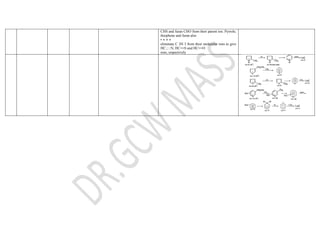
11 Heterocyclic
Compounds
( Aromatic heterocyclic compounds show intense
molecular ion peak. They undergo
fragmentation similar to benzene, e.g. benzene
eliminates C2H2 from its molecular
ion, whereas pyrrole and pyridine loose HCN.
Similarly, thiophene eliminates
CHS and furan CHO from their parent ion. Pyrrole,
thiophene and furan also
• + + +
eliminate C 3H 3 from their molecular ions to give
HC:;:::N, HC==S and HC==O
ions, respectively

Mass chart Fragmentation

  • 1.
    Mass Spectrometry FragmentationPattern Sr. NO TYPE OF functional Group Group Sub Group Rule 1 Rule 2 example 1 Hydrocarbo ns Alkanes Straight-chain alkanes highly branched and arise via molecular rearrangements The most intense peaks are at mle 43 and 57 due to C 3Hj and C 4H; fragment ions, respectively Branched- chain alkanes Bond cleavage favourably occur at the branch point because it gives more stable carbocations Generally, the largest substituent at a branch point is eliminated most readily as a radical because it is stabilized by delocalization of the lone electron Cycloalkanes. In cycloalkanes with side chains, cleavage tends to occur at the a bond, i.e. the fission of bond between the ring and side chain occurs. This is just a special case of fragmentation at brauch point. Fragmentation of the ring requires the fission of at least two bonds. Alkenes (Oiefins) The most common fragmentation of alkenes is the allylic cleavage, i.e. cleavage of the band ß to the double band resulting in the formation of a resonance stabilized allylic cation:. Alkenes having a yhydrogen with respect to the double band also undergo the McLafferty rearrangement.
  • 2.
    Cycloalkenes. Cyclohexene andits derivatives undergo characteristic fragmentation through retro-Diels- Alder reaction in which a diene and a monoene fragments are formed. Alkynes In alkynes, the fragment ions (with composition CnH2n_3) are generally formed by loss of alkyl radicals. Thus, M-15, M-29, M-43 etc. peaks are commonly present in the mass spectra of all<ynes. Alkynes having a y hydrogen with respect to the triple bond also undergo the McLafferty rearrangement Aromatic Hydrocarbo ns Molecular ion peaks in aromatic compounds are fairly !arge because an aromatic ring stabilizes the molecular ion. In alkylbenzenes, the dominant fragmentation involves the cleavage of the bond ß to the aromatic ring (benzylic cleavage) because it gives resonance stabilized carbocations 2 (ii) Halogen Compounds A compound containing two chlorines, or two bromines, or one chlorine and one bromine will show M + 2 and M + 4 peaks.
  • 3.
    (a) Alkyl Halides The intensitiesof molecular ion peaks of alkyl halides follow the order: RI > RBr > RCI > RF The intensity of the molecular ion decreases with increase in chain length and increase in branching. Cleavage of a C-C bond ß to the halogen atom is the favourable mode of fragmentation. The intensity of these ions is attributed to the stability of the five-membered cyclic structure. (b) Aryl Halides The molecular ion peaks are strong in aryl halides. M-X peak is intense for all compounds containing X directly attached to the ring Benzyl halides lose halogen to form benzyl eation whieh ehanges to the more stable tropylium ion. For example, 3 Hydroxy Compounds (a) Aliphatic Alcohols In all the three classes of aleohols, i.e. primary, seeondary and tertiary alcohols, the a-eleavage of C-C bond is eharaeteristie. The largest alkyl group is expelled most readily as a radieal because a Iong-ehain radieal is stabilized by delocalization of the lone eleetron
  • 4.
    Maclaferty Rearrangement b) Aromatic Alcohols (Molecularion peak is generally strong in benzyl alcohols. Benzylic cleavage occurs and the charge is retained by the aryl group . (c) Phenols The most common fragmentations in phenols involve the loss of CO (M-28) and CHO (M- 29). In addition, a small peak at M-1 is also observed due to loss of hydrogen radical.
  • 5.
    4 a) Aliphatic Ethers (Cleavage of the C-C bond next to the oxygen atom. The loss of the !arger fragment as a radical is preferred. A weak M-1 peak is also formed by loss of an a-H (b) Aromatic Ethers Primary fragmentation occurs at the bond ß to the ring, and the ion thus formed fragments further, e.g. anisole gives ions of m/e 93 and 65 In alkyl aryl ethers, when the alkyl group has two or more carbon atoms, cleavage ß to the ring is accompanied by hydrogen rearrangement. Here, C-C cleavage next to the oxygen atom is insignificant (c) Acetalsand Ket als Their mass spectra show very weak molecular ion peaks. Following is the characteristic fragmentation mode of
  • 6.
    acetals which is mediatedby an oxygen atom and this facile. 5 Aldehydes and Ketones a-Cleavage. This involves the cleavage of the C-C bond next to the oxygen atom to give resonance- stabilized acylium ions as Cleavage ( McLafferty rearrangement). Aldehydes and ketones containing a y-hydrogen atom undergo ~cleavage via McLafferty rearrangement as Aromatic aldehydes and ketones undergo a-cleavage to give characteristic + ArC===O ion which usually accounts for the base peak. Cyclic Ketones Theseshow prominent molecular ion peak. Primary cleavage of the C-C bond next to the oxygen atom produces an ion which undergoes hydrogen rearrangement from a primary radical to a more stable conjugated secondary radical 6 Carboxylic Acids, Estersand Amides Carboxyli c Acids, Estersand Amides (a) Aliphatic Aliphatic acids, esters and amidesundergo a-cleavage, i.e. cleavage ofbonds next to C =0, and the positive charge may remain with R or Y. R+ and y+ may also appear. In short- chain acids, peaks at M- OH and M-COOH are prominent. Long-ehain aeids exhibit two series of peaks resulting from cleavage at eaeh C-C bond with retention of eharge either on the oxygen-eontaining fragment (m/e 45, 59, 73, 87, ... )
  • 7.
    Carboxylie aeids, estersand amides undergo MeLafferty rearrangement if they eontain y hydrogen. Acetates eliminate CH3COOH and unsaturated esters eliminate C02 as In addition to a-cleavage and McLafferty rearrangement (ß- cleavage), suitable amides also undergo y8 C-C bond cleavage, e.g. b) Aromatic Ortho effect. When a substituent and a hydrogen are in close proximity to form a six-membered transition state, the loss of neutral molecules of H20, ROH or NH3 occurs. This is called ortho effect Benzyl and phenyl acetates eliminate ketenes to form the base peak. In case + ofbenzyl acetate, peaks due to CH 3 C=O (m/e 43) and tropylium ion (mle 91) are also prominent.
  • 8.
    7 Amines (a)Aliphatic The cleavage of the C-C bond next to the nitrogen atom is the most favourable fragmentation pattern of amines. The primary fragment (I) from a secondary or tertiary amine undergoes fragmentation via hydrogen rearrangement similar tothat described for aliphatic ethers to 'give a peak (b) Cyclic Their primary cleavage occurs at the bond next to the nitrogen atom leading to loss of an a-hydrogen atom to gi ve a strong M-1 peak, (c) Aromatic Loss of one of the amino hydrogens of aniline gives an intense M-1 peak. Loss of HCN followed by loss of a H atom also gives prominent peaks. 8 Aliphatic Nitriles The molecular ion peaks of aliphatic nitriles are weak and sometimes undetectable. M-1 peak formed by loss of a-hydrogen is weak but very useful for their detection
  • 9.
    9 Nitro Compounds (a) Aliphatic Theirmolecular ion peaks are weak or absent. Presence of a nitro group is + + indicated by peaks at m/e 30 (NO) and 46 ( N0 2). The main peaks are due to the hydrocarbon fragments up to M- 46. (b) Aromatic Their molecular ion peak are strong. Elimination of an N02 radical gives M-46 peak (the base peak in nitrobenzene) and neutral NO molecule is lost to give strong M-30 peak due to the phenoxy cation (mle 93). When a substituent is present in the m- or p- positions, e.g. in m- and pnitroanilines, the fragmentation pattern similar tothat of nitrobenzene is observed. However, when a hydrogen-containing substituent is present ortho to the nitro group 10 Sulphur Compounds The molecular ion peaks of sulphur compounds is generally much more intense than the corresponding oxygen-containing compounds. This is because the ionization energy of the non-bonding sulphur electron is lower than that of oxygen (a) Thioalcohols (Thiols or Mercaptans) These show fragmentation modes very similar to that of alcohols, i.e. a-cleavage, the cleavage with loss of hydrogen sulphide (M-34) and the cleavage with loss of H 2S together with elimination of an olefin are characteristic (b) Thioethers (Sulphides) These show fragmentation modes very similar to that of ethers. Cleavage of a, ß C-C bonds occur with favourable loss of the largest group. 11 Heterocyclic Compounds ( Aromatic heterocyclic compounds show intense molecular ion peak. They undergo fragmentation similar to benzene, e.g. benzene eliminates C2H2 from its molecular ion, whereas pyrrole and pyridine loose HCN. Similarly, thiophene eliminates
  • 10.
    CHS and furanCHO from their parent ion. Pyrrole, thiophene and furan also • + + + eliminate C 3H 3 from their molecular ions to give HC:;:::N, HC==S and HC==O ions, respectively