By
Mr. Dhiraj S. Bhagwat
B.Pharm
University Department of Pharmaceutical Sciences,
R.T.M. Nagpur University, Nagpur-440033
2017-2018
Synthon Approach
11/10/2017 1
Contents
211/10/2017
1. Introduction
2. Definition of terms
a. Disconnection
b. Synthon
c. Functional Group Interconversion
3. Basic rule in disconnecion
4. Use of synthon approach in synthesis of some medical or organic synthesis
5. References
1. Introduction
311/10/2017
• Synthon term was coined by Prof. E.J.Corey in mid 1960’s
• Elegant and more systematic approach
• Depends on perception of structural feature in the reaction product and manipulation of
structures in the reverse synthetic sense.
• Designate ‘structural units within a molecule which are related to possible synthetic
operations’.
• Helps in eliminations of low probability variants.
411/10/2017
Target
Molecule
Disconnected
Precursors
Process called Analysis
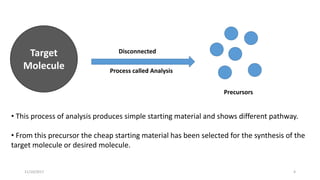
• This process of analysis produces simple starting material and shows different pathway.
• From this precursor the cheap starting material has been selected for the synthesis of the
target molecule or desired molecule.
511/10/2017
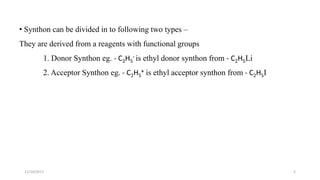
• Synthon can be divided in to following two types –
They are derived from a reagents with functional groups
1. Donor Synthon eg. - C2H5
- is ethyl donor synthon from - C2H5Li
2. Acceptor Synthon eg. - C2H5
+ is ethyl acceptor synthon from - C2H5I
2. Definition of Terms
611/10/2017
a. Disconnection :
It is an imaginary process in which the bonds are broken to get simple possible starting
materials. This is also called as "transform". A curred line is used at the point of
disconnection of bond and a double line arrow (=>) is used for representing
disconnection.
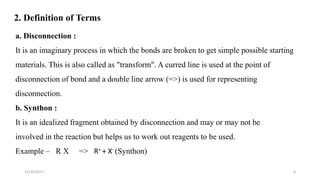
b. Synthon :
It is an idealized fragment obtained by disconnection and may or may not be
involved in the reaction but helps us to work out reagents to be used.
Example – R X => R+ + X- (Synthon)
11/10/2017 7
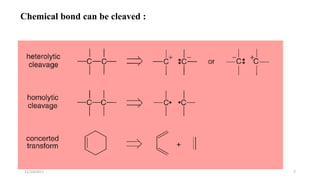
Chemical bond can be cleaved :
811/10/2017
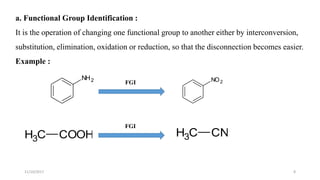
a. Functional Group Identification :
It is the operation of changing one functional group to another either by interconversion,
substitution, elimination, oxidation or reduction, so that the disconnection becomes easier.
Example :
NO2
NH2 FGI
CH3 COOH CH3 CN
FGI
3. Basic Rules In Disconnection
911/10/2017
• When one thinks of retrosynthetic analysis of a target molecule, it is a question ‘where
the disconnection is to be done?’. This is generally governed by certain rules :
Rule -1
Disconnection of a bond should be done in such a way that it produces stable fragments.
While carrying out a disconnection the molecule is broken down by one bond at a time.
e.g.
R
O2N
C NO2
- + C R+
1011/10/2017
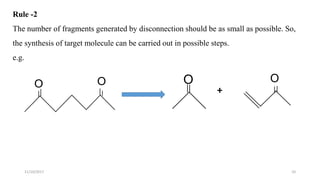
Rule -2
The number of fragments generated by disconnection should be as small as possible. So,
the synthesis of target molecule can be carried out in possible steps.
e.g.
O O O O
+
1111/10/2017
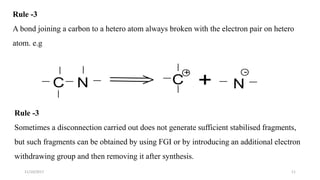
Rule -3
A bond joining a carbon to a hetero atom always broken with the electron pair on hetero
atom. e.g
Rule -3
Sometimes a disconnection carried out does not generate sufficient stabilised fragments,
but such fragments can be obtained by using FGI or by introducing an additional electron
withdrawing group and then removing it after synthesis.
C N C
+
+ N
-
1211/10/2017
Guidelines For Disconnection :
(i) Make the analysis in such a way that the synthesis become as short as possible.
(ii) Use the only disconnections corresponding to known reliable reaction.
(iii) Disconnect C-X bonds especially two group disconnections.
(iv) Choose the disconnection corresponding to the highest yielding reaction, if known.
(v) Disconnect back to recognisable starting materials or to compounds which can be
easily be made.
(vi) Disconnect C-C bonds according to the functional groups in the molecule , if possible
- disconnect at the middle of the molecule.
1311/10/2017
Guidelines For Good Synthesis :
In retrosynthetic approach, there are usually more than one way to synthesize a
compound. But the selection of a best desirable route is important. Thereafter the
following factors are considered in order to decide which one of the routes is safe and
simple to employ.
(i) Availability of starting material.
(ii) Which route involves the least number of separation operations ?
(iii) Which route gives the highest overall yield ?
(iv) How expensive are the starting materials and reagents ?
(v) Which route includes least time and effort ?
1411/10/2017
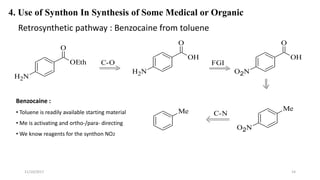
Retrosynthetic pathway : Benzocaine from toluene
4. Use of Synthon In Synthesis of Some Medical or Organic
OEth
O
NH2
C-O
NH2
OH
O
FGI
O2N
OH
O
O2N
Me
C-NMe
Benzocaine :
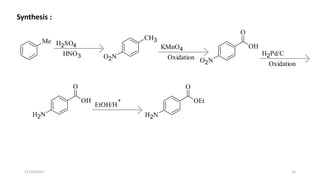
• Toluene is readily available starting material
• Me is activating and ortho-/para- directing
• We know reagents for the synthon NO2
11/10/2017 15
Me H2SO4
HNO3
CH3
O2N
KMnO4
Oxidation O2N
OH
O
H2Pd/C
Oxidation
H2N
OH
O
EtOH/H
+
H2N
OEt
O
Synthesis :
1. Inamdar NN. A companion to Medicinal Chemistry. 1st ed. Career publication 2012. p. 408-422.
2. Algarsamy V. Textbook of Medicinal Chemistry. Vol. 2. 1st ed. Elsevier Health Sciences,
2012. p. 88-129
3. Lemke TL, Williams DA, Roche VF, Zito WS. Foye’s Principles of Medicinal Chemistry 6th ed.
Lippincott Williams and Wilkins. 2010. p. 504
4. J.March “Advance organic chemistry” 3rd edition, Wiley New York P-184 (1985).
5. E.J. Corey, J.Am.Soc. 98, 189, (1976).
11/10/2017 16
5. References
THANK YOU
11/10/2017 17

Synthon Approach ppt

  • 1.
    By Mr. Dhiraj S.Bhagwat B.Pharm University Department of Pharmaceutical Sciences, R.T.M. Nagpur University, Nagpur-440033 2017-2018 Synthon Approach 11/10/2017 1
  • 2.
    Contents 211/10/2017 1. Introduction 2. Definitionof terms a. Disconnection b. Synthon c. Functional Group Interconversion 3. Basic rule in disconnecion 4. Use of synthon approach in synthesis of some medical or organic synthesis 5. References
  • 3.
    1. Introduction 311/10/2017 • Synthonterm was coined by Prof. E.J.Corey in mid 1960’s • Elegant and more systematic approach • Depends on perception of structural feature in the reaction product and manipulation of structures in the reverse synthetic sense. • Designate ‘structural units within a molecule which are related to possible synthetic operations’. • Helps in eliminations of low probability variants.
  • 4.
    411/10/2017 Target Molecule Disconnected Precursors Process called Analysis •This process of analysis produces simple starting material and shows different pathway. • From this precursor the cheap starting material has been selected for the synthesis of the target molecule or desired molecule.
  • 5.
    511/10/2017 • Synthon canbe divided in to following two types – They are derived from a reagents with functional groups 1. Donor Synthon eg. - C2H5 - is ethyl donor synthon from - C2H5Li 2. Acceptor Synthon eg. - C2H5 + is ethyl acceptor synthon from - C2H5I
  • 6.
    2. Definition ofTerms 611/10/2017 a. Disconnection : It is an imaginary process in which the bonds are broken to get simple possible starting materials. This is also called as "transform". A curred line is used at the point of disconnection of bond and a double line arrow (=>) is used for representing disconnection. b. Synthon : It is an idealized fragment obtained by disconnection and may or may not be involved in the reaction but helps us to work out reagents to be used. Example – R X => R+ + X- (Synthon)
  • 7.
  • 8.
    811/10/2017 a. Functional GroupIdentification : It is the operation of changing one functional group to another either by interconversion, substitution, elimination, oxidation or reduction, so that the disconnection becomes easier. Example : NO2 NH2 FGI CH3 COOH CH3 CN FGI
  • 9.
    3. Basic RulesIn Disconnection 911/10/2017 • When one thinks of retrosynthetic analysis of a target molecule, it is a question ‘where the disconnection is to be done?’. This is generally governed by certain rules : Rule -1 Disconnection of a bond should be done in such a way that it produces stable fragments. While carrying out a disconnection the molecule is broken down by one bond at a time. e.g. R O2N C NO2 - + C R+
  • 10.
    1011/10/2017 Rule -2 The numberof fragments generated by disconnection should be as small as possible. So, the synthesis of target molecule can be carried out in possible steps. e.g. O O O O +
  • 11.
    1111/10/2017 Rule -3 A bondjoining a carbon to a hetero atom always broken with the electron pair on hetero atom. e.g Rule -3 Sometimes a disconnection carried out does not generate sufficient stabilised fragments, but such fragments can be obtained by using FGI or by introducing an additional electron withdrawing group and then removing it after synthesis. C N C + + N -
  • 12.
    1211/10/2017 Guidelines For Disconnection: (i) Make the analysis in such a way that the synthesis become as short as possible. (ii) Use the only disconnections corresponding to known reliable reaction. (iii) Disconnect C-X bonds especially two group disconnections. (iv) Choose the disconnection corresponding to the highest yielding reaction, if known. (v) Disconnect back to recognisable starting materials or to compounds which can be easily be made. (vi) Disconnect C-C bonds according to the functional groups in the molecule , if possible - disconnect at the middle of the molecule.
  • 13.
    1311/10/2017 Guidelines For GoodSynthesis : In retrosynthetic approach, there are usually more than one way to synthesize a compound. But the selection of a best desirable route is important. Thereafter the following factors are considered in order to decide which one of the routes is safe and simple to employ. (i) Availability of starting material. (ii) Which route involves the least number of separation operations ? (iii) Which route gives the highest overall yield ? (iv) How expensive are the starting materials and reagents ? (v) Which route includes least time and effort ?
  • 14.
    1411/10/2017 Retrosynthetic pathway :Benzocaine from toluene 4. Use of Synthon In Synthesis of Some Medical or Organic OEth O NH2 C-O NH2 OH O FGI O2N OH O O2N Me C-NMe Benzocaine : • Toluene is readily available starting material • Me is activating and ortho-/para- directing • We know reagents for the synthon NO2
  • 15.
    11/10/2017 15 Me H2SO4 HNO3 CH3 O2N KMnO4 OxidationO2N OH O H2Pd/C Oxidation H2N OH O EtOH/H + H2N OEt O Synthesis :
  • 16.
    1. Inamdar NN.A companion to Medicinal Chemistry. 1st ed. Career publication 2012. p. 408-422. 2. Algarsamy V. Textbook of Medicinal Chemistry. Vol. 2. 1st ed. Elsevier Health Sciences, 2012. p. 88-129 3. Lemke TL, Williams DA, Roche VF, Zito WS. Foye’s Principles of Medicinal Chemistry 6th ed. Lippincott Williams and Wilkins. 2010. p. 504 4. J.March “Advance organic chemistry” 3rd edition, Wiley New York P-184 (1985). 5. E.J. Corey, J.Am.Soc. 98, 189, (1976). 11/10/2017 16 5. References
  • 17.