CYCLIC PREFIX
WINDOWING - OFDM
T SRIRAM REDDY
OFDM
Orthogonal frequency-division multiplexing (OFDM) is a method
of digital signal modulation in which a single data stream is split across
several separate narrowband channels at different frequencies to reduce
interference and crosstalk.
The original data stream bits -- that in a conventional single-channel
modulation scheme would be sent serially (one after the other) -- are
transmitted in parallel (several at once on separate channels) .
Although the sidebands from each carrier overlap, they can still be
received without the interference that might be expected because they are
orthogonal to each another. This is achieved by having the carrier spacing
equal to the reciprocal of the symbol period.
Each subcarrier is modulated with a conventional modulation scheme
(such as QAM or PSK) at a low symbol rate. This maintains total data
rates similar to conventional single-carrier modulation schemes in the
same bandwidth.
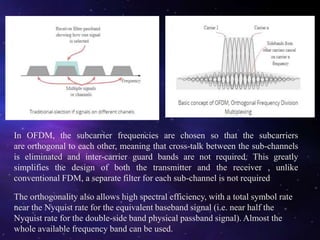
In OFDM, the subcarrier frequencies are chosen so that the subcarriers
are orthogonal to each other, meaning that cross-talk between the sub-channels
is eliminated and inter-carrier guard bands are not required. This greatly
simplifies the design of both the transmitter and the receiver , unlike
conventional FDM, a separate filter for each sub-channel is not required
The orthogonality also allows high spectral efficiency, with a total symbol rate
near the Nyquist rate for the equivalent baseband signal (i.e. near half the
Nyquist rate for the double-side band physical passband signal). Almost the
whole available frequency band can be used.
FADING
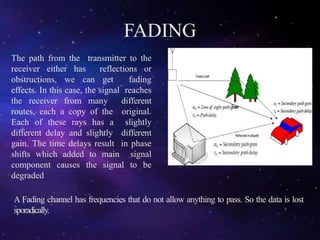
The path from the transmitter to the
receiver either has reflections or
obstructions, we can get fading
effects. In this case, the signal reaches
the receiver from many different
routes, each a copy of the original.
Each of these rays has a slightly
different delay and slightly different
gain. The time delays result in phase
shifts which added to main signal
component causes the signal to be
degraded
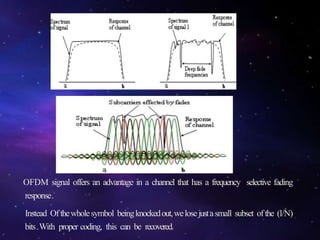
A Fading channel has frequencies that do not allow anything to pass. So the data is lost
sporadically.
OFDM signal offers an advantage in a channel that has a frequency selective fading
response.
Instead Ofthewholesymbol beingknockedout,welosejustasmall subset ofthe (l/N)
bits.With proper coding, this can be recovered.
WINDOWING
Windowing is used to reduce the out of band spectrum
Windowing is a duel technique, multiplying an OFDM signal by an window
means the spectrum is going to be a convolution of the spectrum of the
window function with asset impulse functions at the subcarriers
frequencies.
When filtering is applied ,a convolution is done in the time domain and the
OFDM spectrum is multiplied by the frequency response of the filter
Windowing is applied in receiver to reduce ICI.
Mostly Raised Cosine Windowing is used in applications.
CYCLIC PREFIX/POSTFIX
The cyclic prefix used in Frequency Division Multiplexing schemes
including OFDM to primarily act as a guard band between successive
symbols to overcome intersymbol interference, ISI.This can be an issue in
some circumstances even with the much lower data rates that are
transmitted in the multicarrier OFDM signal.
The cyclic prefix performs two main functions:
The cyclic prefix provides a guard interval to eliminate intersymbol
interference from the previous symbol.
It repeats the end of the symbol so the linear convolution of a frequency-
selective multipath channel can be modeled as circular convolution, which
in turn may transform to the frequency domain via a discrete Fourier
transform. This approach accommodates simple frequency domain
processing, such as channel estimation and equalization.
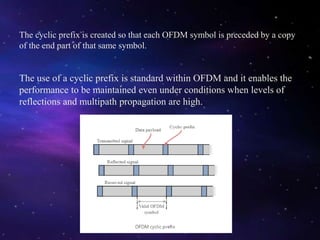
The cyclic prefix is created so that each OFDM symbol is preceded by a copy
of the end part of that same symbol.
The use of a cyclic prefix is standard within OFDM and it enables the
performance to be maintained even under conditions when levels of
reflections and multipath propagation are high.
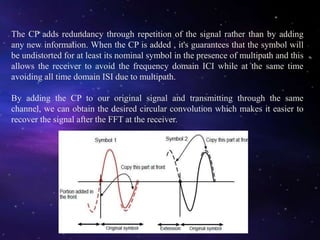
The CP adds redundancy through repetition of the signal rather than by adding
any new information. When the CP is added , it's guarantees that the symbol will
be undistorted for at least its nominal symbol in the presence of multipath and this
allows the receiver to avoid the frequency domain ICI while at the same time
avoiding all time domain ISI due to multipath.
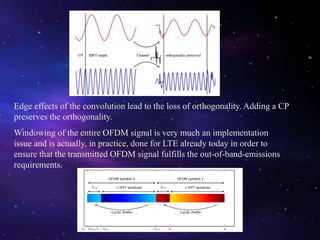
By adding the CP to our original signal and transmitting through the same
channel, we can obtain the desired circular convolution which makes it easier to
recover the signal after the FFT at the receiver.
Edge effects of the convolution lead to the loss of orthogonality. Adding a CP
preserves the orthogonality.
Windowing of the entire OFDM signal is very much an implementation
issue and is actually, in practice, done for LTE already today in order to
ensure that the transmitted OFDM signal fulfills the out-of-band-emissions
requirements.
ADVANTAGES
Provides robustness : The addition of the cyclic prefix adds robustness to the
OFDM signal. The data that is retransmitted can be used if required.
Reduces inter-symbol interference: The guard interval introduced by the
cyclic prefix enables the effects of inter-symbol interference to be reduced.
DISADVANTAGES
Reduces data capacity: As the cyclic prefix re-transmits data that is
already being transmitted, it takes up system capacity and reduces the overall
data rate.
The OFDM signal has a noise like amplitude with a very large dynamic
range, therefore it requires RF power amplifiers with a high peak to average
power ratio.
REFERENCES
Fundamentals of Wireless Communication, by David Tse and Pramod Viswanath,
Cambridge University Press (2005).
"The history of orthogonal frequency-division multiplexing". IEEE
Communications Magazine. IEEE Communications Magazine ( Volume: 47, Issue:
11, November 2009 ).
P. Banelli et al., "Modulation Formats and Waveforms for the Physical Layer of
5G Wireless Networks: Who Will be the Heir of OFDM?", July 2014.
Sahidullah Md, Goutam Saha, "A novel windowing technique for efficient
computation of MFCC for speaker recognition", IEEE signal processing letters,
vol. 20, no. 2, pp. 149-152, Feb. 2013.
Windowing ofdm

Windowing ofdm

  • 1.
    CYCLIC PREFIX WINDOWING -OFDM T SRIRAM REDDY
  • 2.
    OFDM Orthogonal frequency-division multiplexing(OFDM) is a method of digital signal modulation in which a single data stream is split across several separate narrowband channels at different frequencies to reduce interference and crosstalk. The original data stream bits -- that in a conventional single-channel modulation scheme would be sent serially (one after the other) -- are transmitted in parallel (several at once on separate channels) . Although the sidebands from each carrier overlap, they can still be received without the interference that might be expected because they are orthogonal to each another. This is achieved by having the carrier spacing equal to the reciprocal of the symbol period. Each subcarrier is modulated with a conventional modulation scheme (such as QAM or PSK) at a low symbol rate. This maintains total data rates similar to conventional single-carrier modulation schemes in the same bandwidth.
  • 3.
    In OFDM, thesubcarrier frequencies are chosen so that the subcarriers are orthogonal to each other, meaning that cross-talk between the sub-channels is eliminated and inter-carrier guard bands are not required. This greatly simplifies the design of both the transmitter and the receiver , unlike conventional FDM, a separate filter for each sub-channel is not required The orthogonality also allows high spectral efficiency, with a total symbol rate near the Nyquist rate for the equivalent baseband signal (i.e. near half the Nyquist rate for the double-side band physical passband signal). Almost the whole available frequency band can be used.
  • 4.
    FADING The path fromthe transmitter to the receiver either has reflections or obstructions, we can get fading effects. In this case, the signal reaches the receiver from many different routes, each a copy of the original. Each of these rays has a slightly different delay and slightly different gain. The time delays result in phase shifts which added to main signal component causes the signal to be degraded A Fading channel has frequencies that do not allow anything to pass. So the data is lost sporadically.
  • 5.
    OFDM signal offersan advantage in a channel that has a frequency selective fading response. Instead Ofthewholesymbol beingknockedout,welosejustasmall subset ofthe (l/N) bits.With proper coding, this can be recovered.
  • 6.
    WINDOWING Windowing is usedto reduce the out of band spectrum Windowing is a duel technique, multiplying an OFDM signal by an window means the spectrum is going to be a convolution of the spectrum of the window function with asset impulse functions at the subcarriers frequencies. When filtering is applied ,a convolution is done in the time domain and the OFDM spectrum is multiplied by the frequency response of the filter Windowing is applied in receiver to reduce ICI. Mostly Raised Cosine Windowing is used in applications.
  • 7.
    CYCLIC PREFIX/POSTFIX The cyclicprefix used in Frequency Division Multiplexing schemes including OFDM to primarily act as a guard band between successive symbols to overcome intersymbol interference, ISI.This can be an issue in some circumstances even with the much lower data rates that are transmitted in the multicarrier OFDM signal. The cyclic prefix performs two main functions: The cyclic prefix provides a guard interval to eliminate intersymbol interference from the previous symbol. It repeats the end of the symbol so the linear convolution of a frequency- selective multipath channel can be modeled as circular convolution, which in turn may transform to the frequency domain via a discrete Fourier transform. This approach accommodates simple frequency domain processing, such as channel estimation and equalization.
  • 8.
    The cyclic prefixis created so that each OFDM symbol is preceded by a copy of the end part of that same symbol. The use of a cyclic prefix is standard within OFDM and it enables the performance to be maintained even under conditions when levels of reflections and multipath propagation are high.
  • 9.
    The CP addsredundancy through repetition of the signal rather than by adding any new information. When the CP is added , it's guarantees that the symbol will be undistorted for at least its nominal symbol in the presence of multipath and this allows the receiver to avoid the frequency domain ICI while at the same time avoiding all time domain ISI due to multipath. By adding the CP to our original signal and transmitting through the same channel, we can obtain the desired circular convolution which makes it easier to recover the signal after the FFT at the receiver.
  • 10.
    Edge effects ofthe convolution lead to the loss of orthogonality. Adding a CP preserves the orthogonality. Windowing of the entire OFDM signal is very much an implementation issue and is actually, in practice, done for LTE already today in order to ensure that the transmitted OFDM signal fulfills the out-of-band-emissions requirements.
  • 11.
    ADVANTAGES Provides robustness :The addition of the cyclic prefix adds robustness to the OFDM signal. The data that is retransmitted can be used if required. Reduces inter-symbol interference: The guard interval introduced by the cyclic prefix enables the effects of inter-symbol interference to be reduced.
  • 12.
    DISADVANTAGES Reduces data capacity:As the cyclic prefix re-transmits data that is already being transmitted, it takes up system capacity and reduces the overall data rate. The OFDM signal has a noise like amplitude with a very large dynamic range, therefore it requires RF power amplifiers with a high peak to average power ratio.
  • 13.
    REFERENCES Fundamentals of WirelessCommunication, by David Tse and Pramod Viswanath, Cambridge University Press (2005). "The history of orthogonal frequency-division multiplexing". IEEE Communications Magazine. IEEE Communications Magazine ( Volume: 47, Issue: 11, November 2009 ). P. Banelli et al., "Modulation Formats and Waveforms for the Physical Layer of 5G Wireless Networks: Who Will be the Heir of OFDM?", July 2014. Sahidullah Md, Goutam Saha, "A novel windowing technique for efficient computation of MFCC for speaker recognition", IEEE signal processing letters, vol. 20, no. 2, pp. 149-152, Feb. 2013.