Interference and System Capacity
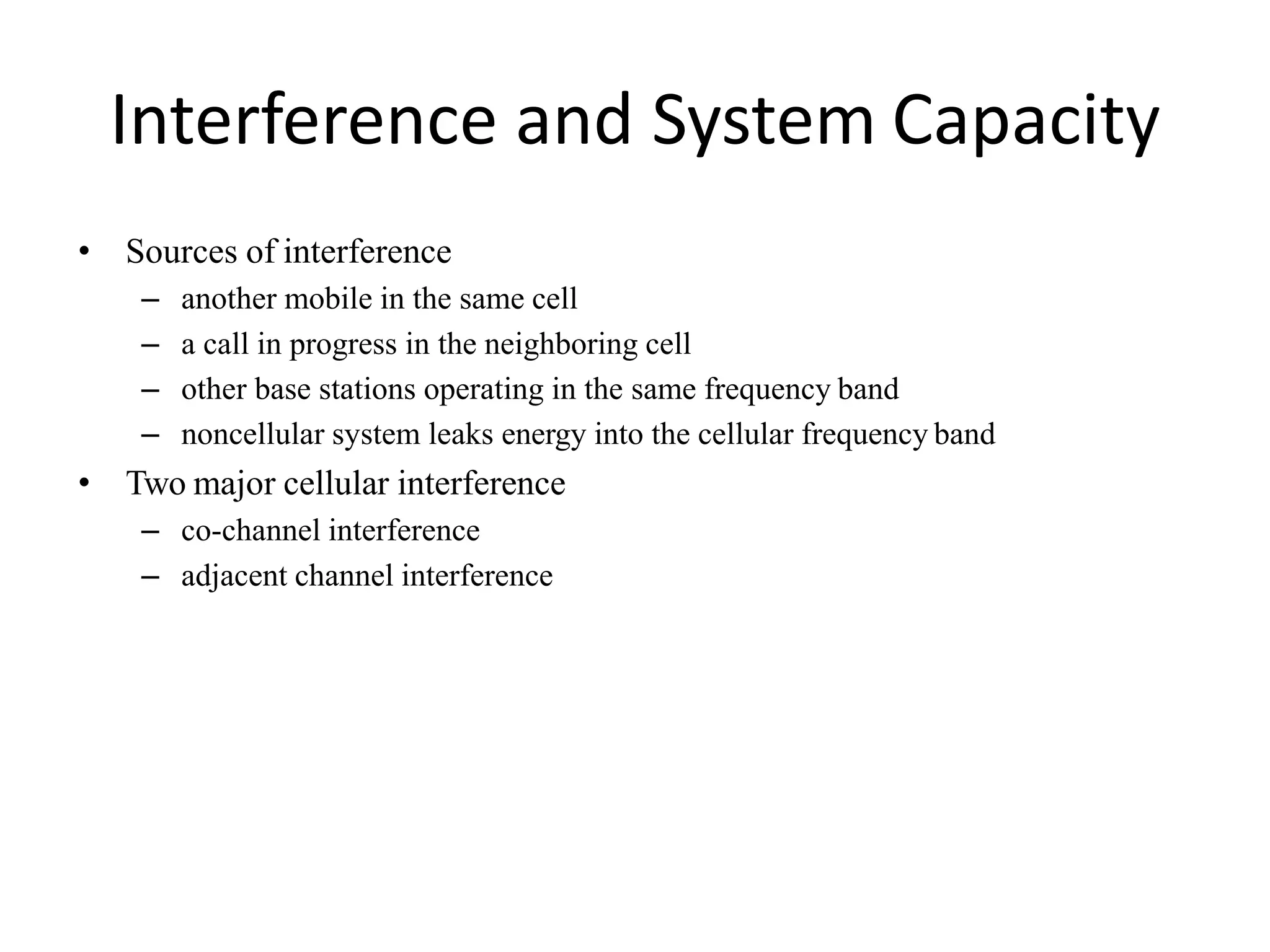
• Sources of interference
– another mobile in the same cell
– a call in progress in the neighboring cell
– other base stations operating in the same frequency band
– noncellular system leaks energy into the cellular frequency band
• Two major cellular interference
– co-channel interference
– adjacent channel interference
3
Co-Channel Interference
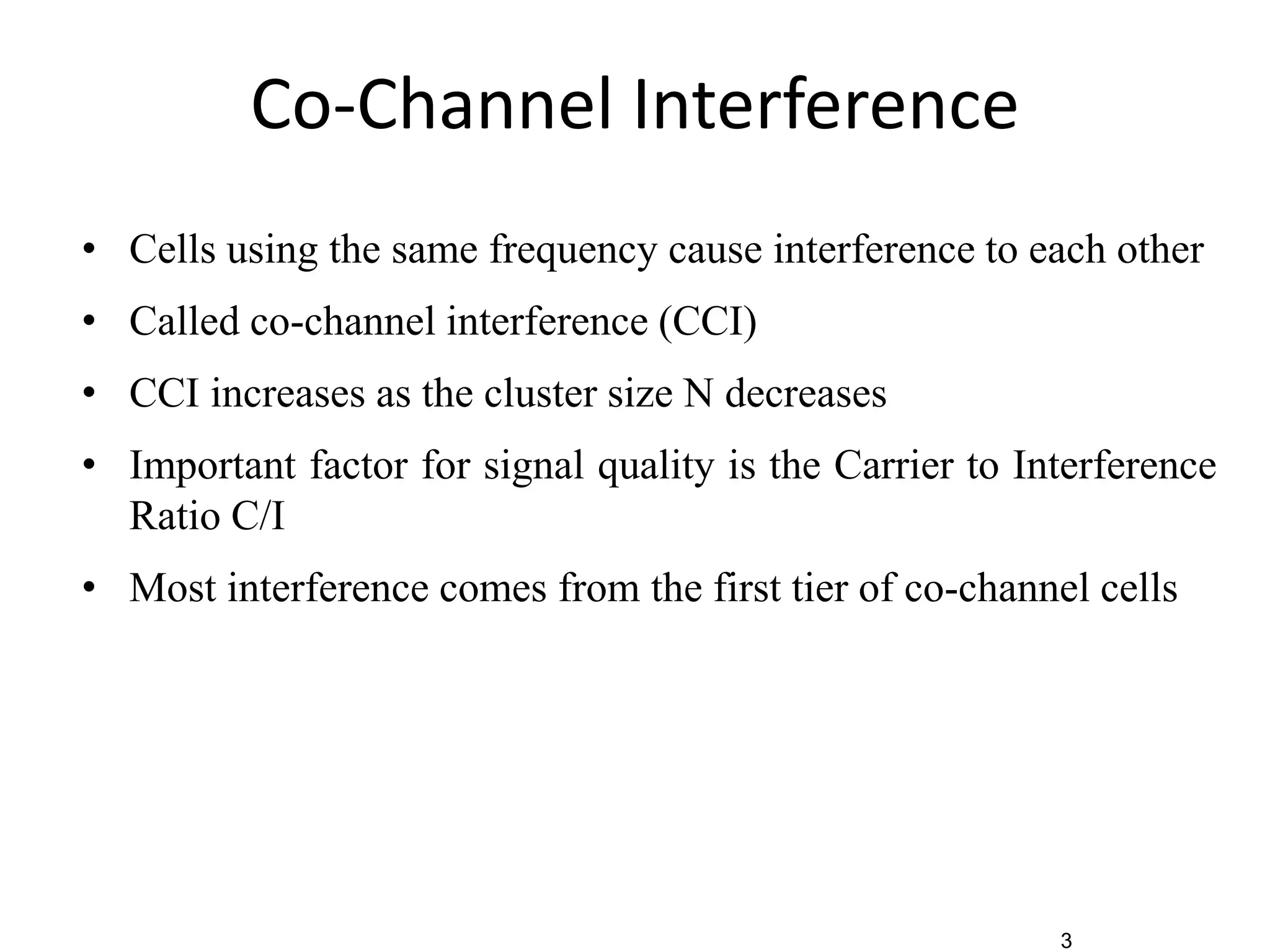
• Cells using the same frequency cause interference to each other
• Called co-channel interference (CCI)
• CCI increases as the cluster size N decreases
• Important factor for signal quality is the Carrier to Interference
Ratio C/I
• Most interference comes from the first tier of co-channel cells
Co-channel Interference and System
Capacity
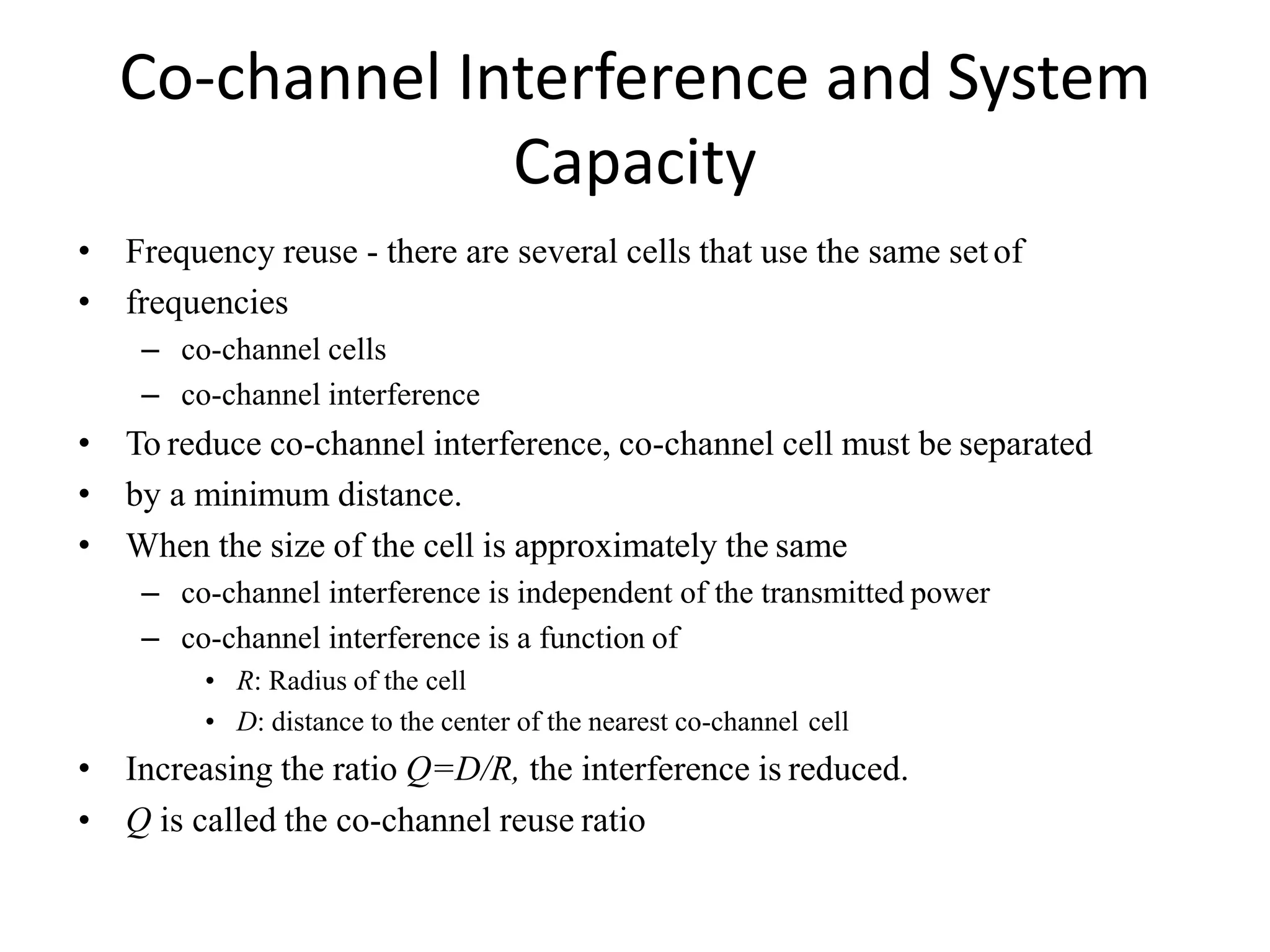
• Frequency reuse - there are several cells that use the same setof
• frequencies
– co-channel cells
– co-channel interference
• To reduce co-channel interference, co-channel cell must be separated
• by a minimum distance.
• When the size of the cell is approximately the same
– co-channel interference is independent of the transmitted power
– co-channel interference is a function of
• R: Radius of the cell
• D: distance to the center of the nearest co-channel cell
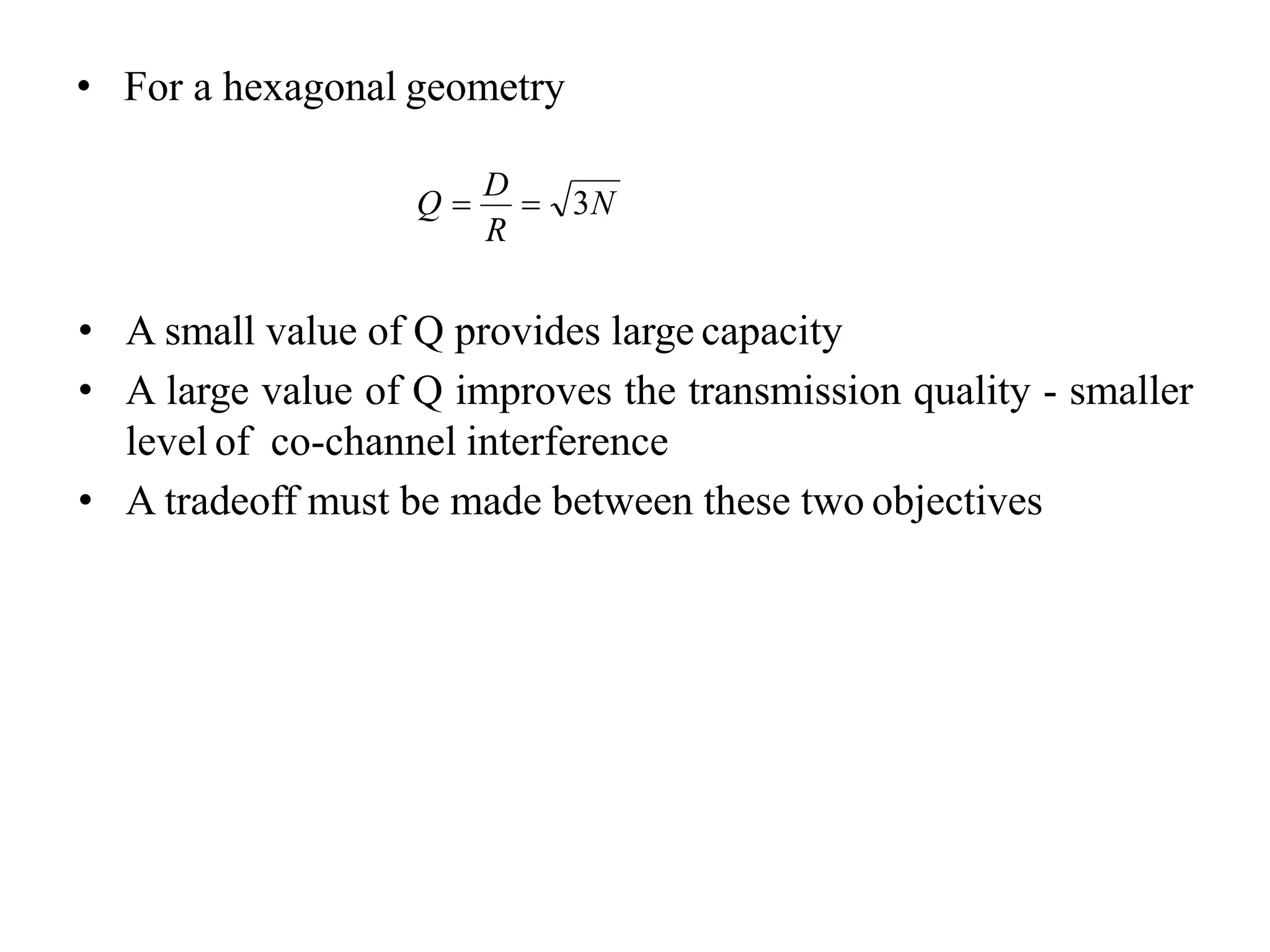
• Increasing the ratio Q=D/R, the interference is reduced.
• Q is called the co-channel reuse ratio
• For a hexagonal geometry
• A small value of Q provides large capacity
• A large value of Q improves the transmission quality - smaller
level of co-channel interference
• A tradeoff must be made between these two objectives
R
Q 
D
 3N
Adjacent Channel Interference
• Adjacent channel interference: interference from adjacent in frequency to
the desired signal.
• Imperfect receiver filters allow nearby frequencies to leak into the passband
• Performance degrade seriously due to near-far effect.
• Adjacent channel interference can be minimized through careful filtering
and channel assignment.
• Keep the frequency separation between each channel in a given cell as
large as possible
• A channel separation greater than six is needed to bring the adjacent
channel interference to an acceptable level.
`
desired
signal
desired
signal
interference
interference
signal on adjacent
channelsignal on adjacent
channel
FILTER
receiving filter
response
Power Control for Reducing
Interference
• Ensure each mobile transmits the smallest power necessary to maintain
• a good quality link on the reverse channel
– long battery life
– increase SIR
– solve the near-far problem

Interference and system capacity

  • 1.
  • 2.
    Interference and SystemCapacity • Sources of interference – another mobile in the same cell – a call in progress in the neighboring cell – other base stations operating in the same frequency band – noncellular system leaks energy into the cellular frequency band • Two major cellular interference – co-channel interference – adjacent channel interference
  • 3.
    3 Co-Channel Interference • Cellsusing the same frequency cause interference to each other • Called co-channel interference (CCI) • CCI increases as the cluster size N decreases • Important factor for signal quality is the Carrier to Interference Ratio C/I • Most interference comes from the first tier of co-channel cells
  • 4.
    Co-channel Interference andSystem Capacity • Frequency reuse - there are several cells that use the same setof • frequencies – co-channel cells – co-channel interference • To reduce co-channel interference, co-channel cell must be separated • by a minimum distance. • When the size of the cell is approximately the same – co-channel interference is independent of the transmitted power – co-channel interference is a function of • R: Radius of the cell • D: distance to the center of the nearest co-channel cell • Increasing the ratio Q=D/R, the interference is reduced. • Q is called the co-channel reuse ratio
  • 5.
    • For ahexagonal geometry • A small value of Q provides large capacity • A large value of Q improves the transmission quality - smaller level of co-channel interference • A tradeoff must be made between these two objectives R Q  D  3N
  • 6.
    Adjacent Channel Interference •Adjacent channel interference: interference from adjacent in frequency to the desired signal. • Imperfect receiver filters allow nearby frequencies to leak into the passband • Performance degrade seriously due to near-far effect. • Adjacent channel interference can be minimized through careful filtering and channel assignment. • Keep the frequency separation between each channel in a given cell as large as possible • A channel separation greater than six is needed to bring the adjacent channel interference to an acceptable level.
  • 7.
  • 8.
    Power Control forReducing Interference • Ensure each mobile transmits the smallest power necessary to maintain • a good quality link on the reverse channel – long battery life – increase SIR – solve the near-far problem