Strategic Interventions
Prepared by Mr Rabeel Sabar
Intervention
A sequence of planned activities, actions,
and events intended to help an
organization improve its performance and
effectiveness.
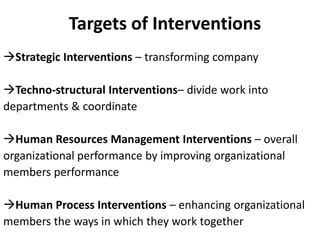
Targets of Interventions
Strategic Interventions – transforming company
Techno-structural Interventions– divide work into
departments & coordinate
Human Resources Management Interventions – overall
organizational performance by improving organizational
members performance
Human Process Interventions – enhancing organizational
members the ways in which they work together
Strategic Intervention
An intervention aimed at effecting a
suitable fit among a firm’s strategy,
structure, culture, and external
environments.
Strategic Interventions
Mergers & Acquisitions
Culture Change
Creativity & Innovation
Creativity & Innovation
• Creativity
–The ability to combine ideas in a unique
new or modified way.
• Innovation
–The process of taking a creative idea and
turning it into a useful product, service, or
method of operation.
Structural Variables Affecting
Innovation
• Organic structures
– Positively influence innovation through less work
specialization, fewer rules and decentralization.
• Easy availability of plentiful resources
– Allow management to purchase innovations, bear
the cost of instituting innovations, and absorb
failures.
• Frequent inter-unit communication
– Helps to break down barriers to innovation by
facilitating interaction across departmental lines.
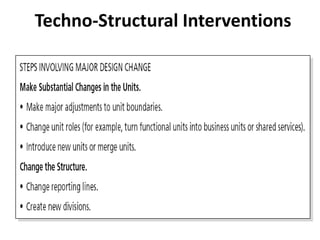
Techno-Structural Intervention
An intervention technique in which
employees collect information on existing
formal organizational structures and analyze
it for the purpose of redesigning and
implementing new organizational structures,
technology or procedures.
Techno-Structural Interventions
Human Resource Management
Interventions
HRM interventions aim to enhance overall
organizational performance by improving
the performance of individuals and groups
within the organization.
Human Resource Management
Interventions
Goal Setting
Performance Appraisal
Reward Systems
Career Planning & Development
Coaching and Counseling Activities
Managing Work Force Diversity
Human Process Interventions
Aimed at enabling employees to develop
a better understanding of their own and
others’ behaviors for the purpose of
improving that behavior such that the
organization benefits.
Human Process Interventions
Sensitivity Training
Team Building
Process Consulting
Large-group Interventions
Skills Training
Job Redesign
Conflict Resolution
Employee Wellness
Sensitivity Training (T-Groups)
Purpose is to increase participants’
insight into their own behavior and that
of others by encouraging an open
expression of feelings in a trainer-
guided group.
Team Building
An intervention designed to improve
the effectiveness of a work group.
Process Consulting
Process consulting is carefully
intervening in a group or team to help
it to accomplish its goals. It
concentrates on the way the team
works, rather than what it is working
on.
Large Group Interventions
Events that bring all of the key members
of a group together in one room for an
extended period of time.
Skills Training
Increasing the job knowledge, skills,
and abilities that are necessary to do a
job effectively.
Job Redesign
An intervention method that alters jobs
to improve the fit between individual
skills and the demands of the job.
Conflict Resolution
Five methods for conflict resolution:
1. Accommodation
2. Avoidance
3. Collaboration
4. Compromise
5. Competition
Accommodation
• Surrender one's own needs and
wishes to accommodate the other
party. Used when the relationship
and peace is more important than
the issue.
Avoidance
• Avoid or postpone conflict by
ignoring it, changing the subject, etc.
Avoidance can be useful as a
temporary measure to buy time or a
means of dealing with very minor
conflicts.
Collaboration
• Work together to find a mutually
beneficial solution. Satisfying both side’s
needs can be seen as the only win-win
solution to conflict, collaboration can
also be time-intensive and inappropriate
when there is not enough trust, respect
or communication among participants
for collaboration to occur.
Compromise
• Bring the problem into the open and
have the third person present. The
aim of conflict resolution is to reach
agreement and better alternative to
both side’s demands.
Competition
• Assert one's viewpoint at the
potential expense of another. People
who tend towards a competitive
style take a firm stand, and know
what they want.
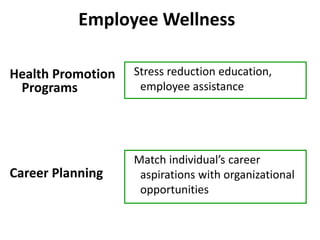
Employee Wellness
Health Promotion
Programs
Career Planning
Stress reduction education,
employee assistance
Match individual’s career
aspirations with organizational
opportunities
Advice for Structuring Interventions
Relevant
Problem oriented
Clear goals
Realistic expectations
Experience-based learning
Easy-going climate
Learn how to learn
Total situation should come into play
Results expected from Intervention
Feedback
Awareness of norms
Increased interaction
Increased communication
Confrontation
Education
Participation
Increased accountability
Optimism
Evaluation
Feedback to organization members about
progress and impact of interventions.

Strategic interventions

  • 1.
  • 2.
    Intervention A sequence ofplanned activities, actions, and events intended to help an organization improve its performance and effectiveness.
  • 3.
    Targets of Interventions StrategicInterventions – transforming company Techno-structural Interventions– divide work into departments & coordinate Human Resources Management Interventions – overall organizational performance by improving organizational members performance Human Process Interventions – enhancing organizational members the ways in which they work together
  • 4.
    Strategic Intervention An interventionaimed at effecting a suitable fit among a firm’s strategy, structure, culture, and external environments.
  • 5.
    Strategic Interventions Mergers &Acquisitions Culture Change Creativity & Innovation
  • 6.
    Creativity & Innovation •Creativity –The ability to combine ideas in a unique new or modified way. • Innovation –The process of taking a creative idea and turning it into a useful product, service, or method of operation.
  • 7.
    Structural Variables Affecting Innovation •Organic structures – Positively influence innovation through less work specialization, fewer rules and decentralization. • Easy availability of plentiful resources – Allow management to purchase innovations, bear the cost of instituting innovations, and absorb failures. • Frequent inter-unit communication – Helps to break down barriers to innovation by facilitating interaction across departmental lines.
  • 8.
    Techno-Structural Intervention An interventiontechnique in which employees collect information on existing formal organizational structures and analyze it for the purpose of redesigning and implementing new organizational structures, technology or procedures.
  • 9.
  • 10.
    Human Resource Management Interventions HRMinterventions aim to enhance overall organizational performance by improving the performance of individuals and groups within the organization.
  • 11.
    Human Resource Management Interventions GoalSetting Performance Appraisal Reward Systems Career Planning & Development Coaching and Counseling Activities Managing Work Force Diversity
  • 12.
    Human Process Interventions Aimedat enabling employees to develop a better understanding of their own and others’ behaviors for the purpose of improving that behavior such that the organization benefits.
  • 13.
    Human Process Interventions SensitivityTraining Team Building Process Consulting Large-group Interventions Skills Training Job Redesign Conflict Resolution Employee Wellness
  • 14.
    Sensitivity Training (T-Groups) Purposeis to increase participants’ insight into their own behavior and that of others by encouraging an open expression of feelings in a trainer- guided group.
  • 15.
    Team Building An interventiondesigned to improve the effectiveness of a work group.
  • 16.
    Process Consulting Process consultingis carefully intervening in a group or team to help it to accomplish its goals. It concentrates on the way the team works, rather than what it is working on.
  • 17.
    Large Group Interventions Eventsthat bring all of the key members of a group together in one room for an extended period of time.
  • 18.
    Skills Training Increasing thejob knowledge, skills, and abilities that are necessary to do a job effectively.
  • 19.
    Job Redesign An interventionmethod that alters jobs to improve the fit between individual skills and the demands of the job.
  • 20.
    Conflict Resolution Five methodsfor conflict resolution: 1. Accommodation 2. Avoidance 3. Collaboration 4. Compromise 5. Competition
  • 21.
    Accommodation • Surrender one'sown needs and wishes to accommodate the other party. Used when the relationship and peace is more important than the issue.
  • 22.
    Avoidance • Avoid orpostpone conflict by ignoring it, changing the subject, etc. Avoidance can be useful as a temporary measure to buy time or a means of dealing with very minor conflicts.
  • 23.
    Collaboration • Work togetherto find a mutually beneficial solution. Satisfying both side’s needs can be seen as the only win-win solution to conflict, collaboration can also be time-intensive and inappropriate when there is not enough trust, respect or communication among participants for collaboration to occur.
  • 24.
    Compromise • Bring theproblem into the open and have the third person present. The aim of conflict resolution is to reach agreement and better alternative to both side’s demands.
  • 25.
    Competition • Assert one'sviewpoint at the potential expense of another. People who tend towards a competitive style take a firm stand, and know what they want.
  • 26.
    Employee Wellness Health Promotion Programs CareerPlanning Stress reduction education, employee assistance Match individual’s career aspirations with organizational opportunities
  • 27.
    Advice for StructuringInterventions Relevant Problem oriented Clear goals Realistic expectations Experience-based learning Easy-going climate Learn how to learn Total situation should come into play
  • 28.
    Results expected fromIntervention Feedback Awareness of norms Increased interaction Increased communication Confrontation Education Participation Increased accountability Optimism
  • 29.
    Evaluation Feedback to organizationmembers about progress and impact of interventions.