ISO
PRESENTED BY DR.PRIYANKA R. PHONDE.
           ITM HEALTHCARE MANAGEMENT
          ROLL NO : KHR2011EMBAHC5P007
              FACULTY :DR.DEV TANEJA
SUBJECT : TOTAL QUALITY MANAGEMENT IN HOSPITALS


                                     29/01/2012 11:00AM
About ISO
• ISO (International Organization for Standardization) is
  the world's largest developer and publisher
  of International Standards.
• ISO is a network of the national standards institutes
  of 163 countries, one member per country, with a
  Central Secretariat in Geneva, Switzerland, that
  coordinates the system.
• ISO is a non-governmental organization that forms a
  bridge between the public and private sectors.
• ISO has developed over 18,500 International Standards
  on a variety of subjects and some 1100 new ISO
  standards are published every year.
• The three official languages of the ISO
  are English, French, and Russian. The
  organization's logos in two of its official languages
  English and French.
• The organization which today is known as ISO began in
  1926 as the International Federation of the National
  Standardizing Associations (ISA)
• ISO is a voluntary organization whose members are
  recognized authorities on standards, each one
  representing one country. The bulk of the work of ISO
  is done by the 2700 technical committees,
  subcommittees, and working groups. Each committee
  and subcommittee is headed by a Secretariat from one
  of the member organizations.
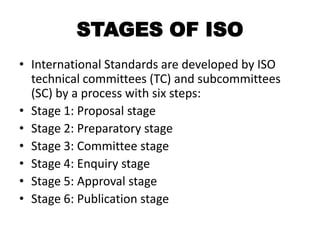
STAGES OF ISO
• International Standards are developed by ISO
  technical committees (TC) and subcommittees
  (SC) by a process with six steps:
• Stage 1: Proposal stage
• Stage 2: Preparatory stage
• Stage 3: Committee stage
• Stage 4: Enquiry stage
• Stage 5: Approval stage
• Stage 6: Publication stage
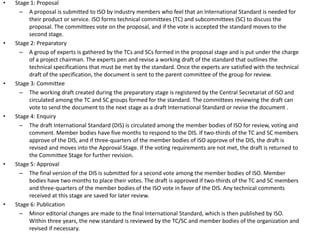
•   Stage 1: Proposal
      – A proposal is submitted to ISO by industry members who feel that an International Standard is needed for
         their product or service. ISO forms technical committees (TC) and subcommittees (SC) to discuss the
         proposal. The committees vote on the proposal, and if the vote is accepted the standard moves to the
         second stage.
•   Stage 2: Preparatory
      – A group of experts is gathered by the TCs and SCs formed in the proposal stage and is put under the charge
         of a project chairman. The experts pen and revise a working draft of the standard that outlines the
         technical specifications that must be met by the standard. Once the experts are satisfied with the technical
         draft of the specification, the document is sent to the parent committee of the group for review.
•   Stage 3: Committee
      – The working draft created during the preparatory stage is registered by the Central Secretariat of ISO and
         circulated among the TC and SC groups formed for the standard. The committees reviewing the draft can
         vote to send the document to the next stage as a draft International Standard or revise the document .
•   Stage 4: Enquiry
      – The draft International Standard (DIS) is circulated among the member bodies of ISO for review, voting and
         comment. Member bodies have five months to respond to the DIS. If two-thirds of the TC and SC members
         approve of the DIS, and if three-quarters of the member bodies of ISO approve of the DIS, the draft is
         revised and moves into the Approval Stage. If the voting requirements are not met, the draft is returned to
         the Committee Stage for further revision.
•   Stage 5: Approval
      – The final version of the DIS is submitted for a second vote among the member bodies of ISO. Member
         bodies have two months to place their votes. The draft is approved if two-thirds of the TC and SC members
         and three-quarters of the member bodies of the ISO vote in favor of the DIS. Any technical comments
         received at this stage are saved for later review.
•   Stage 6: Publication
      – Minor editorial changes are made to the final International Standard, which is then published by ISO.
         Within three years, the new standard is reviewed by the TC/SC and member bodies of the organization and
         revised if necessary.
Why did one hospital pursue
       certification in 9001:2000
• If hospital is looking to enhance its healthcare
  quality management system. What makes ISO
  unique is that it relies on the individual
  organization to establish, document, implement
  and maintain a quality management system and
  continually improve its effectiveness.
• ISO assists the organization in designing and
  ensuring its documented processes are effective
  and support its mission.
ISO 9001 Certification for Hospital
     Quality Management Systems
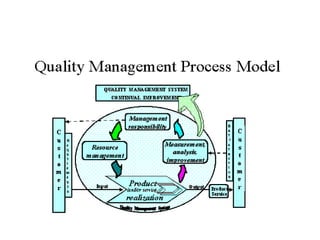
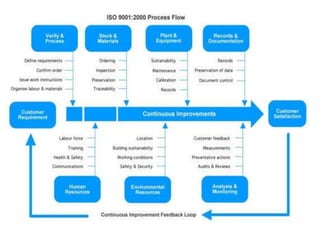
• An ISO 9000 implementation gives a basic road
  map for integration of all functions involved in
  total health care services, for ensuring a better
  quality of service to the patients.
• The latest version, the ISO 9001:2008, is
  especially relevant to the Healthcare Services
  Sector as it focuses on fulfilling customer
  (patient) expectations, improving the quality of
  an organization’s business and management
  processes.
Hospital aspiring for an ISO 9001
            Certification are:
•   Acceptable quality care at affordable prices.
•   Timely care.
•   Clear communication to the patients.
•   Best practices for fixing appointment and service
    delivery.
•   Reliable diagnostic and laboratory support.
•   Reliable support services like canteen, ambulance,
    pharmacy, etc.
•   Safe and pleasant environment.
•   Technical competence, courtesy and attitude of staff.
NABH & NABL Accreditation
                Assistance
• The National Accreditation Board for Hospitals & Healthcare
  Providers (NABH) Standards is today the highest benchmark
  standard for hospital quality in India. Though developed by the
  Quality Council of India on the lines of International Accreditation
  Standards like the JCI, ACHS and the Canadian Hospital
  Accreditation Standards, the NABH is however seen as a more
  practical set of Standards, topical and very relevant to India’s
  unique healthcare system requirements.
• National Accreditation Board for Testing & Calibration Laboratories
  (NABL), similar to the NABH, is also an autonomous body, under the
  Quality Council of India. The primary objective being to maintain an
  accreditation system for laboratories suitable for India, developed
  in accordance with relevant national and international standards
  and guides. The NABL Accreditation is a formal recognition of the
  technical competence of a laboratory based on third party
  assessment and following international guidelines.
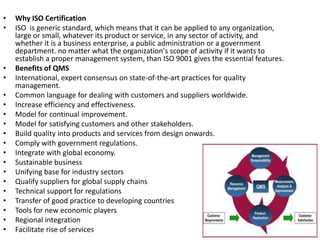
•   Why ISO Certification
•   ISO is generic standard, which means that it can be applied to any organization,
    large or small, whatever its product or service, in any sector of activity, and
    whether it is a business enterprise, a public administration or a government
    department. no matter what the organization's scope of activity if it wants to
    establish a proper management system, than ISO 9001 gives the essential features.
•   Benefits of QMS
•   International, expert consensus on state-of-the-art practices for quality
    management.
•   Common language for dealing with customers and suppliers worldwide.
•   Increase efficiency and effectiveness.
•   Model for continual improvement.
•   Model for satisfying customers and other stakeholders.
•   Build quality into products and services from design onwards.
•   Comply with government regulations.
•   Integrate with global economy.
•   Sustainable business
•   Unifying base for industry sectors
•   Qualify suppliers for global supply chains
•   Technical support for regulations
•   Transfer of good practice to developing countries
•   Tools for new economic players
•   Regional integration
•   Facilitate rise of services
Some examples ..
• Surgical Gloves                                        • Castors and Wheels on
ISO 10282: 2002 details packaging and storage
     requirements for surgical gloves. The goal of the
                                                           Hospital Beds
     standard is to prevent cross-contamination          ISO 22882: 2004 specifies technical requirements
     between patients.                                        and dimensions for wheels and locking
                                                              mechanisms on hospital beds.
• Heating Pads and
                                                         • Medical Face-Mask
  Blankets
ISO 80601: 2009 covers safety concerns related to
                                                           Quality
     heating pads, blankets and other electrical               ISO 22609 does not cover a mask's resistance
     bedding used on pediatric patients                            to airborne pathogens.
                                                               ISO 22609:2004 addresses a laboratory testing
                                                             method which measures how effectively
                                                             medical face masks resist penetration by a
                                                             splash of synthetic blood.
THANK YOU.

Iso

  • 1.
    ISO PRESENTED BY DR.PRIYANKAR. PHONDE. ITM HEALTHCARE MANAGEMENT ROLL NO : KHR2011EMBAHC5P007 FACULTY :DR.DEV TANEJA SUBJECT : TOTAL QUALITY MANAGEMENT IN HOSPITALS 29/01/2012 11:00AM
  • 2.
    About ISO • ISO(International Organization for Standardization) is the world's largest developer and publisher of International Standards. • ISO is a network of the national standards institutes of 163 countries, one member per country, with a Central Secretariat in Geneva, Switzerland, that coordinates the system. • ISO is a non-governmental organization that forms a bridge between the public and private sectors. • ISO has developed over 18,500 International Standards on a variety of subjects and some 1100 new ISO standards are published every year.
  • 3.
    • The threeofficial languages of the ISO are English, French, and Russian. The organization's logos in two of its official languages English and French. • The organization which today is known as ISO began in 1926 as the International Federation of the National Standardizing Associations (ISA) • ISO is a voluntary organization whose members are recognized authorities on standards, each one representing one country. The bulk of the work of ISO is done by the 2700 technical committees, subcommittees, and working groups. Each committee and subcommittee is headed by a Secretariat from one of the member organizations.
  • 5.
    STAGES OF ISO •International Standards are developed by ISO technical committees (TC) and subcommittees (SC) by a process with six steps: • Stage 1: Proposal stage • Stage 2: Preparatory stage • Stage 3: Committee stage • Stage 4: Enquiry stage • Stage 5: Approval stage • Stage 6: Publication stage
  • 7.
    Stage 1: Proposal – A proposal is submitted to ISO by industry members who feel that an International Standard is needed for their product or service. ISO forms technical committees (TC) and subcommittees (SC) to discuss the proposal. The committees vote on the proposal, and if the vote is accepted the standard moves to the second stage. • Stage 2: Preparatory – A group of experts is gathered by the TCs and SCs formed in the proposal stage and is put under the charge of a project chairman. The experts pen and revise a working draft of the standard that outlines the technical specifications that must be met by the standard. Once the experts are satisfied with the technical draft of the specification, the document is sent to the parent committee of the group for review. • Stage 3: Committee – The working draft created during the preparatory stage is registered by the Central Secretariat of ISO and circulated among the TC and SC groups formed for the standard. The committees reviewing the draft can vote to send the document to the next stage as a draft International Standard or revise the document . • Stage 4: Enquiry – The draft International Standard (DIS) is circulated among the member bodies of ISO for review, voting and comment. Member bodies have five months to respond to the DIS. If two-thirds of the TC and SC members approve of the DIS, and if three-quarters of the member bodies of ISO approve of the DIS, the draft is revised and moves into the Approval Stage. If the voting requirements are not met, the draft is returned to the Committee Stage for further revision. • Stage 5: Approval – The final version of the DIS is submitted for a second vote among the member bodies of ISO. Member bodies have two months to place their votes. The draft is approved if two-thirds of the TC and SC members and three-quarters of the member bodies of the ISO vote in favor of the DIS. Any technical comments received at this stage are saved for later review. • Stage 6: Publication – Minor editorial changes are made to the final International Standard, which is then published by ISO. Within three years, the new standard is reviewed by the TC/SC and member bodies of the organization and revised if necessary.
  • 9.
    Why did onehospital pursue certification in 9001:2000 • If hospital is looking to enhance its healthcare quality management system. What makes ISO unique is that it relies on the individual organization to establish, document, implement and maintain a quality management system and continually improve its effectiveness. • ISO assists the organization in designing and ensuring its documented processes are effective and support its mission.
  • 10.
    ISO 9001 Certificationfor Hospital Quality Management Systems • An ISO 9000 implementation gives a basic road map for integration of all functions involved in total health care services, for ensuring a better quality of service to the patients. • The latest version, the ISO 9001:2008, is especially relevant to the Healthcare Services Sector as it focuses on fulfilling customer (patient) expectations, improving the quality of an organization’s business and management processes.
  • 12.
    Hospital aspiring foran ISO 9001 Certification are: • Acceptable quality care at affordable prices. • Timely care. • Clear communication to the patients. • Best practices for fixing appointment and service delivery. • Reliable diagnostic and laboratory support. • Reliable support services like canteen, ambulance, pharmacy, etc. • Safe and pleasant environment. • Technical competence, courtesy and attitude of staff.
  • 15.
    NABH & NABLAccreditation Assistance • The National Accreditation Board for Hospitals & Healthcare Providers (NABH) Standards is today the highest benchmark standard for hospital quality in India. Though developed by the Quality Council of India on the lines of International Accreditation Standards like the JCI, ACHS and the Canadian Hospital Accreditation Standards, the NABH is however seen as a more practical set of Standards, topical and very relevant to India’s unique healthcare system requirements. • National Accreditation Board for Testing & Calibration Laboratories (NABL), similar to the NABH, is also an autonomous body, under the Quality Council of India. The primary objective being to maintain an accreditation system for laboratories suitable for India, developed in accordance with relevant national and international standards and guides. The NABL Accreditation is a formal recognition of the technical competence of a laboratory based on third party assessment and following international guidelines.
  • 16.
    Why ISO Certification • ISO is generic standard, which means that it can be applied to any organization, large or small, whatever its product or service, in any sector of activity, and whether it is a business enterprise, a public administration or a government department. no matter what the organization's scope of activity if it wants to establish a proper management system, than ISO 9001 gives the essential features. • Benefits of QMS • International, expert consensus on state-of-the-art practices for quality management. • Common language for dealing with customers and suppliers worldwide. • Increase efficiency and effectiveness. • Model for continual improvement. • Model for satisfying customers and other stakeholders. • Build quality into products and services from design onwards. • Comply with government regulations. • Integrate with global economy. • Sustainable business • Unifying base for industry sectors • Qualify suppliers for global supply chains • Technical support for regulations • Transfer of good practice to developing countries • Tools for new economic players • Regional integration • Facilitate rise of services
  • 18.
    Some examples .. •Surgical Gloves • Castors and Wheels on ISO 10282: 2002 details packaging and storage requirements for surgical gloves. The goal of the Hospital Beds standard is to prevent cross-contamination ISO 22882: 2004 specifies technical requirements between patients. and dimensions for wheels and locking mechanisms on hospital beds. • Heating Pads and • Medical Face-Mask Blankets ISO 80601: 2009 covers safety concerns related to Quality heating pads, blankets and other electrical ISO 22609 does not cover a mask's resistance bedding used on pediatric patients to airborne pathogens. ISO 22609:2004 addresses a laboratory testing method which measures how effectively medical face masks resist penetration by a splash of synthetic blood.
  • 19.