ORGANIZATIONAL BEHAVIOR
S T E P H E N P. R O B B I N S
E L E V E N T H E D I T I O N
W W W . P R E N H A L L . C O M / R O B B I N S
© 2005 Prentice Hall Inc.
All rights reserved.
PowerPoint Presentation
by Charlie Cook
Organizational Change
and Stress Management
TWELFTH EDITION
Organization Change
➢ Organizational change is the process through which an
organisation moves from the present state to an
improved state.
➢ Change management comprises three elements:
evolution of the firm, its management and organization,
and the people who work for it.
➢ Three levels of change are observed: individual level,
group level, and organisations.
Nature of Change
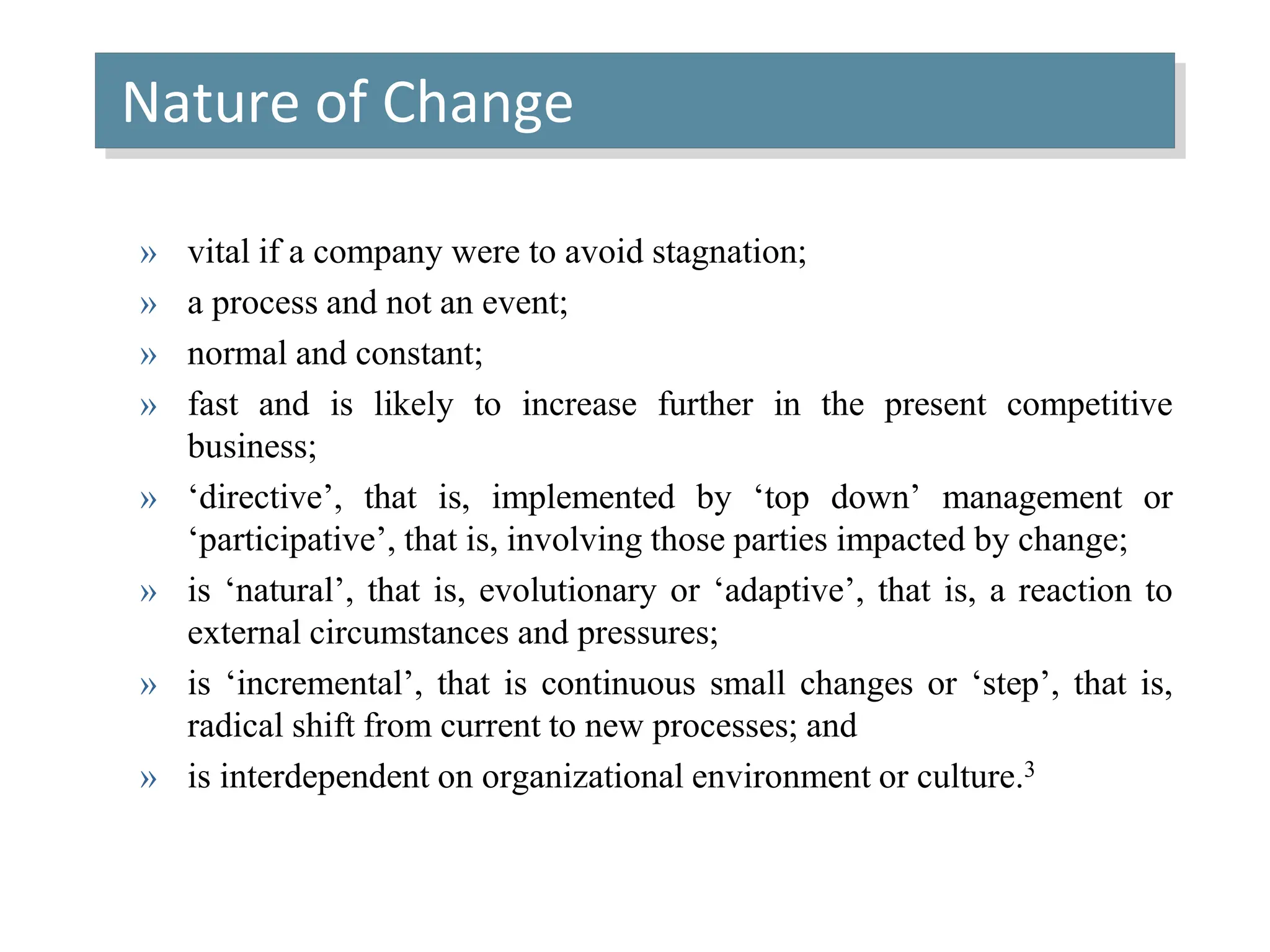
» vital if a company were to avoid stagnation;
» a process and not an event;
» normal and constant;
» fast and is likely to increase further in the present competitive
business;
» ‘directive’, that is, implemented by ‘top down’ management or
‘participative’, that is, involving those parties impacted by change;
» is ‘natural’, that is, evolutionary or ‘adaptive’, that is, a reaction to
external circumstances and pressures;
» is ‘incremental’, that is continuous small changes or ‘step’, that is,
radical shift from current to new processes; and
» is interdependent on organizational environment or culture.3
18–3
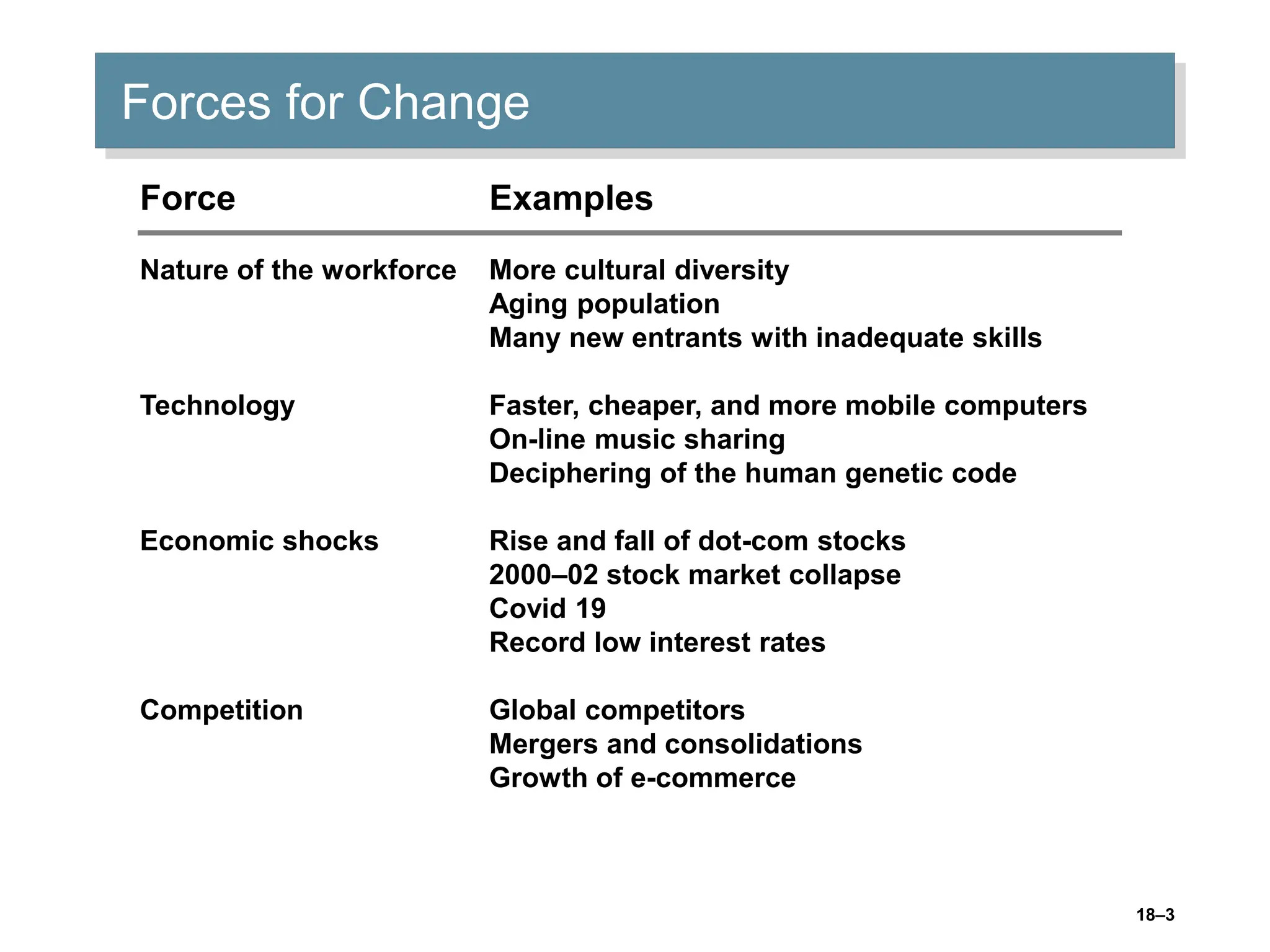
Forces for Change
Force Examples
Nature of the workforce More cultural diversity
Aging population
Many new entrants with inadequate skills
Technology Faster, cheaper, and more mobile computers
On-line music sharing
Deciphering of the human genetic code
Economic shocks Rise and fall of dot-com stocks
2000–02 stock market collapse
Covid 19
Record low interest rates
Competition Global competitors
Mergers and consolidations
Growth of e-commerce
Forces for Change
Force Examples
Social trends Internet chat rooms
Retirement of Baby Boomers
Rise in discount and “big box” retailers
World politics Iraq–U.S. war
Ukraine- Russia war
Opening of markets in China
War on terrorism following 9/11/01
Types of change
➢ Evolutionary change and revolutionary change
➢ Reactive change & proactive change
Managing Planned Change
Goals of Planned
Change:
Improving the ability of
the organization to
adapt to changes in its
environment.
Changing the behavior
of individuals and
groups in the
organization.
Change
Making things different.
Planned Change
Activities that are
intentional and goal
oriented.
Change Agents
Persons who act as
catalysts and assume the
responsibility for managing
change activities.
Resistance to Change
Forms of Resistance to Change
– Overt and immediate
• Voicing complaints, engaging in job actions
– Implicit and deferred
• Loss of employee loyalty and motivation, increased
errors or mistakes, increased absenteeism
• Deferred resistance clouds the link between source and
reaction
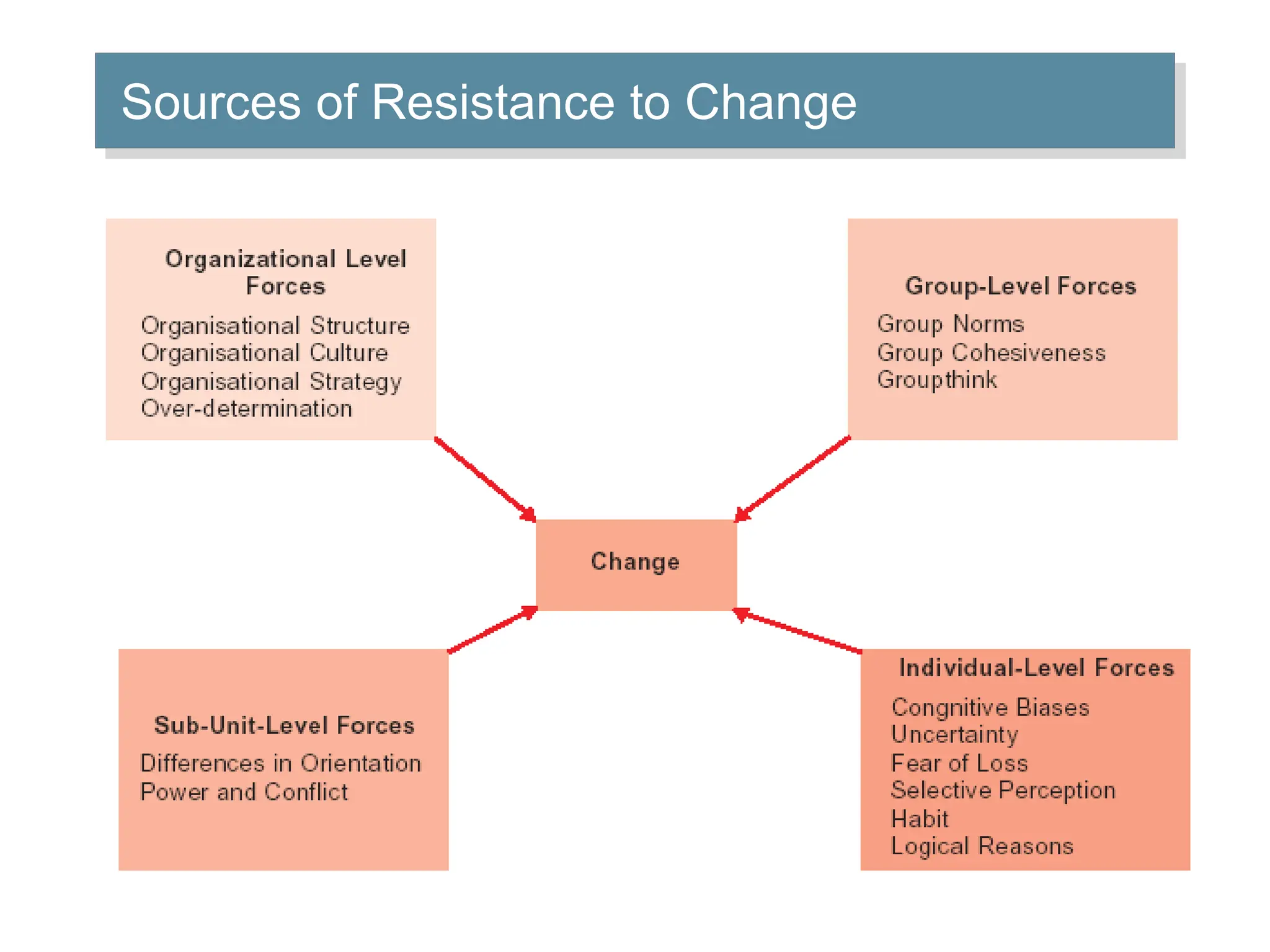
Sources of Resistance to Change
Sources of Individual Resistance to Change
Sources of Organizational Resistance to
Change
Overcoming Resistance to Change
Tactics for dealing with resistance
to change:
• Education and communication
• Participation
• Facilitation and support
• Negotiation
• Manipulation and cooptation
• Coercion
Tactics for Overcoming Resistance to Change
➢ Education and Communication
– Show those effected the logic behind the change
➢ Participation
– Participation in the decision process lessens resistance
➢ Building Support and Commitment
– Counseling, therapy, or new-skills training
➢ Implementing Change Fairly
– Be consistent and procedurally fair
➢ Manipulation and Cooptation
– “Spinning” the message to gain cooperation
➢ Selecting people who accept change
– Hire people who enjoy change in the first place
➢ Coercion
– Direct threats and force
Six Methods for Dealing With Resistance to Change
The Politics of Change
➢ Impetus for change is likely to come from outside
change agents.
➢ Internal change agents are most threatened by
their loss of status in the organization.
➢ Long-time power holders tend to implement only
incremental change.
➢ The outcomes of power struggles in the
organization will determine the speed and quality
of change.
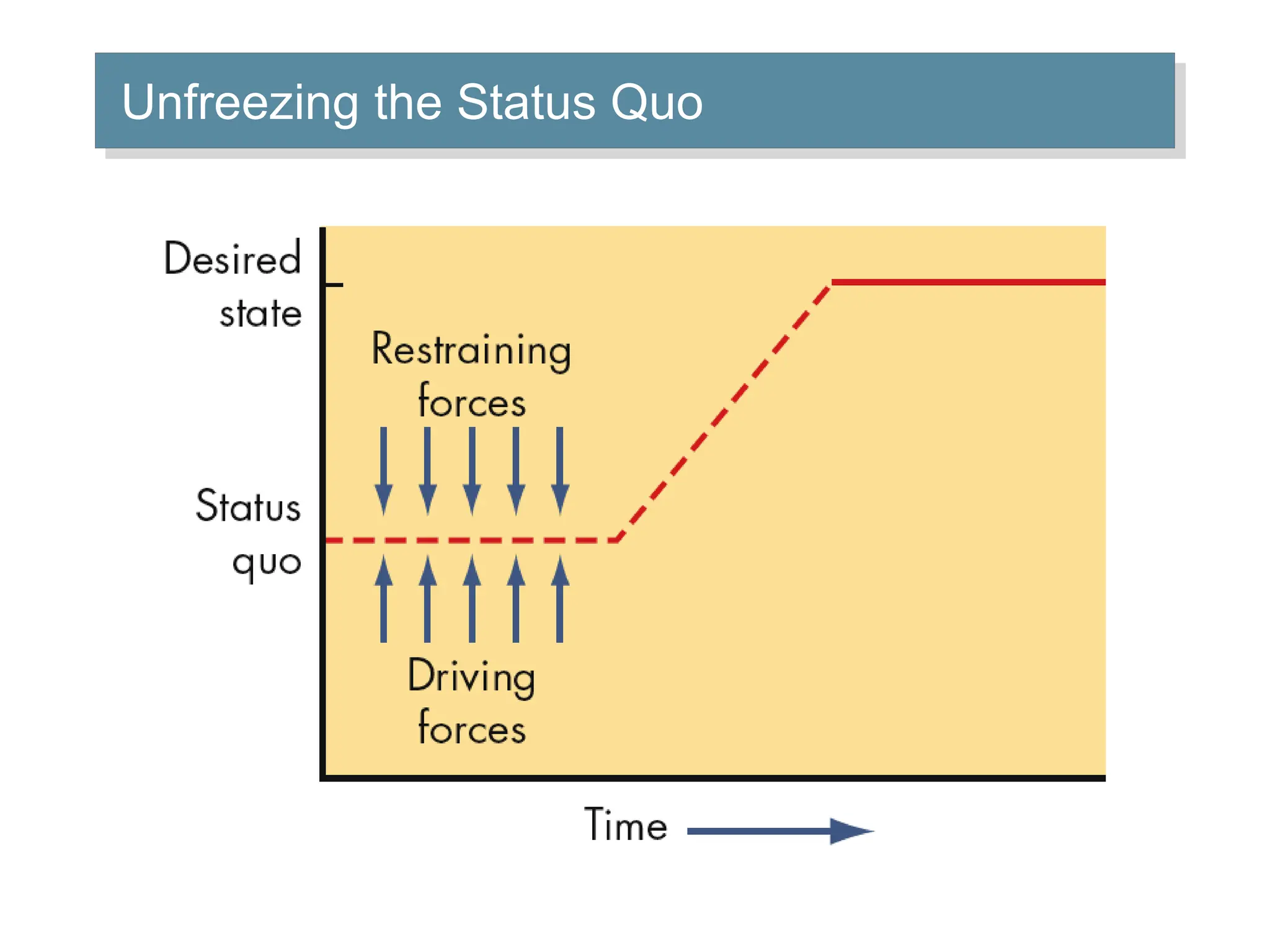
Lewin’s Three-Step Change Model
Unfreezing
Change efforts to overcome
the pressures of both
individual resistance and
group conformity.
Refreezing
Stabilizing a change
intervention by balancing
driving and restraining forces.
Driving Forces
Forces that direct behavior
away from the status quo.
Restraining Forces
Forces that hinder movement
from the existing equilibrium.
Unfreezing the Status Quo
Case of Kodak
Caselet: Kodak's Digital Revolution Challenge
Once an industry leader known for revolutionizing
photography with its film-based products, Kodak now finds itself at a
crossroads in the digital era. The advent of digital photography has
disrupted the traditional film-based business model, forcing Kodak to
confront the need for a profound organizational change. The
leadership, led by CEO Michael Reynolds, recognizes the urgency to
transform Kodak and ensure its relevance in the digital age.
Question:
• How does Kodak plan to align its digital transformation strategy
with the evolving needs and preferences of consumers in the
digital photography market, and what steps will be taken to
ensure a seamless transition from film-based to digital products?
The Six-Stage Change Process
Kotter’s Eight-Step Plan for Implementing Change
1. Establish a sense of urgency by creating a compelling reason
for why change is needed.
2. Form a coalition with enough power to lead the change.
3. Create a new vision to direct the change and strategies for
achieving the vision.
4. Communicate the vision throughout the organization.
5. Empower others to act on the vision by removing barriers to
change and encouraging risk taking and creative problem
solving.
6. Plan for, create, and reward short-term “wins” that move the
organization toward the new vision.
7. Consolidate improvements, reassess changes, and make
necessary adjustments in the new programs.
8. Reinforce the changes by demonstrating the relationship
between new behaviors and organizational success.
Kotter’s Eight-Step Plan
➢ Builds from Lewin’s Model
➢ To implement change:
1. Establish a sense of urgency
2. Form a coalition
3. Create a new vision
4. Communicate the vision
5. Empower others by removing barriers
6. Create and reward short-term “wins”
7. Consolidate, reassess, and adjust
8. Reinforce the changes
Unfreezing
Movement
Refreezing
Action Research
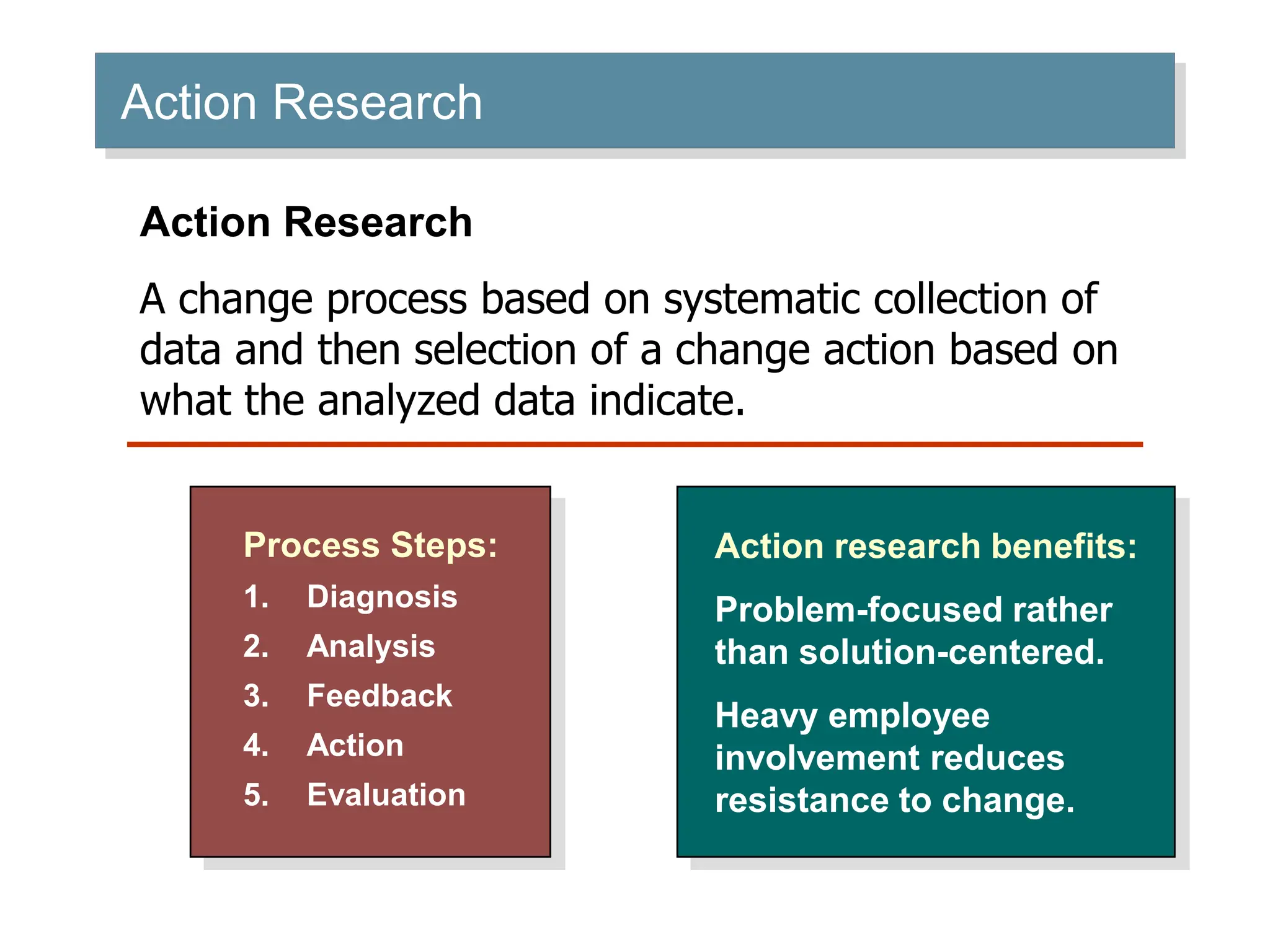
Process Steps:
1. Diagnosis
2. Analysis
3. Feedback
4. Action
5. Evaluation
Action research benefits:
Problem-focused rather
than solution-centered.
Heavy employee
involvement reduces
resistance to change.
Action Research
A change process based on systematic collection of
data and then selection of a change action based on
what the analyzed data indicate.
Organizational Development
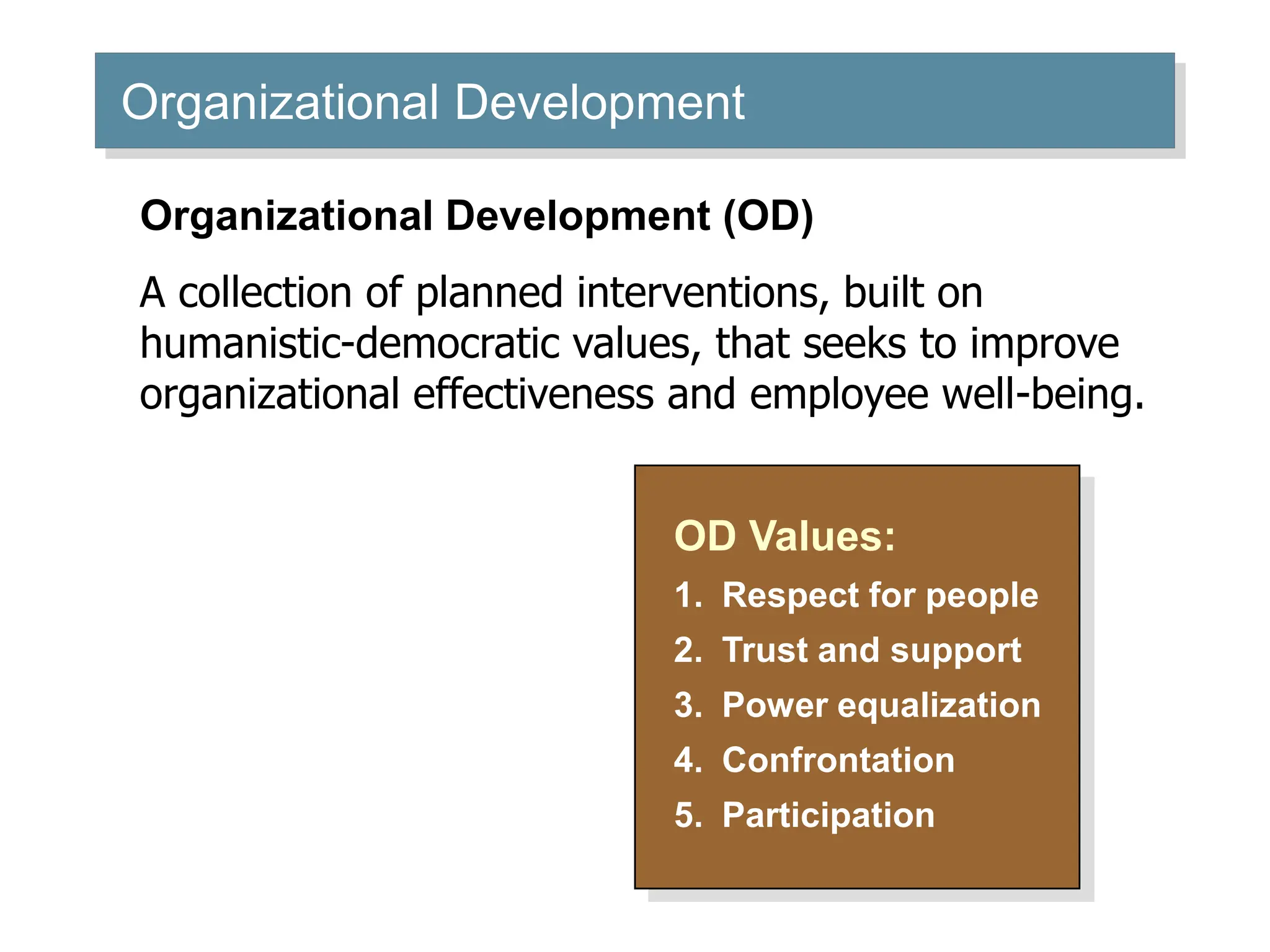
OD Values:
1. Respect for people
2. Trust and support
3. Power equalization
4. Confrontation
5. Participation
Organizational Development (OD)
A collection of planned interventions, built on
humanistic-democratic values, that seeks to improve
organizational effectiveness and employee well-being.
Organizational Development Techniques
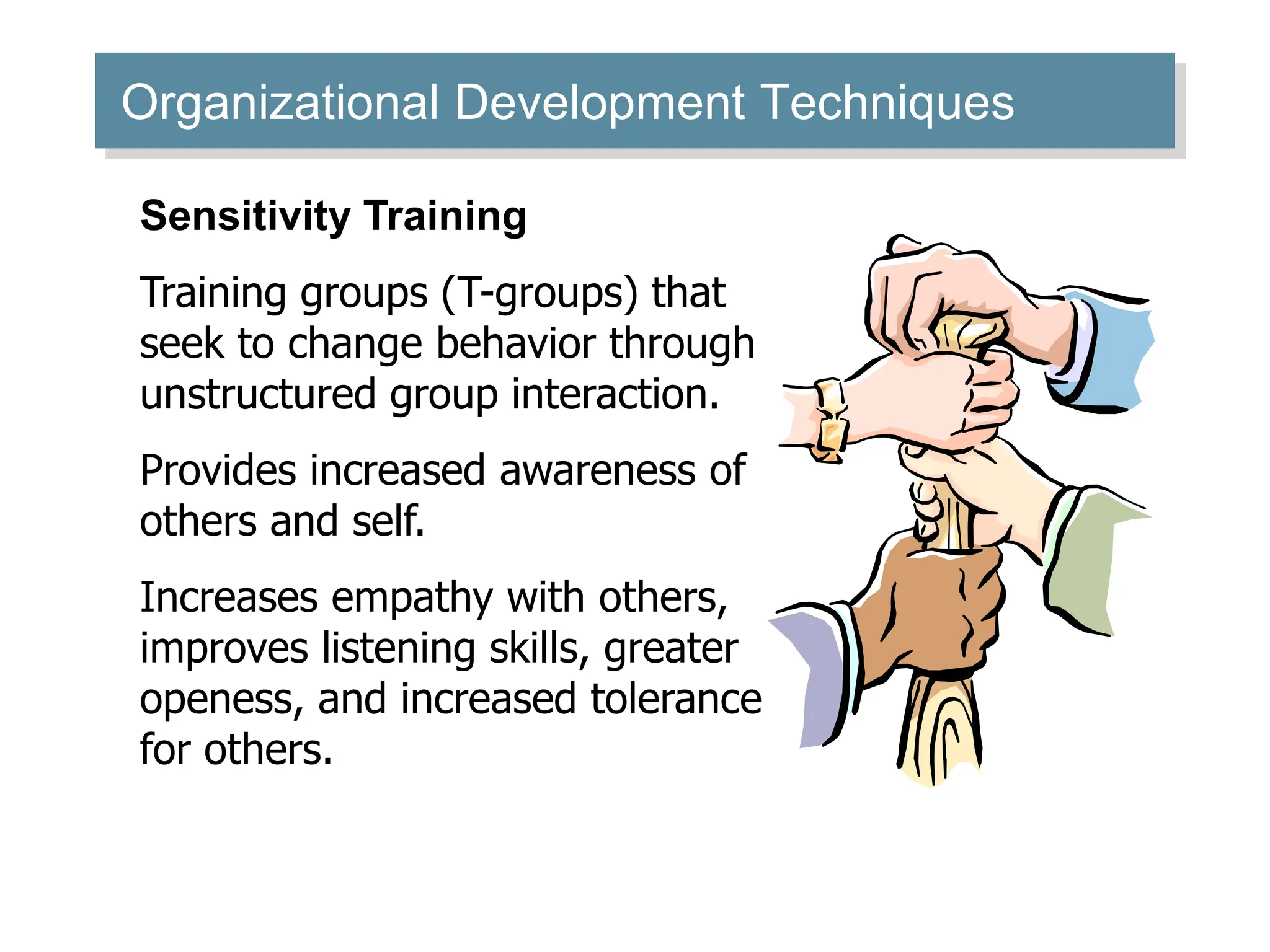
Sensitivity Training
Training groups (T-groups) that
seek to change behavior through
unstructured group interaction.
Provides increased awareness of
others and self.
Increases empathy with others,
improves listening skills, greater
openess, and increased tolerance
for others.
Organizational Development Techniques
(cont’d)
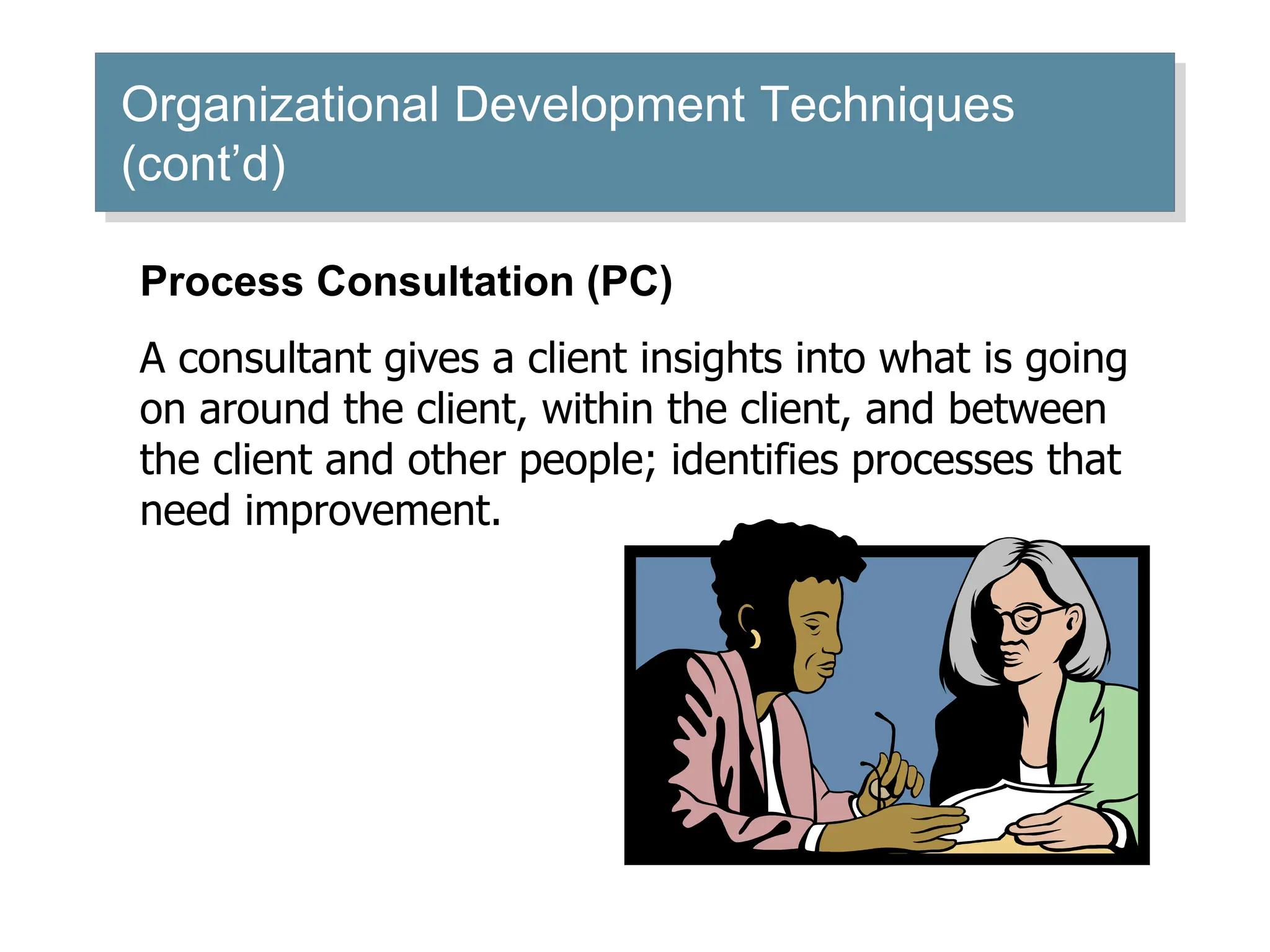
Process Consultation (PC)
A consultant gives a client insights into what is going
on around the client, within the client, and between
the client and other people; identifies processes that
need improvement.
Organizational Development Techniques
(cont’d)
Team Building Activities:
• Goal and priority setting.
• Developing interpersonal relations.
• Role analysis to each member’s role and
responsibilities.
• Team process analysis.
Team Building
High interaction among team members to
increase trust and openness.
Contemporary Change Issues for Today’s
Managers: Stimulating Innovation (cont’d)
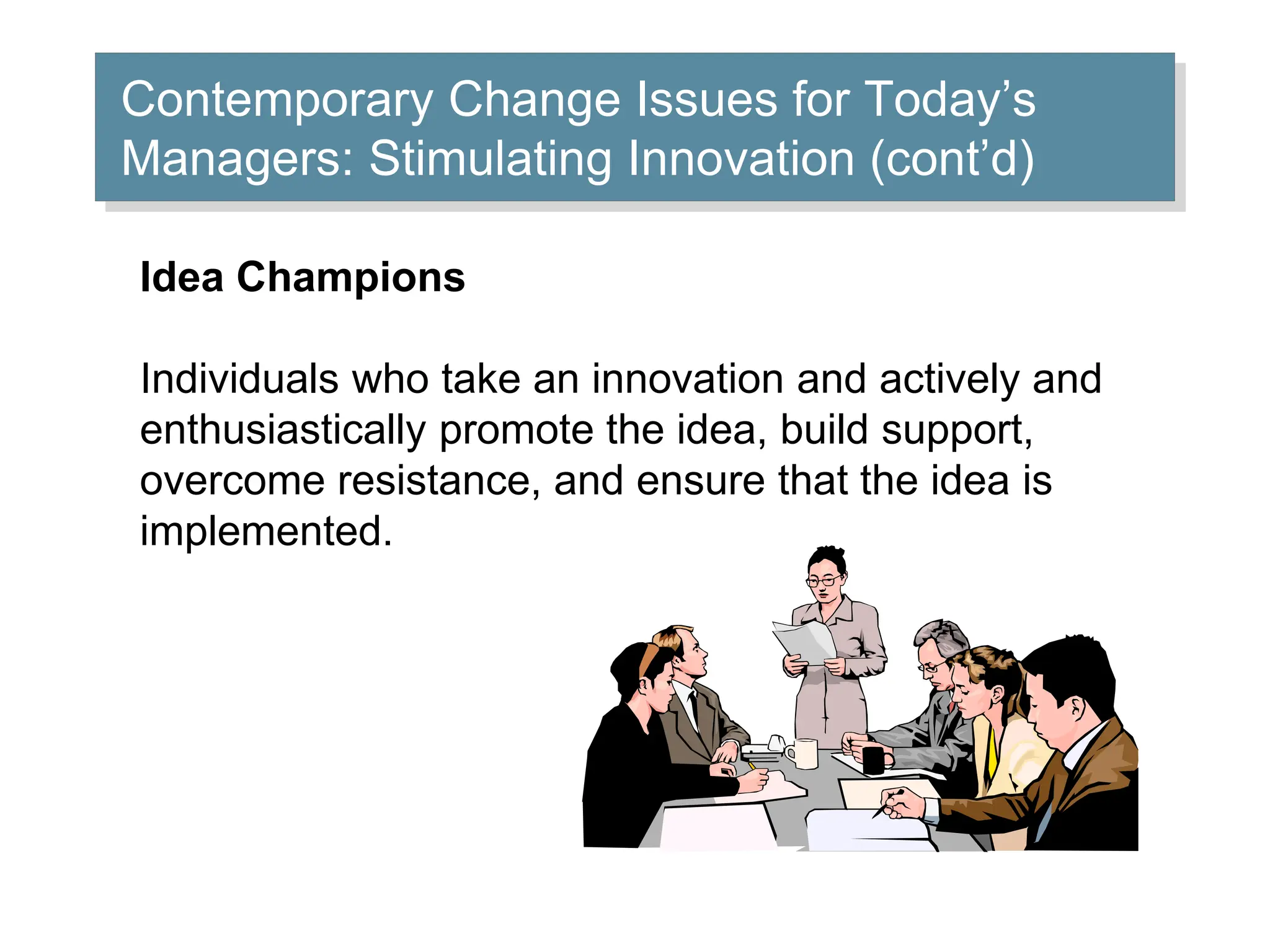
Idea Champions
Individuals who take an innovation and actively and
enthusiastically promote the idea, build support,
overcome resistance, and ensure that the idea is
implemented.
Creating a Learning Organization
Characteristics:
1. Holds a shared vision
2. Discards old ways of
thinking.
3. Views organization as
system of relationships.
4. Communicates openly.
5. Works together to
achieve shared vision.
Learning Organization
An organization that has
developed the continuous
capacity to adapt and
change.
Source: Based on P. M. Senge, The Fifth Discipline (New York: Doubleday, 1990).
Creating a Learning Organization
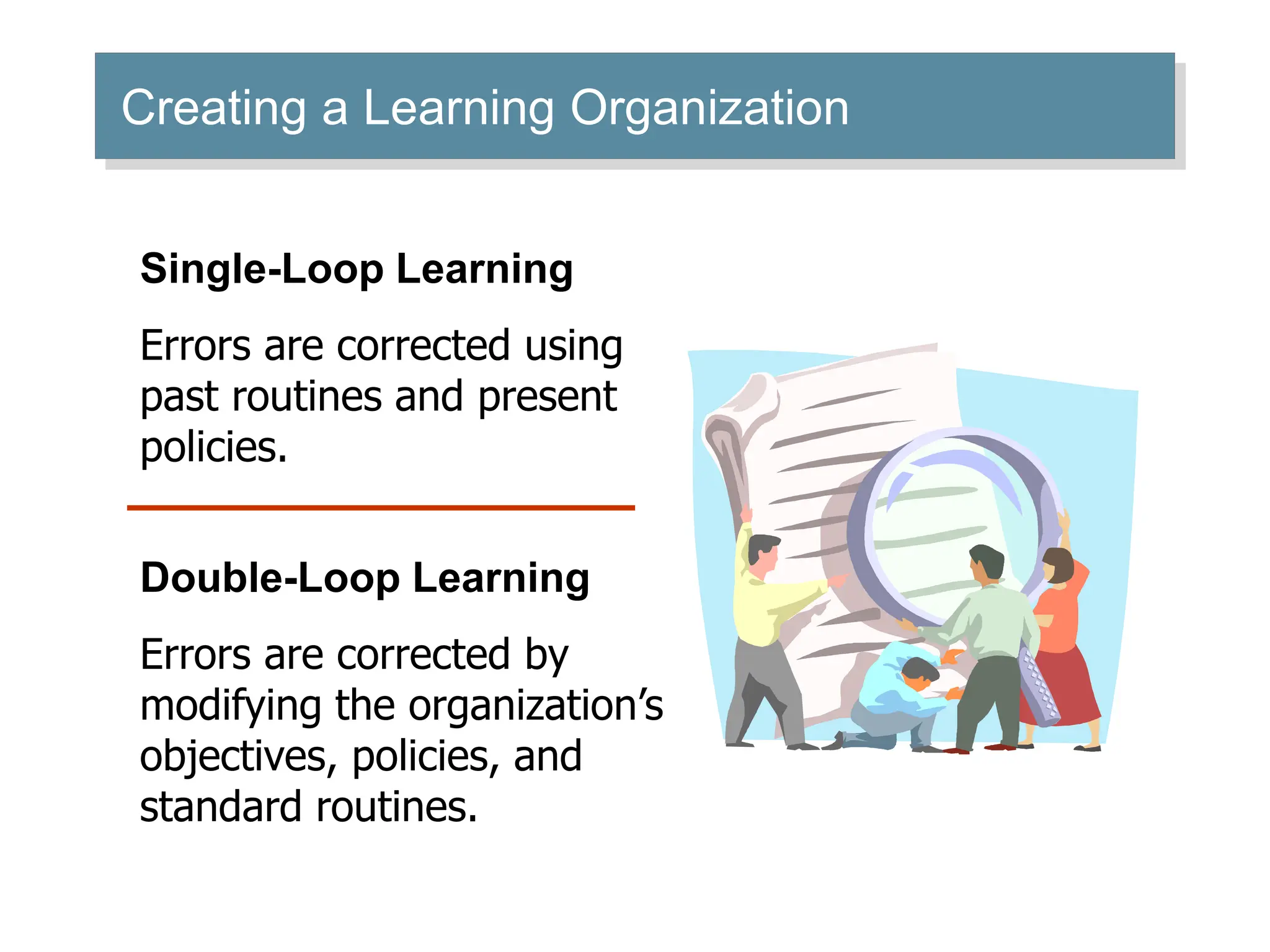
Single-Loop Learning
Errors are corrected using
past routines and present
policies.
Double-Loop Learning
Errors are corrected by
modifying the organization’s
objectives, policies, and
standard routines.
© 2005 Prentice Hall Inc. All rights reserved. 18–30
A Model of Stress
© 2005 Prentice Hall Inc. All rights reserved. 18–31
Managing Stress
➢ Individual Approaches
– Implementing time management
– Increasing physical exercise
– Relaxation training
– Expanding social support network
© 2005 Prentice Hall Inc. All rights reserved. 18–32
Managing Stress
➢ Organizational Approaches
– Improved personnel selection and job placement
– Training
– Use of realistic goal setting
– Redesigning of jobs
– Increased employee involvement
– Improved organizational communication
– Offering employee sabbaticals
– Establishment of corporate wellness programs
© 2005 Prentice Hall Inc. All rights reserved. 18–33
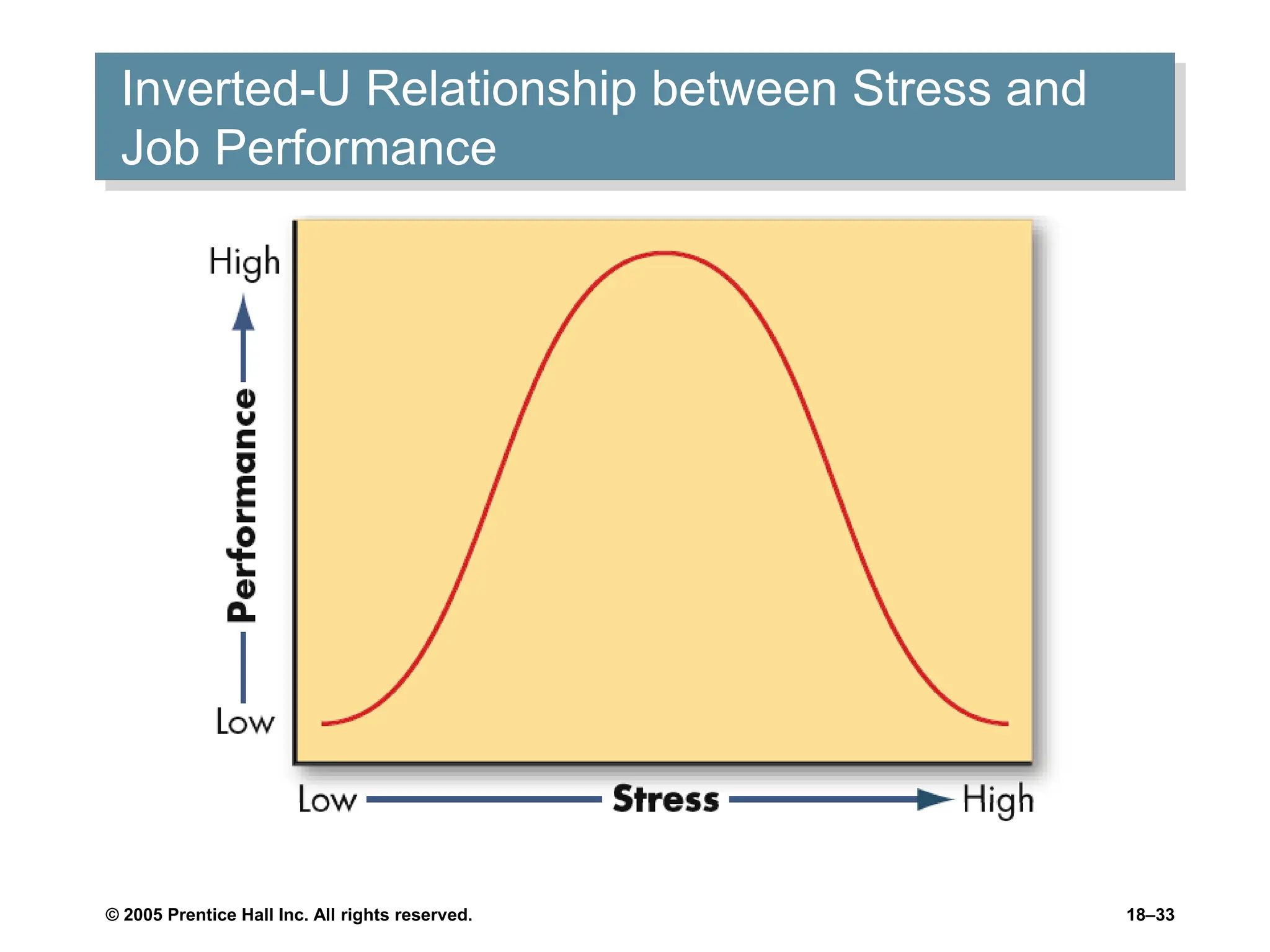
Inverted-U Relationship between Stress and
Job Performance

Organizational Change in Organizational Behaviour.pdf

  • 1.
    ORGANIZATIONAL BEHAVIOR S TE P H E N P. R O B B I N S E L E V E N T H E D I T I O N W W W . P R E N H A L L . C O M / R O B B I N S © 2005 Prentice Hall Inc. All rights reserved. PowerPoint Presentation by Charlie Cook Organizational Change and Stress Management TWELFTH EDITION
  • 2.
    Organization Change ➢ Organizationalchange is the process through which an organisation moves from the present state to an improved state. ➢ Change management comprises three elements: evolution of the firm, its management and organization, and the people who work for it. ➢ Three levels of change are observed: individual level, group level, and organisations.
  • 3.
    Nature of Change »vital if a company were to avoid stagnation; » a process and not an event; » normal and constant; » fast and is likely to increase further in the present competitive business; » ‘directive’, that is, implemented by ‘top down’ management or ‘participative’, that is, involving those parties impacted by change; » is ‘natural’, that is, evolutionary or ‘adaptive’, that is, a reaction to external circumstances and pressures; » is ‘incremental’, that is continuous small changes or ‘step’, that is, radical shift from current to new processes; and » is interdependent on organizational environment or culture.3
  • 4.
    18–3 Forces for Change ForceExamples Nature of the workforce More cultural diversity Aging population Many new entrants with inadequate skills Technology Faster, cheaper, and more mobile computers On-line music sharing Deciphering of the human genetic code Economic shocks Rise and fall of dot-com stocks 2000–02 stock market collapse Covid 19 Record low interest rates Competition Global competitors Mergers and consolidations Growth of e-commerce
  • 5.
    Forces for Change ForceExamples Social trends Internet chat rooms Retirement of Baby Boomers Rise in discount and “big box” retailers World politics Iraq–U.S. war Ukraine- Russia war Opening of markets in China War on terrorism following 9/11/01
  • 6.
    Types of change ➢Evolutionary change and revolutionary change ➢ Reactive change & proactive change
  • 7.
    Managing Planned Change Goalsof Planned Change: Improving the ability of the organization to adapt to changes in its environment. Changing the behavior of individuals and groups in the organization. Change Making things different. Planned Change Activities that are intentional and goal oriented. Change Agents Persons who act as catalysts and assume the responsibility for managing change activities.
  • 8.
    Resistance to Change Formsof Resistance to Change – Overt and immediate • Voicing complaints, engaging in job actions – Implicit and deferred • Loss of employee loyalty and motivation, increased errors or mistakes, increased absenteeism • Deferred resistance clouds the link between source and reaction
  • 9.
  • 10.
    Sources of IndividualResistance to Change
  • 11.
    Sources of OrganizationalResistance to Change
  • 12.
    Overcoming Resistance toChange Tactics for dealing with resistance to change: • Education and communication • Participation • Facilitation and support • Negotiation • Manipulation and cooptation • Coercion
  • 13.
    Tactics for OvercomingResistance to Change ➢ Education and Communication – Show those effected the logic behind the change ➢ Participation – Participation in the decision process lessens resistance ➢ Building Support and Commitment – Counseling, therapy, or new-skills training ➢ Implementing Change Fairly – Be consistent and procedurally fair ➢ Manipulation and Cooptation – “Spinning” the message to gain cooperation ➢ Selecting people who accept change – Hire people who enjoy change in the first place ➢ Coercion – Direct threats and force
  • 14.
    Six Methods forDealing With Resistance to Change
  • 15.
    The Politics ofChange ➢ Impetus for change is likely to come from outside change agents. ➢ Internal change agents are most threatened by their loss of status in the organization. ➢ Long-time power holders tend to implement only incremental change. ➢ The outcomes of power struggles in the organization will determine the speed and quality of change.
  • 16.
    Lewin’s Three-Step ChangeModel Unfreezing Change efforts to overcome the pressures of both individual resistance and group conformity. Refreezing Stabilizing a change intervention by balancing driving and restraining forces. Driving Forces Forces that direct behavior away from the status quo. Restraining Forces Forces that hinder movement from the existing equilibrium.
  • 17.
  • 19.
    Case of Kodak Caselet:Kodak's Digital Revolution Challenge Once an industry leader known for revolutionizing photography with its film-based products, Kodak now finds itself at a crossroads in the digital era. The advent of digital photography has disrupted the traditional film-based business model, forcing Kodak to confront the need for a profound organizational change. The leadership, led by CEO Michael Reynolds, recognizes the urgency to transform Kodak and ensure its relevance in the digital age. Question: • How does Kodak plan to align its digital transformation strategy with the evolving needs and preferences of consumers in the digital photography market, and what steps will be taken to ensure a seamless transition from film-based to digital products?
  • 20.
  • 21.
    Kotter’s Eight-Step Planfor Implementing Change 1. Establish a sense of urgency by creating a compelling reason for why change is needed. 2. Form a coalition with enough power to lead the change. 3. Create a new vision to direct the change and strategies for achieving the vision. 4. Communicate the vision throughout the organization. 5. Empower others to act on the vision by removing barriers to change and encouraging risk taking and creative problem solving. 6. Plan for, create, and reward short-term “wins” that move the organization toward the new vision. 7. Consolidate improvements, reassess changes, and make necessary adjustments in the new programs. 8. Reinforce the changes by demonstrating the relationship between new behaviors and organizational success.
  • 22.
    Kotter’s Eight-Step Plan ➢Builds from Lewin’s Model ➢ To implement change: 1. Establish a sense of urgency 2. Form a coalition 3. Create a new vision 4. Communicate the vision 5. Empower others by removing barriers 6. Create and reward short-term “wins” 7. Consolidate, reassess, and adjust 8. Reinforce the changes Unfreezing Movement Refreezing
  • 23.
    Action Research Process Steps: 1.Diagnosis 2. Analysis 3. Feedback 4. Action 5. Evaluation Action research benefits: Problem-focused rather than solution-centered. Heavy employee involvement reduces resistance to change. Action Research A change process based on systematic collection of data and then selection of a change action based on what the analyzed data indicate.
  • 24.
    Organizational Development OD Values: 1.Respect for people 2. Trust and support 3. Power equalization 4. Confrontation 5. Participation Organizational Development (OD) A collection of planned interventions, built on humanistic-democratic values, that seeks to improve organizational effectiveness and employee well-being.
  • 25.
    Organizational Development Techniques SensitivityTraining Training groups (T-groups) that seek to change behavior through unstructured group interaction. Provides increased awareness of others and self. Increases empathy with others, improves listening skills, greater openess, and increased tolerance for others.
  • 26.
    Organizational Development Techniques (cont’d) ProcessConsultation (PC) A consultant gives a client insights into what is going on around the client, within the client, and between the client and other people; identifies processes that need improvement.
  • 27.
    Organizational Development Techniques (cont’d) TeamBuilding Activities: • Goal and priority setting. • Developing interpersonal relations. • Role analysis to each member’s role and responsibilities. • Team process analysis. Team Building High interaction among team members to increase trust and openness.
  • 28.
    Contemporary Change Issuesfor Today’s Managers: Stimulating Innovation (cont’d) Idea Champions Individuals who take an innovation and actively and enthusiastically promote the idea, build support, overcome resistance, and ensure that the idea is implemented.
  • 29.
    Creating a LearningOrganization Characteristics: 1. Holds a shared vision 2. Discards old ways of thinking. 3. Views organization as system of relationships. 4. Communicates openly. 5. Works together to achieve shared vision. Learning Organization An organization that has developed the continuous capacity to adapt and change. Source: Based on P. M. Senge, The Fifth Discipline (New York: Doubleday, 1990).
  • 30.
    Creating a LearningOrganization Single-Loop Learning Errors are corrected using past routines and present policies. Double-Loop Learning Errors are corrected by modifying the organization’s objectives, policies, and standard routines.
  • 31.
    © 2005 PrenticeHall Inc. All rights reserved. 18–30 A Model of Stress
  • 32.
    © 2005 PrenticeHall Inc. All rights reserved. 18–31 Managing Stress ➢ Individual Approaches – Implementing time management – Increasing physical exercise – Relaxation training – Expanding social support network
  • 33.
    © 2005 PrenticeHall Inc. All rights reserved. 18–32 Managing Stress ➢ Organizational Approaches – Improved personnel selection and job placement – Training – Use of realistic goal setting – Redesigning of jobs – Increased employee involvement – Improved organizational communication – Offering employee sabbaticals – Establishment of corporate wellness programs
  • 34.
    © 2005 PrenticeHall Inc. All rights reserved. 18–33 Inverted-U Relationship between Stress and Job Performance