9-1
9-2
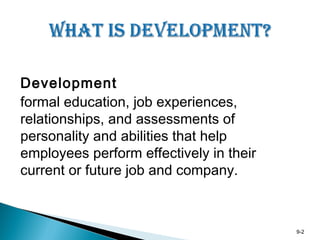
Development
formal education, job experiences,
relationships, and assessments of
personality and abilities that help
employees perform effectively in their
current or future job and company.
9-3
9-4
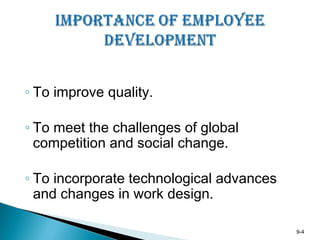
◦ To improve quality.
◦ To meet the challenges of global
competition and social change.
◦ To incorporate technological advances
and changes in work design.
9-5
 Development activities can help companies
reduce turnover by:
◦ showing employees that the company is investing in
the employees’ skill development.
◦ developing managers who can create a positive work
environment that makes employees want to come to
work and contribute to the company goals.
9-6
 Formal education programs include:
◦ off-site and on-site programs designed specifically for the
company’s employees.
◦ short courses offered by consultants or universities,
executive MBA programs, and university programs.
 Tuition reimbursement - the practice of
reimbursing employees’ costs for college and
university courses and degree programs.
9-7
 Assessment
◦ Collecting information and providing feedback to
employees about their behavior, communication style,
values, or skills.
◦ Used most frequently to identify employees with
managerial potential, and measure current managers’
strengths and weaknesses.
◦ Companies vary in the methods and sources of information
they use in developmental assessment.
9-8
 Myers-Briggs Type Indicator (MBTI)
◦ Most popular psychological test for employee
development.
◦ Identifies individuals’ preferences for energy,
information gathering, decision making, and lifestyle.
◦ It is a valuable tool for understanding communication
styles and the ways people prefer to interact with
others.
9-9
 Assessment center - multiple raters or
evaluators evaluate employees’ performance on a
number of exercises.
◦ It is used to identify:
 if employees have the abilities, personality, and behaviors for
management jobs.
 if employees have the necessary skills to work in teams.
◦ Types of exercises used include leaderless group
discussions, interviews, in-baskets, and role plays.
9-10
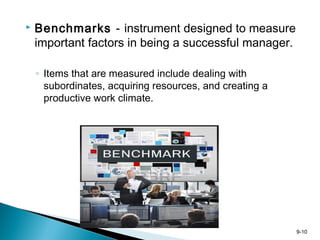
 Benchmarks - instrument designed to measure
important factors in being a successful manager.
◦ Items that are measured include dealing with
subordinates, acquiring resources, and creating a
productive work climate.
9-11
 Performance appraisal - process of measuring
employees’ performance.
◦ Different approaches for measuring performance:
 Ranking employees.
 Rating their work behaviors.
 Rating the extent to which employees have desirable traits
believed to be necessary for job success.
◦ The appraisal system must give employees specific
information about their performance problems and ways
they can improve their performance.
◦ Managers must be trained in providing performance
feedback.
9-12
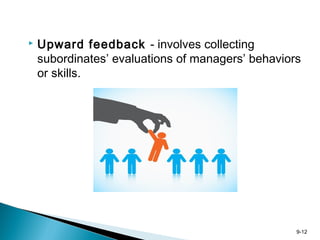
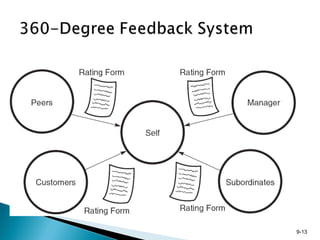
 Upward feedback - involves collecting
subordinates’ evaluations of managers’ behaviors
or skills.
9-13
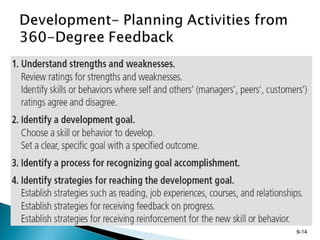
9-14
9-15
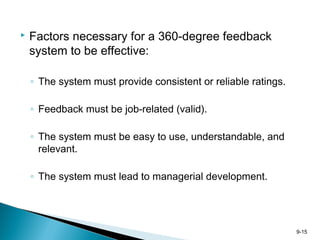
 Factors necessary for a 360-degree feedback
system to be effective:
◦ The system must provide consistent or reliable ratings.
◦ Feedback must be job-related (valid).
◦ The system must be easy to use, understandable, and
relevant.
◦ The system must lead to managerial development.
9-16
Job Experiences
relationships, problems, demands, tasks, or other
features that employees face in their jobs.
◦ A major assumption is that development is most likely to
occur when there is a mismatch between the
employee’s skills and past experiences and the skills
required for the job.
9-17
9-18
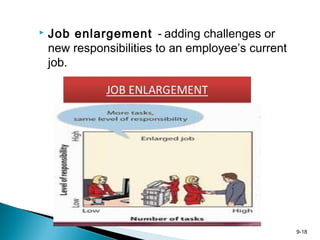
 Job enlargement - adding challenges or
new responsibilities to an employee’s current
job.
9-19
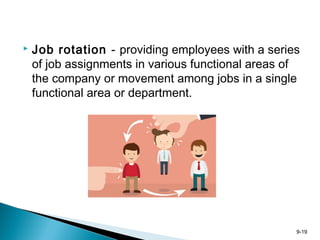
 Job rotation - providing employees with a series
of job assignments in various functional areas of
the company or movement among jobs in a single
functional area or department.
9-20
 Job rotation is used to develop skills as well as give
employees experience needed for managerial positions

Employees understand specific skills that will be
developed by rotation
 Job rotation is used for all levels and types of
employees
 All employees have equal opportunities for job rotation
assignments
9-21

Job rotation is linked with the career
management process so employees know the
development needs addressed by each job
assignment

Benefits of rotation are maximized and costs
are minimized through managing time of
rotations to reduce workload costs

and help employees understand job rotation’s
role in their development plans
9-22
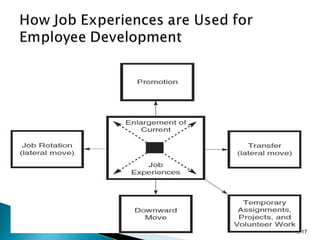
 Transfer - an employee is given a different job
assignment in a different area of the company.
 Promotions - advancements into positions with
greater challenges, more responsibility, and more
authority than in the previous job.
 Downward move - occurs when an employee is
given a reduced level of responsibility and
authority.
9-23
 Externships - employees take full-time,
temporary operational roles at another company.
 Employee exchange is one example of
temporary assignments in which two companies
agree to exchange employees.
9-24
 Volunteer assignments offer employees
opportunities to manage change, to teach, to take
on a higher level of responsibility, or to be exposed
to other job demands.
 Interpersonal relationships
◦ Mentor - experienced, productive senior employee who
helps develop a less experienced employee (the
protégé).
◦ Mentors provide career support and psychosocial support
to the protégé.
9-25
◦ Provide opportunities for mentors to:
Develop interpersonal skills, increase feelings
of self-esteem and worth to the organization,
and gain knowledge about important new
scientific developments.
9-26
 Interpersonal relationships
◦ Purposes of Mentoring Programs
 To socialize new employees and to increase the likelihood of
skill transfer from training to the work setting.
 To enable women and minorities to gain the experience and
skills needed for managerial positions.
 To develop managers for top-level management positions or
to help them acquire specific skills.
◦ Group mentoring programs - successful senior
employee is paired with four to six less experienced
protégés.
9-27
 Interpersonal relationships
Coach - a peer or manager who works with employees to
motivate them, help them develop skills, and provide
reinforcement and feedback.
The best coaches are empathetic, supportive, practical, and
self-confident but do not appear to know all the answers or want
to tell others what to do.
9-28
 Interpersonal relationships
◦ Three roles that a coach can play:
 One-on-one with an employee, providing feedback based on
psychological tests, 360-degree assessment, or interviews
with bosses, peers, and subordinates.
 Help employees learn for themselves by putting them in
touch with experts who can help them with their concerns
and by teaching them how to obtain feedback from others.
 Provide the employee with resources such as mentors,
courses, or job experiences that the employee may not
otherwise have access to.
9-29
 It involves:
◦ identifying development needs.
◦ choosing a development goal.
◦ identifying the actions that need to be taken by the
employee and the company to achieve the goal.
◦ determining how progress toward goal attainment will be
measured.
◦ investing time and energy to achieve the goal.
◦ establishing a timetable for development.
9-30
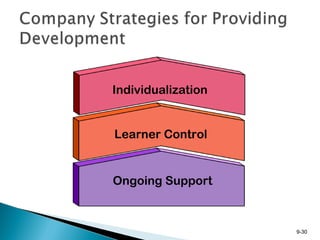
Individualization
Learner Control
Ongoing Support

Employee development

  • 1.
  • 2.
    9-2 Development formal education, jobexperiences, relationships, and assessments of personality and abilities that help employees perform effectively in their current or future job and company.
  • 3.
  • 4.
    9-4 ◦ To improvequality. ◦ To meet the challenges of global competition and social change. ◦ To incorporate technological advances and changes in work design.
  • 5.
    9-5  Development activitiescan help companies reduce turnover by: ◦ showing employees that the company is investing in the employees’ skill development. ◦ developing managers who can create a positive work environment that makes employees want to come to work and contribute to the company goals.
  • 6.
    9-6  Formal educationprograms include: ◦ off-site and on-site programs designed specifically for the company’s employees. ◦ short courses offered by consultants or universities, executive MBA programs, and university programs.  Tuition reimbursement - the practice of reimbursing employees’ costs for college and university courses and degree programs.
  • 7.
    9-7  Assessment ◦ Collectinginformation and providing feedback to employees about their behavior, communication style, values, or skills. ◦ Used most frequently to identify employees with managerial potential, and measure current managers’ strengths and weaknesses. ◦ Companies vary in the methods and sources of information they use in developmental assessment.
  • 8.
    9-8  Myers-Briggs TypeIndicator (MBTI) ◦ Most popular psychological test for employee development. ◦ Identifies individuals’ preferences for energy, information gathering, decision making, and lifestyle. ◦ It is a valuable tool for understanding communication styles and the ways people prefer to interact with others.
  • 9.
    9-9  Assessment center- multiple raters or evaluators evaluate employees’ performance on a number of exercises. ◦ It is used to identify:  if employees have the abilities, personality, and behaviors for management jobs.  if employees have the necessary skills to work in teams. ◦ Types of exercises used include leaderless group discussions, interviews, in-baskets, and role plays.
  • 10.
    9-10  Benchmarks -instrument designed to measure important factors in being a successful manager. ◦ Items that are measured include dealing with subordinates, acquiring resources, and creating a productive work climate.
  • 11.
    9-11  Performance appraisal- process of measuring employees’ performance. ◦ Different approaches for measuring performance:  Ranking employees.  Rating their work behaviors.  Rating the extent to which employees have desirable traits believed to be necessary for job success. ◦ The appraisal system must give employees specific information about their performance problems and ways they can improve their performance. ◦ Managers must be trained in providing performance feedback.
  • 12.
    9-12  Upward feedback- involves collecting subordinates’ evaluations of managers’ behaviors or skills.
  • 13.
  • 14.
  • 15.
    9-15  Factors necessaryfor a 360-degree feedback system to be effective: ◦ The system must provide consistent or reliable ratings. ◦ Feedback must be job-related (valid). ◦ The system must be easy to use, understandable, and relevant. ◦ The system must lead to managerial development.
  • 16.
    9-16 Job Experiences relationships, problems,demands, tasks, or other features that employees face in their jobs. ◦ A major assumption is that development is most likely to occur when there is a mismatch between the employee’s skills and past experiences and the skills required for the job.
  • 17.
  • 18.
    9-18  Job enlargement- adding challenges or new responsibilities to an employee’s current job.
  • 19.
    9-19  Job rotation- providing employees with a series of job assignments in various functional areas of the company or movement among jobs in a single functional area or department.
  • 20.
    9-20  Job rotationis used to develop skills as well as give employees experience needed for managerial positions  Employees understand specific skills that will be developed by rotation  Job rotation is used for all levels and types of employees  All employees have equal opportunities for job rotation assignments
  • 21.
    9-21  Job rotation islinked with the career management process so employees know the development needs addressed by each job assignment  Benefits of rotation are maximized and costs are minimized through managing time of rotations to reduce workload costs  and help employees understand job rotation’s role in their development plans
  • 22.
    9-22  Transfer -an employee is given a different job assignment in a different area of the company.  Promotions - advancements into positions with greater challenges, more responsibility, and more authority than in the previous job.  Downward move - occurs when an employee is given a reduced level of responsibility and authority.
  • 23.
    9-23  Externships -employees take full-time, temporary operational roles at another company.  Employee exchange is one example of temporary assignments in which two companies agree to exchange employees.
  • 24.
    9-24  Volunteer assignmentsoffer employees opportunities to manage change, to teach, to take on a higher level of responsibility, or to be exposed to other job demands.  Interpersonal relationships ◦ Mentor - experienced, productive senior employee who helps develop a less experienced employee (the protégé). ◦ Mentors provide career support and psychosocial support to the protégé.
  • 25.
    9-25 ◦ Provide opportunitiesfor mentors to: Develop interpersonal skills, increase feelings of self-esteem and worth to the organization, and gain knowledge about important new scientific developments.
  • 26.
    9-26  Interpersonal relationships ◦Purposes of Mentoring Programs  To socialize new employees and to increase the likelihood of skill transfer from training to the work setting.  To enable women and minorities to gain the experience and skills needed for managerial positions.  To develop managers for top-level management positions or to help them acquire specific skills. ◦ Group mentoring programs - successful senior employee is paired with four to six less experienced protégés.
  • 27.
    9-27  Interpersonal relationships Coach- a peer or manager who works with employees to motivate them, help them develop skills, and provide reinforcement and feedback. The best coaches are empathetic, supportive, practical, and self-confident but do not appear to know all the answers or want to tell others what to do.
  • 28.
    9-28  Interpersonal relationships ◦Three roles that a coach can play:  One-on-one with an employee, providing feedback based on psychological tests, 360-degree assessment, or interviews with bosses, peers, and subordinates.  Help employees learn for themselves by putting them in touch with experts who can help them with their concerns and by teaching them how to obtain feedback from others.  Provide the employee with resources such as mentors, courses, or job experiences that the employee may not otherwise have access to.
  • 29.
    9-29  It involves: ◦identifying development needs. ◦ choosing a development goal. ◦ identifying the actions that need to be taken by the employee and the company to achieve the goal. ◦ determining how progress toward goal attainment will be measured. ◦ investing time and energy to achieve the goal. ◦ establishing a timetable for development.
  • 30.