DESIGNING
AND
MANAGING SERVICES
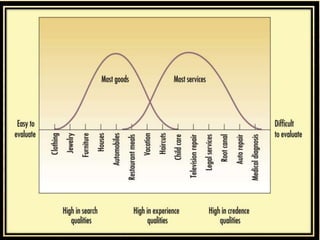
THE NATURE OF SERVICES
A Services is any act or Performance one party
can offer to another is essentially intangible and
does not result in the ownership of anything.
The government sector with its courts,
employment services, loan, agencies, military
services, police and fire departments, Private non-
profit sector museum, charities, colleges.
CATEGORIES OF SERVICES MIX
1. Pure tangible good –
soap, toothpaste salt with no accompanying
services.
2. Tangible good with accompanying services –
car, computer cell phone , more technological advanced
product .
3. Hybrid - An offering like a restaurant meal of equal parts of
goods and services.
4. Major services with accompanying a minor goods and services
- major services , like air travel with additional services such as
snacks and drinks.
5. Pure services – intangible services , like babysitting ,
psychotherapy , massage.
DISTINCTIVE CHARACTERISTICS OF
SERVICES
4 characteristics greatly affect the design
of marketing programs .
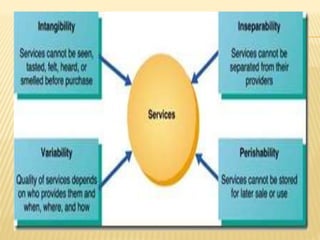
1. Intangibility
2. Inseparability
3. Variability
4. Perishability
1. INTANGIBILITY
1. Place –
The Exterior and interior should have clean lines.
2.People-
Should sufficient number of employee to manage
workload.
3. Equipment-
Computers , copy ATMs should look like and be state
of the art.
4. Communication material –
Printed materials , text and photo should suggest
efficiency and speed.
5.symbols –
Bank’s name & symbol could suggest fast services.
6.Price- bank could advertise.
2. SERVICE INSEPARABILITY
 The customer is present when the
services is produced.
 means that services cannot be separated
from their both (1) providers and (2) other
customers.
 If a service employee provides the service,
then the employee is part of the service.
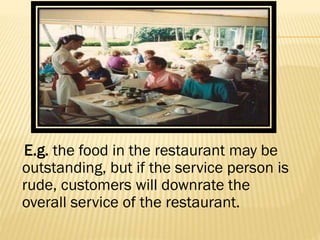
E.g. the food in the restaurant may be
outstanding, but if the service person is
rude, customers will downrate the
overall service of the restaurant.
3. SERVICE VARIABILITY
 Service providers vary with respect to attitudes,
skills, mood, etc. Even the same provider may give
different service on a different day.
 Quality control is critical:
 Hiring the right people
 Standardizing service
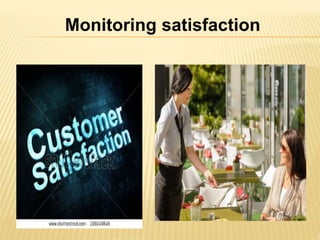
 Monitoring satisfaction
Hiring the right people
Eg. Recruiting right
employee
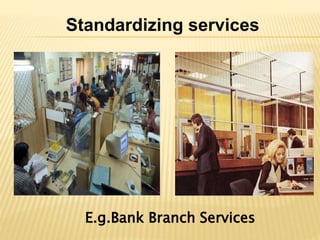
Standardizing services
E.g.Bank Branch Services
Monitoring satisfaction
4.SERVICE PERISHABILITY
 Services can not be inventoried or
otherwise stored.
 Capacity / demand management is
critical:
– Demand side strategies
– Supply side strategies
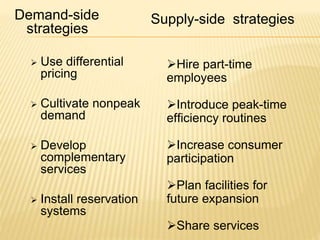
Demand-side
strategies
 Use differential
pricing
 Cultivate nonpeak
demand
 Develop
complementary
services
 Install reservation
systems
Supply-side strategies
Hire part-time
employees
Introduce peak-time
efficiency routines
Increase consumer
participation
Plan facilities for
future expansion
Share services
THE NEW SERVICES REALITIES
 A Shifting Customer Relationship
1.CUSTOMER EMPOWERMENT
 Customers are becoming more sophisticated about
buying product-support services and are pressing
for “ unbundled services.”
 A person who has a good customer experience is
more likely to talk about it, someone who has a
bad experience will talk to more people.
One expert believes companies should,
(1) send an automated reply to tell customers
when a more complete answer will arrive (ideally
within24 hours),
(2) ensure the subject line always contains the
company name,
(3) make the message easy to scan for relevant
information, and
(4) give customers an easy way to respond with
follow up questions.
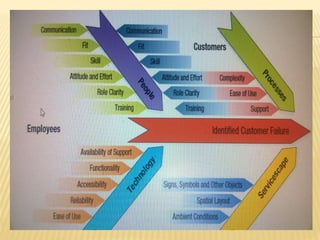
2.CUSTOMER COPRODUCTION
 customers do not merely purchase and use a service; they play
an active role in its delivery.
 words and actions affect the quality of their service experiences
and those of others, and the productivity of frontline employees.
 Cause of Customer failure:
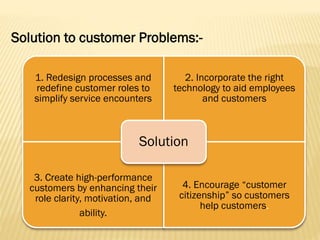
Solution to customer Problems:-
1. Redesign processes and
redefine customer roles to
simplify service encounters
2. Incorporate the right
technology to aid employees
and customers
3. Create high-performance
customers by enhancing their
role clarity, motivation, and
ability.
4. Encourage “customer
citizenship” so customers
help customers.
Solution
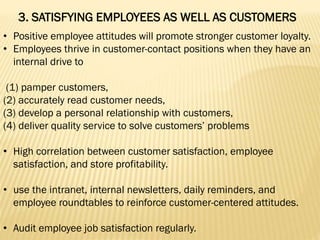
3. SATISFYING EMPLOYEES AS WELL AS CUSTOMERS
• Positive employee attitudes will promote stronger customer loyalty.
• Employees thrive in customer-contact positions when they have an
internal drive to
(1) pamper customers,
(2) accurately read customer needs,
(3) develop a personal relationship with customers,
(4) deliver quality service to solve customers’ problems
• High correlation between customer satisfaction, employee
satisfaction, and store profitability.
• use the intranet, internal newsletters, daily reminders, and
employee roundtables to reinforce customer-centered attitudes.
• Audit employee job satisfaction regularly.
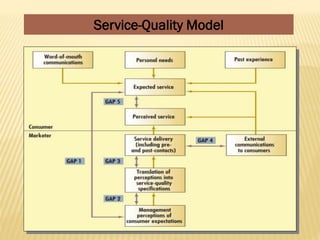
Managing Service Quality
• Perceived service
• Expected service
Marketing Strategies
for Service Firms
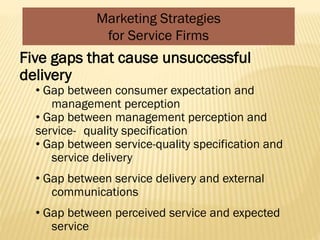
Five gaps that cause unsuccessful
delivery
• Gap between consumer expectation and
management perception
• Gap between management perception and
service- quality specification
• Gap between service-quality specification and
service delivery
• Gap between service delivery and external
communications
• Gap between perceived service and expected
service
Service-Quality Model
Marketing Strategies
for Service Firms
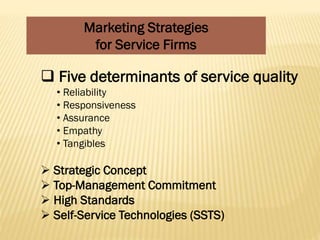
 Five determinants of service quality
• Reliability
• Responsiveness
• Assurance
• Empathy
• Tangibles
 Strategic Concept
 Top-Management Commitment
 High Standards
 Self-Service Technologies (SSTS)
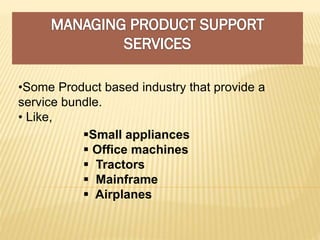
•Some Product based industry that provide a
service bundle.
• Like,
Small appliances
 Office machines
 Tractors
 Mainframe
 Airplanes
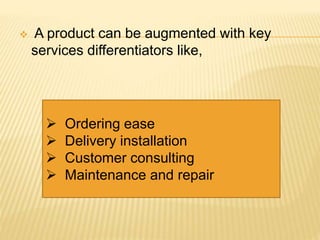
 A product can be augmented with key
services differentiators like,
 Ordering ease
 Delivery installation
 Customer consulting
 Maintenance and repair
 Manufacturer must identify the services the
customer value most and their relative
importance.
 In case of expensive equipments manufacturer
offer facilitating services such as,
- installation
- staff training
- maintenance and repair
- financing
- value augmenting services,that extends
beyonds the functioning and performance of the
product itself.
For ex- Johnson control
 A manufacturer can offer and charge for
product support service in different ways.
for e.g.
- Standard product plus basic level of services
- service contract
POSTSALE SERVICES
-After sales provide services
- Also eager to receive customer request suggestion
or even complains and handle them.
1. customer-service evolution:
Now-a-days manufacturer switch
more maintenance and repair services to
authorized distuributors and dealers thats are
close to the customers operate in more location
and can offer quicker services.
2. The customer-service imperative :
customer service choices are
increasing rapidly however, an equipment
manufacturerers increasingly must figure
out how to make money on their equipment
independent of service contract.
For ex- new cars warranties now cover 100000
k.m. Before services.

designing and managing service

  • 1.
  • 2.
    THE NATURE OFSERVICES A Services is any act or Performance one party can offer to another is essentially intangible and does not result in the ownership of anything. The government sector with its courts, employment services, loan, agencies, military services, police and fire departments, Private non- profit sector museum, charities, colleges.
  • 3.
    CATEGORIES OF SERVICESMIX 1. Pure tangible good – soap, toothpaste salt with no accompanying services. 2. Tangible good with accompanying services – car, computer cell phone , more technological advanced product . 3. Hybrid - An offering like a restaurant meal of equal parts of goods and services. 4. Major services with accompanying a minor goods and services - major services , like air travel with additional services such as snacks and drinks. 5. Pure services – intangible services , like babysitting , psychotherapy , massage.
  • 5.
    DISTINCTIVE CHARACTERISTICS OF SERVICES 4characteristics greatly affect the design of marketing programs . 1. Intangibility 2. Inseparability 3. Variability 4. Perishability
  • 6.
    1. INTANGIBILITY 1. Place– The Exterior and interior should have clean lines. 2.People- Should sufficient number of employee to manage workload. 3. Equipment- Computers , copy ATMs should look like and be state of the art. 4. Communication material – Printed materials , text and photo should suggest efficiency and speed. 5.symbols – Bank’s name & symbol could suggest fast services. 6.Price- bank could advertise.
  • 9.
    2. SERVICE INSEPARABILITY The customer is present when the services is produced.  means that services cannot be separated from their both (1) providers and (2) other customers.  If a service employee provides the service, then the employee is part of the service.
  • 10.
    E.g. the foodin the restaurant may be outstanding, but if the service person is rude, customers will downrate the overall service of the restaurant.
  • 11.
    3. SERVICE VARIABILITY Service providers vary with respect to attitudes, skills, mood, etc. Even the same provider may give different service on a different day.  Quality control is critical:  Hiring the right people  Standardizing service  Monitoring satisfaction
  • 12.
    Hiring the rightpeople Eg. Recruiting right employee
  • 13.
  • 14.
  • 15.
    4.SERVICE PERISHABILITY  Servicescan not be inventoried or otherwise stored.  Capacity / demand management is critical: – Demand side strategies – Supply side strategies
  • 17.
    Demand-side strategies  Use differential pricing Cultivate nonpeak demand  Develop complementary services  Install reservation systems Supply-side strategies Hire part-time employees Introduce peak-time efficiency routines Increase consumer participation Plan facilities for future expansion Share services
  • 18.
    THE NEW SERVICESREALITIES  A Shifting Customer Relationship 1.CUSTOMER EMPOWERMENT  Customers are becoming more sophisticated about buying product-support services and are pressing for “ unbundled services.”  A person who has a good customer experience is more likely to talk about it, someone who has a bad experience will talk to more people.
  • 19.
    One expert believescompanies should, (1) send an automated reply to tell customers when a more complete answer will arrive (ideally within24 hours), (2) ensure the subject line always contains the company name, (3) make the message easy to scan for relevant information, and (4) give customers an easy way to respond with follow up questions.
  • 20.
    2.CUSTOMER COPRODUCTION  customersdo not merely purchase and use a service; they play an active role in its delivery.  words and actions affect the quality of their service experiences and those of others, and the productivity of frontline employees.  Cause of Customer failure:
  • 23.
    Solution to customerProblems:- 1. Redesign processes and redefine customer roles to simplify service encounters 2. Incorporate the right technology to aid employees and customers 3. Create high-performance customers by enhancing their role clarity, motivation, and ability. 4. Encourage “customer citizenship” so customers help customers. Solution
  • 24.
    3. SATISFYING EMPLOYEESAS WELL AS CUSTOMERS • Positive employee attitudes will promote stronger customer loyalty. • Employees thrive in customer-contact positions when they have an internal drive to (1) pamper customers, (2) accurately read customer needs, (3) develop a personal relationship with customers, (4) deliver quality service to solve customers’ problems • High correlation between customer satisfaction, employee satisfaction, and store profitability. • use the intranet, internal newsletters, daily reminders, and employee roundtables to reinforce customer-centered attitudes. • Audit employee job satisfaction regularly.
  • 25.
    Managing Service Quality •Perceived service • Expected service
  • 26.
    Marketing Strategies for ServiceFirms Five gaps that cause unsuccessful delivery • Gap between consumer expectation and management perception • Gap between management perception and service- quality specification • Gap between service-quality specification and service delivery • Gap between service delivery and external communications • Gap between perceived service and expected service
  • 27.
  • 28.
    Marketing Strategies for ServiceFirms  Five determinants of service quality • Reliability • Responsiveness • Assurance • Empathy • Tangibles  Strategic Concept  Top-Management Commitment  High Standards  Self-Service Technologies (SSTS)
  • 29.
    •Some Product basedindustry that provide a service bundle. • Like, Small appliances  Office machines  Tractors  Mainframe  Airplanes
  • 30.
     A productcan be augmented with key services differentiators like,  Ordering ease  Delivery installation  Customer consulting  Maintenance and repair
  • 31.
     Manufacturer mustidentify the services the customer value most and their relative importance.  In case of expensive equipments manufacturer offer facilitating services such as, - installation - staff training - maintenance and repair - financing - value augmenting services,that extends beyonds the functioning and performance of the product itself. For ex- Johnson control
  • 32.
     A manufacturercan offer and charge for product support service in different ways. for e.g. - Standard product plus basic level of services - service contract
  • 33.
    POSTSALE SERVICES -After salesprovide services - Also eager to receive customer request suggestion or even complains and handle them. 1. customer-service evolution: Now-a-days manufacturer switch more maintenance and repair services to authorized distuributors and dealers thats are close to the customers operate in more location and can offer quicker services.
  • 34.
    2. The customer-serviceimperative : customer service choices are increasing rapidly however, an equipment manufacturerers increasingly must figure out how to make money on their equipment independent of service contract. For ex- new cars warranties now cover 100000 k.m. Before services.