SERVICES
MARKETING
CHAPTER 1
INTRODUCTION
HIGHLIGHTS
1. Definition of services Marketing
2. Characteristics of services
3. 8Ps of Services Marketing
4. Servuction Model (Service Experience)
OUTCOME
• Be able to illustrate, in detail, the principle variables
that differentiate marketing services with that of
product marketing
• Realise that the consumer’s contact of service
marketing is very much different from that of product
marketing
• Understand the unique challenges of doing marketing
for services
CONSIDER THIS….
• Services account for more than 60 percent of world’s
GDP
• Almost all economies have a substantial service sector
• Most new employment is provided by services
• Strongest growth area for marketing
DEFINITION OF SERVICES
MARKETING
• Are economic activities offered by one party to another in order
to exchange value
In exchange for their money, time, and effort, service customers expect to
obtain value from:
o Access to goods, labor, facilities, environments, professional
skills, networks, and systems
o But they do not normally take ownership of any of the physical
elements involved
DIFFERENCES BETWEEN SERVICES
MARKETING & PRODUCT MARKETING
• Marketing management tasks in the service sector
differ from those in the manufacturing sector
• The eight common differences are:
1. Most service products cannot be inventoried
2. Intangible elements usually dominate value creation
3. Services are often difficult to visualize and understand
4. Customers may be involved in co-production
5. People may be part of the service experience
6. Operational inputs and outputs tend to vary more widely
7. The time factor often assumes great importance
8. Distribution may take place through nonphysical channels
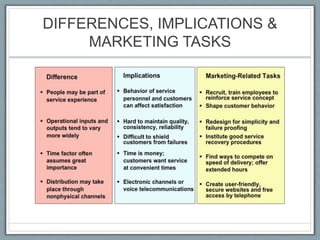
• What are the implications?
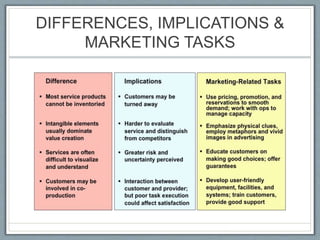
DIFFERENCES, IMPLICATIONS &
MARKETING TASKS
DIFFERENCES, IMPLICATIONS &
MARKETING TASKS
WHAT WE’VE LEARNT SO
FAR….
• Services are an integral part of business & marketing
• Requires a different approach than product-based
marketing
• Have unique implications on marketing management
END OF PART ONE
CHARACTERISTICS OF
SERVICES
• Four characteristics:
1. Intangibility
2. Perishability
3. Inseparability
4. Variability/Heterogeneity
• Requires unique strategies to overcome these
shortcomings
CHARACTERISTICS OF
SERVICES
 Intangibility
o Lack of tangible assets which can be seen, touched, smelled,
heard or tasted prior to purchase
o However, there are tangible items used to perform the service
o Ex: college education-there are physical structure such as
classrooms
STRATEGIES
i) Stressing tangible cues
ii) Using personal sources of information
iii) Stimulating word of mouth communication
iv) Creating a strong corporate image
v) Encouraging employees to communicate with customers
CHARACTERISTICS OF
SERVICES
 Perishability
o The service cannot be inventoried or stored
o Ex: to maximize revenue, airlines wants to fill every seat in an
airplane. The same is true for sporting events and concerts
STRATEGIES
i) Simultaneous adjustments in demand, supply and capacity
(demand equal supply will equal capacity)
 Ex: cinema/movie-adjusting demand is to move some of the
demand from the high peak showings to nonpeak
 Or reducing the price in the nonpeak showings
 Or multiple showings of the popular movies during high peak
 Or to increase capacity, show popular movie in more mini
theaters at the same time
CHARACTERISTICS OF
SERVICES
 Inseparability
o The simultaneous production and consumption of services
o Goods can be produced and then sold at a later time,
services cannot
 Ex: getting medical services involves a doctor or a dentist performing
an examination or procedure while the customer is present
o Quality of the service is highly dependent on:
 The ability of the service provider
 The quality of interaction between the service provider and the
customer
STRATEGIES
i) Look for ways to automate their service through use of
machines and computers
 Ex: Cash deposit, Maybank2U
ii) Emphasize selection and training of its employees and
service provider
iii) Should have a process to manage their customers
iv) Open multiple sites
CHARACTERISTICS OF
SERVICES
 Variability/Heterogeneity
o Refers to unwanted or random levels of service quality
customers receive when they patronize a service
o The outcome will differ if the firm uses different employees
each time a business is serviced
o Because of the variability characteristics of services,
standardization and quality control are more difficult
STRATEGIES
i) Industrialize their operations
ii) Mass producing product in advance, more customers can
be served during peak demand
iii) Employees are also trained to follow a specific procedure
END OF PART TWO
SERVICES REQUIRES AN
EXPANDED MARKETING MIX
• Marketing can be viewed as:
• A strategic and competitive thrust pursued by top management
• A set of functional activities performed by line managers
• A customer-driven orientation for the entire organization
• Marketing is the only function to bring operating revenues into a
business; all other functions are cost centers
• The “8Ps” of services marketing are needed to create viable
strategies for meeting customer needs profitably in a competitive
marketplace
THE 8Ps OF SERVICES
MARKETING
1. Product
2. Place
3. Price
4. Promotion and Education
5. Process
6. Physical Environment
7. People
8. Productivity and Quality
PRODUCT
• Embrace all aspects of service performance that create value
• Core product responds to customer’s primary need
• Array of supplementary service elements
 Help customer use core product effectively
 Add value through useful enhancements
• Planning marketing mix begins with creating a service
concept that:
 Will offer value to target customers
 Satisfy their needs better than competing alternatives
PLACE
• Delivery decisions: Where, When, How
• Geographic locations served
• Service schedules
• Physical channels
• Electronic channels
• Customer control and convenience
• Channel partners/intermediaries
PRICE
• Marketers must recognize that customer outlays
involve more than price paid to seller
• Identify and minimize other costs incurred by users:
Additional monetary costs associated with service usage
(Ex: travel to service location, parking, phone, babysitting,
etc.)
Time expenditures, especially waiting
Negative sensory experiences
PROMOTION & EDUCATION
• Informing, educating, persuading, reminding customers
• Marketing communication tools
• Imagery and recognition
• Content
PROCESS
• How firm does things may be as important as what it
does
• Customers often actively involved in processes, especially
when acting as co-producers of service
• Process involves choices of method and sequence in service
creation and delivery
• Badly designed processes waste time, create poor
experiences, and disappoint customers
PHYSICAL ENVIRONMENT
• Design servicescape and provide tangible evidence of
service performances
• Create and maintain physical appearances
• Manage physical cues carefully— can have profound impact
on customer impressions
PEOPLE
• Interactions between customers and contact personnel
strongly influence customer perceptions of service
quality
• The right customer-contact
• The right customers for firm’s mission
• Contribute positively to experience of other customers
• Possess—or can be trained to have— needed skills (co-
production)
• Can shape customer roles and manage customer behavior
PRODUCTIVITY & QUALITY
• Productivity and quality must work hand in hand
• Improving productivity key to reducing costs
• Improving and maintaining quality essential for building
customer satisfaction and loyalty
• Technology often the key
Technology-based innovations have potential to create
high payoffs
END OF PART THREE
TUTORIAL QUESTIONS
1. Give an example of a service that offers labor and expertise
rental
2. Give an example of a service that offers access to physical
environments as a form of rental
3. Describe the eight Ps of service that would be involved in a
banking service.
• Product:
• Place:
• Price:
• Promotion:
• Process:
• Physical Environment:
• People:
• Productivity & Quality:
MEETING THE CHALLENGES OF
SERVICES MARKETING
1. Framing the service experience (Servuction
Model)
2. Role of Marketing in services
3. The Services Revolution: Changing the
perspective of Marketing
THE SERVUCTION MODEL
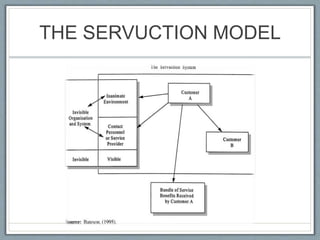
• Model used to illustrate factors that influence service
experience, including those that are visible and
invisible to consumer
• Invisible component consists of invisible organizations
and systems
THE SERVUCTION MODEL
• Visible part consists of 3 parts: inanimate environment,
contact personnel/service providers, and other
consumers
Inanimate environment: All nonliving features present
during service encounter
Contact personnel: :Employees other than primary
providers that interact with consumer
THE SERVUCTION MODEL
• Service Provider: Primary provider of core service, such
as dentist, physician or instructor
• Other Customers
Customer A : Recipient of bundle of benefits created
through service experience
Customer B : Other customers who are part of Customers
A’s experience
THE SERVUCTION MODEL
CUSTOMER INVOLVEMENT IN
THE SERVICE EXPERIENCE
• Servuction model demonstrates consumers are an
integral part of service process
• Participation may be active or passive, but always there
• Managers must understand interactive nature of
services and customer involvement in production
process
ROLE OF MARKETING IN
SERVICES
• The core element in the exchange between firms and
customers is service provision
• Consumers acquire products to obtain the services
that they provide
• Information technology drives services
• Marketing helps firm to leverage technological
advancement and customer engagement
THE SERVICES
REVOLUTION
• Having a “service logic” approach to Marketing
• Customer is the value creator
• In a service-centric world, marketing is reinvented as a
customer centric, multi-functional and relational
customer management process
CONCLUSION
• Services marketing has fundamental differences with
goods marketing
• Need to expand the marketing mix (from 4Ps to 8Ps)
• Services marketing is influenced by the inherent
characteristics of services
• A service-centric world had created a paradigm change
in Marketing
THANK YOU

Servmarkchpter1

  • 1.
  • 2.
    HIGHLIGHTS 1. Definition ofservices Marketing 2. Characteristics of services 3. 8Ps of Services Marketing 4. Servuction Model (Service Experience)
  • 3.
    OUTCOME • Be ableto illustrate, in detail, the principle variables that differentiate marketing services with that of product marketing • Realise that the consumer’s contact of service marketing is very much different from that of product marketing • Understand the unique challenges of doing marketing for services
  • 4.
    CONSIDER THIS…. • Servicesaccount for more than 60 percent of world’s GDP • Almost all economies have a substantial service sector • Most new employment is provided by services • Strongest growth area for marketing
  • 5.
    DEFINITION OF SERVICES MARKETING •Are economic activities offered by one party to another in order to exchange value In exchange for their money, time, and effort, service customers expect to obtain value from: o Access to goods, labor, facilities, environments, professional skills, networks, and systems o But they do not normally take ownership of any of the physical elements involved
  • 6.
    DIFFERENCES BETWEEN SERVICES MARKETING& PRODUCT MARKETING • Marketing management tasks in the service sector differ from those in the manufacturing sector • The eight common differences are: 1. Most service products cannot be inventoried 2. Intangible elements usually dominate value creation 3. Services are often difficult to visualize and understand 4. Customers may be involved in co-production 5. People may be part of the service experience 6. Operational inputs and outputs tend to vary more widely 7. The time factor often assumes great importance 8. Distribution may take place through nonphysical channels • What are the implications?
  • 7.
  • 8.
  • 9.
    WHAT WE’VE LEARNTSO FAR…. • Services are an integral part of business & marketing • Requires a different approach than product-based marketing • Have unique implications on marketing management
  • 10.
  • 11.
    CHARACTERISTICS OF SERVICES • Fourcharacteristics: 1. Intangibility 2. Perishability 3. Inseparability 4. Variability/Heterogeneity • Requires unique strategies to overcome these shortcomings
  • 12.
    CHARACTERISTICS OF SERVICES  Intangibility oLack of tangible assets which can be seen, touched, smelled, heard or tasted prior to purchase o However, there are tangible items used to perform the service o Ex: college education-there are physical structure such as classrooms
  • 13.
    STRATEGIES i) Stressing tangiblecues ii) Using personal sources of information iii) Stimulating word of mouth communication iv) Creating a strong corporate image v) Encouraging employees to communicate with customers
  • 14.
    CHARACTERISTICS OF SERVICES  Perishability oThe service cannot be inventoried or stored o Ex: to maximize revenue, airlines wants to fill every seat in an airplane. The same is true for sporting events and concerts
  • 15.
    STRATEGIES i) Simultaneous adjustmentsin demand, supply and capacity (demand equal supply will equal capacity)  Ex: cinema/movie-adjusting demand is to move some of the demand from the high peak showings to nonpeak  Or reducing the price in the nonpeak showings  Or multiple showings of the popular movies during high peak  Or to increase capacity, show popular movie in more mini theaters at the same time
  • 16.
    CHARACTERISTICS OF SERVICES  Inseparability oThe simultaneous production and consumption of services o Goods can be produced and then sold at a later time, services cannot  Ex: getting medical services involves a doctor or a dentist performing an examination or procedure while the customer is present o Quality of the service is highly dependent on:  The ability of the service provider  The quality of interaction between the service provider and the customer
  • 17.
    STRATEGIES i) Look forways to automate their service through use of machines and computers  Ex: Cash deposit, Maybank2U ii) Emphasize selection and training of its employees and service provider iii) Should have a process to manage their customers iv) Open multiple sites
  • 18.
    CHARACTERISTICS OF SERVICES  Variability/Heterogeneity oRefers to unwanted or random levels of service quality customers receive when they patronize a service o The outcome will differ if the firm uses different employees each time a business is serviced o Because of the variability characteristics of services, standardization and quality control are more difficult
  • 19.
    STRATEGIES i) Industrialize theiroperations ii) Mass producing product in advance, more customers can be served during peak demand iii) Employees are also trained to follow a specific procedure
  • 20.
  • 21.
    SERVICES REQUIRES AN EXPANDEDMARKETING MIX • Marketing can be viewed as: • A strategic and competitive thrust pursued by top management • A set of functional activities performed by line managers • A customer-driven orientation for the entire organization • Marketing is the only function to bring operating revenues into a business; all other functions are cost centers • The “8Ps” of services marketing are needed to create viable strategies for meeting customer needs profitably in a competitive marketplace
  • 22.
    THE 8Ps OFSERVICES MARKETING 1. Product 2. Place 3. Price 4. Promotion and Education 5. Process 6. Physical Environment 7. People 8. Productivity and Quality
  • 23.
    PRODUCT • Embrace allaspects of service performance that create value • Core product responds to customer’s primary need • Array of supplementary service elements  Help customer use core product effectively  Add value through useful enhancements • Planning marketing mix begins with creating a service concept that:  Will offer value to target customers  Satisfy their needs better than competing alternatives
  • 24.
    PLACE • Delivery decisions:Where, When, How • Geographic locations served • Service schedules • Physical channels • Electronic channels • Customer control and convenience • Channel partners/intermediaries
  • 25.
    PRICE • Marketers mustrecognize that customer outlays involve more than price paid to seller • Identify and minimize other costs incurred by users: Additional monetary costs associated with service usage (Ex: travel to service location, parking, phone, babysitting, etc.) Time expenditures, especially waiting Negative sensory experiences
  • 26.
    PROMOTION & EDUCATION •Informing, educating, persuading, reminding customers • Marketing communication tools • Imagery and recognition • Content
  • 27.
    PROCESS • How firmdoes things may be as important as what it does • Customers often actively involved in processes, especially when acting as co-producers of service • Process involves choices of method and sequence in service creation and delivery • Badly designed processes waste time, create poor experiences, and disappoint customers
  • 28.
    PHYSICAL ENVIRONMENT • Designservicescape and provide tangible evidence of service performances • Create and maintain physical appearances • Manage physical cues carefully— can have profound impact on customer impressions
  • 29.
    PEOPLE • Interactions betweencustomers and contact personnel strongly influence customer perceptions of service quality • The right customer-contact • The right customers for firm’s mission • Contribute positively to experience of other customers • Possess—or can be trained to have— needed skills (co- production) • Can shape customer roles and manage customer behavior
  • 30.
    PRODUCTIVITY & QUALITY •Productivity and quality must work hand in hand • Improving productivity key to reducing costs • Improving and maintaining quality essential for building customer satisfaction and loyalty • Technology often the key Technology-based innovations have potential to create high payoffs
  • 31.
  • 32.
    TUTORIAL QUESTIONS 1. Givean example of a service that offers labor and expertise rental 2. Give an example of a service that offers access to physical environments as a form of rental 3. Describe the eight Ps of service that would be involved in a banking service. • Product: • Place: • Price: • Promotion: • Process: • Physical Environment: • People: • Productivity & Quality:
  • 33.
    MEETING THE CHALLENGESOF SERVICES MARKETING 1. Framing the service experience (Servuction Model) 2. Role of Marketing in services 3. The Services Revolution: Changing the perspective of Marketing
  • 34.
    THE SERVUCTION MODEL •Model used to illustrate factors that influence service experience, including those that are visible and invisible to consumer • Invisible component consists of invisible organizations and systems
  • 35.
    THE SERVUCTION MODEL •Visible part consists of 3 parts: inanimate environment, contact personnel/service providers, and other consumers Inanimate environment: All nonliving features present during service encounter Contact personnel: :Employees other than primary providers that interact with consumer
  • 36.
    THE SERVUCTION MODEL •Service Provider: Primary provider of core service, such as dentist, physician or instructor • Other Customers Customer A : Recipient of bundle of benefits created through service experience Customer B : Other customers who are part of Customers A’s experience
  • 37.
  • 38.
    CUSTOMER INVOLVEMENT IN THESERVICE EXPERIENCE • Servuction model demonstrates consumers are an integral part of service process • Participation may be active or passive, but always there • Managers must understand interactive nature of services and customer involvement in production process
  • 39.
    ROLE OF MARKETINGIN SERVICES • The core element in the exchange between firms and customers is service provision • Consumers acquire products to obtain the services that they provide • Information technology drives services • Marketing helps firm to leverage technological advancement and customer engagement
  • 40.
    THE SERVICES REVOLUTION • Havinga “service logic” approach to Marketing • Customer is the value creator • In a service-centric world, marketing is reinvented as a customer centric, multi-functional and relational customer management process
  • 41.
    CONCLUSION • Services marketinghas fundamental differences with goods marketing • Need to expand the marketing mix (from 4Ps to 8Ps) • Services marketing is influenced by the inherent characteristics of services • A service-centric world had created a paradigm change in Marketing
  • 42.