By
Mrs. Miriam George
Asst Professor
Dept Of MBA
By Mrs.Miriam George,Asst Professor
 Service is an act or performance that one
party can offer to another that is essentially
intangible and does not result in any
ownership of anything. Its production may or
may not be tied to physical products.(Philip
Kotler)
 It is based on relationship and value.
 It may be used to market a service or product.
By Mrs.Miriam George,Asst Professor
 A SURVEYTO BE DONE BY STUDENTS FOR
IDENTIFYING INDUSTRIESWHERE
SERVICING CUSTOMERS ARE OF UTMOST
RELEVANCE
By Mrs.Miriam George,Asst Professor
Upward trend in disposable income
 Income increasing in the past 20 years: Disposable
Personal Income in India increased to 71640930 INR
Million in 2011 from 60158160 INR Million in 2010
 Developing country
 Liberalization
 Job Opportunities
 Demand increases with disposable income
Increasing Specialization
 Technology
 Cost effective
 Expert and professionals
 Development of services, financial, banking
By Mrs.Miriam George,Asst Professor
Changing Lifestyle
 Development of corporate culture
 Jogging, gym centre
 Adapting western culture: foreign brands
Increasing Literacy Rate
Professionalism in education
Information explosion
Government Regulations
Consumer protection, KYC
By Mrs.Miriam George,Asst Professor
 In recent times the service sector is increasing at
a very fast pace.After the liberalization in the
year 1991, the contribution of service sector is
continuously increasing in the growth of our
economy.
 However, agriculture is still dominating the
Indian economy. Service sector are growing not
only in volume but also in sophistication and
complexity.The growth of service industry is the
result of combination of several reasons, they
are,
By Mrs.Miriam George,Asst Professor
 The Services Sector contributes the most to the
Indian GDP.The Sector of Services in India has
the biggest share in the country's GDP, it
accounts for more than 50% contribution
 The various sectors under the Services Sector in
India are construction, trade, hotels, transport,
restaurant, communication and storage, social
and personal services, community, insurance,
financing, business services, and real estate.
By Mrs.Miriam George,Asst Professor
 Increasing affluence(wealth)
 More leisure(free time) time
 Greater life expectancy(hope)
 Greater complexity of the product
 Higher percentage of working women
 Increasing complexity of life
 Increasing number of new products
By Mrs.Miriam George,Asst Professor
 Intangibility
 Inseparability
 Variability
 Perish ability
By Mrs.Miriam George,Asst Professor
 Services are intangible means it cannot be seen, tasted felt, heard
or smelled before purchase.
 Evaluation is a challenge
 Intangibility is used in marketing to describe the inability to assess
the value gained from engaging in an activity using any tangible
evidence
 It draws inferences about:
 Place
 People
 Equipment
 Communication Material
 Symbols
 Price
By Mrs.Miriam George,Asst Professor
 Services are produced and consumed
simultaneously
 Provider-client interactions is a special
feature of service marketing.
 In inseparability, key quality of services as
distinct from goods
 A live theatre performance, a makeover
By Mrs.Miriam George,Asst Professor
 It is otherwise called heterogeneity
 Services are highly variable
 The state or characteristic of being variable
 Eg: service firms
 A car servicing varies each time
 Mc Donald’s consumables maybe
standardized but a weekday or a weekend
maybe different.
By Mrs.Miriam George,Asst Professor
 Perish ability is used in marketing to describe
the way in which service capacity cannot be
stored for sale in the future
 Services cannot be stored
 A 100 m race in Olympics(4 years)
By Mrs.Miriam George,Asst Professor
 When Michelle goes to her local restaurant , she
sometimes gets her food fast and hot. Other times her
order is slow, and her food arrives at her table cold. If
Michelle wants a special order, like her burger with a
baked potato instead of fries, she never knows how
long she’ll have to wait for her food. Michelle is
experiencing the service characteristic of ?
 Intangibility
 Inseparability
 Variability
 Perish ability
By Mrs.Miriam George,Asst Professor
 Banking, Stock broking
 Restaurants, Bars, Catering
 Insurance
 News and entertainment
 Healthcare
 Education
 Professional(Architecture and Consulting)
 Wholesaling and Retailing
By Mrs.Miriam George,Asst Professor
Services Marketing Mix:7 Ps for Services:-
 Product
 Price
 Place
 Promotion
 People
 Process
 Physical Evidence
By Mrs.Miriam George,Asst Professor
 Organization size and Structure
 Regulatory Bodies
 Growth in service Industries
 Customer/employer interaction
 Service Quality
 Specific sectors
By Mrs.Miriam George,Asst Professor
LowValue Misconception
Low Capital Interest
Small ScaleView
Cannot ProvideWealth
Cost
By Mrs.Miriam George,Asst Professor
 Focus on a service organization. In the context you
are focusing on, who occupies each of the three
points of the triangle?
 How is each type of marketing being carried out
currently?
 Are the three sides of the triangle well aligned?
By Mrs.Miriam George,Asst Professor
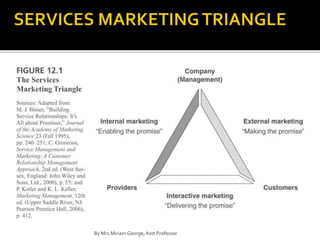
Internal Marketing
 Internal marketing is the side of the triangle
between your organization and your employees
 Provide services to customers.
 Adequate training on the services to be
delivered
 Customer satisfaction service techniques.
 Involve with your employees
 Performance rewards system for employees who
deliver the highest level of customer service.
By Mrs.Miriam George,Asst Professor
 External marketing goes from your business
organization out to customers and
prospective customers.
 Traditional form of business marketing,
 How the services provided by your business
benefit customers.
 External marketing includes advertising, your
website and your company's social media
efforts.
 Fill the business pipeline with future business.
By Mrs.Miriam George,Asst Professor
 The side of the triangle between your employees
and customers is called interactive marketing.
 How your employees deliver the services your
company provides.
 Goal is to have highly satisfied customers who
become long-term, repeat customers.
 Effectiveness of the interactive marketing
relates back to the internal marketing efforts of
your business.
 How your employees keep the promises made
by your external marketing efforts.
By Mrs.Miriam George,Asst Professor
 Overall StrategicAssessment
 How is the service organization doing on all three
sides of the triangle?
 Where are the weaknesses?
 What are the strengths?
 Specific Service Implementation
 What is being promoted and by whom?
 How will it be delivered and by whom?
 Are the supporting systems in place to deliver the
promised service?
By Mrs.Miriam George,Asst Professor
 The Gaps Model was proposed by A
Parasuraman, Valarie Zeithaml and LL
Berry in 1985 in the Journal Of Marketing:
By Mrs.Miriam George,Asst Professor
 Introduce a framework, called the gaps model of
service quality.
 Demonstrate that the most critical service
quality gap to close is the customer gap, the
difference between customer expectations and
perceptions.
 Show that four gaps that occur in companies,
which we call provider gaps, are responsible for
the customer gap.
 Identify the factors responsible for each of the
four provider gaps.
By Mrs.Miriam George,Asst Professor
 Gaps Model of Service Quality Customer Gap:
difference between customer expectations and
perceptions Provider Gap 1 (The Knowledge Gap ):
 Not knowing what customers expect Provider Gap 2
(The Service Design & Standards Gap ):
 Not having the right service designs and standards
Provider Gap 3 (The Service Performance Gap ):
 Not delivering to service standards Provider Gap 4 (
The Communication Gap ):
 Not matching performance to promises
By Mrs.Miriam George,Asst Professor
 The difference between customer
expectations of service standards & quality
and the service provider’s understanding of
these expectations
By Mrs.Miriam George,Asst Professor
 Inadequate marketing research,
 Research not focused on service quality
 Research findings not used properly
 Lack of upward communication from
customers & frontline employees,
 Too many layers
 Lack of market segmentation
 Focus on transactions & customer acquisition
 Inadequate service recovery
By Mrs.Miriam George,Asst Professor
 The difference between service provider’s
understanding of customer expectations and
development of customer-driven service
design & standards
By Mrs.Miriam George,Asst Professor
 Poor / vague / undefined service design
 Unsystematic service development process,
 Failure to match service design to service
positioning
 Lack of customer defined standards
 Lack of focus on customer requirements,
 Absence of formal process for setting service
quality goals & standards
 Lack of attention to physical evidence
 The packaging of the service
By Mrs.Miriam George,Asst Professor
 The discrepancy between development of
customer-driven service standards and actual
service delivery or performance
By Mrs.Miriam George,Asst Professor
 Deficiencies in HR policies
 Wrong recruitment, role ambiguity / conflict,
poor employee / technology fit,
 Evaluation / compensation schemes,
Empowerment etc
 Supply demand gaps
 Over reliance on pricing strategies to close gaps
 Customers not fulfilling roles (ignorance?)
 Intermediaries – conflicts re objectives,
 Performance, rewards, empowerment, control
etc
By Mrs.Miriam George,Asst Professor
 Provider Gap 4The difference between
service provider’s external (marketing)
communications and service delivery
By Mrs.Miriam George,Asst Professor
 Absence of integrated marketing
communications
 Lack of interactive marketing in
communications plan,
 Inadequate internal marketing program
 Gaps in horizontal communications between
sales, marketing and operations
 Ineffective management of customer
expectations
By Mrs.Miriam George,Asst Professor
 The difference between customer
expectations from the service and customer
perceptions of the delivered service.
 Customer perceptions are subjective
assessments of service experiences.
 Customer expectations are the standards
against which service experiences are
compared.
By Mrs.Miriam George,Asst Professor
 Customer expectations – from marketer controlled
factors as well as factors outside the control of the
marketer or service provider such as personal needs,
word of mouth and past experiences
 The aim is to reduce Gap 5 by suitable strategic and
tactical actions in marketing, sales, operations and
communications
 Unique characteristics of services – intangibility,
heterogeneity, inseparability & perishability
contribute to Gap 5
By Mrs.Miriam George,Asst Professor
 Current thinking: More Gaps An extension of the Gaps
Model has been put forward by Dr Arash Shahin.Two
more gaps have been proposed.These centre around
"Employees’ Perceptions of Customers’ Expectations"
 Gap 6:
 Gap 6The discrepancy between customers’ expectations
and employees’ perceptions of customers’ expectations
 Gap 7:
 Gap 7The discrepancy between employees’ perceptions of
customers’ expectations and management (or company)
perceptions of customers’ expectations
By Mrs.Miriam George,Asst Professor
 The Customer Gap Expected service Perceived service Customer Gap
 Key Factors Leading to the Customer Gap:
Key Factors Leading to the Customer Gap Customer Expectations Customer
PerceptionsCustomer Gap
 Customer Expectations Company Perceptions of Customer Expectations Key
Factors Leading to Provider Gap 1 Gap 1

Key Factors Leading to Provider Gap 2:
 Customer-Driven Service Designs and Standards Management Perceptions of
Customer Expectations Key Factors Leading to Provider Gap 2 Gap 2

Key Factors Leading to Provider Gap 3:
 Service Delivery Customer-Driven Service Designs an Standards Key Factors
Leading to Provider Gap 3 Gap 3

Key Factors Leading to Provider Gap 4:
 Service Delivery External Communications to Customers Key Factors Leading to
Provider Gap 4 Gap 4
By Mrs.Miriam George,Asst Professor
 Perceived Service Expected Service
CUSTOMER COMPANY Customer Gap Gap 1
Gap 2 Gap 3 External Communications to
Customers Gap 4 Service DeliveryCustomer-
Driven Service Designs and Standards
Company Perceptions of Consumer
Expectations Gaps Model of Service Quality
By Mrs.Miriam George,Asst Professor
 Consumer Behaviour is the process and activities people engage in when
searching for selecting, purchasing, using, evaluating and disposing of
products and services so as to satisfy their needs and services
 (Belch and Belch)
 Consumer Behavior includes those activities directly involved in
obtaining, consuming and disposing of products, services including the
decision processes that precede and follow these actions
 Engel, Blackwell and Miniard
 Who buys products or services
 How do they buy produts or services
 Where do they buy them
 How often do they buy them
 How often do they use them
 When do they buy them
 Why do they buy them
By Mrs.Miriam George,Asst Professor
 Goods are high on search attributes eg:
goods can be seen, touched and felt or
evaluate their physical properties
 In Services experience is needed before
evaluating them. Customers cannot be sure
of attributes even after the experience. these
are credence attributes
By Mrs.Miriam George,Asst Professor
 Attributes a consumer can determine before
purchase
 Physical goods tend to emphasize search
attributes
 Style, colour, texture, taste, test drive,
clothing, furniture, cars electronic
equipments are high in search attributes
 Tangible attributes help in evaluation
By Mrs.Miriam George,Asst Professor
 Holidays, live entertainment performances
scuba diving different for different consumers
 ATrip on a ship
 A Carribean experience, trekking
By Mrs.Miriam George,Asst Professor
 Impossible to evaluate even after purchase
and consumption
 Forced to think that it has been delivered
 Example:An appendicitis operation/A Root
canal treatment
By Mrs.Miriam George,Asst Professor
 Customer expectations are beliefs about service
delivery that serve as standards or reference points
against which performance is judged.
 Knowing what the customer expects is the first and
possibly most critical step in delivering good quality
service
 What types of expectation standards do customers
hold about services?What factors most influence the
formation of these expectations?What role do
 These factors play in changing expectations? How can
a service company meet or exceed customer
expectations?
By Mrs.Miriam George,Asst Professor
IDEAL EXPECTATIONS
‘Everyone says this restaurant is as good as one in France and I want to go
somewhere very special for my anniversary.’
NORMATIVE SHOULD EXPECTATIONS
‘As expensive as this restaurant is, it ought to have excellent food service.’
EXPERIENCE BASED NORMS
‘Most times this restaurant is very good, but when it gets busy the service is
slow.’
ACCEPTABLE EXPECTATIONS
‘I expect this restaurant to serve me in an adequate manner.’
MINIMUMTOLERABLE EXPECTATIONS
‘I expect terrible service from this restaurant but come because the price is
low.’
By Mrs.Miriam George,Asst Professor
1. Desired Service Expectations
It means the level of service customer hopes to receive
Desired service is a blend of what customers can be and should be
They are further classified into two types
1) Ideal Expectations:
This is the highest degree of customer service expectations
Customer wants to adjust her expectations
Normative Expectations
This is the second highest degree of expectations and at this level the
customer has a pre-decided mindset that the service should be
beyond or at par with respect to a particular expected level
By Mrs.Miriam George,Asst Professor
2. Adequate Service Expectations
It is the service expectation which has the minimum threshold level
which is acceptable to the customer.
According to these expectations the services at this point are acceptable
to customer but not so as desired by customer
They are classified into three
Experience based expectations
Acceptable expectations--based on charges
MinimumTolerable expectations
These are the boundary line of lowest level degree expecting lesser
standard of service since price is low
By Mrs.Miriam George,Asst Professor
Services are heterogeneous and performance vary across providers
and employees. The extent to which customers recognize and are
willing to accept the variation
The gap between the desired and adequate service has been called the
zone of tolerance
If service drops below adequate service, the minimum level considered
acceptable customers will be frustrated
Service performance is higher than the top level of zone of tolerance
were performance exceeds desired service customers will be
pleased/delighted
Service within the zone of tolerance where customers do not notice
the service in particular
Example waiting time in a grocery store
Different customers poses different zones of tolerance
Example price increases zone of tolerance is lesser
By Mrs.Miriam George,Asst Professor
1.Need Recognition
2. Information Search
3. Evaluation of Alternatives
4. Purchase Decision
5. Post purchase Behaviour
By Mrs.Miriam George,Asst Professor
The first step of this process requires
determining the difference between an ideal
state and the physical situation. It can be
triggered through marketing.
Example:A mother sees a commercial for
milk and realizes she is almost out.
By Mrs.Miriam George,Asst Professor
The second stage defines a consumer's options available and the product
package - or bundle of benefits the customer perceives the item to be.
This includes the price, quality, and access to the product.Two types of
information searches exist.
A) Internal: Most often used in frequent purchases.The potential buyer
recalls memories and previous experiences with a product or with the
company.
B) External: Most often used when there is a lack of prior experience
with a product.The risk of making a wrong purchase decision is greater.
3 Primary sources of external information are...
-Personal (friends, family, co-workers)
-Public (media reviews, magazines, i.e. Consumer Reports)
-Marketed (commercials, print ads, websites, sales person)
By Mrs.Miriam George,Asst Professor
Here the consumer notes product features he
or she wants and does not want. Brands play
a significant role in this step. A consumer is
likely to go with a brand that is trusted, or
resume information search.The alternatives
will be weighed to seek the best outcome.
By Mrs.Miriam George,Asst Professor
 This is the actual action taken by the consumer.
Does the customer choose an alternative? If not,
three possibilities remains...
-Where to buy (choose a person, location, or
company). Past experience with the seller again
will affect the decision, along with terms of the
sale and policies.
 -When to buy (immediate transaction or
postpone until later).Time availability,
convenience, and sales are considered.
-Don't Buy
By Mrs.Miriam George,Asst Professor
 This is the evaluation of purchase, pleased or
displeased. If satisfied, customer loyalty is
gained - the right decision was made. If not,
negative feedback may occur and lose of
loyalty.Warranties, support, future discounts,
and surveyors can contribute to post-
purchase behaviour.
By Mrs.Miriam George,Asst Professor
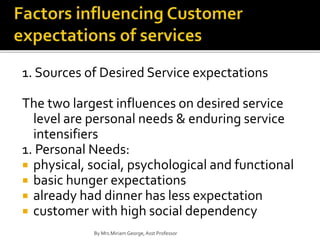
1. Sources of Desired Service expectations
The two largest influences on desired service
level are personal needs & enduring service
intensifiers
1. Personal Needs:
 physical, social, psychological and functional
 basic hunger expectations
 already had dinner has less expectation
 customer with high social dependency
By Mrs.Miriam George,Asst Professor
2. Enduring service intensifiers
Heightened sensitivity to services
a) Derived service expectations is based on the
dependency of other people's expectations,
example planning of a party
b) Personal service philosophy
customer's underlying generic attitude about
the meaning of service Eg: serving food
By Mrs.Miriam George,Asst Professor
2. Sources of adequate service expectations
level of service the customer finds acceptable
they are short term and tend to fluctuate
1. Transitory service intensifiers:
temporary short term factors that make customer aware of the need
of the service personal emergency situation accident/automobile
insurance
2. Perceived service alternative
 multiple service providers
 small town and airline operators customer is more tolerant
 customer in bigger cities have less tolerance level
3. Customers self perceived service role
 customers influence on the level of service
 customers demands on certain parameters might make her more
choosy than those who do not
By Mrs.Miriam George,Asst Professor
4. Situational factors
tornadoes floods rains lowers level of service
expectation
5 predicted service:
predicted patterns during weekends and
weekdays
By Mrs.Miriam George,Asst Professor
3. Source of both desired and predicted service expectation
information from different sources internal and external
experience
1. explicit service promises personal by salespeople non
personal through advertising and media in control of the
service provider
2. implicit service promises tangibles, prices higher price
higher quality
3. word of mouth communication shaping expectations of
service
4. past experience
By Mrs.Miriam George,Asst Professor
 Perception is the process by which
information from the outside environment is
selected, received, organized and interpreted
to give meaning to the environment
By Mrs.Miriam George,Asst Professor
1. Service Encounters:
every encounter sums up to the customer satisfaction
2. Service Evidence
People: Employees and Customers
Process: Operational flow of activities steps in process,
Technology vs Human
Physical Evidence:Tangible servicescape,
guarantee, technology website
3. Organizational Image
4. Price
By Mrs.Miriam George,Asst Professor
1. Measure and manage customer satisfaction
2. Aim for customer quality and satisfaction in
every service
3. Plan for effective recovery
4. Facilitate adaptability and flexibility
5. Encourage spontaneity
6. Help employees cope with problem customers
7. Manage dimensions of quality at encounter level
8.Evidence of service
9.Communicate and create realistic image
10. Enhance customer perception of quality
and value through pricing
By Mrs.Miriam George,Asst Professor
 The interaction between the customer and the
service provider represents the company to the
customer
 The core of service element is the interaction
between those providing services and the
customer which is known as service encounter
also known as the moment of truth
 Customer satisfaction is achieved when
appropriate processes are designed to ensure
that the service encounters meets customer
expectations
By Mrs.Miriam George,Asst Professor
During each service encounter the customer goes through a
range of mental states
1. Experiencing the needs
2. Anxiety about how to fulfill the need or whether or not it
will be fulfilled
3. Sensitivity about whether the right choice has been made
or not or whether to accept the way in which service is
being provided or not
4. Dependence or a child like relationship to the product or
service
5. Happiness or unhappiness according to the degree of
success of the encounter or transaction
6. Satisfaction or resentment after the encounter is over
according to the outcome
By Mrs.Miriam George,Asst Professor
1. Service encounters are purposeful:
doctor visit even relieving boredom
2. Service providers are humane
3. In service encounter prior acquaintance is not necessary:
hairdresser
color consultant wardrobe advisors
4.Task related information dominates train timings exchange rate
5. Service encounters are limited in scope with the scope of
interchange being restricted by nature and content of the service
to be delivered
example: no extra service only the concerned
6.Temporary suspension of normal social status of participants
doctors and dentists cater to lower levels of society
By Mrs.Miriam George,Asst Professor
1. Shares the customers perception of service
received
2. Implications on visitors satisfaction
evaluation
Types of service encounters
 Remote encounter
 Online
 Face to face
By Mrs.Miriam George,Asst Professor
1.Recovery
2. Adaptability- employee response to
customer needs
3. Spontaneity: unprompted and unsolicited
employee actions
4. Coping-employee response to customer
problem
phone encounter
By Mrs.Miriam George,Asst Professor
 Role theory:
Interactive features of service provider-client
interface and a clearer focus on role
performance and the interpersonal
dimensions of service quality.
 ScriptTheory
Types of Service Encounter:
 Remote
 Phone
 Face to face
By Mrs.Miriam George,Asst Professor
1. Product
2. Sales activity
3. After sales
4. Culture
By Mrs.Miriam George,Asst Professor
1. Products and service feature
2. Consumer emotions
3. Attributions for service success or failure
4. Perceptions of equity or fairness:
The belief is that people value fair treatment
which causes them to be motivated to keep the
fairness maintained within the relationships of
their employees and customers
5. Other consumer, family, co workers
By Mrs.Miriam George,Asst Professor
 Customer Expectation is of paramount
importance to provide good quality of
service
 Marketing research plays a major role in
establishing the expectations of a customer
 An organization that does not research
consumer expectation cannot understand
their needs and hence cannot grow
 Research helps bring customer expectation
realistically
By Mrs.Miriam George,Asst Professor
 To identify dissatisfied customer
 Discover customer requirements
 Monitor and track service performance
 Assess overall company performanceVs
competition
 Gaps between customer expectations and
perceptions
 Gauge effectiveness of changes in services
 Appraise service performance
 Monitor changing expectations
 Forecast Future Expectations
By Mrs.Miriam George,Asst Professor
 Complaints
 Requirements
 Critical Incidence/factors t customer touch
points
 Trailer calls to track performance
 Mystery shopping to monitor quality
 Customer panel/forum
 Lost customers..why shifting loyalty
 Satisfaction survey
By Mrs.Miriam George,Asst Professor
STAGE 1: Define Problem
STAGE 2: Develop Measurement strategy
STAGE 3 Implement Research Program
STAGE 4: Collect andTabulate Data
STAGE 5 Interpret and Analyze findings
STAGE 6: Report Findings
By Mrs.Miriam George,Asst Professor
Relationship Marketing:
 is a philosophy of doing business that focuses on keeping
and improving current customers
 does not emphasize acquiring new customers
 is usually cheaper (for the firm)--to keep a
 current customer costs less than to attract anew one
 goal = to build and maintain a base of
committed customers who are profitable for the organization
 thus, the focus is on the attraction, retention,and
enhancement of customer relationships
By Mrs.Miriam George,Asst Professor
To the customer
To the firm
By Mrs.Miriam George,Asst Professor
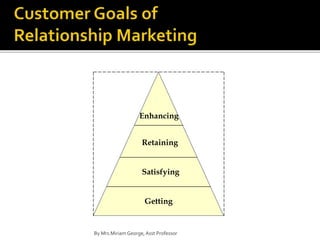
Getting
Satisfying
Retaining
Enhancing
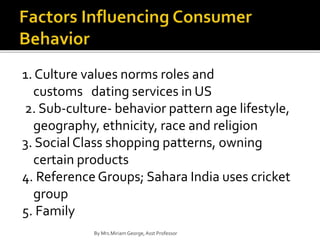
1. Culture values norms roles and
customs dating services in US
2. Sub-culture- behavior pattern age lifestyle,
geography, ethnicity, race and religion
3. Social Class shopping patterns, owning
certain products
4. Reference Groups; Sahara India uses cricket
group
5. Family
By Mrs.Miriam George,Asst Professor