CHAPTER - 1


 SERVICES
MARKETING


                1
KEY POINTS
 1> Introduction.
 2> Reason for growth.
 3> The role of services.
 4> Definition of services.
 5> Types of services.
 6> Nature.
 7> characteristics.
 8> Difference between goods and services.
 9> Need for services marketing.
10> Obstacles in service marketing.
11> The service challenge.
                                             2
INTRODUCTION
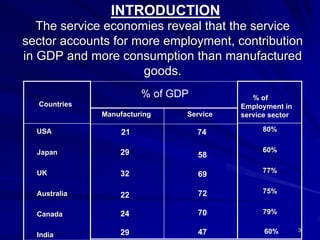
   The service economies reveal that the service
sector accounts for more employment, contribution
in GDP and more consumption than manufactured
                     goods.
                        % of GDP            % of
  Countries                              Employment in
              Manufacturing    Service   service sector

  USA              21              74         80%


  Japan           29                          60%
                                   58

  UK              32                          77%
                                   69

  Australia                        72         75%
                  22

  Canada          24               70         79%

                                   47          60%        3
  India           29
REASONS FOR GROWTH IN
   SERVICE SECTOR
Increase in population creates a new
market for different kind of services.

The economic reforms have ushered
consumerism & middle class is
emerging as “Consumption
Community”.
                                         4
Increase in govt. interaction in the trade
sector has increased trade relationships
between nations leading to development of
tourism & hotel industry.

Changing lifestyles due to cultural exchange
& communication networks resulted in
continued emphasis on services.

The boom in I.T industry & computer
sciences encouraged the shift in service
industry like Travel, Banking, Education,
Financial services etc.


                                             5
THE ROLE OF SERVICES IN AN ECONOMY

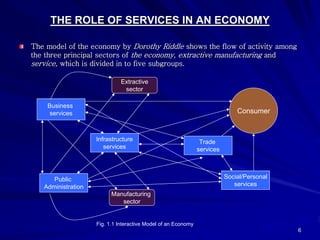
The model of the economy by Dorothy Riddle shows the flow of activity among
the three principal sectors of the economy, extractive manufacturing and
service, which is divided in to five subgroups.

                              Extractive
                               sector

    Business
     services                                                                 Consumer


                    Infrastructure                              Trade
                       services                                services


      Public                                                              Social/Personal
   Administration                                                            services
                          Manufacturing
                             sector


                    Fig. 1.1 Interactive Model of an Economy
                                                                                            6
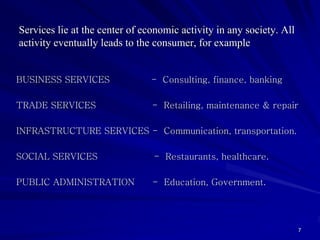
Services lie at the center of economic activity in any society. All
activity eventually leads to the consumer, for example


BUSINESS SERVICES               - Consulting, finance, banking

TRADE SERVICES                  - Retailing, maintenance & repair

INFRASTRUCTURE SERVICES - Communication, transportation.

SOCIAL SERVICES                 - Restaurants, healthcare.

PUBLIC ADMINISTRATION           - Education, Government.


                                                                      7
INDIAN SCENARIO

India is among the early leaders of the
developing world in the race for service
exports compared to its exports of
manufacturers.

  India’s service exports in 1997 were $
  9.3 billion against its merchandise
  exports of $ 32.2 billion.

                                           8
In recent days India is becoming
service economy like Hong Kong &
Singapore as the share of services in
India’s GDP is almost 47%, against
29% for industry and 24% for
agriculture.

India didn’t meet even the South Asian
standards because of its poor policies
but still there is a hope to lean over
the Asian neighbors.
                                         9
DEFINITION OF SERVICES
 The Service Industries Journal defines
“service as any primary or complimentary
activity that does not directly produce a
physical product, that is, the non goods part
of transaction between buyer and seller.”

 “Services are those separately identifiable,
essentially intangible activities, which
provide want satisfaction when marketed to
consumers and/or industrial uses and which
are not necessarily tied to the sale of a
product or another service” - Stanton.

                                                10
“A service is an activity or benefit
that one party can offer to another that
is essentially intangible and does not
result in the ownership of anything. Its
production may or may not be tied to a
physical product”

- Kotler and Armstrong (1981)


                                       11
TYPES OF SERVICES

Professional Services
 Which serve the business market
segments in which advisory & problem
solving provided by a qualified
professional known for their
specialty... e.g. Financial services,
advertising, business and management
consultancy, engineering, medical etc.

                                     12
Consumer oriented Services
The ones which the consumer is
more acquainted with, such as
holiday tour companies,
entertainment, travel, healthcare,
social services etc.


                                     13
THE NATURE OF SERVICES

The basic nature of the service is
its Intangibility. The more a
product is intangible, the more it
becomes a service rather than a
good. Products that are primarily
intangible are classified as
services.
                                     14
Goods are produced while services
are performed.

Intangibility, heterogeneity,
inseparability and perishability
suggest certain marketing
approaches, which in turn lead to
particular marketing strategies, that
differ from those for goods.

                                   15
CHARACTERISICS OF
        SERVICES

INTANGIBILITY
 - Make service more tangible.
 - Focus on the service provider.
SERVICE VARIABILITY
 - Increase control over the service.
 - Switch from people to machines.
 - Reduce perceived risk.
                                        16
SIMULTANEOUS PRODUCTION
AND CONSUMPTION
 - Simplicity of Distribution.
 - Importance of many locations.
 - Image of the service provider.

SERVICE PERISHABILITY
 - Service supply Management
 - Service demand management
                                    17
DIFFERENCES BETWEEN
    GOODS & SERVICES

Many services are essentially
perishable
Lack of transportability
Small firm size
Difficulty in quality control
Labour Intensity
                                18
Legal and Ethical Barriers
Unpredictability of demand
Difficulty in entering foreign
markets
Limited applicability of portfolio
theory
Difficulties in establishing large
market shares

                                     19
NEED FOR SERVICES MARKETING

 In this consumer oriented scenario the
service sector is growing rapidly,
Utility services expenditure growing
rapidly faster than the nation’s total
population. But there was a lack of
innovative marketing on the part of
service industry because of :

Limited View of Marketing
Limited Competition
                                      20
Non-creative Management
No Obsolescence
Lack of Innovation in the Distribution
of Services

        Services require a special
understanding & unique marketing
efforts by marketers. Service industry
has to be consumer oriented to
compete more effectively.
                                         21
OBSTACLES IN SERVICE
        MARKETING

The factors of Intangibility and
Inseparability.

Difficulties in maintaining the same service
quality.

Making comprehensive service marketing.

The lack of imagination and creative
innovation.                                    22
THE SERVICE CHALLENGE
The service challenge is the quest to :

 - Constantly develop new services that
   will better meet customer needs;
 - Improve upon the quality and variety of
   existing services;
 - Provide and distribute these services in
   a manner that best serves the customer.
                                          23
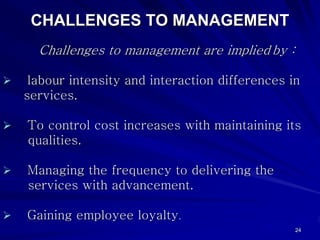
CHALLENGES TO MANAGEMENT
  Challenges to management are implied by :

 labour intensity and interaction differences in
services.

To control cost increases with maintaining its
qualities.

Managing the frequency to delivering the
services with advancement.

Gaining employee loyalty.
                                               24
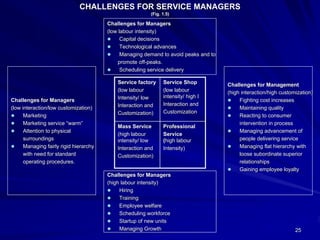
CHALLENGES FOR SERVICE MANAGERS
                                                         (Fig. 1.5)

                                        Challenges for Managers
                                        (low labour intensity)
                                              Capital decisions
                                              Technological advances
                                              Managing demand to avoid peaks and to
                                            promote off-peaks.
                                                       off-
                                              Scheduling service delivery

                                            Service factory    Service Shop           Challenges for Management
                                            (low labour        (low labour            (high interaction/high customization)
                                            Intensity/ low     intensity/ high I
Challenges for Managers                                                                    Fighting cost increases
                                            Interaction and    Interaction and
(low interaction/low customization)                                                        Maintaining quality
                                            Customization)     Customization
      Marketing                                                                            Reacting to consumer
      Marketing service “warm”
                          warm”                                                            intervention in process
                                            Mass Service       Professional
      Attention to physical                                                                Managing advancement of
                                            (high labour       Service
      surroundings                          intensity/ low     (high labour                people delivering service
      Managing fairly rigid hierarchy       Interaction and    Intensity)                  Managing flat hierarchy with
      with need for standard                Customization)                                 loose subordinate superior
      operating procedures.                                                                relationships
                                                                                           Gaining employee loyalty
                                        Challenges for Managers
                                        (high labour intensity)
                                             Hiring
                                             Training
                                             Employee welfare
                                             Scheduling workforce
                                             Startup of new units
                                             Managing Growth                                                       25
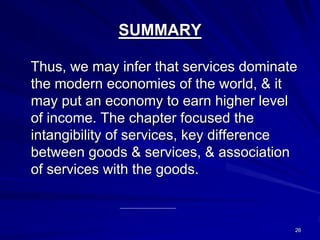
SUMMARY

Thus, we may infer that services dominate
the modern economies of the world, & it
may put an economy to earn higher level
of income. The chapter focused the
intangibility of services, key difference
between goods & services, & association
of services with the goods.


                                        26

An Introduction to Services Marketing

  • 1.
    CHAPTER - 1 SERVICES MARKETING 1
  • 2.
    KEY POINTS 1>Introduction. 2> Reason for growth. 3> The role of services. 4> Definition of services. 5> Types of services. 6> Nature. 7> characteristics. 8> Difference between goods and services. 9> Need for services marketing. 10> Obstacles in service marketing. 11> The service challenge. 2
  • 3.
    INTRODUCTION The service economies reveal that the service sector accounts for more employment, contribution in GDP and more consumption than manufactured goods. % of GDP % of Countries Employment in Manufacturing Service service sector USA 21 74 80% Japan 29 60% 58 UK 32 77% 69 Australia 72 75% 22 Canada 24 70 79% 47 60% 3 India 29
  • 4.
    REASONS FOR GROWTHIN SERVICE SECTOR Increase in population creates a new market for different kind of services. The economic reforms have ushered consumerism & middle class is emerging as “Consumption Community”. 4
  • 5.
    Increase in govt.interaction in the trade sector has increased trade relationships between nations leading to development of tourism & hotel industry. Changing lifestyles due to cultural exchange & communication networks resulted in continued emphasis on services. The boom in I.T industry & computer sciences encouraged the shift in service industry like Travel, Banking, Education, Financial services etc. 5
  • 6.
    THE ROLE OFSERVICES IN AN ECONOMY The model of the economy by Dorothy Riddle shows the flow of activity among the three principal sectors of the economy, extractive manufacturing and service, which is divided in to five subgroups. Extractive sector Business services Consumer Infrastructure Trade services services Public Social/Personal Administration services Manufacturing sector Fig. 1.1 Interactive Model of an Economy 6
  • 7.
    Services lie atthe center of economic activity in any society. All activity eventually leads to the consumer, for example BUSINESS SERVICES - Consulting, finance, banking TRADE SERVICES - Retailing, maintenance & repair INFRASTRUCTURE SERVICES - Communication, transportation. SOCIAL SERVICES - Restaurants, healthcare. PUBLIC ADMINISTRATION - Education, Government. 7
  • 8.
    INDIAN SCENARIO India isamong the early leaders of the developing world in the race for service exports compared to its exports of manufacturers. India’s service exports in 1997 were $ 9.3 billion against its merchandise exports of $ 32.2 billion. 8
  • 9.
    In recent daysIndia is becoming service economy like Hong Kong & Singapore as the share of services in India’s GDP is almost 47%, against 29% for industry and 24% for agriculture. India didn’t meet even the South Asian standards because of its poor policies but still there is a hope to lean over the Asian neighbors. 9
  • 10.
    DEFINITION OF SERVICES The Service Industries Journal defines “service as any primary or complimentary activity that does not directly produce a physical product, that is, the non goods part of transaction between buyer and seller.” “Services are those separately identifiable, essentially intangible activities, which provide want satisfaction when marketed to consumers and/or industrial uses and which are not necessarily tied to the sale of a product or another service” - Stanton. 10
  • 11.
    “A service isan activity or benefit that one party can offer to another that is essentially intangible and does not result in the ownership of anything. Its production may or may not be tied to a physical product” - Kotler and Armstrong (1981) 11
  • 12.
    TYPES OF SERVICES ProfessionalServices Which serve the business market segments in which advisory & problem solving provided by a qualified professional known for their specialty... e.g. Financial services, advertising, business and management consultancy, engineering, medical etc. 12
  • 13.
    Consumer oriented Services Theones which the consumer is more acquainted with, such as holiday tour companies, entertainment, travel, healthcare, social services etc. 13
  • 14.
    THE NATURE OFSERVICES The basic nature of the service is its Intangibility. The more a product is intangible, the more it becomes a service rather than a good. Products that are primarily intangible are classified as services. 14
  • 15.
    Goods are producedwhile services are performed. Intangibility, heterogeneity, inseparability and perishability suggest certain marketing approaches, which in turn lead to particular marketing strategies, that differ from those for goods. 15
  • 16.
    CHARACTERISICS OF SERVICES INTANGIBILITY - Make service more tangible. - Focus on the service provider. SERVICE VARIABILITY - Increase control over the service. - Switch from people to machines. - Reduce perceived risk. 16
  • 17.
    SIMULTANEOUS PRODUCTION AND CONSUMPTION - Simplicity of Distribution. - Importance of many locations. - Image of the service provider. SERVICE PERISHABILITY - Service supply Management - Service demand management 17
  • 18.
    DIFFERENCES BETWEEN GOODS & SERVICES Many services are essentially perishable Lack of transportability Small firm size Difficulty in quality control Labour Intensity 18
  • 19.
    Legal and EthicalBarriers Unpredictability of demand Difficulty in entering foreign markets Limited applicability of portfolio theory Difficulties in establishing large market shares 19
  • 20.
    NEED FOR SERVICESMARKETING In this consumer oriented scenario the service sector is growing rapidly, Utility services expenditure growing rapidly faster than the nation’s total population. But there was a lack of innovative marketing on the part of service industry because of : Limited View of Marketing Limited Competition 20
  • 21.
    Non-creative Management No Obsolescence Lackof Innovation in the Distribution of Services Services require a special understanding & unique marketing efforts by marketers. Service industry has to be consumer oriented to compete more effectively. 21
  • 22.
    OBSTACLES IN SERVICE MARKETING The factors of Intangibility and Inseparability. Difficulties in maintaining the same service quality. Making comprehensive service marketing. The lack of imagination and creative innovation. 22
  • 23.
    THE SERVICE CHALLENGE Theservice challenge is the quest to : - Constantly develop new services that will better meet customer needs; - Improve upon the quality and variety of existing services; - Provide and distribute these services in a manner that best serves the customer. 23
  • 24.
    CHALLENGES TO MANAGEMENT Challenges to management are implied by : labour intensity and interaction differences in services. To control cost increases with maintaining its qualities. Managing the frequency to delivering the services with advancement. Gaining employee loyalty. 24
  • 25.
    CHALLENGES FOR SERVICEMANAGERS (Fig. 1.5) Challenges for Managers (low labour intensity) Capital decisions Technological advances Managing demand to avoid peaks and to promote off-peaks. off- Scheduling service delivery Service factory Service Shop Challenges for Management (low labour (low labour (high interaction/high customization) Intensity/ low intensity/ high I Challenges for Managers Fighting cost increases Interaction and Interaction and (low interaction/low customization) Maintaining quality Customization) Customization Marketing Reacting to consumer Marketing service “warm” warm” intervention in process Mass Service Professional Attention to physical Managing advancement of (high labour Service surroundings intensity/ low (high labour people delivering service Managing fairly rigid hierarchy Interaction and Intensity) Managing flat hierarchy with with need for standard Customization) loose subordinate superior operating procedures. relationships Gaining employee loyalty Challenges for Managers (high labour intensity) Hiring Training Employee welfare Scheduling workforce Startup of new units Managing Growth 25
  • 26.
    SUMMARY Thus, we mayinfer that services dominate the modern economies of the world, & it may put an economy to earn higher level of income. The chapter focused the intangibility of services, key difference between goods & services, & association of services with the goods. 26