Chapter 2:
Customer Behavior in
Service Marketing
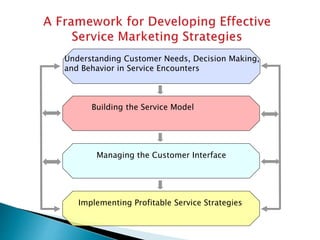
Understanding Customer Needs, Decision Making,
and Behavior in Service Encounters
Building the Service Model
Managing the Customer Interface
Implementing Profitable Service Strategies
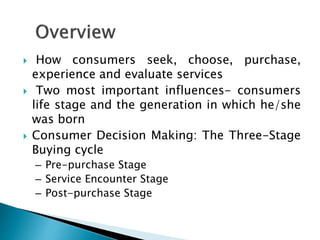
 How consumers seek, choose, purchase,
experience and evaluate services
 Two most important influences- consumers
life stage and the generation in which he/she
was born
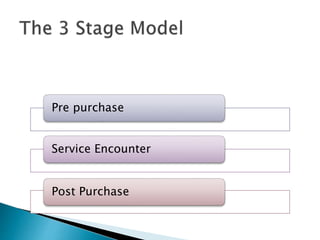
 Consumer Decision Making: The Three-Stage
Buying cycle
– Pre-purchase Stage
– Service Encounter Stage
– Post-purchase Stage
 Consumers are rarely involved in the manufacture of
goods but often participate in service creation and
delivery
 Challenge for service marketers is to understand
how customers interact with service operations
 Based on differences in nature of service act
(tangible/intangible) and who or what is direct
recipient of service (people/possessions), there are
four categories of services:
◦ People processing
◦ Possession processing
◦ Mental stimulus processing
◦ Information processing
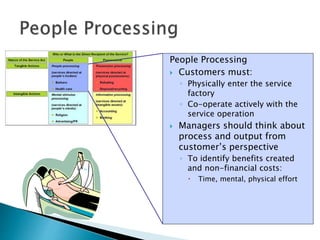
 People Processing
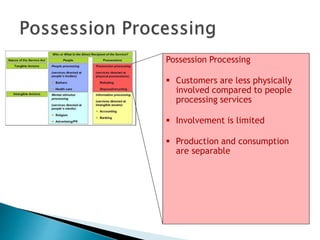
 Possession processing
 Mental stimulus processing
 Information processing
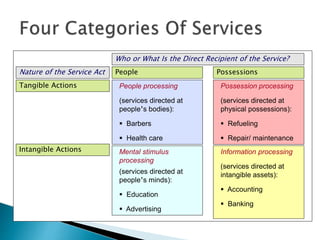
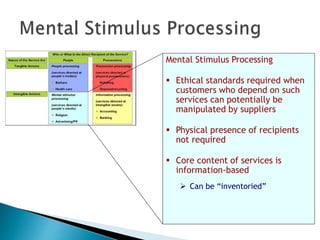
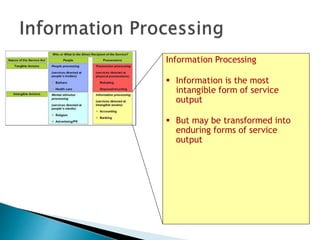
Information processing
(services directed at
intangible assets):
 Accounting
 Banking
Nature of the Service Act People Possessions
Tangible Actions People processing
(services directed at
people’s bodies):
 Barbers
 Health care
Who or What Is the Direct Recipient of the Service?
Possession processing
(services directed at
physical possessions):
 Refueling
 Repair/ maintenance
Mental stimulus
processing
(services directed at
people’s minds):
 Education
 Advertising
Intangible Actions
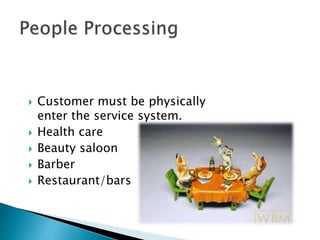
 Customer must be physically
enter the service system.
 Health care
 Beauty saloon
 Barber
 Restaurant/bars
People Processing
 Customers must:
◦ Physically enter the service
factory
◦ Co-operate actively with the
service operation
 Managers should think about
process and output from
customer’s perspective
◦ To identify benefits created
and non-financial costs:
 Time, mental, physical effort
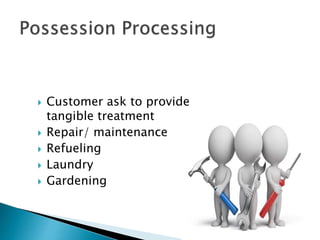
 Customer ask to provide
tangible treatment
 Repair/ maintenance
 Refueling
 Laundry
 Gardening
Possession Processing
 Customers are less physically
involved compared to people
processing services
 Involvement is limited
 Production and consumption
are separable
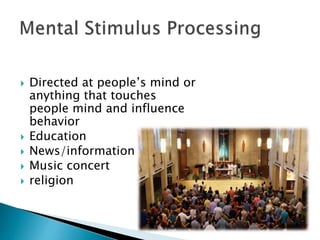
 Directed at people’s mind or
anything that touches
people mind and influence
behavior
 Education
 News/information
 Music concert
 religion
Mental Stimulus Processing
 Ethical standards required when
customers who depend on such
services can potentially be
manipulated by suppliers
 Physical presence of recipients
not required
 Core content of services is
information-based
 Can be “inventoried”
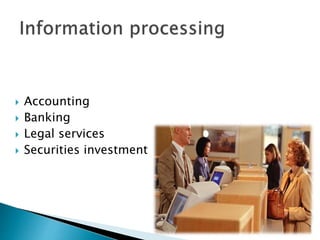
 Accounting
 Banking
 Legal services
 Securities investment
Information Processing
 Information is the most
intangible form of service
output
 But may be transformed into
enduring forms of service
output
Pre purchase
Service Encounter
Post Purchase
 The decision to buy and use a service is made
in the pre purchase stage.
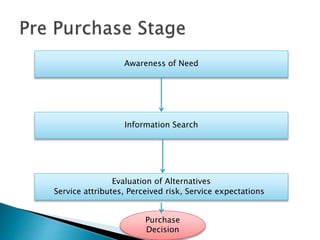
Awareness of Need
Information Search
Evaluation of Alternatives
Service attributes, Perceived risk, Service expectations
Purchase
Decision
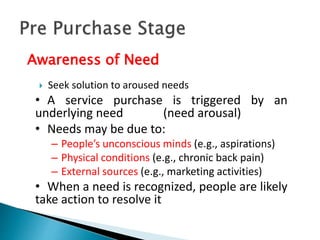
 Seek solution to aroused needs
• A service purchase is triggered by an
underlying need (need arousal)
• Needs may be due to:
– People’s unconscious minds (e.g., aspirations)
– Physical conditions (e.g., chronic back pain)
– External sources (e.g., marketing activities)
• When a need is recognized, people are likely
take action to resolve it
Awareness of Need
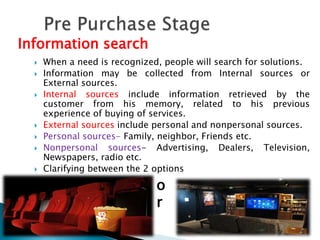
 When a need is recognized, people will search for solutions.
 Information may be collected from Internal sources or
External sources.
 Internal sources include information retrieved by the
customer from his memory, related to his previous
experience of buying of services.
 External sources include personal and nonpersonal sources.
 Personal sources- Family, neighbor, Friends etc.
 Nonpersonal sources- Advertising, Dealers, Television,
Newspapers, radio etc.
 Clarifying between the 2 options
Information search
o
r
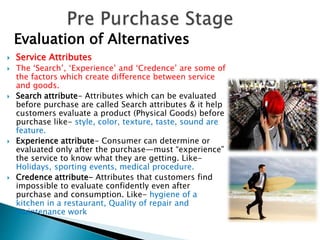
 Service Attributes
 The ‘Search’, ‘Experience’ and ‘Credence’ are some of
the factors which create difference between service
and goods.
 Search attribute- Attributes which can be evaluated
before purchase are called Search attributes & it help
customers evaluate a product (Physical Goods) before
purchase like- style, color, texture, taste, sound are
feature.
 Experience attribute- Consumer can determine or
evaluated only after the purchase—must “experience”
the service to know what they are getting. Like-
Holidays, sporting events, medical procedure.
 Credence attribute- Attributes that customers find
impossible to evaluate confidently even after
purchase and consumption. Like- hygiene of a
kitchen in a restaurant, Quality of repair and
maintenance work
Evaluation of Alternatives
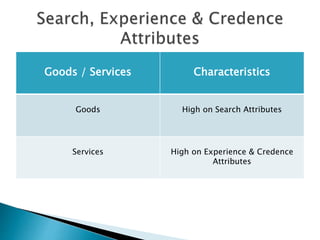
Goods / Services Characteristics
Goods High on Search Attributes
Services High on Experience & Credence
Attributes
Aditya Global Business
School(Marketing Team)
Perceived Risks
A perceived risk is the uncertainty faced by consumers when they
can’t asses the post purchase consequences before purchasing
the product & it is involved in all customer decision.
• Functional Risk – Risk faced by customer that product which
customer purchased may fail to function according to his
expectations or unsatisfactory performance outcomes.
• Financial Risk – Risk faced by consumers when he needs to pay
for the service like- monetary loss, unexpected extra costs
• Physical Risk – It involve the risk to the physical safety of the
customer by using the products/ services. personal injury etc.
• Psychological Risk – It is the risk of causing harm to one’s self
image by making a poor service. Like- fears and negative
emotions
• Social Risk – This is the risk of having to face social
embarrassment as a result of make a poor service choice.
• Time Risk- This is the risk that time spent to search and locate
a service prior to purchase may have been wasted, if service
does not confirm to the customer’s expectations.
Aditya Global Business
School(Marketing Team)
• When possible alternatives have been
compared and evaluated, the best option
is selected
• Can be quite simple if perceived risks are
low and alternatives are clear
• Price is often a key factor in the purchase
decision
Service encounter Stage
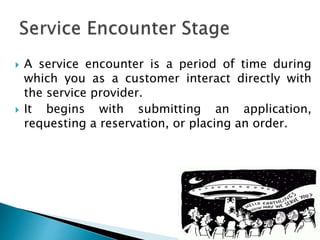
 A service encounter is a period of time during
which you as a customer interact directly with
the service provider.
 It begins with submitting an application,
requesting a reservation, or placing an order.
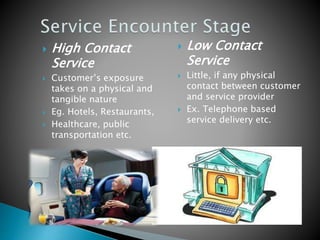
 High Contact
Service
 Customer’s exposure
takes on a physical and
tangible nature
 Eg. Hotels, Restaurants,
 Healthcare, public
transportation etc.
 Low Contact
Service
 Little, if any physical
contact between customer
and service provider
 Ex. Telephone based
service delivery etc.
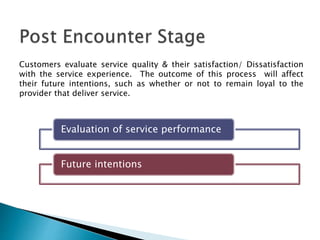
Evaluation of service performance
Future intentions
Customers evaluate service quality & their satisfaction/ Dissatisfaction
with the service experience. The outcome of this process will affect
their future intentions, such as whether or not to remain loyal to the
provider that deliver service.
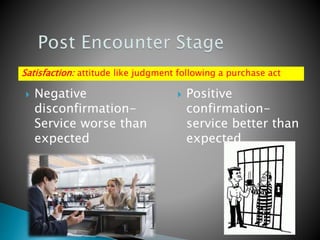
 Negative
disconfirmation-
Service worse than
expected
 Positive
confirmation-
service better than
expected
Satisfaction: attitude like judgment following a purchase act
 Customer evaluate service quality by comparing
what they expected with what they received.
 If their expectations are met or exceeded, they
believe they have received high quality service
and customer is satisfied.
 If the service experience does not meet
customers’ expectations, they may complain
about poor service quality, suffer in silence, or
switch providers in the futures.
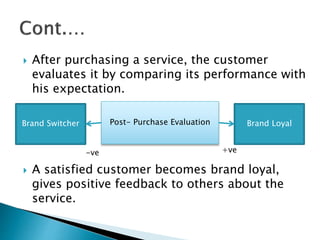
 After purchasing a service, the customer
evaluates it by comparing its performance with
his expectation.
 A satisfied customer becomes brand loyal,
gives positive feedback to others about the
service.
Brand Switcher Brand LoyalPost- Purchase Evaluation
-ve +ve
 Delight- The product’s performance is exceeds
the buyer’s expectations.
 Satisfaction- The product’s performance
matches the buyer’s expectation.
 Dissatisfaction- The product’s is performance
does not match the buyer’s expectation.
 Cognitive Dissonance (Post- purchase Doubt)-
The buyer is unsure of the product performance
relative to his or her expectations.
Consumer behaviour in service marketing

Consumer behaviour in service marketing

  • 1.
    Chapter 2: Customer Behaviorin Service Marketing
  • 2.
    Understanding Customer Needs,Decision Making, and Behavior in Service Encounters Building the Service Model Managing the Customer Interface Implementing Profitable Service Strategies
  • 3.
     How consumersseek, choose, purchase, experience and evaluate services  Two most important influences- consumers life stage and the generation in which he/she was born  Consumer Decision Making: The Three-Stage Buying cycle – Pre-purchase Stage – Service Encounter Stage – Post-purchase Stage
  • 4.
     Consumers arerarely involved in the manufacture of goods but often participate in service creation and delivery  Challenge for service marketers is to understand how customers interact with service operations  Based on differences in nature of service act (tangible/intangible) and who or what is direct recipient of service (people/possessions), there are four categories of services: ◦ People processing ◦ Possession processing ◦ Mental stimulus processing ◦ Information processing
  • 5.
     People Processing Possession processing  Mental stimulus processing  Information processing
  • 6.
    Information processing (services directedat intangible assets):  Accounting  Banking Nature of the Service Act People Possessions Tangible Actions People processing (services directed at people’s bodies):  Barbers  Health care Who or What Is the Direct Recipient of the Service? Possession processing (services directed at physical possessions):  Refueling  Repair/ maintenance Mental stimulus processing (services directed at people’s minds):  Education  Advertising Intangible Actions
  • 7.
     Customer mustbe physically enter the service system.  Health care  Beauty saloon  Barber  Restaurant/bars
  • 8.
    People Processing  Customersmust: ◦ Physically enter the service factory ◦ Co-operate actively with the service operation  Managers should think about process and output from customer’s perspective ◦ To identify benefits created and non-financial costs:  Time, mental, physical effort
  • 9.
     Customer askto provide tangible treatment  Repair/ maintenance  Refueling  Laundry  Gardening
  • 10.
    Possession Processing  Customersare less physically involved compared to people processing services  Involvement is limited  Production and consumption are separable
  • 11.
     Directed atpeople’s mind or anything that touches people mind and influence behavior  Education  News/information  Music concert  religion
  • 12.
    Mental Stimulus Processing Ethical standards required when customers who depend on such services can potentially be manipulated by suppliers  Physical presence of recipients not required  Core content of services is information-based  Can be “inventoried”
  • 13.
     Accounting  Banking Legal services  Securities investment
  • 14.
    Information Processing  Informationis the most intangible form of service output  But may be transformed into enduring forms of service output
  • 15.
  • 16.
     The decisionto buy and use a service is made in the pre purchase stage.
  • 17.
    Awareness of Need InformationSearch Evaluation of Alternatives Service attributes, Perceived risk, Service expectations Purchase Decision
  • 18.
     Seek solutionto aroused needs • A service purchase is triggered by an underlying need (need arousal) • Needs may be due to: – People’s unconscious minds (e.g., aspirations) – Physical conditions (e.g., chronic back pain) – External sources (e.g., marketing activities) • When a need is recognized, people are likely take action to resolve it Awareness of Need
  • 19.
     When aneed is recognized, people will search for solutions.  Information may be collected from Internal sources or External sources.  Internal sources include information retrieved by the customer from his memory, related to his previous experience of buying of services.  External sources include personal and nonpersonal sources.  Personal sources- Family, neighbor, Friends etc.  Nonpersonal sources- Advertising, Dealers, Television, Newspapers, radio etc.  Clarifying between the 2 options Information search o r
  • 20.
     Service Attributes The ‘Search’, ‘Experience’ and ‘Credence’ are some of the factors which create difference between service and goods.  Search attribute- Attributes which can be evaluated before purchase are called Search attributes & it help customers evaluate a product (Physical Goods) before purchase like- style, color, texture, taste, sound are feature.  Experience attribute- Consumer can determine or evaluated only after the purchase—must “experience” the service to know what they are getting. Like- Holidays, sporting events, medical procedure.  Credence attribute- Attributes that customers find impossible to evaluate confidently even after purchase and consumption. Like- hygiene of a kitchen in a restaurant, Quality of repair and maintenance work Evaluation of Alternatives
  • 21.
    Goods / ServicesCharacteristics Goods High on Search Attributes Services High on Experience & Credence Attributes
  • 22.
    Aditya Global Business School(MarketingTeam) Perceived Risks A perceived risk is the uncertainty faced by consumers when they can’t asses the post purchase consequences before purchasing the product & it is involved in all customer decision. • Functional Risk – Risk faced by customer that product which customer purchased may fail to function according to his expectations or unsatisfactory performance outcomes. • Financial Risk – Risk faced by consumers when he needs to pay for the service like- monetary loss, unexpected extra costs • Physical Risk – It involve the risk to the physical safety of the customer by using the products/ services. personal injury etc. • Psychological Risk – It is the risk of causing harm to one’s self image by making a poor service. Like- fears and negative emotions • Social Risk – This is the risk of having to face social embarrassment as a result of make a poor service choice. • Time Risk- This is the risk that time spent to search and locate a service prior to purchase may have been wasted, if service does not confirm to the customer’s expectations.
  • 23.
    Aditya Global Business School(MarketingTeam) • When possible alternatives have been compared and evaluated, the best option is selected • Can be quite simple if perceived risks are low and alternatives are clear • Price is often a key factor in the purchase decision
  • 24.
  • 25.
     A serviceencounter is a period of time during which you as a customer interact directly with the service provider.  It begins with submitting an application, requesting a reservation, or placing an order.
  • 26.
     High Contact Service Customer’s exposure takes on a physical and tangible nature  Eg. Hotels, Restaurants,  Healthcare, public transportation etc.  Low Contact Service  Little, if any physical contact between customer and service provider  Ex. Telephone based service delivery etc.
  • 27.
    Evaluation of serviceperformance Future intentions Customers evaluate service quality & their satisfaction/ Dissatisfaction with the service experience. The outcome of this process will affect their future intentions, such as whether or not to remain loyal to the provider that deliver service.
  • 28.
     Negative disconfirmation- Service worsethan expected  Positive confirmation- service better than expected Satisfaction: attitude like judgment following a purchase act
  • 29.
     Customer evaluateservice quality by comparing what they expected with what they received.  If their expectations are met or exceeded, they believe they have received high quality service and customer is satisfied.  If the service experience does not meet customers’ expectations, they may complain about poor service quality, suffer in silence, or switch providers in the futures.
  • 30.
     After purchasinga service, the customer evaluates it by comparing its performance with his expectation.  A satisfied customer becomes brand loyal, gives positive feedback to others about the service. Brand Switcher Brand LoyalPost- Purchase Evaluation -ve +ve
  • 31.
     Delight- Theproduct’s performance is exceeds the buyer’s expectations.  Satisfaction- The product’s performance matches the buyer’s expectation.  Dissatisfaction- The product’s is performance does not match the buyer’s expectation.  Cognitive Dissonance (Post- purchase Doubt)- The buyer is unsure of the product performance relative to his or her expectations.