Next
Copyright © by Houghton Mifflin Harcourt Publishing Company
Chapter 4
US History: Civil War to the Present
The Second Industrial Revolution
The Big Idea
The Second Industrial Revolution led to new sources of power and advances in transportation and
communication.
Main Ideas
•Breakthroughs in steel processing led to a boom in railroad construction.
•Advances in the use of oil and electricity improved communications and transportation.
•A rush of inventions changed Americans’ lives.
Copyright © by Houghton Mifflin Harcourt Publishing Company
NextPrevious
Chapter 4
US History: Civil War to the Present
Main Idea 1: Breakthroughs in steel processing led to a boom in railroad
construction.
• Technological advances were important to Second Industrial Revolution, period of rapid
growth in U.S. manufacturing in late 1800s
• Bessemer process, invented mid-1850s, allowed steel to be produced quickly and
cheaply.
– Helped increase steel production from 77,000 tons in 1870 to more than 1
million tons in 1879
• As steel dropped in price, so did the cost of building railroads, generating a boom in
railroad construction.
– Growth of railroads helped the country expand and prosper.
Copyright © by Houghton Mifflin Harcourt Publishing Company
NextPrevious
Chapter 4
US History: Civil War to the Present
Main Idea 2: Advances in the use of oil and electricity improved communications
and transportation.
•Chemists invented a way to convert crude oil into fuel called kerosene in the 1850s.
•Kerosene, which could be used for cooking, heating, and lighting, created a demand
for oil.
•A huge oil industry developed after a way to pump oil from the ground was
developed in 1859.
Copyright © by Houghton Mifflin Harcourt Publishing Company
NextPrevious
Chapter 4
US History: Civil War to the Present
Spread
• Edison created a power company to
distribute electricity, but could not send it
over long distances.
• George Westinghouse built a power system
that could send electricity many miles across
the country.
Development of Electricity
Invention
•Inventor Thomas Edison, who held more than
1,000 patents, worked to invent an electric
light.
•Edison and his team introduced the first
practical electric light bulb in 1879.
Copyright © by Houghton Mifflin Harcourt Publishing Company
NextPrevious
Chapter 4
US History: Civil War to the Present
Main Idea 3: A rush of inventions changed Americans’ lives.
•New telegraph technology connected the United States with Britain by cable in 1866.
• Alexander Graham Bell patented the telephone in 1876.
•Telephones were rapidly adopted, the number rising from 55,000 in 1880 to almost 1.5
million in 1900.
Copyright © by Houghton Mifflin Harcourt Publishing Company
NextPrevious
Chapter 4
US History: Civil War to the Present
Automobiles and Planes
• The automobile industry grew in steps.
– 1876 – German engineer invented the gasoline-powered engine.
– 1893 – The United States built its first practical motorcar.
– 1908 – Henry Ford introduced the Model T.
• Ford was first to implement the moving assembly line in manufacturing, making cars
more affordable.
• Wilbur and Orville Wright invented an airplane powered by a gas engine in 1903.
Copyright © by Houghton Mifflin Harcourt Publishing Company
NextPrevious
Chapter 4
US History: Civil War to the Present
Big Business
The Big Idea
The growth of big business in the late 1800s led to the creation of monopolies.
Main Ideas
•The rise of corporations and powerful business leaders led to the dominance of big business in
the United States.
•People and the government began to question the methods of big business.
Copyright © by Houghton Mifflin Harcourt Publishing Company
NextPrevious
Chapter 4
US History: Civil War to the Present
Main Idea 1: The rise of corporations and powerful business leaders led to the
dominance of big business in the United States.
• Many entrepreneurs formed their businesses in the late 1800s as corporations, or
businesses that sell portions of ownership called stock shares.
• Corporate leaders were some of the most widely respected members of American
society.
• Successful corporations rewarded not only the people who founded them, but also
investors who held stock.
• Corporations encouraged more investment in businesses because stockholders could sell
stock whenever they wanted.
Copyright © by Houghton Mifflin Harcourt Publishing Company
NextPrevious
Chapter 4
US History: Civil War to the Present
Business Leaders
John D. Rockefeller
•Standard Oil Company was
country’s largest refinery
•Developed horizontal
integration, owning all
businesses in a field
•Formed a trust, grouping
many companies under a
single board
Andrew Carnegie
•One of most admired
businesspeople of the time
•Focused on steelmaking
•Used vertical integration,
owning businesses involved in
each step of manufacturing, to
lower costs
Leland Stanford
•Made fortune selling
equipment to miners
•Governor of California, one of
founders of Central Pacific
Railroad, and founder of
Stanford University
Copyright © by Houghton Mifflin Harcourt Publishing Company
NextPrevious
Chapter 4
US History: Civil War to the Present
Main Idea 2: People and the government began to question the methods of big
business.
• People and the government began to view big business as a problem in the late 1800s.
– Concerned about child labor, low wages, and poor working conditions
• Many business leaders believed in social Darwinism.
–Darwin’s “survival of fittest” applied to which human beings would succeed
in business and in life in general.
• Other business leaders believed that the rich should help the poor.
–Carnegie, Rockefeller, Stanford, and other business leaders gave away large
sums of money to charities.
Copyright © by Houghton Mifflin Harcourt Publishing Company
NextPrevious
Chapter 4
US History: Civil War to the Present
The Antitrust Movement
• Critics said many businesses earned their fortunes through unfair business practices.
– Used size and strength to drive smaller competitors out of business
– Powerful trusts sold goods and services below market value until smaller
competitors went out of business, then raised prices.
• Some people were concerned when a trust gained a monopoly, or total ownership of a
product or service.
• The Sherman Antitrust Act passed in 1890 made it illegal to create monopolies or trusts
that restrained trade.
– The act did not clearly define a trust in legal terms, so it was hard to
enforce.
– Corporations and trusts continued to grow in size and power.
Copyright © by Houghton Mifflin Harcourt Publishing Company
NextPrevious
Chapter 4
US History: Civil War to the Present
Industrial Workers
The Big Idea
Changes in the workplace led to a rise in labor unions and workers’ strikes.
Main Ideas
•The desire to maximize profits and become more efficient led to poor working conditions.
•Workers began to organize and demand improvements in working conditions and pay.
•Labor strikes often turned violent and failed to accomplish their goals.
Copyright © by Houghton Mifflin Harcourt Publishing Company
NextPrevious
Chapter 4
US History: Civil War to the Present
Main Idea 1: The desire to maximize profits and become more efficient led to poor
working conditions.
• Several factors led to a decline in the quality of working conditions in the late 1800s.
– Machines and unskilled workers replaced skilled craftspeople.
–These low-paid workers could easily be replaced. They brought costs down
and caused production to rise.
• Frederick W. Taylor, an efficiency expert, published The Principles of Scientific
Management in 1909.
– Encouraged managers to view workers as interchangeable parts
– Injuries increased, and conditions worsened.
– Workers looked for ways to bring about change.
Copyright © by Houghton Mifflin Harcourt Publishing Company
NextPrevious
Chapter 4
US History: Civil War to the Present
Poor Working Conditions
• Small, crowded rooms
• Specialization made workers tired, bored, and more likely to be injured.
• Managers paid less attention to working conditions.
• Stuffy air
• Unsafe workplaces
• Long hours
• Low wages
• No job security
Copyright © by Houghton Mifflin Harcourt Publishing Company
NextPrevious
Chapter 4
US History: Civil War to the Present
American Federation of Labor
•Organized individual national unions, such as
mine-workers’ and steelworkers’ unions
•Limited membership to skilled workers
•Used collective bargaining, in which all
workers acted collectively, or together, to
negotiate with management
Main Idea 2: Workers began to organize and demand improvements in working
conditions and pay.
Knights of Labor
•First national labor union, founded in 1870s
•Pushed for eight-hour workday, equal pay for
equal work, and end to child labor
•Included both skilled and unskilled workers
• Terence V. Powderly became leader in 1879
and ended secrecy of organization.
Copyright © by Houghton Mifflin Harcourt Publishing Company
NextPrevious
Chapter 4
US History: Civil War to the Present
Main Idea 3: Labor strikes often turned violent and failed to accomplish their
goals.
Homestead Strike
•Strike occurred at Carnegie
Steel Company in Homestead,
Pennsylvania.
•Resulting fight left workers
and Pinkerton guards dead.
Haymarket Riot
•Erupted between protesters
and police in Chicago
•Resulted in decline of Knights
of Labor
Pullman Strike
•Began with workers who
made Pullman train cars
•Spread to workers who
worked on trains pulling
sleeping cars
•Federal troops stopped
strike.
Copyright © by Houghton Mifflin Harcourt Publishing Company
Previous
Chapter 4
US History: Civil War to the Present
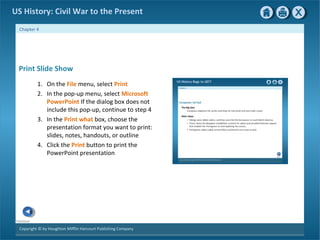
Print Slide Show
1. On the File menu, select Print
2. In the pop-up menu, select Microsoft
PowerPoint If the dialog box does not
include this pop-up, continue to step 4
3. In the Print what box, choose the
presentation format you want to print:
slides, notes, handouts, or outline
4. Click the Print button to print the
PowerPoint presentation

Ch.4 the industrial age

  • 1.
    Next Copyright © byHoughton Mifflin Harcourt Publishing Company Chapter 4 US History: Civil War to the Present The Second Industrial Revolution The Big Idea The Second Industrial Revolution led to new sources of power and advances in transportation and communication. Main Ideas •Breakthroughs in steel processing led to a boom in railroad construction. •Advances in the use of oil and electricity improved communications and transportation. •A rush of inventions changed Americans’ lives.
  • 2.
    Copyright © byHoughton Mifflin Harcourt Publishing Company NextPrevious Chapter 4 US History: Civil War to the Present Main Idea 1: Breakthroughs in steel processing led to a boom in railroad construction. • Technological advances were important to Second Industrial Revolution, period of rapid growth in U.S. manufacturing in late 1800s • Bessemer process, invented mid-1850s, allowed steel to be produced quickly and cheaply. – Helped increase steel production from 77,000 tons in 1870 to more than 1 million tons in 1879 • As steel dropped in price, so did the cost of building railroads, generating a boom in railroad construction. – Growth of railroads helped the country expand and prosper.
  • 3.
    Copyright © byHoughton Mifflin Harcourt Publishing Company NextPrevious Chapter 4 US History: Civil War to the Present Main Idea 2: Advances in the use of oil and electricity improved communications and transportation. •Chemists invented a way to convert crude oil into fuel called kerosene in the 1850s. •Kerosene, which could be used for cooking, heating, and lighting, created a demand for oil. •A huge oil industry developed after a way to pump oil from the ground was developed in 1859.
  • 4.
    Copyright © byHoughton Mifflin Harcourt Publishing Company NextPrevious Chapter 4 US History: Civil War to the Present Spread • Edison created a power company to distribute electricity, but could not send it over long distances. • George Westinghouse built a power system that could send electricity many miles across the country. Development of Electricity Invention •Inventor Thomas Edison, who held more than 1,000 patents, worked to invent an electric light. •Edison and his team introduced the first practical electric light bulb in 1879.
  • 5.
    Copyright © byHoughton Mifflin Harcourt Publishing Company NextPrevious Chapter 4 US History: Civil War to the Present Main Idea 3: A rush of inventions changed Americans’ lives. •New telegraph technology connected the United States with Britain by cable in 1866. • Alexander Graham Bell patented the telephone in 1876. •Telephones were rapidly adopted, the number rising from 55,000 in 1880 to almost 1.5 million in 1900.
  • 6.
    Copyright © byHoughton Mifflin Harcourt Publishing Company NextPrevious Chapter 4 US History: Civil War to the Present Automobiles and Planes • The automobile industry grew in steps. – 1876 – German engineer invented the gasoline-powered engine. – 1893 – The United States built its first practical motorcar. – 1908 – Henry Ford introduced the Model T. • Ford was first to implement the moving assembly line in manufacturing, making cars more affordable. • Wilbur and Orville Wright invented an airplane powered by a gas engine in 1903.
  • 7.
    Copyright © byHoughton Mifflin Harcourt Publishing Company NextPrevious Chapter 4 US History: Civil War to the Present Big Business The Big Idea The growth of big business in the late 1800s led to the creation of monopolies. Main Ideas •The rise of corporations and powerful business leaders led to the dominance of big business in the United States. •People and the government began to question the methods of big business.
  • 8.
    Copyright © byHoughton Mifflin Harcourt Publishing Company NextPrevious Chapter 4 US History: Civil War to the Present Main Idea 1: The rise of corporations and powerful business leaders led to the dominance of big business in the United States. • Many entrepreneurs formed their businesses in the late 1800s as corporations, or businesses that sell portions of ownership called stock shares. • Corporate leaders were some of the most widely respected members of American society. • Successful corporations rewarded not only the people who founded them, but also investors who held stock. • Corporations encouraged more investment in businesses because stockholders could sell stock whenever they wanted.
  • 9.
    Copyright © byHoughton Mifflin Harcourt Publishing Company NextPrevious Chapter 4 US History: Civil War to the Present Business Leaders John D. Rockefeller •Standard Oil Company was country’s largest refinery •Developed horizontal integration, owning all businesses in a field •Formed a trust, grouping many companies under a single board Andrew Carnegie •One of most admired businesspeople of the time •Focused on steelmaking •Used vertical integration, owning businesses involved in each step of manufacturing, to lower costs Leland Stanford •Made fortune selling equipment to miners •Governor of California, one of founders of Central Pacific Railroad, and founder of Stanford University
  • 10.
    Copyright © byHoughton Mifflin Harcourt Publishing Company NextPrevious Chapter 4 US History: Civil War to the Present Main Idea 2: People and the government began to question the methods of big business. • People and the government began to view big business as a problem in the late 1800s. – Concerned about child labor, low wages, and poor working conditions • Many business leaders believed in social Darwinism. –Darwin’s “survival of fittest” applied to which human beings would succeed in business and in life in general. • Other business leaders believed that the rich should help the poor. –Carnegie, Rockefeller, Stanford, and other business leaders gave away large sums of money to charities.
  • 11.
    Copyright © byHoughton Mifflin Harcourt Publishing Company NextPrevious Chapter 4 US History: Civil War to the Present The Antitrust Movement • Critics said many businesses earned their fortunes through unfair business practices. – Used size and strength to drive smaller competitors out of business – Powerful trusts sold goods and services below market value until smaller competitors went out of business, then raised prices. • Some people were concerned when a trust gained a monopoly, or total ownership of a product or service. • The Sherman Antitrust Act passed in 1890 made it illegal to create monopolies or trusts that restrained trade. – The act did not clearly define a trust in legal terms, so it was hard to enforce. – Corporations and trusts continued to grow in size and power.
  • 12.
    Copyright © byHoughton Mifflin Harcourt Publishing Company NextPrevious Chapter 4 US History: Civil War to the Present Industrial Workers The Big Idea Changes in the workplace led to a rise in labor unions and workers’ strikes. Main Ideas •The desire to maximize profits and become more efficient led to poor working conditions. •Workers began to organize and demand improvements in working conditions and pay. •Labor strikes often turned violent and failed to accomplish their goals.
  • 13.
    Copyright © byHoughton Mifflin Harcourt Publishing Company NextPrevious Chapter 4 US History: Civil War to the Present Main Idea 1: The desire to maximize profits and become more efficient led to poor working conditions. • Several factors led to a decline in the quality of working conditions in the late 1800s. – Machines and unskilled workers replaced skilled craftspeople. –These low-paid workers could easily be replaced. They brought costs down and caused production to rise. • Frederick W. Taylor, an efficiency expert, published The Principles of Scientific Management in 1909. – Encouraged managers to view workers as interchangeable parts – Injuries increased, and conditions worsened. – Workers looked for ways to bring about change.
  • 14.
    Copyright © byHoughton Mifflin Harcourt Publishing Company NextPrevious Chapter 4 US History: Civil War to the Present Poor Working Conditions • Small, crowded rooms • Specialization made workers tired, bored, and more likely to be injured. • Managers paid less attention to working conditions. • Stuffy air • Unsafe workplaces • Long hours • Low wages • No job security
  • 15.
    Copyright © byHoughton Mifflin Harcourt Publishing Company NextPrevious Chapter 4 US History: Civil War to the Present American Federation of Labor •Organized individual national unions, such as mine-workers’ and steelworkers’ unions •Limited membership to skilled workers •Used collective bargaining, in which all workers acted collectively, or together, to negotiate with management Main Idea 2: Workers began to organize and demand improvements in working conditions and pay. Knights of Labor •First national labor union, founded in 1870s •Pushed for eight-hour workday, equal pay for equal work, and end to child labor •Included both skilled and unskilled workers • Terence V. Powderly became leader in 1879 and ended secrecy of organization.
  • 16.
    Copyright © byHoughton Mifflin Harcourt Publishing Company NextPrevious Chapter 4 US History: Civil War to the Present Main Idea 3: Labor strikes often turned violent and failed to accomplish their goals. Homestead Strike •Strike occurred at Carnegie Steel Company in Homestead, Pennsylvania. •Resulting fight left workers and Pinkerton guards dead. Haymarket Riot •Erupted between protesters and police in Chicago •Resulted in decline of Knights of Labor Pullman Strike •Began with workers who made Pullman train cars •Spread to workers who worked on trains pulling sleeping cars •Federal troops stopped strike.
  • 17.
    Copyright © byHoughton Mifflin Harcourt Publishing Company Previous Chapter 4 US History: Civil War to the Present Print Slide Show 1. On the File menu, select Print 2. In the pop-up menu, select Microsoft PowerPoint If the dialog box does not include this pop-up, continue to step 4 3. In the Print what box, choose the presentation format you want to print: slides, notes, handouts, or outline 4. Click the Print button to print the PowerPoint presentation