Climate 
Climate
•    The general condition of temperature and 
precipitation for an area for an extended period of 
time.
•    The climate of any region of the world is 
determined by 2 factors:  1) temperature and 2) 
precipitation.
Factors that Affect Temperature
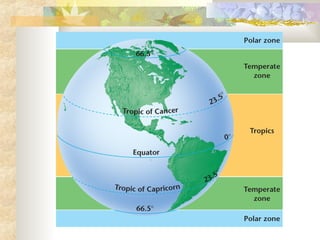
1) Latitude
•    Areas close to the equator receive direct rays 
(warmer).
•    In Polar Regions, sun’s rays are not as direct.  
(cooler temperatures).
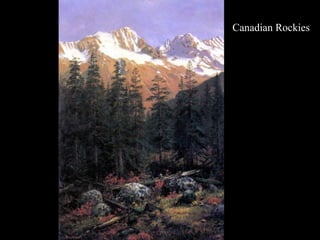
2 ) Elevation

•    As elevation increases, the 
   temperature decreases.
• Air is less dense. 
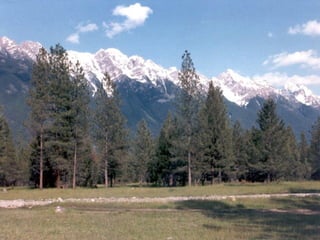
Canadian Rockies
3. Ocean Currents
•    Some currents are warm.
•    Surface temperature of water affects the 
temperature of the air above it.
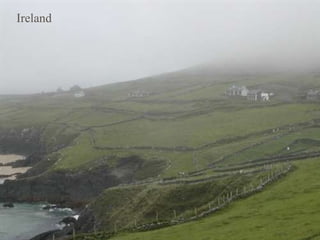
•    Land near warm currents has warmer 
temperatures.  Ex:  Ireland
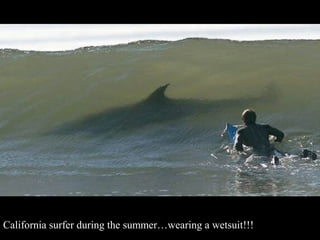
Land near cold currents has cooler temperatures.  
Ex: California coast. 
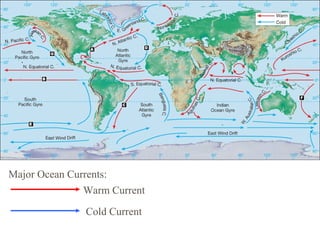
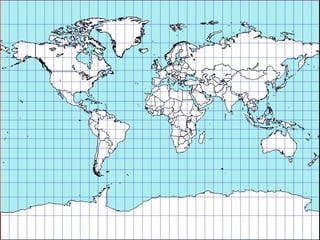
Major Ocean Currents:
               Warm Current

               Cold Current
Ireland
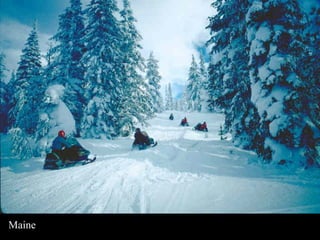
Maine
California surfer during the summer…wearing a wetsuit!!!
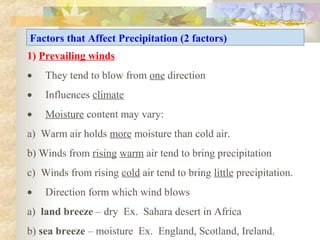
Factors that Affect Precipitation (2 factors)
1) Prevailing winds
•   They tend to blow from one direction
•   Influences climate
•   Moisture content may vary:
a) Warm air holds more moisture than cold air.
b) Winds from rising warm air tend to bring precipitation
c) Winds from rising cold air tend to bring little precipitation.
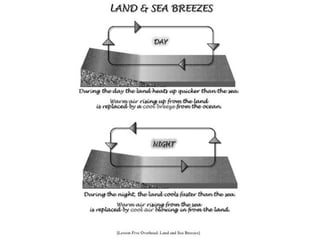
•   Direction form which wind blows
a) land breeze – dry Ex. Sahara desert in Africa
b) sea breeze – moisture Ex. England, Scotland, Ireland.
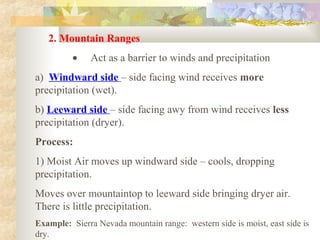
2. Mountain Ranges
          •    Act as a barrier to winds and precipitation
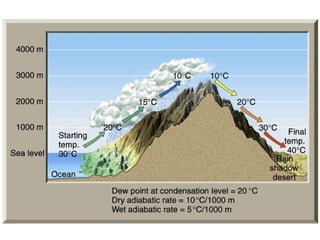
a) Windward side – side facing wind receives more
precipitation (wet).
b) Leeward side – side facing awy from wind receives less
precipitation (dryer).
Process:
1) Moist Air moves up windward side – cools, dropping
precipitation.
Moves over mountaintop to leeward side bringing dryer air.
There is little precipitation.
Example: Sierra Nevada mountain range: western side is moist, east side is
dry.
FACTORS THAT AFFECT CLIMATE: 5 MIN
Climate Zones


Climates are divided by average
temperature determined by:
1) Location
2) Latitude
3 Climate Zones:


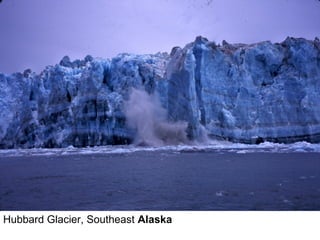
1) Polar (Alaska)
• Arctic regions
•   90° - 60° latitude
• coldest, temps are below freezing
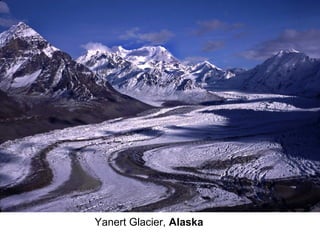
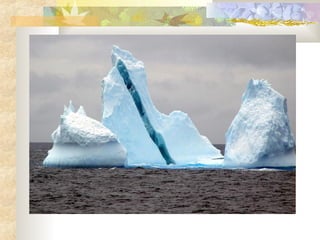
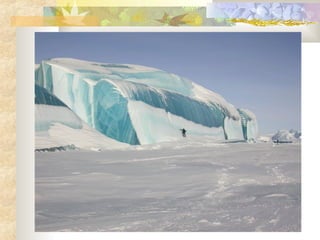
Yanert Glacier, Alaska
Hubbard Glacier, Southeast Alaska
2) Temperate (USA)
• Middle latitude/60° - 30° latitude
• average precip of rain (year round) and
snow (winter) is about the same
• Temps vary: 5° C - 20° C
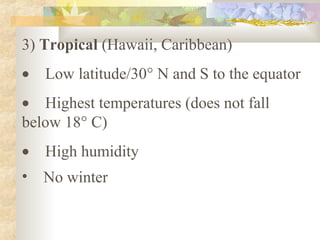
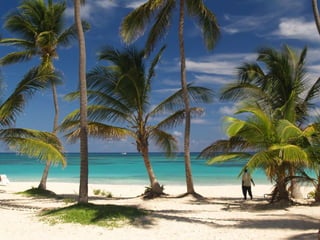
3) Tropical (Hawaii, Caribbean)
• Low latitude/30° N and S to the equator
• Highest temperatures (does not fall
below 18° C)
• High humidity
•   No winter
CLIMATE REGIONS: 2 MIN
Changes in Climate
What causes the climate to change?
3 natural factors:
1) slow drifting of continents
2) changes in the sun’s energy output
3) variations in the position of the Earth relative to the sun,
collectively known as the “Milankovitch Cycles.”
1. Ice Ages


•Periodically, the Earth’s surface have been covered enormous
sheets of ice.
•4 major ice ages (major glaciations) during the past 2 million
years.
•Average temperature was about 6° C below today’s avg. temp.
•Lasts about 100,000 or more. The most recent began about 1.75
mya and ended 10,000 ago.
•Time period between major glaciations are called interglacials.
(warm period - today)
What kind of life existed?
Based on true events? 2 min
2. Drifting Continents


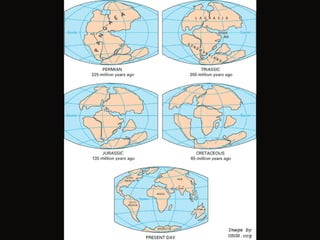
•   Approximately 200 mya, Pangaea started to drift.
•   Plate tectonics.
•   Temp and precip dropped.
• Moves only a few cm/yr. So, climate changes will
happen over millions of years.


Where did our present continents originate from?
3. Extinction of Dinosaurs
 
Possible reasons:
1) Dinosaurs could not adapt to the slow change in climate.  
2) Many plants became extinct.
3) Asteroid struck the Earth 65 mya.  This resulted in enormous 
clouds and dust worldwide blocking the sun’s rays.  
Temperatures dropped.


Actually, the real reason why dinosaurs became extinct is
because of…
4. Variations in Radiant Energy 
Some scientists believe the sun’s energy output changes over time, 
affecting the Earth’s temperature.  But there is no evidence.


                         5. Global Warming
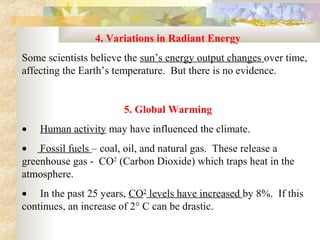
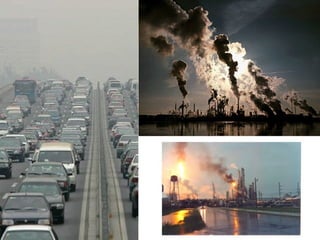
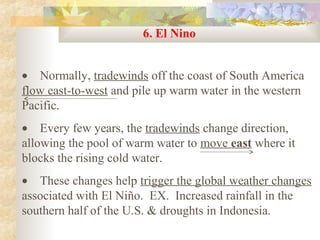
•     Human activity may have influenced the climate.
•     Fossil fuels – coal, oil, and natural gas.  These release a 
greenhouse gas -  CO2 (Carbon Dioxide) which traps heat in the 
atmosphere.
•     In the past 25 years, CO2 levels have increased by 8%.  If this 
continues, an increase of 2° C can be drastic.
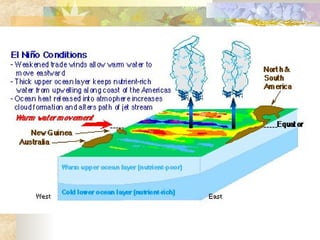
6. El Nino


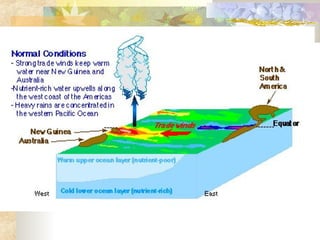
•    Normally, tradewinds off the coast of South America 
flow east-to-west and pile up warm water in the western 
Pacific.
•    Every few years, the tradewinds change direction, 
allowing the pool of warm water to move east where it 
blocks the rising cold water. 
•    These changes help trigger the global weather changes 
associated with El Niño.  EX.  Increased rainfall in the 
southern half of the U.S. & droughts in Indonesia.
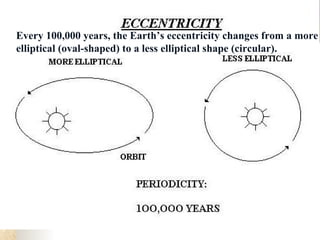
Every 100,000 years, the Earth’s eccentricity changes from a more
elliptical (oval-shaped) to a less elliptical shape (circular).
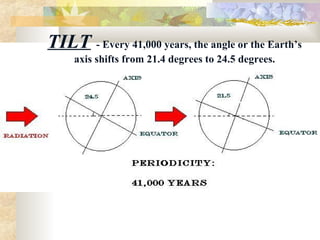
TILT - Every 41,000 years, the angle or the Earth’s
     axis shifts from 21.4 degrees to 24.5 degrees.
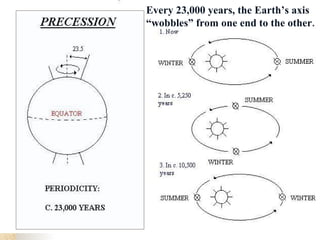
Every 23,000 years, the Earth’s axis
“wobbles” from one end to the other.
El Nino and La Nina: 1:44 min

Climate