Ch. 28  - The Rococo  French  ro caille – pebble or shell Baro cco  – baroque
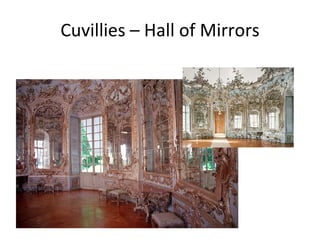
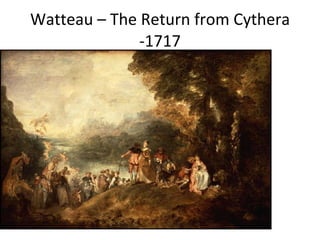
Aristocrats parallel in the shift the Baroque to the Rococo  Fete galante – which portrays the aristocracy in their leisurely  pursuits. Paintings can be seductive Lavish, no straight lines in the Rococo – sophisticated and elegantly refined.  Curves are a prominent feature in the Rococo architecture
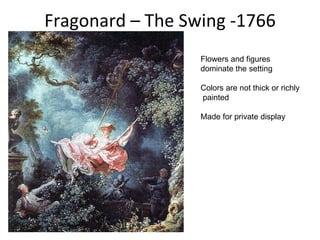
Fragonard – The Swing -1766 Flowers and figures  dominate the setting Colors are not thick or richly painted  Made for private display
Cuvillies – Hall of Mirrors
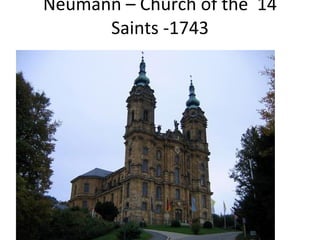
Neumann – Church of the  14 Saints -1743
Watteau – The Return from Cythera -1717
The Enlightment  18 th  Century – revolutions erupted in France and America – ( French, American  and Industrial Revolution in England all happened at the same time)  Social and economic life dissolved.  The Enlightment was a new way to think critically about the world. To think independent of religion, myth and  tradition. Questioning theories, god, and now experimenting with science. Voltaire and his writings were very important
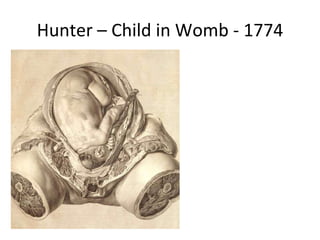
Hunter – Child in Womb - 1774
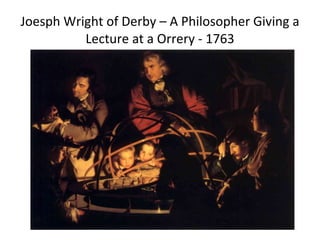
Joesph Wright of Derby – A Philosopher Giving a Lecture at a Orrery - 1763
Darby III & Pritchard – Iron Bridge at Coalbrookdale, England -1776 Bridge made out of iron Previous bridges made out of wood
Voltaire and Rousseau  Voltaire believed that the salvation of humanity was in advancement of science and the improvement of society Rousseau said that the “arts” had corrupted humanity from its original condition. “ Nature alone must be our guide”
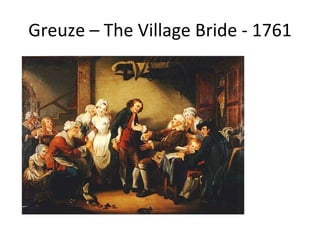
Greuze – The Village Bride - 1761
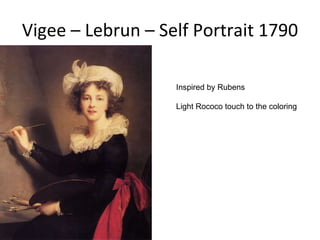
Vigee – Lebrun – Self Portrait 1790 Inspired by Rubens Light Rococo touch to the coloring
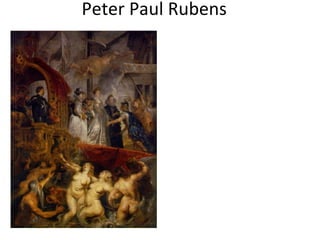
Peter Paul Rubens
English Painters & The Enlightment
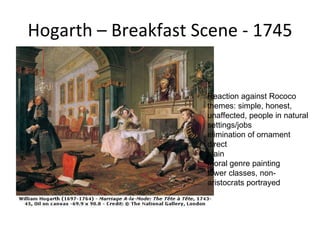
Hogarth – Breakfast Scene - 1745 Reaction against Rococo  themes: simple, honest, unaffected, people in natural settings/jobs  elimination of ornament  direct  plain  moral genre painting  lower classes, non-aristocrats portrayed
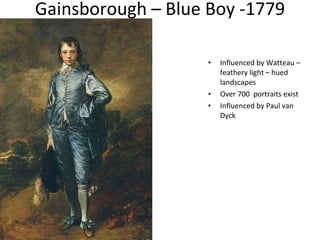
Gainsborough – Blue Boy -1779 Influenced by Watteau – feathery light – hued landscapes Over 700  portraits exist  Influenced by Paul van Dyck
 
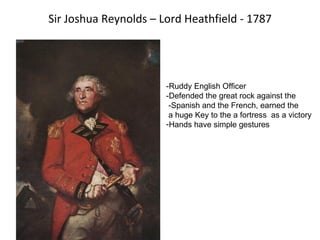
Reynolds  - Lord Heathfield -1787
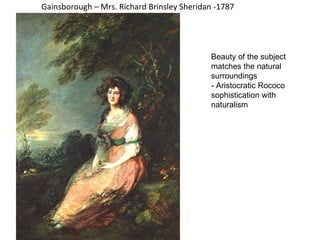
Gainsborough – Mrs. Richard Brinsley Sheridan -1787 Beaut Beauty of the subject matches the natural surroundings - Aristocratic Rococo sophistication with naturalism
Sir Joshua Reynolds – Lord Heathfield - 1787 -Ruddy English Officer -Defended the great rock against the -Spanish and the French, earned the a huge Key to the a fortress  as a victory Hands have simple gestures
Colonial America  Neoclassicism  - Neoclassicism inspired by the unearthing of the ruins at Pompeii and books of Johann Winckelmann  (first art history book) in 1764 Classical allusions ( with contemporary portraits) 18 th  century – Industrial Revolution  Enlightment brings on rejection of royal & aristocratic authority Classical Training at academies around Europe and the US
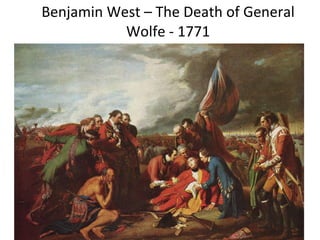
Benjamin West – The Death of General Wolfe - 1771
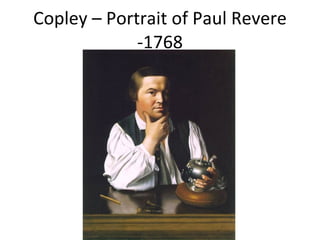
Copley – Portrait of Paul Revere -1768
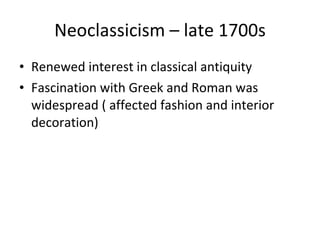
Neoclassicism – late 1700s Renewed interest in classical antiquity Fascination with Greek and Roman was widespread ( affected fashion and interior decoration)
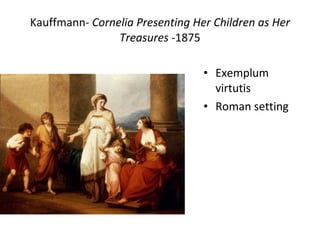
Kauffmann-  Cornelia Presenting Her Children as Her Treasures  -1875 Exemplum virtutis Roman setting
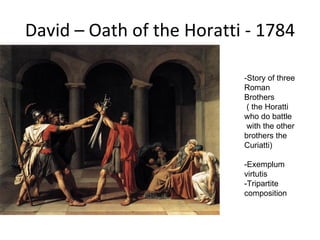
David – Oath of the Horatti - 1784 -Story of three Roman Brothers ( the Horatti who do battle with the other brothers the Curiatti)  -Exemplum virtutis -Tripartite composition
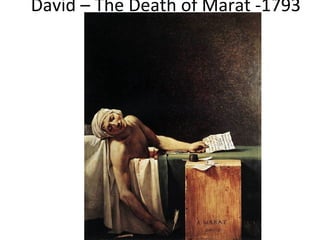
David – The Death of Marat -1793
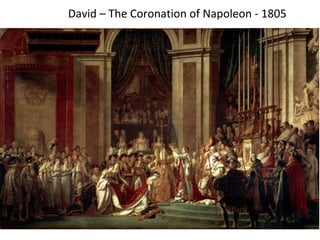
David – The Coronation of Napoleon - 1805
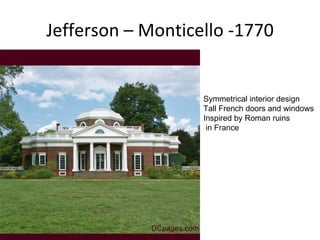
Jefferson – Monticello -1770 Symmetrical interior design Tall French doors and windows Inspired by Roman ruins in France
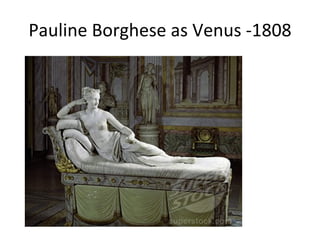
Pauline Borghese as Venus -1808

Ch.28 Rococo

  • 1.
    Ch. 28 - The Rococo French ro caille – pebble or shell Baro cco – baroque
  • 2.
    Aristocrats parallel inthe shift the Baroque to the Rococo Fete galante – which portrays the aristocracy in their leisurely pursuits. Paintings can be seductive Lavish, no straight lines in the Rococo – sophisticated and elegantly refined. Curves are a prominent feature in the Rococo architecture
  • 3.
    Fragonard – TheSwing -1766 Flowers and figures dominate the setting Colors are not thick or richly painted Made for private display
  • 4.
  • 5.
    Neumann – Churchof the 14 Saints -1743
  • 6.
    Watteau – TheReturn from Cythera -1717
  • 7.
    The Enlightment 18 th Century – revolutions erupted in France and America – ( French, American and Industrial Revolution in England all happened at the same time) Social and economic life dissolved. The Enlightment was a new way to think critically about the world. To think independent of religion, myth and tradition. Questioning theories, god, and now experimenting with science. Voltaire and his writings were very important
  • 8.
    Hunter – Childin Womb - 1774
  • 9.
    Joesph Wright ofDerby – A Philosopher Giving a Lecture at a Orrery - 1763
  • 10.
    Darby III &Pritchard – Iron Bridge at Coalbrookdale, England -1776 Bridge made out of iron Previous bridges made out of wood
  • 11.
    Voltaire and Rousseau Voltaire believed that the salvation of humanity was in advancement of science and the improvement of society Rousseau said that the “arts” had corrupted humanity from its original condition. “ Nature alone must be our guide”
  • 12.
    Greuze – TheVillage Bride - 1761
  • 13.
    Vigee – Lebrun– Self Portrait 1790 Inspired by Rubens Light Rococo touch to the coloring
  • 14.
  • 15.
    English Painters &The Enlightment
  • 16.
    Hogarth – BreakfastScene - 1745 Reaction against Rococo themes: simple, honest, unaffected, people in natural settings/jobs elimination of ornament direct plain moral genre painting lower classes, non-aristocrats portrayed
  • 17.
    Gainsborough – BlueBoy -1779 Influenced by Watteau – feathery light – hued landscapes Over 700 portraits exist Influenced by Paul van Dyck
  • 18.
  • 19.
    Reynolds -Lord Heathfield -1787
  • 20.
    Gainsborough – Mrs.Richard Brinsley Sheridan -1787 Beaut Beauty of the subject matches the natural surroundings - Aristocratic Rococo sophistication with naturalism
  • 21.
    Sir Joshua Reynolds– Lord Heathfield - 1787 -Ruddy English Officer -Defended the great rock against the -Spanish and the French, earned the a huge Key to the a fortress as a victory Hands have simple gestures
  • 22.
    Colonial America Neoclassicism - Neoclassicism inspired by the unearthing of the ruins at Pompeii and books of Johann Winckelmann (first art history book) in 1764 Classical allusions ( with contemporary portraits) 18 th century – Industrial Revolution Enlightment brings on rejection of royal & aristocratic authority Classical Training at academies around Europe and the US
  • 23.
    Benjamin West –The Death of General Wolfe - 1771
  • 24.
    Copley – Portraitof Paul Revere -1768
  • 25.
    Neoclassicism – late1700s Renewed interest in classical antiquity Fascination with Greek and Roman was widespread ( affected fashion and interior decoration)
  • 26.
    Kauffmann- CorneliaPresenting Her Children as Her Treasures -1875 Exemplum virtutis Roman setting
  • 27.
    David – Oathof the Horatti - 1784 -Story of three Roman Brothers ( the Horatti who do battle with the other brothers the Curiatti) -Exemplum virtutis -Tripartite composition
  • 28.
    David – TheDeath of Marat -1793
  • 29.
    David – TheCoronation of Napoleon - 1805
  • 30.
    Jefferson – Monticello-1770 Symmetrical interior design Tall French doors and windows Inspired by Roman ruins in France
  • 31.