Background
@  Begun as a French style of interior
   decoration during the period that
   followed Louis XIV’s death.
     E  Régence Style (1715-1723)
     E  Versailles society was in a
        temporary eclipse.
     E  French power and fashion centered
        around the court of the Regent,
        Philippe d’Orleáns at the Palais-
        Royal in Paris.
Background
@  Derived from the French word, rocaille,
   or “rock-work.”
@  The ‘softer side’ of the Baroque [or a
   reaction against it].
     E  A backlash to the darkness of the
        Baroque  less formal &
        grandiose.
@  Eventually replaced by Neo-
   Classicism, the artistic style of the
   American and French Revolutions.
@  Light, elaborate, decorative.


@  The Rococo palette, softer and paler
   [pastels] than the rich primary colors
   and dark tonalities of the Baroque
   style.

@  Ornate and fussy details.
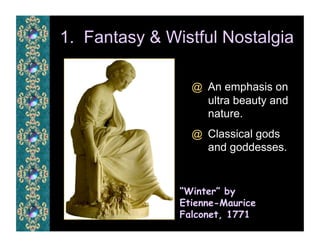
1. Fantasy & Wistful Nostalgia

                 @  An emphasis on
                    ultra beauty and
                    nature.
                 @  Classical gods
                    and goddesses.


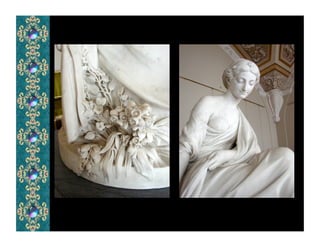
               “Winter” by
               Etienne-Maurice
               Falconet, 1771
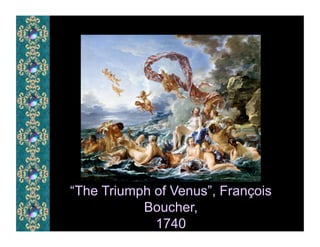
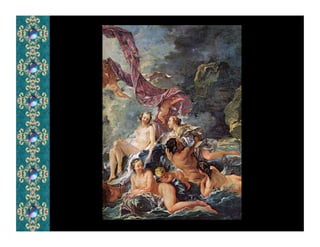
“The Triumph of Venus”, François
           Boucher,
             1740
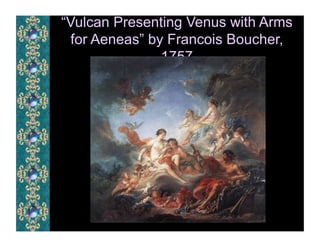
“Vulcan Presenting Venus with Arms
  for Aeneas” by Francois Boucher,
                1757
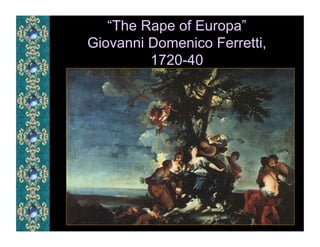
“The Rape of Europa”
Giovanni Domenico Ferretti,
         1720-40
2. Love, Romance, & Eroticism
                @  [about Boucher]
                    His canvases
                    often seem to
                    consist of little
                    beyond mounds
                    of pink flesh…


                “The Toilet of Venus”
                by François Boucher,
                1751
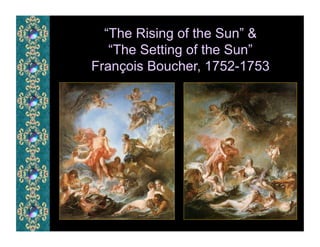
“The Rising of the Sun” &
   “The Setting of the Sun”
François Boucher, 1752-1753
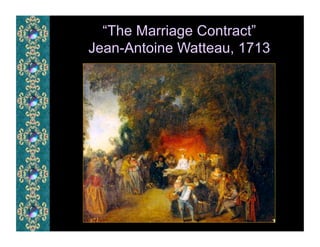
“The Marriage Contract”
Jean-Antoine Watteau, 1713
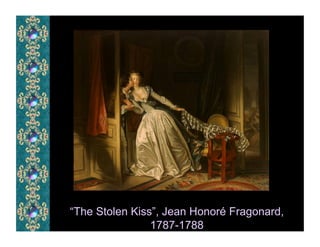
“The Stolen Kiss”, Jean Honoré Fragonard,
                1787-1788
3. Domestic & Family Life

 @  Portrays the carefree life of the
    upper class.
     E  The Galante style.
 @  Informal, decorous intimacy of
    peoples’ manners.
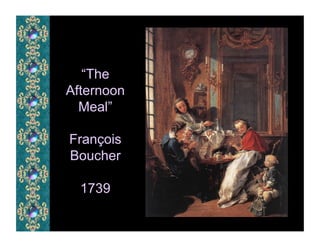
“The
Afternoon
  Meal”

François
Boucher

  1739
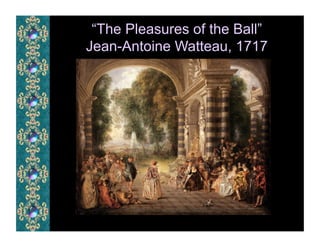
“The Pleasures of the Ball”
Jean-Antoine Watteau, 1717
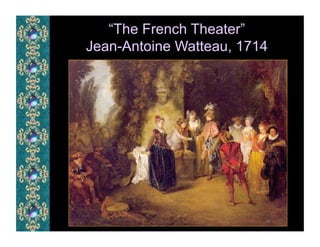
“The French Theater”
Jean-Antoine Watteau, 1714
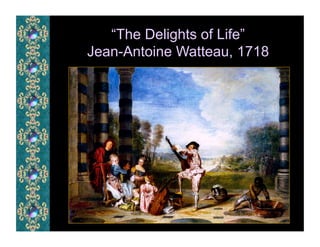
“The Delights of Life”
Jean-Antoine Watteau, 1718
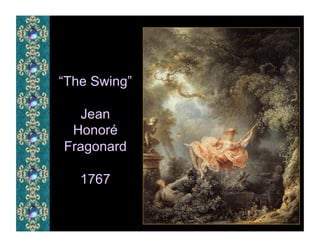
“The Swing”

   Jean
 Honoré
Fragonard

   1767
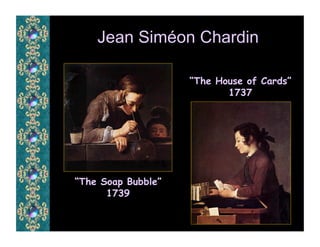
Jean Siméon Chardin

                    “The House of Cards”
                           1737


“The Soap Bubble”
      1739
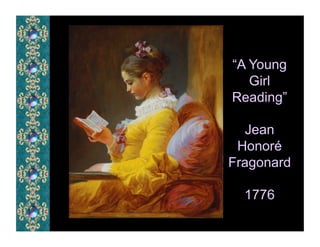
“A Young
   Girl
Reading”

   Jean
 Honoré
Fragonard

  1776
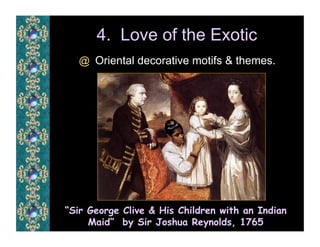
4. Love of the Exotic
  @  Oriental decorative motifs & themes.


“Sir George Clive & His Children with an Indian
     Maid” by Sir Joshua Reynolds, 1765
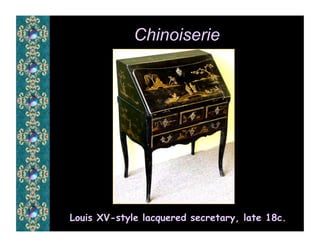
Chinoiserie


Louis XV-style lacquered secretary, late 18c.
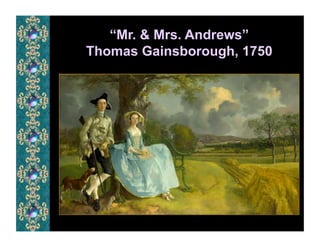
“Mr. & Mrs. Andrews”
Thomas Gainsborough, 1750
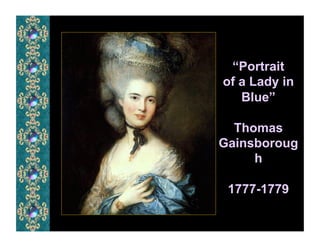
“Portrait
of a Lady in
   Blue”

  Thomas
Gainsboroug
     h

 1777-1779
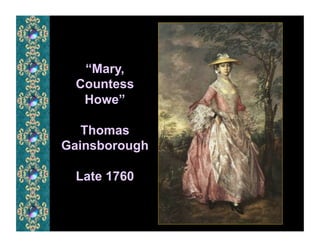
“Mary,
 Countess
  Howe”

   Thomas
Gainsborough

 Late 1760
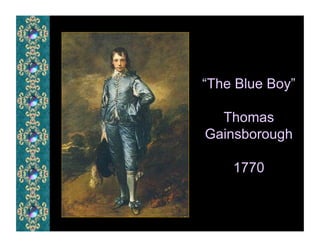
“The Blue Boy”

  Thomas
Gainsborough

    1770
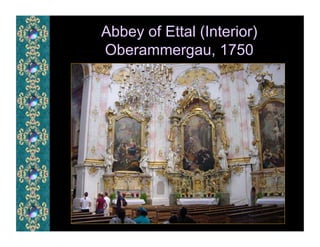
Abbey of Ettal (Interior)
Oberammergau, 1750
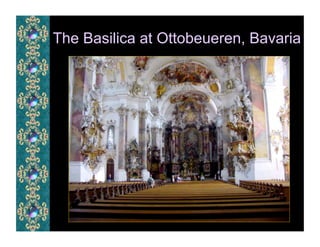
The Basilica at Ottobeueren, Bavaria
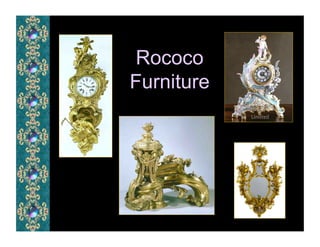
Rococo
Furniture
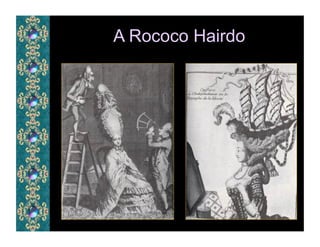
A Rococo Hairdo
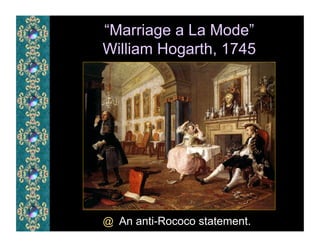
“Marriage a La Mode”
William Hogarth, 1745


@  An anti-Rococo statement.

Rococo Art