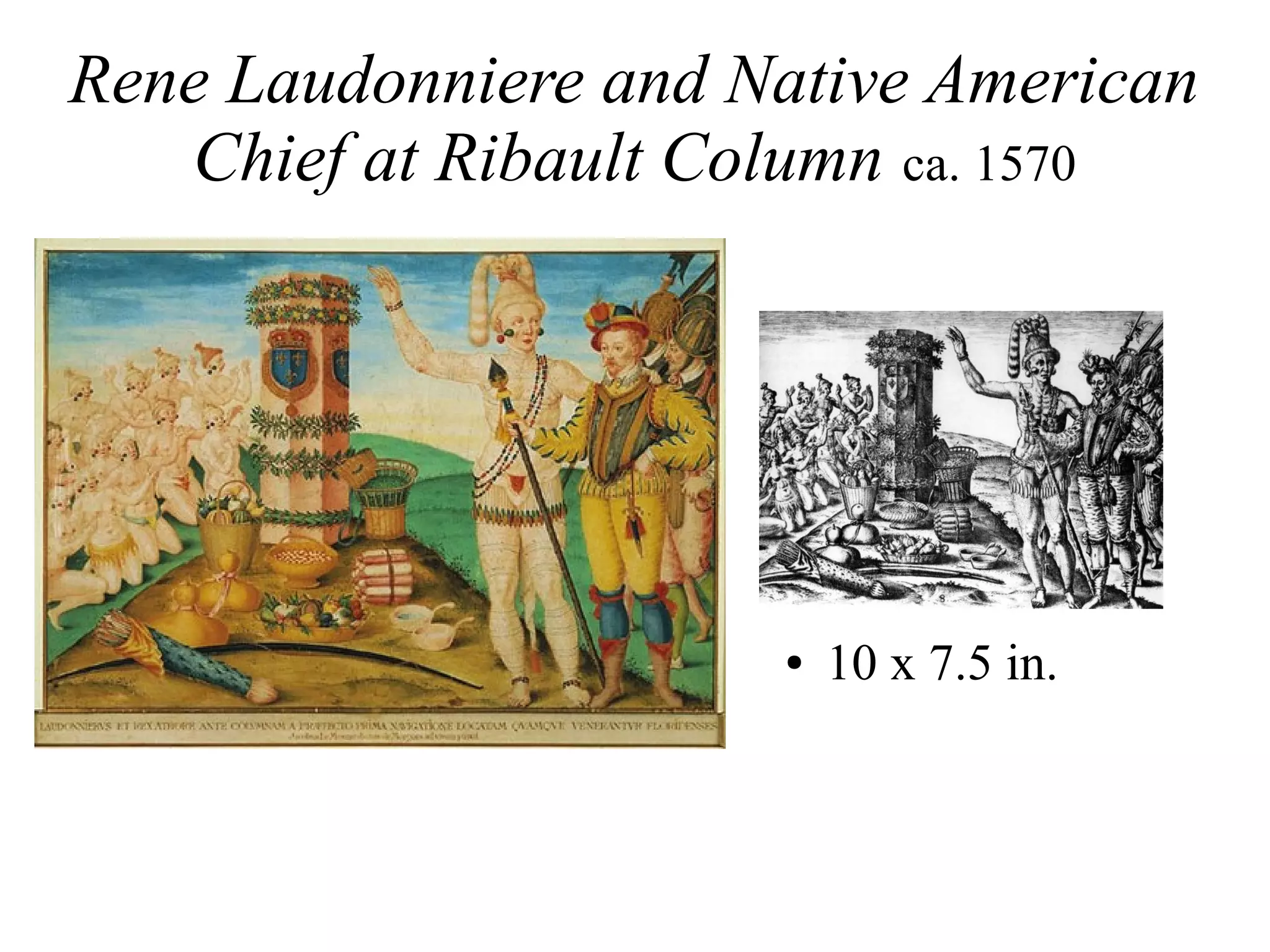
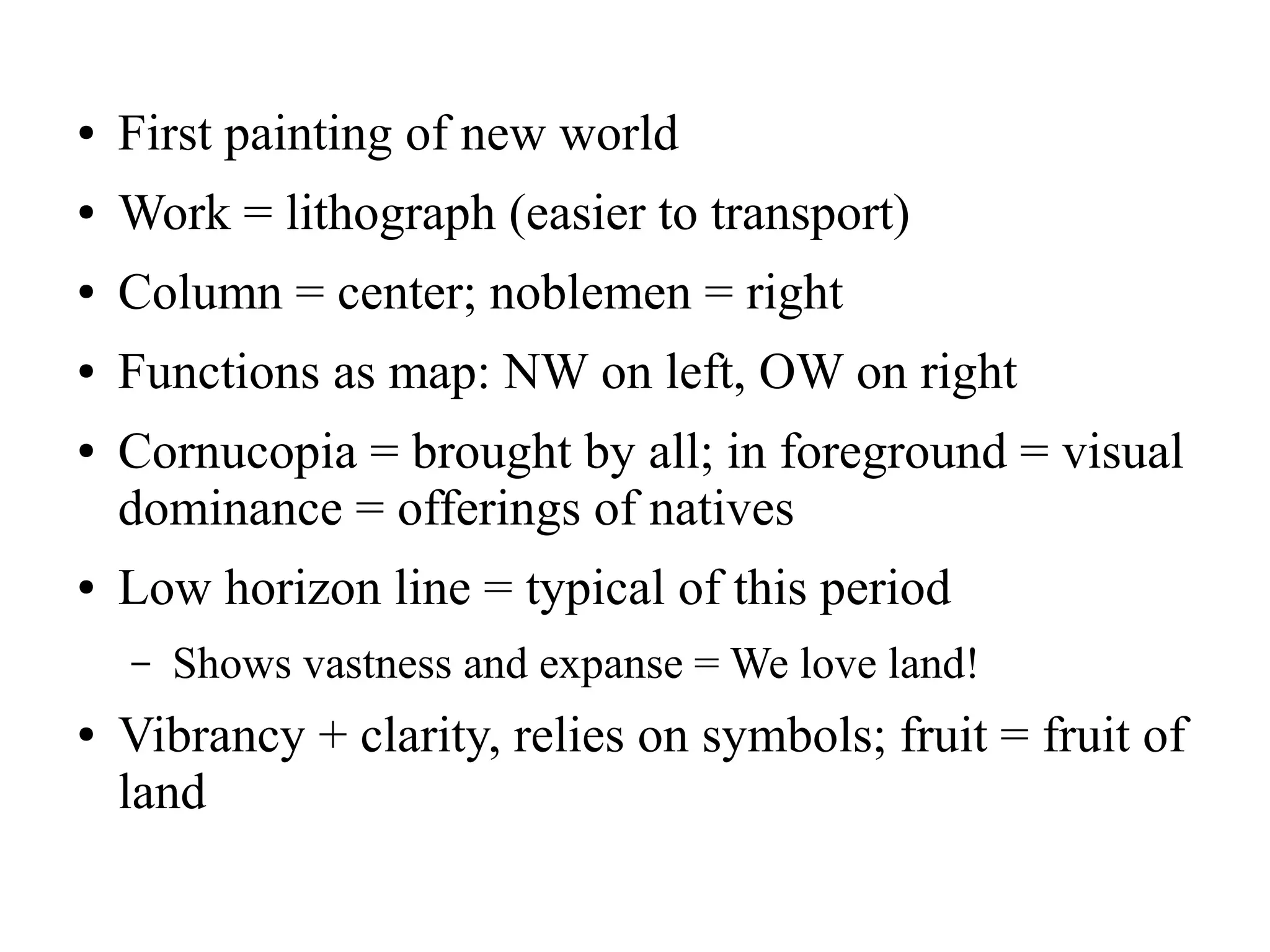
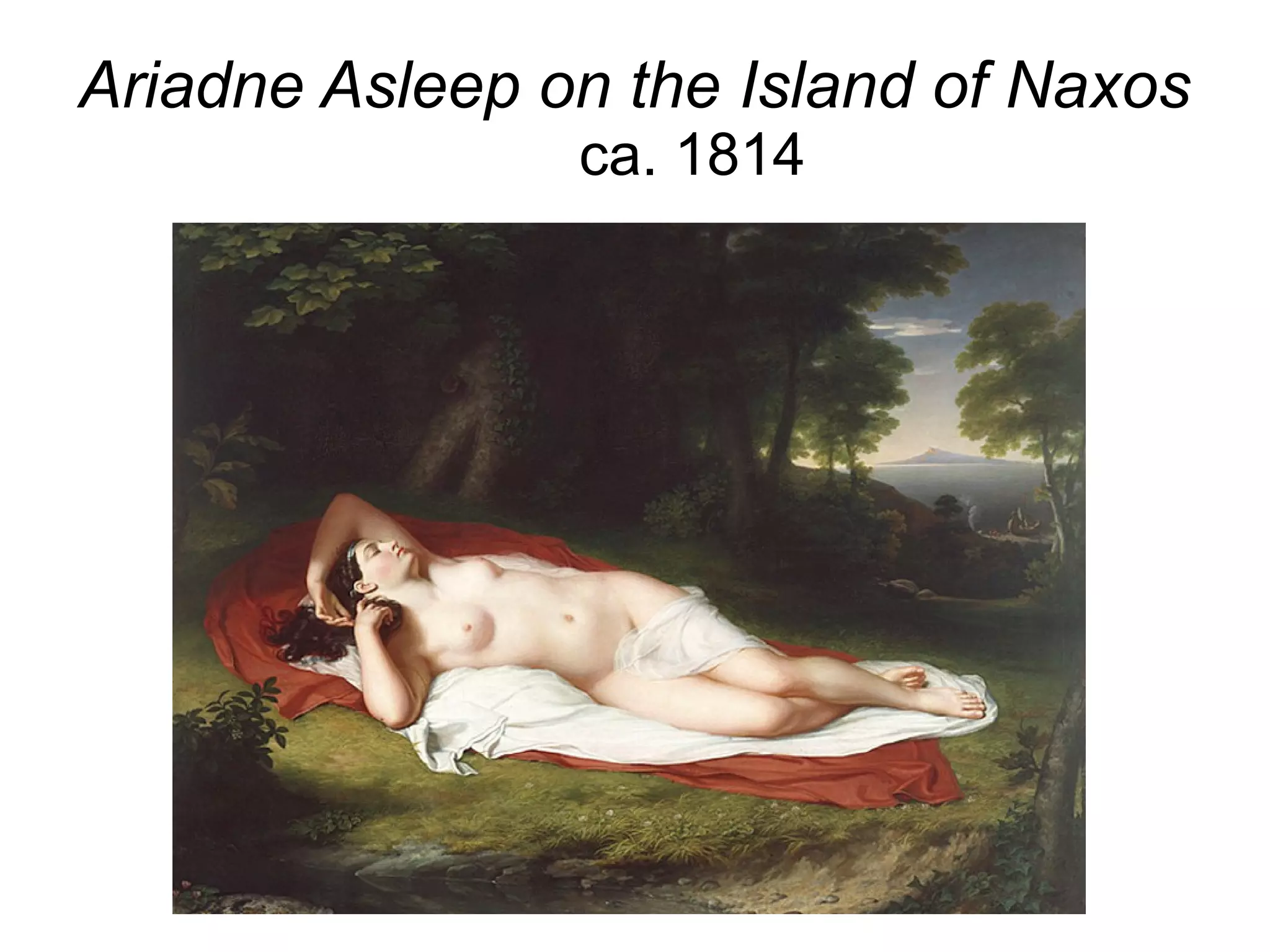
Rene Laudonniere and Native American
Chief at Ribault Column ca. 1570
● 10 x 7.5 in.
● First painting of new world
● Work = lithograph (easier to transport)
● Column = center; noblemen = right
● Functions as map: NW on left, OW on right
● Cornucopia = brought by all; in foreground = visual
dominance = offerings of natives
● Low horizon line = typical of this period
– Shows vastness and expanse = We love land!
● Vibrancy + clarity, relies on symbols; fruit = fruit of
land
● Column built in 1562 by Jean Ribault, a French navy
officer, explorer, and colonizer
● In Jax, FL! Statement to claim land 4 France
● Meant to document historical event but did Le Moyne
ever see it??
*About memory
● Natives naked = statement of uncivilized + kneeling =
no pwr
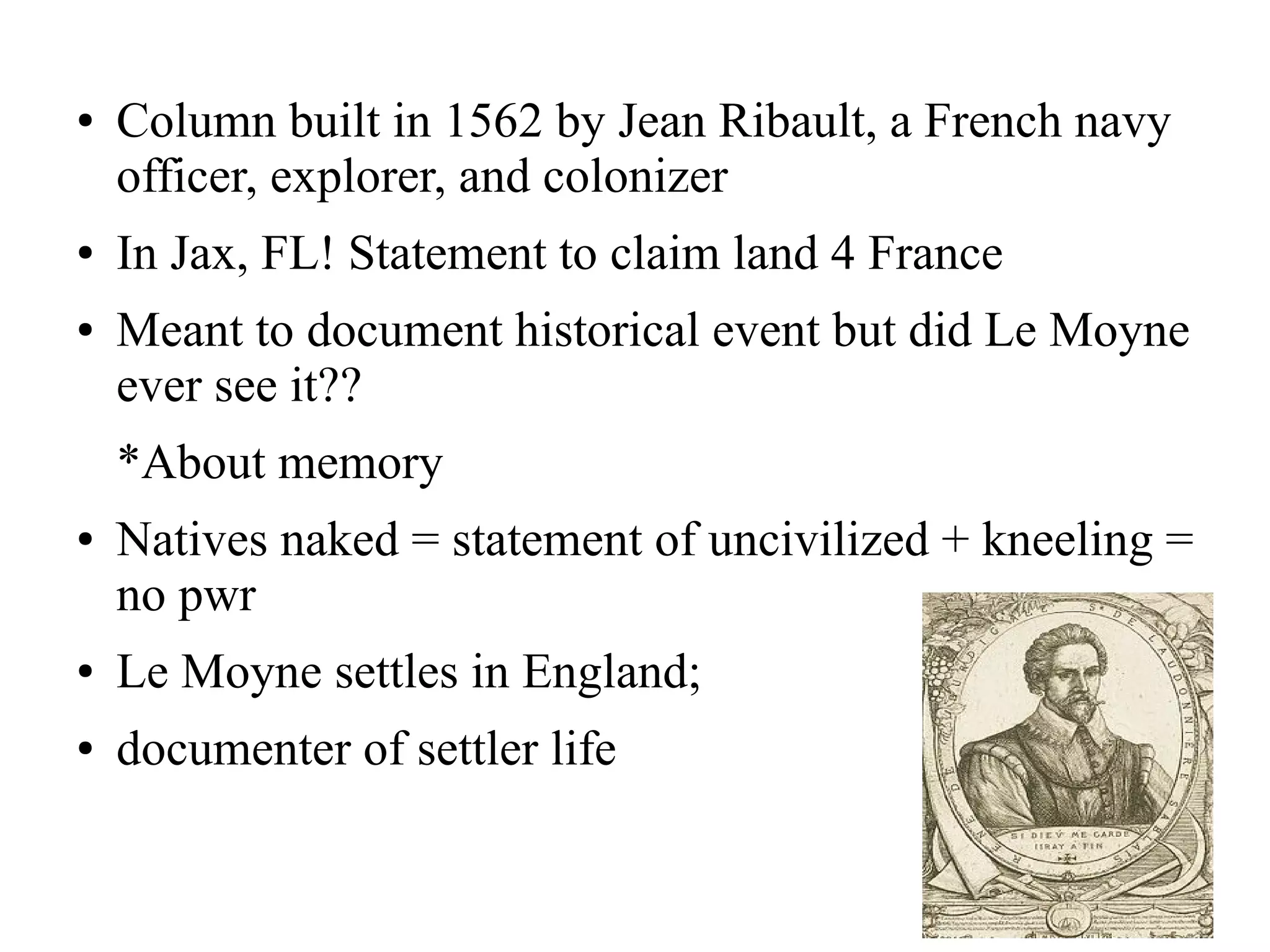
● Le Moyne settles in England;
● documenter of settler life
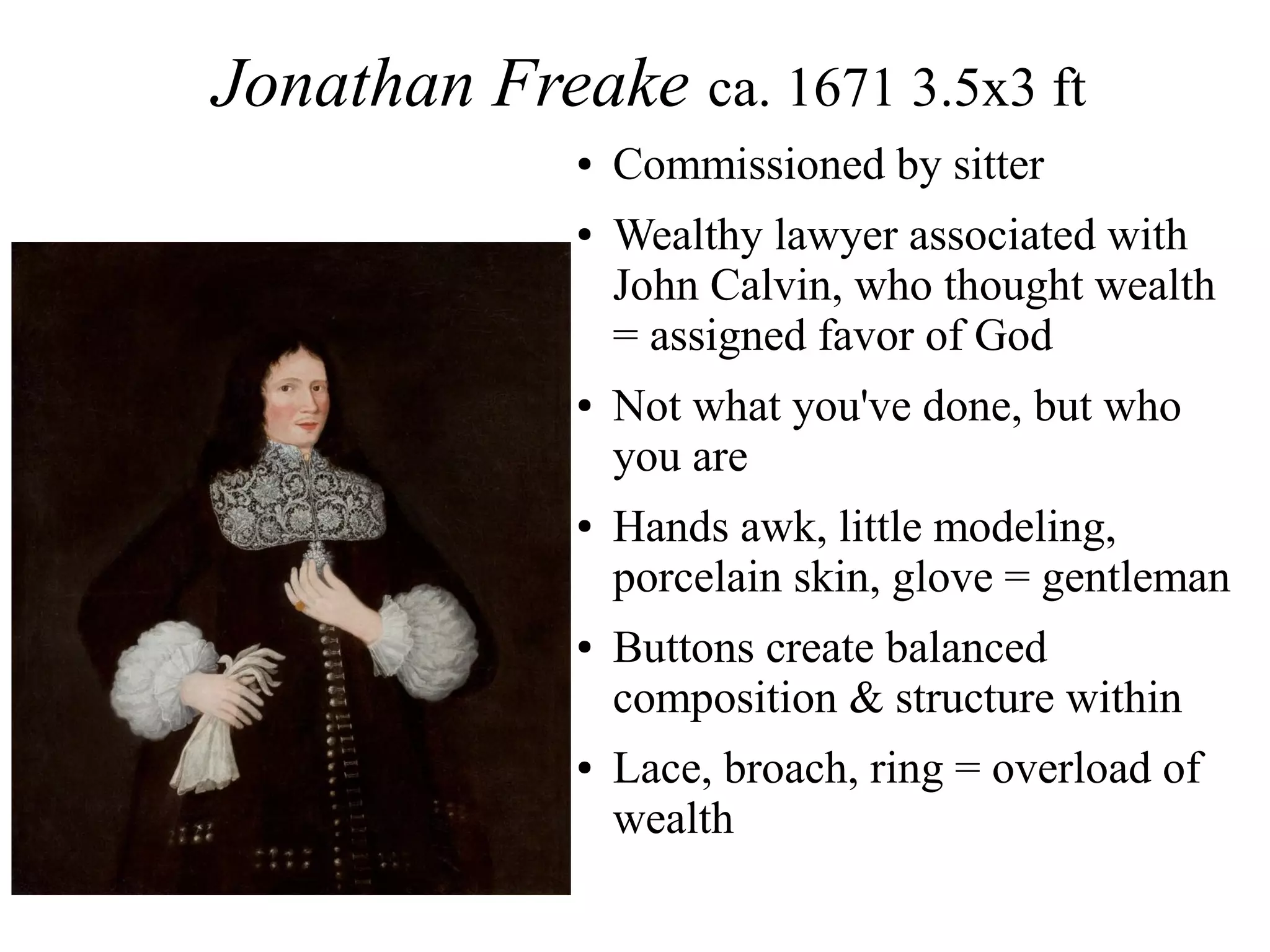
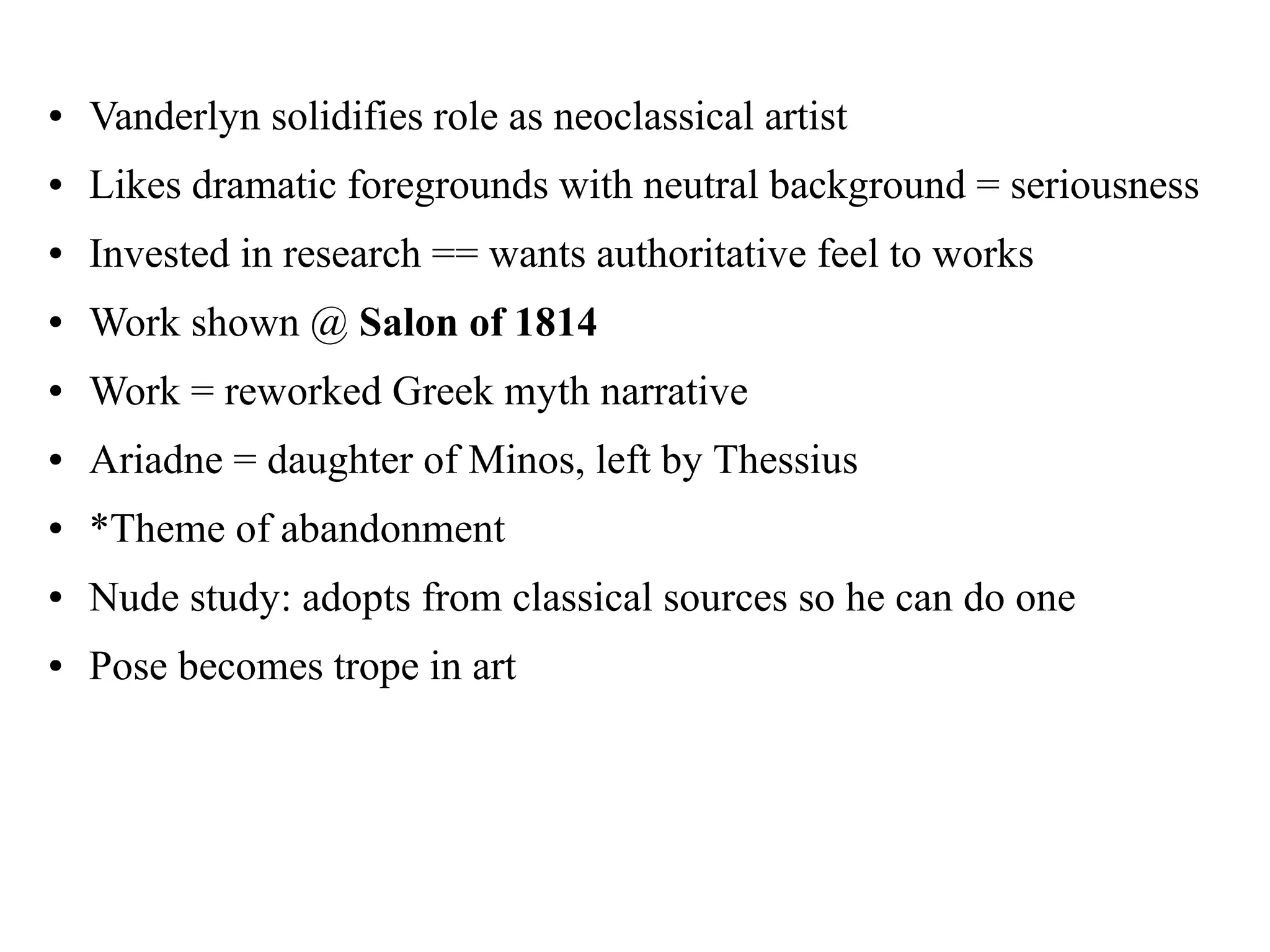
Jonathan Freake ca. 1671 3.5x3 ft
● Commissioned by sitter
● Wealthy lawyer associated with
John Calvin, who thought wealth
= assigned favor of God
● Not what you've done, but who
you are
● Hands awk, little modeling,
porcelain skin, glove = gentleman
● Buttons create balanced
composition & structure within
● Lace, broach, ring = overload of
wealth
Jonathan Freake cont.
● Sense of elegance conveyed
● No wig = no British association
● Imported fashions – distinguished from Brits + wrking class
● Long hair = not puritan, but hair length = medium = balance
puritan and wrking class = intersection of 3 IDs
● Flushed cheeks, direct gaze, position of confidence
● Freake portraits = identity + balance
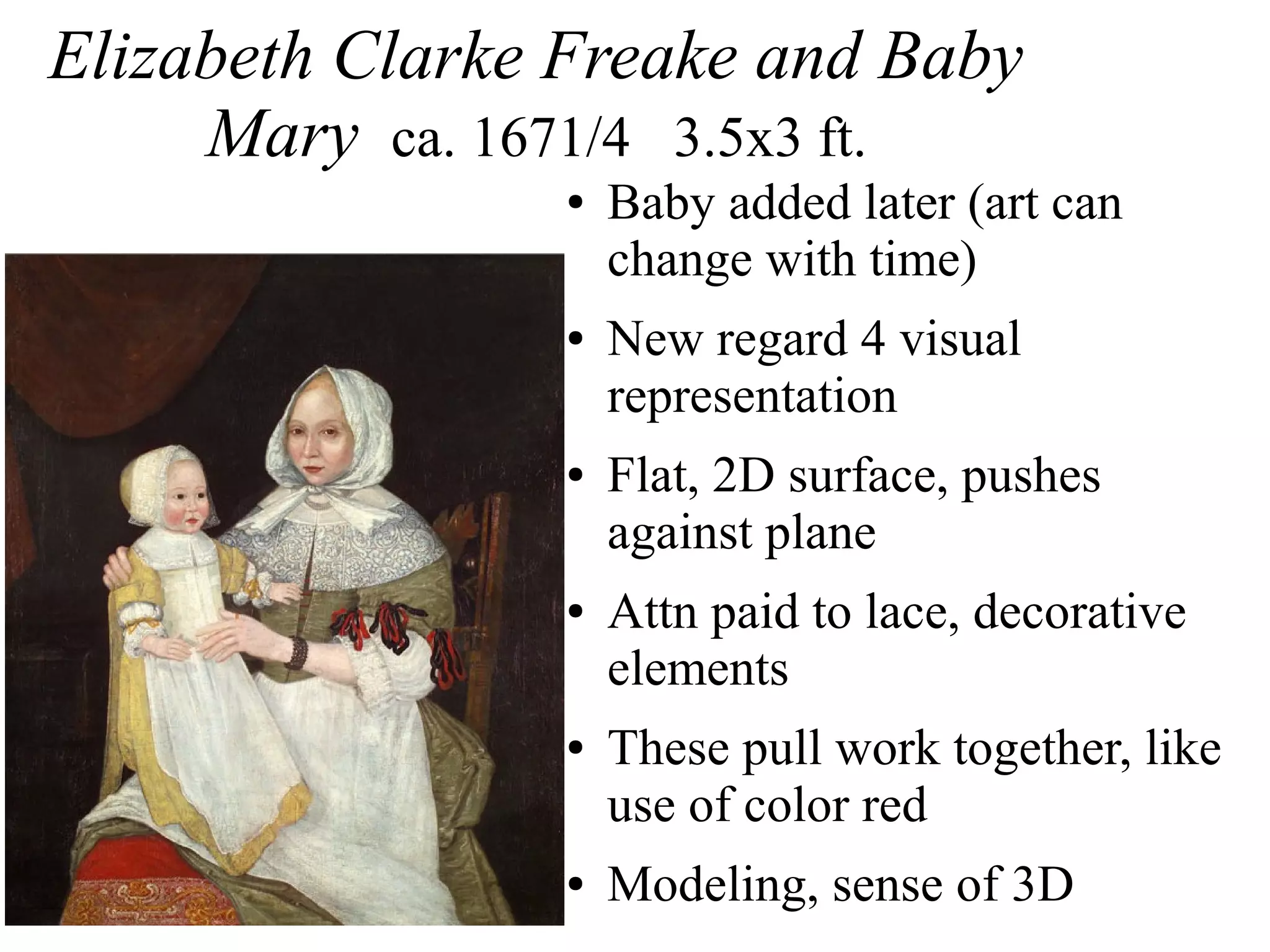
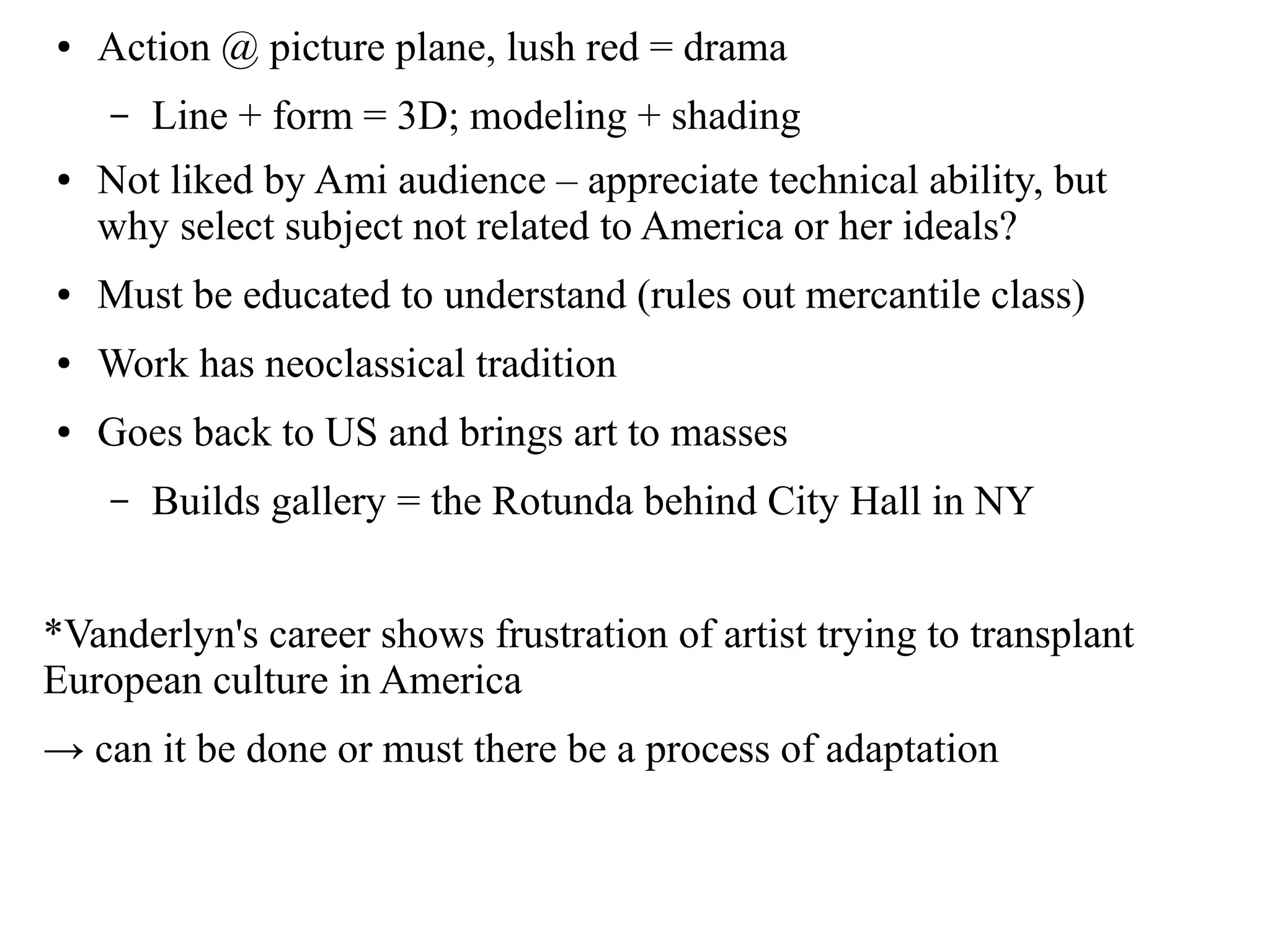
Elizabeth Clarke Freake and Baby
Mary ca. 1671/4 3.5x3 ft.
● Baby added later (art can
change with time)
● New regard 4 visual
representation
● Flat, 2D surface, pushes
against plane
● Attn paid to lace, decorative
elements
● These pull work together, like
use of color red
● Modeling, sense of 3D
Elizabeth Clarke Freake and Baby
Mary cont.
● Typical madonna + child placement/motif = conscious
Xtian reference
● Gold + silver displayed; tapestry (Baroque flavor)
● “turkey-work”: gesture to Middle Eastern influences
→ suggestion of worldliness
● Her clothes probably from all over Europe
● These portraits set precedent of including furniture as
sign of affluence (Cromwellian chair)
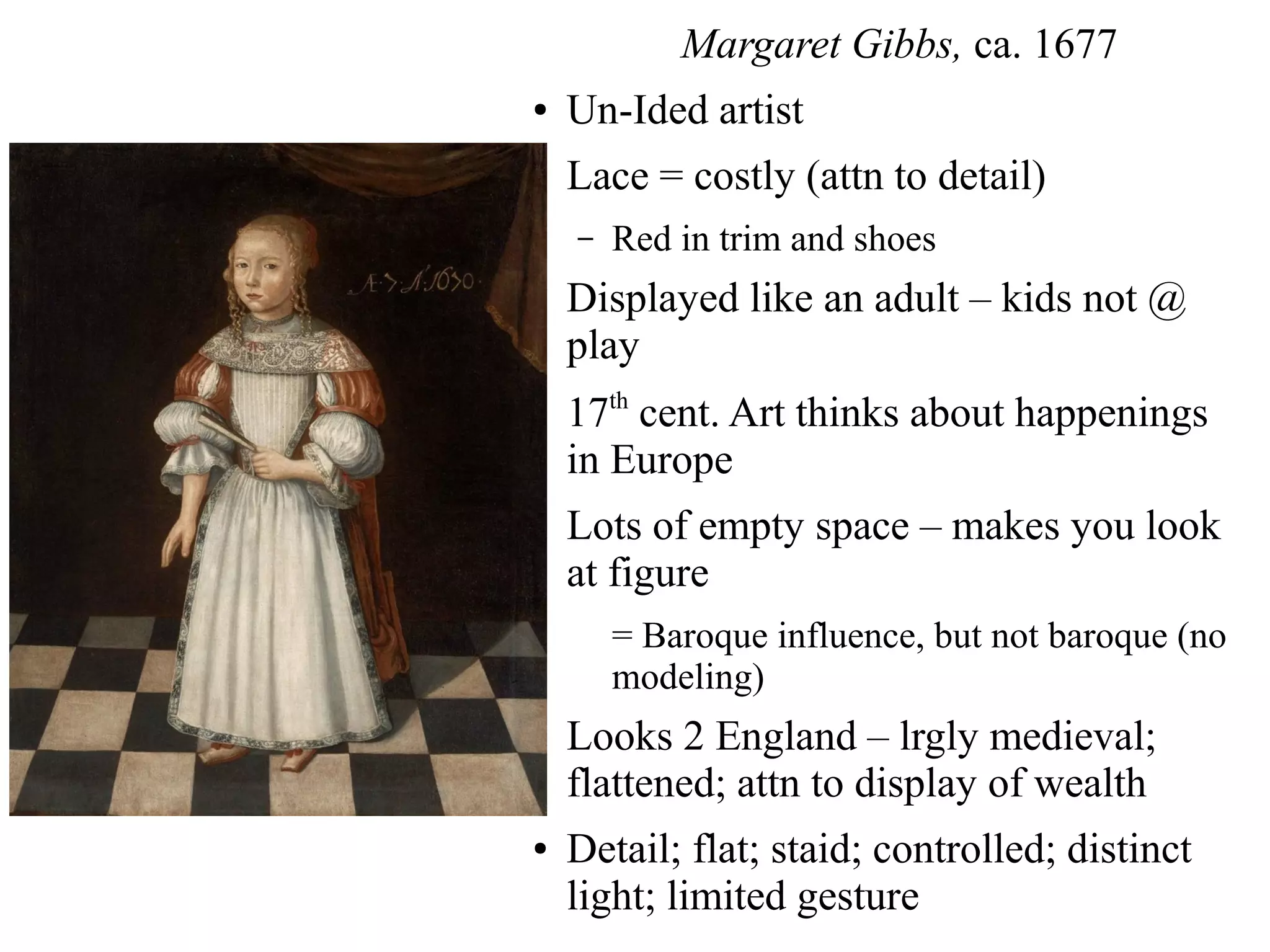
Margaret Gibbs, ca. 1677
● Un-Ided artist
● Lace = costly (attn to detail)
– Red in trim and shoes
● Displayed like an adult – kids not @
play
●
17th
cent. Art thinks about happenings
in Europe
● Lots of empty space – makes you look
at figure
= Baroque influence, but not baroque (no
modeling)
● Looks 2 England – lrgly medieval;
flattened; attn to display of wealth
● Detail; flat; staid; controlled; distinct
light; limited gesture
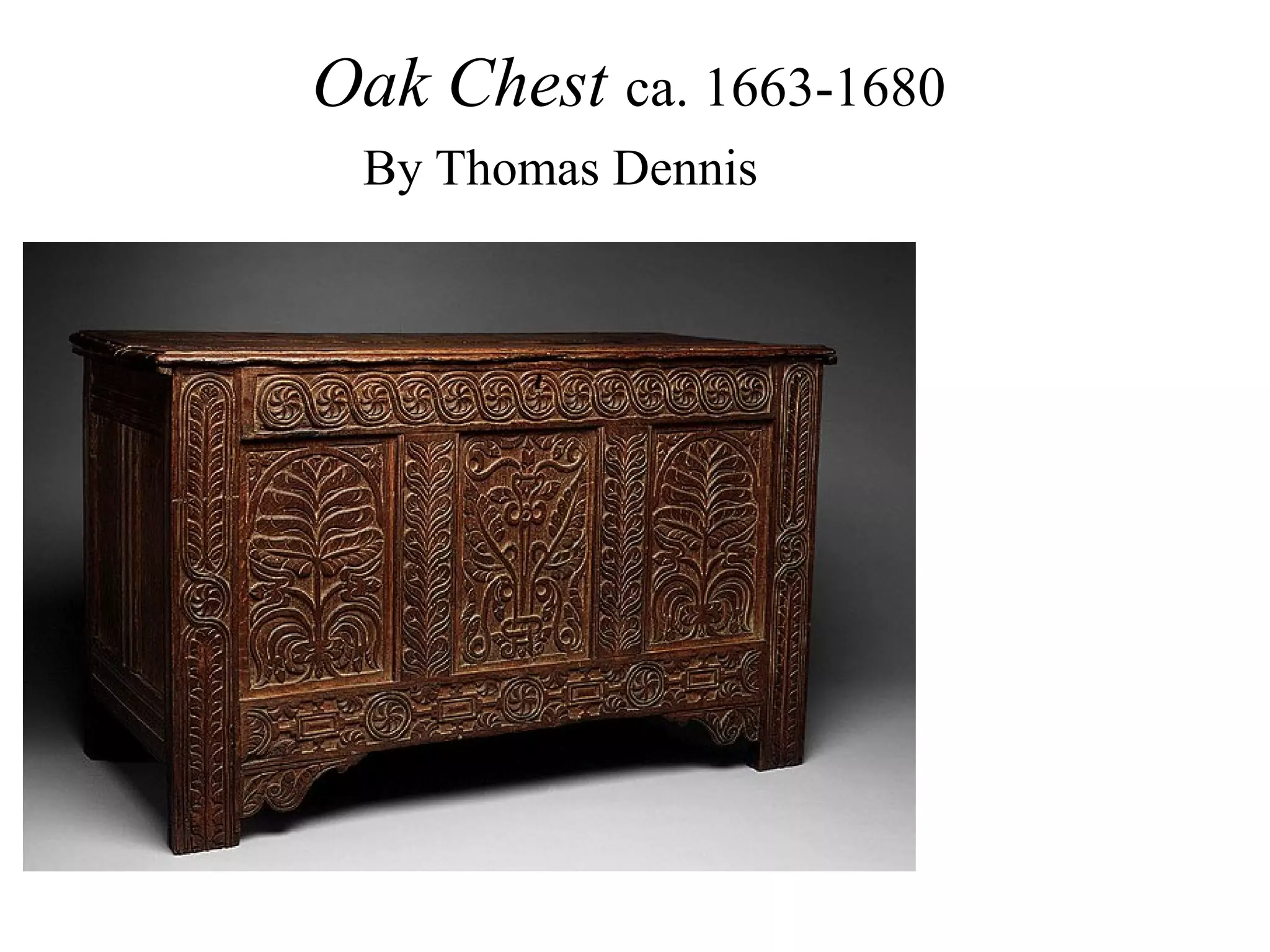
Oak Chest ca. 1663-1680
By Thomas Dennis
Oak Chest by Thomas Dennis
● Furniture, dress = material culture = manmade objects
● Jules Prown (scholar) thought manmade works reflect values
of those who made them & society in which they live
● Owned by wealthy, ornate, careful detail
● High skill required (usually thru apprenticeship)
● Covered in decorative patterning = low-relief (sculptural)
● Intricate patterns
● Artisans make material culture
● Displays skill of carver, aesthetic + technical skill liked
● Blend of artistry + practicality
● Art served greater purpose than hanging in museums
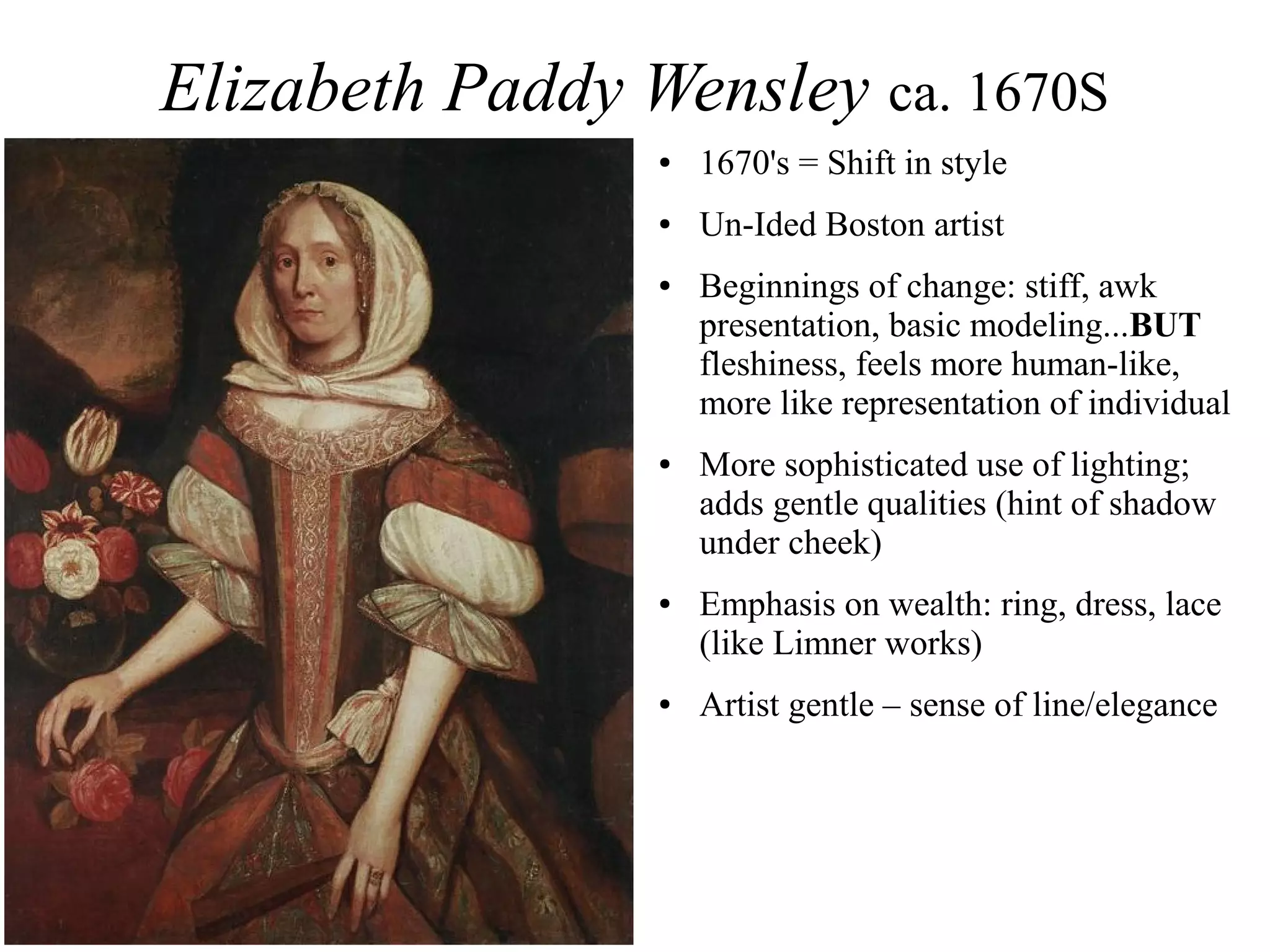
Elizabeth Paddy Wensley ca. 1670S
● 1670's = Shift in style
● Un-Ided Boston artist
● Beginnings of change: stiff, awk
presentation, basic modeling...BUT
fleshiness, feels more human-like,
more like representation of individual
● More sophisticated use of lighting;
adds gentle qualities (hint of shadow
under cheek)
● Emphasis on wealth: ring, dress, lace
(like Limner works)
● Artist gentle – sense of line/elegance
Elizabeth Paddy Wensley cont.
dow device: gives perspective = challenge for
scape hard 2 read, but Baroque influence with
sh court styles (rich color)
t aware of what needs to be added to show
acteristic of sitter (wants to make her pretty)
e comfort among artists in New World
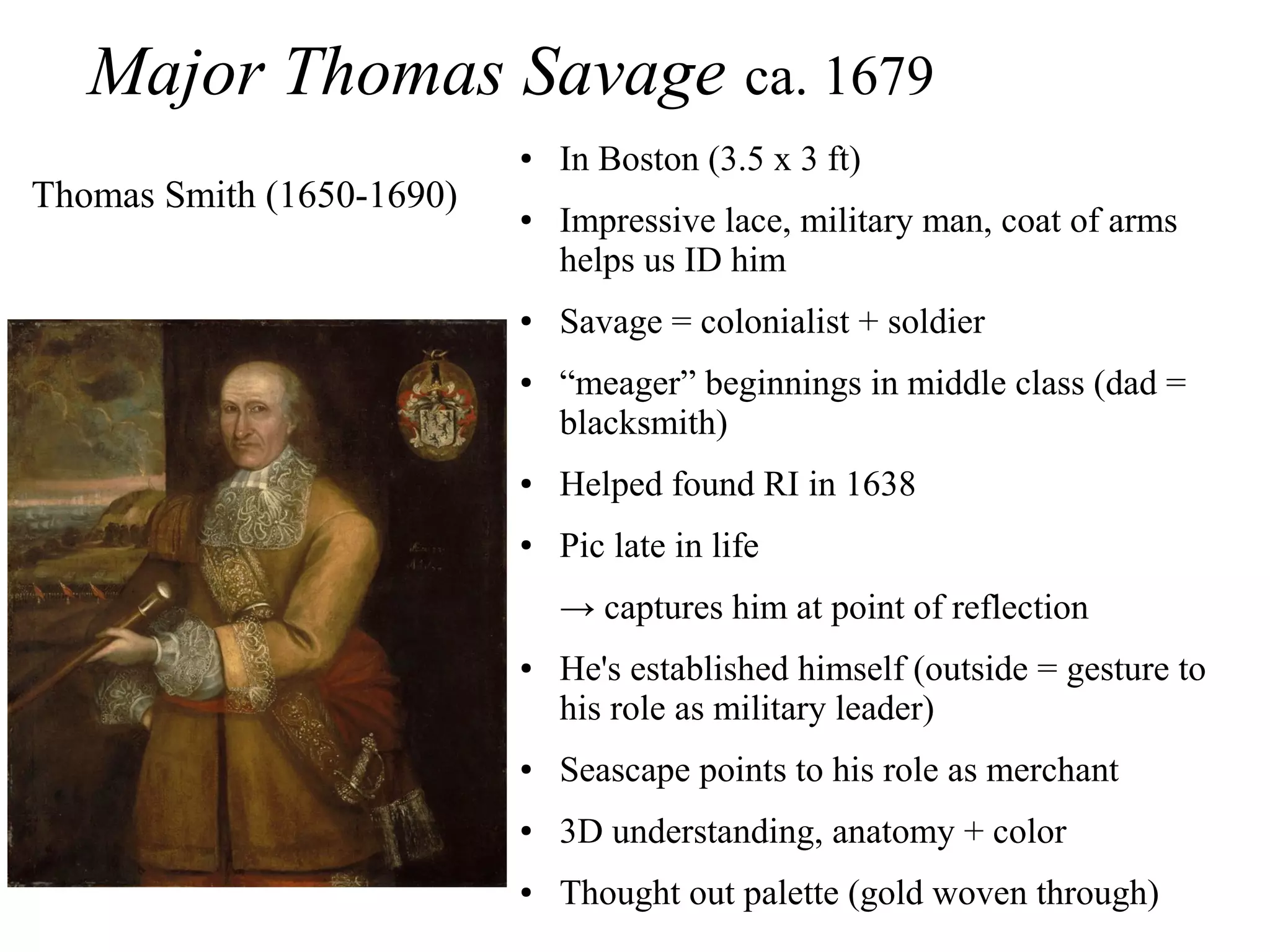
Major Thomas Savage ca. 1679
● In Boston (3.5 x 3 ft)
● Impressive lace, military man, coat of arms
helps us ID him
● Savage = colonialist + soldier
● “meager” beginnings in middle class (dad =
blacksmith)
● Helped found RI in 1638
● Pic late in life
→ captures him at point of reflection
● He's established himself (outside = gesture to
his role as military leader)
● Seascape points to his role as merchant
● 3D understanding, anatomy + color
● Thought out palette (gold woven through)
Thomas Smith (1650-1690)
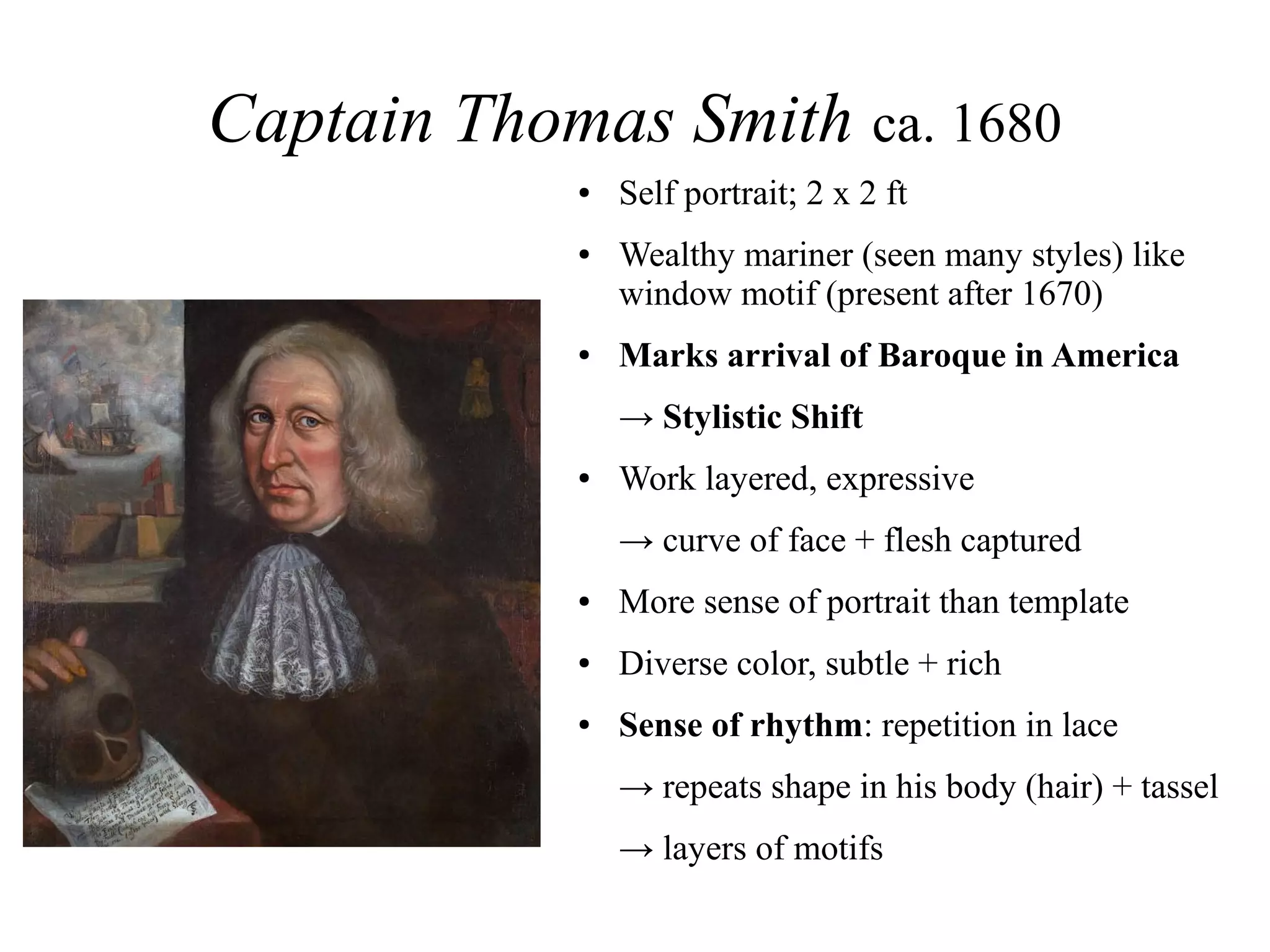
Captain Thomas Smith ca. 1680
● Self portrait; 2 x 2 ft
● Wealthy mariner (seen many styles) like
window motif (present after 1670)
● Marks arrival of Baroque in America
→ Stylistic Shift
● Work layered, expressive
→ curve of face + flesh captured
● More sense of portrait than template
● Diverse color, subtle + rich
● Sense of rhythm: repetition in lace
→ repeats shape in his body (hair) + tassel
→ layers of motifs
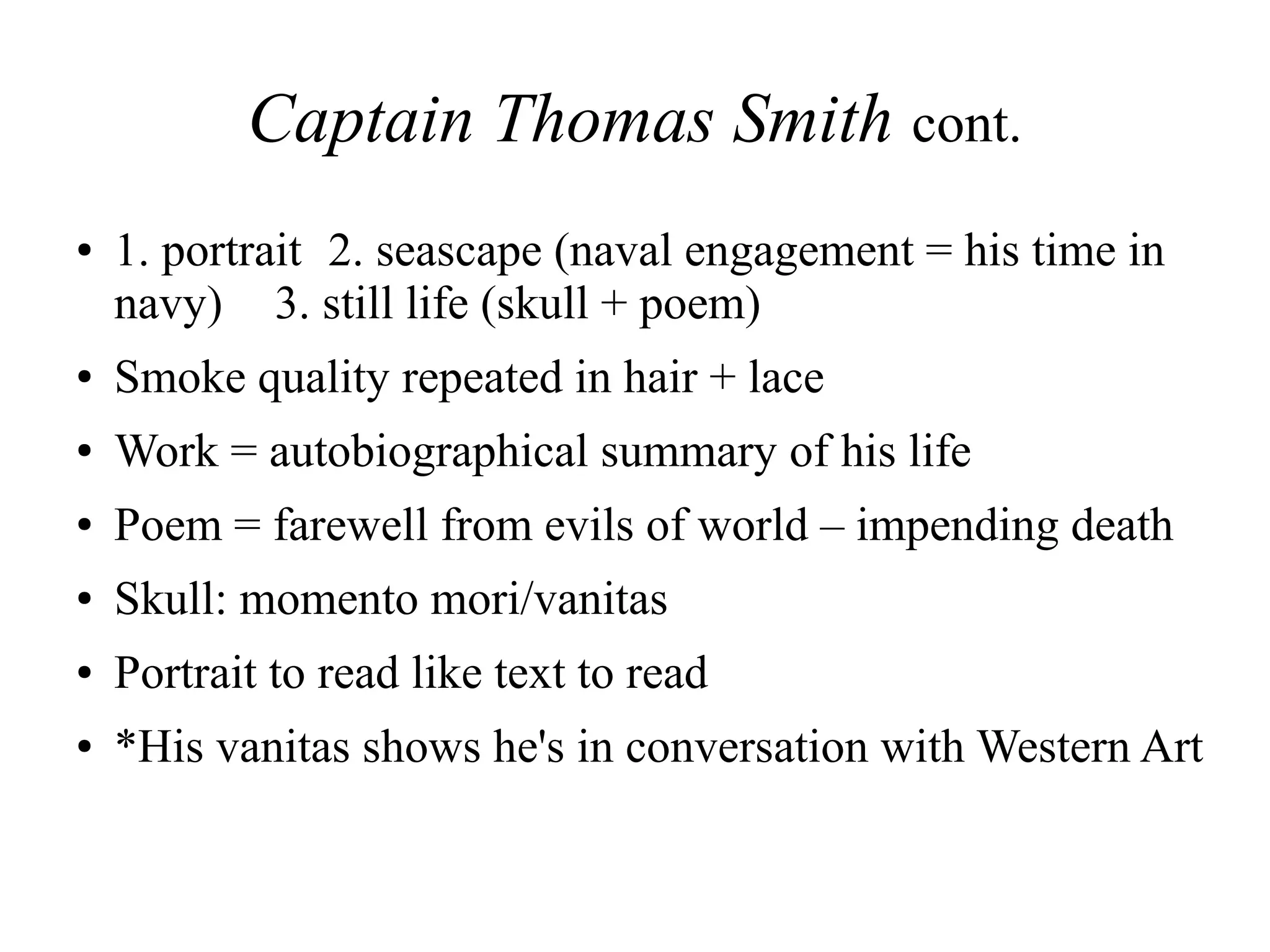
Captain Thomas Smith cont.
● 1. portrait 2. seascape (naval engagement = his time in
navy) 3. still life (skull + poem)
● Smoke quality repeated in hair + lace
● Work = autobiographical summary of his life
● Poem = farewell from evils of world – impending death
● Skull: momento mori/vanitas
● Portrait to read like text to read
● *His vanitas shows he's in conversation with Western Art
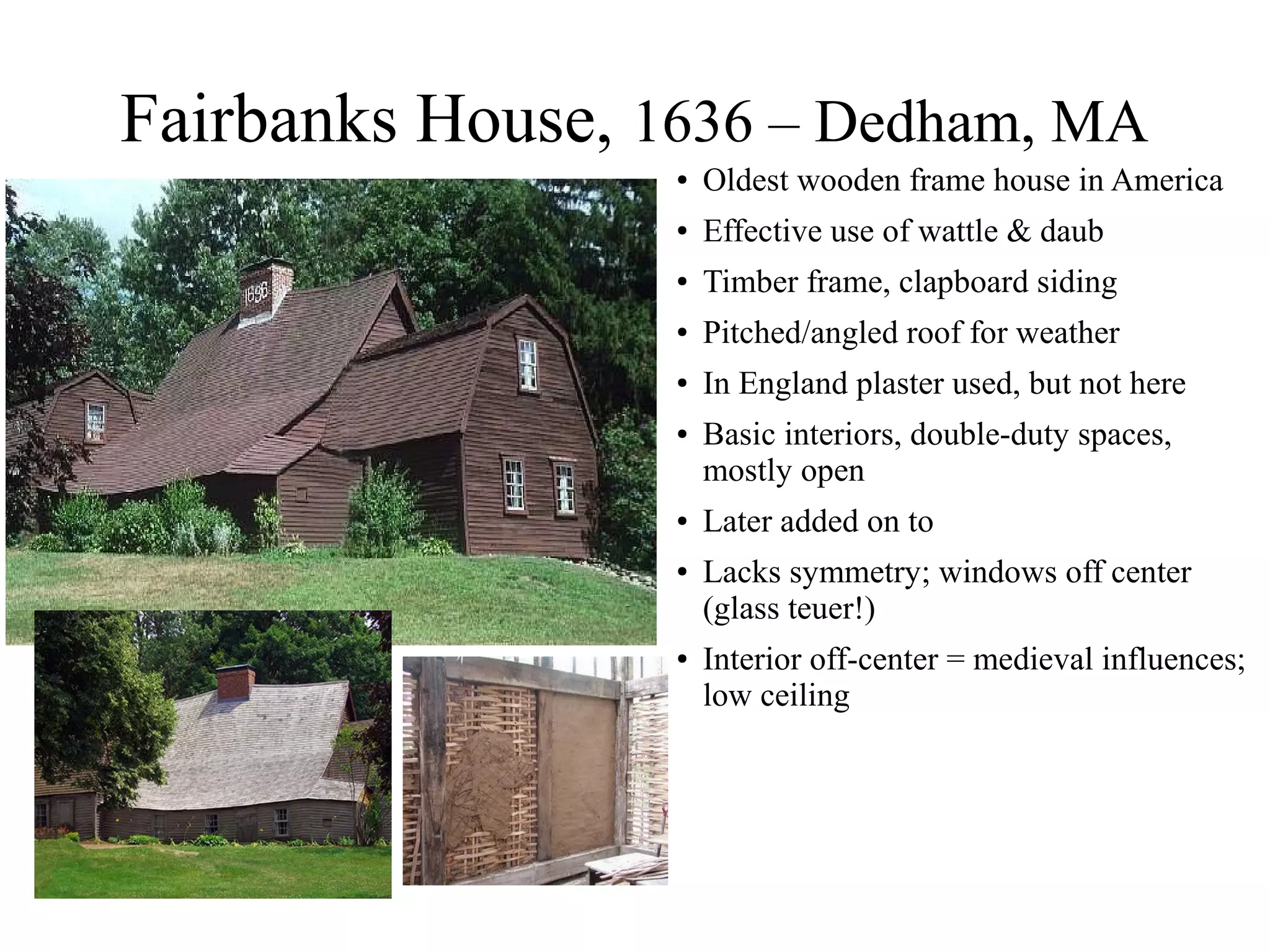
Fairbanks House, 1636 – Dedham, MA
● Oldest wooden frame house in America
● Effective use of wattle & daub
● Timber frame, clapboard siding
● Pitched/angled roof for weather
● In England plaster used, but not here
● Basic interiors, double-duty spaces,
mostly open
● Later added on to
● Lacks symmetry; windows off center
(glass teuer!)
● Interior off-center = medieval influences;
low ceiling
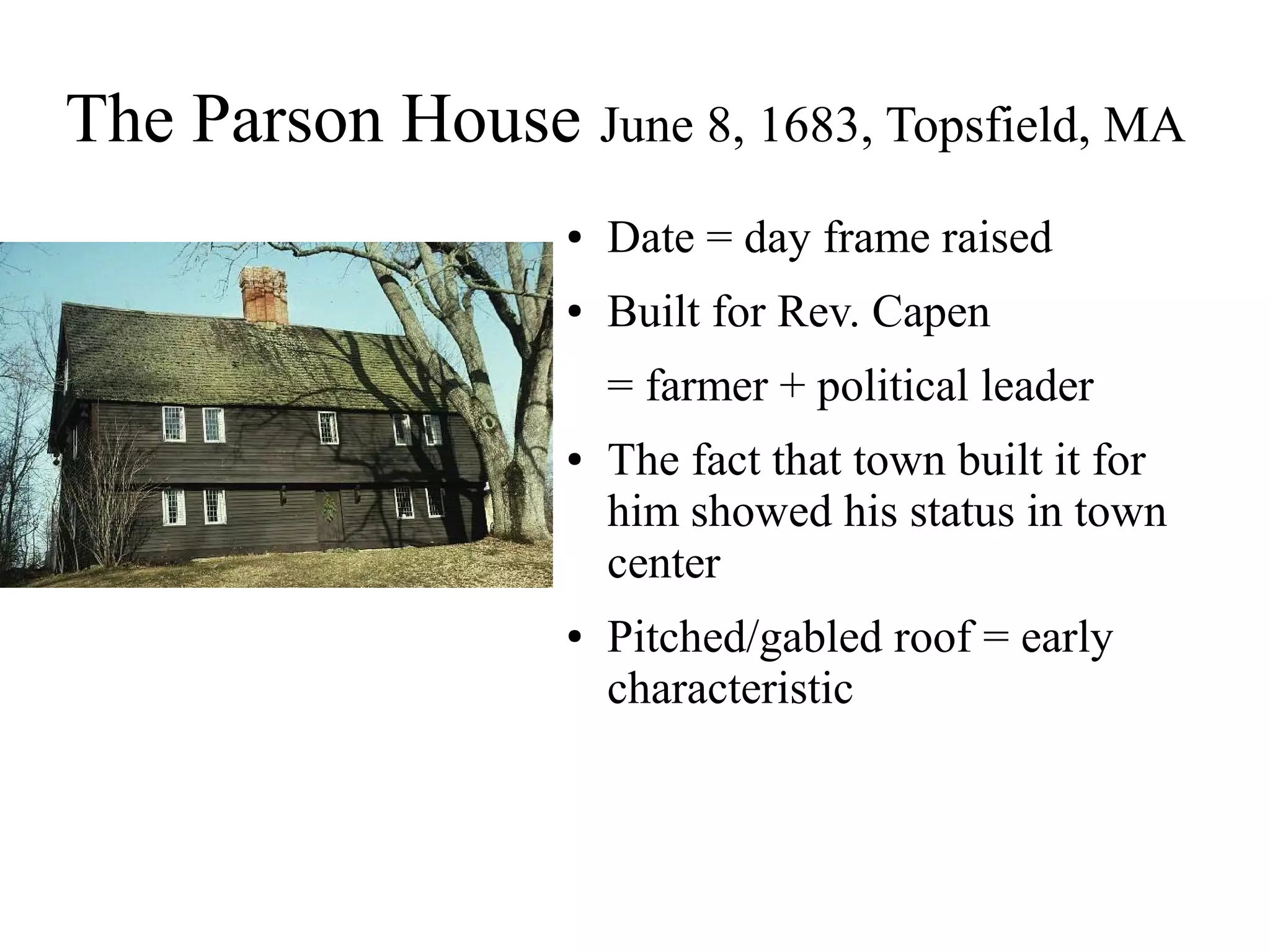
The Parson House June 8, 1683, Topsfield, MA
● Date = day frame raised
● Built for Rev. Capen
= farmer + political leader
● The fact that town built it for
him showed his status in town
center
● Pitched/gabled roof = early
characteristic
The Parson House cont.
● Straight, large beam = simple
● Planks convey sense of importance
● Largely asymmetrical = public statement = propaganda
● Conscious gesture toward medieval style (comes directly from England)
– Gables, sharply sloped roofs
● Prominent chimney = sign of wealth – here we have 2 chimneys, but back to
back to look like 1
= Modesty
→ comes from Puritan vein
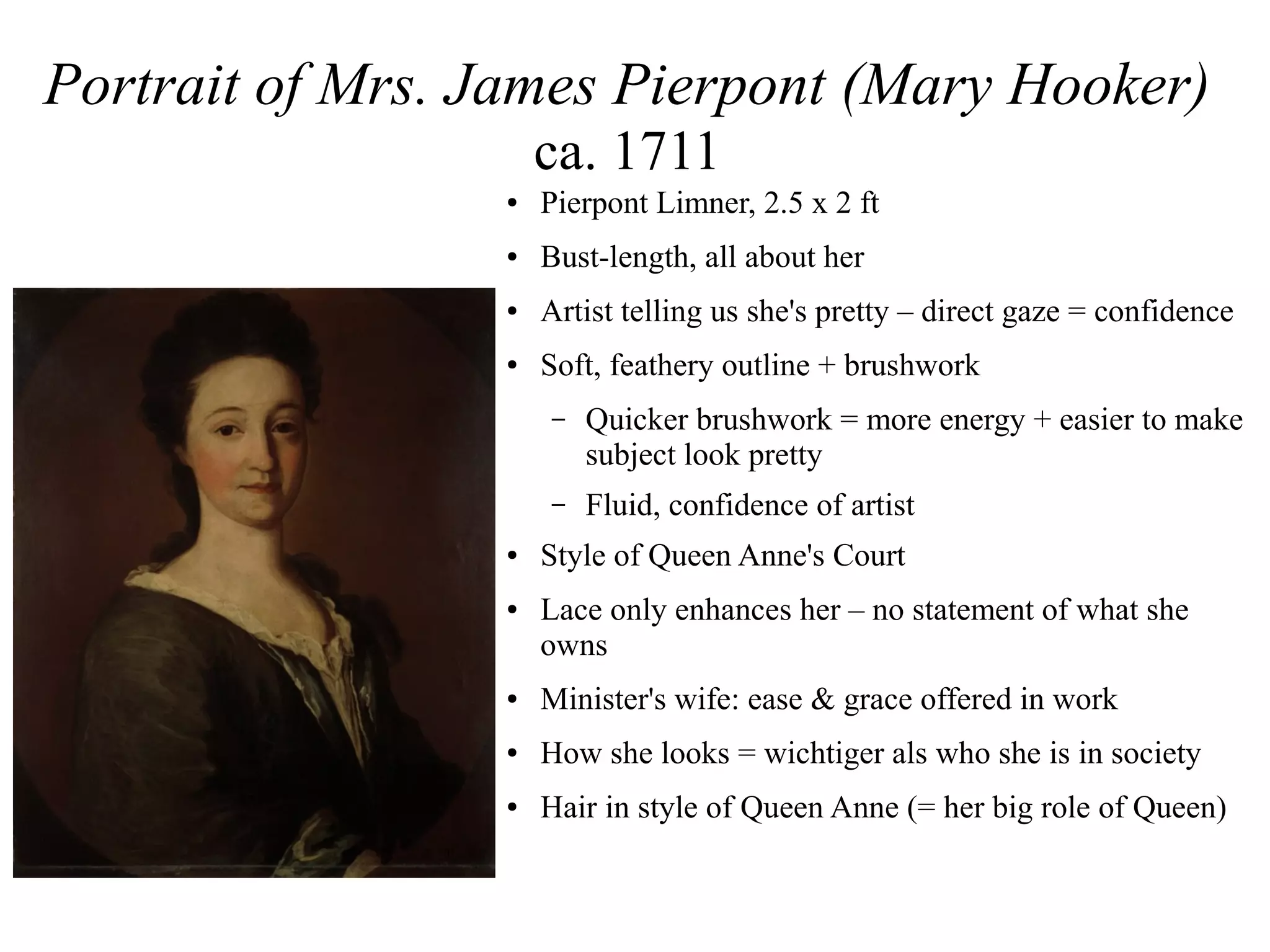
Portrait of Mrs. James Pierpont (Mary Hooker)
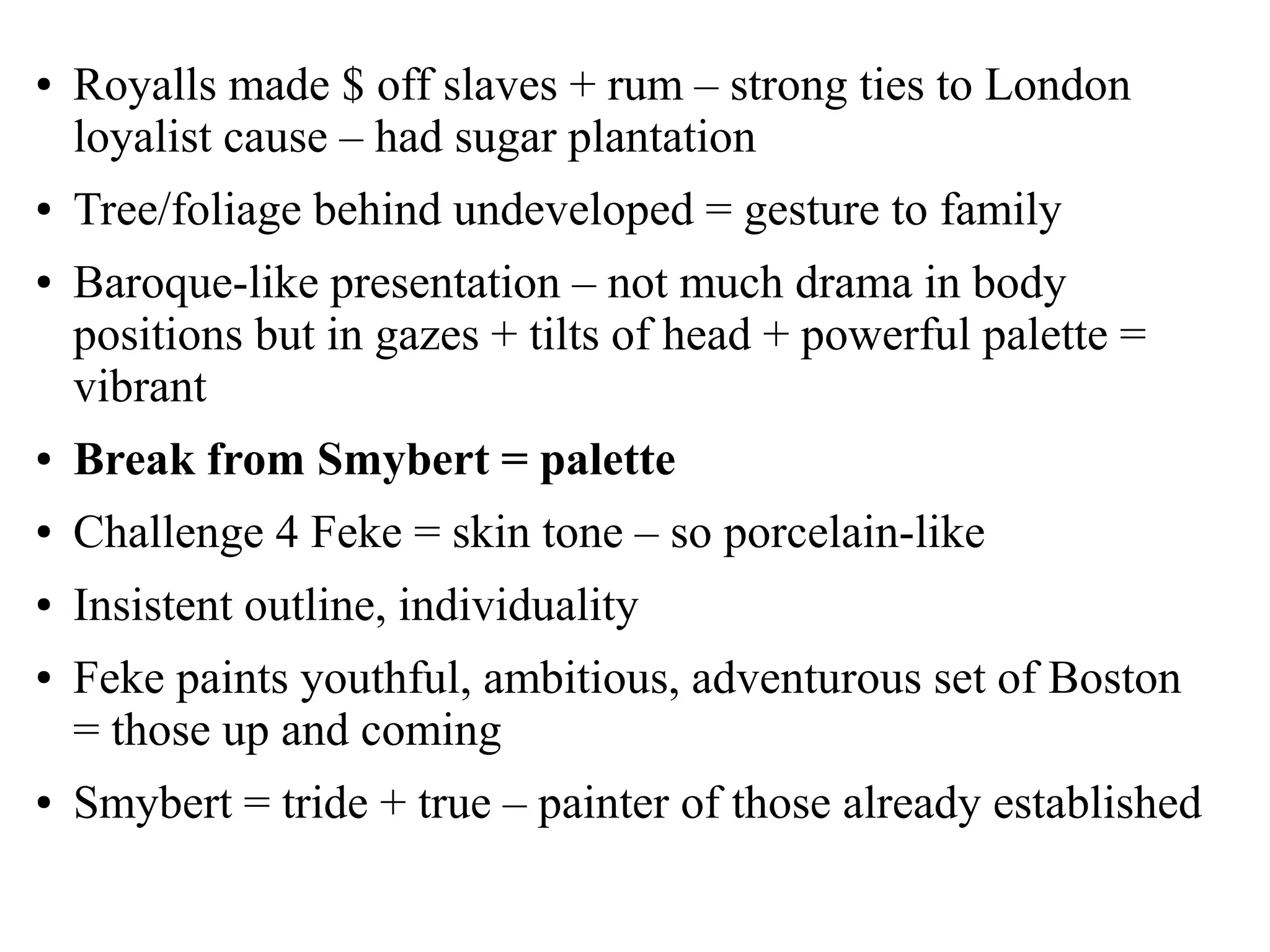
ca. 1711
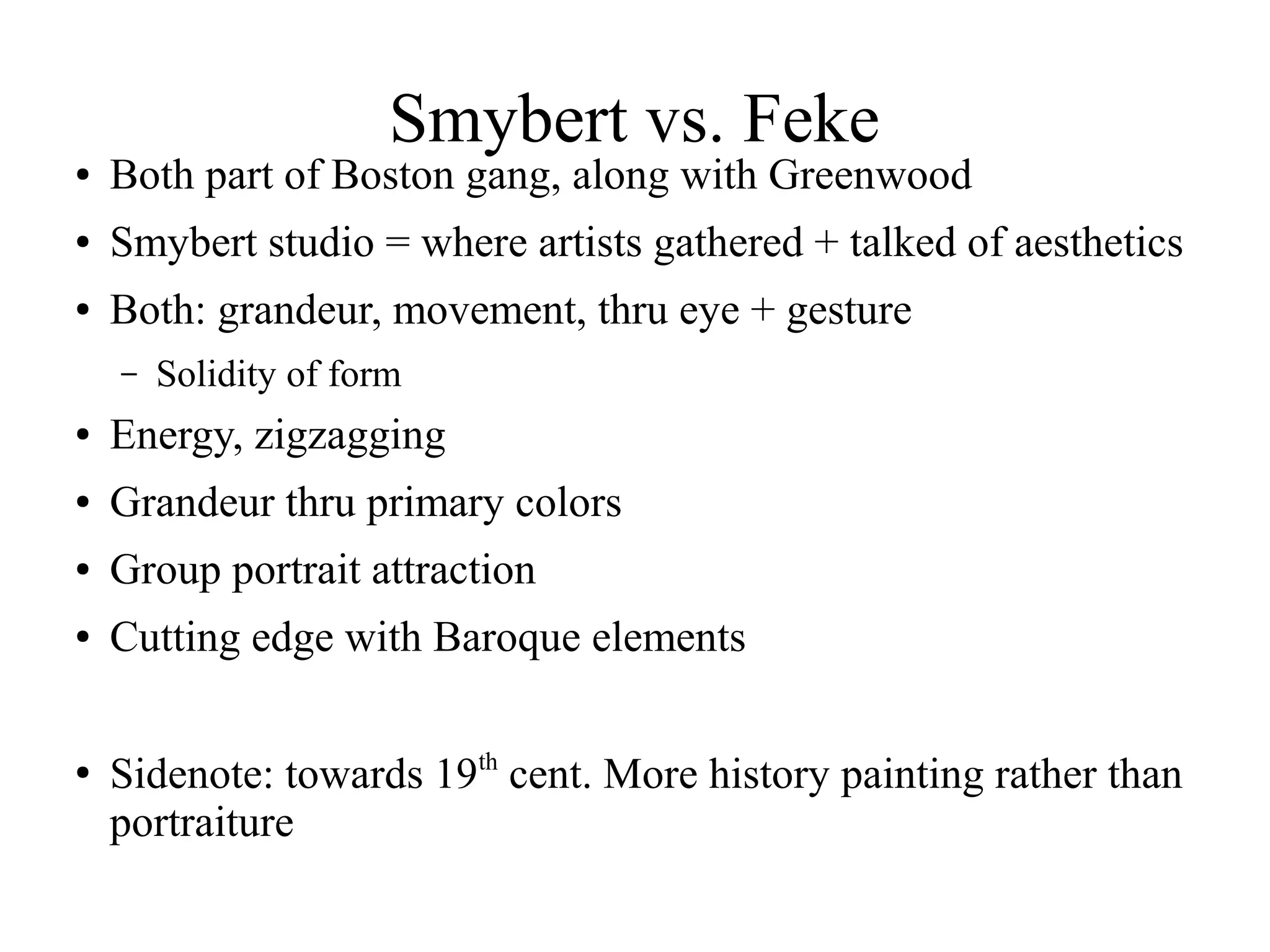
● Pierpont Limner, 2.5 x 2 ft
● Bust-length, all about her
● Artist telling us she's pretty – direct gaze = confidence
● Soft, feathery outline + brushwork
– Quicker brushwork = more energy + easier to make
subject look pretty
– Fluid, confidence of artist
● Style of Queen Anne's Court
● Lace only enhances her – no statement of what she
owns
● Minister's wife: ease & grace offered in work
● How she looks = wichtiger als who she is in society
● Hair in style of Queen Anne (= her big role of Queen)
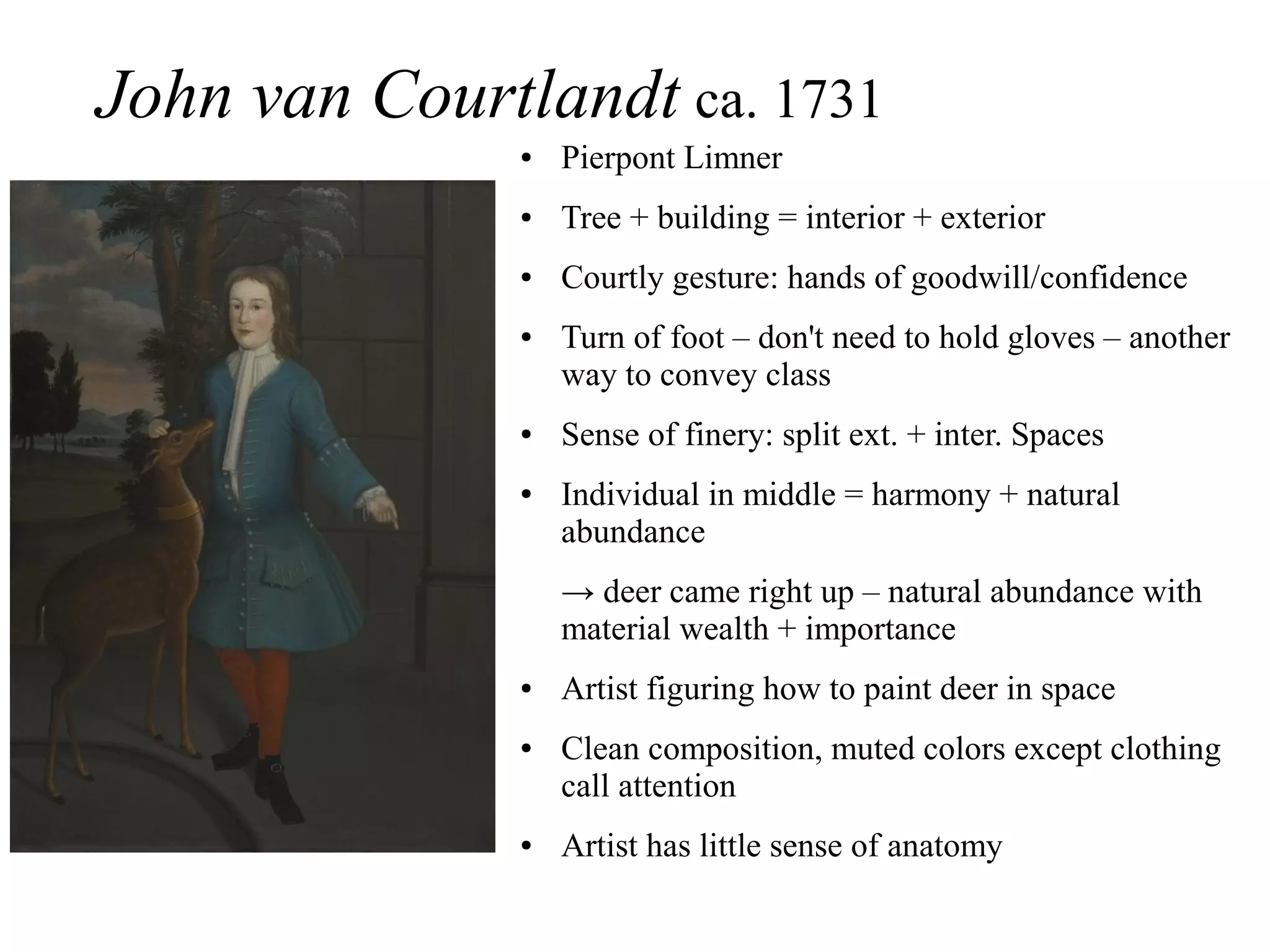
John van Courtlandt ca. 1731
● Pierpont Limner
● Tree + building = interior + exterior
● Courtly gesture: hands of goodwill/confidence
● Turn of foot – don't need to hold gloves – another
way to convey class
● Sense of finery: split ext. + inter. Spaces
● Individual in middle = harmony + natural
abundance
→ deer came right up – natural abundance with
material wealth + importance
● Artist figuring how to paint deer in space
● Clean composition, muted colors except clothing
call attention
● Artist has little sense of anatomy
Background...
Hierarchy
history + religious painting (meant to teach)
portraiture/landscape (in Western art)
still-life
genre (everyday life)
● Americans not painting history – have none and no true religious
foundation
● 1700: most colonialists of Euro descent
– Mainly Brits (300K) vs. French (600)
● Influences from Britain – many artists go there and come back
● Growing merchant class – have economic + cultural power
● Class awareness – partly comes from Brits
● Transatlantic Xchange – wealthy & use $ to act like Brits
● Increased emphasis on decorum + education
● Painting rapidly develops
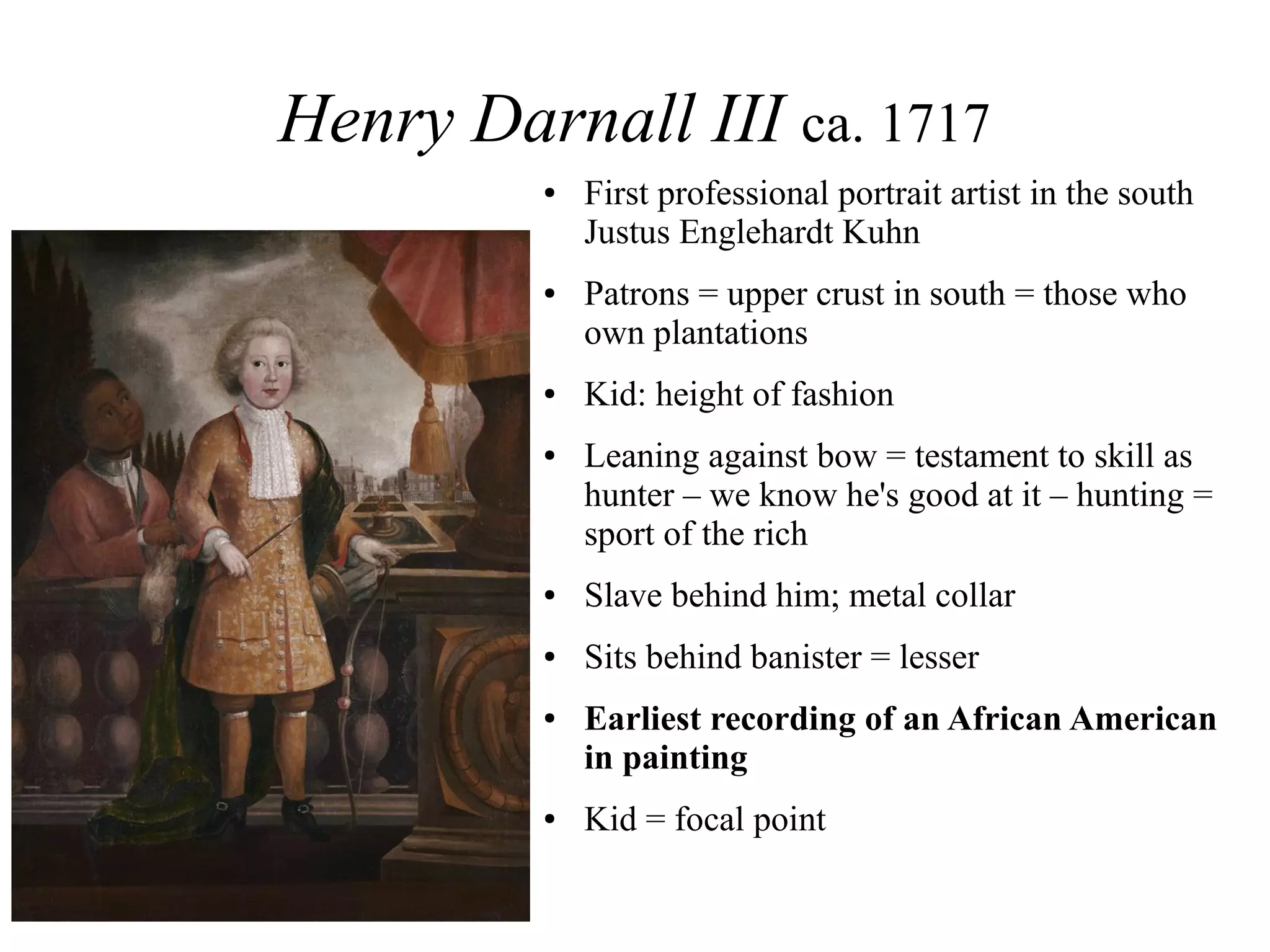
Henry Darnall III ca. 1717
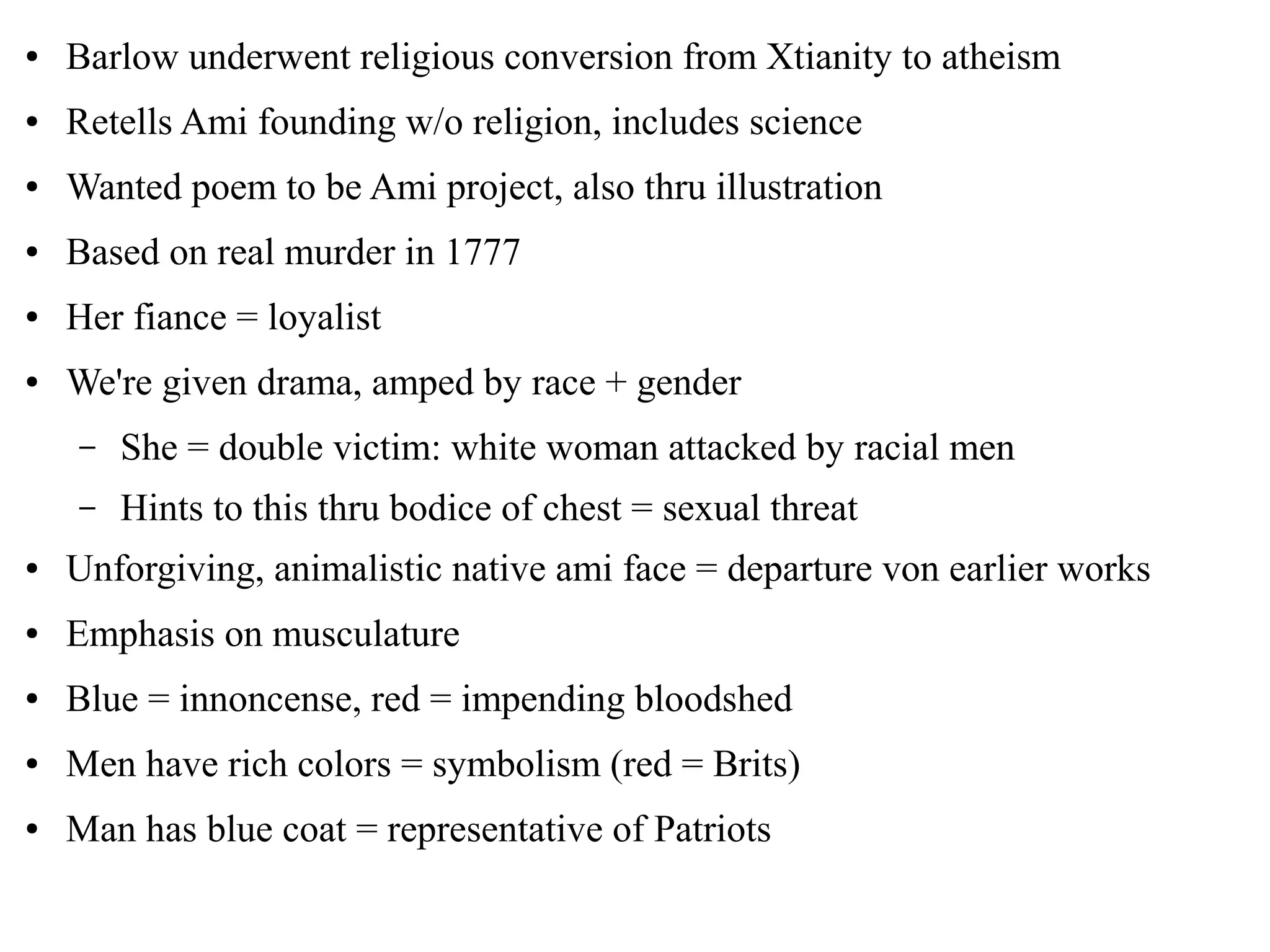
● First professional portrait artist in the south
Justus Englehardt Kuhn
● Patrons = upper crust in south = those who
own plantations
● Kid: height of fashion
● Leaning against bow = testament to skill as
hunter – we know he's good at it – hunting =
sport of the rich
● Slave behind him; metal collar
● Sits behind banister = lesser
● Earliest recording of an African American
in painting
● Kid = focal point
Henry Darnall III cont.
● Slave's head much lower, gazes on master
– Presentation of class + wealth
● Wondrous landscape in back – palatial, not America
● About grandeur + elegance – testament to Europe and
all family has and knows
● Loose brushwork though stiff & forward facing kid
● Loose curtain + tassel = baroque, trying to push forward
● New way to show wealth – not just by lace
● Kuhn slowly falls out of favor & dies in poverty
Gustave Hesselius ca. 1682-1755
● Born in Sweden moved in 1711 to Philly/DL
● Studied in London, then Sweden
● Has official artistic training. In 1712 = main portrait artist in Philly
● People wanted more artist training abroad
– Lots of economic contact btwn here + GB
● Art important statement – focus on fine art
– Still serves a purpose, but not just documentation or comment on sitter
● Different kinds of art – gesturing in to Biblical stories + mythology
● Grand tradition of European painting – theme taken from mythology
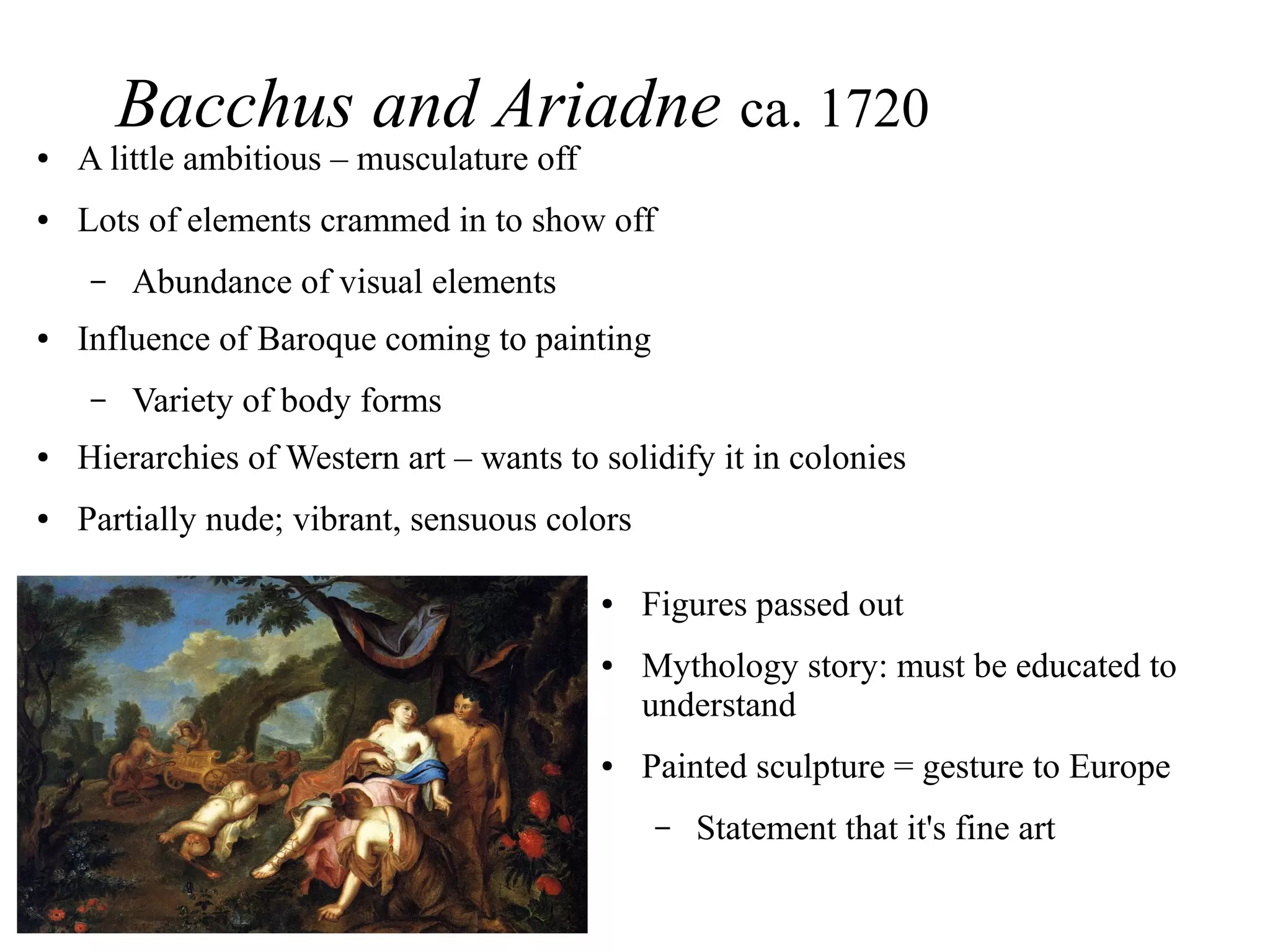
Bacchus and Ariadne ca. 1720
● A little ambitious – musculature off
● Lots of elements crammed in to show off
– Abundance of visual elements
● Influence of Baroque coming to painting
– Variety of body forms
● Hierarchies of Western art – wants to solidify it in colonies
● Partially nude; vibrant, sensuous colors
● Figures passed out
● Mythology story: must be educated to
understand
● Painted sculpture = gesture to Europe
– Statement that it's fine art
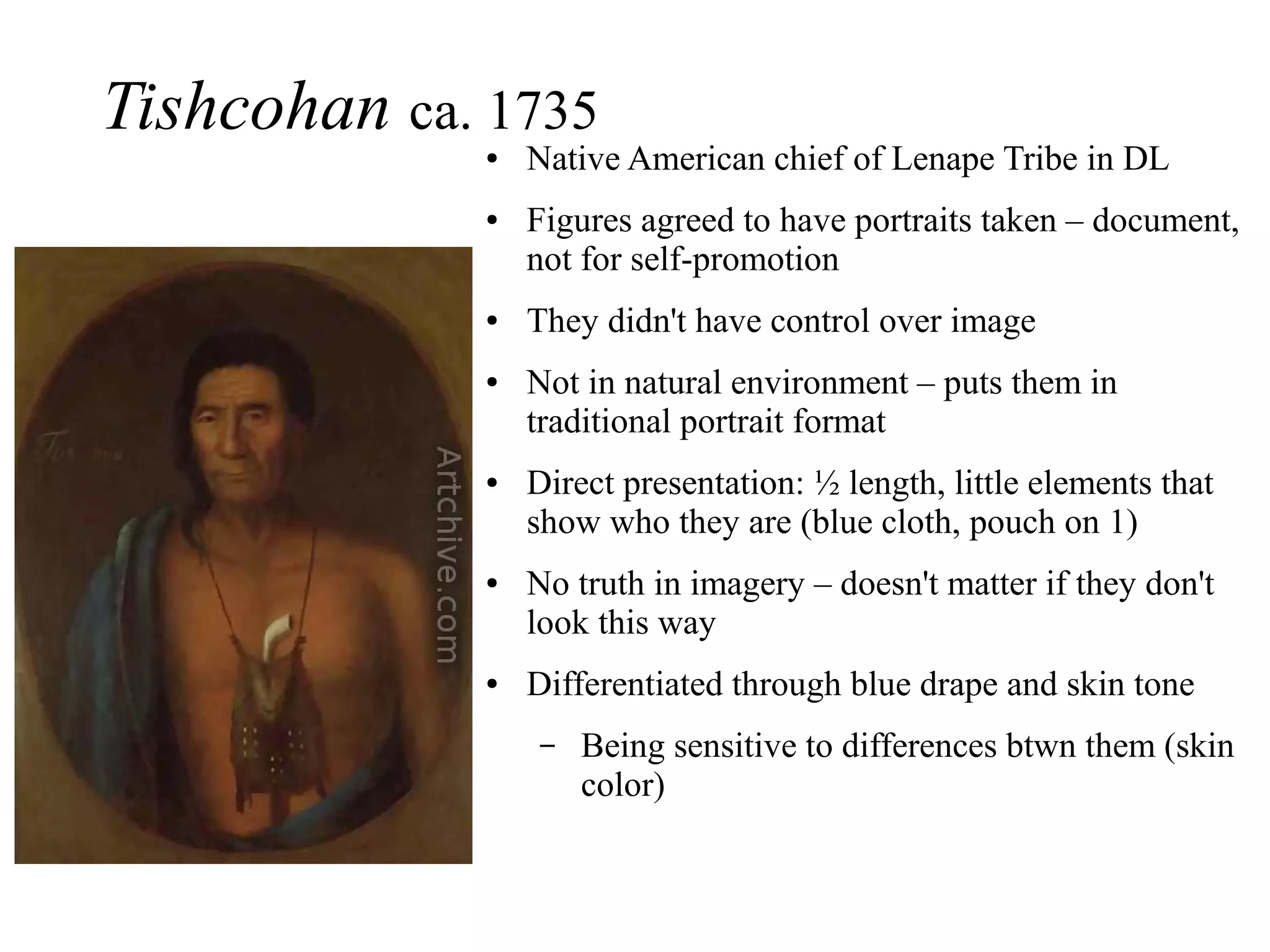
Tishcohan ca. 1735
● Native American chief of Lenape Tribe in DL
● Figures agreed to have portraits taken – document,
not for self-promotion
● They didn't have control over image
● Not in natural environment – puts them in
traditional portrait format
● Direct presentation: ½ length, little elements that
show who they are (blue cloth, pouch on 1)
● No truth in imagery – doesn't matter if they don't
look this way
● Differentiated through blue drape and skin tone
– Being sensitive to differences btwn them (skin
color)
Tischcohan “He who never blackens himself”
● Direct, forward presentation: about individual, not stereotype
● Coming for objectivity – he's recording
● Indians 2 be signers of Walking Peace treaty
● Sons of William Penn (John + Thomas) claimed they had
original treaty from 1680 promising to sell land as far as man
can walk
● Treaty = lie John + Thomas made indians sign it
● Portraits document treaty – not weighing in politically or
socially
● Commissioned by Brit named Penn
● Pushing toward noble savage
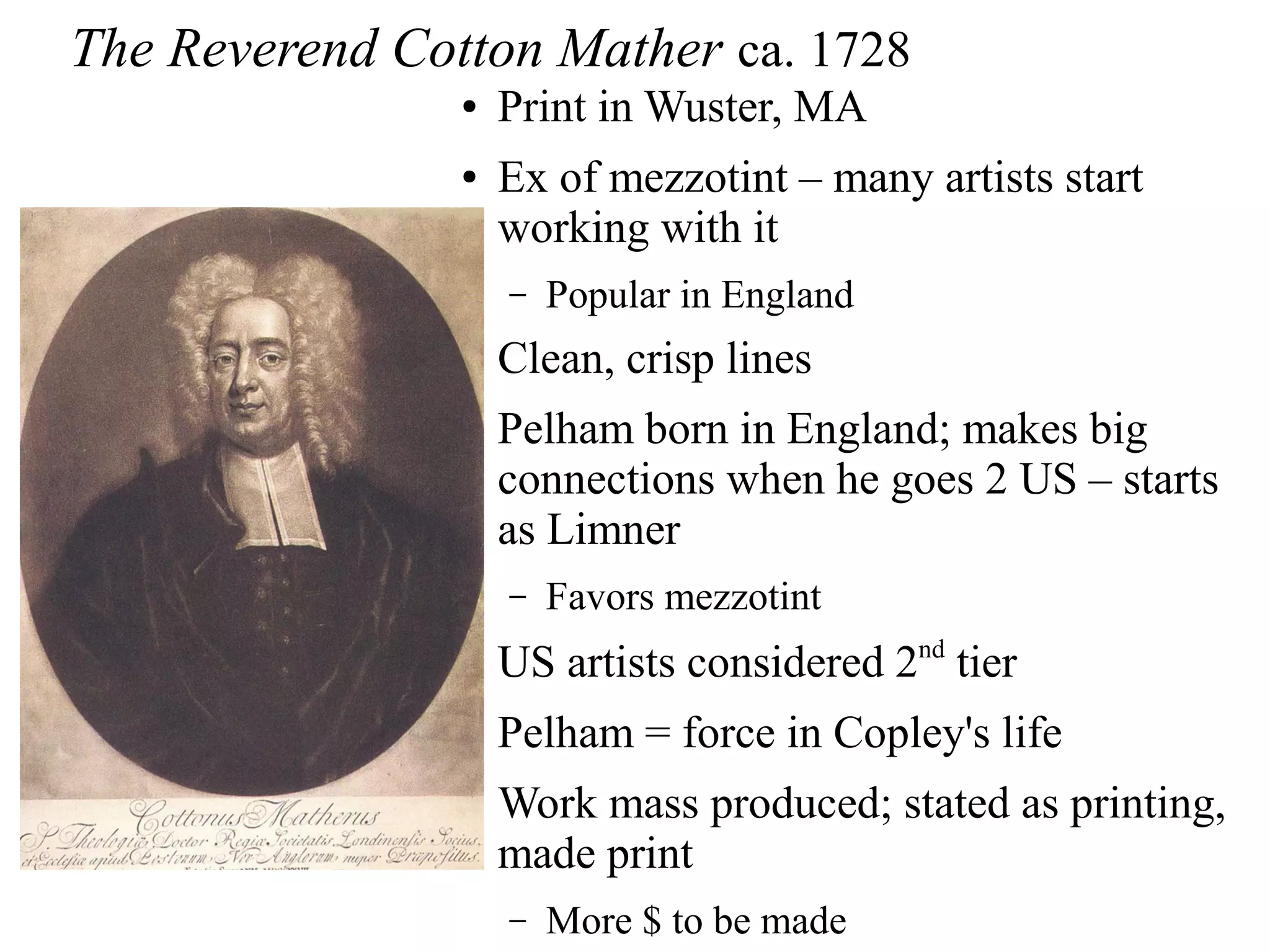
The Reverend Cotton Mather ca. 1728
● Print in Wuster, MA
● Ex of mezzotint – many artists start
working with it
– Popular in England
● Clean, crisp lines
● Pelham born in England; makes big
connections when he goes 2 US – starts
as Limner
– Favors mezzotint
● US artists considered 2nd
tier
● Pelham = force in Copley's life
● Work mass produced; stated as printing,
made print
– More $ to be made
Reverend Cotton Mather ca. 1728 cont.
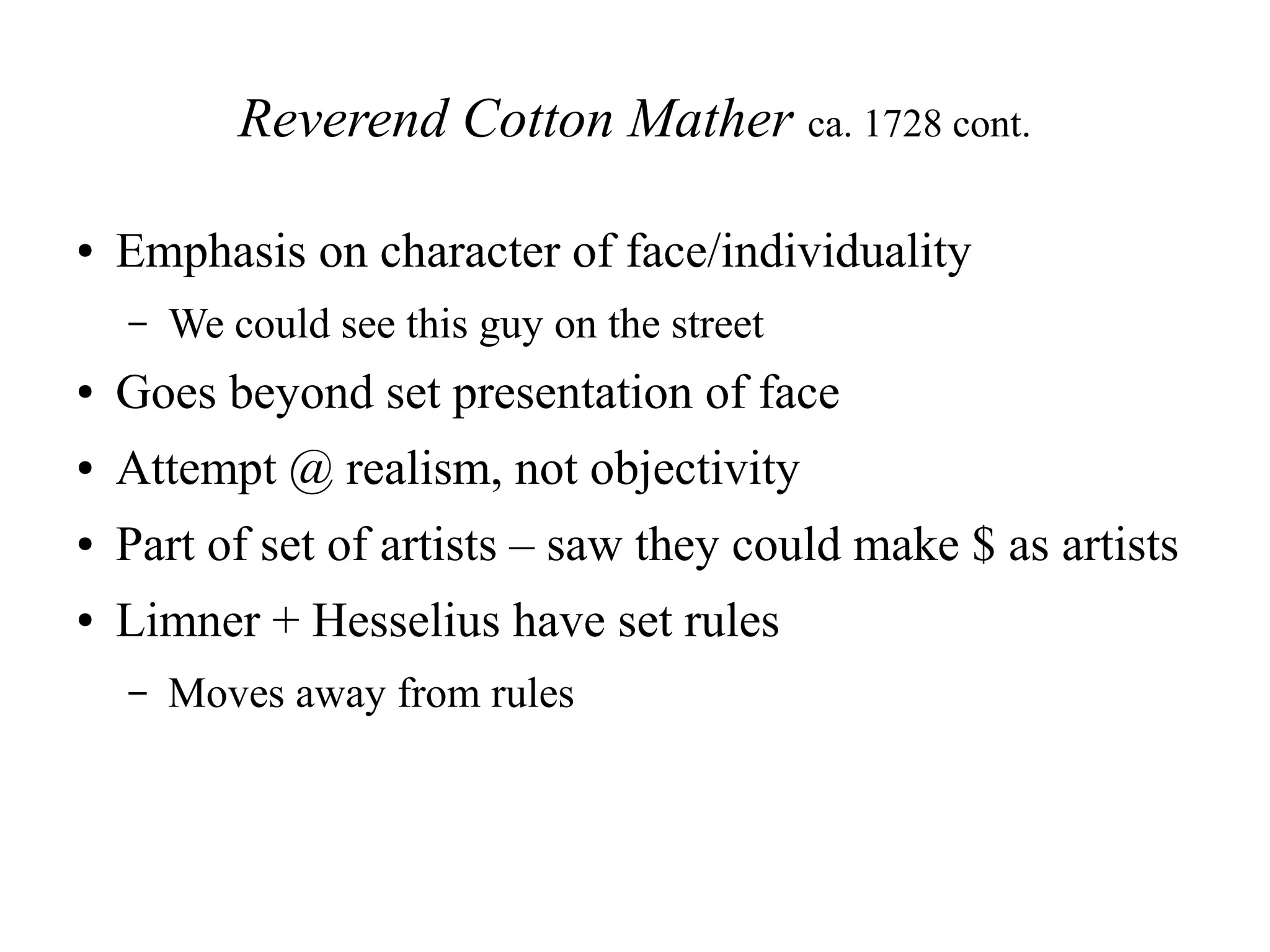
● Emphasis on character of face/individuality
– We could see this guy on the street
● Goes beyond set presentation of face
● Attempt @ realism, not objectivity
● Part of set of artists – saw they could make $ as artists
● Limner + Hesselius have set rules
– Moves away from rules
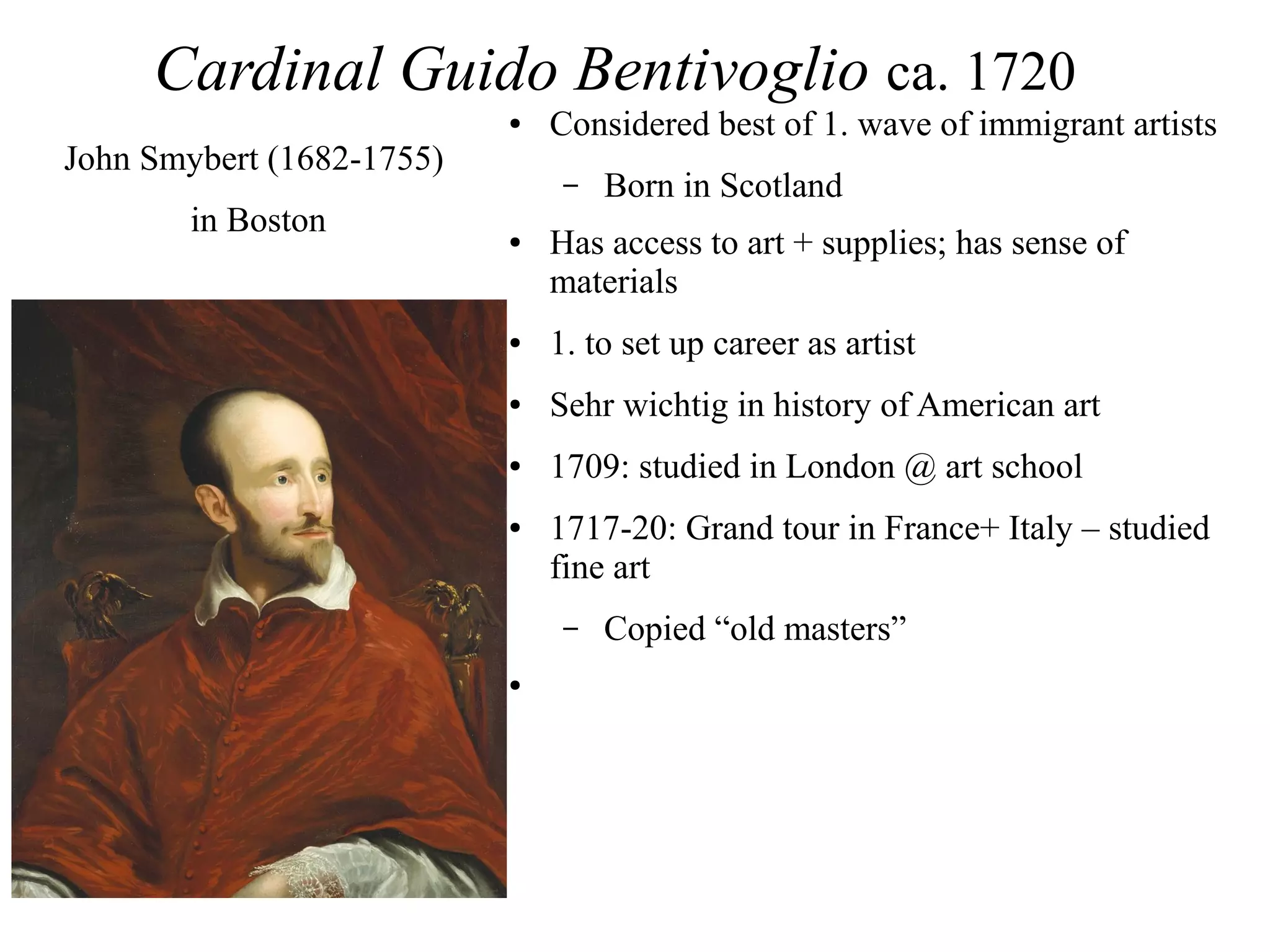
Cardinal Guido Bentivoglio ca. 1720
● Considered best of 1. wave of immigrant artists
– Born in Scotland
● Has access to art + supplies; has sense of
materials
● 1. to set up career as artist
● Sehr wichtig in history of American art
● 1709: studied in London @ art school
● 1717-20: Grand tour in France+ Italy – studied
fine art
– Copied “old masters”
●
John Smybert (1682-1755)
in Boston
Cardinal Guido Bentivoglio cont.
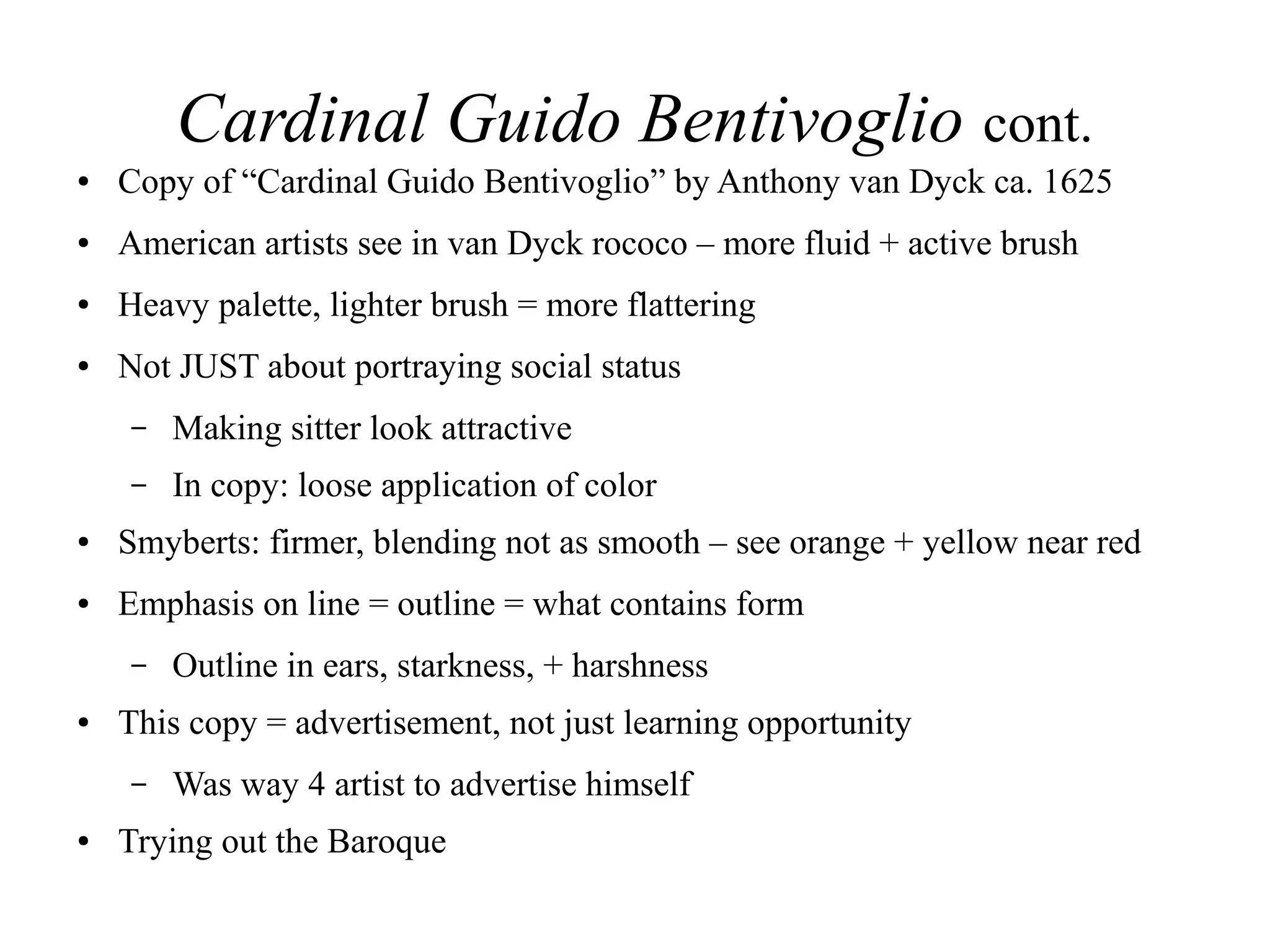
● Copy of “Cardinal Guido Bentivoglio” by Anthony van Dyck ca. 1625
● American artists see in van Dyck rococo – more fluid + active brush
● Heavy palette, lighter brush = more flattering
● Not JUST about portraying social status
– Making sitter look attractive
– In copy: loose application of color
● Smyberts: firmer, blending not as smooth – see orange + yellow near red
● Emphasis on line = outline = what contains form
– Outline in ears, starkness, + harshness
● This copy = advertisement, not just learning opportunity
– Was way 4 artist to advertise himself
● Trying out the Baroque
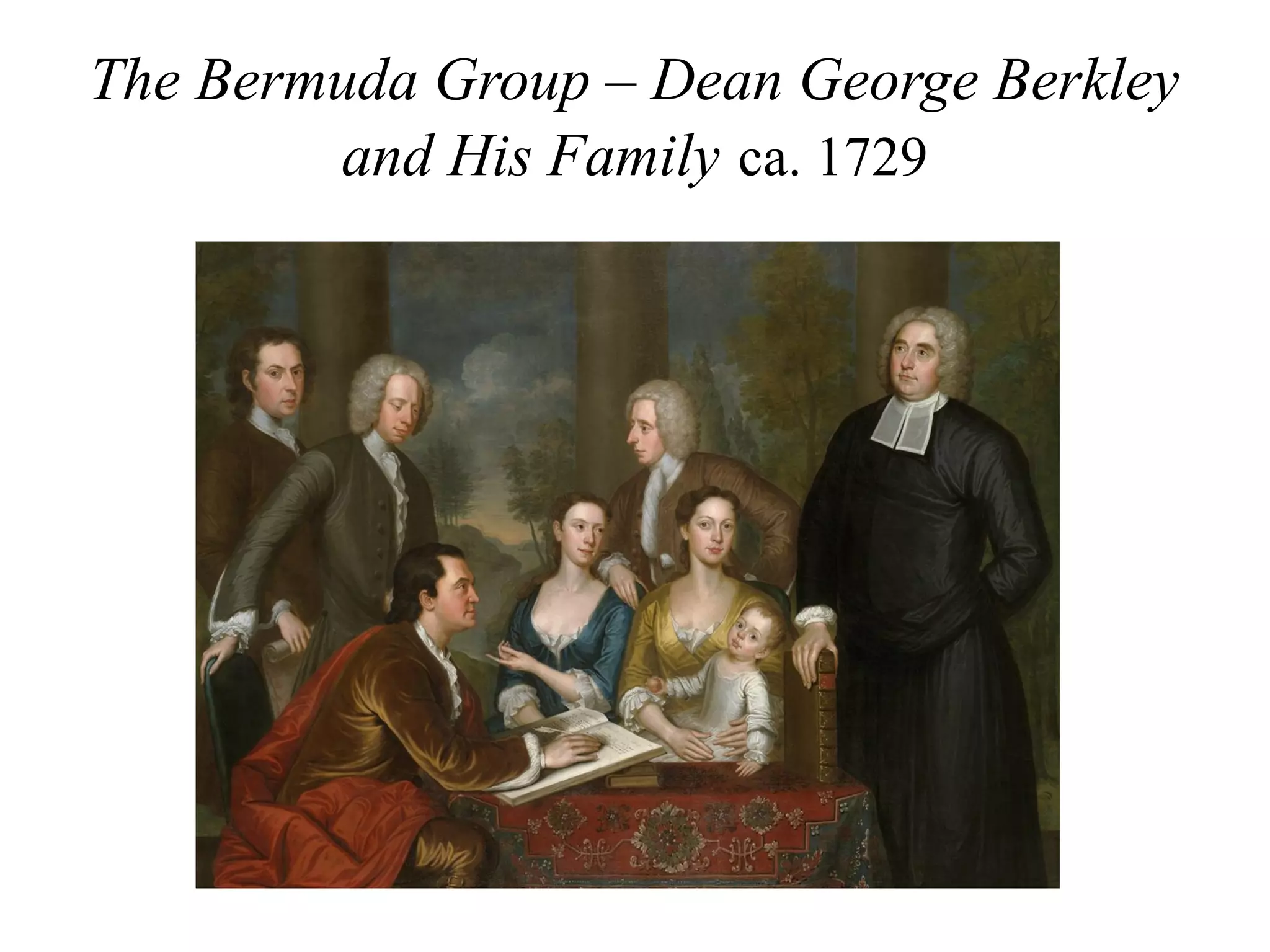
The Bermuda Group – Dean George Berkley
and His Family ca. 1729
The Bermuda Group...
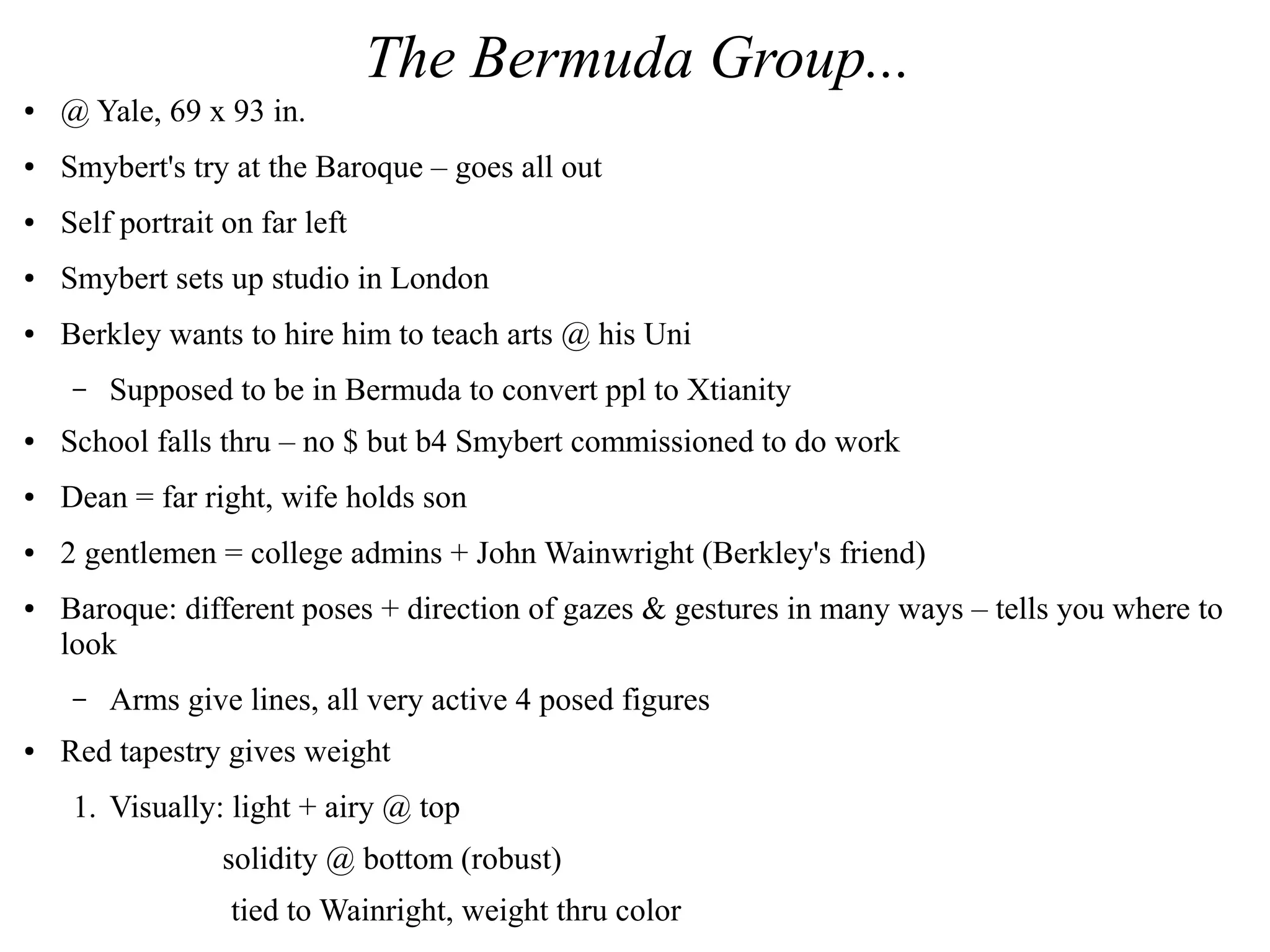
● @ Yale, 69 x 93 in.
● Smybert's try at the Baroque – goes all out
● Self portrait on far left
● Smybert sets up studio in London
● Berkley wants to hire him to teach arts @ his Uni
– Supposed to be in Bermuda to convert ppl to Xtianity
● School falls thru – no $ but b4 Smybert commissioned to do work
● Dean = far right, wife holds son
● 2 gentlemen = college admins + John Wainwright (Berkley's friend)
● Baroque: different poses + direction of gazes & gestures in many ways – tells you where to
look
– Arms give lines, all very active 4 posed figures
● Red tapestry gives weight
1. Visually: light + airy @ top
solidity @ bottom (robust)
tied to Wainright, weight thru color
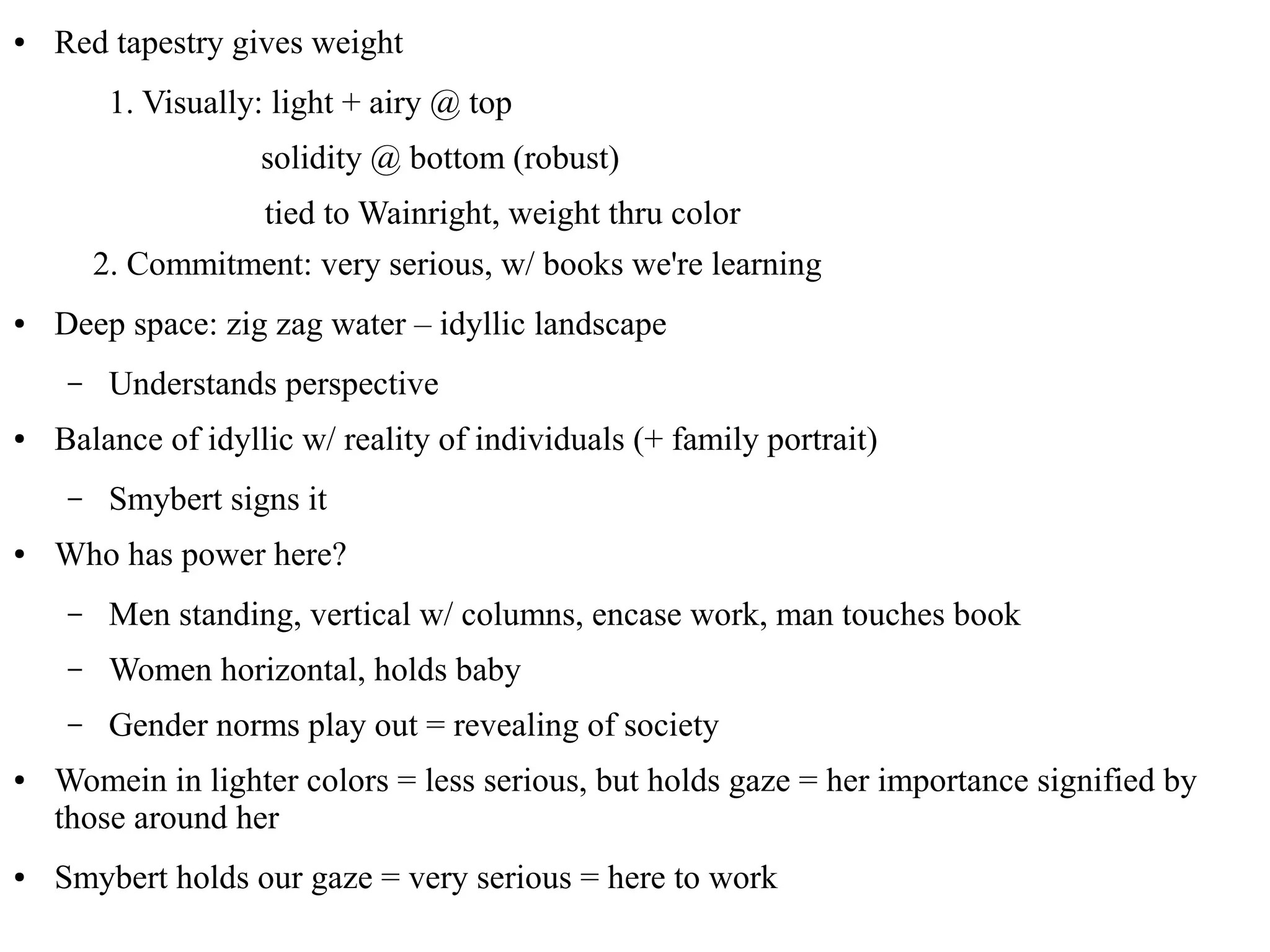
● Red tapestry gives weight
1. Visually: light + airy @ top
solidity @ bottom (robust)
tied to Wainright, weight thru color
2. Commitment: very serious, w/ books we're learning
● Deep space: zig zag water – idyllic landscape
– Understands perspective
● Balance of idyllic w/ reality of individuals (+ family portrait)
– Smybert signs it
● Who has power here?
– Men standing, vertical w/ columns, encase work, man touches book
– Women horizontal, holds baby
– Gender norms play out = revealing of society
● Womein in lighter colors = less serious, but holds gaze = her importance signified by
those around her
● Smybert holds our gaze = very serious = here to work
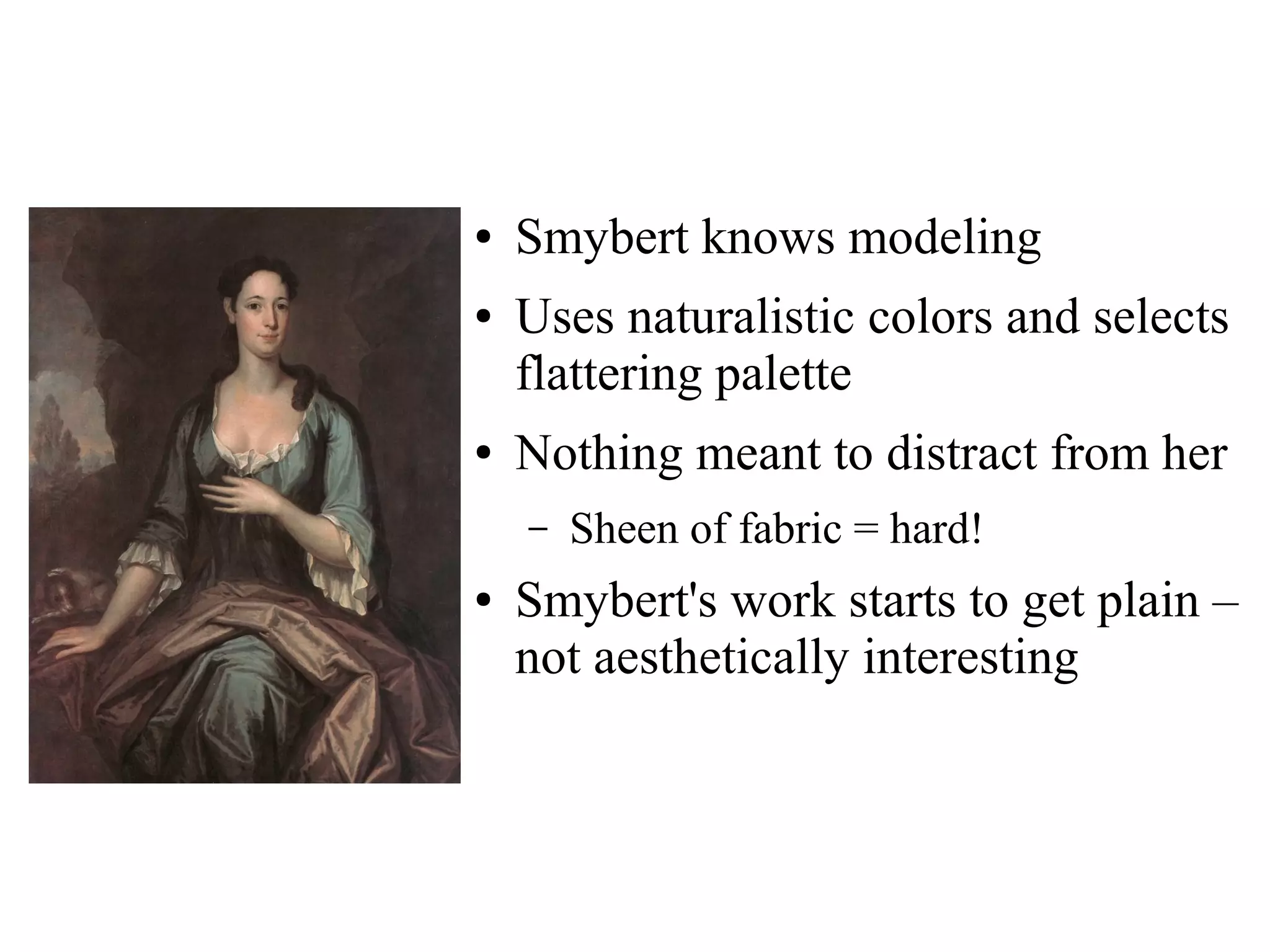
● Smybert knows modeling
● Uses naturalistic colors and selects
flattering palette
● Nothing meant to distract from her
– Sheen of fabric = hard!
● Smybert's work starts to get plain –
not aesthetically interesting
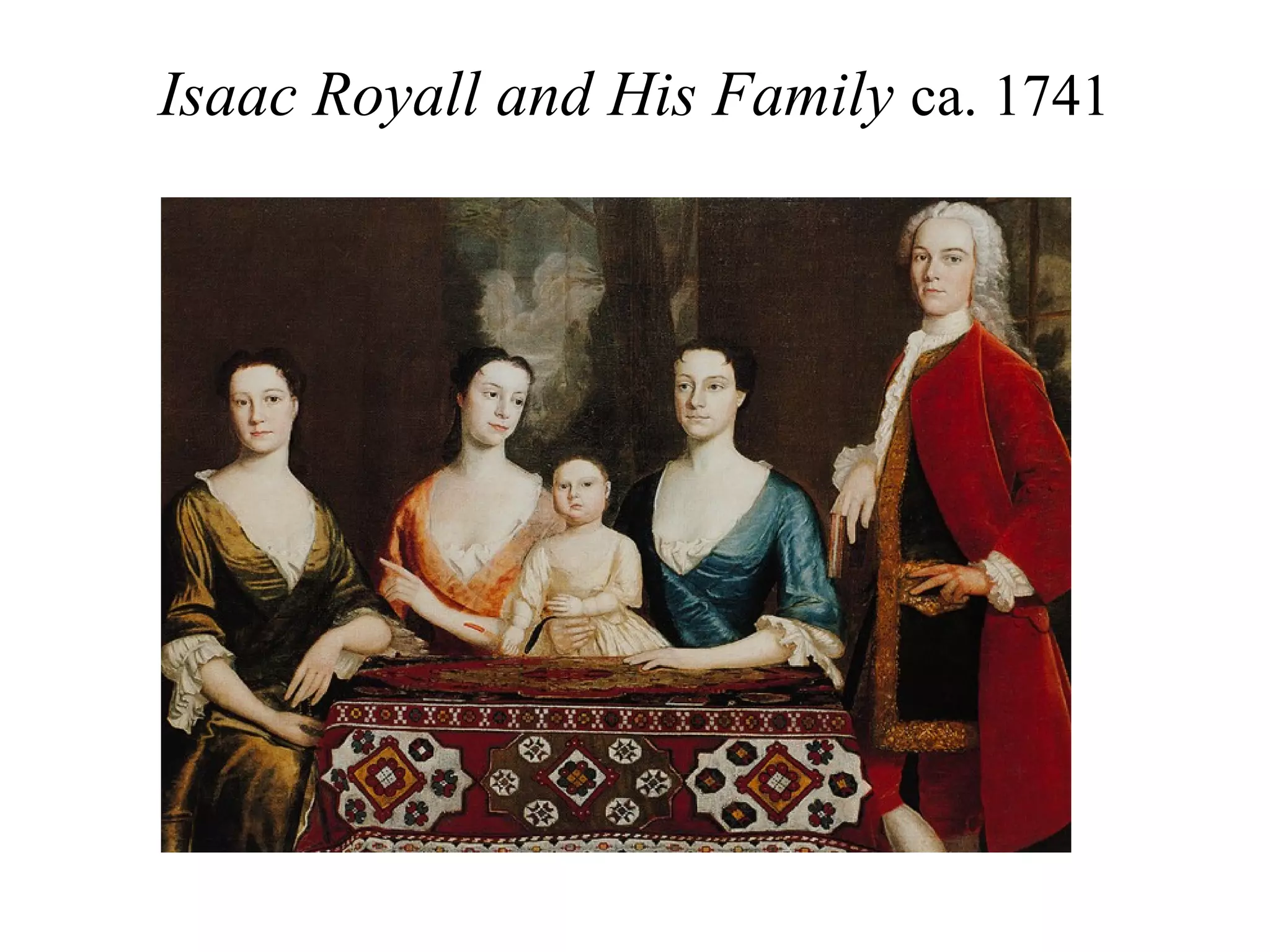
Isaac Royall and His Family ca. 1741
● @ Harvard Law, 56 x 78 in.
● Isaac Royall Jr. shown
● Accomplished artist but gone by 1750s
– Takes over Smybert's patronage
● Born in Long Island; mariner, son of preacher
● Self-taught status, but can paint on grand scale
– Grand scale 1720-1760
– Gives weight to figures + table
● Stark lighting = harder quality – less naturalistic
● Emphasis on outline + form = colonial impulse
– Reminds of early Limners
● Gender: formula followed
– Man standing in robust, eye-catching form, captures visual interest, becomes
viewer's resource
– Women = horizontal, emphasized by table
– Formulaic composition
● Royalls made $ off slaves + rum – strong ties to London
loyalist cause – had sugar plantation
● Tree/foliage behind undeveloped = gesture to family
● Baroque-like presentation – not much drama in body
positions but in gazes + tilts of head + powerful palette =
vibrant
● Break from Smybert = palette
● Challenge 4 Feke = skin tone – so porcelain-like
● Insistent outline, individuality
● Feke paints youthful, ambitious, adventurous set of Boston
= those up and coming
● Smybert = tride + true – painter of those already established
Smybert vs. Feke
● Both part of Boston gang, along with Greenwood
● Smybert studio = where artists gathered + talked of aesthetics
● Both: grandeur, movement, thru eye + gesture
– Solidity of form
● Energy, zigzagging
● Grandeur thru primary colors
● Group portrait attraction
● Cutting edge with Baroque elements
●
Sidenote: towards 19th
cent. More history painting rather than
portraiture
Feke
● Women portraits: grace, dignity, ease, charm = aristocratic values
● Women = principle of femininity – presentation of self
● Emphasis on line, understands fabrics
● Women = central, but to R = landscape
● Feke = popular + taking over; follows similar structure
● Baroque → Rococo: Serious → playful
● What americans borrow:
– multiple gazes solid form + grander
– naturalistic presentation of interior (not lighting, but body placement)
– Purpose + message = serious
● Rococo: fun, central pleasures, lighter, brighter palette, curvy →
emphasis on narrative, less moral direction
● Sensuous line – over the top – Americans don't go far w/ it
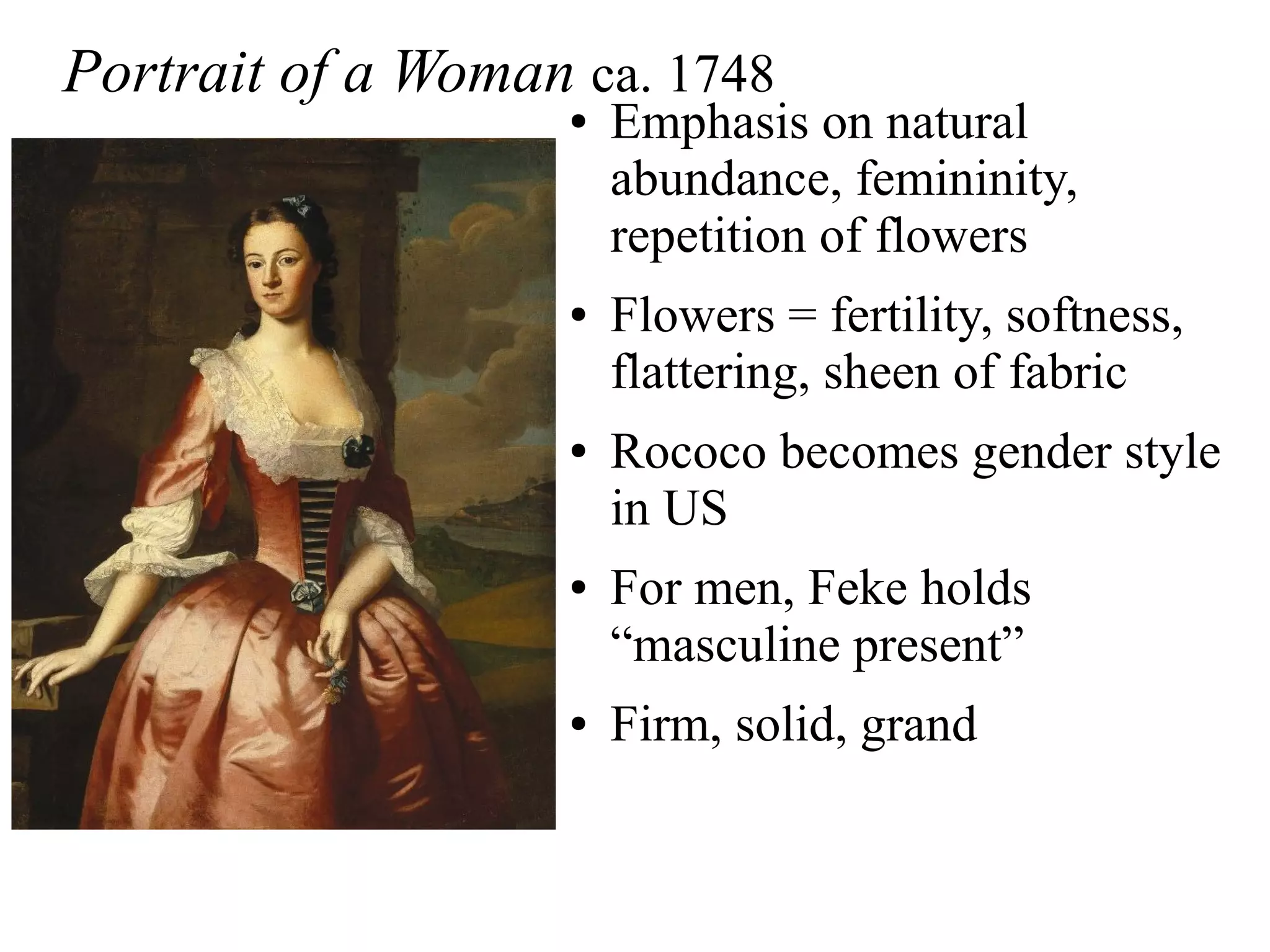
Portrait of a Woman ca. 1748
● Emphasis on natural
abundance, femininity,
repetition of flowers
● Flowers = fertility, softness,
flattering, sheen of fabric
● Rococo becomes gender style
in US
● For men, Feke holds
“masculine present”
● Firm, solid, grand
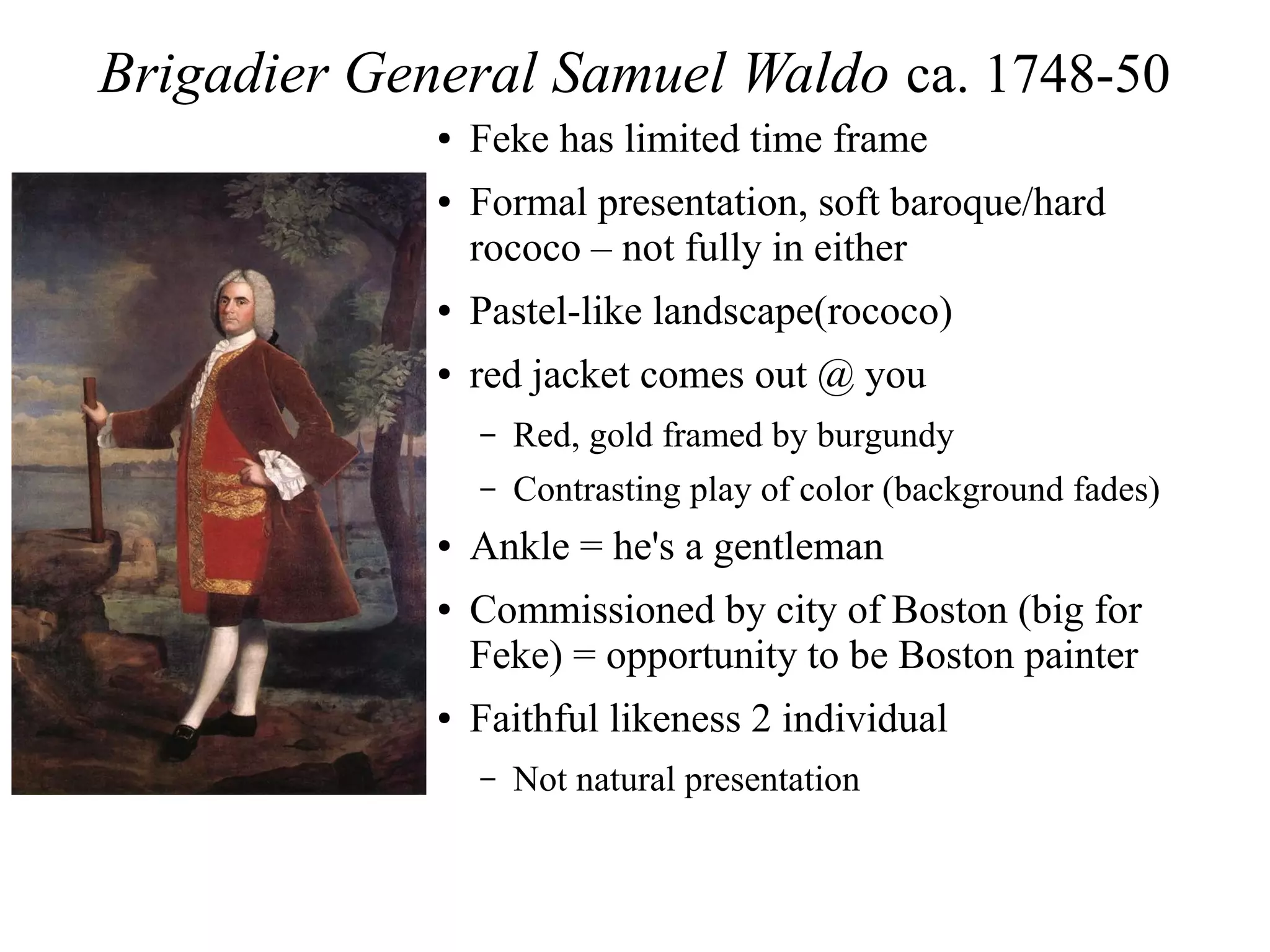
Brigadier General Samuel Waldo ca. 1748-50
● Feke has limited time frame
● Formal presentation, soft baroque/hard
rococo – not fully in either
● Pastel-like landscape(rococo)
● red jacket comes out @ you
– Red, gold framed by burgundy
– Contrasting play of color (background fades)
● Ankle = he's a gentleman
● Commissioned by city of Boston (big for
Feke) = opportunity to be Boston painter
● Faithful likeness 2 individual
– Not natural presentation
● Background tells this is Boston: natural + city qualities
● Conventional pose + baton = trope
– Manmade instrument of action – sense of power
– All emphasis on him
● #1 native born painter @ end of work + 1. native q/ aesthetic
impact on color & changes he made on Smybert's formula
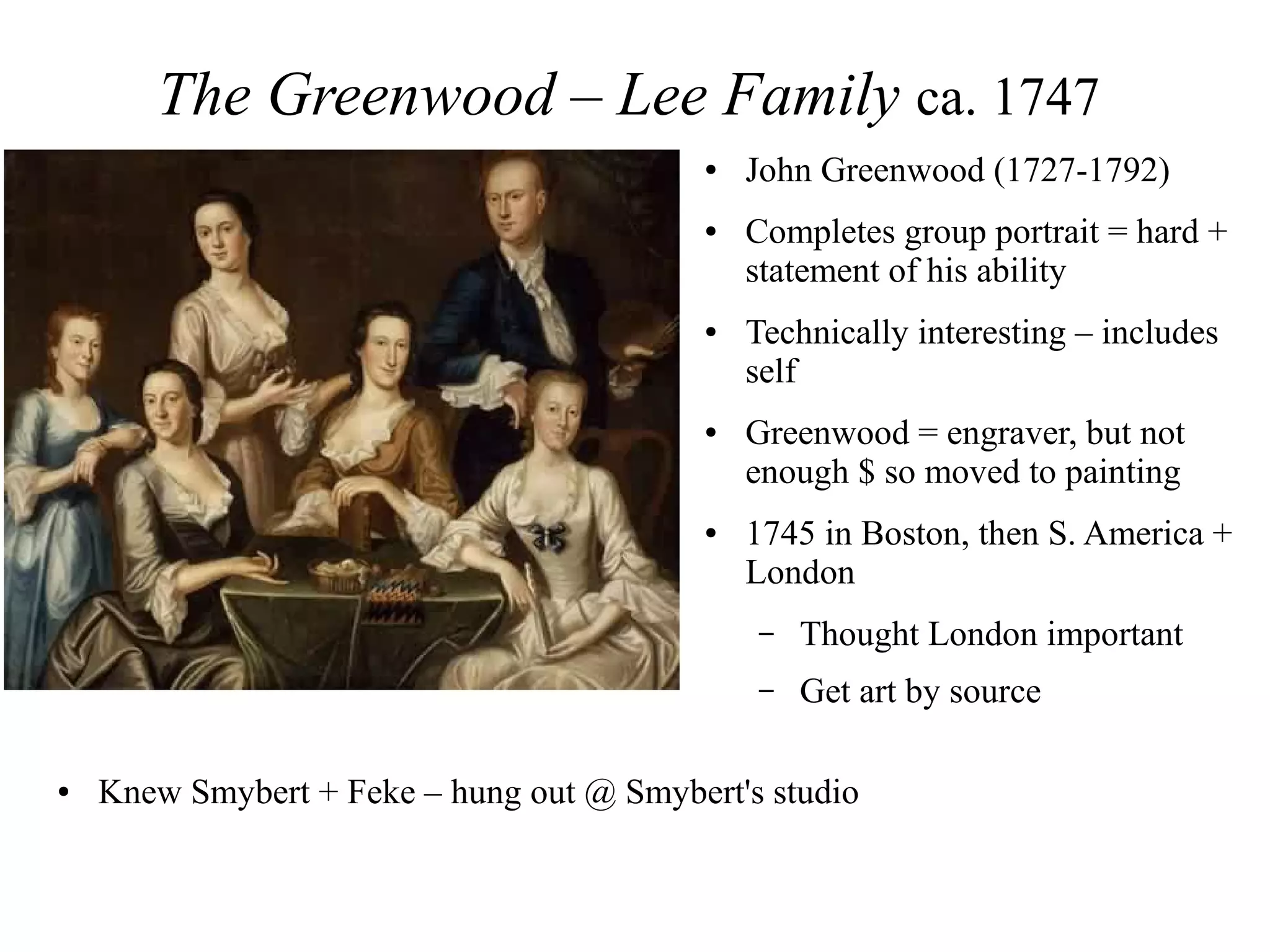
The Greenwood – Lee Family ca. 1747
● John Greenwood (1727-1792)
● Completes group portrait = hard +
statement of his ability
● Technically interesting – includes
self
● Greenwood = engraver, but not
enough $ so moved to painting
● 1745 in Boston, then S. America +
London
– Thought London important
– Get art by source
● Knew Smybert + Feke – hung out @ Smybert's studio
The Greenwood-Lee Family cont.
● Work = bold presentation of artist
● Ambitious with lots of movement
● Little anatomical knowledge
● Domestic scene – gives sense of sitters
– Women circle table = domesticity
● Dark color: sense of solidity
● Sheen of fabric
● Greenwood follows business (itinerant)
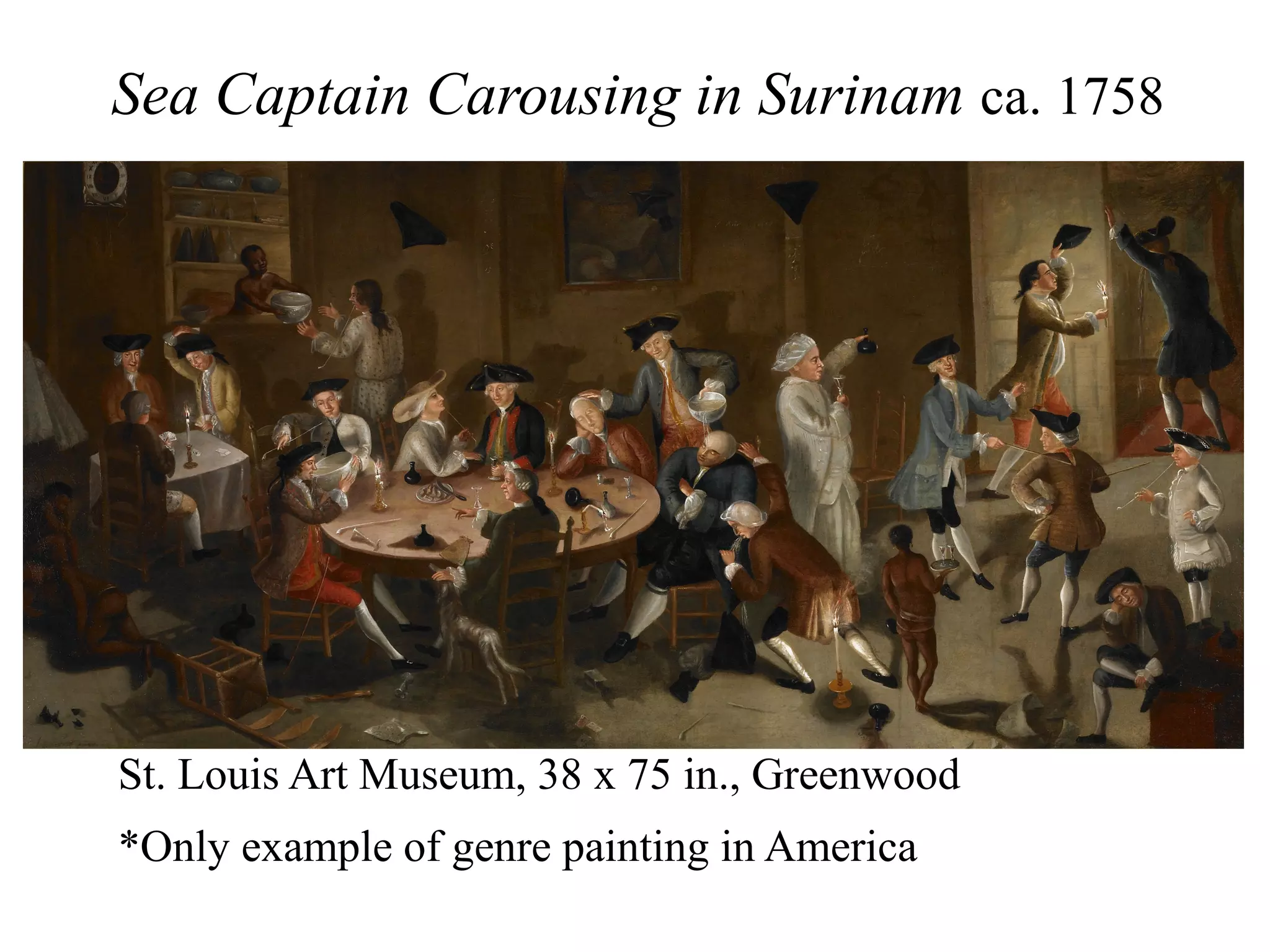
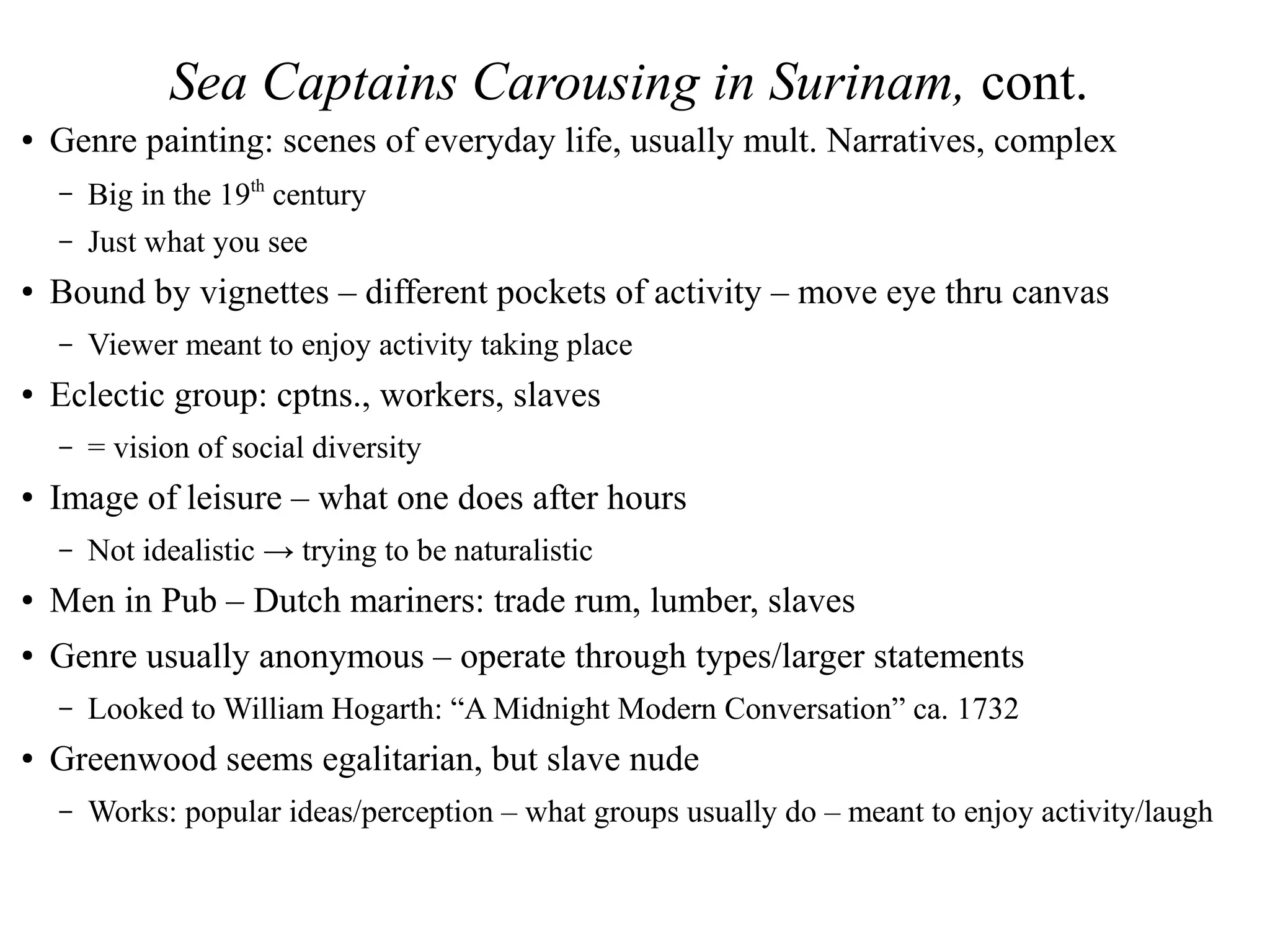
Sea Captain Carousing in Surinam ca. 1758
St. Louis Art Museum, 38 x 75 in., Greenwood
*Only example of genre painting in America
Sea Captains Carousing in Surinam, cont.
● Genre painting: scenes of everyday life, usually mult. Narratives, complex
– Big in the 19th
century
– Just what you see
● Bound by vignettes – different pockets of activity – move eye thru canvas
– Viewer meant to enjoy activity taking place
● Eclectic group: cptns., workers, slaves
– = vision of social diversity
● Image of leisure – what one does after hours
– Not idealistic → trying to be naturalistic
● Men in Pub – Dutch mariners: trade rum, lumber, slaves
● Genre usually anonymous – operate through types/larger statements
– Looked to William Hogarth: “A Midnight Modern Conversation” ca. 1732
● Greenwood seems egalitarian, but slave nude
– Works: popular ideas/perception – what groups usually do – meant to enjoy activity/laugh
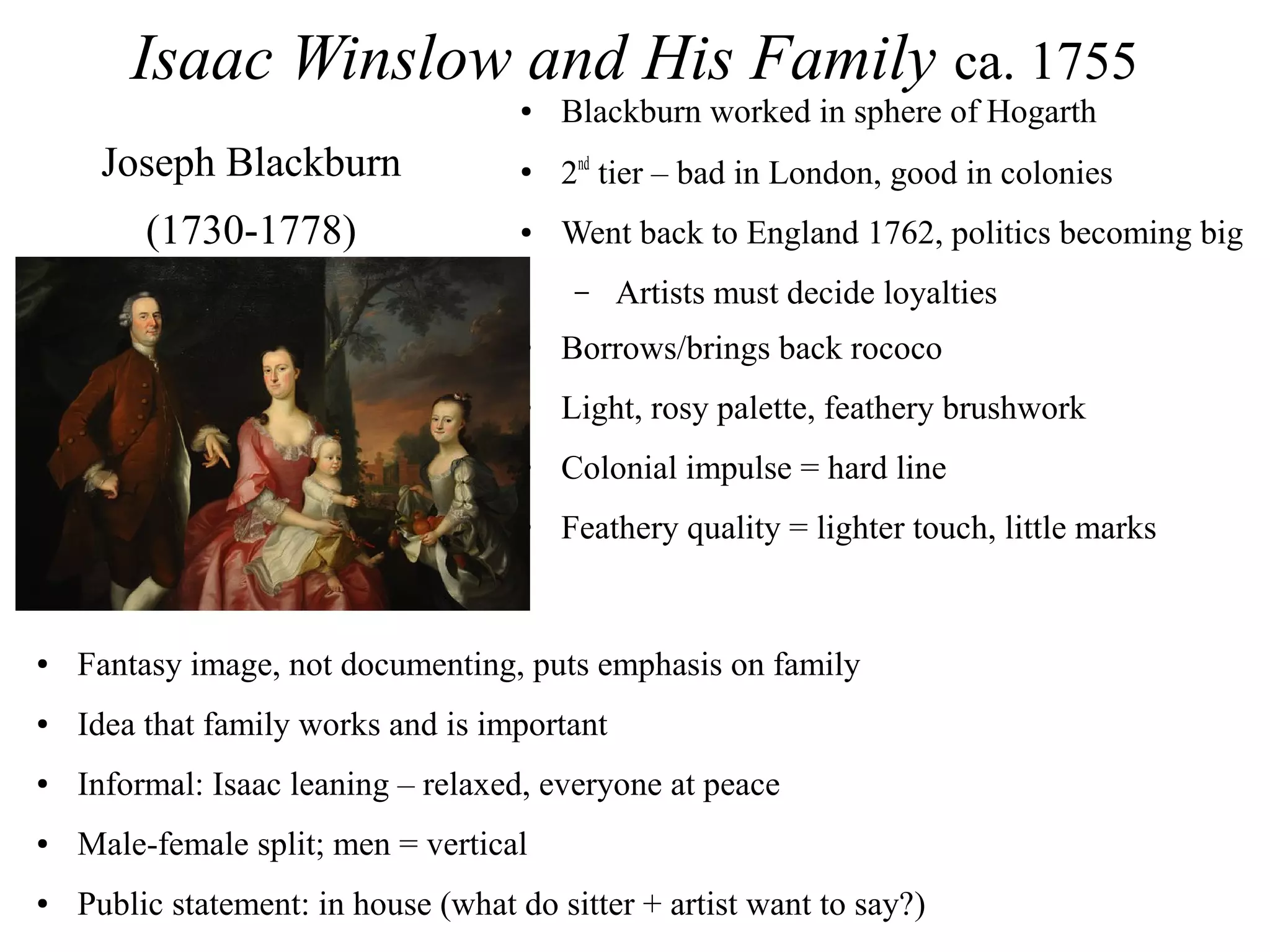
Isaac Winslow and His Family ca. 1755
● Blackburn worked in sphere of Hogarth
● 2nd
tier – bad in London, good in colonies
● Went back to England 1762, politics becoming big
– Artists must decide loyalties
● Borrows/brings back rococo
● Light, rosy palette, feathery brushwork
● Colonial impulse = hard line
● Feathery quality = lighter touch, little marks
Joseph Blackburn
(1730-1778)
● Fantasy image, not documenting, puts emphasis on family
● Idea that family works and is important
● Informal: Isaac leaning – relaxed, everyone at peace
● Male-female split; men = vertical
● Public statement: in house (what do sitter + artist want to say?)
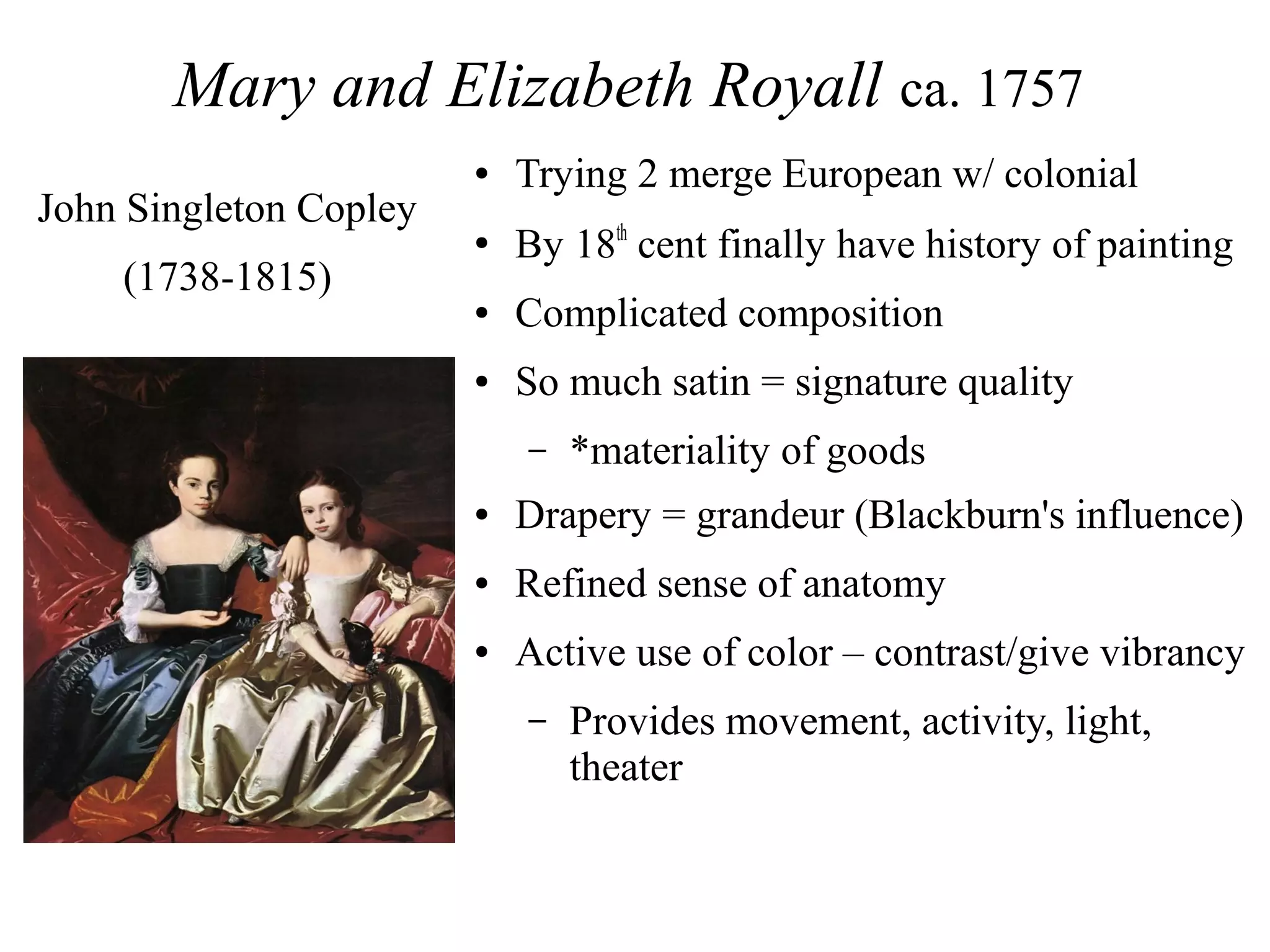
Mary and Elizabeth Royall ca. 1757
● Trying 2 merge European w/ colonial
●
By 18th
cent finally have history of painting
● Complicated composition
● So much satin = signature quality
– *materiality of goods
● Drapery = grandeur (Blackburn's influence)
● Refined sense of anatomy
● Active use of color – contrast/give vibrancy
– Provides movement, activity, light,
theater
John Singleton Copley
(1738-1815)
Mary and Elizabeth Royall cont.
● Hand on shoulder = physical contact = warmth, family, ease
● Balance theatricality w/ warmth
● Dependence/emphasis on line
● Focus on detail (fur of dog, starkness of satin)
– Accurate likeness: individualized, but flattering
● Complete Clarity: not about what eye does
– Copley asserting aesthetic presence – controls what you see
and how you see it
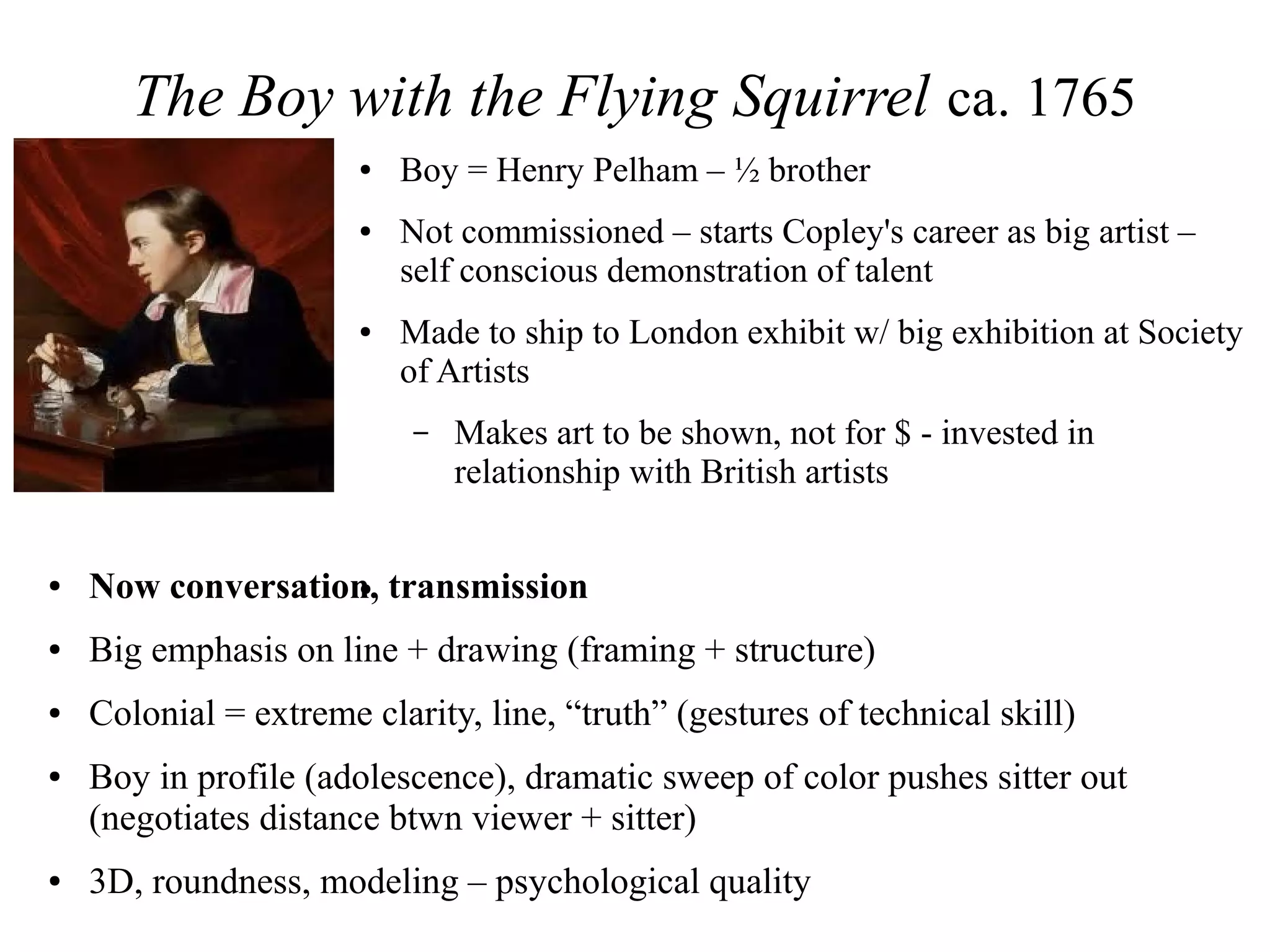
The Boy with the Flying Squirrel ca. 1765
● Boy = Henry Pelham – ½ brother
● Not commissioned – starts Copley's career as big artist –
self conscious demonstration of talent
● Made to ship to London exhibit w/ big exhibition at Society
of Artists
– Makes art to be shown, not for $ - invested in
relationship with British artists
●● Now conversation, transmission
● Big emphasis on line + drawing (framing + structure)
● Colonial = extreme clarity, line, “truth” (gestures of technical skill)
● Boy in profile (adolescence), dramatic sweep of color pushes sitter out
(negotiates distance btwn viewer + sitter)
● 3D, roundness, modeling – psychological quality
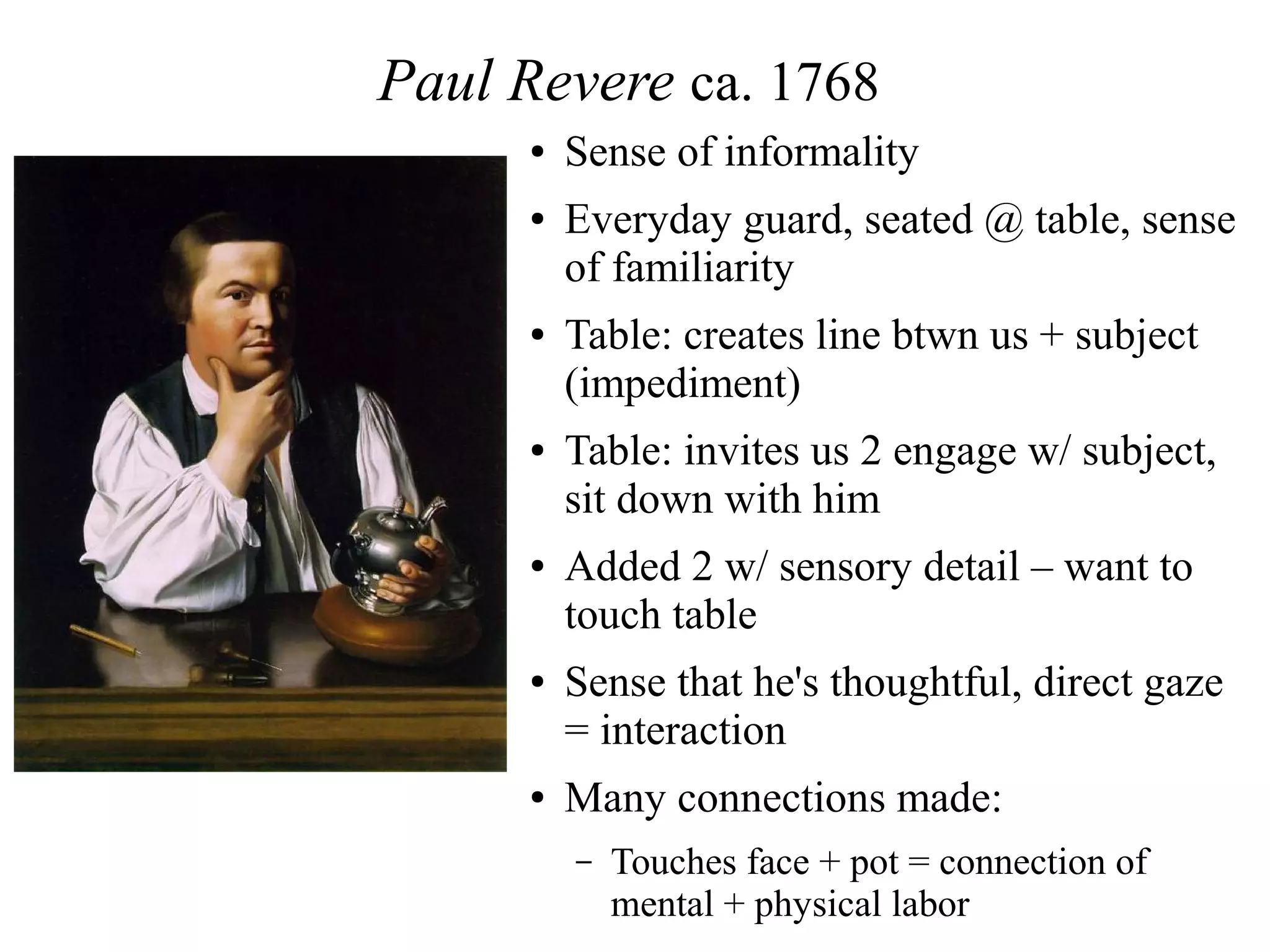
Paul Revere ca. 1768
● Sense of informality
● Everyday guard, seated @ table, sense
of familiarity
● Table: creates line btwn us + subject
(impediment)
● Table: invites us 2 engage w/ subject,
sit down with him
● Added 2 w/ sensory detail – want to
touch table
● Sense that he's thoughtful, direct gaze
= interaction
● Many connections made:
– Touches face + pot = connection of
mental + physical labor
Paul Revere cont.
● Idea of pot, pot came from mind
● Draws eye between intellect, what he's made
● Reflective surfaces – good @ perspective
● Weight given to figure in part thru background
● Takes visual + physical space
● Materiality of objects: etches name on pot as maker
● Visual qualities of American art: line + detail (Puritan values
find their way in to this kind of art – doesn't work w/ Copley
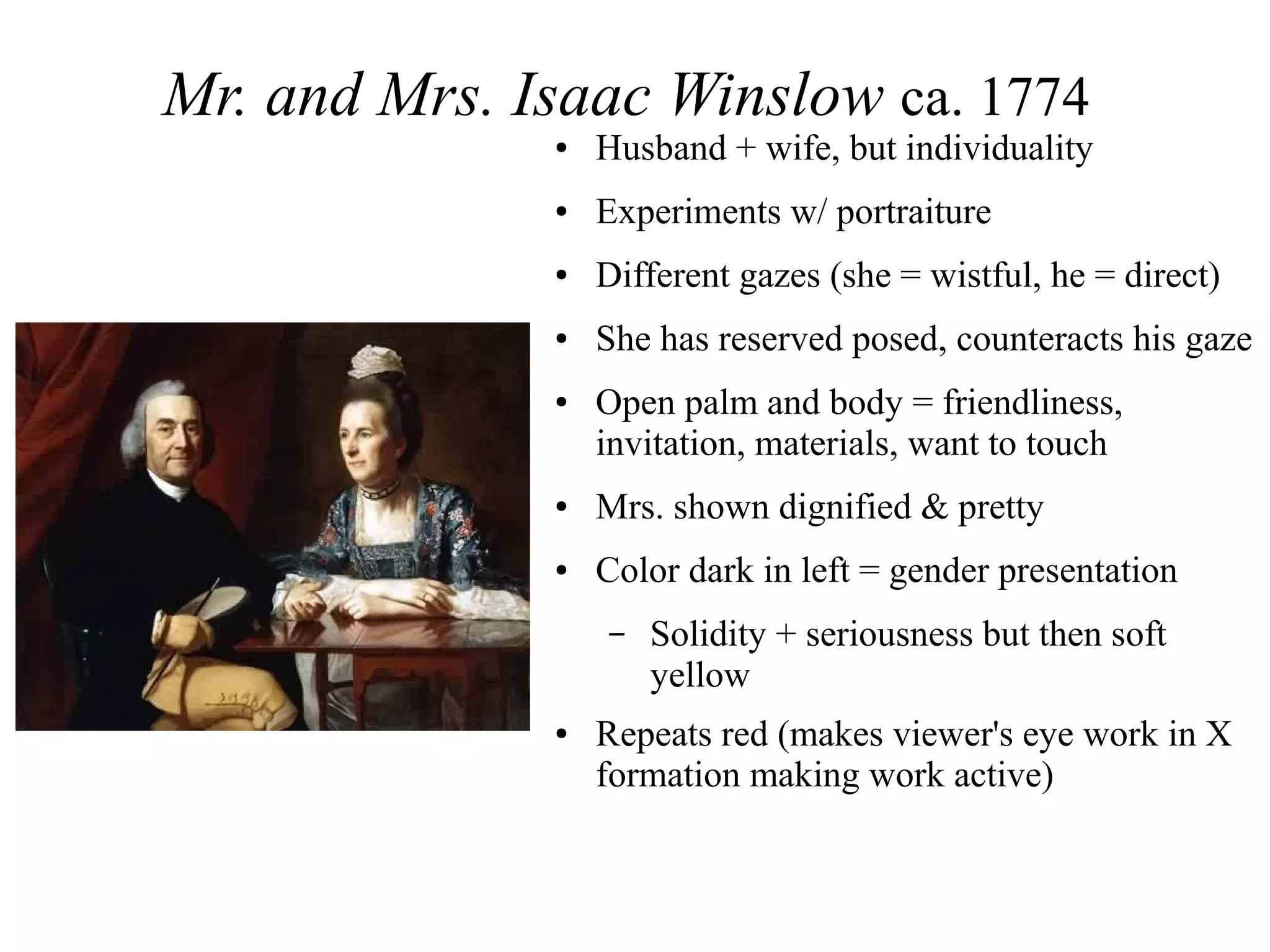
Mr. and Mrs. Isaac Winslow ca. 1774
● Husband + wife, but individuality
● Experiments w/ portraiture
● Different gazes (she = wistful, he = direct)
● She has reserved posed, counteracts his gaze
● Open palm and body = friendliness,
invitation, materials, want to touch
● Mrs. shown dignified & pretty
● Color dark in left = gender presentation
– Solidity + seriousness but then soft
yellow
● Repeats red (makes viewer's eye work in X
formation making work active)
Watson and the Shark ca. 1778
● 6 x 8 ft, 4 diff versions, APEX of western art
● About Watson Brook who fell off boat in Havanna Harbor
● Gift 2 orphanage, about perseverance, succeeding despite
adversary
● Very personal – relationship between Copley and Watson
● Emph on Watson: only guy in water, w/ imminent threat, standard
pyramidal arrgment, ppl seek to help him, naked?, shark + him =
action
● Brings intense emotion
● Comment on slavery + dismemberment of British Empire
● American revolution disruptive personally + professionally
● Prof wanted to make aesthetic art convo with England
– Wanted to be part of royal academy
● Wants 2 push into history painting, but court already had official painter
● Work meant to be hopeful = biographical
● = symbolic work in realistic style = REALISM (history painting goes to it)
– Recognizable forms + elements, suggests truth
● Dramatic lung of shark
1. lower ½ of nature + man – altered visual detail 2 show importance
2. upper ½ = dramatic rescue
● Theatrical, pyramidal structure (=stability, balance), though it leans
– Gives surging drama, heightens emotions
● Focus/weight @ hopeful contact: is he going to make it?
● Viewers become +savvy – coincides with rise of sensationalism
– Ppl want excitement, this work feeds this
● Symbolism: loss of leg (perseverance), shark (adversary) – has reflective surface
which heightens artificiality of work – loses materiality..doesn't really pull it off.
Normally it seems like artist was there in history works
● Representative of nature + the exotic
● Caribbean port = specific of exotic locale (shark lives in colonial waters)
● *scholars don't agree on visual sources
1. Grouping with movement/action
– Copley looks to Lacöon → sense of flow + movement, turn + twist
– More movement than seen before
– Rope coiling, connects visual elements; surging/diagonal
– Figure of African descent meant 2 be white, but made black later
– = comment on slave trade, black body at top = inversion of practice of
overthrowing sick slaves *Copley doesn't take a position
2. Source from Prometheus by de Ribera ca. 1630
– Circulating in London, mid 18th
century, moment of suspending animation, dark
palette = focus on body
● *Fated Exchange: commentary on occurring contest → ppl fight over America
● Colonies being dismembered (like leg)
3. Biblical Image but no longer accepted
The Death of General Wolfe ca. 1770
● National Gallery Canada, 5x7ft
● History = grand themes + grand ideas = pinnacle of painting
– = belief from 16th
century → hard 2 do therefore important
● Painting = visual form of history, has greatest potential 2 affect viewer
– Meant to impress/instruct
● Place, person/hero (to express ideals) + EVENT needed (should be dramatic!)
● Viewers meant to feel inspired by his sacrifice
● West = court painter to George III; makes career in London but born in PA
● **1. american artist to achieve international acclaim
● In NY, travels, Grand Tour (Italy 1760, London 1763)
● Royal patronage influences what he paints
● West founds ROYAL ACADEMY in London
● This work gets West in trouble with George III = beginning of his end
● Exhibits @ Royal Academy in 1771, widespread acclaim
– ISSUE: contemporary in subject
– Never before put people in contemporary clothes
– Takes moment in Battle of Plains of Abraham, French and Indian War in
1759, war was precursor to Revolution
– Brits vs. French fight for Quebec, Brits win
● NEOCLASSICISM: Wolfe knew @ death that Brits won, fighting all around
● Set 3 Groupings: center = drama: light on body – elegant pose, emphasis on
pyramidal structure, draws eye to location
● Death scene: heightened drama → The Lamentation, 1612 Rubens
– = moment of contact btwn Christ + mourners
● Wolfe = prone – has contact w/ soldiers around him
● He tried to get lots of portraits to capture sense of grief
● Reference to Bible = big deal, BUT contemporary history painting
● *How do you get sense of marvelous/extraordinary – no blood, only evocation of
violence
● Political Undercurrents:
– Reference 2 America → Native American
– = creative departure, pose of contemplation, bears witness – plays role of
noble savage, Passive body, unconcerned
– Celebrates GB, warning to colonies (France = threat!)
– Exotic landscape (like Copley), eye-witness account
● Copley + West study landscape
● Historical authority: GB's story to tell → affirms state and its power
● So many layers to political works → nothing left to chance
● Artists construct history like construct painting = “real”, “accurate”
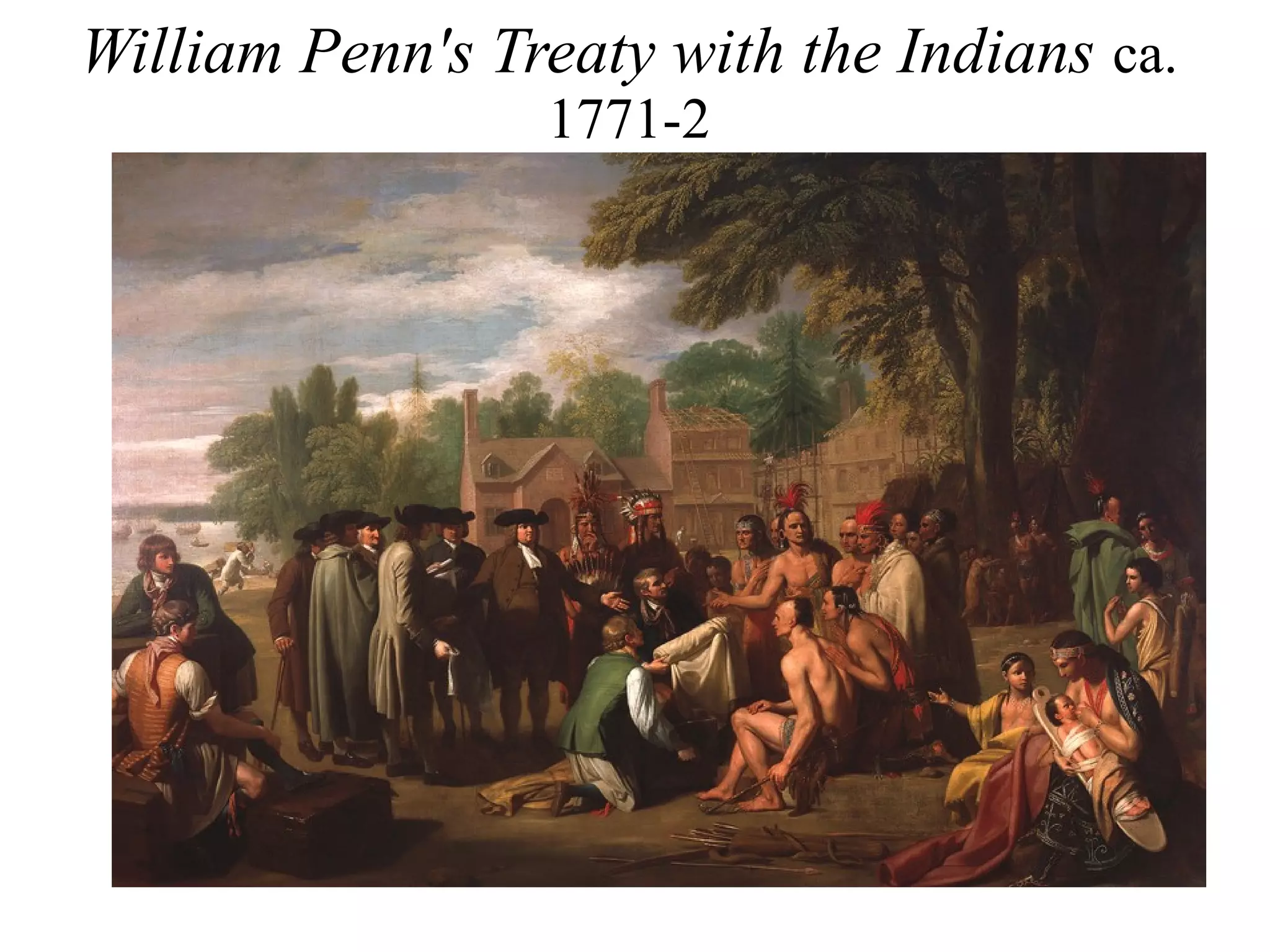
William Penn's Treaty with the Indians ca.
1771-2
● Commissioned by Thomas Penn (William's son)
● He wanted to document the founding of PA
● Set on Delaware River, settlers vs. natives
– Not about integration = mtg btwn 2 different groups (ca. 1682)
● = “Treaty of Friendship”
● Natives shown in typical garb – historical accuracy of clothes?
● Native Americans presented as type
● Quakers, Merchants, Indians all = in act of settlement
● Madonna scene – says Indian existence not compromised by treaty
● All =, peace, friendship + historical document of treaty
– References physical document
● “Stately Elm” = @ site @ time = way West makes image have historical
accuracy
● *American painting, American treaty = between natives
● All about here and now
● Sense of harmony, reserve, grandeur
● Cohesive color – all level + equal → how bodies nebeneinander
● West: 1.) surging drama 2.)treaty equal + peaceful
● = Source for Copley
The Death of Major Pierson ca. 1782-84
●
In England, date January 6th
, 1781, 8x12 ft
● Very recent event (2 years prior)
● Battle of Jersey: French vs. Brits 2 secure island
● Heated tensions = shifts in Empires – fighting 4 control
● 1781: engagement assoc. with American Revolution
● Pierson died → American/British history painting
● Surging diagonal w/ blood, falling body
● Collection of soldiers catch body, showing honor, delicacy
● Color red = urgency, drama
● Lamentation reference: compositional quality; 3 Groupings:
1.) Soldiers: lined = dramatic background, drummer's hand guides view
● Black figure = historically accurate, avenges Pierson's death
– Important visual + narrative part (not an outsider)
– Integrated visually, repetition of color
2.) fleeing women + kids: higher stakes in fight – families
3.) Middle: surging diagonal, cannon moves us to ladies, L → R
● Bold colors meant to make you part of history
● 17 complete studies of this work
● Invested in detail, careful composition: feels staged, fixed, dramatic but located
→ Baroque quality
● Flag = pseudo-cross, propaganda (Pierson = Christ)
● *contemporary events with contemporary people can be just as valuable
– * = create new pantheon of history painting
– Stakes higher!!
Charles Willson Peale (1741-1827)
● From Maryland, starts art in his 20s
● Has craftsman skills, taught by John Hesselius
● Sees Smybert's works, meets Copley + West (1767-1769)
● Studies with West for 2 years in London
● Paints portraits, patriot, served in military
– Made maps
● Heads = ovals = Smybert's influence
● *colonial: clarity, hard line, drawing
● Merged colonial with Rococo (tries to stray from set
presentation)
● Affection shown
Charles Willson Peale cont.
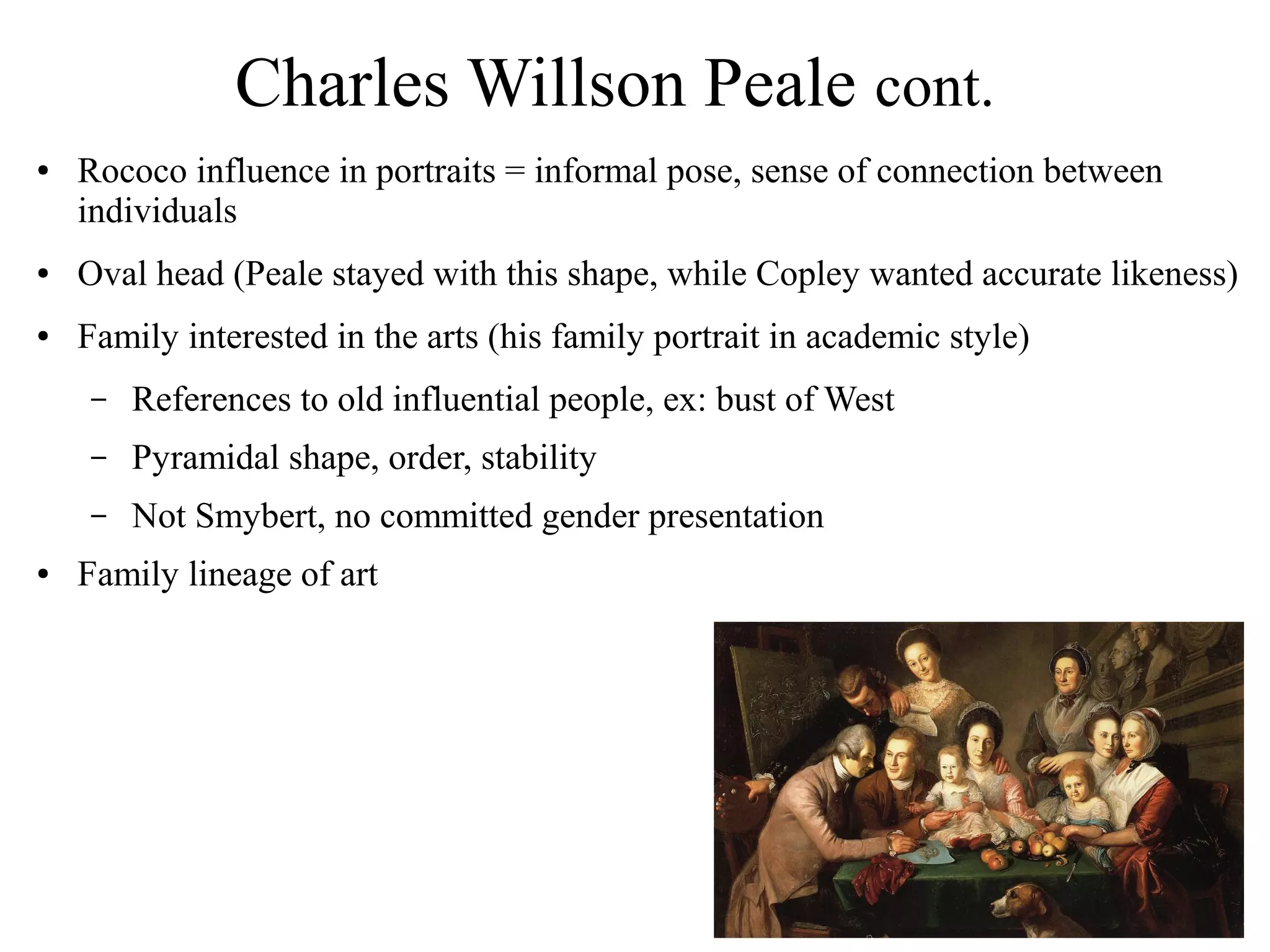
● Rococo influence in portraits = informal pose, sense of connection between
individuals
● Oval head (Peale stayed with this shape, while Copley wanted accurate likeness)
● Family interested in the arts (his family portrait in academic style)
– References to old influential people, ex: bust of West
– Pyramidal shape, order, stability
– Not Smybert, no committed gender presentation
● Family lineage of art
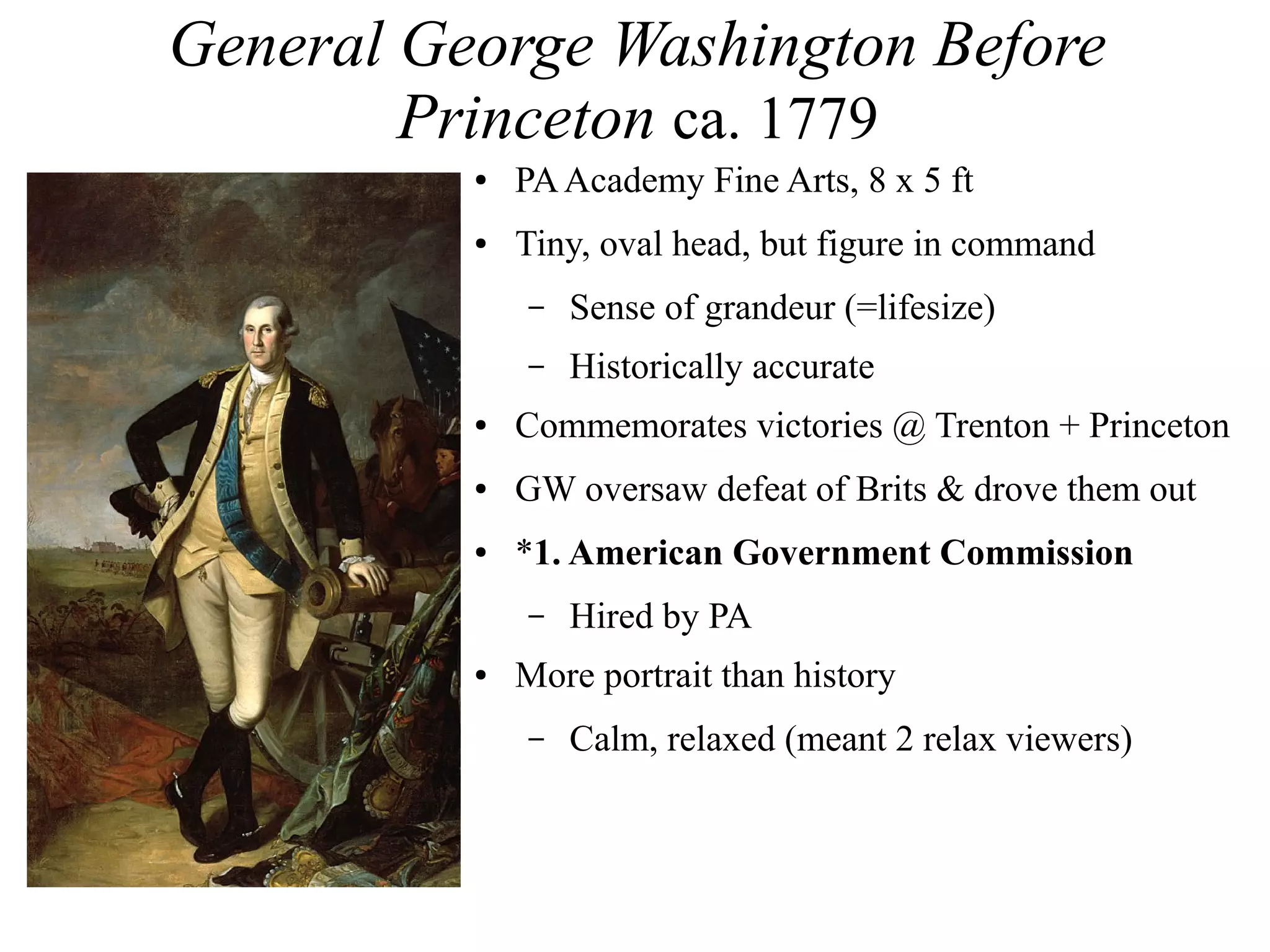
General George Washington Before
Princeton ca. 1779
● PAAcademy Fine Arts, 8 x 5 ft
● Tiny, oval head, but figure in command
– Sense of grandeur (=lifesize)
– Historically accurate
● Commemorates victories @ Trenton + Princeton
● GW oversaw defeat of Brits & drove them out
● *1. American Government Commission
– Hired by PA
● More portrait than history
– Calm, relaxed (meant 2 relax viewers)
● Clouds: dark, smoke passing on, skies clearing
● Colonial elements add strength
– Various manmade details = items transformed America's win
● Contemporary event = in the moment
– Creates heros @ moment events happen (feels like document)
● Metaphor: rising American nationalism (flag shown), 4reignors lost
● Deco adds grandeur + color + drama in foreground
● Peale wants to make heros out of war
– Nation defines itself through these representatives
● Emphasis on self-made individual
– No sense of humility – more individualistic
– Natural aristocrats ascended socially through hard work
– Get sense of importance/status
● All else is simplified → desire of accurate likeness
● *direct gazes, neutral backgrounds to emphasize making of hero
– → less emphasis on material wealth
● Peale wants to exult Benjamin West
● Sees importance in museums → invested in archives
● Wants to institutionalize American history through representation
The Staircase Group ca. 1795
● Deliberate convo btwn viewer + art
● Deliberately individual
● Sons shown = celebration of art in the family
● Poignant work (Titian dies later): What's its purpose?
● Emphasis on vertical = look @ stairs
● Invitation to move into work
●
Portrait + trompe L'oeil (fool the eye): 17th
century Dutch
● Tromp L'oeil: witty, serious, offshoot of still-life
● Game artists play with viewer bridges convo btwn artist + viewer
● Peale asserts mastery over allusion
– Makes you aware of nature of painting (smart of Peale 2 have done)
● Grain of wood emphasized, ticket on steps (=exhibition ticket)
– References moment – work on exhibition = centerpiece
● Establishes museum in Philly, open to public
● 1801 collection moves to Independence Hall
● Not limited to art, but also liked technology
● Portrait artist, history painter, still-life?
● Excavation of mastodon; from experience comes work
– 1. archeological dig in US
– Generational element: showed moment – cultural convo
– Broader issues btwn man + nature (how does it fit into Xtian
narrative?)
– This dig possible through divine God,
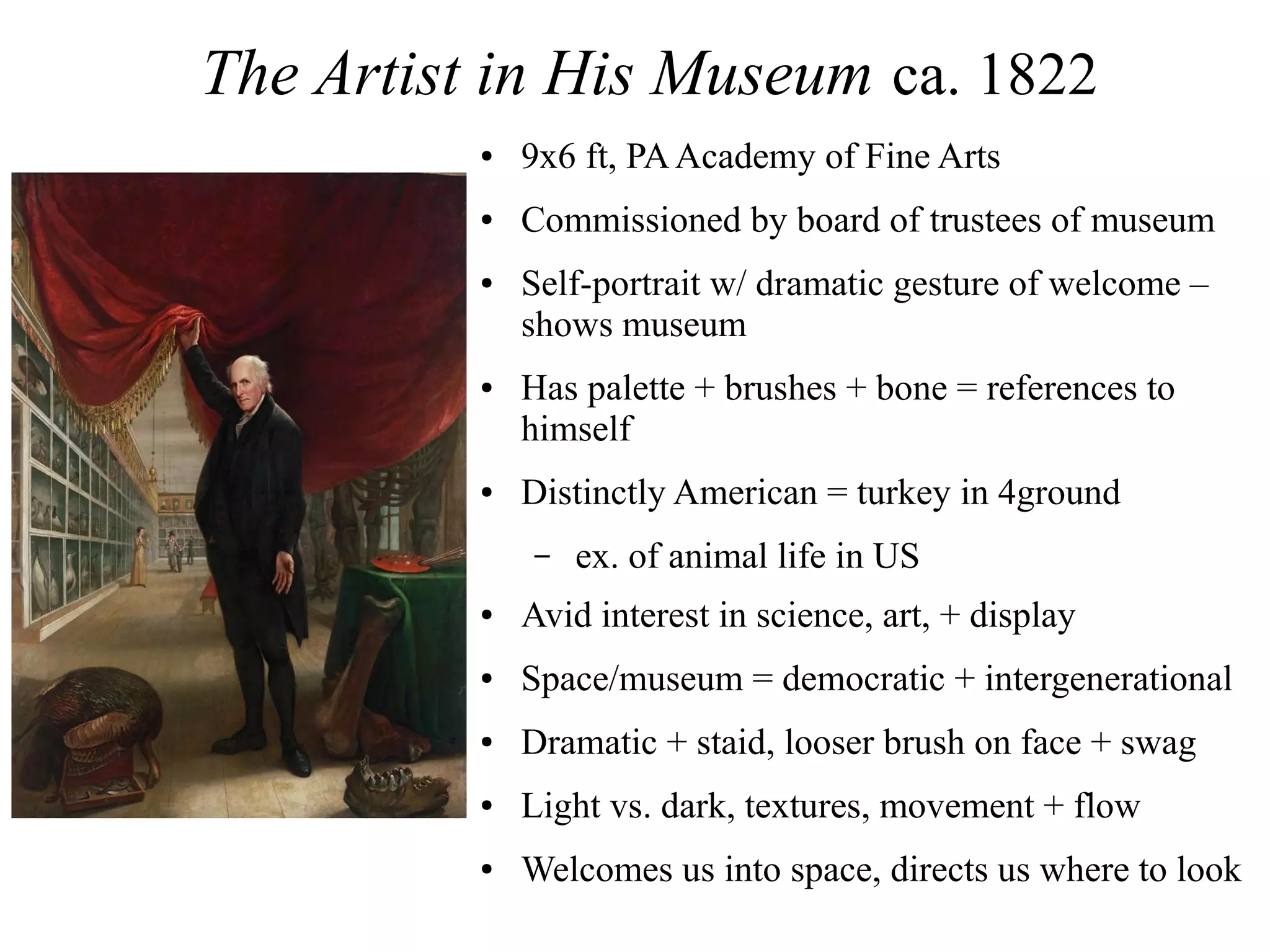
The Artist in His Museum ca. 1822
● 9x6 ft, PAAcademy of Fine Arts
● Commissioned by board of trustees of museum
● Self-portrait w/ dramatic gesture of welcome –
shows museum
● Has palette + brushes + bone = references to
himself
● Distinctly American = turkey in 4ground
– ex. of animal life in US
● Avid interest in science, art, + display
● Space/museum = democratic + intergenerational
● Dramatic + staid, looser brush on face + swag
● Light vs. dark, textures, movement + flow
● Welcomes us into space, directs us where to look
John Trumbull (1756-1843)
● Goes to Harvard, joins Army, drew maps
● IDs himself like Peale as having nat'nl importance
● Son of wealthy merchant/ CT governor
● 1778: rents Smybert's studio, later in London with West 1784
● Wants to paint history, but can't do it in London b/c political reasons + West
already there
● Neoclassicism: influence on West, Copley, Trumbull
– Based on ancient Greek + Roman sources
– Emphasize aesthetic + cultural ideas
● = direct reaction to Rococo
● Before Romanticism, coincides with Enlightenment
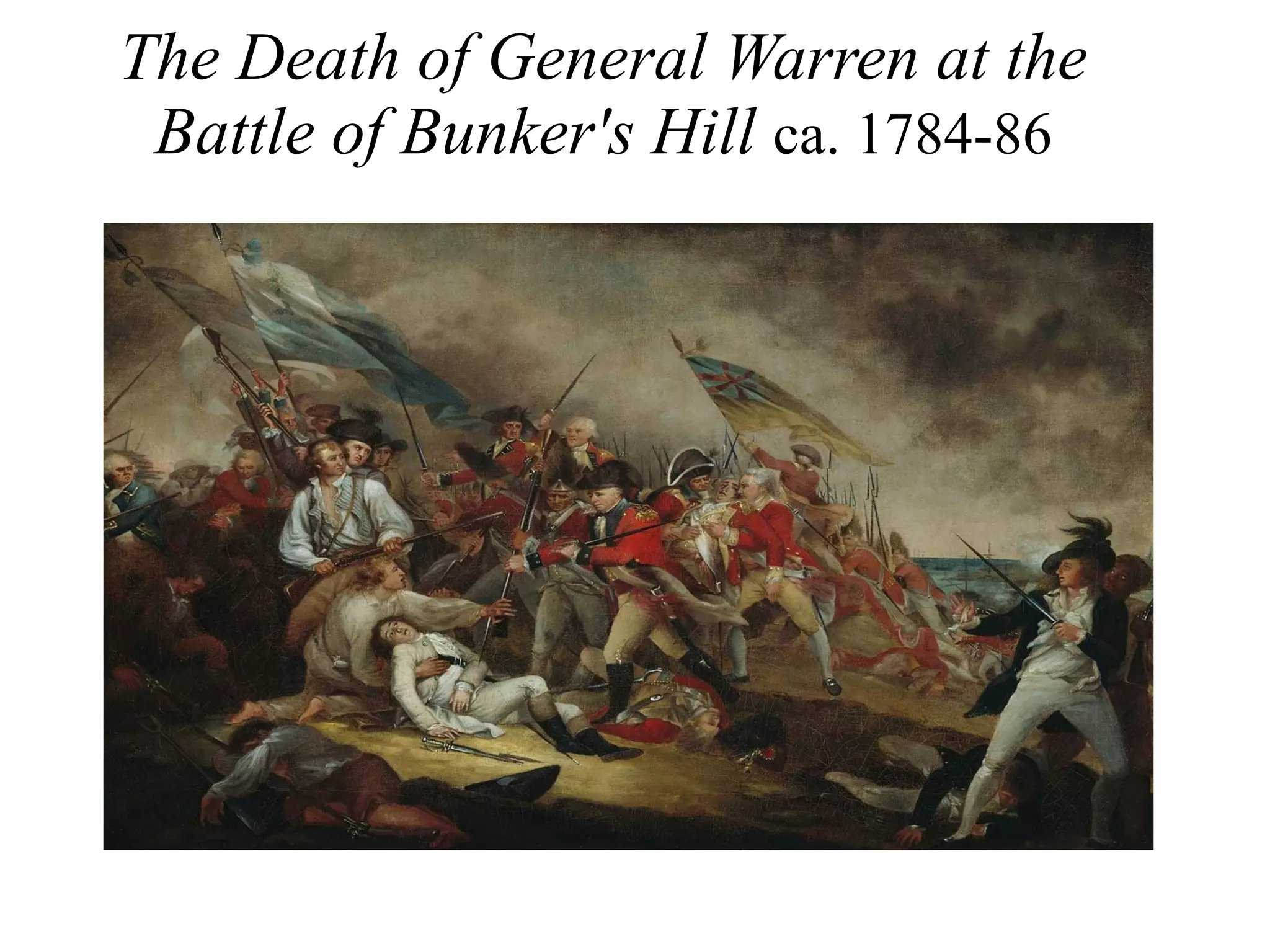
The Death of General Warren at the
Battle of Bunker's Hill ca. 1784-86
● Contemporary history work: big, noble ideas
● Trumbull saw this battle at a glance
● So dramatic/staged → Ex: surging flag
● Here = authenticity → bodies littered
● Drama shows stake here in battle (more carnage)
● Bodies strewn, variety of poses, lines veer off = chaos
● *Sublime element: dying for one's country
– Thing of greatness/ importance – so big and massive
– Creates pleasurable terror in you
– Noble death gives sense of sublime
● Convo with West + Copley = not possible without their examples
● High moral value, Warren sacrificed himself
● *About America! Establishes national history
● = art with ideological purpose
Enlightenment Influence on Neoclassicism
1. Human affairs ruled by reason + common good
→ not simply tradition/established rule
2. Activity @ foreground
3. Controlled brushwork = emphasis on contour
4. Rich, saturated, vibrant colors
5. About noble ideas = fits in w/ what America is + wants to be
→ America crafting what it wants to be
→ convo between American artists + David in France
6. Loss sense of informality – staged quality
7. Set in ancient Greece/Rome
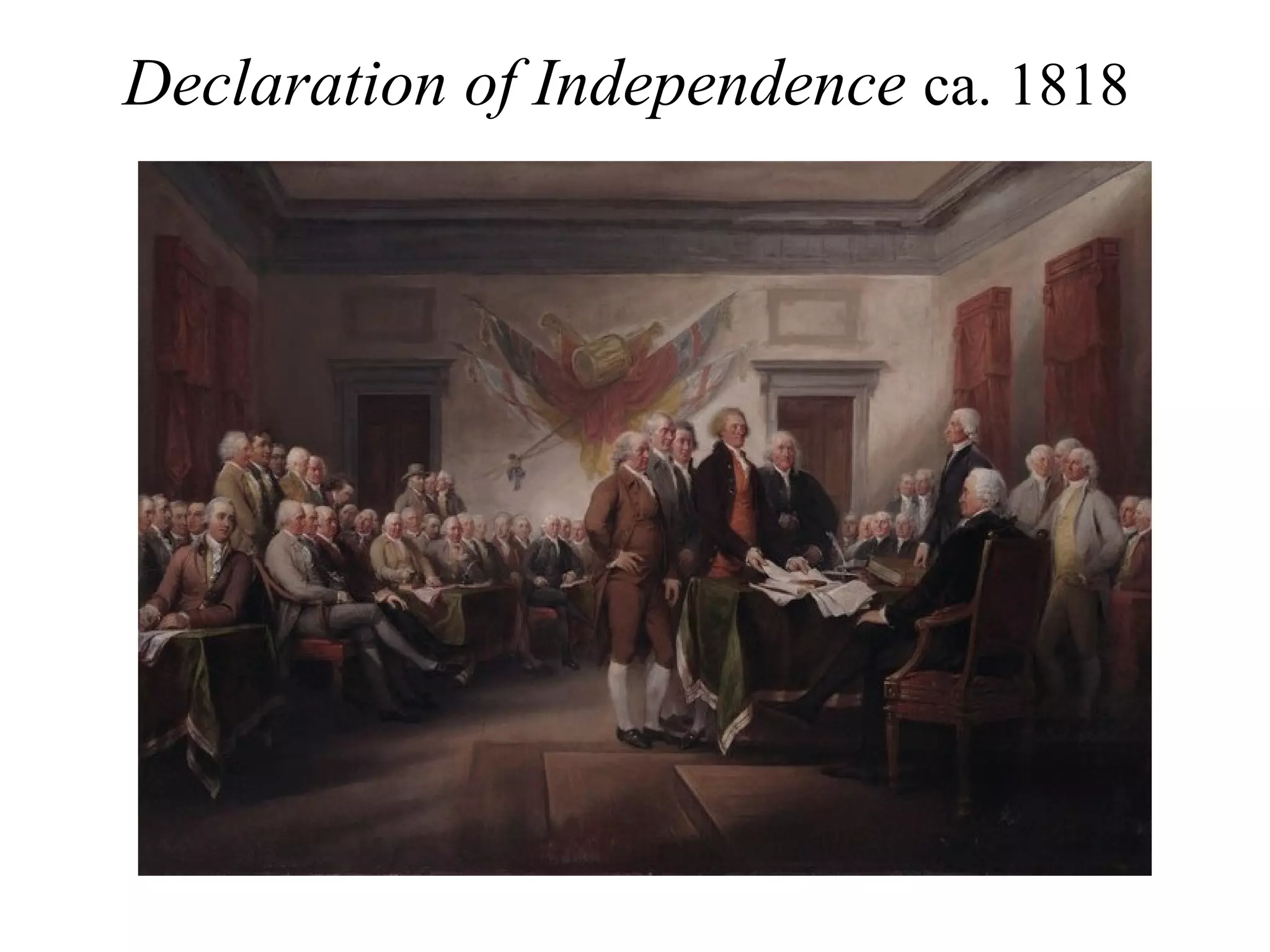
Declaration of Independence ca. 1818
● 2 copies, 1 in Capitol, 1 at Yale
● Trumbull more comfortable on small scale
● Met TJ in Paris, gave him 1. hand info on what room looked like, though
had partially forgotten
● In Independence Hall in Boston
– Documents important ceremony
●
= 2nd
Continental Congress (June 26th
, 1776)
● Wanted meeting to have meaning
– Includes all big players (not wholly accurate)
– Creates vision of historical event
● 48/49 portraits in work, TJ in center = accurate likenesses
= witnesses 2 event + tell viewer how to look at work
● Dramatic moment = signing of work
● Tells us who's wichtig = propaganda
● Ppl coming together, conflict resolution
– Put aside individual desires for common good
● Tighter brushwork
● Repeated colors, balanced, equality
– Heads aligned, no surging dramatic lines
● Became gov't portrait painter in 1810 = lots $$
● American Rev influenced how artists trained – brought back more
Euro styles
– Doesn't transform American culture overall
– Remnants of “folk/home” style
– Greater divide btwn home taught + those who studied
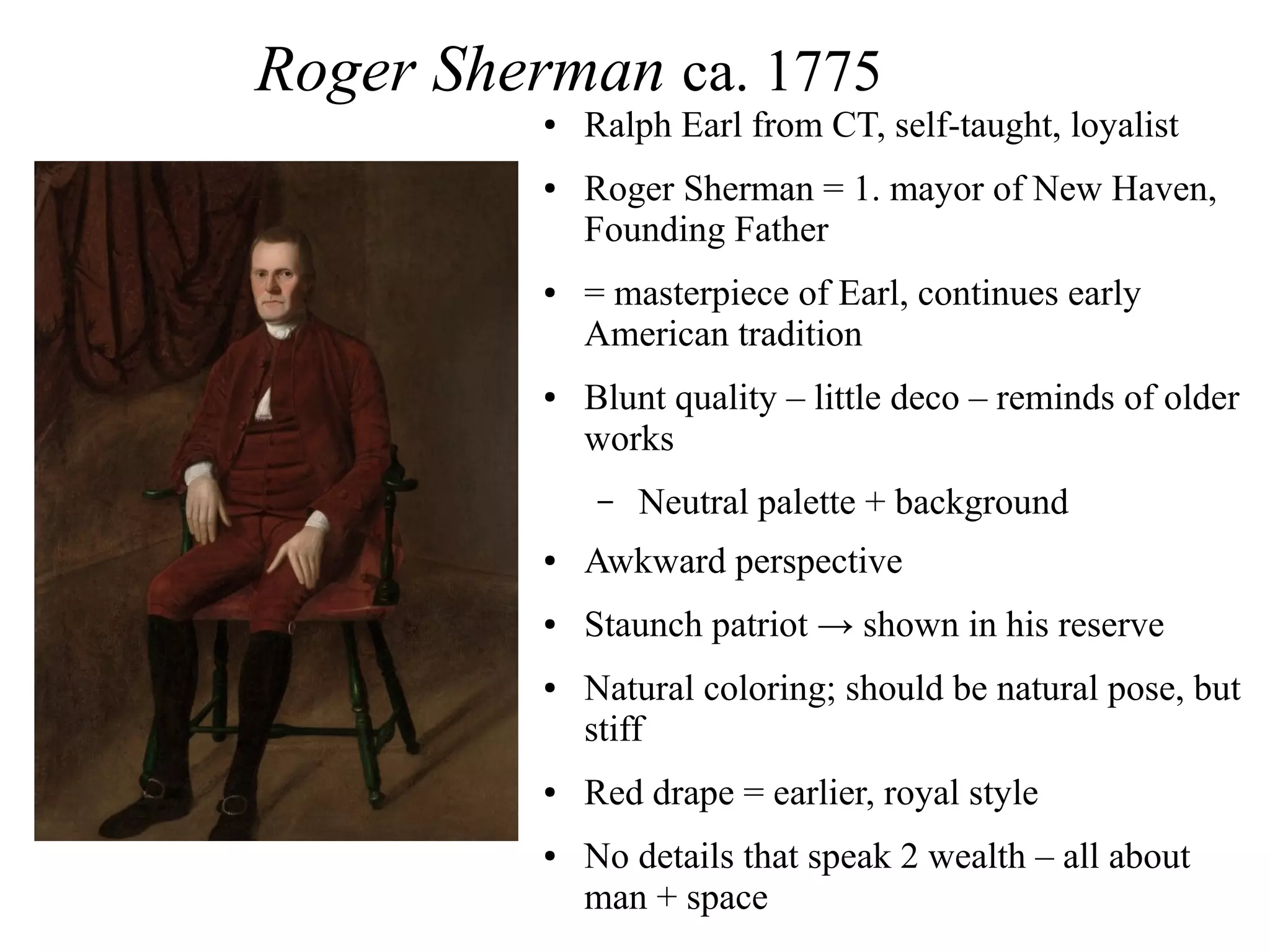
Roger Sherman ca. 1775
● Ralph Earl from CT, self-taught, loyalist
● Roger Sherman = 1. mayor of New Haven,
Founding Father
● = masterpiece of Earl, continues early
American tradition
● Blunt quality – little deco – reminds of older
works
– Neutral palette + background
● Awkward perspective
● Staunch patriot → shown in his reserve
● Natural coloring; should be natural pose, but
stiff
● Red drape = earlier, royal style
● No details that speak 2 wealth – all about
man + space
● Itinerant limner style in bluntness of presentation
● Little embellishment, almost crude
● Though swag and red color echoed in clothes
● Obvious presentation – viewer has full access
● Not much sophistication needed in part of viewer
● Lines + lighting reveal status of artist
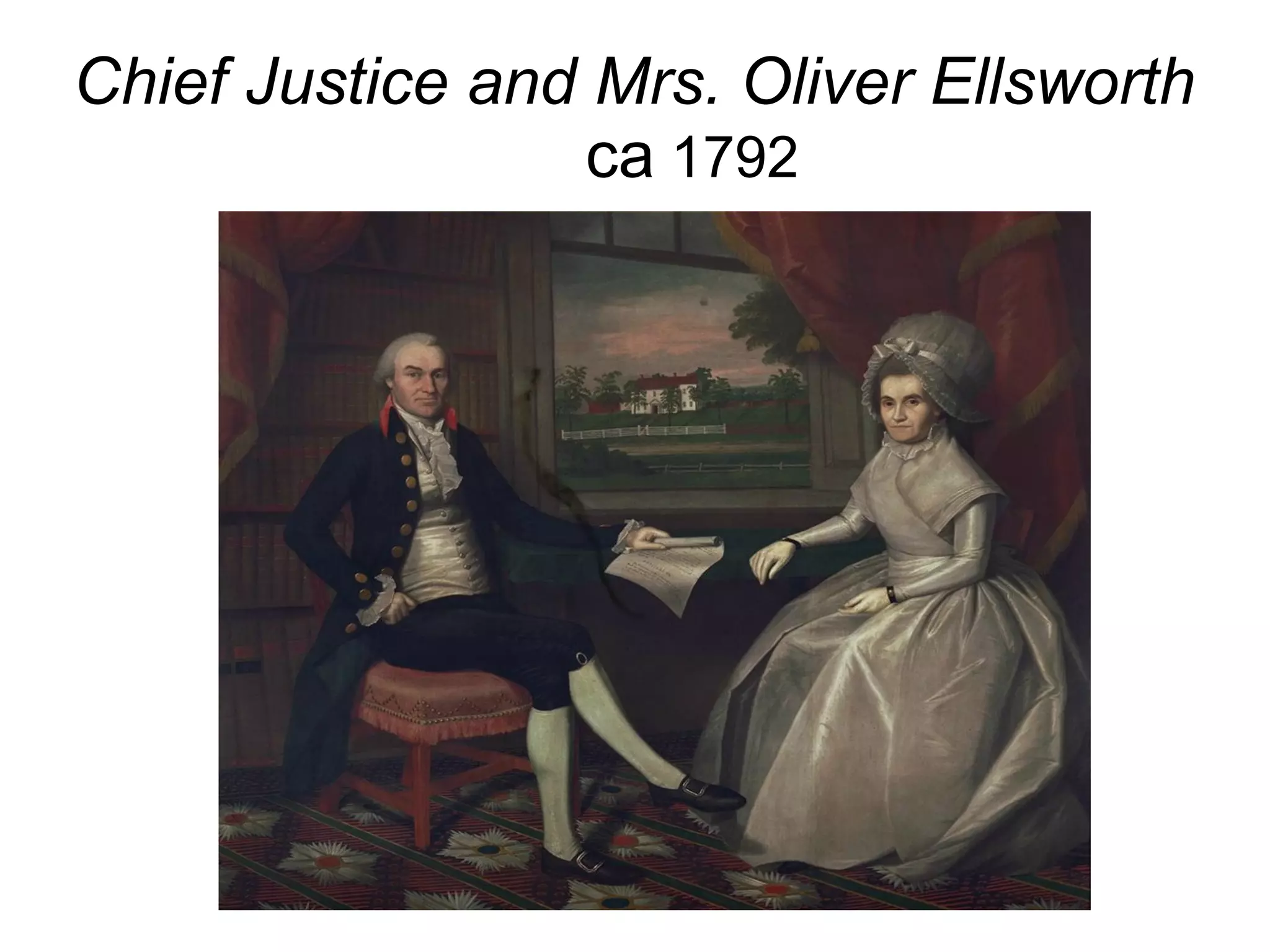
Chief Justice and Mrs. Oliver Ellsworth
ca 1792
● Ralph Earl, 6x7 ft, in Wadsworth Collection, CT
● Gesture to grand manner taking hold in American art
● Land = center (almost its own portrait)
● Female dress speaks to status
● Proportions off → chief has long torso
● Many facial details → the face was the most important for Earl
● Rug + fringe = finery that speaks to sitter
● Gender norms: books behind him, nature close to her
● Sitting @ estate, looking @ estate
– = celebration of what they own
● Emphasis on outline + palette relying on “local color” – nothing startling
● Modeling on face, but not much on body
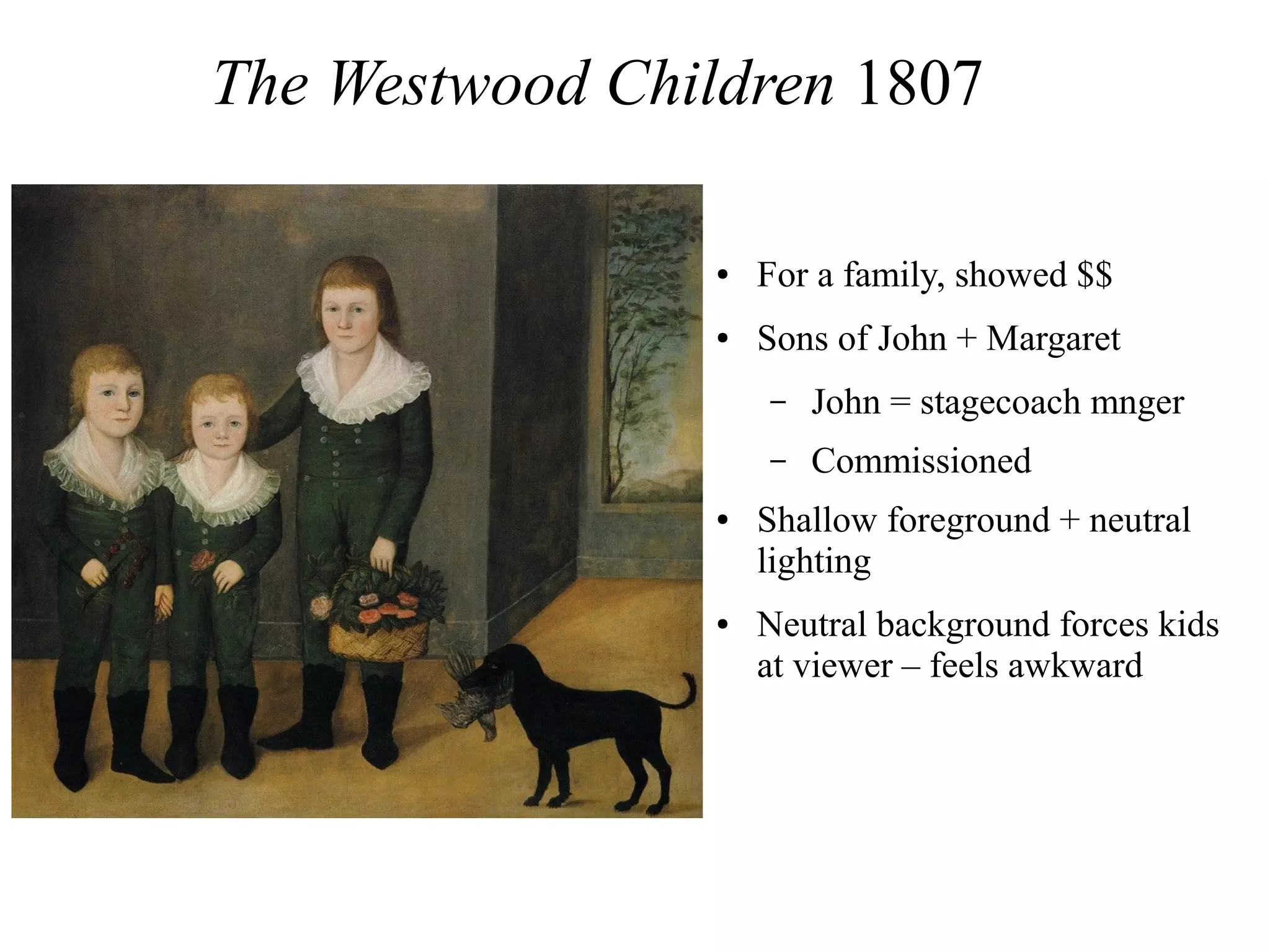
The Westwood Children 1807
● For a family, showed $$
● Sons of John + Margaret
– John = stagecoach mnger
– Commissioned
● Shallow foreground + neutral
lighting
● Neutral background forces kids
at viewer – feels awkward
Joshua Johnston (1763-1822)
● 1. African American to be established portrait painter
● 1796: gained freedom in Baltimore
● Modeling limited, anatomy limited
● Early itinerant limner tradition
● Flat background, flat use of color
● All have similar head + shape
● = composed individuals, but you're a part of the family
● Flat black dog pops out = silhouette feel
● Still life + portrait + landscape = demonstration of skill
● *associated with folk art, or nonacademic
– In 19th
century, folk + intellectual art split wide open
Gilbert Stuart (1755-1828)
● Principle portraitist 1790s – 1825 = FEDERAL PERIOD
● Apprenticed with Scottish portraitist
● 1775: Stuart meets West, stays 5 years there
● 1790s: moved back to US, Boston in 1805
● *early style = colonial style
– Emphasis on line/linearity, figures stuck to canvas, froze in space
– Little knowledge of anatomy, direct gaze, neutral background
● Exposed to West and things change
– Adopts British style = looser brush, subtly in tones, concept of
authority
● Only did portraits + traveled around
Side Notes
● Trumbull + Stuart push for nationalistic art to serve republic
– America still suspicious of art bc of its sensual quality
– Battle/push + pull affects fates of artists
– Fine, European art associated with aristocracy
● GS: invested in showing new kind of hero
● Thinks about American art as itself – an independent style
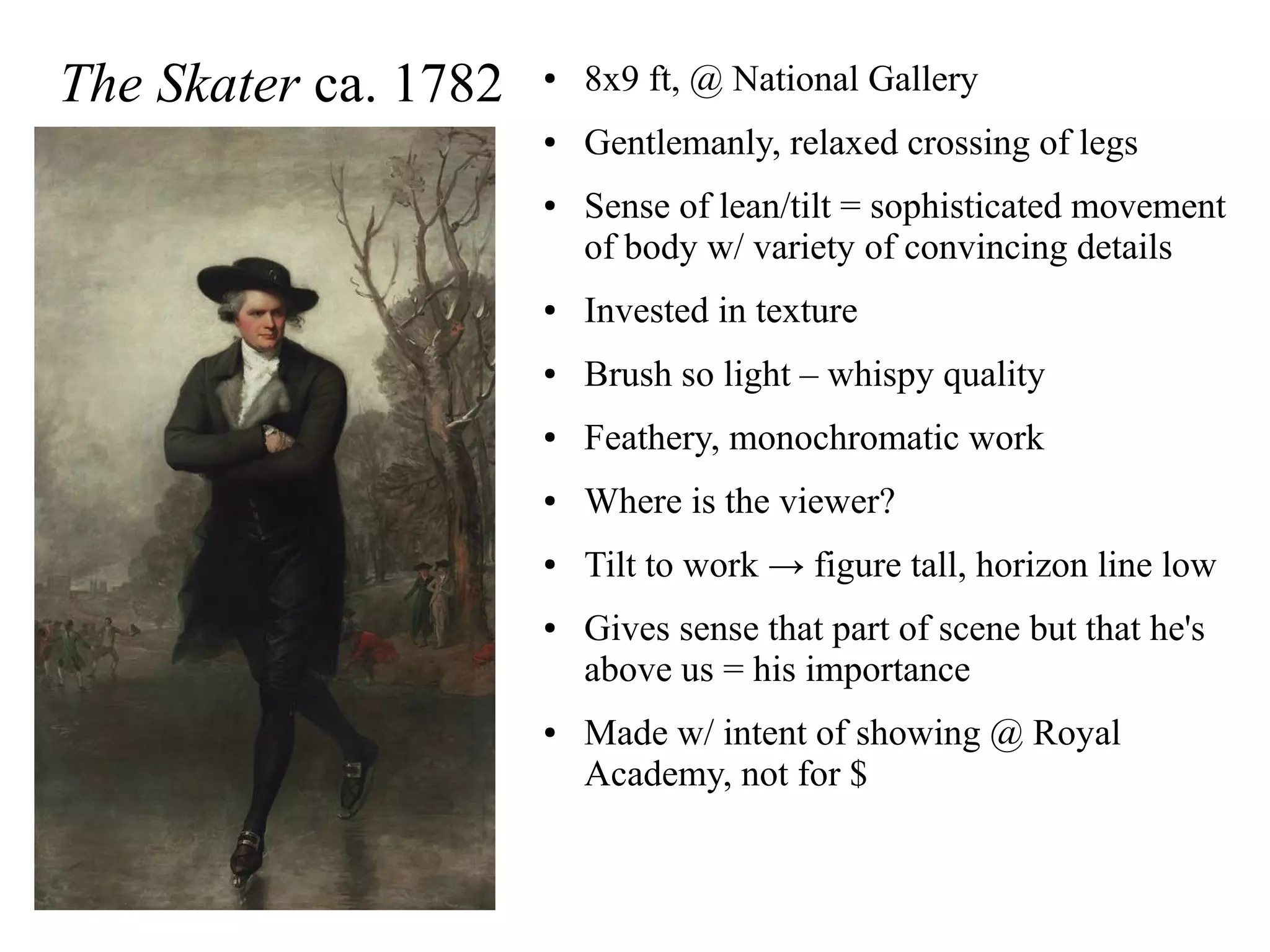
The Skater ca. 1782 ● 8x9 ft, @ National Gallery
● Gentlemanly, relaxed crossing of legs
● Sense of lean/tilt = sophisticated movement
of body w/ variety of convincing details
● Invested in texture
● Brush so light – whispy quality
● Feathery, monochromatic work
● Where is the viewer?
● Tilt to work → figure tall, horizon line low
● Gives sense that part of scene but that he's
above us = his importance
● Made w/ intent of showing @ Royal
Academy, not for $
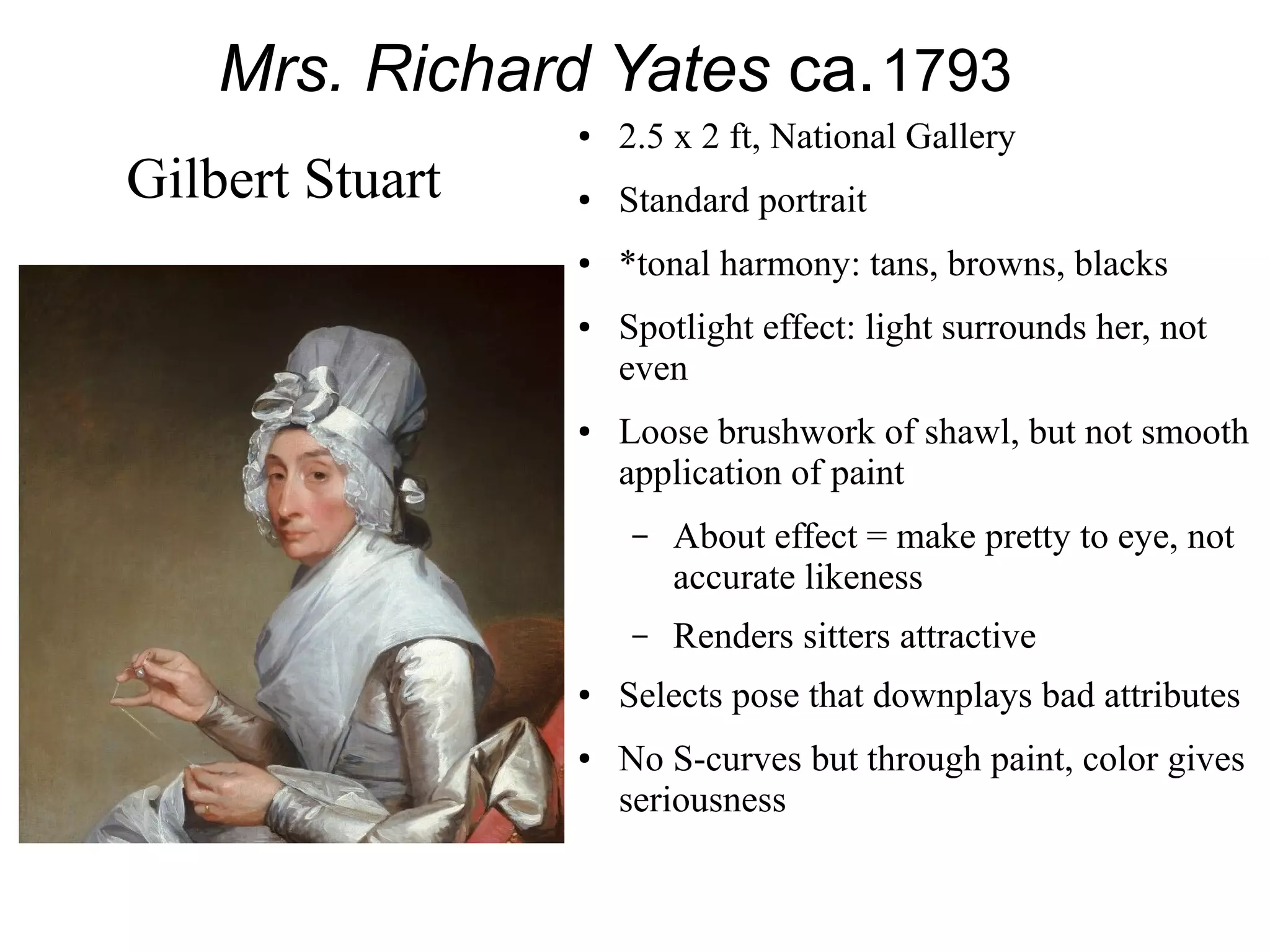
Mrs. Richard Yates ca.1793
● 2.5 x 2 ft, National Gallery
● Standard portrait
● *tonal harmony: tans, browns, blacks
● Spotlight effect: light surrounds her, not
even
● Loose brushwork of shawl, but not smooth
application of paint
– About effect = make pretty to eye, not
accurate likeness
– Renders sitters attractive
● Selects pose that downplays bad attributes
● No S-curves but through paint, color gives
seriousness
Gilbert Stuart
● Well to do, but not aristocratic
● Sewing = female activity
● *immediacy of work through loose brushwork
– Doesn't look frozen
● Complexity in position of hand = delicacy w/ solid form
*What will be the American art style of the New Republic?
● Desire to create independent art ID – up until 1945
– Push/pull with Europe
● Limners more American
– Not touched by Euro influence
– Wrestling with European undercurrent
Gilbert Stuart GW Studies
● Best known for his works of GW
– Goes to Philly
● Vaughn-type: more of right side
● Antenaeum-type: more of left side
● GS softened likeness – sense of directness
● Exchange between viewer + subject
● Not about accuracy, but about conveying hero
● Once you solidify icons, no longer about documentation
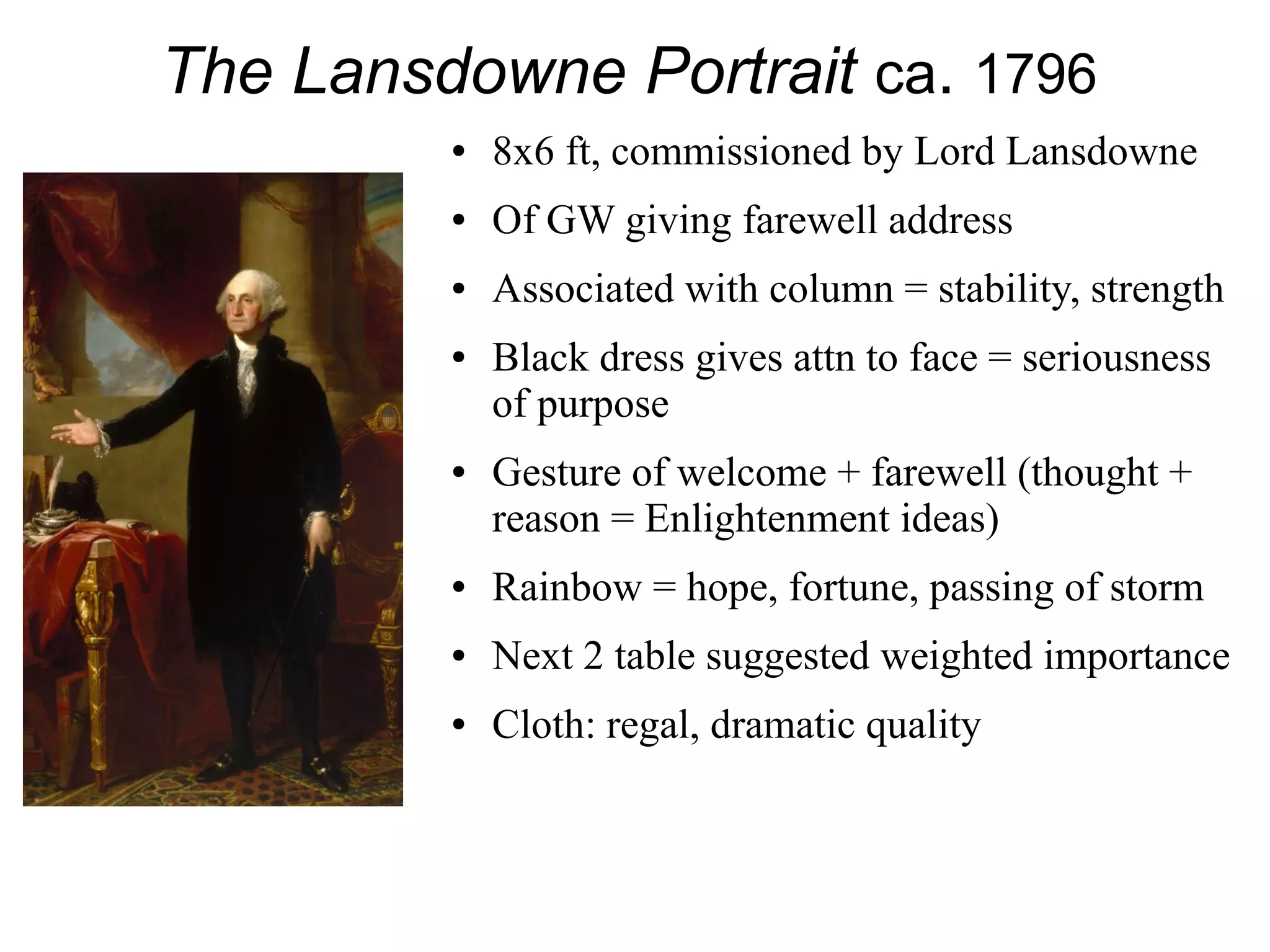
The Lansdowne Portrait ca. 1796
● 8x6 ft, commissioned by Lord Lansdowne
● Of GW giving farewell address
● Associated with column = stability, strength
● Black dress gives attn to face = seriousness
of purpose
● Gesture of welcome + farewell (thought +
reason = Enlightenment ideas)
● Rainbow = hope, fortune, passing of storm
● Next 2 table suggested weighted importance
● Cloth: regal, dramatic quality
● In regular clothes: humility
● Sword: gesture to time as general
– Successful not thru violence but thru thought + reason
● Quintessential aristocratic portrait of new republic, but not
aristocratically shown
● Dramatic use of color = stateliness
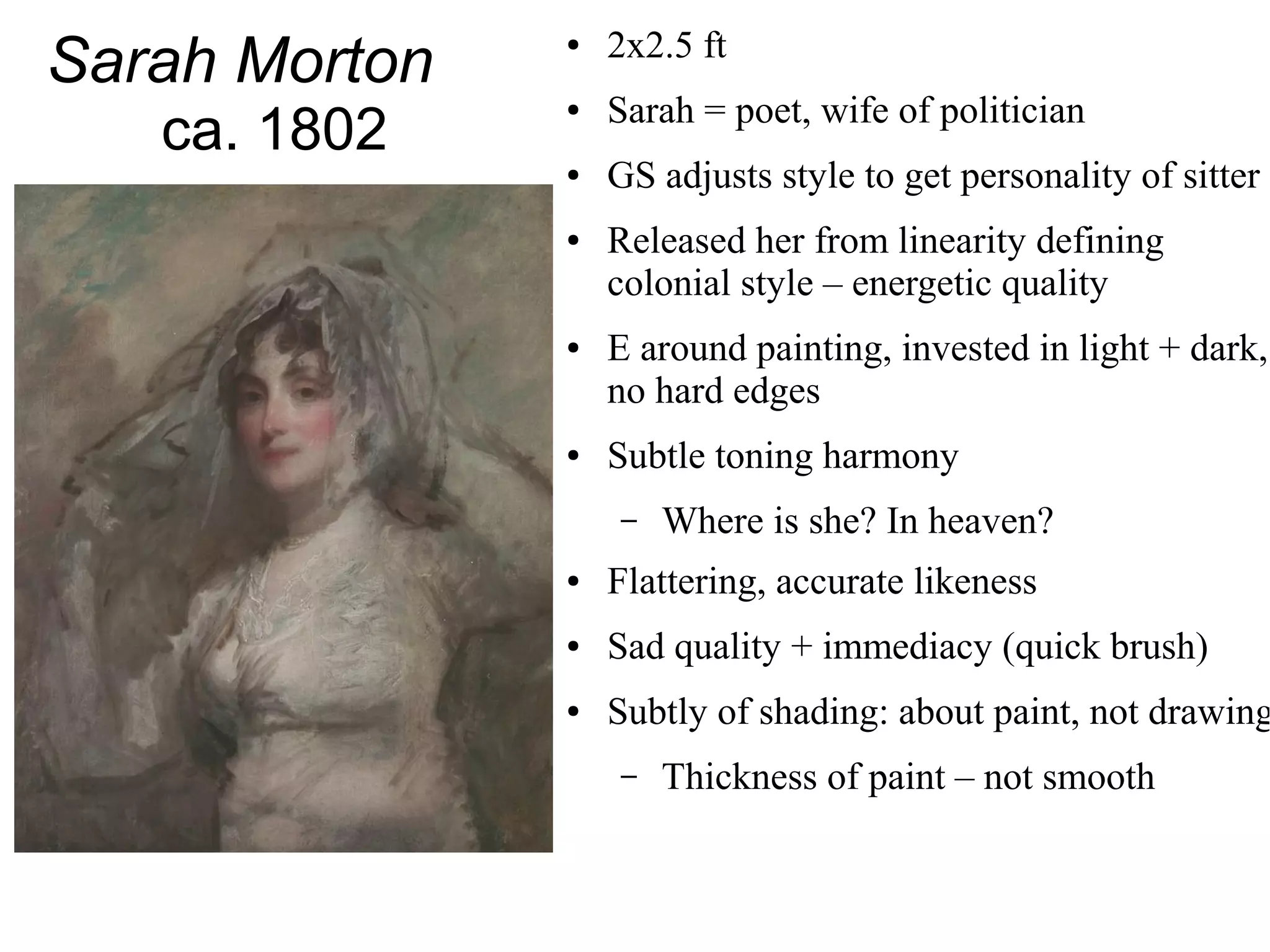
Sarah Morton
ca. 1802
● 2x2.5 ft
● Sarah = poet, wife of politician
● GS adjusts style to get personality of sitter
● Released her from linearity defining
colonial style – energetic quality
● E around painting, invested in light + dark,
no hard edges
● Subtle toning harmony
– Where is she? In heaven?
● Flattering, accurate likeness
● Sad quality + immediacy (quick brush)
● Subtly of shading: about paint, not drawing
– Thickness of paint – not smooth
John Vanderlyn (1775-1825)
● Wants grand manner of painting
● Art that was associated with aristocracy on the defensive
● Artists don't want to hold to European ideals they just broke from
● How do you adapt? Evolve?
● *Leads to American High Manner!
● Von NY, family invested in his art training: read + copied engraving
● American high art developing in communities + small circles
● Goes to France for education: *1. Ami to study in France
– Bc of Burr and his political ideas, doesn't like GB
● France ca. 1800 = Neoclassical style
1. Emphasis on Line
2.Action pushed to Frontal plane – little in background
3.Sentiment on high ideals (truth, honor, justice → pull from
classical sources)
4.Emphasis on anatomy – what Vanderlyn takes away
● Vanderlyn becomes supreme draftsman: good @ balance → learns
from David, realizes doesn't want to be portrait painter
● Heard this with Copley – wants to do more, but Amis have little
interest in such works
● Does what Copley did: history painting on recent event + includes
Americans
● *Looks to recent history, then to Roman hist. Then to the nude
The Murder of Jane McCrea, ca. 1804
● 2x3 ft, NEOCLASSICAL
● Native amis + woman framed against
frontal plane
– Directs eye to narrative
● Trees + woods = dark, makes scene pop
– Man in back posed to action
● *based on poem by Joel Barlow
– Spent time in France until 1805,
diplomat, patriot
– Had dreams of grandeur, poem: “The
Columbian”
– Glorifies America & her progress von
discovery to reovlution
● Barlow underwent religious conversion from Xtianity to atheism
● Retells Ami founding w/o religion, includes science
● Wanted poem to be Ami project, also thru illustration
● Based on real murder in 1777
● Her fiance = loyalist
● We're given drama, amped by race + gender
– She = double victim: white woman attacked by racial men
– Hints to this thru bodice of chest = sexual threat
● Unforgiving, animalistic native ami face = departure von earlier works
● Emphasis on musculature
● Blue = innoncense, red = impending bloodshed
● Men have rich colors = symbolism (red = Brits)
● Man has blue coat = representative of Patriots
● According to poem, Brits paid Native Americans to suppress colonial
population
– Work + poem = ANTI BRITISH
● Propaganda (like all history works) uses gender + race
– She's also a maiden
● Shows in Salon of 1804 – hosted by Louvre = big deal
● Lots of drama, but controlled
● In French Grand Style
– Presents honor, pure emotion, containment of emotion – overall
controlled
● Lighting everywhere on her body: emphasis on muscles threatening her
● Louisiana Purchase: indians stand in way of progression – justifies
more aggressive policies, slowly vanish in Ami art
Ariadne Asleep on the Island of Naxos
ca. 1814
● Vanderlyn solidifies role as neoclassical artist
● Likes dramatic foregrounds with neutral background = seriousness
● Invested in research == wants authoritative feel to works
● Work shown @ Salon of 1814
● Work = reworked Greek myth narrative
● Ariadne = daughter of Minos, left by Thessius
● *Theme of abandonment
● Nude study: adopts from classical sources so he can do one
● Pose becomes trope in art
● Action @ picture plane, lush red = drama
– Line + form = 3D; modeling + shading
● Not liked by Ami audience – appreciate technical ability, but
why select subject not related to America or her ideals?
● Must be educated to understand (rules out mercantile class)
● Work has neoclassical tradition
● Goes back to US and brings art to masses
– Builds gallery = the Rotunda behind City Hall in NY
*Vanderlyn's career shows frustration of artist trying to transplant
European culture in America
→ can it be done or must there be a process of adaptation

Arth 2751 midterm slide list

  • 1.
    Rene Laudonniere andNative American Chief at Ribault Column ca. 1570 ● 10 x 7.5 in.
  • 2.
    ● First paintingof new world ● Work = lithograph (easier to transport) ● Column = center; noblemen = right ● Functions as map: NW on left, OW on right ● Cornucopia = brought by all; in foreground = visual dominance = offerings of natives ● Low horizon line = typical of this period – Shows vastness and expanse = We love land! ● Vibrancy + clarity, relies on symbols; fruit = fruit of land
  • 3.
    ● Column builtin 1562 by Jean Ribault, a French navy officer, explorer, and colonizer ● In Jax, FL! Statement to claim land 4 France ● Meant to document historical event but did Le Moyne ever see it?? *About memory ● Natives naked = statement of uncivilized + kneeling = no pwr ● Le Moyne settles in England; ● documenter of settler life
  • 4.
    Jonathan Freake ca.1671 3.5x3 ft ● Commissioned by sitter ● Wealthy lawyer associated with John Calvin, who thought wealth = assigned favor of God ● Not what you've done, but who you are ● Hands awk, little modeling, porcelain skin, glove = gentleman ● Buttons create balanced composition & structure within ● Lace, broach, ring = overload of wealth
  • 5.
    Jonathan Freake cont. ●Sense of elegance conveyed ● No wig = no British association ● Imported fashions – distinguished from Brits + wrking class ● Long hair = not puritan, but hair length = medium = balance puritan and wrking class = intersection of 3 IDs ● Flushed cheeks, direct gaze, position of confidence ● Freake portraits = identity + balance
  • 6.
    Elizabeth Clarke Freakeand Baby Mary ca. 1671/4 3.5x3 ft. ● Baby added later (art can change with time) ● New regard 4 visual representation ● Flat, 2D surface, pushes against plane ● Attn paid to lace, decorative elements ● These pull work together, like use of color red ● Modeling, sense of 3D
  • 7.
    Elizabeth Clarke Freakeand Baby Mary cont. ● Typical madonna + child placement/motif = conscious Xtian reference ● Gold + silver displayed; tapestry (Baroque flavor) ● “turkey-work”: gesture to Middle Eastern influences → suggestion of worldliness ● Her clothes probably from all over Europe ● These portraits set precedent of including furniture as sign of affluence (Cromwellian chair)
  • 8.
    Margaret Gibbs, ca.1677 ● Un-Ided artist ● Lace = costly (attn to detail) – Red in trim and shoes ● Displayed like an adult – kids not @ play ● 17th cent. Art thinks about happenings in Europe ● Lots of empty space – makes you look at figure = Baroque influence, but not baroque (no modeling) ● Looks 2 England – lrgly medieval; flattened; attn to display of wealth ● Detail; flat; staid; controlled; distinct light; limited gesture
  • 9.
    Oak Chest ca.1663-1680 By Thomas Dennis
  • 10.
    Oak Chest byThomas Dennis ● Furniture, dress = material culture = manmade objects ● Jules Prown (scholar) thought manmade works reflect values of those who made them & society in which they live ● Owned by wealthy, ornate, careful detail ● High skill required (usually thru apprenticeship) ● Covered in decorative patterning = low-relief (sculptural) ● Intricate patterns ● Artisans make material culture ● Displays skill of carver, aesthetic + technical skill liked ● Blend of artistry + practicality ● Art served greater purpose than hanging in museums
  • 11.
    Elizabeth Paddy Wensleyca. 1670S ● 1670's = Shift in style ● Un-Ided Boston artist ● Beginnings of change: stiff, awk presentation, basic modeling...BUT fleshiness, feels more human-like, more like representation of individual ● More sophisticated use of lighting; adds gentle qualities (hint of shadow under cheek) ● Emphasis on wealth: ring, dress, lace (like Limner works) ● Artist gentle – sense of line/elegance
  • 12.
    Elizabeth Paddy Wensleycont. dow device: gives perspective = challenge for scape hard 2 read, but Baroque influence with sh court styles (rich color) t aware of what needs to be added to show acteristic of sitter (wants to make her pretty) e comfort among artists in New World
  • 13.
    Major Thomas Savageca. 1679 ● In Boston (3.5 x 3 ft) ● Impressive lace, military man, coat of arms helps us ID him ● Savage = colonialist + soldier ● “meager” beginnings in middle class (dad = blacksmith) ● Helped found RI in 1638 ● Pic late in life → captures him at point of reflection ● He's established himself (outside = gesture to his role as military leader) ● Seascape points to his role as merchant ● 3D understanding, anatomy + color ● Thought out palette (gold woven through) Thomas Smith (1650-1690)
  • 14.
    Captain Thomas Smithca. 1680 ● Self portrait; 2 x 2 ft ● Wealthy mariner (seen many styles) like window motif (present after 1670) ● Marks arrival of Baroque in America → Stylistic Shift ● Work layered, expressive → curve of face + flesh captured ● More sense of portrait than template ● Diverse color, subtle + rich ● Sense of rhythm: repetition in lace → repeats shape in his body (hair) + tassel → layers of motifs
  • 15.
    Captain Thomas Smithcont. ● 1. portrait 2. seascape (naval engagement = his time in navy) 3. still life (skull + poem) ● Smoke quality repeated in hair + lace ● Work = autobiographical summary of his life ● Poem = farewell from evils of world – impending death ● Skull: momento mori/vanitas ● Portrait to read like text to read ● *His vanitas shows he's in conversation with Western Art
  • 16.
    Fairbanks House, 1636– Dedham, MA ● Oldest wooden frame house in America ● Effective use of wattle & daub ● Timber frame, clapboard siding ● Pitched/angled roof for weather ● In England plaster used, but not here ● Basic interiors, double-duty spaces, mostly open ● Later added on to ● Lacks symmetry; windows off center (glass teuer!) ● Interior off-center = medieval influences; low ceiling
  • 17.
    The Parson HouseJune 8, 1683, Topsfield, MA ● Date = day frame raised ● Built for Rev. Capen = farmer + political leader ● The fact that town built it for him showed his status in town center ● Pitched/gabled roof = early characteristic
  • 18.
    The Parson Housecont. ● Straight, large beam = simple ● Planks convey sense of importance ● Largely asymmetrical = public statement = propaganda ● Conscious gesture toward medieval style (comes directly from England) – Gables, sharply sloped roofs ● Prominent chimney = sign of wealth – here we have 2 chimneys, but back to back to look like 1 = Modesty → comes from Puritan vein
  • 19.
    Portrait of Mrs.James Pierpont (Mary Hooker) ca. 1711 ● Pierpont Limner, 2.5 x 2 ft ● Bust-length, all about her ● Artist telling us she's pretty – direct gaze = confidence ● Soft, feathery outline + brushwork – Quicker brushwork = more energy + easier to make subject look pretty – Fluid, confidence of artist ● Style of Queen Anne's Court ● Lace only enhances her – no statement of what she owns ● Minister's wife: ease & grace offered in work ● How she looks = wichtiger als who she is in society ● Hair in style of Queen Anne (= her big role of Queen)
  • 20.
    John van Courtlandtca. 1731 ● Pierpont Limner ● Tree + building = interior + exterior ● Courtly gesture: hands of goodwill/confidence ● Turn of foot – don't need to hold gloves – another way to convey class ● Sense of finery: split ext. + inter. Spaces ● Individual in middle = harmony + natural abundance → deer came right up – natural abundance with material wealth + importance ● Artist figuring how to paint deer in space ● Clean composition, muted colors except clothing call attention ● Artist has little sense of anatomy
  • 21.
    Background... Hierarchy history + religiouspainting (meant to teach) portraiture/landscape (in Western art) still-life genre (everyday life) ● Americans not painting history – have none and no true religious foundation ● 1700: most colonialists of Euro descent – Mainly Brits (300K) vs. French (600) ● Influences from Britain – many artists go there and come back ● Growing merchant class – have economic + cultural power ● Class awareness – partly comes from Brits ● Transatlantic Xchange – wealthy & use $ to act like Brits ● Increased emphasis on decorum + education ● Painting rapidly develops
  • 22.
    Henry Darnall IIIca. 1717 ● First professional portrait artist in the south Justus Englehardt Kuhn ● Patrons = upper crust in south = those who own plantations ● Kid: height of fashion ● Leaning against bow = testament to skill as hunter – we know he's good at it – hunting = sport of the rich ● Slave behind him; metal collar ● Sits behind banister = lesser ● Earliest recording of an African American in painting ● Kid = focal point
  • 23.
    Henry Darnall IIIcont. ● Slave's head much lower, gazes on master – Presentation of class + wealth ● Wondrous landscape in back – palatial, not America ● About grandeur + elegance – testament to Europe and all family has and knows ● Loose brushwork though stiff & forward facing kid ● Loose curtain + tassel = baroque, trying to push forward ● New way to show wealth – not just by lace ● Kuhn slowly falls out of favor & dies in poverty
  • 24.
    Gustave Hesselius ca.1682-1755 ● Born in Sweden moved in 1711 to Philly/DL ● Studied in London, then Sweden ● Has official artistic training. In 1712 = main portrait artist in Philly ● People wanted more artist training abroad – Lots of economic contact btwn here + GB ● Art important statement – focus on fine art – Still serves a purpose, but not just documentation or comment on sitter ● Different kinds of art – gesturing in to Biblical stories + mythology ● Grand tradition of European painting – theme taken from mythology
  • 25.
    Bacchus and Ariadneca. 1720 ● A little ambitious – musculature off ● Lots of elements crammed in to show off – Abundance of visual elements ● Influence of Baroque coming to painting – Variety of body forms ● Hierarchies of Western art – wants to solidify it in colonies ● Partially nude; vibrant, sensuous colors ● Figures passed out ● Mythology story: must be educated to understand ● Painted sculpture = gesture to Europe – Statement that it's fine art
  • 26.
    Tishcohan ca. 1735 ●Native American chief of Lenape Tribe in DL ● Figures agreed to have portraits taken – document, not for self-promotion ● They didn't have control over image ● Not in natural environment – puts them in traditional portrait format ● Direct presentation: ½ length, little elements that show who they are (blue cloth, pouch on 1) ● No truth in imagery – doesn't matter if they don't look this way ● Differentiated through blue drape and skin tone – Being sensitive to differences btwn them (skin color)
  • 27.
    Tischcohan “He whonever blackens himself” ● Direct, forward presentation: about individual, not stereotype ● Coming for objectivity – he's recording ● Indians 2 be signers of Walking Peace treaty ● Sons of William Penn (John + Thomas) claimed they had original treaty from 1680 promising to sell land as far as man can walk ● Treaty = lie John + Thomas made indians sign it ● Portraits document treaty – not weighing in politically or socially ● Commissioned by Brit named Penn ● Pushing toward noble savage
  • 28.
    The Reverend CottonMather ca. 1728 ● Print in Wuster, MA ● Ex of mezzotint – many artists start working with it – Popular in England ● Clean, crisp lines ● Pelham born in England; makes big connections when he goes 2 US – starts as Limner – Favors mezzotint ● US artists considered 2nd tier ● Pelham = force in Copley's life ● Work mass produced; stated as printing, made print – More $ to be made
  • 29.
    Reverend Cotton Matherca. 1728 cont. ● Emphasis on character of face/individuality – We could see this guy on the street ● Goes beyond set presentation of face ● Attempt @ realism, not objectivity ● Part of set of artists – saw they could make $ as artists ● Limner + Hesselius have set rules – Moves away from rules
  • 30.
    Cardinal Guido Bentivoglioca. 1720 ● Considered best of 1. wave of immigrant artists – Born in Scotland ● Has access to art + supplies; has sense of materials ● 1. to set up career as artist ● Sehr wichtig in history of American art ● 1709: studied in London @ art school ● 1717-20: Grand tour in France+ Italy – studied fine art – Copied “old masters” ● John Smybert (1682-1755) in Boston
  • 31.
    Cardinal Guido Bentivogliocont. ● Copy of “Cardinal Guido Bentivoglio” by Anthony van Dyck ca. 1625 ● American artists see in van Dyck rococo – more fluid + active brush ● Heavy palette, lighter brush = more flattering ● Not JUST about portraying social status – Making sitter look attractive – In copy: loose application of color ● Smyberts: firmer, blending not as smooth – see orange + yellow near red ● Emphasis on line = outline = what contains form – Outline in ears, starkness, + harshness ● This copy = advertisement, not just learning opportunity – Was way 4 artist to advertise himself ● Trying out the Baroque
  • 32.
    The Bermuda Group– Dean George Berkley and His Family ca. 1729
  • 33.
    The Bermuda Group... ●@ Yale, 69 x 93 in. ● Smybert's try at the Baroque – goes all out ● Self portrait on far left ● Smybert sets up studio in London ● Berkley wants to hire him to teach arts @ his Uni – Supposed to be in Bermuda to convert ppl to Xtianity ● School falls thru – no $ but b4 Smybert commissioned to do work ● Dean = far right, wife holds son ● 2 gentlemen = college admins + John Wainwright (Berkley's friend) ● Baroque: different poses + direction of gazes & gestures in many ways – tells you where to look – Arms give lines, all very active 4 posed figures ● Red tapestry gives weight 1. Visually: light + airy @ top solidity @ bottom (robust) tied to Wainright, weight thru color
  • 34.
    ● Red tapestrygives weight 1. Visually: light + airy @ top solidity @ bottom (robust) tied to Wainright, weight thru color 2. Commitment: very serious, w/ books we're learning ● Deep space: zig zag water – idyllic landscape – Understands perspective ● Balance of idyllic w/ reality of individuals (+ family portrait) – Smybert signs it ● Who has power here? – Men standing, vertical w/ columns, encase work, man touches book – Women horizontal, holds baby – Gender norms play out = revealing of society ● Womein in lighter colors = less serious, but holds gaze = her importance signified by those around her ● Smybert holds our gaze = very serious = here to work
  • 35.
    ● Smybert knowsmodeling ● Uses naturalistic colors and selects flattering palette ● Nothing meant to distract from her – Sheen of fabric = hard! ● Smybert's work starts to get plain – not aesthetically interesting
  • 36.
    Isaac Royall andHis Family ca. 1741
  • 37.
    ● @ HarvardLaw, 56 x 78 in. ● Isaac Royall Jr. shown ● Accomplished artist but gone by 1750s – Takes over Smybert's patronage ● Born in Long Island; mariner, son of preacher ● Self-taught status, but can paint on grand scale – Grand scale 1720-1760 – Gives weight to figures + table ● Stark lighting = harder quality – less naturalistic ● Emphasis on outline + form = colonial impulse – Reminds of early Limners ● Gender: formula followed – Man standing in robust, eye-catching form, captures visual interest, becomes viewer's resource – Women = horizontal, emphasized by table – Formulaic composition
  • 38.
    ● Royalls made$ off slaves + rum – strong ties to London loyalist cause – had sugar plantation ● Tree/foliage behind undeveloped = gesture to family ● Baroque-like presentation – not much drama in body positions but in gazes + tilts of head + powerful palette = vibrant ● Break from Smybert = palette ● Challenge 4 Feke = skin tone – so porcelain-like ● Insistent outline, individuality ● Feke paints youthful, ambitious, adventurous set of Boston = those up and coming ● Smybert = tride + true – painter of those already established
  • 39.
    Smybert vs. Feke ●Both part of Boston gang, along with Greenwood ● Smybert studio = where artists gathered + talked of aesthetics ● Both: grandeur, movement, thru eye + gesture – Solidity of form ● Energy, zigzagging ● Grandeur thru primary colors ● Group portrait attraction ● Cutting edge with Baroque elements ● Sidenote: towards 19th cent. More history painting rather than portraiture
  • 40.
    Feke ● Women portraits:grace, dignity, ease, charm = aristocratic values ● Women = principle of femininity – presentation of self ● Emphasis on line, understands fabrics ● Women = central, but to R = landscape ● Feke = popular + taking over; follows similar structure ● Baroque → Rococo: Serious → playful ● What americans borrow: – multiple gazes solid form + grander – naturalistic presentation of interior (not lighting, but body placement) – Purpose + message = serious ● Rococo: fun, central pleasures, lighter, brighter palette, curvy → emphasis on narrative, less moral direction ● Sensuous line – over the top – Americans don't go far w/ it
  • 41.
    Portrait of aWoman ca. 1748 ● Emphasis on natural abundance, femininity, repetition of flowers ● Flowers = fertility, softness, flattering, sheen of fabric ● Rococo becomes gender style in US ● For men, Feke holds “masculine present” ● Firm, solid, grand
  • 42.
    Brigadier General SamuelWaldo ca. 1748-50 ● Feke has limited time frame ● Formal presentation, soft baroque/hard rococo – not fully in either ● Pastel-like landscape(rococo) ● red jacket comes out @ you – Red, gold framed by burgundy – Contrasting play of color (background fades) ● Ankle = he's a gentleman ● Commissioned by city of Boston (big for Feke) = opportunity to be Boston painter ● Faithful likeness 2 individual – Not natural presentation
  • 43.
    ● Background tellsthis is Boston: natural + city qualities ● Conventional pose + baton = trope – Manmade instrument of action – sense of power – All emphasis on him ● #1 native born painter @ end of work + 1. native q/ aesthetic impact on color & changes he made on Smybert's formula
  • 44.
    The Greenwood –Lee Family ca. 1747 ● John Greenwood (1727-1792) ● Completes group portrait = hard + statement of his ability ● Technically interesting – includes self ● Greenwood = engraver, but not enough $ so moved to painting ● 1745 in Boston, then S. America + London – Thought London important – Get art by source ● Knew Smybert + Feke – hung out @ Smybert's studio
  • 45.
    The Greenwood-Lee Familycont. ● Work = bold presentation of artist ● Ambitious with lots of movement ● Little anatomical knowledge ● Domestic scene – gives sense of sitters – Women circle table = domesticity ● Dark color: sense of solidity ● Sheen of fabric ● Greenwood follows business (itinerant)
  • 46.
    Sea Captain Carousingin Surinam ca. 1758 St. Louis Art Museum, 38 x 75 in., Greenwood *Only example of genre painting in America
  • 47.
    Sea Captains Carousingin Surinam, cont. ● Genre painting: scenes of everyday life, usually mult. Narratives, complex – Big in the 19th century – Just what you see ● Bound by vignettes – different pockets of activity – move eye thru canvas – Viewer meant to enjoy activity taking place ● Eclectic group: cptns., workers, slaves – = vision of social diversity ● Image of leisure – what one does after hours – Not idealistic → trying to be naturalistic ● Men in Pub – Dutch mariners: trade rum, lumber, slaves ● Genre usually anonymous – operate through types/larger statements – Looked to William Hogarth: “A Midnight Modern Conversation” ca. 1732 ● Greenwood seems egalitarian, but slave nude – Works: popular ideas/perception – what groups usually do – meant to enjoy activity/laugh
  • 48.
    Isaac Winslow andHis Family ca. 1755 ● Blackburn worked in sphere of Hogarth ● 2nd tier – bad in London, good in colonies ● Went back to England 1762, politics becoming big – Artists must decide loyalties ● Borrows/brings back rococo ● Light, rosy palette, feathery brushwork ● Colonial impulse = hard line ● Feathery quality = lighter touch, little marks Joseph Blackburn (1730-1778) ● Fantasy image, not documenting, puts emphasis on family ● Idea that family works and is important ● Informal: Isaac leaning – relaxed, everyone at peace ● Male-female split; men = vertical ● Public statement: in house (what do sitter + artist want to say?)
  • 49.
    Mary and ElizabethRoyall ca. 1757 ● Trying 2 merge European w/ colonial ● By 18th cent finally have history of painting ● Complicated composition ● So much satin = signature quality – *materiality of goods ● Drapery = grandeur (Blackburn's influence) ● Refined sense of anatomy ● Active use of color – contrast/give vibrancy – Provides movement, activity, light, theater John Singleton Copley (1738-1815)
  • 50.
    Mary and ElizabethRoyall cont. ● Hand on shoulder = physical contact = warmth, family, ease ● Balance theatricality w/ warmth ● Dependence/emphasis on line ● Focus on detail (fur of dog, starkness of satin) – Accurate likeness: individualized, but flattering ● Complete Clarity: not about what eye does – Copley asserting aesthetic presence – controls what you see and how you see it
  • 51.
    The Boy withthe Flying Squirrel ca. 1765 ● Boy = Henry Pelham – ½ brother ● Not commissioned – starts Copley's career as big artist – self conscious demonstration of talent ● Made to ship to London exhibit w/ big exhibition at Society of Artists – Makes art to be shown, not for $ - invested in relationship with British artists ●● Now conversation, transmission ● Big emphasis on line + drawing (framing + structure) ● Colonial = extreme clarity, line, “truth” (gestures of technical skill) ● Boy in profile (adolescence), dramatic sweep of color pushes sitter out (negotiates distance btwn viewer + sitter) ● 3D, roundness, modeling – psychological quality
  • 52.
    Paul Revere ca.1768 ● Sense of informality ● Everyday guard, seated @ table, sense of familiarity ● Table: creates line btwn us + subject (impediment) ● Table: invites us 2 engage w/ subject, sit down with him ● Added 2 w/ sensory detail – want to touch table ● Sense that he's thoughtful, direct gaze = interaction ● Many connections made: – Touches face + pot = connection of mental + physical labor
  • 53.
    Paul Revere cont. ●Idea of pot, pot came from mind ● Draws eye between intellect, what he's made ● Reflective surfaces – good @ perspective ● Weight given to figure in part thru background ● Takes visual + physical space ● Materiality of objects: etches name on pot as maker ● Visual qualities of American art: line + detail (Puritan values find their way in to this kind of art – doesn't work w/ Copley
  • 54.
    Mr. and Mrs.Isaac Winslow ca. 1774 ● Husband + wife, but individuality ● Experiments w/ portraiture ● Different gazes (she = wistful, he = direct) ● She has reserved posed, counteracts his gaze ● Open palm and body = friendliness, invitation, materials, want to touch ● Mrs. shown dignified & pretty ● Color dark in left = gender presentation – Solidity + seriousness but then soft yellow ● Repeats red (makes viewer's eye work in X formation making work active)
  • 55.
    Watson and theShark ca. 1778 ● 6 x 8 ft, 4 diff versions, APEX of western art ● About Watson Brook who fell off boat in Havanna Harbor ● Gift 2 orphanage, about perseverance, succeeding despite adversary ● Very personal – relationship between Copley and Watson ● Emph on Watson: only guy in water, w/ imminent threat, standard pyramidal arrgment, ppl seek to help him, naked?, shark + him = action ● Brings intense emotion ● Comment on slavery + dismemberment of British Empire ● American revolution disruptive personally + professionally ● Prof wanted to make aesthetic art convo with England – Wanted to be part of royal academy
  • 56.
    ● Wants 2push into history painting, but court already had official painter ● Work meant to be hopeful = biographical ● = symbolic work in realistic style = REALISM (history painting goes to it) – Recognizable forms + elements, suggests truth ● Dramatic lung of shark 1. lower ½ of nature + man – altered visual detail 2 show importance 2. upper ½ = dramatic rescue ● Theatrical, pyramidal structure (=stability, balance), though it leans – Gives surging drama, heightens emotions ● Focus/weight @ hopeful contact: is he going to make it? ● Viewers become +savvy – coincides with rise of sensationalism – Ppl want excitement, this work feeds this ● Symbolism: loss of leg (perseverance), shark (adversary) – has reflective surface which heightens artificiality of work – loses materiality..doesn't really pull it off. Normally it seems like artist was there in history works
  • 57.
    ● Representative ofnature + the exotic ● Caribbean port = specific of exotic locale (shark lives in colonial waters) ● *scholars don't agree on visual sources 1. Grouping with movement/action – Copley looks to Lacöon → sense of flow + movement, turn + twist – More movement than seen before – Rope coiling, connects visual elements; surging/diagonal – Figure of African descent meant 2 be white, but made black later – = comment on slave trade, black body at top = inversion of practice of overthrowing sick slaves *Copley doesn't take a position 2. Source from Prometheus by de Ribera ca. 1630 – Circulating in London, mid 18th century, moment of suspending animation, dark palette = focus on body ● *Fated Exchange: commentary on occurring contest → ppl fight over America ● Colonies being dismembered (like leg) 3. Biblical Image but no longer accepted
  • 58.
    The Death ofGeneral Wolfe ca. 1770 ● National Gallery Canada, 5x7ft ● History = grand themes + grand ideas = pinnacle of painting – = belief from 16th century → hard 2 do therefore important ● Painting = visual form of history, has greatest potential 2 affect viewer – Meant to impress/instruct ● Place, person/hero (to express ideals) + EVENT needed (should be dramatic!) ● Viewers meant to feel inspired by his sacrifice ● West = court painter to George III; makes career in London but born in PA ● **1. american artist to achieve international acclaim ● In NY, travels, Grand Tour (Italy 1760, London 1763) ● Royal patronage influences what he paints ● West founds ROYAL ACADEMY in London
  • 59.
    ● This workgets West in trouble with George III = beginning of his end ● Exhibits @ Royal Academy in 1771, widespread acclaim – ISSUE: contemporary in subject – Never before put people in contemporary clothes – Takes moment in Battle of Plains of Abraham, French and Indian War in 1759, war was precursor to Revolution – Brits vs. French fight for Quebec, Brits win ● NEOCLASSICISM: Wolfe knew @ death that Brits won, fighting all around ● Set 3 Groupings: center = drama: light on body – elegant pose, emphasis on pyramidal structure, draws eye to location ● Death scene: heightened drama → The Lamentation, 1612 Rubens – = moment of contact btwn Christ + mourners ● Wolfe = prone – has contact w/ soldiers around him ● He tried to get lots of portraits to capture sense of grief
  • 60.
    ● Reference toBible = big deal, BUT contemporary history painting ● *How do you get sense of marvelous/extraordinary – no blood, only evocation of violence ● Political Undercurrents: – Reference 2 America → Native American – = creative departure, pose of contemplation, bears witness – plays role of noble savage, Passive body, unconcerned – Celebrates GB, warning to colonies (France = threat!) – Exotic landscape (like Copley), eye-witness account ● Copley + West study landscape ● Historical authority: GB's story to tell → affirms state and its power ● So many layers to political works → nothing left to chance ● Artists construct history like construct painting = “real”, “accurate”
  • 61.
    William Penn's Treatywith the Indians ca. 1771-2
  • 62.
    ● Commissioned byThomas Penn (William's son) ● He wanted to document the founding of PA ● Set on Delaware River, settlers vs. natives – Not about integration = mtg btwn 2 different groups (ca. 1682) ● = “Treaty of Friendship” ● Natives shown in typical garb – historical accuracy of clothes? ● Native Americans presented as type ● Quakers, Merchants, Indians all = in act of settlement ● Madonna scene – says Indian existence not compromised by treaty ● All =, peace, friendship + historical document of treaty – References physical document ● “Stately Elm” = @ site @ time = way West makes image have historical accuracy
  • 63.
    ● *American painting,American treaty = between natives ● All about here and now ● Sense of harmony, reserve, grandeur ● Cohesive color – all level + equal → how bodies nebeneinander ● West: 1.) surging drama 2.)treaty equal + peaceful ● = Source for Copley
  • 64.
    The Death ofMajor Pierson ca. 1782-84 ● In England, date January 6th , 1781, 8x12 ft ● Very recent event (2 years prior) ● Battle of Jersey: French vs. Brits 2 secure island ● Heated tensions = shifts in Empires – fighting 4 control ● 1781: engagement assoc. with American Revolution ● Pierson died → American/British history painting ● Surging diagonal w/ blood, falling body ● Collection of soldiers catch body, showing honor, delicacy ● Color red = urgency, drama ● Lamentation reference: compositional quality; 3 Groupings: 1.) Soldiers: lined = dramatic background, drummer's hand guides view
  • 65.
    ● Black figure= historically accurate, avenges Pierson's death – Important visual + narrative part (not an outsider) – Integrated visually, repetition of color 2.) fleeing women + kids: higher stakes in fight – families 3.) Middle: surging diagonal, cannon moves us to ladies, L → R ● Bold colors meant to make you part of history ● 17 complete studies of this work ● Invested in detail, careful composition: feels staged, fixed, dramatic but located → Baroque quality ● Flag = pseudo-cross, propaganda (Pierson = Christ) ● *contemporary events with contemporary people can be just as valuable – * = create new pantheon of history painting – Stakes higher!!
  • 66.
    Charles Willson Peale(1741-1827) ● From Maryland, starts art in his 20s ● Has craftsman skills, taught by John Hesselius ● Sees Smybert's works, meets Copley + West (1767-1769) ● Studies with West for 2 years in London ● Paints portraits, patriot, served in military – Made maps ● Heads = ovals = Smybert's influence ● *colonial: clarity, hard line, drawing ● Merged colonial with Rococo (tries to stray from set presentation) ● Affection shown
  • 67.
    Charles Willson Pealecont. ● Rococo influence in portraits = informal pose, sense of connection between individuals ● Oval head (Peale stayed with this shape, while Copley wanted accurate likeness) ● Family interested in the arts (his family portrait in academic style) – References to old influential people, ex: bust of West – Pyramidal shape, order, stability – Not Smybert, no committed gender presentation ● Family lineage of art
  • 68.
    General George WashingtonBefore Princeton ca. 1779 ● PAAcademy Fine Arts, 8 x 5 ft ● Tiny, oval head, but figure in command – Sense of grandeur (=lifesize) – Historically accurate ● Commemorates victories @ Trenton + Princeton ● GW oversaw defeat of Brits & drove them out ● *1. American Government Commission – Hired by PA ● More portrait than history – Calm, relaxed (meant 2 relax viewers)
  • 69.
    ● Clouds: dark,smoke passing on, skies clearing ● Colonial elements add strength – Various manmade details = items transformed America's win ● Contemporary event = in the moment – Creates heros @ moment events happen (feels like document) ● Metaphor: rising American nationalism (flag shown), 4reignors lost ● Deco adds grandeur + color + drama in foreground ● Peale wants to make heros out of war – Nation defines itself through these representatives ● Emphasis on self-made individual – No sense of humility – more individualistic – Natural aristocrats ascended socially through hard work – Get sense of importance/status
  • 70.
    ● All elseis simplified → desire of accurate likeness ● *direct gazes, neutral backgrounds to emphasize making of hero – → less emphasis on material wealth ● Peale wants to exult Benjamin West ● Sees importance in museums → invested in archives ● Wants to institutionalize American history through representation
  • 71.
    The Staircase Groupca. 1795 ● Deliberate convo btwn viewer + art ● Deliberately individual ● Sons shown = celebration of art in the family ● Poignant work (Titian dies later): What's its purpose? ● Emphasis on vertical = look @ stairs ● Invitation to move into work ● Portrait + trompe L'oeil (fool the eye): 17th century Dutch ● Tromp L'oeil: witty, serious, offshoot of still-life ● Game artists play with viewer bridges convo btwn artist + viewer ● Peale asserts mastery over allusion – Makes you aware of nature of painting (smart of Peale 2 have done)
  • 72.
    ● Grain ofwood emphasized, ticket on steps (=exhibition ticket) – References moment – work on exhibition = centerpiece ● Establishes museum in Philly, open to public ● 1801 collection moves to Independence Hall ● Not limited to art, but also liked technology ● Portrait artist, history painter, still-life? ● Excavation of mastodon; from experience comes work – 1. archeological dig in US – Generational element: showed moment – cultural convo – Broader issues btwn man + nature (how does it fit into Xtian narrative?) – This dig possible through divine God,
  • 73.
    The Artist inHis Museum ca. 1822 ● 9x6 ft, PAAcademy of Fine Arts ● Commissioned by board of trustees of museum ● Self-portrait w/ dramatic gesture of welcome – shows museum ● Has palette + brushes + bone = references to himself ● Distinctly American = turkey in 4ground – ex. of animal life in US ● Avid interest in science, art, + display ● Space/museum = democratic + intergenerational ● Dramatic + staid, looser brush on face + swag ● Light vs. dark, textures, movement + flow ● Welcomes us into space, directs us where to look
  • 74.
    John Trumbull (1756-1843) ●Goes to Harvard, joins Army, drew maps ● IDs himself like Peale as having nat'nl importance ● Son of wealthy merchant/ CT governor ● 1778: rents Smybert's studio, later in London with West 1784 ● Wants to paint history, but can't do it in London b/c political reasons + West already there ● Neoclassicism: influence on West, Copley, Trumbull – Based on ancient Greek + Roman sources – Emphasize aesthetic + cultural ideas ● = direct reaction to Rococo ● Before Romanticism, coincides with Enlightenment
  • 75.
    The Death ofGeneral Warren at the Battle of Bunker's Hill ca. 1784-86
  • 76.
    ● Contemporary historywork: big, noble ideas ● Trumbull saw this battle at a glance ● So dramatic/staged → Ex: surging flag ● Here = authenticity → bodies littered ● Drama shows stake here in battle (more carnage) ● Bodies strewn, variety of poses, lines veer off = chaos ● *Sublime element: dying for one's country – Thing of greatness/ importance – so big and massive – Creates pleasurable terror in you – Noble death gives sense of sublime ● Convo with West + Copley = not possible without their examples ● High moral value, Warren sacrificed himself ● *About America! Establishes national history ● = art with ideological purpose
  • 77.
    Enlightenment Influence onNeoclassicism 1. Human affairs ruled by reason + common good → not simply tradition/established rule 2. Activity @ foreground 3. Controlled brushwork = emphasis on contour 4. Rich, saturated, vibrant colors 5. About noble ideas = fits in w/ what America is + wants to be → America crafting what it wants to be → convo between American artists + David in France 6. Loss sense of informality – staged quality 7. Set in ancient Greece/Rome
  • 78.
  • 79.
    ● 2 copies,1 in Capitol, 1 at Yale ● Trumbull more comfortable on small scale ● Met TJ in Paris, gave him 1. hand info on what room looked like, though had partially forgotten ● In Independence Hall in Boston – Documents important ceremony ● = 2nd Continental Congress (June 26th , 1776) ● Wanted meeting to have meaning – Includes all big players (not wholly accurate) – Creates vision of historical event ● 48/49 portraits in work, TJ in center = accurate likenesses = witnesses 2 event + tell viewer how to look at work ● Dramatic moment = signing of work
  • 80.
    ● Tells uswho's wichtig = propaganda ● Ppl coming together, conflict resolution – Put aside individual desires for common good ● Tighter brushwork ● Repeated colors, balanced, equality – Heads aligned, no surging dramatic lines ● Became gov't portrait painter in 1810 = lots $$ ● American Rev influenced how artists trained – brought back more Euro styles – Doesn't transform American culture overall – Remnants of “folk/home” style – Greater divide btwn home taught + those who studied
  • 81.
    Roger Sherman ca.1775 ● Ralph Earl from CT, self-taught, loyalist ● Roger Sherman = 1. mayor of New Haven, Founding Father ● = masterpiece of Earl, continues early American tradition ● Blunt quality – little deco – reminds of older works – Neutral palette + background ● Awkward perspective ● Staunch patriot → shown in his reserve ● Natural coloring; should be natural pose, but stiff ● Red drape = earlier, royal style ● No details that speak 2 wealth – all about man + space
  • 82.
    ● Itinerant limnerstyle in bluntness of presentation ● Little embellishment, almost crude ● Though swag and red color echoed in clothes ● Obvious presentation – viewer has full access ● Not much sophistication needed in part of viewer ● Lines + lighting reveal status of artist
  • 83.
    Chief Justice andMrs. Oliver Ellsworth ca 1792
  • 84.
    ● Ralph Earl,6x7 ft, in Wadsworth Collection, CT ● Gesture to grand manner taking hold in American art ● Land = center (almost its own portrait) ● Female dress speaks to status ● Proportions off → chief has long torso ● Many facial details → the face was the most important for Earl ● Rug + fringe = finery that speaks to sitter ● Gender norms: books behind him, nature close to her ● Sitting @ estate, looking @ estate – = celebration of what they own ● Emphasis on outline + palette relying on “local color” – nothing startling ● Modeling on face, but not much on body
  • 85.
    The Westwood Children1807 ● For a family, showed $$ ● Sons of John + Margaret – John = stagecoach mnger – Commissioned ● Shallow foreground + neutral lighting ● Neutral background forces kids at viewer – feels awkward
  • 86.
    Joshua Johnston (1763-1822) ●1. African American to be established portrait painter ● 1796: gained freedom in Baltimore ● Modeling limited, anatomy limited ● Early itinerant limner tradition ● Flat background, flat use of color ● All have similar head + shape ● = composed individuals, but you're a part of the family ● Flat black dog pops out = silhouette feel ● Still life + portrait + landscape = demonstration of skill ● *associated with folk art, or nonacademic – In 19th century, folk + intellectual art split wide open
  • 87.
    Gilbert Stuart (1755-1828) ●Principle portraitist 1790s – 1825 = FEDERAL PERIOD ● Apprenticed with Scottish portraitist ● 1775: Stuart meets West, stays 5 years there ● 1790s: moved back to US, Boston in 1805 ● *early style = colonial style – Emphasis on line/linearity, figures stuck to canvas, froze in space – Little knowledge of anatomy, direct gaze, neutral background ● Exposed to West and things change – Adopts British style = looser brush, subtly in tones, concept of authority ● Only did portraits + traveled around
  • 88.
    Side Notes ● Trumbull+ Stuart push for nationalistic art to serve republic – America still suspicious of art bc of its sensual quality – Battle/push + pull affects fates of artists – Fine, European art associated with aristocracy ● GS: invested in showing new kind of hero ● Thinks about American art as itself – an independent style
  • 89.
    The Skater ca.1782 ● 8x9 ft, @ National Gallery ● Gentlemanly, relaxed crossing of legs ● Sense of lean/tilt = sophisticated movement of body w/ variety of convincing details ● Invested in texture ● Brush so light – whispy quality ● Feathery, monochromatic work ● Where is the viewer? ● Tilt to work → figure tall, horizon line low ● Gives sense that part of scene but that he's above us = his importance ● Made w/ intent of showing @ Royal Academy, not for $
  • 90.
    Mrs. Richard Yatesca.1793 ● 2.5 x 2 ft, National Gallery ● Standard portrait ● *tonal harmony: tans, browns, blacks ● Spotlight effect: light surrounds her, not even ● Loose brushwork of shawl, but not smooth application of paint – About effect = make pretty to eye, not accurate likeness – Renders sitters attractive ● Selects pose that downplays bad attributes ● No S-curves but through paint, color gives seriousness Gilbert Stuart
  • 91.
    ● Well todo, but not aristocratic ● Sewing = female activity ● *immediacy of work through loose brushwork – Doesn't look frozen ● Complexity in position of hand = delicacy w/ solid form *What will be the American art style of the New Republic? ● Desire to create independent art ID – up until 1945 – Push/pull with Europe ● Limners more American – Not touched by Euro influence – Wrestling with European undercurrent
  • 92.
    Gilbert Stuart GWStudies ● Best known for his works of GW – Goes to Philly ● Vaughn-type: more of right side ● Antenaeum-type: more of left side ● GS softened likeness – sense of directness ● Exchange between viewer + subject ● Not about accuracy, but about conveying hero ● Once you solidify icons, no longer about documentation
  • 93.
    The Lansdowne Portraitca. 1796 ● 8x6 ft, commissioned by Lord Lansdowne ● Of GW giving farewell address ● Associated with column = stability, strength ● Black dress gives attn to face = seriousness of purpose ● Gesture of welcome + farewell (thought + reason = Enlightenment ideas) ● Rainbow = hope, fortune, passing of storm ● Next 2 table suggested weighted importance ● Cloth: regal, dramatic quality
  • 94.
    ● In regularclothes: humility ● Sword: gesture to time as general – Successful not thru violence but thru thought + reason ● Quintessential aristocratic portrait of new republic, but not aristocratically shown ● Dramatic use of color = stateliness
  • 95.
    Sarah Morton ca. 1802 ●2x2.5 ft ● Sarah = poet, wife of politician ● GS adjusts style to get personality of sitter ● Released her from linearity defining colonial style – energetic quality ● E around painting, invested in light + dark, no hard edges ● Subtle toning harmony – Where is she? In heaven? ● Flattering, accurate likeness ● Sad quality + immediacy (quick brush) ● Subtly of shading: about paint, not drawing – Thickness of paint – not smooth
  • 96.
    John Vanderlyn (1775-1825) ●Wants grand manner of painting ● Art that was associated with aristocracy on the defensive ● Artists don't want to hold to European ideals they just broke from ● How do you adapt? Evolve? ● *Leads to American High Manner! ● Von NY, family invested in his art training: read + copied engraving ● American high art developing in communities + small circles ● Goes to France for education: *1. Ami to study in France – Bc of Burr and his political ideas, doesn't like GB
  • 97.
    ● France ca.1800 = Neoclassical style 1. Emphasis on Line 2.Action pushed to Frontal plane – little in background 3.Sentiment on high ideals (truth, honor, justice → pull from classical sources) 4.Emphasis on anatomy – what Vanderlyn takes away ● Vanderlyn becomes supreme draftsman: good @ balance → learns from David, realizes doesn't want to be portrait painter ● Heard this with Copley – wants to do more, but Amis have little interest in such works ● Does what Copley did: history painting on recent event + includes Americans ● *Looks to recent history, then to Roman hist. Then to the nude
  • 98.
    The Murder ofJane McCrea, ca. 1804 ● 2x3 ft, NEOCLASSICAL ● Native amis + woman framed against frontal plane – Directs eye to narrative ● Trees + woods = dark, makes scene pop – Man in back posed to action ● *based on poem by Joel Barlow – Spent time in France until 1805, diplomat, patriot – Had dreams of grandeur, poem: “The Columbian” – Glorifies America & her progress von discovery to reovlution
  • 99.
    ● Barlow underwentreligious conversion from Xtianity to atheism ● Retells Ami founding w/o religion, includes science ● Wanted poem to be Ami project, also thru illustration ● Based on real murder in 1777 ● Her fiance = loyalist ● We're given drama, amped by race + gender – She = double victim: white woman attacked by racial men – Hints to this thru bodice of chest = sexual threat ● Unforgiving, animalistic native ami face = departure von earlier works ● Emphasis on musculature ● Blue = innoncense, red = impending bloodshed ● Men have rich colors = symbolism (red = Brits) ● Man has blue coat = representative of Patriots
  • 100.
    ● According topoem, Brits paid Native Americans to suppress colonial population – Work + poem = ANTI BRITISH ● Propaganda (like all history works) uses gender + race – She's also a maiden ● Shows in Salon of 1804 – hosted by Louvre = big deal ● Lots of drama, but controlled ● In French Grand Style – Presents honor, pure emotion, containment of emotion – overall controlled ● Lighting everywhere on her body: emphasis on muscles threatening her ● Louisiana Purchase: indians stand in way of progression – justifies more aggressive policies, slowly vanish in Ami art
  • 101.
    Ariadne Asleep onthe Island of Naxos ca. 1814
  • 102.
    ● Vanderlyn solidifiesrole as neoclassical artist ● Likes dramatic foregrounds with neutral background = seriousness ● Invested in research == wants authoritative feel to works ● Work shown @ Salon of 1814 ● Work = reworked Greek myth narrative ● Ariadne = daughter of Minos, left by Thessius ● *Theme of abandonment ● Nude study: adopts from classical sources so he can do one ● Pose becomes trope in art
  • 103.
    ● Action @picture plane, lush red = drama – Line + form = 3D; modeling + shading ● Not liked by Ami audience – appreciate technical ability, but why select subject not related to America or her ideals? ● Must be educated to understand (rules out mercantile class) ● Work has neoclassical tradition ● Goes back to US and brings art to masses – Builds gallery = the Rotunda behind City Hall in NY *Vanderlyn's career shows frustration of artist trying to transplant European culture in America → can it be done or must there be a process of adaptation