

Uploaded byJOYCE TEOH
Baroque and Rococo Art/Design
Baroque art emerged in the early 17th century in Rome and spread across Europe. It used dramatic styles in painting, sculpture and architecture to convey religious themes promoted by the Catholic Church against the Protestant Reformation. Rococo art developed in 18th century France as a lighter, more playful reaction to the grandeur of Baroque and Versailles. Rococo emphasized asymmetry, natural forms and intimacy over Baroque's dynamism. While both styles centered around elaborate detail and motion, Baroque was grand and serious in service of Catholicism and royalty, whereas Rococo embraced softness and decorativeness during a more relaxed age.
More Related Content


Similar to Baroque and Rococo Art/Design


Baroque and Rococo Art/Design
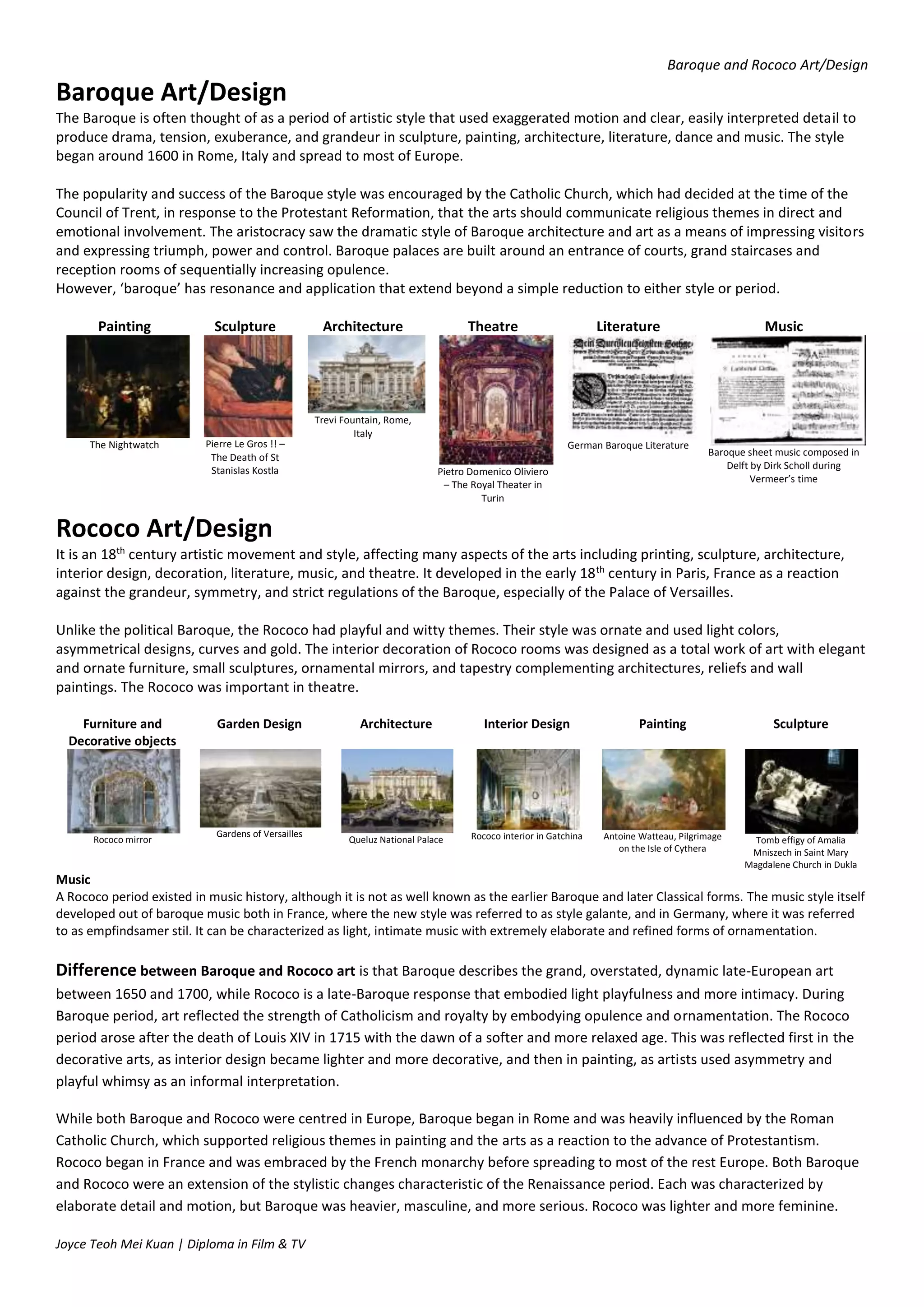
- 1. Baroque and RococoArt/Design Joyce Teoh Mei Kuan | Diploma in Film & TV Baroque Art/Design The Baroque is often thought of as a period of artistic style that used exaggerated motion and clear, easily interpreted detail to produce drama, tension, exuberance, and grandeur in sculpture, painting, architecture, literature, dance and music. The style began around 1600 in Rome, Italy and spread to most of Europe. The popularity and success of the Baroque style was encouraged by the Catholic Church, which had decided at the time of the Council of Trent, in response to the Protestant Reformation, that the arts should communicate religious themes in direct and emotional involvement. The aristocracy saw the dramatic style of Baroque architecture and art as a means of impressing visitors and expressing triumph, power and control. Baroque palaces are built around an entrance of courts, grand staircases and reception rooms of sequentially increasing opulence. However, ‘baroque’ has resonance and application that extend beyond a simple reduction to either style or period. Painting Sculpture Architecture Theatre Literature Music The Nightwatch Pierre Le Gros !! – The Death of St Stanislas Kostla Trevi Fountain, Rome, Italy Pietro Domenico Oliviero – The Royal Theater in Turin German Baroque Literature Baroque sheet music composed in Delft by Dirk Scholl during Vermeer’s time Rococo Art/Design It is an 18th century artistic movement and style, affecting many aspects of the arts including printing, sculpture, architecture, interior design, decoration, literature, music, and theatre. It developed in the early 18th century in Paris, France as a reaction against the grandeur, symmetry, and strict regulations of the Baroque, especially of the Palace of Versailles. Unlike the political Baroque, the Rococo had playful and witty themes. Their style was ornate and used light colors, asymmetrical designs, curves and gold. The interior decoration of Rococo rooms was designed as a total work of art with elegant and ornate furniture, small sculptures, ornamental mirrors, and tapestry complementing architectures, reliefs and wall paintings. The Rococo was important in theatre. Furniture and Decorative objects Garden Design Architecture Interior Design Painting Sculpture Rococo mirror Gardens of Versailles Queluz National Palace Rococo interior in Gatchina Antoine Watteau, Pilgrimage on the Isle of Cythera Tomb effigy of Amalia Mniszech in Saint Mary Magdalene Church in Dukla Music A Rococo period existed in music history, although it is not as well known as the earlier Baroque and later Classical forms. The music style itself developed out of baroque music both in France, where the new style was referred to as style galante, and in Germany, where it was referred to as empfindsamer stil. It can be characterized as light, intimate music with extremely elaborate and refined forms of ornamentation. Difference between Baroque and Rococo art is that Baroque describes the grand, overstated, dynamic late-European art between 1650 and 1700, while Rococo is a late-Baroque response that embodied light playfulness and more intimacy. During Baroque period, art reflected the strength of Catholicism and royalty by embodying opulence and ornamentation. The Rococo period arose after the death of Louis XIV in 1715 with the dawn of a softer and more relaxed age. This was reflected first in the decorative arts, as interior design became lighter and more decorative, and then in painting, as artists used asymmetry and playful whimsy as an informal interpretation. While both Baroque and Rococo were centred in Europe, Baroque began in Rome and was heavily influenced by the Roman Catholic Church, which supported religious themes in painting and the arts as a reaction to the advance of Protestantism. Rococo began in France and was embraced by the French monarchy before spreading to most of the rest Europe. Both Baroque and Rococo were an extension of the stylistic changes characteristic of the Renaissance period. Each was characterized by elaborate detail and motion, but Baroque was heavier, masculine, and more serious. Rococo was lighter and more feminine.