Rococo Era
Stonie Zhao
introduction
The Rococo movement was an art
movement that emerged in France and
spread throughout the world in the late
17th and early 18th century. The word is a
derivative of the French term rocaille,
which means “rock and shell garden
ornamentation”. Rococo style affected
many aspects of the arts including painting,
sculpture, architecture, interior
design, decoration, literature, music, and
Fashion
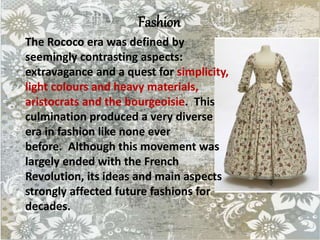
The Rococo era was defined by
seemingly contrasting aspects:
extravagance and a quest for simplicity,
light colours and heavy materials,
aristocrats and the bourgeoisie. This
culmination produced a very diverse
era in fashion like none ever
before. Although this movement was
largely ended with the French
Revolution, its ideas and main aspects
strongly affected future fashions for
decades.
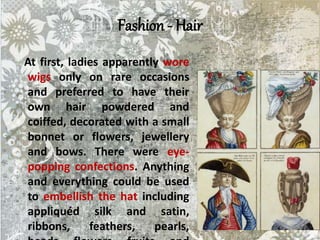
Fashion - Hair
At first, ladies apparently wore
wigs only on rare occasions
and preferred to have their
own hair powdered and
coiffed, decorated with a small
bonnet or flowers, jewellery
and bows. There were eye-
popping confections. Anything
and everything could be used
to embellish the hat including
appliquéd silk and satin,
ribbons, feathers, pearls,
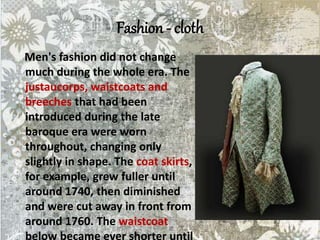
Fashion - cloth
Men's fashion did not change
much during the whole era. The
justaucorps, waistcoats and
breeches that had been
introduced during the late
baroque era were worn
throughout, changing only
slightly in shape. The coat skirts,
for example, grew fuller until
around 1740, then diminished
and were cut away in front from
around 1760. The waistcoat
below became ever shorter until
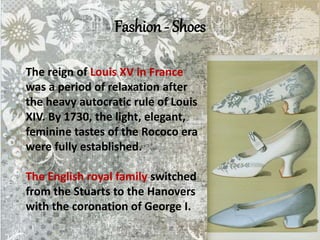
Fashion - Shoes
The reign of Louis XV in France
was a period of relaxation after
the heavy autocratic rule of Louis
XIV. By 1730, the light, elegant,
feminine tastes of the Rococo era
were fully established.
The English royal family switched
from the Stuarts to the Hanovers
with the coronation of George I.
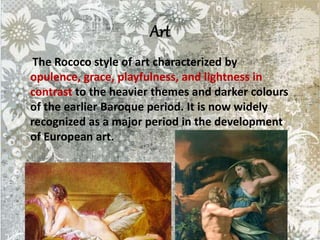
Art
The Rococo style of art characterized by
opulence, grace, playfulness, and lightness in
contrast to the heavier themes and darker colours
of the earlier Baroque period. It is now widely
recognized as a major period in the development
of European art.
Art - Painting
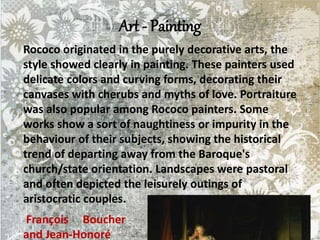
Rococo originated in the purely decorative arts, the
style showed clearly in painting. These painters used
delicate colors and curving forms, decorating their
canvases with cherubs and myths of love. Portraiture
was also popular among Rococo painters. Some
works show a sort of naughtiness or impurity in the
behaviour of their subjects, showing the historical
trend of departing away from the Baroque's
church/state orientation. Landscapes were pastoral
and often depicted the leisurely outings of
aristocratic couples.
François Boucher
and Jean-Honoré
Art - Sculpture
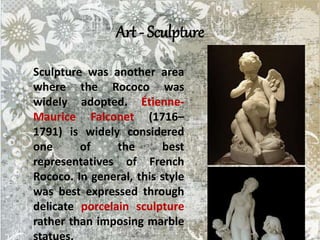
Sculpture was another area
where the Rococo was
widely adopted. Étienne-
Maurice Falconet (1716–
1791) is widely considered
one of the best
representatives of French
Rococo. In general, this style
was best expressed through
delicate porcelain sculpture
rather than imposing marble
Music
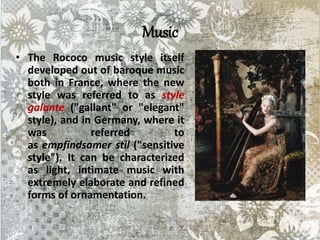
• The Rococo music style itself
developed out of baroque music
both in France, where the new
style was referred to as style
galante ("gallant" or "elegant"
style), and in Germany, where it
was referred to
as empfindsamer stil ("sensitive
style"). It can be characterized
as light, intimate music with
extremely elaborate and refined
forms of ornamentation.
Music - Instrument
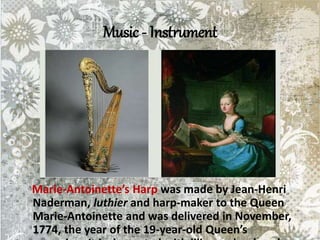
Marie-Antoinette’s Harp was made by Jean-Henri
Naderman, luthier and harp-maker to the Queen,
Marie-Antoinette and was delivered in November,
1774, the year of the 19-year-old Queen’s
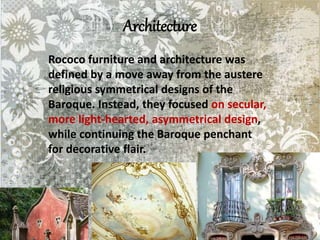
Architecture
Rococo furniture and architecture was
defined by a move away from the austere
religious symmetrical designs of the
Baroque. Instead, they focused on secular,
more light-hearted, asymmetrical design,
while continuing the Baroque penchant
for decorative flair.
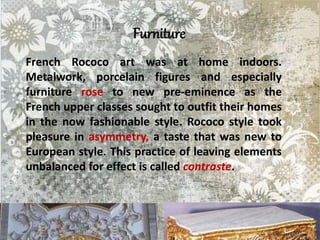
Furniture
French Rococo art was at home indoors.
Metalwork, porcelain figures and especially
furniture rose to new pre-eminence as the
French upper classes sought to outfit their homes
in the now fashionable style. Rococo style took
pleasure in asymmetry, a taste that was new to
European style. This practice of leaving elements
unbalanced for effect is called contraste.

Rococo

  • 1.
  • 2.
    introduction The Rococo movementwas an art movement that emerged in France and spread throughout the world in the late 17th and early 18th century. The word is a derivative of the French term rocaille, which means “rock and shell garden ornamentation”. Rococo style affected many aspects of the arts including painting, sculpture, architecture, interior design, decoration, literature, music, and
  • 3.
    Fashion The Rococo erawas defined by seemingly contrasting aspects: extravagance and a quest for simplicity, light colours and heavy materials, aristocrats and the bourgeoisie. This culmination produced a very diverse era in fashion like none ever before. Although this movement was largely ended with the French Revolution, its ideas and main aspects strongly affected future fashions for decades.
  • 4.
    Fashion - Hair Atfirst, ladies apparently wore wigs only on rare occasions and preferred to have their own hair powdered and coiffed, decorated with a small bonnet or flowers, jewellery and bows. There were eye- popping confections. Anything and everything could be used to embellish the hat including appliquéd silk and satin, ribbons, feathers, pearls,
  • 5.
    Fashion - cloth Men'sfashion did not change much during the whole era. The justaucorps, waistcoats and breeches that had been introduced during the late baroque era were worn throughout, changing only slightly in shape. The coat skirts, for example, grew fuller until around 1740, then diminished and were cut away in front from around 1760. The waistcoat below became ever shorter until
  • 6.
    Fashion - Shoes Thereign of Louis XV in France was a period of relaxation after the heavy autocratic rule of Louis XIV. By 1730, the light, elegant, feminine tastes of the Rococo era were fully established. The English royal family switched from the Stuarts to the Hanovers with the coronation of George I.
  • 7.
    Art The Rococo styleof art characterized by opulence, grace, playfulness, and lightness in contrast to the heavier themes and darker colours of the earlier Baroque period. It is now widely recognized as a major period in the development of European art.
  • 8.
    Art - Painting Rococooriginated in the purely decorative arts, the style showed clearly in painting. These painters used delicate colors and curving forms, decorating their canvases with cherubs and myths of love. Portraiture was also popular among Rococo painters. Some works show a sort of naughtiness or impurity in the behaviour of their subjects, showing the historical trend of departing away from the Baroque's church/state orientation. Landscapes were pastoral and often depicted the leisurely outings of aristocratic couples. François Boucher and Jean-Honoré
  • 9.
    Art - Sculpture Sculpturewas another area where the Rococo was widely adopted. Étienne- Maurice Falconet (1716– 1791) is widely considered one of the best representatives of French Rococo. In general, this style was best expressed through delicate porcelain sculpture rather than imposing marble
  • 10.
    Music • The Rococomusic style itself developed out of baroque music both in France, where the new style was referred to as style galante ("gallant" or "elegant" style), and in Germany, where it was referred to as empfindsamer stil ("sensitive style"). It can be characterized as light, intimate music with extremely elaborate and refined forms of ornamentation.
  • 11.
    Music - Instrument Marie-Antoinette’sHarp was made by Jean-Henri Naderman, luthier and harp-maker to the Queen, Marie-Antoinette and was delivered in November, 1774, the year of the 19-year-old Queen’s
  • 12.
    Architecture Rococo furniture andarchitecture was defined by a move away from the austere religious symmetrical designs of the Baroque. Instead, they focused on secular, more light-hearted, asymmetrical design, while continuing the Baroque penchant for decorative flair.
  • 13.
    Furniture French Rococo artwas at home indoors. Metalwork, porcelain figures and especially furniture rose to new pre-eminence as the French upper classes sought to outfit their homes in the now fashionable style. Rococo style took pleasure in asymmetry, a taste that was new to European style. This practice of leaving elements unbalanced for effect is called contraste.