Byzantine Art
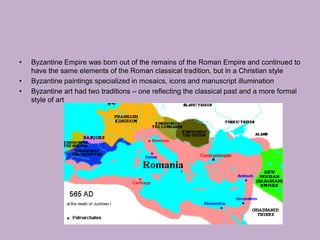
•   Byzantine Empire was born out of the remains of the Roman Empire and continued to
    have the same elements of the Roman classical tradition, but in a Christian style
•   Byzantine paintings specialized in mosaics, icons and manuscript illumination
•   Byzantine art had two traditions – one reflecting the classical past and a more formal
    style of art
Time Periods
•   Early Byzantine 500-726
•   Iconoclastic Controversy 726-843
•   Middle or High Byzantine 843-1204
•   Late Byzantine 1204-1453, and beyond
Early Byzantine Art
• Justinian and Empress Theodora
• Drove Ostrogoths out of Italy
• Tons of money spent on over 30 building
  projects
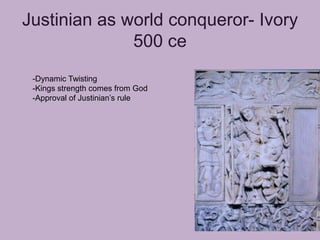
Justinian as world conqueror- Ivory
              500 ce
 -Dynamic Twisting
 -Kings strength comes from God
 -Approval of Justinian’s rule
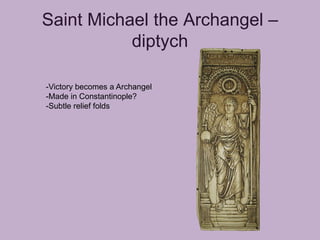
Saint Michael the Archangel –
           diptych

-Victory becomes a Archangel
-Made in Constantinople?
-Subtle relief folds
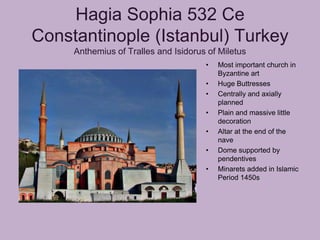
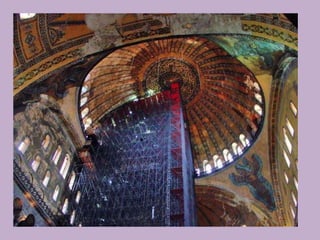
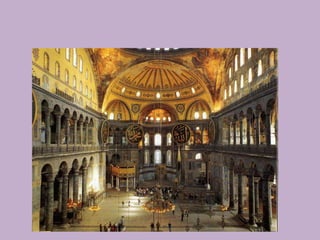
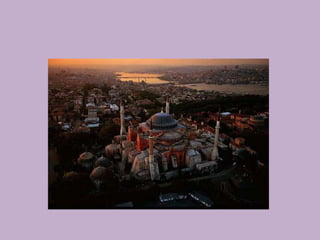
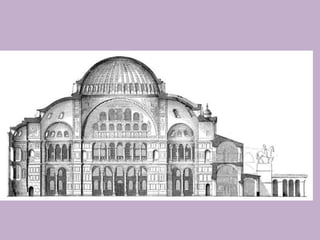
Hagia Sophia 532 Ce
Constantinople (Istanbul) Turkey
     Anthemius of Tralles and Isidorus of Miletus
                                      •   Most important church in
                                          Byzantine art
                                      •   Huge Buttresses
                                      •   Centrally and axially
                                          planned
                                      •   Plain and massive little
                                          decoration
                                      •   Altar at the end of the
                                          nave
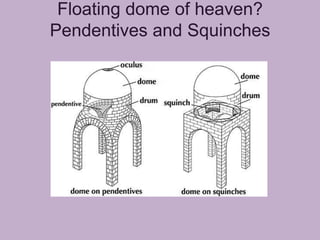
                                      •   Dome supported by
                                          pendentives
                                      •   Minarets added in Islamic
                                          Period 1450s
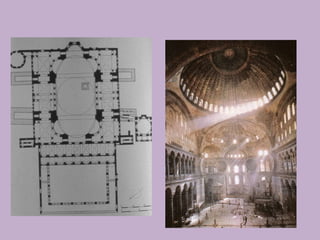
Floating dome of heaven?
Pendentives and Squinches
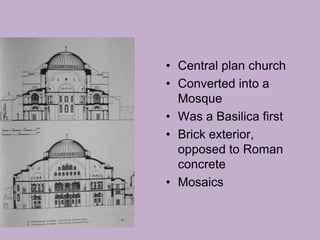
• Central plan church
• Converted into a
  Mosque
• Was a Basilica first
• Brick exterior,
  opposed to Roman
  concrete
• Mosaics
Ravenna – San Vitale
•   Theodoric, the Ostrogoth’s greatest king made Ravenna the new capital of
    the Kingdom
•   Best reign from an Emperor when Justinian was King
•   San Vitale ( or Saint Vitalis who was martyred at Ravenna in the second
    century)
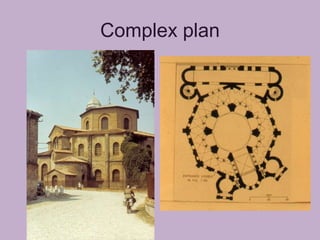
•   Polygonal apse, plain exterior
•   Eight Sided church
•   Interior has thin columns and open arched spaces
•   Plain exterior except porch added later in Renaissance
•   Clerestory lighting
•   Built after Theordoric’s death
Complex plan
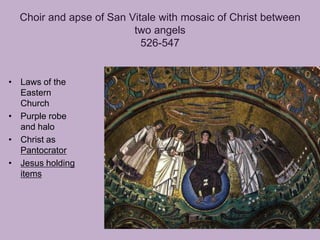
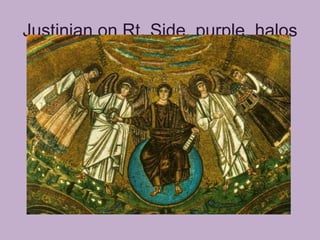
Choir and apse of San Vitale with mosaic of Christ between
                         two angels
                           526-547


• Laws of the
  Eastern
  Church
• Purple robe
  and halo
• Christ as
  Pantocrator
• Jesus holding
  items
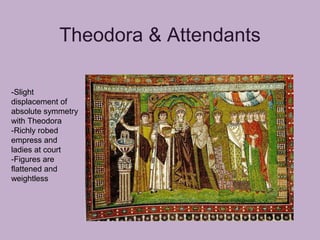
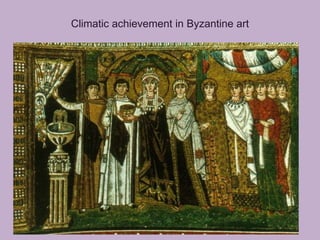
Theodora & Attendants

-Slight
displacement of
absolute symmetry
with Theodora
-Richly robed
empress and
ladies at court
-Figures are
flattened and
weightless
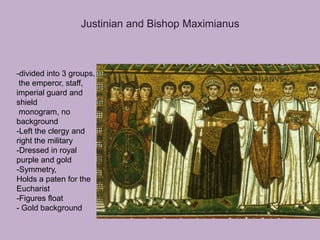
Justinian and Bishop Maximianus


-divided into 3 groups,
 the emperor, staff,
imperial guard and
shield
 monogram, no
background
-Left the clergy and
right the military
-Dressed in royal
purple and gold
-Symmetry,
Holds a paten for the
Eucharist
-Figures float
- Gold background
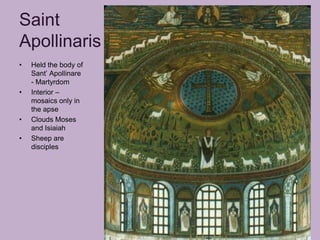
Saint
Apollinaris
•   Held the body of
    Sant’ Apollinare
    - Martyrdom
•   Interior –
    mosaics only in
    the apse
•   Clouds Moses
    and Isiaiah
•   Sheep are
    disciples
Justinian on Rt. Side, purple, halos
Climatic achievement in Byzantine art
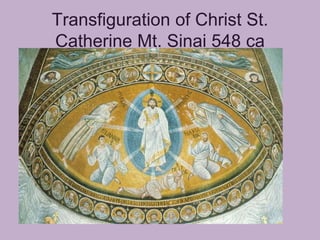
Transfiguration of Christ St.
Catherine Mt. Sinai 548 ca
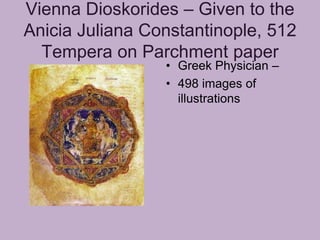
Vienna Dioskorides – Given to the
Anicia Juliana Constantinople, 512
  Tempera on Parchment paper
                 • Greek Physician –
                 • 498 images of
                   illustrations
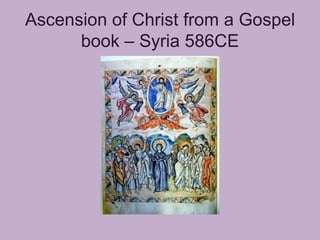
Ascension of Christ from a Gospel
      book – Syria 586CE
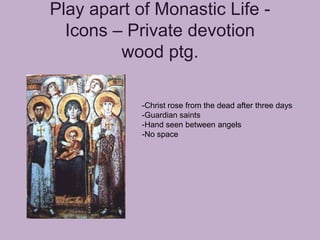
Play apart of Monastic Life -
  Icons – Private devotion
         wood ptg.

            -Christ rose from the dead after three days
            -Guardian saints
            -Hand seen between angels
            -No space
Iconoclasm (726- 843 ce)
• Preservation of Icons began from Mt. Sinai
  Monastery
• Arabs would rise ( Islamic Religion)
  conquered Byzantium's eastern provinces
  and Persia.
• Uneasy times, Byzantine territory was lost
  – ends… Starts the middle age
  -Iconoclasts destroyed Icons
• Emperor Leo – thinks God is punishing the
  Roman Empire for worshiping icons
• 726ce, banned Icon paintings
• No new art
• The cross was used, scrolls, floral,
  animals and architectural motifs
Middle Byzantine Art ( 843-1204)
• Images return
• Basil I thinks he is a restorer of the Roman
  Empire
• Undoes Iconclasm
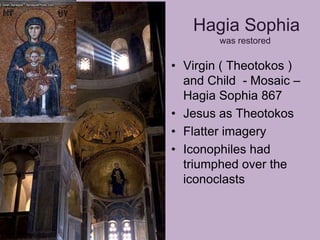
Hagia Sophia
        was restored

• Virgin ( Theotokos )
  and Child - Mosaic –
  Hagia Sophia 867
• Jesus as Theotokos
• Flatter imagery
• Iconophiles had
  triumphed over the
  iconoclasts
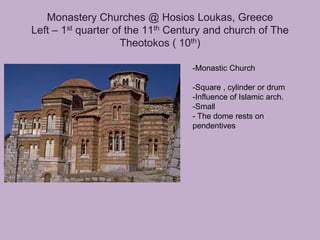
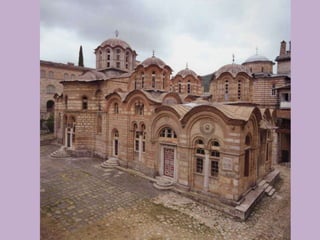
Monastery Churches @ Hosios Loukas, Greece
Left – 1st quarter of the 11th Century and church of The
                     Theotokos ( 10th)

                                   -Monastic Church

                                   -Square , cylinder or drum
                                   -Influence of Islamic arch.
                                   -Small
                                   - The dome rests on
                                   pendentives
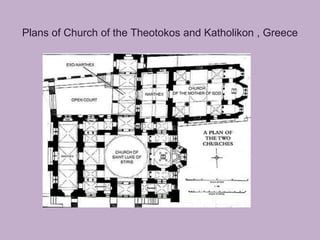
Plans of Church of the Theotokos and Katholikon , Greece
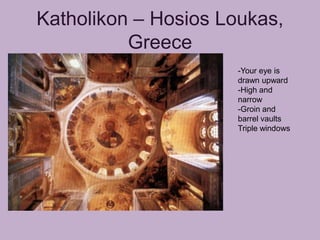
Katholikon – Hosios Loukas,
          Greece
                      -Your eye is
                      drawn upward
                      -High and
                      narrow
                      -Groin and
                      barrel vaults
                      Triple windows
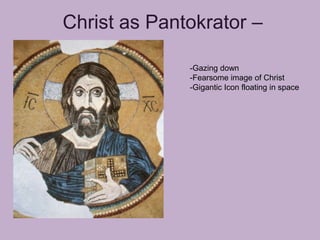
Christ as Pantokrator –

              -Gazing down
              -Fearsome image of Christ
              -Gigantic Icon floating in space
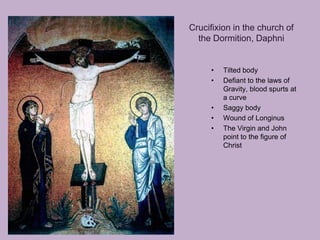
Crucifixion in the church of
  the Dormition, Daphni


     •   Tilted body
     •   Defiant to the laws of
         Gravity, blood spurts at
         a curve
     •   Saggy body
     •   Wound of Longinus
     •   The Virgin and John
         point to the figure of
         Christ
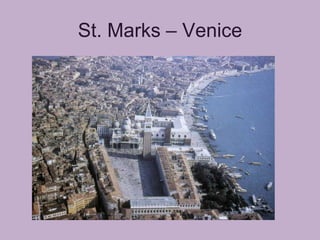
St. Marks – Venice
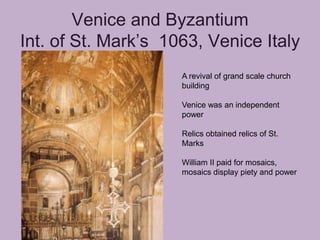
Venice and Byzantium
Int. of St. Mark’s 1063, Venice Italy
                     A revival of grand scale church
                     building

                     Venice was an independent
                     power

                     Relics obtained relics of St.
                     Marks

                     William II paid for mosaics,
                     mosaics display piety and power
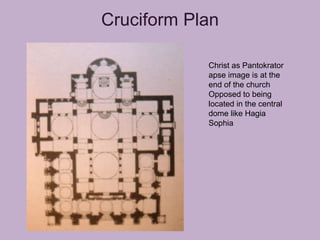
Cruciform Plan

            Christ as Pantokrator
            apse image is at the
            end of the church
            Opposed to being
            located in the central
            dome like Hagia
            Sophia
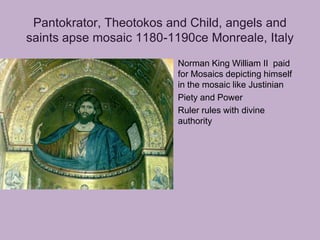
Pantokrator, Theotokos and Child, angels and
saints apse mosaic 1180-1190ce Monreale, Italy
                        • Norman King William II paid
                          for Mosaics depicting himself
                          in the mosaic like Justinian
                        • Piety and Power
                        • Ruler rules with divine
                          authority
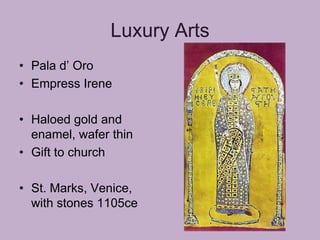
Luxury Arts
• Pala d’ Oro
• Empress Irene

• Haloed gold and
  enamel, wafer thin
• Gift to church

• St. Marks, Venice,
  with stones 1105ce
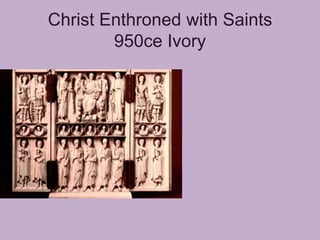
Christ Enthroned with Saints
        950ce Ivory
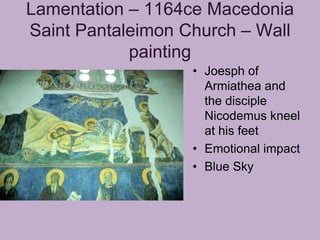
Lamentation – 1164ce Macedonia
Saint Pantaleimon Church – Wall
            painting
                   • Joesph of
                     Armiathea and
                     the disciple
                     Nicodemus kneel
                     at his feet
                   • Emotional impact
                   • Blue Sky
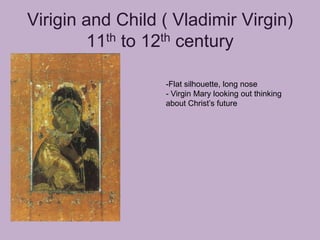
Virigin and Child ( Vladimir Virgin)
         11th to 12th century

                  -Flat silhouette, long nose
                  - Virgin Mary looking out thinking
                  about Christ’s future
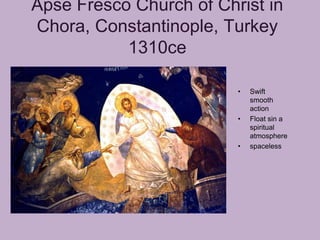
Apse Fresco Church of Christ in
Chora, Constantinople, Turkey
           1310ce

                         •   Swift
                             smooth
                             action
                         •   Float sin a
                             spiritual
                             atmosphere
                         •   spaceless
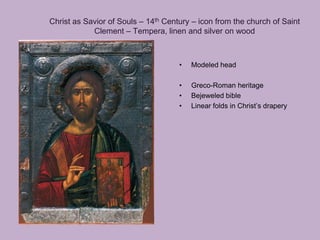
Christ as Savior of Souls – 14th Century – icon from the church of Saint
            Clement – Tempera, linen and silver on wood


                                     •   Modeled head

                                     •   Greco-Roman heritage
                                     •   Bejeweled bible
                                     •   Linear folds in Christ’s drapery
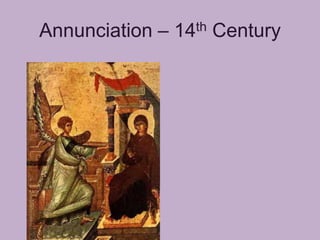
Annunciation – 14th Century

Byzantine art

  • 1.
  • 2.
    Byzantine Empire was born out of the remains of the Roman Empire and continued to have the same elements of the Roman classical tradition, but in a Christian style • Byzantine paintings specialized in mosaics, icons and manuscript illumination • Byzantine art had two traditions – one reflecting the classical past and a more formal style of art
  • 3.
    Time Periods • Early Byzantine 500-726 • Iconoclastic Controversy 726-843 • Middle or High Byzantine 843-1204 • Late Byzantine 1204-1453, and beyond
  • 4.
    Early Byzantine Art •Justinian and Empress Theodora • Drove Ostrogoths out of Italy • Tons of money spent on over 30 building projects
  • 5.
    Justinian as worldconqueror- Ivory 500 ce -Dynamic Twisting -Kings strength comes from God -Approval of Justinian’s rule
  • 6.
    Saint Michael theArchangel – diptych -Victory becomes a Archangel -Made in Constantinople? -Subtle relief folds
  • 7.
    Hagia Sophia 532Ce Constantinople (Istanbul) Turkey Anthemius of Tralles and Isidorus of Miletus • Most important church in Byzantine art • Huge Buttresses • Centrally and axially planned • Plain and massive little decoration • Altar at the end of the nave • Dome supported by pendentives • Minarets added in Islamic Period 1450s
  • 13.
    Floating dome ofheaven? Pendentives and Squinches
  • 14.
    • Central planchurch • Converted into a Mosque • Was a Basilica first • Brick exterior, opposed to Roman concrete • Mosaics
  • 15.
    Ravenna – SanVitale • Theodoric, the Ostrogoth’s greatest king made Ravenna the new capital of the Kingdom • Best reign from an Emperor when Justinian was King • San Vitale ( or Saint Vitalis who was martyred at Ravenna in the second century) • Polygonal apse, plain exterior • Eight Sided church • Interior has thin columns and open arched spaces • Plain exterior except porch added later in Renaissance • Clerestory lighting • Built after Theordoric’s death
  • 16.
  • 17.
    Choir and apseof San Vitale with mosaic of Christ between two angels 526-547 • Laws of the Eastern Church • Purple robe and halo • Christ as Pantocrator • Jesus holding items
  • 18.
    Theodora & Attendants -Slight displacementof absolute symmetry with Theodora -Richly robed empress and ladies at court -Figures are flattened and weightless
  • 19.
    Justinian and BishopMaximianus -divided into 3 groups, the emperor, staff, imperial guard and shield monogram, no background -Left the clergy and right the military -Dressed in royal purple and gold -Symmetry, Holds a paten for the Eucharist -Figures float - Gold background
  • 20.
    Saint Apollinaris • Held the body of Sant’ Apollinare - Martyrdom • Interior – mosaics only in the apse • Clouds Moses and Isiaiah • Sheep are disciples
  • 21.
    Justinian on Rt.Side, purple, halos
  • 22.
  • 24.
    Transfiguration of ChristSt. Catherine Mt. Sinai 548 ca
  • 25.
    Vienna Dioskorides –Given to the Anicia Juliana Constantinople, 512 Tempera on Parchment paper • Greek Physician – • 498 images of illustrations
  • 26.
    Ascension of Christfrom a Gospel book – Syria 586CE
  • 27.
    Play apart ofMonastic Life - Icons – Private devotion wood ptg. -Christ rose from the dead after three days -Guardian saints -Hand seen between angels -No space
  • 28.
    Iconoclasm (726- 843ce) • Preservation of Icons began from Mt. Sinai Monastery • Arabs would rise ( Islamic Religion) conquered Byzantium's eastern provinces and Persia. • Uneasy times, Byzantine territory was lost – ends… Starts the middle age -Iconoclasts destroyed Icons
  • 29.
    • Emperor Leo– thinks God is punishing the Roman Empire for worshiping icons • 726ce, banned Icon paintings • No new art • The cross was used, scrolls, floral, animals and architectural motifs
  • 30.
    Middle Byzantine Art( 843-1204) • Images return • Basil I thinks he is a restorer of the Roman Empire • Undoes Iconclasm
  • 31.
    Hagia Sophia was restored • Virgin ( Theotokos ) and Child - Mosaic – Hagia Sophia 867 • Jesus as Theotokos • Flatter imagery • Iconophiles had triumphed over the iconoclasts
  • 32.
    Monastery Churches @Hosios Loukas, Greece Left – 1st quarter of the 11th Century and church of The Theotokos ( 10th) -Monastic Church -Square , cylinder or drum -Influence of Islamic arch. -Small - The dome rests on pendentives
  • 33.
    Plans of Churchof the Theotokos and Katholikon , Greece
  • 35.
    Katholikon – HosiosLoukas, Greece -Your eye is drawn upward -High and narrow -Groin and barrel vaults Triple windows
  • 36.
    Christ as Pantokrator– -Gazing down -Fearsome image of Christ -Gigantic Icon floating in space
  • 37.
    Crucifixion in thechurch of the Dormition, Daphni • Tilted body • Defiant to the laws of Gravity, blood spurts at a curve • Saggy body • Wound of Longinus • The Virgin and John point to the figure of Christ
  • 38.
  • 39.
    Venice and Byzantium Int.of St. Mark’s 1063, Venice Italy A revival of grand scale church building Venice was an independent power Relics obtained relics of St. Marks William II paid for mosaics, mosaics display piety and power
  • 40.
    Cruciform Plan Christ as Pantokrator apse image is at the end of the church Opposed to being located in the central dome like Hagia Sophia
  • 41.
    Pantokrator, Theotokos andChild, angels and saints apse mosaic 1180-1190ce Monreale, Italy • Norman King William II paid for Mosaics depicting himself in the mosaic like Justinian • Piety and Power • Ruler rules with divine authority
  • 42.
    Luxury Arts • Palad’ Oro • Empress Irene • Haloed gold and enamel, wafer thin • Gift to church • St. Marks, Venice, with stones 1105ce
  • 43.
    Christ Enthroned withSaints 950ce Ivory
  • 44.
    Lamentation – 1164ceMacedonia Saint Pantaleimon Church – Wall painting • Joesph of Armiathea and the disciple Nicodemus kneel at his feet • Emotional impact • Blue Sky
  • 45.
    Virigin and Child( Vladimir Virgin) 11th to 12th century -Flat silhouette, long nose - Virgin Mary looking out thinking about Christ’s future
  • 46.
    Apse Fresco Churchof Christ in Chora, Constantinople, Turkey 1310ce • Swift smooth action • Float sin a spiritual atmosphere • spaceless
  • 47.
    Christ as Saviorof Souls – 14th Century – icon from the church of Saint Clement – Tempera, linen and silver on wood • Modeled head • Greco-Roman heritage • Bejeweled bible • Linear folds in Christ’s drapery
  • 48.