Chapter 5   - Greek Art-
Early Greek World 2300BCE
Later Greek Colonies
 
Greek Origins Aegean and European traits Formed Independent city states or Poleis Political rule was first by Kings –then by    Tyrants Tyrants overthrown in Athens 2500 years ago. Democracy established Olympics – 776 BCE  Greeks regarded themselves as Hellas, rather than Barbarians ( which surrounded the boundaries) Western colonies in Italy = Best preserved temples
Greek Humanism Democracy Art, History, Literature Western culture = taken from the Greeks Religion-  Like divinities of the Near East, the gods assumed human form and were immortal “ Humans, are the measure of all things” from Philosopher Protagoras Athens - HUGE symbol of Greek Culture - Great Plays held there, Market places, Gymnasiums Socrates and Plato= encouraged philosophy and Plato formulated his idea for the best government Greeks loved exercise, education and daily life Greeks borrowed from Egypt and Near east – owed debts to them
Greek Civilization Slavery was natural Greek women were not equal with men  Democracy – dominated by white males based on military thinking Greek men – educated with Homer’s Hero’s  War- among the city states was atrocious & fell into Rome’s Imperialism
The Geometric  and Orientalzing Periods Reading and writing lost, frescos sculpting Disappearance of Kings led to loss of knowledge Trade began  Homer’s stories memorized Olympic games start
Geometric Krater – Athens 740 BCE angular motifs, key/meander patterns = Geometric Style
Hero and Centaur Centaur –  Greek Invention
Orientalizing Art Mantiklos Apollo   Bronze, 700-800 BCE Thebes, Greece Statue made for a god for a favor in return Characteristics -
Corinthian black figure amphora with animal friezes   625-600 BCE   Organized bands What influence?
Stone Temples 625 BCE Trading with Egypt the Greeks saw the monumental sculpture of the Egyptians Temple A for unknown deity
Lady of Auxerre – 650 BCE  Statue of a goddess of Kore  Gesture of Prayer Daedalic
Kouros – 600 BCE Like Egyptian sculptures Funerary sculpture– stood over grave Similar to Egyptian  however very different Liberated from stone block Nude
Calf Bearer- Greece 560 BCE Offering  Left foot forward – trait of Kouri Archaic Statue Smile  V shape body Thin Cloak
Krisos Boy – Greece 530 BCE Died a Hero’s death Skin left natural color Polished (eyes, lips, drapery were painted encaustic)
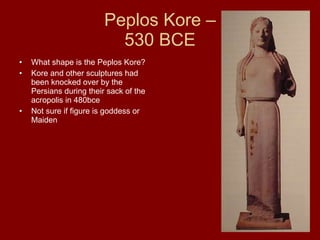
Peplos Kore –  530 BCE  What shape is the Peplos Kore? Kore and other sculptures had been knocked over by the Persians during their sack of the acropolis in 480bce Not sure if figure is goddess or Maiden
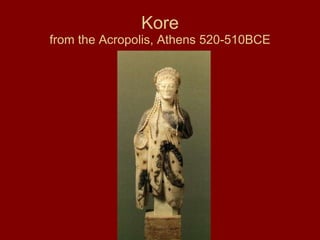
Kore from the Acropolis, Athens 520-510BCE
Early Greek Arch. Early Greek arch. did not survive due to the use of mudbrick Oak columns were replaced with Marble Their temples influenced western world Greek Temple shrines – the altar lay outside the temple – at the east end facing the rising sun (cult sculpture outside of temple) Greeks used proportion in their temple plans Classical temples are longer Harmony and music was in proportion
Doric and Ionic Temples
Greek Arch.  ( Balance and Clarity) 550BCE Used columns for load bearing not like Egyptians Temple of Hera I Cella is split in middle  Doric Capitals
 
West Pediment from the Temple of Artemis – 600-580 BCE Pediment What is the problem with Pediments? Arm bent ( pinwheel) Gorgon Medusa, Chrysaor and pegasus – Medusa’s Children ---
Reconstruction of the Siphnian Treasury –   Delphi, Greece 530 BCE Set up for storage of offerings and votives Caryatid- A female figure that supports a column Frieze on all 4 sides
Gigantomachy-  From Siphnian Treasury– Delphi 530 BCE -Gigantomachy – battle of gods and giants ( popular theme) -Apollo and Artemis attacking the giants
Francois Vase – 570BCE Archaic painted vases Black figure painting Volute with handles By Kleitias and Ergotimos  200 Figures in 6 registers Figures are all from Greek Mythology
 
Exekias -  Achilles and Ajax Blk figure ptg 540BCE No horizontal bands Amphora – a jar to hold wine or water
Exekias- Achllies and  Ajax playing dice game – Bilingual Painting
Euphronios – Herkales wrestling Antaios – 510BCE  Thinner glaze for giant  Compositional human figure not correct
Euthymides – 3 Revelers 510BCE
Onesimos – Girl Preparing to Bathe
Temple of Aphaia- Greece 500-490 BCE Doric columns, displaced Local goddess worship Statue added – placed on central axis
Temple plan of Aphaia Three aisles dividing up space Three rooms rooms
Dying Warrior from the East  Pediment of the Temple of Aphaia – 490-480BCE
Dying Warrior from the West Pediment – 500-490 BCE
Temple of Hera II – 460 BCE
Temple of Zeus – Greece 470-456BCE
 
The Seer 470-456BCE
Athena, Herakles and Atlas – with the apples of Hesperides – 470-456BCE Metopes
Kritios Boy – 480 BCE  Contrapposto (counterbalance)
Discus Thrower  ( Roman Copy) 450 BCE Tension in body
Polykleitos -Doryphorus – 450-440BCE Perfect image of man  Well balanced Lost in Pompeii
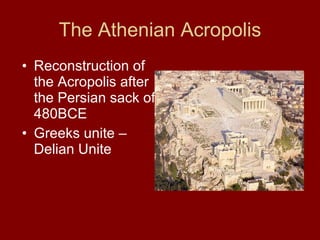
The Athenian Acropolis Reconstruction of the Acropolis after the Persian sack of 480BCE Greeks unite – Delian Unite
Iktinos and KALLIKRATES - PARTHENON
Parthenon Architects -Iktinos and Kallikrates   X = 2y+1 Harmonious Design and mathematical precision Strict guidelines Mixing doric and ionic Irregular shape Athena Statue
Phidias Athenia Parthenos in the cella of the Parthenon
Lapith vs. Centaurs  Almost fully in the round Metopes ( best preserved) Greeks have the upper hand Greek Body
East Pediment of Parthenon Helios, Horses and Dionysos ( Herkales) 438 BCE Who did the Pediment celebrate? East pediment damaged when the apse was added to the Partheon Helios emerging  Herkales
The Three Graces  Figures related to each other Clinging  Drapery Pose
Inner Frieze  - Panathenaic Festival Procession –every 4 years in Athens Roles of Deities Aphrodite, left hand to draw her son Eros’s to the Athenians Celebration
Propylaia – Acropolis – 437BCE Two orders mixed Acropolis Gateway
 
Erechtheion– Acropolis 437BCE Ionic roof supported columns Doric order was ext. Caryatids(Porch of Maidens) Museum Honored Athenia
Temple of Athena Nike -427Bce Monumental, gateway No decoration Ionic Order Amphiprostyle with 4 columns in the front
Nike , adjusting her sandal 410 BCE  Graceful Delicate incised drapery, revealing body
Grave stele of Hegeso, Athens 400BCE
Lekythhoi – Perfumed oil flask White ground technique Offerings for deceased Wide range of colors, meant that the owner did not use it as a eveyday object
The Late Classical Period Peloponnesian War – 431 BCE- defeat of Athens – Greece drained of stength. Sparta was the victor Greek cities united – Philip II came into power took over, he was then assassinated in 336 and Alexander the Great ( His son) succeeded him.  Alexander overthrew Persian Empire, Egypt and reached India
Art in Greek Late Classical Period Contrapposto  Idealization of forms Polykleitos – canon of proportions  Heavy muscles  Praxiteles, - great sculpture of his avg., 1/8 of the body heads, and “s” curve frames
Praxiteles –  Aphrodite of Knidos Sensual She is admired She is taking a cloak off a water jar S curve
Hermes and Infant Dionysos – 340BCE S curve Dangle grapes to Hermes Interaction between a child and a adult Delicate
Grave Stele of a young hunter – 340BCE
Lysippos  - Late Classical Sculptor Alexander the Great – selected him for official portrait Heads are roughly 1/8 of the body More slender then Polykleitos Apoxyomenos ( Scraper) Shift in weight,  Breaks out of box Scraping oil off Far away look
Lysippos - Herkales Weary Herkales Overly muscular prop to hold him up
Alexander the Great  He  believed Lysippos could only capture his portrait Macedonian Court is where he ruled
Battle of Issus – 310 BC –  Philoxenos of Eretria
 
Polykleitos the Younger – Greece 350BCE Theater, Greece 350 BCE
Polykleitos The Younger – 350 BCE Corinthian Capital
Hellenistic Period   Temple of Apollo Dipteral plan
Stoa of Attalos II Agora Athens,  Greece  150 BCE Stores 21 shops More common in Hellenistic More widely spaced then temple arch.
Altar of Zeus – 175 BCE , Turkey Pergamon ( Alexander’s Empire)
Athena battling Alkyoneos – Gigantomachy Frieze  - 175 BCE Grabs hair of Alkyoneos Nike crowns Athena Drapery Zeus throws thunderbolts Battle
Epigonos – Gallic Chieftain 230bce
Dying Gaul – 230 BCE
Nike, 190 BCE
Alexandros of Antioch on the Meander –   Venus de Milo aka Aphrodite
Aphrodite, Eros and Pan – 100BCE
Seated Boxer – 100-50 BCE
Old Market Woman – 150-100 BCE
Demosthenes – 280 BCE
Laocoon and his Sons-   early first century CE

Chapter 5 Greek

  • 1.
    Chapter 5 - Greek Art-
  • 2.
  • 3.
  • 4.
  • 5.
    Greek Origins Aegeanand European traits Formed Independent city states or Poleis Political rule was first by Kings –then by  Tyrants Tyrants overthrown in Athens 2500 years ago. Democracy established Olympics – 776 BCE Greeks regarded themselves as Hellas, rather than Barbarians ( which surrounded the boundaries) Western colonies in Italy = Best preserved temples
  • 6.
    Greek Humanism DemocracyArt, History, Literature Western culture = taken from the Greeks Religion- Like divinities of the Near East, the gods assumed human form and were immortal “ Humans, are the measure of all things” from Philosopher Protagoras Athens - HUGE symbol of Greek Culture - Great Plays held there, Market places, Gymnasiums Socrates and Plato= encouraged philosophy and Plato formulated his idea for the best government Greeks loved exercise, education and daily life Greeks borrowed from Egypt and Near east – owed debts to them
  • 7.
    Greek Civilization Slaverywas natural Greek women were not equal with men Democracy – dominated by white males based on military thinking Greek men – educated with Homer’s Hero’s War- among the city states was atrocious & fell into Rome’s Imperialism
  • 8.
    The Geometric and Orientalzing Periods Reading and writing lost, frescos sculpting Disappearance of Kings led to loss of knowledge Trade began Homer’s stories memorized Olympic games start
  • 9.
    Geometric Krater –Athens 740 BCE angular motifs, key/meander patterns = Geometric Style
  • 10.
    Hero and CentaurCentaur – Greek Invention
  • 11.
    Orientalizing Art MantiklosApollo Bronze, 700-800 BCE Thebes, Greece Statue made for a god for a favor in return Characteristics -
  • 12.
    Corinthian black figureamphora with animal friezes 625-600 BCE Organized bands What influence?
  • 13.
    Stone Temples 625BCE Trading with Egypt the Greeks saw the monumental sculpture of the Egyptians Temple A for unknown deity
  • 14.
    Lady of Auxerre– 650 BCE Statue of a goddess of Kore Gesture of Prayer Daedalic
  • 15.
    Kouros – 600BCE Like Egyptian sculptures Funerary sculpture– stood over grave Similar to Egyptian however very different Liberated from stone block Nude
  • 16.
    Calf Bearer- Greece560 BCE Offering Left foot forward – trait of Kouri Archaic Statue Smile V shape body Thin Cloak
  • 17.
    Krisos Boy –Greece 530 BCE Died a Hero’s death Skin left natural color Polished (eyes, lips, drapery were painted encaustic)
  • 18.
    Peplos Kore – 530 BCE What shape is the Peplos Kore? Kore and other sculptures had been knocked over by the Persians during their sack of the acropolis in 480bce Not sure if figure is goddess or Maiden
  • 19.
    Kore from theAcropolis, Athens 520-510BCE
  • 20.
    Early Greek Arch.Early Greek arch. did not survive due to the use of mudbrick Oak columns were replaced with Marble Their temples influenced western world Greek Temple shrines – the altar lay outside the temple – at the east end facing the rising sun (cult sculpture outside of temple) Greeks used proportion in their temple plans Classical temples are longer Harmony and music was in proportion
  • 21.
  • 22.
  • 23.
    Greek Arch. ( Balance and Clarity) 550BCE Used columns for load bearing not like Egyptians Temple of Hera I Cella is split in middle Doric Capitals
  • 24.
  • 25.
    West Pediment fromthe Temple of Artemis – 600-580 BCE Pediment What is the problem with Pediments? Arm bent ( pinwheel) Gorgon Medusa, Chrysaor and pegasus – Medusa’s Children ---
  • 26.
    Reconstruction of theSiphnian Treasury – Delphi, Greece 530 BCE Set up for storage of offerings and votives Caryatid- A female figure that supports a column Frieze on all 4 sides
  • 27.
    Gigantomachy- FromSiphnian Treasury– Delphi 530 BCE -Gigantomachy – battle of gods and giants ( popular theme) -Apollo and Artemis attacking the giants
  • 28.
    Francois Vase –570BCE Archaic painted vases Black figure painting Volute with handles By Kleitias and Ergotimos 200 Figures in 6 registers Figures are all from Greek Mythology
  • 29.
  • 30.
    Exekias - Achilles and Ajax Blk figure ptg 540BCE No horizontal bands Amphora – a jar to hold wine or water
  • 31.
    Exekias- Achllies and Ajax playing dice game – Bilingual Painting
  • 32.
    Euphronios – Herkaleswrestling Antaios – 510BCE Thinner glaze for giant Compositional human figure not correct
  • 33.
    Euthymides – 3Revelers 510BCE
  • 34.
    Onesimos – GirlPreparing to Bathe
  • 35.
    Temple of Aphaia-Greece 500-490 BCE Doric columns, displaced Local goddess worship Statue added – placed on central axis
  • 36.
    Temple plan ofAphaia Three aisles dividing up space Three rooms rooms
  • 37.
    Dying Warrior fromthe East Pediment of the Temple of Aphaia – 490-480BCE
  • 38.
    Dying Warrior fromthe West Pediment – 500-490 BCE
  • 39.
    Temple of HeraII – 460 BCE
  • 40.
    Temple of Zeus– Greece 470-456BCE
  • 41.
  • 42.
  • 43.
    Athena, Herakles andAtlas – with the apples of Hesperides – 470-456BCE Metopes
  • 44.
    Kritios Boy –480 BCE Contrapposto (counterbalance)
  • 45.
    Discus Thrower ( Roman Copy) 450 BCE Tension in body
  • 46.
    Polykleitos -Doryphorus –450-440BCE Perfect image of man Well balanced Lost in Pompeii
  • 47.
    The Athenian AcropolisReconstruction of the Acropolis after the Persian sack of 480BCE Greeks unite – Delian Unite
  • 48.
  • 49.
    Parthenon Architects -Iktinosand Kallikrates X = 2y+1 Harmonious Design and mathematical precision Strict guidelines Mixing doric and ionic Irregular shape Athena Statue
  • 50.
    Phidias Athenia Parthenosin the cella of the Parthenon
  • 51.
    Lapith vs. Centaurs Almost fully in the round Metopes ( best preserved) Greeks have the upper hand Greek Body
  • 52.
    East Pediment ofParthenon Helios, Horses and Dionysos ( Herkales) 438 BCE Who did the Pediment celebrate? East pediment damaged when the apse was added to the Partheon Helios emerging Herkales
  • 53.
    The Three Graces Figures related to each other Clinging Drapery Pose
  • 54.
    Inner Frieze - Panathenaic Festival Procession –every 4 years in Athens Roles of Deities Aphrodite, left hand to draw her son Eros’s to the Athenians Celebration
  • 55.
    Propylaia – Acropolis– 437BCE Two orders mixed Acropolis Gateway
  • 56.
  • 57.
    Erechtheion– Acropolis 437BCEIonic roof supported columns Doric order was ext. Caryatids(Porch of Maidens) Museum Honored Athenia
  • 58.
    Temple of AthenaNike -427Bce Monumental, gateway No decoration Ionic Order Amphiprostyle with 4 columns in the front
  • 59.
    Nike , adjustingher sandal 410 BCE Graceful Delicate incised drapery, revealing body
  • 60.
    Grave stele ofHegeso, Athens 400BCE
  • 61.
    Lekythhoi – Perfumedoil flask White ground technique Offerings for deceased Wide range of colors, meant that the owner did not use it as a eveyday object
  • 62.
    The Late ClassicalPeriod Peloponnesian War – 431 BCE- defeat of Athens – Greece drained of stength. Sparta was the victor Greek cities united – Philip II came into power took over, he was then assassinated in 336 and Alexander the Great ( His son) succeeded him. Alexander overthrew Persian Empire, Egypt and reached India
  • 63.
    Art in GreekLate Classical Period Contrapposto Idealization of forms Polykleitos – canon of proportions Heavy muscles Praxiteles, - great sculpture of his avg., 1/8 of the body heads, and “s” curve frames
  • 64.
    Praxiteles – Aphrodite of Knidos Sensual She is admired She is taking a cloak off a water jar S curve
  • 65.
    Hermes and InfantDionysos – 340BCE S curve Dangle grapes to Hermes Interaction between a child and a adult Delicate
  • 66.
    Grave Stele ofa young hunter – 340BCE
  • 67.
    Lysippos -Late Classical Sculptor Alexander the Great – selected him for official portrait Heads are roughly 1/8 of the body More slender then Polykleitos Apoxyomenos ( Scraper) Shift in weight, Breaks out of box Scraping oil off Far away look
  • 68.
    Lysippos - HerkalesWeary Herkales Overly muscular prop to hold him up
  • 69.
    Alexander the Great He believed Lysippos could only capture his portrait Macedonian Court is where he ruled
  • 70.
    Battle of Issus– 310 BC – Philoxenos of Eretria
  • 71.
  • 72.
    Polykleitos the Younger– Greece 350BCE Theater, Greece 350 BCE
  • 73.
    Polykleitos The Younger– 350 BCE Corinthian Capital
  • 74.
    Hellenistic Period Temple of Apollo Dipteral plan
  • 75.
    Stoa of AttalosII Agora Athens, Greece 150 BCE Stores 21 shops More common in Hellenistic More widely spaced then temple arch.
  • 76.
    Altar of Zeus– 175 BCE , Turkey Pergamon ( Alexander’s Empire)
  • 77.
    Athena battling Alkyoneos– Gigantomachy Frieze - 175 BCE Grabs hair of Alkyoneos Nike crowns Athena Drapery Zeus throws thunderbolts Battle
  • 78.
    Epigonos – GallicChieftain 230bce
  • 79.
  • 80.
  • 81.
    Alexandros of Antiochon the Meander – Venus de Milo aka Aphrodite
  • 82.
    Aphrodite, Eros andPan – 100BCE
  • 83.
    Seated Boxer –100-50 BCE
  • 84.
    Old Market Woman– 150-100 BCE
  • 85.
  • 86.
    Laocoon and hisSons- early first century CE

Editor's Notes

  • #18 Ranging Aries he died a heros death, m ore of a Portrait Naturalisitic
  • #19 Left arm extended big break from the usual look of egyptians.
  • #20 Soft material, kore grasping chiffon in her and. Postures of the Kore are like male counterparts
  • #24 80x170 Ft///roof gone.. Peistyle colonade exists
  • #26 Perseus Zeus on the lower pediments
  • #29 Lapiths and centuars battle after a wedding celebratio where man beasts who were invited guests got drunk and attempted to abudct the lapith maidens Did not fil the space between no decorative ornamentation..
  • #31 Shields ready for action, intricate engraving of the paterns and hero’s cloaks, the arches of their back take on the vase Eyes are in a older manner
  • #32 Compoisition created on both sides, one blk and red figures – bilingual vases – outlining figures /red clay reserved for figures
  • #34 Unusual body form, drunk, middle figure is interesting .. Signed Euthymides ptd. Me”
  • #40 Follow plan of Aphaia at Aegina – even number of columns (6) and two short endstemple of zeus more lavishly decorated
  • #53 athenia
  • #55 Animals sacrifice, animals people musiucians chariots A
  • #58 contrapossto
  • #59 Dedicated to a battle, marathon that turned the tiede against of the persians
  • #66 Hermes god of wine /doryphorus