Chapter 9
Wounds
Open Wounds
• A break in the skin’s surface resulting in
external bleeding
• May allow bacteria to enter the body,
causing an infection
Types of Open Wounds
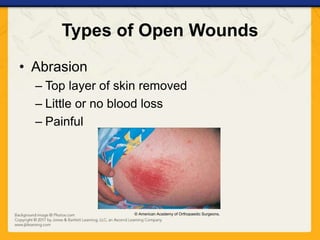
• Abrasion
– Top layer of skin removed
– Little or no blood loss
– Painful
© American Academy of Orthopaedic Surgeons.
Types of Open Wounds
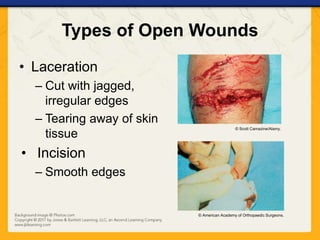
• Laceration
– Cut with jagged,
irregular edges
– Tearing away of skin
tissue
• Incision
– Smooth edges
© Scott Camazine/Alamy.
© American Academy of Orthopaedic Surgeons.
Types of Open Wounds
• Puncture
– Deep, narrow
– High risk of infection
• Avulsion
– Flap of skin torn loose
• Amputation
– Cutting or tearing off of
body part
© American Academy of Orthopaedic Surgeons.
Care for Open Wounds
• Protect yourself from disease (exam
gloves, etc.).
• Expose the wound.
• Control bleeding with direct pressure.
Cleaning a Wound
• Scrub hands with
soap and water.
• Clean wound.
– For shallow wound:
• Wash with soap and
water.
• Flush with clean
water under pressure.
© Jones & Bartlett Learning.
Cleaning a Wound
• Clean wound (cont’d).
− For wound with higher infection risk:
• Clean wound.
• Seek medical care for additional cleaning.
• Use tweezers to remove remaining
embedded debris.
• If bleeding restarts, apply direct pressure.
Covering a Wound
• Dressing: applied over a wound to control
bleeding and prevent contamination
− Should be sterile or as clean as possible
• Bandage: holds dressing in place
– Need not be sterile
Covering a Wound
• If the wound is small, apply thin layer of
antibiotic ointment.
• Cover with a sterile dressing.
• Do not pull off dressing that has become
stuck.
– If you must remove, soak in warm water.
• Change wet or dirty dressings.
When to Seek Medical Care
• High risk wounds
– Embedded foreign material
– Animal and human bites
– Puncture wounds
– Ragged, large, or deep wounds
– Visible bone, joint, muscle, fat, or tendon
– Wound entering joint or body cavity
– “Fight bite”
• Wounds needing sutures
– Best placed within 6 to 8 hours
• Anyone who has not had a tetanus
vaccination within 10 years
– 5 years in the case of a dirty wound
When to Seek Medical Care
Risk of Infection
• Wounds with foreign material
• Ragged or crushed tissue
• Injury to underlying nerves, tendons, joints
• Bite wounds
• Hand and foot wounds
• Puncture wounds or wounds that cannot
drain
Infected Wound:
What to Look For
• Swelling and redness around the wound
• Sensation of warmth
• Throbbing pain
• Pus discharge
• Fever
• Swelling of lymph nodes
• Red streaks leading from wound toward
heart
© Dr. P. Marazzi/Photo Researchers, Inc.
Infected Wound: What to Do
• Soak wound in warm water, or apply
warm, wet packs over infected wound.
• Apply antibiotic ointment.
• Change dressings several times per day.
• Give pain medication.
• Seek medical care if the infection persists
or worsens.
Tetanus
• Caused by toxin-producing bacterium
• Travels to nervous system
• Causes muscle contraction (lockjaw)
• No known antidote to toxin
• Tetanus vaccine and boosters can prevent
the disease.
Tetanus
• Seek vaccine and/or booster if:
– Never immunized
– No tetanus booster in past 10 years
– Dirty, contaminated wound and no booster in
past 5 years
• Must receive within 72 hours
Amputations and Avulsions
• In many cases, an amputated extremity
can be successfully reattached.
• Avulsions most often involve ears, fingers,
and hands.
– Can bleed heavily
Types of Amputations
• Clean
− Clean-cut, complete
• Crushing
− Crushed or mashed off
• Degloving
– Skin is peeled off.
© Chuck Stewart, MD.
Amputations: What to Do
© Jones & Bartlett Learning.
• Call 9-1-1.
• Control bleeding and treat
for shock.
• Care for the part:
– Wrap in a wet sterile gauze
or a clean cloth.
– Put in a waterproof
container of ice.
– Send to the medical facility.
Avulsions: What to Do
• Gently move the skin back to normal
position.
• Cover with sterile or clean dressing and
apply pressure.
• If bleeding continues, apply tourniquet or
hemostatic dressing, if available.
Blisters
• A collection of fluid in a
bubble under the outer
layer of skin
• Caused by repeated
rubbing of the skin
• Treatable and
preventable
© Maximillian Weinzierl/Alamy.
Blisters: What to Do
• Hot spot
– Relieve pressure by applying:
• Blister bandage
• Surgical tape
• Elastic tape
– Trim and round edges of tape.
• Blister that is closed and not very painful
– Use the most appropriate method discussed.
Blisters: What to Do
• Blister that is closed and very painful
– Clean blister and needle with alcohol pad.
– Make several small holes at base of blister
with needle.
© Jones & Bartlett Learning.
Blisters: What to Do
• Blister that is closed and very painful
(cont’d)
– Apply paper tape and cover with elastic or
adhesive tape.
• Trim and round edges of tape.
– Watch for signs of infection.
Blisters: What to Do
• Blister that is very painful and open or torn
– Trim off dead skin.
– Place blister pad over raw skin; cover with
paper tape.
– Cover with elastic or adhesive tape.
• Round edges of tape.
– Watch for signs of infection.
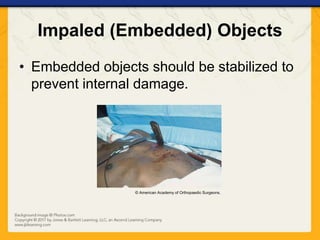
Impaled (Embedded) Objects
• Embedded objects should be stabilized to
prevent internal damage.
© American Academy of Orthopaedic Surgeons.
Sliver (Splinter): What to Do
• Remove with tweezers.
• Wash the area with soap and water.
• Apply antibiotic ointment.
• Apply adhesive bandage.
Large Impaled Object:
What to Do
• Stabilize object.
• If bleeding, apply direct pressure around
base of object.
• If necessary, reduce length or weight of
object by cutting or breaking it.
• Call 9-1-1.
Impaled Object in Cheek:
What to Do
• If you are more than 1 hour from medical
help, consider removing it.
– To remove object:
• Place two fingers next to object.
• Gently pull it in the direction from which it entered.
– If it cannot be removed easily:
• Leave it in place.
• Secure with bulky dressings.
Impaled Object in Cheek:
What to Do
• Control the bleeding.
– After removing object, place dressings over
wound inside mouth.
– Place dressing over outside of wound.
Impaled Object in Eye:
What to Do
• Do not exert pressure on eyeball.
• Stabilize object.
– If long: use bulky dressing and place paper
cup or cone over eye.
– If short: surround eye with ring pad held in
place with roller bandage.
• Cover undamaged eye.
• Call 9-1-1.
Cactus Spines: What to Do
• Removal methods:
– Tweezers
– Glue or rubber cement
• Apply in thin layer.
• Allow to dry and roll up dried glue.
• Combination of tweezers and glue most effective
– Adhesive, duct, or cellophane tape
Fishhooks: What to Do
• Tape fishhook in place.
• If barb has not penetrated skin:
– Remove by “backing out.”
– Treat as puncture wound.
– Seek care for tetanus.
• If barb has entered skin:
– Transport person.
– If far from medical care, remove hook with
pliers or string-jerk method.
© Tosh Brown/Alamy.
Fishhooks: What to Do
• Pliers method
– Apply an ice pack or
hard pressure.
– Push further in until it
emerges through skin.
– Cut off barb with pliers
and push hook back out
through entry.
© Jones & Bartlett Learning.
Fishhooks: What to Do
• String-jerk method
– Loop fishing line over
curve of hook.
– Stabilize and apply
pressure.
– Press down on shank
and eye; jerk line out.
• Movement parallel to
skin’s surface
© Jones & Bartlett Learning.
Closed Wounds
• Caused by strike with blunt object
• Skin is not broken, but tissue and blood
vessels are crushed.
• Types of closed wounds:
– Bruises and contusions
– Hematomas
– Crush injuries
Closed Wounds: What to Do
• Apply an ice pack.
• Injured limb
– Apply elastic bandage for compression.
– Splint limb.
• Check for fractures.
• Elevate extremity above heart level.
Wounds Requiring Medical Care
• Long or deep and needs stitches
• Over a joint
• Animal or human bite
• Impairs function of eye, eyelid, or lip
• All layers of skin removed
• Caused by a metal object or a puncture
wound
• Over possible broken bone
Wounds Requiring Medical Care
• Deep, jagged, or gaping open
• Involves damage to underlying bones,
joints, or tendons
• Foreign material embedded
• Cuts that show signs of infection
• Cuts that include issues with movement or
sensation, or increased pain
Wounds Requiring Medical Care
• Call 9-1-1 immediately if:
– Bleeding does not slow within 15 minutes.
– Signs of shock
– Cut to neck or chest causes difficulty
breathing.
– Deep cut to abdomen, painful
– Eyeball cut
– Amputation or partial amputation
Sutures (Stitches)
• Within 6 to 8 hours of injury
• Benefits
– Faster healing
– Reduced infection and scarring
• Wound does not require sutures if:
– Cut edges of skin fall together.
– Cut is shallow.
Gunshot Wounds
• At the scene of an active shooter: run,
hide, fight
• Bullet causes injury by:
– Laceration and crushing
– Shock waves and temporary cavitation
Gunshot Wounds:
What to Look For
• Penetrating wound—entry only
• Perforating wound—entry and exit points
© American Academy of Orthopaedic Surgeons.© American Academy of Orthopaedic Surgeons.
Gunshot Wounds: What to Do
• Monitor person’s breathing.
• Expose the wound(s).
• Control bleeding with direct pressure.
• Apply dry, sterile dressings and bandage.
• Treat person for shock; keep calm.
• Seek immediate medical care.
Legal Implications of
Gunshot Wounds
• Keep accurate record of observations.
• Preserve evidence, such as shells or
casings.
• Do not touch or move anything unless it is
necessary.
• All gunshot wounds must be reported to
police.

Ch09 presentation wounds

  • 1.
  • 2.
    Open Wounds • Abreak in the skin’s surface resulting in external bleeding • May allow bacteria to enter the body, causing an infection
  • 3.
    Types of OpenWounds • Abrasion – Top layer of skin removed – Little or no blood loss – Painful © American Academy of Orthopaedic Surgeons.
  • 4.
    Types of OpenWounds • Laceration – Cut with jagged, irregular edges – Tearing away of skin tissue • Incision – Smooth edges © Scott Camazine/Alamy. © American Academy of Orthopaedic Surgeons.
  • 5.
    Types of OpenWounds • Puncture – Deep, narrow – High risk of infection • Avulsion – Flap of skin torn loose • Amputation – Cutting or tearing off of body part © American Academy of Orthopaedic Surgeons. © American Academy of Orthopaedic Surgeons.
  • 6.
    Care for OpenWounds • Protect yourself from disease (exam gloves, etc.). • Expose the wound. • Control bleeding with direct pressure.
  • 7.
    Cleaning a Wound •Scrub hands with soap and water. • Clean wound. – For shallow wound: • Wash with soap and water. • Flush with clean water under pressure. © Jones & Bartlett Learning.
  • 8.
    Cleaning a Wound •Clean wound (cont’d). − For wound with higher infection risk: • Clean wound. • Seek medical care for additional cleaning. • Use tweezers to remove remaining embedded debris. • If bleeding restarts, apply direct pressure.
  • 9.
    Covering a Wound •Dressing: applied over a wound to control bleeding and prevent contamination − Should be sterile or as clean as possible • Bandage: holds dressing in place – Need not be sterile
  • 10.
    Covering a Wound •If the wound is small, apply thin layer of antibiotic ointment. • Cover with a sterile dressing. • Do not pull off dressing that has become stuck. – If you must remove, soak in warm water. • Change wet or dirty dressings.
  • 11.
    When to SeekMedical Care • High risk wounds – Embedded foreign material – Animal and human bites – Puncture wounds – Ragged, large, or deep wounds – Visible bone, joint, muscle, fat, or tendon – Wound entering joint or body cavity – “Fight bite”
  • 12.
    • Wounds needingsutures – Best placed within 6 to 8 hours • Anyone who has not had a tetanus vaccination within 10 years – 5 years in the case of a dirty wound When to Seek Medical Care
  • 13.
    Risk of Infection •Wounds with foreign material • Ragged or crushed tissue • Injury to underlying nerves, tendons, joints • Bite wounds • Hand and foot wounds • Puncture wounds or wounds that cannot drain
  • 14.
    Infected Wound: What toLook For • Swelling and redness around the wound • Sensation of warmth • Throbbing pain • Pus discharge • Fever • Swelling of lymph nodes • Red streaks leading from wound toward heart © Dr. P. Marazzi/Photo Researchers, Inc.
  • 15.
    Infected Wound: Whatto Do • Soak wound in warm water, or apply warm, wet packs over infected wound. • Apply antibiotic ointment. • Change dressings several times per day. • Give pain medication. • Seek medical care if the infection persists or worsens.
  • 16.
    Tetanus • Caused bytoxin-producing bacterium • Travels to nervous system • Causes muscle contraction (lockjaw) • No known antidote to toxin • Tetanus vaccine and boosters can prevent the disease.
  • 17.
    Tetanus • Seek vaccineand/or booster if: – Never immunized – No tetanus booster in past 10 years – Dirty, contaminated wound and no booster in past 5 years • Must receive within 72 hours
  • 18.
    Amputations and Avulsions •In many cases, an amputated extremity can be successfully reattached. • Avulsions most often involve ears, fingers, and hands. – Can bleed heavily
  • 19.
    Types of Amputations •Clean − Clean-cut, complete • Crushing − Crushed or mashed off • Degloving – Skin is peeled off. © Chuck Stewart, MD.
  • 20.
    Amputations: What toDo © Jones & Bartlett Learning. • Call 9-1-1. • Control bleeding and treat for shock. • Care for the part: – Wrap in a wet sterile gauze or a clean cloth. – Put in a waterproof container of ice. – Send to the medical facility.
  • 21.
    Avulsions: What toDo • Gently move the skin back to normal position. • Cover with sterile or clean dressing and apply pressure. • If bleeding continues, apply tourniquet or hemostatic dressing, if available.
  • 22.
    Blisters • A collectionof fluid in a bubble under the outer layer of skin • Caused by repeated rubbing of the skin • Treatable and preventable © Maximillian Weinzierl/Alamy.
  • 23.
    Blisters: What toDo • Hot spot – Relieve pressure by applying: • Blister bandage • Surgical tape • Elastic tape – Trim and round edges of tape. • Blister that is closed and not very painful – Use the most appropriate method discussed.
  • 24.
    Blisters: What toDo • Blister that is closed and very painful – Clean blister and needle with alcohol pad. – Make several small holes at base of blister with needle. © Jones & Bartlett Learning.
  • 25.
    Blisters: What toDo • Blister that is closed and very painful (cont’d) – Apply paper tape and cover with elastic or adhesive tape. • Trim and round edges of tape. – Watch for signs of infection.
  • 26.
    Blisters: What toDo • Blister that is very painful and open or torn – Trim off dead skin. – Place blister pad over raw skin; cover with paper tape. – Cover with elastic or adhesive tape. • Round edges of tape. – Watch for signs of infection.
  • 27.
    Impaled (Embedded) Objects •Embedded objects should be stabilized to prevent internal damage. © American Academy of Orthopaedic Surgeons.
  • 28.
    Sliver (Splinter): Whatto Do • Remove with tweezers. • Wash the area with soap and water. • Apply antibiotic ointment. • Apply adhesive bandage.
  • 29.
    Large Impaled Object: Whatto Do • Stabilize object. • If bleeding, apply direct pressure around base of object. • If necessary, reduce length or weight of object by cutting or breaking it. • Call 9-1-1.
  • 30.
    Impaled Object inCheek: What to Do • If you are more than 1 hour from medical help, consider removing it. – To remove object: • Place two fingers next to object. • Gently pull it in the direction from which it entered. – If it cannot be removed easily: • Leave it in place. • Secure with bulky dressings.
  • 31.
    Impaled Object inCheek: What to Do • Control the bleeding. – After removing object, place dressings over wound inside mouth. – Place dressing over outside of wound.
  • 32.
    Impaled Object inEye: What to Do • Do not exert pressure on eyeball. • Stabilize object. – If long: use bulky dressing and place paper cup or cone over eye. – If short: surround eye with ring pad held in place with roller bandage. • Cover undamaged eye. • Call 9-1-1.
  • 33.
    Cactus Spines: Whatto Do • Removal methods: – Tweezers – Glue or rubber cement • Apply in thin layer. • Allow to dry and roll up dried glue. • Combination of tweezers and glue most effective – Adhesive, duct, or cellophane tape
  • 34.
    Fishhooks: What toDo • Tape fishhook in place. • If barb has not penetrated skin: – Remove by “backing out.” – Treat as puncture wound. – Seek care for tetanus. • If barb has entered skin: – Transport person. – If far from medical care, remove hook with pliers or string-jerk method. © Tosh Brown/Alamy.
  • 35.
    Fishhooks: What toDo • Pliers method – Apply an ice pack or hard pressure. – Push further in until it emerges through skin. – Cut off barb with pliers and push hook back out through entry. © Jones & Bartlett Learning.
  • 36.
    Fishhooks: What toDo • String-jerk method – Loop fishing line over curve of hook. – Stabilize and apply pressure. – Press down on shank and eye; jerk line out. • Movement parallel to skin’s surface © Jones & Bartlett Learning.
  • 37.
    Closed Wounds • Causedby strike with blunt object • Skin is not broken, but tissue and blood vessels are crushed. • Types of closed wounds: – Bruises and contusions – Hematomas – Crush injuries
  • 38.
    Closed Wounds: Whatto Do • Apply an ice pack. • Injured limb – Apply elastic bandage for compression. – Splint limb. • Check for fractures. • Elevate extremity above heart level.
  • 39.
    Wounds Requiring MedicalCare • Long or deep and needs stitches • Over a joint • Animal or human bite • Impairs function of eye, eyelid, or lip • All layers of skin removed • Caused by a metal object or a puncture wound • Over possible broken bone
  • 40.
    Wounds Requiring MedicalCare • Deep, jagged, or gaping open • Involves damage to underlying bones, joints, or tendons • Foreign material embedded • Cuts that show signs of infection • Cuts that include issues with movement or sensation, or increased pain
  • 41.
    Wounds Requiring MedicalCare • Call 9-1-1 immediately if: – Bleeding does not slow within 15 minutes. – Signs of shock – Cut to neck or chest causes difficulty breathing. – Deep cut to abdomen, painful – Eyeball cut – Amputation or partial amputation
  • 42.
    Sutures (Stitches) • Within6 to 8 hours of injury • Benefits – Faster healing – Reduced infection and scarring • Wound does not require sutures if: – Cut edges of skin fall together. – Cut is shallow.
  • 43.
    Gunshot Wounds • Atthe scene of an active shooter: run, hide, fight • Bullet causes injury by: – Laceration and crushing – Shock waves and temporary cavitation
  • 44.
    Gunshot Wounds: What toLook For • Penetrating wound—entry only • Perforating wound—entry and exit points © American Academy of Orthopaedic Surgeons.© American Academy of Orthopaedic Surgeons.
  • 45.
    Gunshot Wounds: Whatto Do • Monitor person’s breathing. • Expose the wound(s). • Control bleeding with direct pressure. • Apply dry, sterile dressings and bandage. • Treat person for shock; keep calm. • Seek immediate medical care.
  • 46.
    Legal Implications of GunshotWounds • Keep accurate record of observations. • Preserve evidence, such as shells or casings. • Do not touch or move anything unless it is necessary. • All gunshot wounds must be reported to police.