Electrical shock in first aid
emergency
•Electrical shock
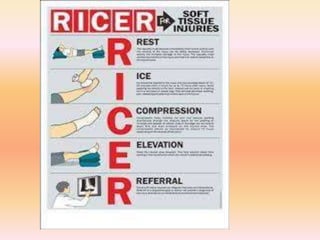
•Soft tissue injuries
•Fracture
•Burns
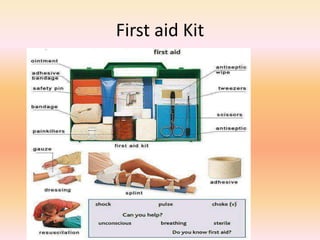
First aid Kit
Meaning
• The danger from an electrical shock depends
on the type of current, how high the voltage
is, how the current traveled through the body,
the person's overall health and how quickly
the person is treated.
Reason for electrical shock occur
• An electrical shock may cause burns, or it may
leave no visible mark on the skin. In either
case, an electrical current passing through the
body can cause internal damage, cardiac
arrest or other injury. Under certain
circumstances, even a small amount of
electricity can be fatal.
Caution
• Don't touch the injured person if he or she is still in
contact with the electrical current.
• Call 108 or your local emergency number if the source
of the burn is a high-voltage wire or lightning.
• Don't get near high-voltage wires until the power is
turned off.
• Overhead power lines usually aren't insulated.
• Stay at least 20 feet (about 6 meters) away — farther if
wires are jumping and sparking.
• Don't move a person with an electrical injury unless he
or she is in immediate danger.
Signs and symptom of electrical
injuries
• injured person experiences:
• Severe burns
• Confusion
• Difficulty breathing
• Heart rhythm problems (arrhythmias)
• Cardiac arrest
• Muscle pain and contractions
• Seizures
• Loss of consciousness
Take these actions immediately while
waiting for medical help:
• Turn off the source of electricity, if possible.
• If not, move the source away from you and the person,
using a dry, non conducting object made of cardboard,
plastic or wood.
• Begin CPR if the person shows no signs of circulation, such
as breathing, coughing or movement.
• Try to prevent the injured person from becoming chilled.
• Apply a bandage.
• Cover any burned areas with a sterile gauze bandage, if
available, or a clean cloth.
• Don't use a blanket or towel, because loose fibers can stick
to the burns.
Treat an electric shock
• Follow these steps to help minimise the impact of electric shock:
• Do not touch the person unless you are sure they are no longer in
contact with the electrical source.
• The live electrical source needs to be powered off or carefully
removed. If you need to handle a live electrical source, use a wood
or rubber object, i.e. a non-conductor of electricity.
• Do not change the victim’s position, unless there’s a danger they
will be shocked again.
• Call emergency services if the victim has been struck by power lines
or lightning, or is experiencing breathing difficulty, seizures, muscle
spasms, heartbeat irregularities, or numbness.
• Assess the victim’s breathing and pulse. Provide cardiopulmonary
resuscitation if required. If the victim is in shock, elevate their legs
and feet.
• Place sterile gauze, if available, over the burns and keep the victim
warm.
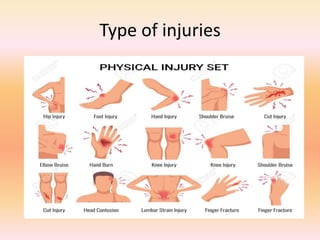
Type of injuries
Fracture
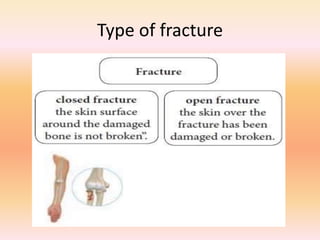
• A break or crack in a bone is called a fracture.
• A dislocation is where a bone has been
displaced from its normal position at a joint. A
fracture is when a bone has been broken.
Type of fracture
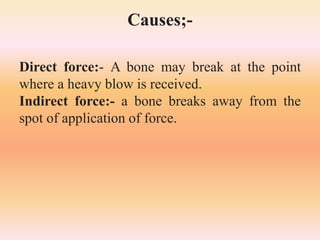
Causes;-
Direct force:- A bone may break at the point
where a heavy blow is received.
Indirect force:- a bone breaks away from the
spot of application of force.
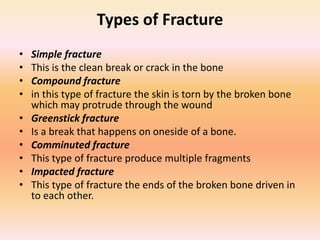
Types of Fracture
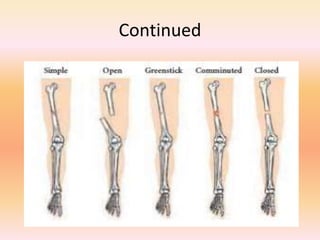
• Simple fracture
• This is the clean break or crack in the bone
• Compound fracture
• in this type of fracture the skin is torn by the broken bone
which may protrude through the wound
• Greenstick fracture
• Is a break that happens on oneside of a bone.
• Comminuted fracture
• This type of fracture produce multiple fragments
• Impacted fracture
• This type of fracture the ends of the broken bone driven in
to each other.
Continued
What to look for – fractures
• Swelling.
• Pain at or near the site of injury.
• Difficulty moving.
• Movement in an unnatural direction.
• A limb that looks shorter, twisted or bent.
• A grating noise or feeling.
• Loss of strength .
The aims of first aid for the fractures
are:
• 1. To prevent further damage
• 2. To reduce pain and shock
• 3. To make the patient feel comfortable
• 4. To get medical aid as soon as possible.
If you suspect that someone has
fractured a bone
• Do’s
· Stop any bleeding .
· Immobilize the injured part.
· Apply ice pack wraped in a towel .
· Treat for shock.
Don’ts
 · Do not force anyone to use a painful body part.
 · Do not straighten a misshapen bone.
 · Do not place ice/cold pack directly on skin.
 · Do not move victim if neck or spine injury is suspected, unless
absolutely necessary.
 · Do not move until injury has been immobilized.
 · Do not remove shoes, boots, or clothes around a possible
fracture.
 · Splinting is unnecessary if victim can give the broken bone
sufficient support and immobility.
 · Do not splint a possible fractured bone if doing so causes pain.
 · Do not Massage the affected area
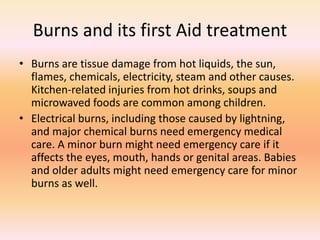
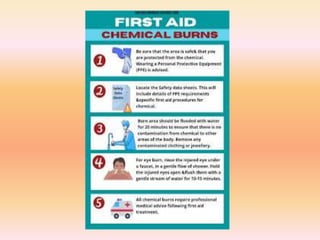
Burns and its first Aid treatment
• Burns are tissue damage from hot liquids, the sun,
flames, chemicals, electricity, steam and other causes.
Kitchen-related injuries from hot drinks, soups and
microwaved foods are common among children.
• Electrical burns, including those caused by lightning,
and major chemical burns need emergency medical
care. A minor burn might need emergency care if it
affects the eyes, mouth, hands or genital areas. Babies
and older adults might need emergency care for minor
burns as well.
When seek medical care
• Are deep, involving all layers of the skin
• Cause the skin to be dry and leathery
• May appear charred or have patches of white,
brown or black
• Are larger than 3 inches (about 8 centimeters) in
diameter
• Cover the hands, feet, face, groin, buttocks or a
major joint, or encircles an arm or leg
• Are accompanied by smoke inhalation
• Begin swelling very quickly
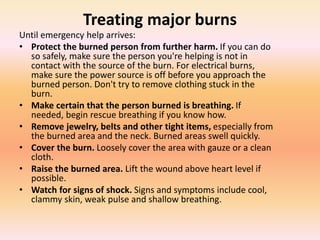
Treating major burns
Until emergency help arrives:
• Protect the burned person from further harm. If you can do
so safely, make sure the person you're helping is not in
contact with the source of the burn. For electrical burns,
make sure the power source is off before you approach the
burned person. Don't try to remove clothing stuck in the
burn.
• Make certain that the person burned is breathing. If
needed, begin rescue breathing if you know how.
• Remove jewelry, belts and other tight items, especially from
the burned area and the neck. Burned areas swell quickly.
• Cover the burn. Loosely cover the area with gauze or a clean
cloth.
• Raise the burned area. Lift the wound above heart level if
possible.
• Watch for signs of shock. Signs and symptoms include cool,
clammy skin, weak pulse and shallow breathing.
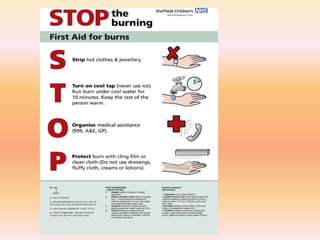
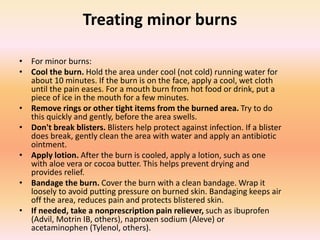
Treating minor burns
• For minor burns:
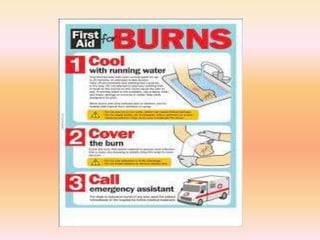
• Cool the burn. Hold the area under cool (not cold) running water for
about 10 minutes. If the burn is on the face, apply a cool, wet cloth
until the pain eases. For a mouth burn from hot food or drink, put a
piece of ice in the mouth for a few minutes.
• Remove rings or other tight items from the burned area. Try to do
this quickly and gently, before the area swells.
• Don't break blisters. Blisters help protect against infection. If a blister
does break, gently clean the area with water and apply an antibiotic
ointment.
• Apply lotion. After the burn is cooled, apply a lotion, such as one
with aloe vera or cocoa butter. This helps prevent drying and
provides relief.
• Bandage the burn. Cover the burn with a clean bandage. Wrap it
loosely to avoid putting pressure on burned skin. Bandaging keeps air
off the area, reduces pain and protects blistered skin.
• If needed, take a nonprescription pain reliever, such as ibuprofen
(Advil, Motrin IB, others), naproxen sodium (Aleve) or
acetaminophen (Tylenol, others).
Electrical shock in first aid emergency.pptx

Electrical shock in first aid emergency.pptx

  • 1.
    Electrical shock infirst aid emergency •Electrical shock •Soft tissue injuries •Fracture •Burns
  • 2.
  • 3.
    Meaning • The dangerfrom an electrical shock depends on the type of current, how high the voltage is, how the current traveled through the body, the person's overall health and how quickly the person is treated.
  • 4.
    Reason for electricalshock occur • An electrical shock may cause burns, or it may leave no visible mark on the skin. In either case, an electrical current passing through the body can cause internal damage, cardiac arrest or other injury. Under certain circumstances, even a small amount of electricity can be fatal.
  • 5.
    Caution • Don't touchthe injured person if he or she is still in contact with the electrical current. • Call 108 or your local emergency number if the source of the burn is a high-voltage wire or lightning. • Don't get near high-voltage wires until the power is turned off. • Overhead power lines usually aren't insulated. • Stay at least 20 feet (about 6 meters) away — farther if wires are jumping and sparking. • Don't move a person with an electrical injury unless he or she is in immediate danger.
  • 6.
    Signs and symptomof electrical injuries • injured person experiences: • Severe burns • Confusion • Difficulty breathing • Heart rhythm problems (arrhythmias) • Cardiac arrest • Muscle pain and contractions • Seizures • Loss of consciousness
  • 7.
    Take these actionsimmediately while waiting for medical help: • Turn off the source of electricity, if possible. • If not, move the source away from you and the person, using a dry, non conducting object made of cardboard, plastic or wood. • Begin CPR if the person shows no signs of circulation, such as breathing, coughing or movement. • Try to prevent the injured person from becoming chilled. • Apply a bandage. • Cover any burned areas with a sterile gauze bandage, if available, or a clean cloth. • Don't use a blanket or towel, because loose fibers can stick to the burns.
  • 9.
    Treat an electricshock • Follow these steps to help minimise the impact of electric shock: • Do not touch the person unless you are sure they are no longer in contact with the electrical source. • The live electrical source needs to be powered off or carefully removed. If you need to handle a live electrical source, use a wood or rubber object, i.e. a non-conductor of electricity. • Do not change the victim’s position, unless there’s a danger they will be shocked again. • Call emergency services if the victim has been struck by power lines or lightning, or is experiencing breathing difficulty, seizures, muscle spasms, heartbeat irregularities, or numbness. • Assess the victim’s breathing and pulse. Provide cardiopulmonary resuscitation if required. If the victim is in shock, elevate their legs and feet. • Place sterile gauze, if available, over the burns and keep the victim warm.
  • 10.
  • 12.
    Fracture • A breakor crack in a bone is called a fracture. • A dislocation is where a bone has been displaced from its normal position at a joint. A fracture is when a bone has been broken.
  • 13.
  • 14.
    Causes;- Direct force:- Abone may break at the point where a heavy blow is received. Indirect force:- a bone breaks away from the spot of application of force.
  • 15.
    Types of Fracture •Simple fracture • This is the clean break or crack in the bone • Compound fracture • in this type of fracture the skin is torn by the broken bone which may protrude through the wound • Greenstick fracture • Is a break that happens on oneside of a bone. • Comminuted fracture • This type of fracture produce multiple fragments • Impacted fracture • This type of fracture the ends of the broken bone driven in to each other.
  • 16.
  • 17.
    What to lookfor – fractures • Swelling. • Pain at or near the site of injury. • Difficulty moving. • Movement in an unnatural direction. • A limb that looks shorter, twisted or bent. • A grating noise or feeling. • Loss of strength .
  • 18.
    The aims offirst aid for the fractures are: • 1. To prevent further damage • 2. To reduce pain and shock • 3. To make the patient feel comfortable • 4. To get medical aid as soon as possible.
  • 19.
    If you suspectthat someone has fractured a bone • Do’s · Stop any bleeding . · Immobilize the injured part. · Apply ice pack wraped in a towel . · Treat for shock.
  • 20.
    Don’ts  · Donot force anyone to use a painful body part.  · Do not straighten a misshapen bone.  · Do not place ice/cold pack directly on skin.  · Do not move victim if neck or spine injury is suspected, unless absolutely necessary.  · Do not move until injury has been immobilized.  · Do not remove shoes, boots, or clothes around a possible fracture.  · Splinting is unnecessary if victim can give the broken bone sufficient support and immobility.  · Do not splint a possible fractured bone if doing so causes pain.  · Do not Massage the affected area
  • 21.
    Burns and itsfirst Aid treatment • Burns are tissue damage from hot liquids, the sun, flames, chemicals, electricity, steam and other causes. Kitchen-related injuries from hot drinks, soups and microwaved foods are common among children. • Electrical burns, including those caused by lightning, and major chemical burns need emergency medical care. A minor burn might need emergency care if it affects the eyes, mouth, hands or genital areas. Babies and older adults might need emergency care for minor burns as well.
  • 22.
    When seek medicalcare • Are deep, involving all layers of the skin • Cause the skin to be dry and leathery • May appear charred or have patches of white, brown or black • Are larger than 3 inches (about 8 centimeters) in diameter • Cover the hands, feet, face, groin, buttocks or a major joint, or encircles an arm or leg • Are accompanied by smoke inhalation • Begin swelling very quickly
  • 23.
    Treating major burns Untilemergency help arrives: • Protect the burned person from further harm. If you can do so safely, make sure the person you're helping is not in contact with the source of the burn. For electrical burns, make sure the power source is off before you approach the burned person. Don't try to remove clothing stuck in the burn. • Make certain that the person burned is breathing. If needed, begin rescue breathing if you know how. • Remove jewelry, belts and other tight items, especially from the burned area and the neck. Burned areas swell quickly. • Cover the burn. Loosely cover the area with gauze or a clean cloth. • Raise the burned area. Lift the wound above heart level if possible. • Watch for signs of shock. Signs and symptoms include cool, clammy skin, weak pulse and shallow breathing.
  • 24.
    Treating minor burns •For minor burns: • Cool the burn. Hold the area under cool (not cold) running water for about 10 minutes. If the burn is on the face, apply a cool, wet cloth until the pain eases. For a mouth burn from hot food or drink, put a piece of ice in the mouth for a few minutes. • Remove rings or other tight items from the burned area. Try to do this quickly and gently, before the area swells. • Don't break blisters. Blisters help protect against infection. If a blister does break, gently clean the area with water and apply an antibiotic ointment. • Apply lotion. After the burn is cooled, apply a lotion, such as one with aloe vera or cocoa butter. This helps prevent drying and provides relief. • Bandage the burn. Cover the burn with a clean bandage. Wrap it loosely to avoid putting pressure on burned skin. Bandaging keeps air off the area, reduces pain and protects blistered skin. • If needed, take a nonprescription pain reliever, such as ibuprofen (Advil, Motrin IB, others), naproxen sodium (Aleve) or acetaminophen (Tylenol, others).