First Aid Principles and Practice

Dr Hariom Sharma MBBS, MS
Global Speciality Hospital Gwalior
Why to know first aid procedures?
• Lives can be saved by the steps anyone can
take until medical help can arrive.
Definition of First Aid
What is First Aid?
Definition:
 Assessment and immediate care .
 Does not take the place of proper medical
treatment and
 Must not delay activation of emergency
medical services or other medical assistance
when required.
First Aid
• Immediate care that can be given to an
injured or suddenly ill person
– With minimal or no proper medical
equipment
– Temporary assistance until arrival of
competent medical care
– Does not take the place of proper medical
treatment
AIMS OF GIVING FIRST AID
To save life.
To control bleeding
To relieve pain.
To promote quick recovery
To prevent further Injuries and
Infection
To be able transport casualties
CONTENTS OF A FIRST AID BOX
•
•
•
•
•
•
•
•
•
•

Bandages
Gauze
Plasters
Scissors
Cotton Wool
Pain Killers
Note Book And Pen
Disinfectant
Iodine /Spirit
Gloves
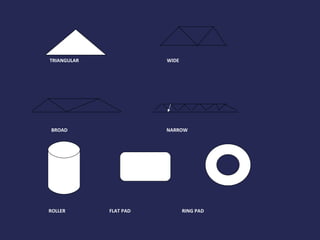
TRIANGULAR

WIDE

BROAD

ROLLER

NARROW

FLAT PAD

RING PAD
CONTENTS OF A FIRST AID BOX
•
•
•
•
•
•
•
•

Surgical Blades
Glucose
Burn Cream
Safety Pins
Ors –Oral Rehydration Salts
Liniment / Deep Heat
Soap Medicated
Splints
RULES OF GIVING FIRST AID
First aiders life comes number one
Do first things first

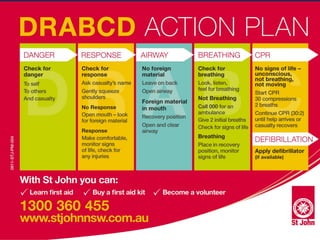
D – anger
R – esponse
A – irway
B – reathing
C – irculation
The three C’s

Check,
Call,
Care!
Look for A B C
A-Airways:Check airway before you give chest
compression .
Pull the tongue out if it is falling
back and blocking the airway.
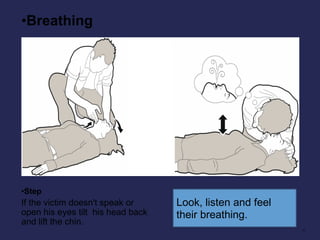
•Breathing
B-breathing:

•Step

If the victim doesn't speak or
open his eyes tilt his head back
and lift the chin.

Look, listen and feel
their breathing.
•3
BLEEDING
• Escape of blood from blood system i.e.
 Capillaries,
 Arteries,
 Veins and
 Heart.
Types of bleeding
Internal Bleeding
This is the escape of blood from arteries,
capillaries and veins into the spaces in the
body. (Remains inside the body).
EXTERNAL BLEEDING
This is the escape of blood from arteries,
capillaries and veins out of the body and is
seen.
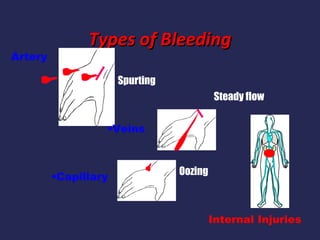
Artery

Types of Bleeding
Spurting
Steady flow
•Veins

•Capillary

Oozing

Internal Injuries
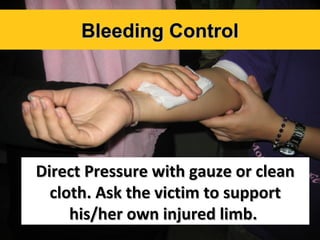
Bleeding Control

Direct Pressure with gauze or clean
cloth. Ask the victim to support
his/her own injured limb.
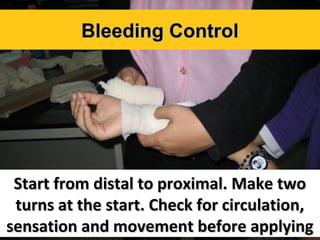
Bleeding Control

Start from distal to proximal. Make two
turns at the start. Check for circulation,
sensation and movement before applying
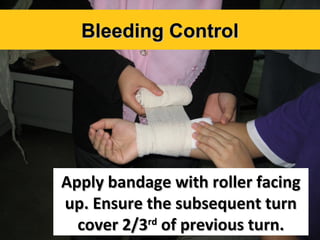
Bleeding Control

Apply bandage with roller facing
up. Ensure the subsequent turn
cover 2/3rd of previous turn.
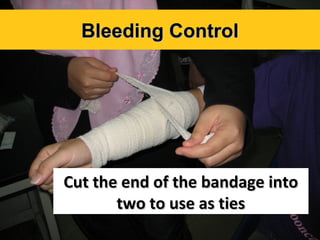
Bleeding Control

Cut the end of the bandage into
two to use as ties
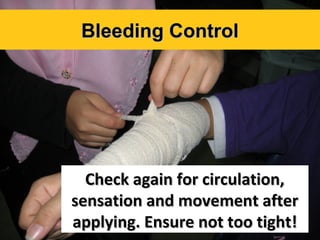
Bleeding Control

Check again for circulation,
sensation and movement after
applying. Ensure not too tight!
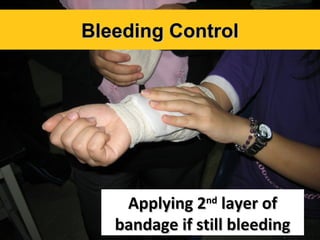
Bleeding Control

Applying 2nd layer of
bandage if still bleeding
Bleeding Control

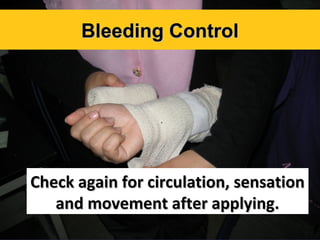
Check again for circulation, sensation
and movement after applying.
Bleeding Control
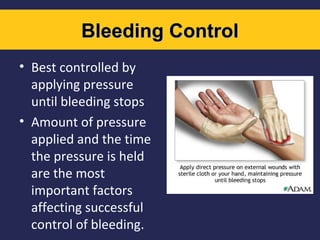
• Best controlled by
applying pressure
until bleeding stops
• Amount of pressure
applied and the time
the pressure is held
are the most
important factors
affecting successful
control of bleeding.
Bleeding Control
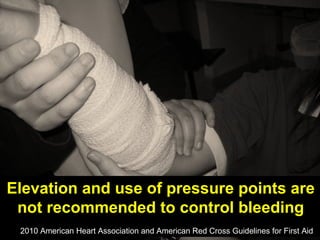
• Elevation and use of pressure points are no
longer recommended to control bleeding.
Why?
1.effectiveness of elevation has not been
studied
2.these unproven procedures may compromise
the proven intervention of direct pressure
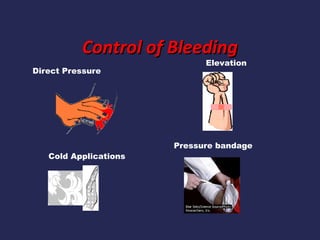
Control of Bleeding
Direct Pressure

Cold Applications

Elevation

Pressure bandage
Elevation and use of pressure points are
not recommended to control bleeding
2010 American Heart Association and American Red Cross Guidelines for First Aid
NOSE BLEEDING
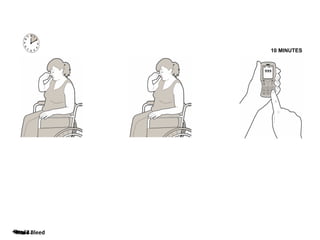
• Make the Victim to sit facing the breeze with the
head slightly forward .
• Ask him to breath through the mouth and not to
blow his nose .
• Apply cold compresses over the nose and fore
head
• Pinch the soft part of nose with the fingers for 10
minutes .
• Apply cold on the back of the neck and forehead
10 MINUTES

•12
•Step 2.1.
•Step 3. Bleed
•Step
•Nose
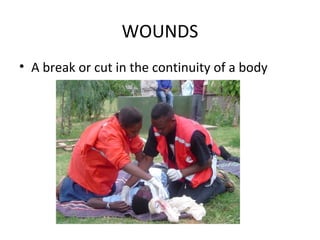
WOUNDS
• A break or cut in the continuity of a body
Types Of Wounds
Closed wounds
This is when the damage occurs under the
skin tissue leaving the outer layer unbroken
e.g. electrical burn.
Open wounds
This is when there is a breakage in the
continuity of the skin e.g. cut by a razorblade,
knife
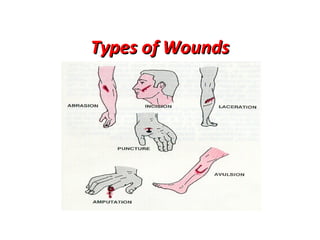
Types of Wounds
Basic First Aid for Wounds
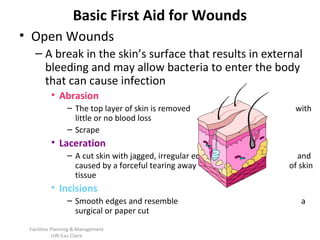
• Open Wounds
– A break in the skin’s surface that results in external
bleeding and may allow bacteria to enter the body
that can cause infection
• Abrasion
– The top layer of skin is removed
little or no blood loss
– Scrape

with

• Laceration
– A cut skin with jagged, irregular edges
caused by a forceful tearing away
tissue

and
of skin

• Incisions
– Smooth edges and resemble
surgical or paper cut
Facilities Planning & Management
UW-Eau Claire

a
Basic First Aid for Wounds Cont.
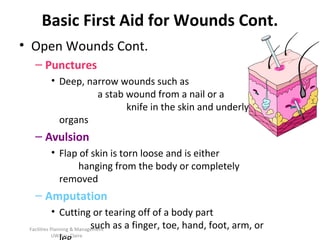
• Open Wounds Cont.
– Punctures
• Deep, narrow wounds such as
a stab wound from a nail or a
knife in the skin and underlying
organs

– Avulsion
• Flap of skin is torn loose and is either
hanging from the body or completely
removed

– Amputation
• Cutting or tearing off of a body part
such as a finger, toe, hand, foot, arm, or
Facilities Planning & Management
UW-Eau Claire
FAM
Safety.
Reassure casualty as you settle him/her in a
comfortable position.
Remove the foreign body if possible.
Dress and bandage the affected part.
Change the dressing every other day.
Burn all used up dressings so as not to
spread infection.
SHOCK
• A condition in which a person’s important
body organs fails to function or slow down
due to less oxygenated blood flow. (Triangle
of life Brain, lungs and heart)
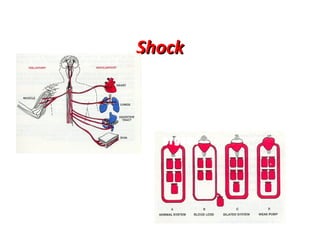
Shock
Shock affects all
major functions of the
body
loss of blood flow to
the tissues and
organs
Shock must be
treated in all
accident cases
Treatment for Shock
•Lie victim down if possible
•Face is pale-raise the tail
•Face is red-raise the head
•Loosen tight clothing
•Keep victim warm and dry
•Do not give anything by mouth
•No stimulants
BURNS AND SCALDS
• Burns are injuries caused by dry heat e.g. hot
metals, iron e.t.c while scalds are injuries
caused by vapor or hot liquids.
FAM
Safety
Pour plenty of cold running water over part
Refer or call for help

• NB Never break blisters
•
Never forcefully remove clothes from
burnt skin
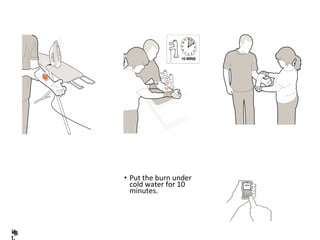
• Put the burn under
cold water for 10
minutes.

•
8

•S
t
e
p

•S
•B
t
2
.
Chemical Burns
Treatment:
•Flood the area with slowly running water for at
least ten minutes. (or proper neutralizing agent)
•Gently remove contaminated clothing while
flooding injured area, taking care not to contaminate
yourself.
•Continue treatment for SEVERE BURNS
•Remove to hospital.
ASPHYXIA
• A condition in which there is insufficient or no
oxygen supply to the vital organs of the body
triangle of life caused by suffocation, chocking
and drowning.
CAUSES
Strangulation
Inhaling poisonous gases
Drowning
Being buried under soil.
Unconsciousness
Overcrowding in a poorly ventilated room
Cardiac Failure
Electric shock
Asthma/Diseases
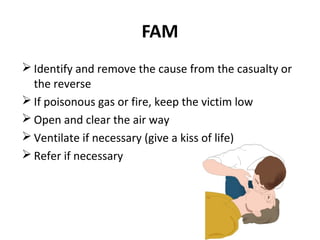
FAM
 Identify and remove the cause from the casualty or
the reverse
 If poisonous gas or fire, keep the victim low
 Open and clear the air way
 Ventilate if necessary (give a kiss of life)
 Refer if necessary
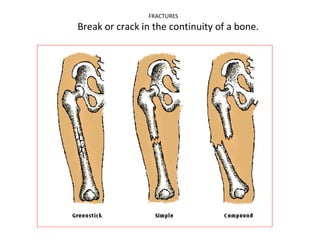
FRACTURES

Break or crack in the continuity of a bone.
CLASSIFICATION OF FRACTURES
Compound/open fracture
This is when a bone breaks and tears through the skin tissue,
and it can be seen.
Simple/closed fracture
This is when a bone breaks/cracks but remains within the
body.
Green stick fracture
This happens in children/infants whose bones have not grown
hard. It bends or cracks but doesn’t break. As their bones are
not hard enough to break.
Complicated fracture
This is when a bone breaks and damages other body organs
and it may be open or closed fracture.
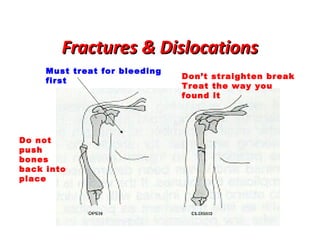
Fractures & Dislocations
Must treat for bleeding
first

Do not
push
bones
back into
place

Don’t straighten break
Treat the way you
found it
FAM
1. Safety
2. Rest the casualty and place affected part in
comfortable position
3. Reassure the casualty
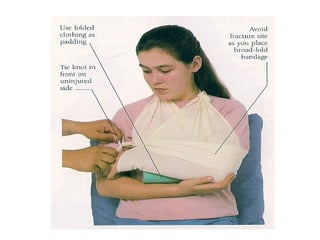
4. Immobilize fracture using splints and
bandages
5. Control bleeding if any
6. Refer
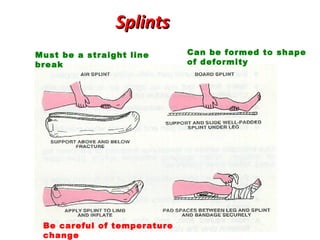
Splints
Must be a straight line
break

Be careful of temperature
change

Can be formed to shape
of deformity
UNCONSCIOUSNESS
• A state of unawareness due to damage or
disturbance of the brain functions
FIRST AID MANAGEMENT FOR
UNCONSCIOUSNESS
 Open the airway by lifting the chin and tilting the head. Check breathing and circulation and be
prepared to resuscitate if necessary.
 If the casualty starts to vomit, put in a recovery position.
 If suspect spinal injury, treat the casualty as a spinal injury.
 Examine the casualty to identify severe bleeding and fractures.
 Control any bleeding as immediately as possible.
 Ensure plenty of fresh air by opening doors, windows or in an open environment.
 Cover the casualty with a worm blanket
Who provides first aid?
•
•
•
•
•
•

Workmates
Friends
Relatives,
Family members,
Teachers
Medical students, anyone ……YOU!
Principles of First Aid
Principle #1: First, do no harm
Know what to do and know what NOT to do
First Do No Harm
• Do no harm does not mean do nothing.
• The wisdom is not just to know what to
do, but what NOT to do
• Sometimes the best thing you can do for
a casualty is to call for help.
• Provide comfort and assurance to the
casualty may be the only thing you can
do
First Do No Harm
• Use treatments you know of that are
most likely to benefit a casualty
• Do not use a treatment that you are not
sure about “just for the sake of trying”
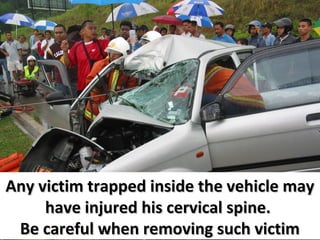
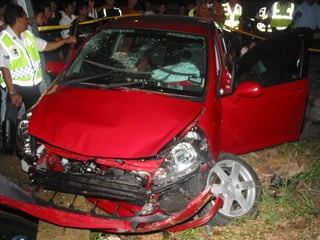
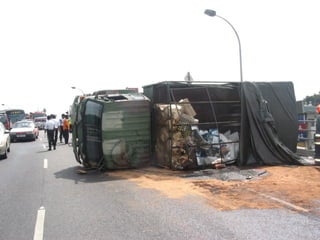
Any victim trapped inside the vehicle may
have injured his cervical spine.
Be careful when removing such victim
Positioning of Victim
• As a general rule a victim should not be
moved
• The indications to move the victim include
1.If the area is unsafe for the rescuer or victim
2.If the victim is face down and is unresponsive
3.If the victim has difficulty breathing because
of copious secretions or vomiting
4.If the victim shows evidence of shock
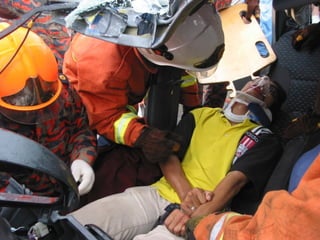
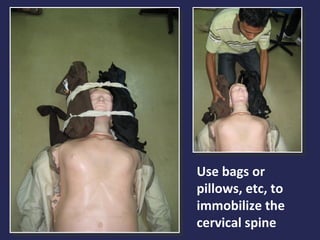
Use bags or
pillows, etc, to
immobilize the
cervical spine
What to do and NOT to do in
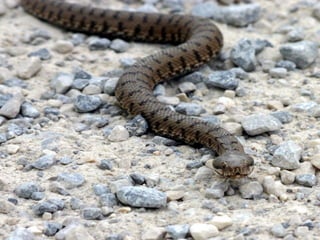
Snake Bite?
• Send any evidence of the snake to the
hospital only if safe to do so.
• Avoid elevating the limb
• DO NOT use an arterial tourniquet
• DO NOT try to capture the snake
• DO NOT cut the bitten area
• DO NOT suck the bitten area
What to do?
• Ensure safety
• Reassure and rest the casualty
• Avoid all unnecessary movement to
prevent venom from spreading in the
body.
• Direct pressure and immobilize the limb
• Get to hospital urgently
Principle #2: First Aid is about Putting
First Things First
First Things First
• Get your priority right
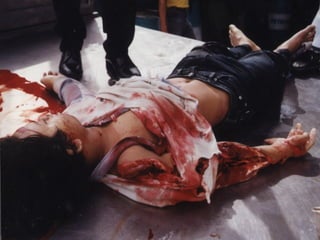
• If there are too many injuries in a
casualty, treat the most urgent injuries
first
• If there are too many casualties
– First, call for help
– Treat the ones with the highest chance of survival
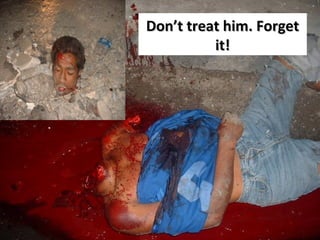
Don’t treat him. Forget
it!
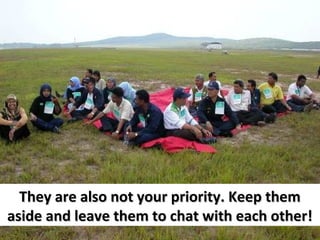
They are also not your priority. Keep them
aside and leave them to chat with each other!
First Things First
• The first step to get our priority right is
to know and recognize what is an
emergency and what is not an
emergency!
• Sometimes it is very difficult, e.g. heart
attack can be silent
Principle #3: Safety Is Of Utmost
Importance In First Aid
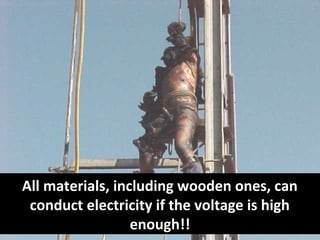
All materials, including wooden ones, can
conduct electricity if the voltage is high
enough!!
TRANSPORTATION
• Method a First Aider can improvise to
move/transfer causality from place of injury to
where he/she is going to be attended to by
first aider or medical personnel.
TYPES OF TRANSPORTATION
Stretcher or improvised e.g. blanket, bed sheets
Dragging
Human cradle
Human crutch
Chair lift
Two handed seat
Four handed seat
Three handed seat
Four handed seat
Pick a back
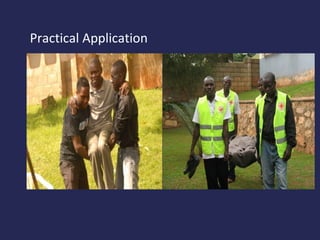
Practical Application
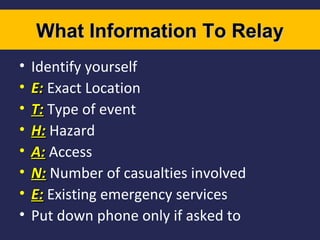
What Information To Relay
•
•
•
•
•
•
•
•

Identify yourself
E: Exact Location
T: Type of event
H: Hazard
A: Access
N: Number of casualties involved
E: Existing emergency services
Put down phone only if asked to
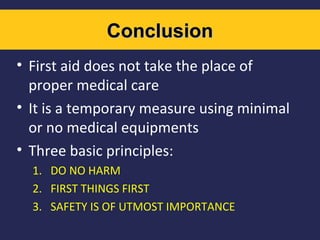
Conclusion
• First aid does not take the place of
proper medical care
• It is a temporary measure using minimal
or no medical equipments
• Three basic principles:
1. DO NO HARM
2. FIRST THINGS FIRST
3. SAFETY IS OF UTMOST IMPORTANCE
First aid by Dr Hariom Sharma Global Speciality Hospital Gwalior