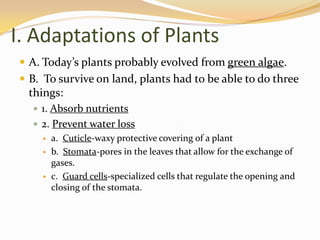
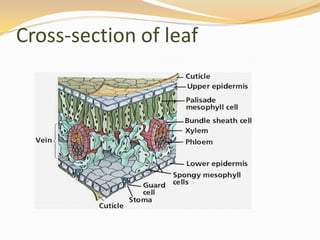
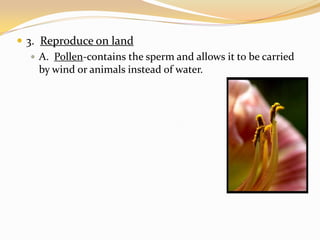
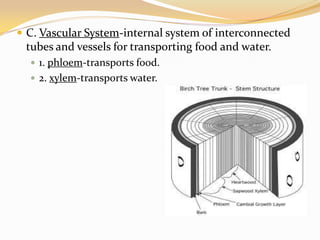
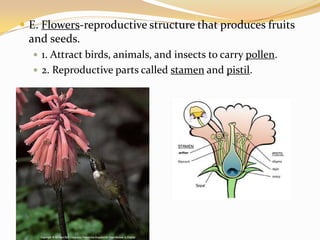
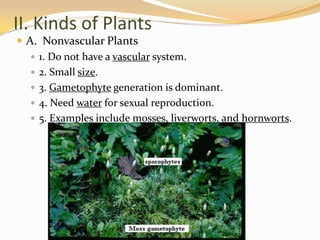
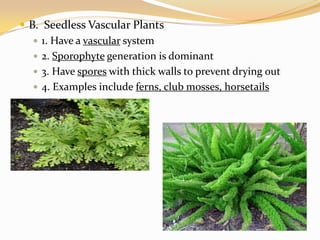
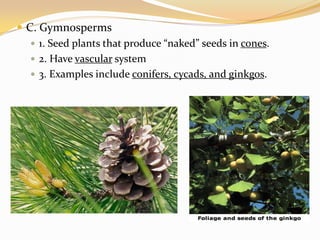
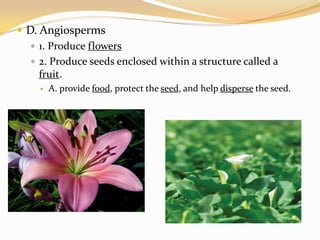
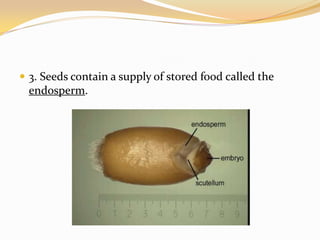
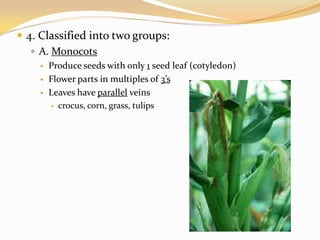
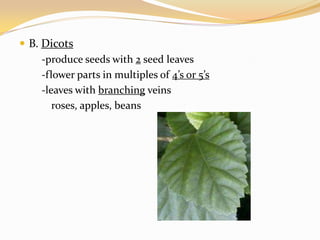
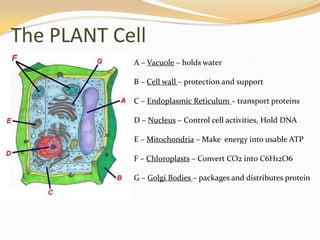
Plants evolved adaptations to survive on land such as developing a waxy cuticle, stomata, and guard cells to regulate water loss. They also evolved vascular tissues to transport water and nutrients, seeds to reproduce, and flowers to attract pollinators. There are four main kinds of plants - nonvascular which rely on water, seedless vascular with spores, gymnosperms with naked seeds, and angiosperms which produce flowers and fruits enclosing seeds. Angiosperms are further divided into monocots and dicots. Plants provide essential resources like food, wood, medicines, and fibers and have cellular structures like chloroplasts and vacuoles that allow them to survive on land.


![Plant kingdom2.pptrb[1]](https://cdn.slidesharecdn.com/ss_thumbnails/plantkingdom-pptrb1-121211114536-phpapp02-thumbnail.jpg?width=640&height=640&fit=bounds)
![Plant kingdom.pptrb[1]](https://cdn.slidesharecdn.com/ss_thumbnails/plantkingdom-pptrb1-121211114250-phpapp01-thumbnail.jpg?width=640&height=640&fit=bounds)
![Plant kingdom4.pptrb[1]](https://cdn.slidesharecdn.com/ss_thumbnails/plantkingdom-pptrb1-121211115127-phpapp01-thumbnail.jpg?width=640&height=640&fit=bounds)


