CHAPTER 9 & 10 NOTES PART 2 DNA PROCESSES
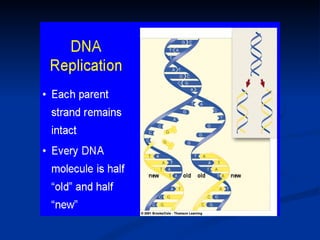
I. REPLICATION The DNA molecule can build an exact  copy  of itself. DNA separates into  two   strands  exposing the bases. The exposed bases combine with free nucleotides. This process is repeated until  two   whole  DNA molecules are formed.
 
Website This is a website showing the process of replication. http:// www.dnai.org/a/index.html
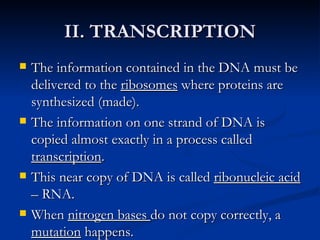
II. TRANSCRIPTION The information contained in the DNA must be delivered to the  ribosomes  where proteins are synthesized (made). The information on one strand of DNA is copied almost exactly in a process called  transcription . This near copy of DNA is called  ribonucleic acid  – RNA. When  nitrogen bases  do not copy correctly, a  mutation  happens.
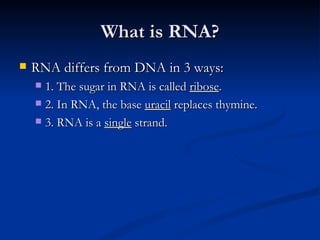
What is RNA? RNA differs from DNA in 3 ways: 1. The sugar in RNA is called  ribose . 2. In RNA, the base  uracil  replaces thymine. 3. RNA is a  single  strand.
What are the types of RNA? There are 3 types of RNA: 1. mRNA (messenger RNA) – acts as a pattern for the order of amino acids in the protein. 2. tRNA (transfer RNA) – carries amino acids in the cytoplasm to the ribosomes. 3. rRNA (ribosomal RNA) – found in the ribosomes.
Website This  is a website showing the process of transcription.
III. TRANSLATION The bases on the mRNA act as a code for each  amino   acid . Groups of 3 bases, called  codons , act as a specific code for each amino acid. The  ribosomes  move along the mRNA reading the codons. The  tRNA  picks up the correct amino acid and brings it to the  mRNA . A chain of amino acids builds up a  protein .
Website This  is a website showing the process of translation.

Chapter 9 & 10 notes part 2

  • 1.
    CHAPTER 9 &10 NOTES PART 2 DNA PROCESSES
  • 2.
    I. REPLICATION TheDNA molecule can build an exact copy of itself. DNA separates into two strands exposing the bases. The exposed bases combine with free nucleotides. This process is repeated until two whole DNA molecules are formed.
  • 3.
  • 4.
    Website This isa website showing the process of replication. http:// www.dnai.org/a/index.html
  • 5.
    II. TRANSCRIPTION Theinformation contained in the DNA must be delivered to the ribosomes where proteins are synthesized (made). The information on one strand of DNA is copied almost exactly in a process called transcription . This near copy of DNA is called ribonucleic acid – RNA. When nitrogen bases do not copy correctly, a mutation happens.
  • 6.
    What is RNA?RNA differs from DNA in 3 ways: 1. The sugar in RNA is called ribose . 2. In RNA, the base uracil replaces thymine. 3. RNA is a single strand.
  • 7.
    What are thetypes of RNA? There are 3 types of RNA: 1. mRNA (messenger RNA) – acts as a pattern for the order of amino acids in the protein. 2. tRNA (transfer RNA) – carries amino acids in the cytoplasm to the ribosomes. 3. rRNA (ribosomal RNA) – found in the ribosomes.
  • 8.
    Website This is a website showing the process of transcription.
  • 9.
    III. TRANSLATION Thebases on the mRNA act as a code for each amino acid . Groups of 3 bases, called codons , act as a specific code for each amino acid. The ribosomes move along the mRNA reading the codons. The tRNA picks up the correct amino acid and brings it to the mRNA . A chain of amino acids builds up a protein .
  • 10.
    Website This is a website showing the process of translation.