Exit tickets A tool for formative assessment
Training opportunities 1.  Google Website creation training and docs (2) 2.  AERIES new features training  (4) 3. Xerox copier training  (3)  4. Marzano vocabulary training (1) Science Course level entrance proficiency exams Revised syllabi submission via Google docs Science Course level challenge exams (finals)
Not a new idea, but yields many dividends Description (brief) Assessment for Learning Time saver? Differentiated instruction Instruction linked to participation Variations
Assessment for Learning When we gather  data   from students about their progress and then  act  on that data by  adjusting   what we are teaching or how we teach it, this is what is known as: Assessment for learning   Often a formal evaluation is too late to measure the effectiveness of your teaching. Quizzes are useful here but is more of a ‘passive’ assessment for students.  There is a need for a more responsive assessment tool that makes the student more accountable.
Explaining Exit Cards to students…  For students to ‘buy in’ they need to feel comfortable with this classroom practice.  Students need to know what the exit cards are being used for. Let them know that you want to know  how well they understand   what is being taught or difficulties they may be having so you can  plan to help them . (Not always graded.) You can announce a scored exit ticket, or a non-scored ticket.  The more non-scored ticket, the more honest answers you will get.
Time sink, or time saver? Teacher time:  In other words,  the teacher  takes a look   at the exit cards, which only takes a few minutes to do.  The teacher will then be given  a clearer indication   of what the students know or don’t know, or their feelings or opinions about a topic, and the teacher can then  move forward   with a degree of  confidence   that s/he is giving students what they  need .
Time out of the lesson? How long do Exit Tickets take? As little as  1 to 2 minutes   up to  10 or 15 minutes , depending on the question the teacher asks. Again, the student is responsible for  summarizing the purpose/objective of  the lesson  (active learning,  and  higher order thinking skills).   Teacher’s  call if you want a simple check for  understanding.
EL, RSP, 504s… better assessing and  meeting their needs “ Teachers  assess   the responses on the exit cards in order to provide  differentiated instruction   to meet the diverse  needs   of learners in the classroom.”
Exit tickets in response to differentiated instruction If a teacher has many examples of students’ work (exit tickets):  Support for recommendations to the RSP case provider on the  teacher comments observations form . EL students can be better assessed and instruction scaffolded before assessment.
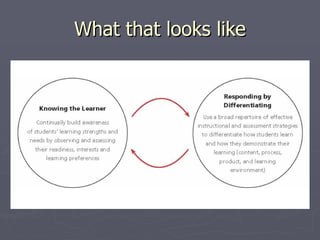
What that looks like
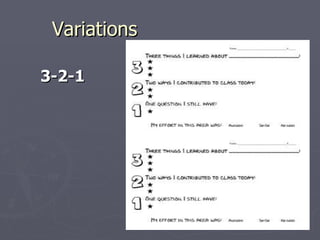
Variations 3-2-1
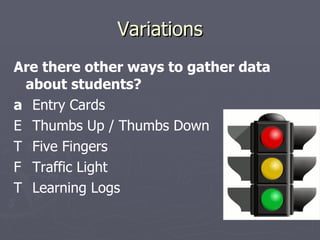
Variations Are there other ways to gather data about students?   Entry Cards   Thumbs Up / Thumbs Down   Five Fingers   Traffic Light   Learning Logs

Exit tickets, a tool for accountable learning

  • 1.
    Exit tickets Atool for formative assessment
  • 2.
    Training opportunities 1. Google Website creation training and docs (2) 2. AERIES new features training (4) 3. Xerox copier training (3) 4. Marzano vocabulary training (1) Science Course level entrance proficiency exams Revised syllabi submission via Google docs Science Course level challenge exams (finals)
  • 3.
    Not a newidea, but yields many dividends Description (brief) Assessment for Learning Time saver? Differentiated instruction Instruction linked to participation Variations
  • 4.
    Assessment for LearningWhen we gather data from students about their progress and then act on that data by adjusting what we are teaching or how we teach it, this is what is known as: Assessment for learning Often a formal evaluation is too late to measure the effectiveness of your teaching. Quizzes are useful here but is more of a ‘passive’ assessment for students. There is a need for a more responsive assessment tool that makes the student more accountable.
  • 5.
    Explaining Exit Cardsto students… For students to ‘buy in’ they need to feel comfortable with this classroom practice. Students need to know what the exit cards are being used for. Let them know that you want to know how well they understand what is being taught or difficulties they may be having so you can plan to help them . (Not always graded.) You can announce a scored exit ticket, or a non-scored ticket. The more non-scored ticket, the more honest answers you will get.
  • 6.
    Time sink, ortime saver? Teacher time: In other words, the teacher takes a look at the exit cards, which only takes a few minutes to do. The teacher will then be given a clearer indication of what the students know or don’t know, or their feelings or opinions about a topic, and the teacher can then move forward with a degree of confidence that s/he is giving students what they need .
  • 7.
    Time out ofthe lesson? How long do Exit Tickets take? As little as 1 to 2 minutes up to 10 or 15 minutes , depending on the question the teacher asks. Again, the student is responsible for summarizing the purpose/objective of the lesson (active learning, and higher order thinking skills). Teacher’s call if you want a simple check for understanding.
  • 8.
    EL, RSP, 504s…better assessing and meeting their needs “ Teachers assess the responses on the exit cards in order to provide differentiated instruction to meet the diverse needs of learners in the classroom.”
  • 9.
    Exit tickets inresponse to differentiated instruction If a teacher has many examples of students’ work (exit tickets): Support for recommendations to the RSP case provider on the teacher comments observations form . EL students can be better assessed and instruction scaffolded before assessment.
  • 10.
  • 11.
  • 12.
    Variations Are thereother ways to gather data about students?  Entry Cards  Thumbs Up / Thumbs Down  Five Fingers  Traffic Light  Learning Logs