FROM BS ENVIRONMENTAL SCIENCE
IV YEAR VIII SEMESTER
COURSE TITLE , MARINE POLLUTION
CONTROL
BY SIR WAQAR AHMED
EZAAN NASEEM
SANA QAYYUM
Definition
‘’Study of history and structure of ocean floor
Involves the geophysical, geo-chemicals , sedimentological and paleontological investigation of
ocean floor coastal zone’’
MARINE GEOLOGY
Ocean floor
• This lesson is all about the ocean floor. Just what is the ocean floor? The ocean floor is literally the floor of the ocean. It is the
bottom of the ocean when you dive. Not too many people have gone to the floor of the ocean as it requires special diving
equipment since the water pressure is very high the farther down you go. You can't be without protective equipment when you
are down that deep. The pressure of the water would crush you.
• Scientists are using various other techniques such as radar to explore the ocean floor. According to Scientific American, the ocean
floor has been mapped to a resolution of 5 kilometers as of 2014. This means that anything larger than 5 kilometers (3.1 miles)
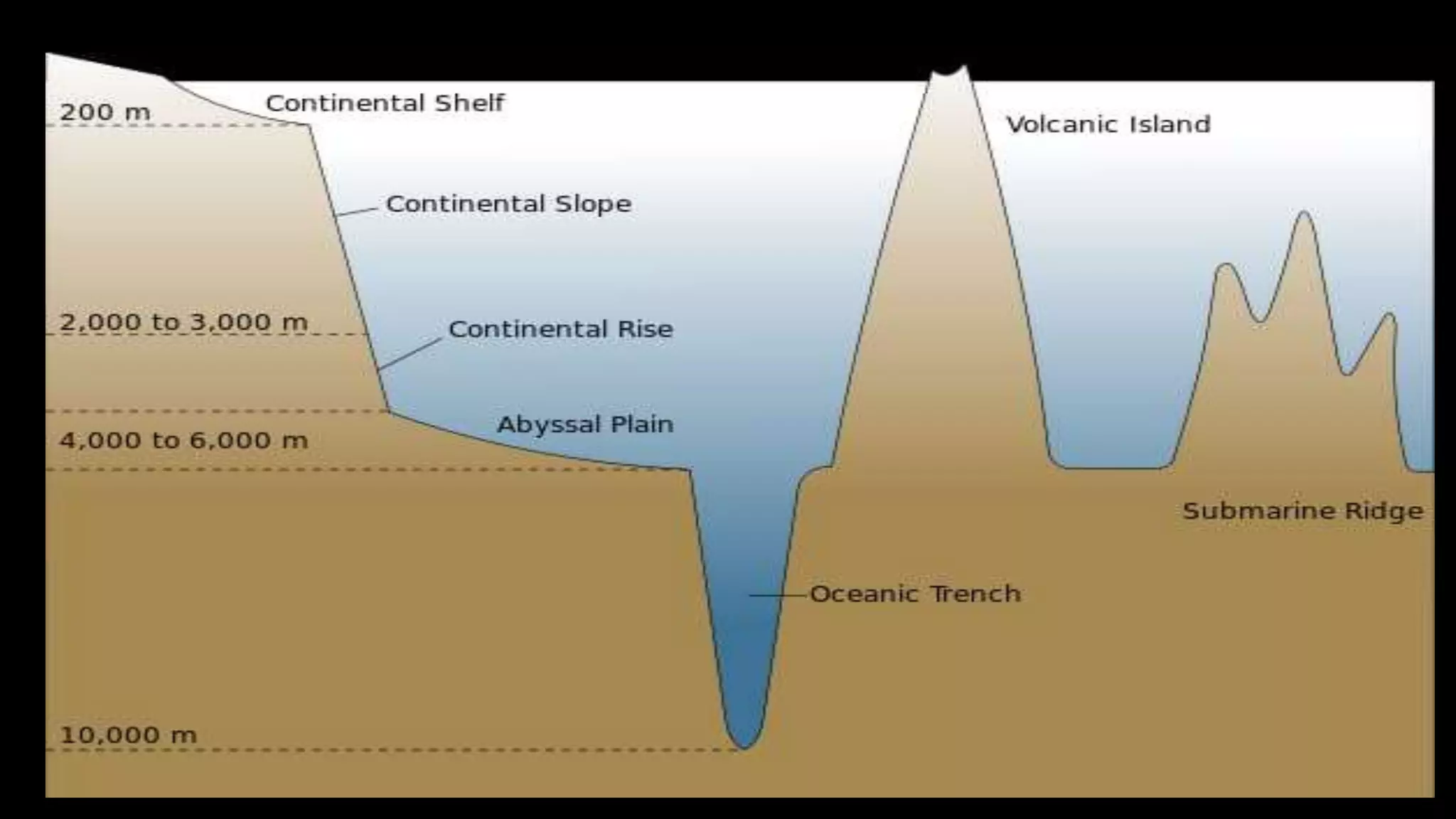
can be seen. From this mapping, you'd be able to see the canyons, abysses, and slopes of the ocean floor.
Physical Features Of The Ocean Floor
The ocean floor is not a flat, featureless surface.
• Plate tectonic theory is useful in understanding many features of the ocean floor.
• The Atlantic and Pacific Ocean floors are very different in terms of size and features.
• The features one would encounter crossing the Atlantic Ocean floor.
• Technology and science are fundamentally intertwined in our efforts to understand the world's
oceans.
Life On Ocean Floor
Unlike what you see on land, most of the ocean floor is lifeless. When you go deep enough
on the ocean floor, sunlight stops penetrating, so there isn't much life in these dark waters.
Closer to shore, you'll find corral forests on the ocean floor that are home to a myriad of
sea creatures from little clownfish to sea urchins. In other parts of the ocean floor, you'll
find king crabs and flounders. In still other parts of the ocean, you'll find mussels and
clams with pearls inside them.
Landscape Of The Ocean Floor
•These canyons, abysses, and slopes make up the landscape of the ocean
floor. This landscape is pretty unique. For example, above water, you have
the Grand Canyon that anybody can climb down into. Underwater, on the
ocean floor, you have abysses that are so deep that only one submersible,
the Deepsea Challenger, is capable of reaching the bottom.
Origin and development Of The Ocean Floor
Morphology andcharacteristic Of The Ocean Floor
• Plate tectonics and the ocean floor
• The shape of the ocean floor, its bathymetry, is largely a result of a process called plate tectonics.
The outer rocky layer of the Earth includes about a dozen large sections called tectonic plates
• Many ocean floor features are a result of the interactions that occur at the edges of these plates
• Marine life and exploration on the ocean floor
• Over the last decade, more than 1500 new species have been discovered in the ocean by marine
biologists and other ocean scientists
•Deepest known underwater volcanic
eruption
• Most of the world’s volcanic activity actually takes place in the ocean, but
most of it goes undetected and unseen.
•First marine national monument
created in Atlantic
• The features in the Northeast Canyons and Seamounts Marine National
Monument were formed millions of years ago by extinct volcanoes and
sediment erosion.
Marine Geologist’s Function
• Study the natural processes that occur on ocean beach and floor
• Collect the sample of sediment and rocks for analyze in laboratory to find their ages
• Typically Specialize in one or more the area of marine geology such as sedimentology
,geochemistry and minerology among many other subfield.
• Conduct lab reseach,computer and field to Learn about earth and ocean.
• In lab try to determine the chemicall composition and ages of sample.
Some Facts About Ocean Floor
THE OCEAN
FLOOR
COVERS
70% OF
THE
EARTH’S
SURFACE.
THE AVERAGE
DEPTH OF THE
OCEAN IS
AROUND 14000
FEET, WHICH IS
EQUAL TO THE
STATUE OF
LIBERTY
STACKED ONE
TOP OF ITSELF
FORTY-SEVEN
TIMES
IF MOUNT EVEREST
WAS PLACED IN THE
DEEPEST PART OF
OCEAN, ITS PEAK
WOULD BE
BY OVER 7000 FEET
OF SEAWATER.
CALLED THE
CHALLENGER DEEP,
IS APPROXIMATELY
36,200 FEET DEEP
AND IS LOCATED IN
THE SOUTHERN
OF THE MARIANA
TRENCH
WE HAVE
BETTER MAPS
OF MARS THAN
WE DO OF THE
OCEAN FLOOR.
ALTHOUGH THE
OCEAN
OVER 70
PERCENT OF
THE EARTH’S
SURFACE, WE
HAVE ONLY
EXPLORED A
MISERLY 5
IT SNOWS UNDERWATER. IN
THE DEEPEST OCEAN, LIGHT
DOESN’T REACH THE
SEAFLOOR, AND
PHOTOSYNTHESIS IS
IMPOSSIBLE. ALL
AND ENERGY COME FROM
PRIMARY PRODUCERS IN
UPPER WATER COLUMN.
WHEN THESE PRIMARY
PRODUCERS AND OTHER
ORGANISMS DIE, THEY
DOWN TO THE OCEAN
IN WHAT IS KNOWN AS
MARINE SNOW[SC:4].
If we could mine all of the
gold from the ocean floor,
we would have enough to
give every person on earth
nine pounds!
Unfortunately, there are no
cost-effective ways to
extract it yet
The largest ocean
basin on earth, the
Pacific Ocean Basin,
is large enough to
hold every continent
on earth[
One of the biggest problems facing
underwater explorers is the
pressure, which increases by one
atmosphere for every 33 feet you go
below the surface. That means that
in the Challenger Deep, the
pressure is approximately 1100
times surface pressure
Underwater kelp
forests are an
amazing feature of
certain oceans.
Hawaii was formed
by huge underwater
volcanoes located on
the ocean floor.
Many animals
which live on the
ocean floor are red.
Red light is completely
absorbed within the first
300 feet of water, meaning
that anything the color red
will appear black or grey.
This is an excellent form of
camouflage
Exploration Of Ocean Floor
• The ocean floor has the same general character as the land areas of the world: mountains, plains, channels,
canyons, exposed rocks, and sediment-covered areas. The lack of weathering and erosion in most areas, however,
allows geological processes to be seen more clearly on the seafloor than on land.
• Because electromagnetic radiation cannot penetrate any significant distance into the sea, the oceanographer uses
acoustic signals, explosives, and earthquakes, as well as gravity and magnetic fields, to probe the seafloor and the
structure beneath
• Various kinds of equipment are used to obtain samples from the seafloor. These include grabbing devices,
dredges, and coring devices
Marine geology

Marine geology

  • 2.
    FROM BS ENVIRONMENTALSCIENCE IV YEAR VIII SEMESTER COURSE TITLE , MARINE POLLUTION CONTROL BY SIR WAQAR AHMED EZAAN NASEEM SANA QAYYUM
  • 3.
    Definition ‘’Study of historyand structure of ocean floor Involves the geophysical, geo-chemicals , sedimentological and paleontological investigation of ocean floor coastal zone’’ MARINE GEOLOGY
  • 4.
    Ocean floor • Thislesson is all about the ocean floor. Just what is the ocean floor? The ocean floor is literally the floor of the ocean. It is the bottom of the ocean when you dive. Not too many people have gone to the floor of the ocean as it requires special diving equipment since the water pressure is very high the farther down you go. You can't be without protective equipment when you are down that deep. The pressure of the water would crush you. • Scientists are using various other techniques such as radar to explore the ocean floor. According to Scientific American, the ocean floor has been mapped to a resolution of 5 kilometers as of 2014. This means that anything larger than 5 kilometers (3.1 miles) can be seen. From this mapping, you'd be able to see the canyons, abysses, and slopes of the ocean floor.
  • 6.
    Physical Features OfThe Ocean Floor The ocean floor is not a flat, featureless surface. • Plate tectonic theory is useful in understanding many features of the ocean floor. • The Atlantic and Pacific Ocean floors are very different in terms of size and features. • The features one would encounter crossing the Atlantic Ocean floor. • Technology and science are fundamentally intertwined in our efforts to understand the world's oceans.
  • 9.
    Life On OceanFloor Unlike what you see on land, most of the ocean floor is lifeless. When you go deep enough on the ocean floor, sunlight stops penetrating, so there isn't much life in these dark waters. Closer to shore, you'll find corral forests on the ocean floor that are home to a myriad of sea creatures from little clownfish to sea urchins. In other parts of the ocean floor, you'll find king crabs and flounders. In still other parts of the ocean, you'll find mussels and clams with pearls inside them.
  • 10.
    Landscape Of TheOcean Floor •These canyons, abysses, and slopes make up the landscape of the ocean floor. This landscape is pretty unique. For example, above water, you have the Grand Canyon that anybody can climb down into. Underwater, on the ocean floor, you have abysses that are so deep that only one submersible, the Deepsea Challenger, is capable of reaching the bottom.
  • 11.
    Origin and developmentOf The Ocean Floor
  • 13.
    Morphology andcharacteristic OfThe Ocean Floor • Plate tectonics and the ocean floor • The shape of the ocean floor, its bathymetry, is largely a result of a process called plate tectonics. The outer rocky layer of the Earth includes about a dozen large sections called tectonic plates • Many ocean floor features are a result of the interactions that occur at the edges of these plates • Marine life and exploration on the ocean floor • Over the last decade, more than 1500 new species have been discovered in the ocean by marine biologists and other ocean scientists
  • 14.
    •Deepest known underwatervolcanic eruption • Most of the world’s volcanic activity actually takes place in the ocean, but most of it goes undetected and unseen. •First marine national monument created in Atlantic • The features in the Northeast Canyons and Seamounts Marine National Monument were formed millions of years ago by extinct volcanoes and sediment erosion.
  • 16.
    Marine Geologist’s Function •Study the natural processes that occur on ocean beach and floor • Collect the sample of sediment and rocks for analyze in laboratory to find their ages • Typically Specialize in one or more the area of marine geology such as sedimentology ,geochemistry and minerology among many other subfield. • Conduct lab reseach,computer and field to Learn about earth and ocean. • In lab try to determine the chemicall composition and ages of sample.
  • 17.
    Some Facts AboutOcean Floor THE OCEAN FLOOR COVERS 70% OF THE EARTH’S SURFACE. THE AVERAGE DEPTH OF THE OCEAN IS AROUND 14000 FEET, WHICH IS EQUAL TO THE STATUE OF LIBERTY STACKED ONE TOP OF ITSELF FORTY-SEVEN TIMES IF MOUNT EVEREST WAS PLACED IN THE DEEPEST PART OF OCEAN, ITS PEAK WOULD BE BY OVER 7000 FEET OF SEAWATER. CALLED THE CHALLENGER DEEP, IS APPROXIMATELY 36,200 FEET DEEP AND IS LOCATED IN THE SOUTHERN OF THE MARIANA TRENCH WE HAVE BETTER MAPS OF MARS THAN WE DO OF THE OCEAN FLOOR. ALTHOUGH THE OCEAN OVER 70 PERCENT OF THE EARTH’S SURFACE, WE HAVE ONLY EXPLORED A MISERLY 5 IT SNOWS UNDERWATER. IN THE DEEPEST OCEAN, LIGHT DOESN’T REACH THE SEAFLOOR, AND PHOTOSYNTHESIS IS IMPOSSIBLE. ALL AND ENERGY COME FROM PRIMARY PRODUCERS IN UPPER WATER COLUMN. WHEN THESE PRIMARY PRODUCERS AND OTHER ORGANISMS DIE, THEY DOWN TO THE OCEAN IN WHAT IS KNOWN AS MARINE SNOW[SC:4].
  • 18.
    If we couldmine all of the gold from the ocean floor, we would have enough to give every person on earth nine pounds! Unfortunately, there are no cost-effective ways to extract it yet The largest ocean basin on earth, the Pacific Ocean Basin, is large enough to hold every continent on earth[ One of the biggest problems facing underwater explorers is the pressure, which increases by one atmosphere for every 33 feet you go below the surface. That means that in the Challenger Deep, the pressure is approximately 1100 times surface pressure Underwater kelp forests are an amazing feature of certain oceans. Hawaii was formed by huge underwater volcanoes located on the ocean floor. Many animals which live on the ocean floor are red. Red light is completely absorbed within the first 300 feet of water, meaning that anything the color red will appear black or grey. This is an excellent form of camouflage
  • 19.
    Exploration Of OceanFloor • The ocean floor has the same general character as the land areas of the world: mountains, plains, channels, canyons, exposed rocks, and sediment-covered areas. The lack of weathering and erosion in most areas, however, allows geological processes to be seen more clearly on the seafloor than on land. • Because electromagnetic radiation cannot penetrate any significant distance into the sea, the oceanographer uses acoustic signals, explosives, and earthquakes, as well as gravity and magnetic fields, to probe the seafloor and the structure beneath • Various kinds of equipment are used to obtain samples from the seafloor. These include grabbing devices, dredges, and coring devices