CHAPTER 2
UNDERSEA LANDSCAPES
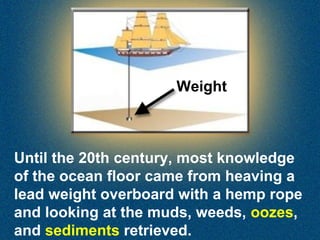
Weight

Until the 20th century, most knowledge
of the ocean floor came from heaving a
lead weight overboard with a hemp rope
and looking at the muds, weeds, oozes,
and sediments retrieved.
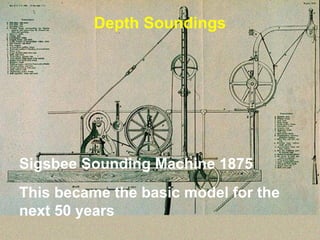
Depth Soundings

Sigsbee Sounding Machine 1875
This became the basic model for the
next 50 years
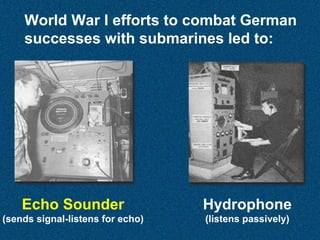
World War I efforts to combat German
successes with submarines led to:

Echo Sounder

Hydrophone

(sends signal-listens for echo)

(listens passively)
Echo Sounder
A device for measuring depth of
water by sending sound waves
down from the surface and recording
the time until the echo returns from
the bottom
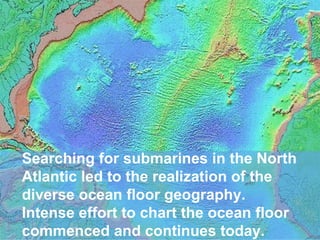
Searching for submarines in the North
Atlantic led to the realization of the
diverse ocean floor geography.
Intense effort to chart the ocean floor
commenced and continues today.
Relief (of the Earth)

The differences in elevation and
slope between the higher and
lower parts of the land surface of
a given area
Topography
Graphic representation on a map
of the surface features of a place
or region, indicating their relative
positions and elevations
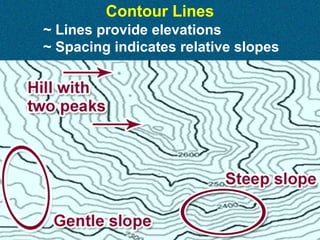
Contour Lines
~ Lines provide elevations
~ Spacing indicates relative slopes
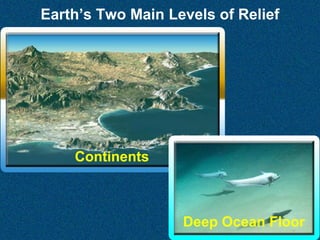
Earth’s Two Main Levels of Relief

Continents

Deep Ocean Floor
DEEP OCEAN FLOOR
Also known as:
~ Deep sea
~ Deep ocean basin
~ Abyss
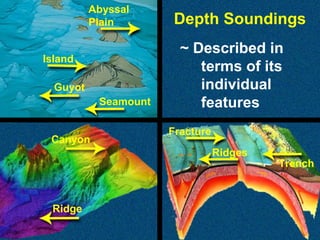
Abyssal
Plain
Island
Guyot
Seamount
Canyon

Depth Soundings
~ Described in
terms of its
individual
features
Fracture
Ridges

Ridge

Trench
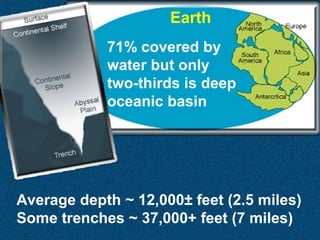
Earth
71% covered by
water but only
two-thirds is deep
oceanic basin

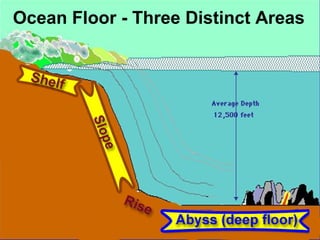
Average depth ~ 12,000± feet (2.5 miles)
Some trenches ~ 37,000+ feet (7 miles)
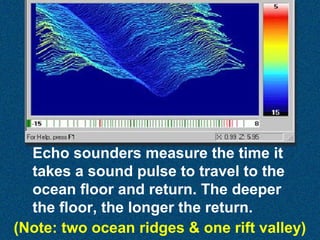
Echo sounders measure the time it
takes a sound pulse to travel to the
ocean floor and return. The deeper
the floor, the longer the return.
(Note: two ocean ridges & one rift valley)
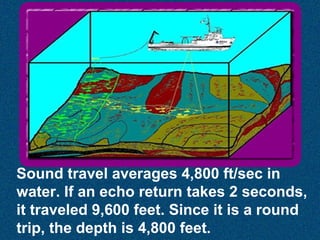
Sound travel averages 4,800 ft/sec in
water. If an echo return takes 2 seconds,
it traveled 9,600 feet. Since it is a round
trip, the depth is 4,800 feet.
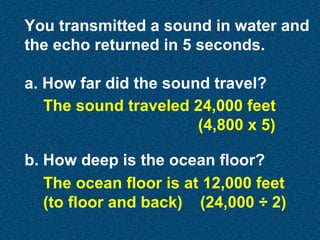
You transmitted a sound in water and
the echo returned in 5 seconds.
a. How far did the sound travel?

b. How deep is the ocean floor?
You transmitted a sound in water and
the echo returned in 5 seconds.
a. How far did the sound travel?
The sound traveled 24,000 feet
(4,800 x 5)
b. How deep is the ocean floor?
The ocean floor is at 12,000 feet
(to floor and back) (24,000 ÷ 2)
Ocean Floor - Three Distinct Areas
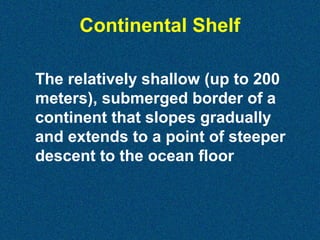
Continental Shelf
The relatively shallow (up to 200
meters), submerged border of a
continent that slopes gradually
and extends to a point of steeper
descent to the ocean floor
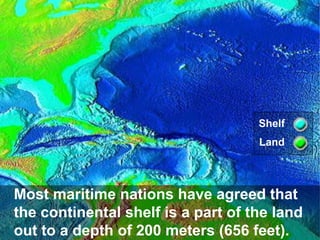
Shelf
Land

Most maritime nations have agreed that
the continental shelf is a part of the land
out to a depth of 200 meters (656 feet).
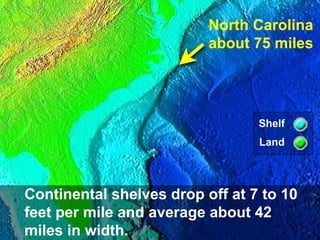
North Carolina
about 75 miles

Shelf
Land

Continental shelves drop off at 7 to 10
feet per mile and average about 42
miles in width.
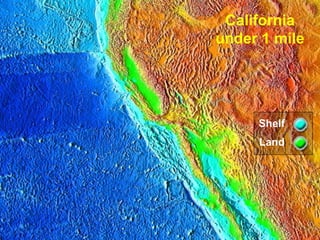
California
under 1 mile

Shelf
Land
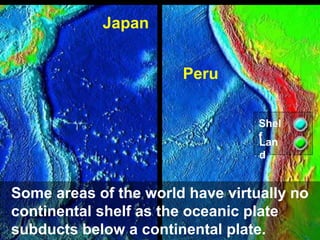
Japan
Peru
Shel
f
Lan
d

Some areas of the world have virtually no
continental shelf as the oceanic plate
subducts below a continental plate.
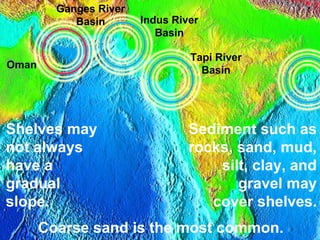
Ganges River
Basin

Indus River
Basin

Oman

Tapi River
Basin

Shelves may
not always
have a
gradual
slope.

Sediment such as
rocks, sand, mud,
silt, clay, and
gravel may
cover shelves.

Coarse sand is the most common.
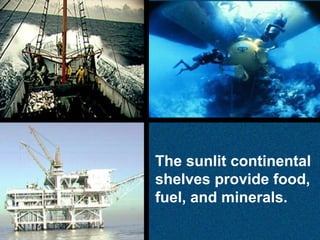
The sunlit continental
shelves provide food,
fuel, and minerals.
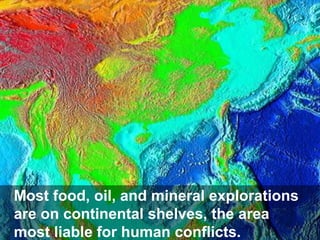
Most food, oil, and mineral explorations
are on continental shelves, the area
most liable for human conflicts.
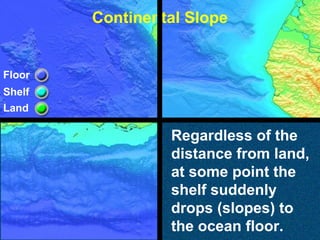
Continental Slope

Floor
Shelf
Land

Regardless of the
distance from land,
at some point the
shelf suddenly
drops (slopes) to
the ocean floor.
Continental Slope
The steep descent of the seabed
from the continental shelf to the
abyssal zone
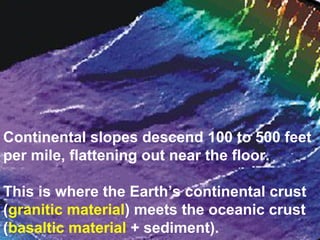
Continental slopes descend 100 to 500 feet
per mile, flattening out near the floor.
This is where the Earth’s continental crust
(granitic material) meets the oceanic crust
(basaltic material + sediment).
Granitic Rock:
~hard, speckled whitish or gray color
~rough appearance
~magma cooled slowly under the
Earth’s surface (intrusive)
~most common rock exposed on surface

Basaltic Rock:
~hard, dark color
~smooth to glassy appearance
~lava cooled rapidly above the
Earth’s surface (extrusive)
~most common rock on Earth’s crust,
covering the oceanic crust’s floor
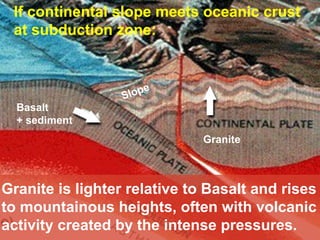
If continental slope meets oceanic crust
at subduction zone:

Basalt
+ sediment

e
lop
S

Granite

Granite is lighter relative to Basalt and rises
to mountainous heights, often with volcanic
activity created by the intense pressures.
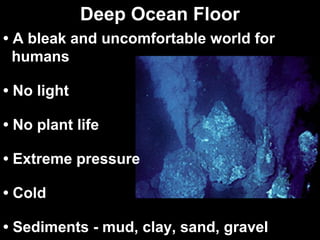
Deep Ocean Floor
• A bleak and uncomfortable world for
humans
• No light
• No plant life
• Extreme pressure
• Cold
• Sediments - mud, clay, sand, gravel
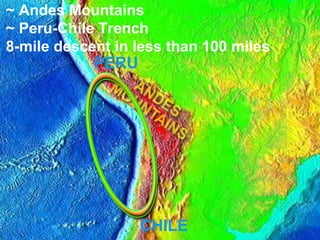
~ Andes Mountains
~ Peru-Chile Trench
8-mile descent in less than 100 miles

PERU

CHILE
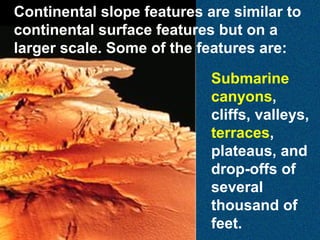
Continental slope features are similar to
continental surface features but on a
larger scale. Some of the features are:
Submarine
canyons,
cliffs, valleys,
terraces,
plateaus, and
drop-offs of
several
thousand of
feet.
Submarine Canyon
A deep underwater valley with
steep sides
Terrace
A nearly level strip of land with a more
or less abrupt descent along the
margin of the sea, a lake, or a river
Continental Slopes

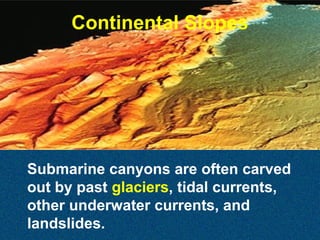
Submarine canyons are often carved
out by past glaciers, tidal currents,
other underwater currents, and
landslides.
Continental Slopes

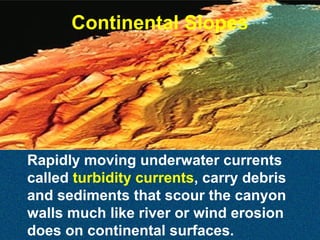
Rapidly moving underwater currents
called turbidity currents, carry debris
and sediments that scour the canyon
walls much like river or wind erosion
does on continental surfaces.
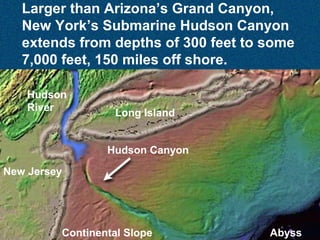
Larger than Arizona’s Grand Canyon,
New York’s Submarine Hudson Canyon
extends from depths of 300 feet to some
7,000 feet, 150 miles off shore.
Hudson
River

Long Island
Hudson Canyon

New Jersey

Continental Slope

Abyss
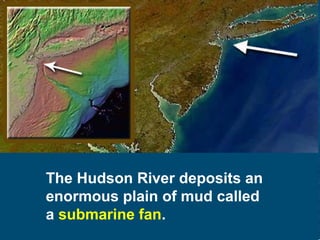
The Hudson River deposits an
enormous plain of mud called
a submarine fan.
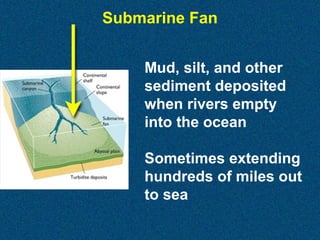
Submarine Fan
Mud, silt, and other
sediment deposited
when rivers empty
into the ocean
Sometimes extending
hundreds of miles out
to sea
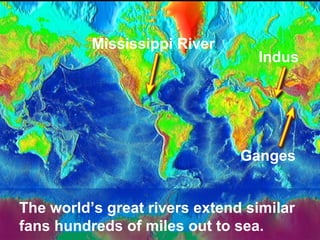
Mississippi River

Indus

Ganges
The world’s great rivers extend similar
fans hundreds of miles out to sea.
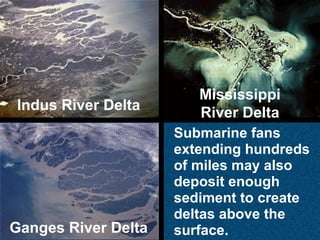
Indus River Delta

Ganges River Delta

Mississippi
River Delta
Submarine fans
extending hundreds
of miles may also
deposit enough
sediment to create
deltas above the
surface.
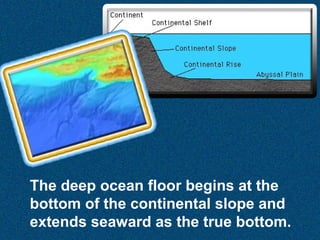
The deep ocean floor begins at the
bottom of the continental slope and
extends seaward as the true bottom.
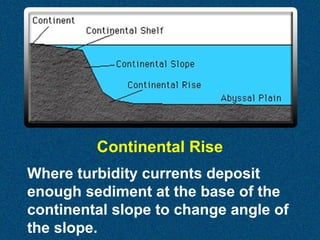
Continental Rise
Where turbidity currents deposit
enough sediment at the base of the
continental slope to change angle of
the slope.
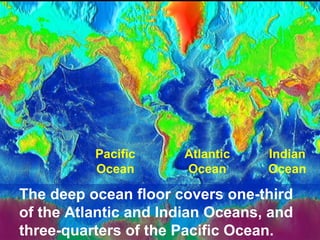
Pacific
Ocean

Atlantic
Ocean

Indian
Ocean

The deep ocean floor covers one-third
of the Atlantic and Indian Oceans, and
three-quarters of the Pacific Ocean.
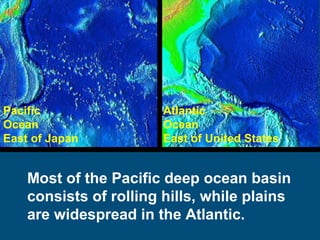
Pacific
Ocean
East of Japan

Atlantic
Ocean
East of United States

Most of the Pacific deep ocean basin
consists of rolling hills, while plains
are widespread in the Atlantic.
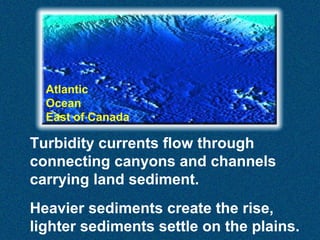
Atlantic
Ocean
East of Canada

Turbidity currents flow through
connecting canyons and channels
carrying land sediment.
Heavier sediments create the rise,
lighter sediments settle on the plains.
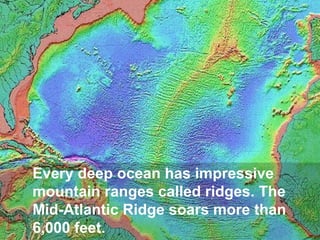
Every deep ocean has impressive
mountain ranges called ridges. The
Mid-Atlantic Ridge soars more than
6,000 feet.
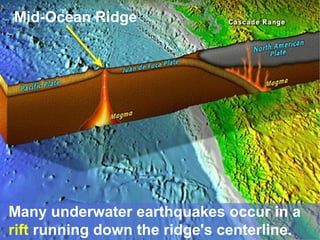
Mid-Ocean Ridge

Many underwater earthquakes occur in a
rift running down the ridge's centerline.
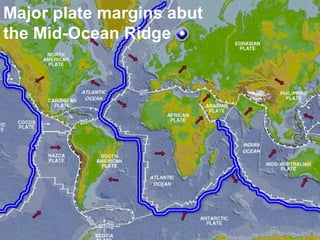
Major plate margins abut
the Mid-Ocean Ridge
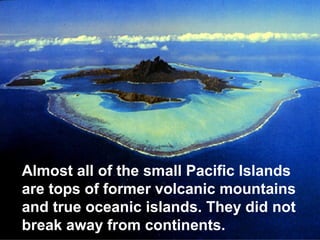
Almost all of the small Pacific Islands
are tops of former volcanic mountains
and true oceanic islands. They did not
break away from continents.
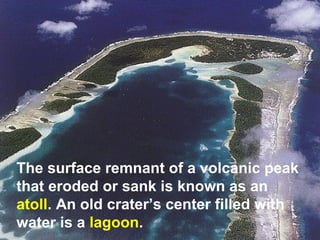
The surface remnant of a volcanic peak
that eroded or sank is known as an
atoll. An old crater’s center filled with
water is a lagoon.
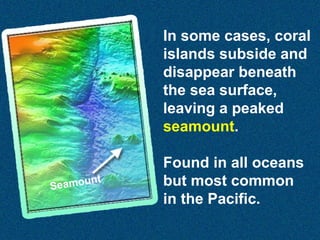
In some cases, coral
islands subside and
disappear beneath
the sea surface,
leaving a peaked
seamount.

t
amoun
Se

Found in all oceans
but most common
in the Pacific.
Seamount
An underwater mountain rising
from the ocean floor and having
a flat topped or peaked summit
below the surface of the sea
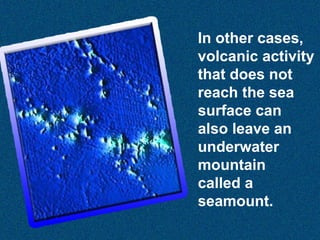
In other cases,
volcanic activity
that does not
reach the sea
surface can
also leave an
underwater
mountain
called a
seamount.
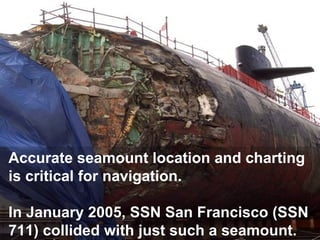
Accurate seamount location and charting
is critical for navigation.
In January 2005, SSN San Francisco (SSN
711) collided with just such a seamount.
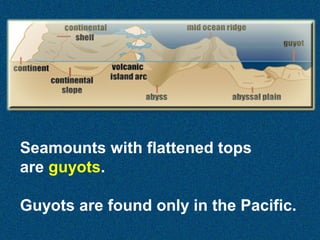
Seamounts with flattened tops
are guyots.
Guyots are found only in the Pacific.
Guyot
A flat topped seamount
Guyots show evidence of having
been above the surface, worn by
ocean waves, and gradually
subsiding under their own weight
as the sea rose.
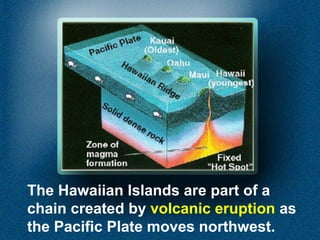
The Hawaiian Islands are part of a
chain created by volcanic eruption as
the Pacific Plate moves northwest.
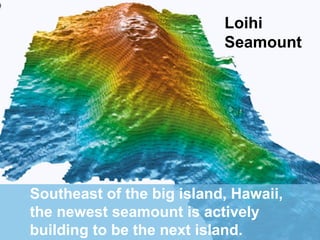
Loihi
Seamount

Southeast of the big island, Hawaii,
the newest seamount is actively
building to be the next island.
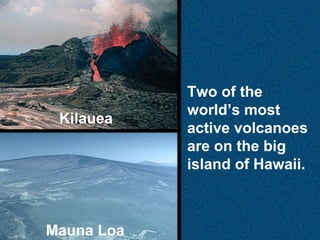
Kilauea

Mauna Loa

Two of the
world’s most
active volcanoes
are on the big
island of Hawaii.
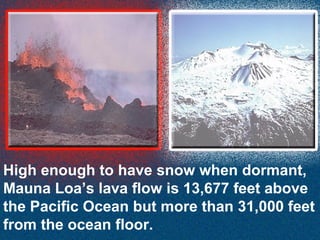
High enough to have snow when dormant,
Mauna Loa’s lava flow is 13,677 feet above
the Pacific Ocean but more than 31,000 feet
from the ocean floor.
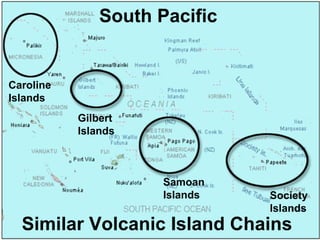
South Pacific

Caroline
Islands
Gilbert
Islands

Samoan
Islands

Society
Islands

Similar Volcanic Island Chains
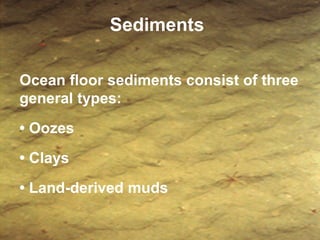
Sediments
Ocean floor sediments consist of three
general types:
• Oozes
• Clays
• Land-derived muds
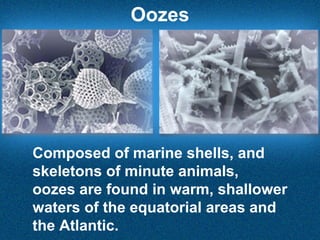
Oozes

Composed of marine shells, and
skeletons of minute animals,
oozes are found in warm, shallower
waters of the equatorial areas and
the Atlantic.
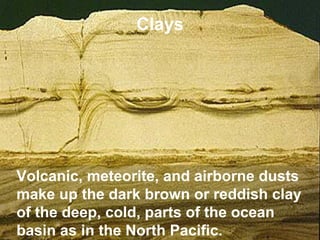
Clays

Volcanic, meteorite, and airborne dusts
make up the dark brown or reddish clay
of the deep, cold, parts of the ocean
basin as in the North Pacific.
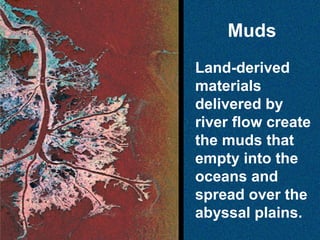
Muds
Land-derived
materials
delivered by
river flow create
the muds that
empty into the
oceans and
spread over the
abyssal plains.
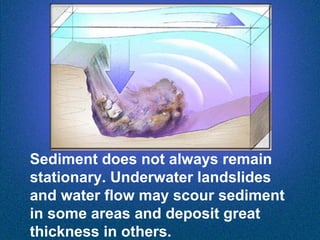
Sediment does not always remain
stationary. Underwater landslides
and water flow may scour sediment
in some areas and deposit great
thickness in others.
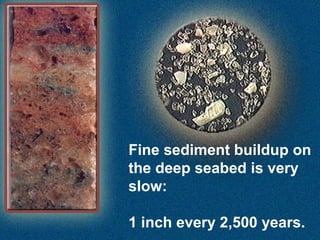
Fine sediment buildup on
the deep seabed is very
slow:
1 inch every 2,500 years.
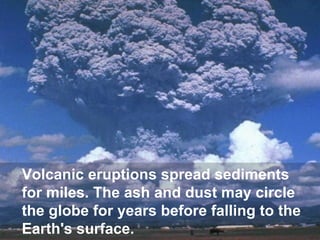
Volcanic eruptions spread sediments
for miles. The ash and dust may circle
the globe for years before falling to the
Earth's surface.
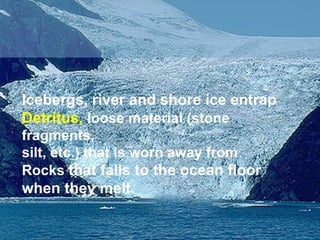
Icebergs, river and shore ice entrap
Detritus, loose material (stone
fragments,
silt, etc.) that is worn away from
Rocks that falls to the ocean floor

when they melt.
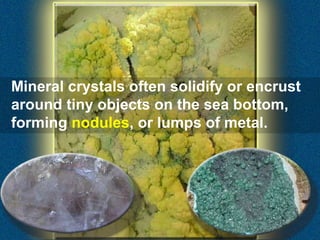
Mineral crystals often solidify or encrust
around tiny objects on the sea bottom,
forming nodules, or lumps of metal.
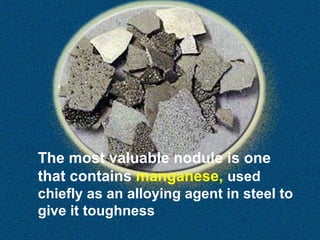
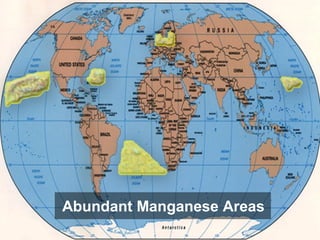
The most valuable nodule is one
that contains manganese, used
chiefly as an alloying agent in steel to
give it toughness
Manganese
A grayish white, usually hard
and brittle, metallic element that
resembles iron but is not magnetic
A valuable oxidizing agent
Used chiefly as an alloying agent
in steel to give it toughness
Abundant Manganese Areas
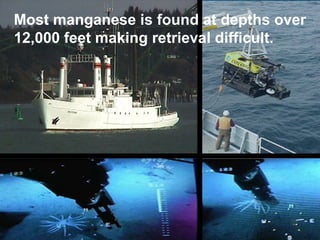
Most manganese is found at depths over
12,000 feet making retrieval difficult.
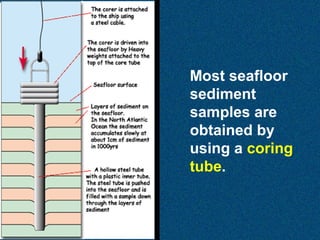
Most seafloor
sediment
samples are
obtained by
using a coring
tube.
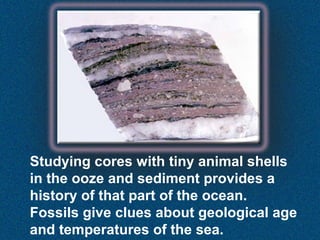
Studying cores with tiny animal shells
in the ooze and sediment provides a
history of that part of the ocean.
Fossils give clues about geological age
and temperatures of the sea.
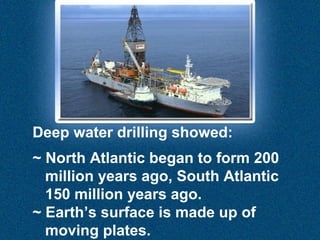
Deep water drilling showed:
~ North Atlantic began to form 200
million years ago, South Atlantic
150 million years ago.
~ Earth’s surface is made up of
moving plates.
Q.1. Who invented the hydrophone?
A.1. A team of U.S. Navy scientists
Q.2. What is the purpose of a relief
map of the Earth’s surface?
A.2. To show elevations of the
Earth’s surface by using colors
or numbers
Q.3. The average width of the
continental shelves is about
how many miles from the shore
line?
A.3. 42 miles
Q.4. What is the average depth of
the ocean?
A.4. 2.5 miles deep
Q.5. In what part of the ocean would
you find sea vegetation?
A.5. The continental shelf
Q.6. What are ocean ridges?
A.6. Ocean ridges are enormous
mountain ranges running along
the center of the ocean floor.
Q.7. The enormous cracks that are
found in the ocean are referred
to as what?
A.7. Rifts
Q.8. What is the drop rate of the
continental slope?
A.8. 100 to 500 feet per mile
Q.9. What type of materials makeup
the ocean floor?
A.9. Oozes, clay, and land-derived
muds
Q.10. What are the three (3) areas
the ocean floor is divided into?
A.10. The continental shelf,
continental slope, and deep
ocean basin
Q.11. What is the deep ocean floor
sometimes referred to?
A.11. The abyss
Q.12. What is a submarine fan?
A.12. The delta of a large river in
which an enormous plain of
mud can be deposited
hundreds of miles out to sea
Q.13. How were most of the Pacific
islands formed?
A.13. Through volcanic eruption
Q.14. What is a guyot, and how is it
formed?
A.14. A flat-topped undersea
mountain believed to have
formed from repeated volcanic
eruptions

Upload undersea landscapes

  • 1.
  • 2.
    Weight Until the 20thcentury, most knowledge of the ocean floor came from heaving a lead weight overboard with a hemp rope and looking at the muds, weeds, oozes, and sediments retrieved.
  • 3.
    Depth Soundings Sigsbee SoundingMachine 1875 This became the basic model for the next 50 years
  • 4.
    World War Iefforts to combat German successes with submarines led to: Echo Sounder Hydrophone (sends signal-listens for echo) (listens passively)
  • 5.
    Echo Sounder A devicefor measuring depth of water by sending sound waves down from the surface and recording the time until the echo returns from the bottom
  • 6.
    Searching for submarinesin the North Atlantic led to the realization of the diverse ocean floor geography. Intense effort to chart the ocean floor commenced and continues today.
  • 7.
    Relief (of theEarth) The differences in elevation and slope between the higher and lower parts of the land surface of a given area
  • 8.
    Topography Graphic representation ona map of the surface features of a place or region, indicating their relative positions and elevations
  • 9.
    Contour Lines ~ Linesprovide elevations ~ Spacing indicates relative slopes
  • 10.
    Earth’s Two MainLevels of Relief Continents Deep Ocean Floor
  • 11.
    DEEP OCEAN FLOOR Alsoknown as: ~ Deep sea ~ Deep ocean basin ~ Abyss
  • 12.
    Abyssal Plain Island Guyot Seamount Canyon Depth Soundings ~ Describedin terms of its individual features Fracture Ridges Ridge Trench
  • 13.
    Earth 71% covered by waterbut only two-thirds is deep oceanic basin Average depth ~ 12,000± feet (2.5 miles) Some trenches ~ 37,000+ feet (7 miles)
  • 14.
    Echo sounders measurethe time it takes a sound pulse to travel to the ocean floor and return. The deeper the floor, the longer the return. (Note: two ocean ridges & one rift valley)
  • 15.
    Sound travel averages4,800 ft/sec in water. If an echo return takes 2 seconds, it traveled 9,600 feet. Since it is a round trip, the depth is 4,800 feet.
  • 16.
    You transmitted asound in water and the echo returned in 5 seconds. a. How far did the sound travel? b. How deep is the ocean floor?
  • 17.
    You transmitted asound in water and the echo returned in 5 seconds. a. How far did the sound travel? The sound traveled 24,000 feet (4,800 x 5) b. How deep is the ocean floor? The ocean floor is at 12,000 feet (to floor and back) (24,000 ÷ 2)
  • 18.
    Ocean Floor -Three Distinct Areas
  • 19.
    Continental Shelf The relativelyshallow (up to 200 meters), submerged border of a continent that slopes gradually and extends to a point of steeper descent to the ocean floor
  • 20.
    Shelf Land Most maritime nationshave agreed that the continental shelf is a part of the land out to a depth of 200 meters (656 feet).
  • 21.
    North Carolina about 75miles Shelf Land Continental shelves drop off at 7 to 10 feet per mile and average about 42 miles in width.
  • 22.
  • 23.
    Japan Peru Shel f Lan d Some areas ofthe world have virtually no continental shelf as the oceanic plate subducts below a continental plate.
  • 24.
    Ganges River Basin Indus River Basin Oman TapiRiver Basin Shelves may not always have a gradual slope. Sediment such as rocks, sand, mud, silt, clay, and gravel may cover shelves. Coarse sand is the most common.
  • 25.
    The sunlit continental shelvesprovide food, fuel, and minerals.
  • 26.
    Most food, oil,and mineral explorations are on continental shelves, the area most liable for human conflicts.
  • 27.
    Continental Slope Floor Shelf Land Regardless ofthe distance from land, at some point the shelf suddenly drops (slopes) to the ocean floor.
  • 28.
    Continental Slope The steepdescent of the seabed from the continental shelf to the abyssal zone
  • 29.
    Continental slopes descend100 to 500 feet per mile, flattening out near the floor. This is where the Earth’s continental crust (granitic material) meets the oceanic crust (basaltic material + sediment).
  • 30.
    Granitic Rock: ~hard, speckledwhitish or gray color ~rough appearance ~magma cooled slowly under the Earth’s surface (intrusive) ~most common rock exposed on surface Basaltic Rock: ~hard, dark color ~smooth to glassy appearance ~lava cooled rapidly above the Earth’s surface (extrusive) ~most common rock on Earth’s crust, covering the oceanic crust’s floor
  • 31.
    If continental slopemeets oceanic crust at subduction zone: Basalt + sediment e lop S Granite Granite is lighter relative to Basalt and rises to mountainous heights, often with volcanic activity created by the intense pressures.
  • 32.
    Deep Ocean Floor •A bleak and uncomfortable world for humans • No light • No plant life • Extreme pressure • Cold • Sediments - mud, clay, sand, gravel
  • 33.
    ~ Andes Mountains ~Peru-Chile Trench 8-mile descent in less than 100 miles PERU CHILE
  • 34.
    Continental slope featuresare similar to continental surface features but on a larger scale. Some of the features are: Submarine canyons, cliffs, valleys, terraces, plateaus, and drop-offs of several thousand of feet.
  • 35.
    Submarine Canyon A deepunderwater valley with steep sides
  • 36.
    Terrace A nearly levelstrip of land with a more or less abrupt descent along the margin of the sea, a lake, or a river
  • 37.
    Continental Slopes Submarine canyonsare often carved out by past glaciers, tidal currents, other underwater currents, and landslides.
  • 38.
    Continental Slopes Rapidly movingunderwater currents called turbidity currents, carry debris and sediments that scour the canyon walls much like river or wind erosion does on continental surfaces.
  • 39.
    Larger than Arizona’sGrand Canyon, New York’s Submarine Hudson Canyon extends from depths of 300 feet to some 7,000 feet, 150 miles off shore. Hudson River Long Island Hudson Canyon New Jersey Continental Slope Abyss
  • 40.
    The Hudson Riverdeposits an enormous plain of mud called a submarine fan.
  • 41.
    Submarine Fan Mud, silt,and other sediment deposited when rivers empty into the ocean Sometimes extending hundreds of miles out to sea
  • 42.
    Mississippi River Indus Ganges The world’sgreat rivers extend similar fans hundreds of miles out to sea.
  • 43.
    Indus River Delta GangesRiver Delta Mississippi River Delta Submarine fans extending hundreds of miles may also deposit enough sediment to create deltas above the surface.
  • 44.
    The deep oceanfloor begins at the bottom of the continental slope and extends seaward as the true bottom.
  • 45.
    Continental Rise Where turbiditycurrents deposit enough sediment at the base of the continental slope to change angle of the slope.
  • 46.
    Pacific Ocean Atlantic Ocean Indian Ocean The deep oceanfloor covers one-third of the Atlantic and Indian Oceans, and three-quarters of the Pacific Ocean.
  • 47.
    Pacific Ocean East of Japan Atlantic Ocean Eastof United States Most of the Pacific deep ocean basin consists of rolling hills, while plains are widespread in the Atlantic.
  • 48.
    Atlantic Ocean East of Canada Turbiditycurrents flow through connecting canyons and channels carrying land sediment. Heavier sediments create the rise, lighter sediments settle on the plains.
  • 49.
    Every deep oceanhas impressive mountain ranges called ridges. The Mid-Atlantic Ridge soars more than 6,000 feet.
  • 50.
    Mid-Ocean Ridge Many underwaterearthquakes occur in a rift running down the ridge's centerline.
  • 51.
    Major plate marginsabut the Mid-Ocean Ridge
  • 52.
    Almost all ofthe small Pacific Islands are tops of former volcanic mountains and true oceanic islands. They did not break away from continents.
  • 53.
    The surface remnantof a volcanic peak that eroded or sank is known as an atoll. An old crater’s center filled with water is a lagoon.
  • 54.
    In some cases,coral islands subside and disappear beneath the sea surface, leaving a peaked seamount. t amoun Se Found in all oceans but most common in the Pacific.
  • 55.
    Seamount An underwater mountainrising from the ocean floor and having a flat topped or peaked summit below the surface of the sea
  • 56.
    In other cases, volcanicactivity that does not reach the sea surface can also leave an underwater mountain called a seamount.
  • 57.
    Accurate seamount locationand charting is critical for navigation. In January 2005, SSN San Francisco (SSN 711) collided with just such a seamount.
  • 58.
    Seamounts with flattenedtops are guyots. Guyots are found only in the Pacific.
  • 59.
    Guyot A flat toppedseamount Guyots show evidence of having been above the surface, worn by ocean waves, and gradually subsiding under their own weight as the sea rose.
  • 60.
    The Hawaiian Islandsare part of a chain created by volcanic eruption as the Pacific Plate moves northwest.
  • 61.
    Loihi Seamount Southeast of thebig island, Hawaii, the newest seamount is actively building to be the next island.
  • 62.
    Kilauea Mauna Loa Two ofthe world’s most active volcanoes are on the big island of Hawaii.
  • 63.
    High enough tohave snow when dormant, Mauna Loa’s lava flow is 13,677 feet above the Pacific Ocean but more than 31,000 feet from the ocean floor.
  • 64.
  • 65.
    Sediments Ocean floor sedimentsconsist of three general types: • Oozes • Clays • Land-derived muds
  • 66.
    Oozes Composed of marineshells, and skeletons of minute animals, oozes are found in warm, shallower waters of the equatorial areas and the Atlantic.
  • 67.
    Clays Volcanic, meteorite, andairborne dusts make up the dark brown or reddish clay of the deep, cold, parts of the ocean basin as in the North Pacific.
  • 68.
    Muds Land-derived materials delivered by river flowcreate the muds that empty into the oceans and spread over the abyssal plains.
  • 69.
    Sediment does notalways remain stationary. Underwater landslides and water flow may scour sediment in some areas and deposit great thickness in others.
  • 70.
    Fine sediment buildupon the deep seabed is very slow: 1 inch every 2,500 years.
  • 71.
    Volcanic eruptions spreadsediments for miles. The ash and dust may circle the globe for years before falling to the Earth's surface.
  • 72.
    Icebergs, river andshore ice entrap Detritus, loose material (stone fragments, silt, etc.) that is worn away from Rocks that falls to the ocean floor when they melt.
  • 73.
    Mineral crystals oftensolidify or encrust around tiny objects on the sea bottom, forming nodules, or lumps of metal.
  • 74.
    The most valuablenodule is one that contains manganese, used chiefly as an alloying agent in steel to give it toughness
  • 75.
    Manganese A grayish white,usually hard and brittle, metallic element that resembles iron but is not magnetic A valuable oxidizing agent Used chiefly as an alloying agent in steel to give it toughness
  • 76.
  • 77.
    Most manganese isfound at depths over 12,000 feet making retrieval difficult.
  • 78.
  • 79.
    Studying cores withtiny animal shells in the ooze and sediment provides a history of that part of the ocean. Fossils give clues about geological age and temperatures of the sea.
  • 80.
    Deep water drillingshowed: ~ North Atlantic began to form 200 million years ago, South Atlantic 150 million years ago. ~ Earth’s surface is made up of moving plates.
  • 81.
    Q.1. Who inventedthe hydrophone? A.1. A team of U.S. Navy scientists
  • 82.
    Q.2. What isthe purpose of a relief map of the Earth’s surface? A.2. To show elevations of the Earth’s surface by using colors or numbers
  • 83.
    Q.3. The averagewidth of the continental shelves is about how many miles from the shore line? A.3. 42 miles
  • 84.
    Q.4. What isthe average depth of the ocean? A.4. 2.5 miles deep
  • 85.
    Q.5. In whatpart of the ocean would you find sea vegetation? A.5. The continental shelf
  • 86.
    Q.6. What areocean ridges? A.6. Ocean ridges are enormous mountain ranges running along the center of the ocean floor.
  • 87.
    Q.7. The enormouscracks that are found in the ocean are referred to as what? A.7. Rifts
  • 88.
    Q.8. What isthe drop rate of the continental slope? A.8. 100 to 500 feet per mile
  • 89.
    Q.9. What typeof materials makeup the ocean floor? A.9. Oozes, clay, and land-derived muds
  • 90.
    Q.10. What arethe three (3) areas the ocean floor is divided into? A.10. The continental shelf, continental slope, and deep ocean basin
  • 91.
    Q.11. What isthe deep ocean floor sometimes referred to? A.11. The abyss
  • 92.
    Q.12. What isa submarine fan? A.12. The delta of a large river in which an enormous plain of mud can be deposited hundreds of miles out to sea
  • 93.
    Q.13. How weremost of the Pacific islands formed? A.13. Through volcanic eruption
  • 94.
    Q.14. What isa guyot, and how is it formed? A.14. A flat-topped undersea mountain believed to have formed from repeated volcanic eruptions