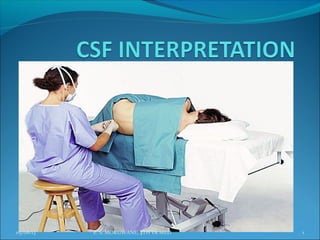
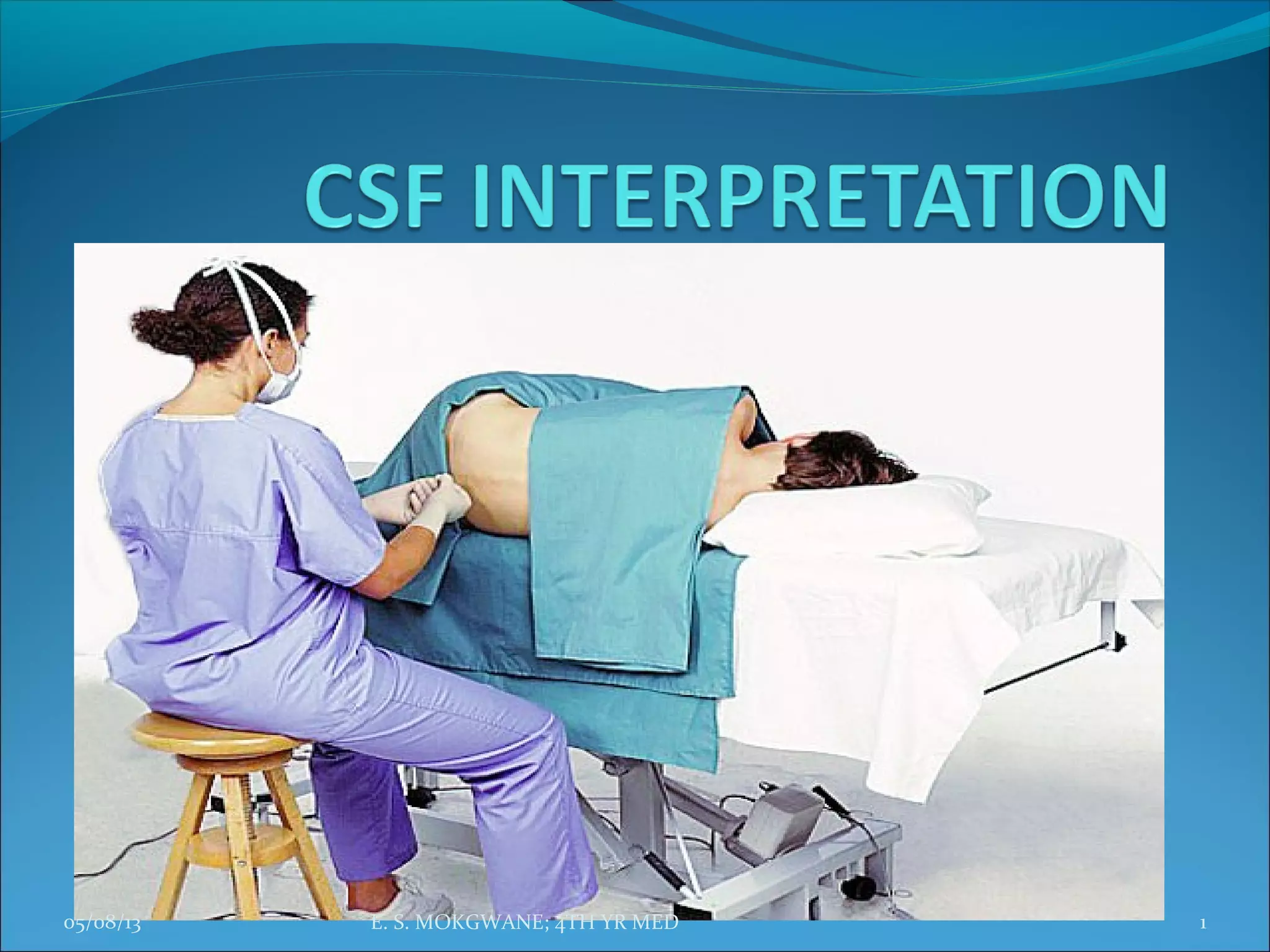
05/08/13 1E. S. MOKGWANE; 4TH YR MED
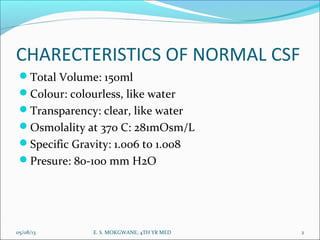
CHARECTERISTICS OF NORMAL CSF
Total Volume: 150ml
Colour: colourless, like water
Transparency: clear, like water
Osmolality at 37o C: 281mOsm/L
Specific Gravity: 1.006 to 1.008
Presure: 80-100 mm H2O
05/08/13 2E. S. MOKGWANE; 4TH YR MED
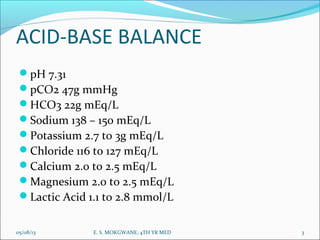
ACID-BASE BALANCE
pH 7.31
pCO2 47g mmHg
HCO3 22g mEq/L
Sodium 138 – 150 mEq/L
Potassium 2.7 to 3g mEq/L
Chloride 116 to 127 mEq/L
Calcium 2.0 to 2.5 mEq/L
Magnesium 2.0 to 2.5 mEq/L
Lactic Acid 1.1 to 2.8 mmol/L
05/08/13 3E. S. MOKGWANE; 4TH YR MED
APPEARANCE
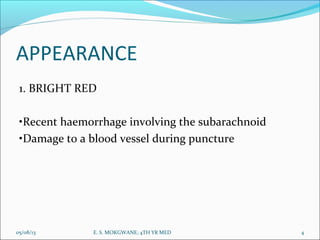
1. BRIGHT RED
•Recent haemorrhage involving the subarachnoid
•Damage to a blood vessel during puncture
05/08/13 4E. S. MOKGWANE; 4TH YR MED
APPERANCE
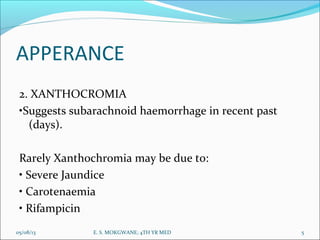
2. XANTHOCROMIA
•Suggests subarachnoid haemorrhage in recent past
(days).
Rarely Xanthochromia may be due to:
• Severe Jaundice
• Carotenaemia
• Rifampicin
05/08/13 5E. S. MOKGWANE; 4TH YR MED
APPERANCE
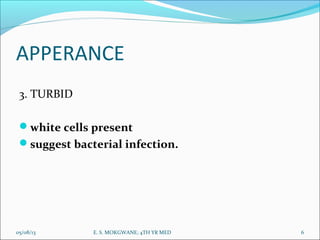
3. TURBID
white cells present
suggest bacterial infection.
05/08/13 6E. S. MOKGWANE; 4TH YR MED
APPERANCE
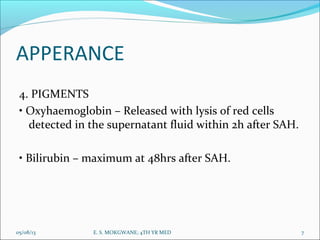
4. PIGMENTS
• Oxyhaemoglobin – Released with lysis of red cells
detected in the supernatant fluid within 2h after SAH.
• Bilirubin – maximum at 48hrs after SAH.
05/08/13 7E. S. MOKGWANE; 4TH YR MED
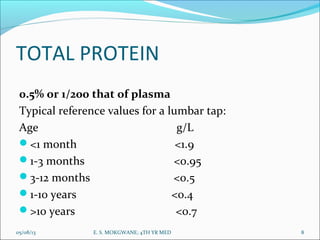
TOTAL PROTEIN
0.5% or 1/200 that of plasma
Typical reference values for a lumbar tap:
Age g/L
<1 month <1.9
1-3 months <0.95
3-12 months <0.5
1-10 years <0.4
>10 years <0.7
05/08/13 8E. S. MOKGWANE; 4TH YR MED
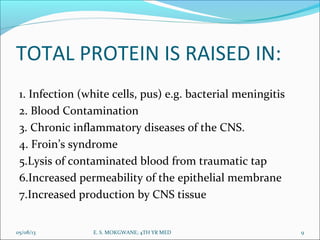
TOTAL PROTEIN IS RAISED IN:
1. Infection (white cells, pus) e.g. bacterial meningitis
2. Blood Contamination
3. Chronic inflammatory diseases of the CNS.
4. Froin’s syndrome
5.Lysis of contaminated blood from traumatic tap
6.Increased permeability of the epithelial membrane
7.Increased production by CNS tissue
05/08/13 9E. S. MOKGWANE; 4TH YR MED
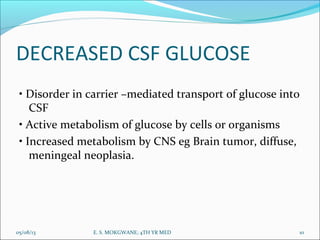
DECREASED CSF GLUCOSE
• Disorder in carrier –mediated transport of glucose into
CSF
• Active metabolism of glucose by cells or organisms
• Increased metabolism by CNS eg Brain tumor, diffuse,
meningeal neoplasia.
05/08/13 10E. S. MOKGWANE; 4TH YR MED
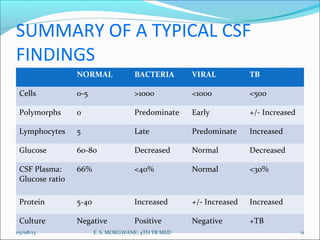
SUMMARY OF A TYPICAL CSF
FINDINGS
NORMAL BACTERIA VIRAL TB
Cells 0-5 >1000 <1000 <500
Polymorphs 0 Predominate Early +/- Increased
Lymphocytes 5 Late Predominate Increased
Glucose 60-80 Decreased Normal Decreased
CSF Plasma:
Glucose ratio
66% <40% Normal <30%
Protein 5-40 Increased +/- Increased Increased
Culture Negative Positive Negative +TB
05/08/13 11E. S. MOKGWANE; 4TH YR MED
END
05/08/13 12E. S. MOKGWANE; 4TH YR MED

Cerebrospinal Fluid Interpretation

  • 1.
    05/08/13 1E. S.MOKGWANE; 4TH YR MED
  • 2.
    CHARECTERISTICS OF NORMALCSF Total Volume: 150ml Colour: colourless, like water Transparency: clear, like water Osmolality at 37o C: 281mOsm/L Specific Gravity: 1.006 to 1.008 Presure: 80-100 mm H2O 05/08/13 2E. S. MOKGWANE; 4TH YR MED
  • 3.
    ACID-BASE BALANCE pH 7.31 pCO247g mmHg HCO3 22g mEq/L Sodium 138 – 150 mEq/L Potassium 2.7 to 3g mEq/L Chloride 116 to 127 mEq/L Calcium 2.0 to 2.5 mEq/L Magnesium 2.0 to 2.5 mEq/L Lactic Acid 1.1 to 2.8 mmol/L 05/08/13 3E. S. MOKGWANE; 4TH YR MED
  • 4.
    APPEARANCE 1. BRIGHT RED •Recenthaemorrhage involving the subarachnoid •Damage to a blood vessel during puncture 05/08/13 4E. S. MOKGWANE; 4TH YR MED
  • 5.
    APPERANCE 2. XANTHOCROMIA •Suggests subarachnoidhaemorrhage in recent past (days). Rarely Xanthochromia may be due to: • Severe Jaundice • Carotenaemia • Rifampicin 05/08/13 5E. S. MOKGWANE; 4TH YR MED
  • 6.
    APPERANCE 3. TURBID white cellspresent suggest bacterial infection. 05/08/13 6E. S. MOKGWANE; 4TH YR MED
  • 7.
    APPERANCE 4. PIGMENTS • Oxyhaemoglobin– Released with lysis of red cells detected in the supernatant fluid within 2h after SAH. • Bilirubin – maximum at 48hrs after SAH. 05/08/13 7E. S. MOKGWANE; 4TH YR MED
  • 8.
    TOTAL PROTEIN 0.5% or1/200 that of plasma Typical reference values for a lumbar tap: Age g/L <1 month <1.9 1-3 months <0.95 3-12 months <0.5 1-10 years <0.4 >10 years <0.7 05/08/13 8E. S. MOKGWANE; 4TH YR MED
  • 9.
    TOTAL PROTEIN ISRAISED IN: 1. Infection (white cells, pus) e.g. bacterial meningitis 2. Blood Contamination 3. Chronic inflammatory diseases of the CNS. 4. Froin’s syndrome 5.Lysis of contaminated blood from traumatic tap 6.Increased permeability of the epithelial membrane 7.Increased production by CNS tissue 05/08/13 9E. S. MOKGWANE; 4TH YR MED
  • 10.
    DECREASED CSF GLUCOSE •Disorder in carrier –mediated transport of glucose into CSF • Active metabolism of glucose by cells or organisms • Increased metabolism by CNS eg Brain tumor, diffuse, meningeal neoplasia. 05/08/13 10E. S. MOKGWANE; 4TH YR MED
  • 11.
    SUMMARY OF ATYPICAL CSF FINDINGS NORMAL BACTERIA VIRAL TB Cells 0-5 >1000 <1000 <500 Polymorphs 0 Predominate Early +/- Increased Lymphocytes 5 Late Predominate Increased Glucose 60-80 Decreased Normal Decreased CSF Plasma: Glucose ratio 66% <40% Normal <30% Protein 5-40 Increased +/- Increased Increased Culture Negative Positive Negative +TB 05/08/13 11E. S. MOKGWANE; 4TH YR MED
  • 12.
    END 05/08/13 12E. S.MOKGWANE; 4TH YR MED