
CASE PRESENTATION ON
ACUTE PANCREATITIS
SUBMITTED BY
METI.BHARATH KUMAR
16DK1T0014
Pharm.D Internship
DEMOGRAPHIC DETAILS
• NAME: jaya ramudu
• AGE:35 years
• GENDER:male
• DEPARTMENT:general medicine
• UNIT:mm-7
• IP NO:68856
• DOA:18/12/2021
• CONSULTANT PHYSICIAN: Dr.harikrishna P.G
SUBJECTIVE EVIDENCE
• A 35 years male patient was admitted in the male medical ward unit-7
with the chief complaints of,
pain in the abdomen (epigastric region) since 2 days associated
with nausea.
no c/o of fever,cold,cough, loose stools.
PAST HISTORY: k/c/o DCLD with portal HTN used medication.
h/o: alcoholic and smoker +
OBJECTIVE EVIDENCE
• USG abdomen: appears bulky and hypocentre with minimal
sascoonding inflammatory changes.
IMPRESSION: “Acute pancreatitis” with grade 2 fatty liver .
Serum amylase:225 u/L ( 40 to 110)
Serum lipase: 198 U/L (10 to 140 )
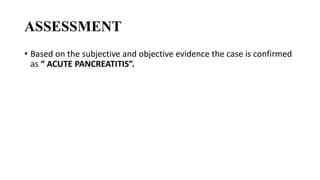
ASSESSMENT
• Based on the subjective and objective evidence the case is confirmed
as “ ACUTE PANCREATITIS”.
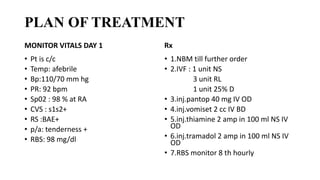
PLAN OF TREATMENT
MONITOR VITALS DAY 1
• Pt is c/c
• Temp: afebrile
• Bp:110/70 mm hg
• PR: 92 bpm
• Sp02 : 98 % at RA
• CVS : s1s2+
• RS :BAE+
• p/a: tenderness +
• RBS: 98 mg/dl
Rx
• 1.NBM till further order
• 2.IVF : 1 unit NS
3 unit RL
1 unit 25% D
• 3.inj.pantop 40 mg IV OD
• 4.inj.vomiset 2 cc IV BD
• 5.inj.thiamine 2 amp in 100 ml NS IV
OD
• 6.inj.tramadol 2 amp in 100 ml NS IV
OD
• 7.RBS monitor 8 th hourly
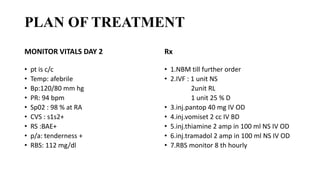
PLAN OF TREATMENT
MONITOR VITALS DAY 2
• pt is c/c
• Temp: afebrile
• Bp:120/80 mm hg
• PR: 94 bpm
• Sp02 : 98 % at RA
• CVS : s1s2+
• RS :BAE+
• p/a: tenderness +
• RBS: 112 mg/dl
Rx
• 1.NBM till further order
• 2.IVF : 1 unit NS
2unit RL
1 unit 25 % D
• 3.inj.pantop 40 mg IV OD
• 4.inj.vomiset 2 cc IV BD
• 5.inj.thiamine 2 amp in 100 ml NS IV OD
• 6.inj.tramadol 2 amp in 100 ml NS IV OD
• 7.RBS monitor 8 th hourly
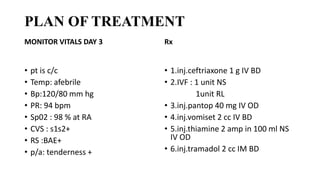
PLAN OF TREATMENT
MONITOR VITALS DAY 3
• pt is c/c
• Temp: afebrile
• Bp:120/80 mm hg
• PR: 94 bpm
• Sp02 : 98 % at RA
• CVS : s1s2+
• RS :BAE+
• p/a: tenderness +
Rx
• 1.inj.ceftriaxone 1 g IV BD
• 2.IVF : 1 unit NS
1unit RL
• 3.inj.pantop 40 mg IV OD
• 4.inj.vomiset 2 cc IV BD
• 5.inj.thiamine 2 amp in 100 ml NS
IV OD
• 6.inj.tramadol 2 cc IM BD
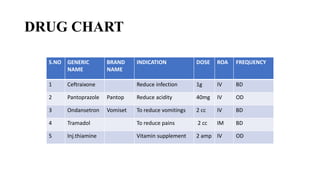
DRUG CHART
S.NO GENERIC
NAME
BRAND
NAME
INDICATION DOSE ROA FREQUENCY
1 Ceftraixone Reduce infection 1g IV BD
2 Pantoprazole Pantop Reduce acidity 40mg IV OD
3 Ondansetron Vomiset To reduce vomitings 2 cc IV BD
4 Tramadol To reduce pains 2 cc IM BD
5 Inj.thiamine Vitamin supplement 2 amp IV OD
PHARMACEUTICAL CARE ISSUES
• No pharmaceutical care issues found the prescription was
rational.
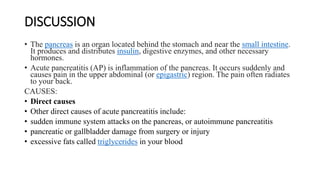
DISCUSSION
• The pancreas is an organ located behind the stomach and near the small intestine.
It produces and distributes insulin, digestive enzymes, and other necessary
hormones.
• Acute pancreatitis (AP) is inflammation of the pancreas. It occurs suddenly and
causes pain in the upper abdominal (or epigastric) region. The pain often radiates
to your back.
CAUSES:
• Direct causes
• Other direct causes of acute pancreatitis include:
• sudden immune system attacks on the pancreas, or autoimmune pancreatitis
• pancreatic or gallbladder damage from surgery or injury
• excessive fats called triglycerides in your blood
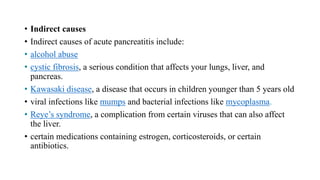
• Indirect causes
• Indirect causes of acute pancreatitis include:
• alcohol abuse
• cystic fibrosis, a serious condition that affects your lungs, liver, and
pancreas.
• Kawasaki disease, a disease that occurs in children younger than 5 years old
• viral infections like mumps and bacterial infections like mycoplasma.
• Reye’s syndrome, a complication from certain viruses that can also affect
the liver.
• certain medications containing estrogen, corticosteroids, or certain
antibiotics.
RISK FACTORS
• Alcohol consumption.
• Tobacco smoking
• A family history of cancer ,inflammation or any other pancreatic
condition may also put at risk.
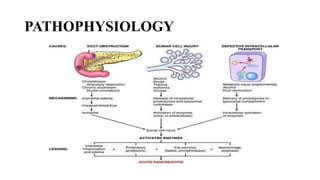
PATHOPHYSIOLOGY
DIAGNOSIS
• Ultrasound of abdomen
• Blood test looks for
serum amylase
serum lipase
TREATMENT AND PATIENT COUNSELLING
• Make sure you get enough
fluids,usually intravenously.
• Pain medictions to relieve pain.
• Life style and diet changes.
• Stay hydrated at all times.
• Keep a water bottle or an
electrolyte infused drink.
• Quit the alcohol consumption.
CASE PRESENTATION ON ACUTE PANCREATITIS

CASE PRESENTATION ON ACUTE PANCREATITIS

  • 1.
    CASE PRESENTATION ON ACUTEPANCREATITIS SUBMITTED BY METI.BHARATH KUMAR 16DK1T0014 Pharm.D Internship
  • 2.
    DEMOGRAPHIC DETAILS • NAME:jaya ramudu • AGE:35 years • GENDER:male • DEPARTMENT:general medicine • UNIT:mm-7 • IP NO:68856 • DOA:18/12/2021 • CONSULTANT PHYSICIAN: Dr.harikrishna P.G
  • 3.
    SUBJECTIVE EVIDENCE • A35 years male patient was admitted in the male medical ward unit-7 with the chief complaints of, pain in the abdomen (epigastric region) since 2 days associated with nausea. no c/o of fever,cold,cough, loose stools. PAST HISTORY: k/c/o DCLD with portal HTN used medication. h/o: alcoholic and smoker +
  • 4.
    OBJECTIVE EVIDENCE • USGabdomen: appears bulky and hypocentre with minimal sascoonding inflammatory changes. IMPRESSION: “Acute pancreatitis” with grade 2 fatty liver . Serum amylase:225 u/L ( 40 to 110) Serum lipase: 198 U/L (10 to 140 )
  • 5.
    ASSESSMENT • Based onthe subjective and objective evidence the case is confirmed as “ ACUTE PANCREATITIS”.
  • 6.
    PLAN OF TREATMENT MONITORVITALS DAY 1 • Pt is c/c • Temp: afebrile • Bp:110/70 mm hg • PR: 92 bpm • Sp02 : 98 % at RA • CVS : s1s2+ • RS :BAE+ • p/a: tenderness + • RBS: 98 mg/dl Rx • 1.NBM till further order • 2.IVF : 1 unit NS 3 unit RL 1 unit 25% D • 3.inj.pantop 40 mg IV OD • 4.inj.vomiset 2 cc IV BD • 5.inj.thiamine 2 amp in 100 ml NS IV OD • 6.inj.tramadol 2 amp in 100 ml NS IV OD • 7.RBS monitor 8 th hourly
  • 7.
    PLAN OF TREATMENT MONITORVITALS DAY 2 • pt is c/c • Temp: afebrile • Bp:120/80 mm hg • PR: 94 bpm • Sp02 : 98 % at RA • CVS : s1s2+ • RS :BAE+ • p/a: tenderness + • RBS: 112 mg/dl Rx • 1.NBM till further order • 2.IVF : 1 unit NS 2unit RL 1 unit 25 % D • 3.inj.pantop 40 mg IV OD • 4.inj.vomiset 2 cc IV BD • 5.inj.thiamine 2 amp in 100 ml NS IV OD • 6.inj.tramadol 2 amp in 100 ml NS IV OD • 7.RBS monitor 8 th hourly
  • 8.
    PLAN OF TREATMENT MONITORVITALS DAY 3 • pt is c/c • Temp: afebrile • Bp:120/80 mm hg • PR: 94 bpm • Sp02 : 98 % at RA • CVS : s1s2+ • RS :BAE+ • p/a: tenderness + Rx • 1.inj.ceftriaxone 1 g IV BD • 2.IVF : 1 unit NS 1unit RL • 3.inj.pantop 40 mg IV OD • 4.inj.vomiset 2 cc IV BD • 5.inj.thiamine 2 amp in 100 ml NS IV OD • 6.inj.tramadol 2 cc IM BD
  • 9.
    DRUG CHART S.NO GENERIC NAME BRAND NAME INDICATIONDOSE ROA FREQUENCY 1 Ceftraixone Reduce infection 1g IV BD 2 Pantoprazole Pantop Reduce acidity 40mg IV OD 3 Ondansetron Vomiset To reduce vomitings 2 cc IV BD 4 Tramadol To reduce pains 2 cc IM BD 5 Inj.thiamine Vitamin supplement 2 amp IV OD
  • 10.
    PHARMACEUTICAL CARE ISSUES •No pharmaceutical care issues found the prescription was rational.
  • 11.
    DISCUSSION • The pancreasis an organ located behind the stomach and near the small intestine. It produces and distributes insulin, digestive enzymes, and other necessary hormones. • Acute pancreatitis (AP) is inflammation of the pancreas. It occurs suddenly and causes pain in the upper abdominal (or epigastric) region. The pain often radiates to your back. CAUSES: • Direct causes • Other direct causes of acute pancreatitis include: • sudden immune system attacks on the pancreas, or autoimmune pancreatitis • pancreatic or gallbladder damage from surgery or injury • excessive fats called triglycerides in your blood
  • 12.
    • Indirect causes •Indirect causes of acute pancreatitis include: • alcohol abuse • cystic fibrosis, a serious condition that affects your lungs, liver, and pancreas. • Kawasaki disease, a disease that occurs in children younger than 5 years old • viral infections like mumps and bacterial infections like mycoplasma. • Reye’s syndrome, a complication from certain viruses that can also affect the liver. • certain medications containing estrogen, corticosteroids, or certain antibiotics.
  • 13.
    RISK FACTORS • Alcoholconsumption. • Tobacco smoking • A family history of cancer ,inflammation or any other pancreatic condition may also put at risk.
  • 14.
  • 15.
    DIAGNOSIS • Ultrasound ofabdomen • Blood test looks for serum amylase serum lipase TREATMENT AND PATIENT COUNSELLING • Make sure you get enough fluids,usually intravenously. • Pain medictions to relieve pain. • Life style and diet changes. • Stay hydrated at all times. • Keep a water bottle or an electrolyte infused drink. • Quit the alcohol consumption.