Clinical Examination of per
abdomen
Chiranjeevi Kumar
Department of Physiology
AIIMS Bhopal
Abdominal Exam
•Inspection
•Auscultation
•Percussion
•Palpate
percussion includes percussion of
liver span, light and deep
palpation, palpation of liver edge,
spleen tip, kidneys, and aorta.
Order of exam is critical. Auscultate BEFORE
palpating!
History taking - summary
• Abdominal pain
• Dysphagia
• Nausea and vomiting
• Anorexia and unexpected weight loss
• Abdominal gas
• Abdominal distension
• Diarrhea
• Constipation
• Gastrointestinal bleeding
• Jaundice
Enhancing the Exam
 Empty bladder
 Patient comfort (pillows and draping)
 Arms at side or crossed over chest
 Legs semi-flexed to relax the abdomen
 Ask him to relax and breath quietly
 Ask the patient to point to any painful areas; examine last
 Warm hands and stethoscope
 Ticklish or nervous patients: slow movements, distraction, use their hands
4
General principles of exam
• If muscles remain tense, patient may be asked to rest feet
on table with hips and knees flexed
General principles of exam
• If the patient is ticklish or frightened
• Initially use the patients hand under yours as you palpate
• When patient calms then use your hands to palpate.
• Watch the patient’s face for discomfort.
Think Anatomically
Think Anatomically
• When looking, listening, feeling and percussing.
• imagine what organs live in the area that you are examining.
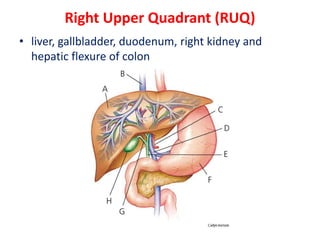
Right Upper Quadrant (RUQ)
• liver, gallbladder, duodenum, right kidney and
hepatic flexure of colon
Right Lower Quadrant (RLQ)
• Cecum, appendix (in case of female, right ovary &
tube)
Left Upper Quadrant (LUQ)
• Stomach, spleen, left kidney, pancreas (tail),
splenic flexure of colon
Left Lower Quadrant (LLQ)
• Sigmoid colon (in case of female, left ovary & tube)
Epigastric Area
• Stomach, pancreas (head and body), aorta
Surface Anatomy
14
Regions
Inspection
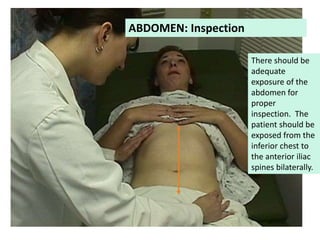
ABDOMEN: Inspection
There should be
adequate
exposure of the
abdomen for
proper
inspection. The
patient should be
exposed from the
inferior chest to
the anterior iliac
spines bilaterally.
Abdominal Physical Exam
Inspection
Contour
Flat
Scaphoid
Distended
Symmetry
Movement
Peristaltic
Respirations
Aortic pulsation
Skin
Scars – cicatrix
Striae
Discoloration
Venous patterns
Edema
19
Symmetrical in shape
Scaphoid or flat in young patients of
normal weight
Slightly full but not distended in older age
group due to poor muscle tone or in subjects
who are mildly overweight
Appreciation of abdominal contours
• Standing at the foot of the table and looking up towards the
patient's head.
• Lower yourself until the anterior abdominal wall and ask the
patient to breathe normally while you are doing so.
Appearance of the abdomen
• Global abdominal enlargement is usually caused by Flatus,
fluid, fetus, full bladder, food, feaces or fat.
abdomen_ascites
Abdomen obese
abdomen_umbo_hernia1 abdomen_umbo_hernia2
Appearance of the abdomen
• Localized enlargement probably distend GB space
occupying lesion, hepatomegaly….
An aortic aneurysm
• Palpable mass
• Patient feeling of pulsation
• On rare occasions, a lump can be visible.
An aortic aneurysm
• 1 in 10 men over 65 may have some enlargement of the
abdominal aorta.
• About 1 in 100 will have a large aneurysm requiring
surgery.
Appearance of the abdomen
(Skin)
• Abnormal venous patterns
• Abnormal discoloration
• Umbilicus is sunken
Striae
• Stretch marks are a light silver hue.
• Pregnancy and obese individuals
• Cushing’s syndrome (more purple or pink).
PINK-PURPLE STRIAE OF CUSHING’S
SYNDROME
Cullen’s sign
• Ecchymosis periumbilically. (intraperitoneal
hemorrhage, ruptured ectopic pregnancy, hemorrhagic
pancreatitis..)
Grey-Turner’s sign
• Ecchymosis of flanks. (retroperitoneal hemorrhage such as
hemorrhagic pancreatitis)
Upward flow direction indicates IVC obstruction
Outward flow pattern from umbilicus in all directions ? Portal HTN
SCAR
DILATED VEIN OF HEPATIC
CIRRHOSIS
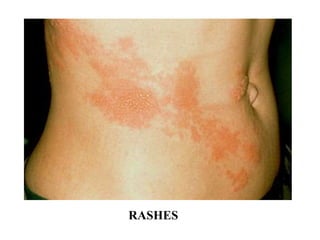
RASHES
UMBILICAL HERNIA IN NEWBORN
Contour of the abdomen
PROTUBERANT
SCAPHOID
(newborn with diaphragmatic
hernia)
Visible Pulsations
• More conspicuous in the
thin than in the fat
• Greater in the old than in
the young.
• Increased in thyrotoxicosis,
hypertension, or aortic
regurgitation)
• In those with an aortic
aneurysm and tortuous
aorta
• In those who have a mass
joining the aorta to the
anterior abdominal wall.
Visible gastric Peristalsis
• Gastric peristalsis is
commonly seen in
neonates with
congenital hypertrophic
pyloric stenosis
• Intestinal peristalsis in
partial and chronic
intestinal obstruction
• Colonic obstruction is
usually not manifest as
visible peristalsis
Visible intestinal Peristalsis
Visible Peristalsis
Auscultation
Abdominal examination
Bowel sounds
Vascular sounds (bruits)
Friction Rubs
Auscultation for bowel sounds
• It is performed before percussion or
palpation
Auscultation for bowel sounds
• Compared to the cardiac and pulmonary exams,
auscultation of the abdomen has a relatively minor role.
Auscultation
Auscultation can be
done with the
diaphragm or the bell;
most examiners use
the diaphragm. You
should listen for at
least 10-15 seconds
and note the pitch
and frequency of
bowel sounds. If you
do not hear any bowel
sounds, you should
listen for a full two
minutes before you
can state that the
patient does not have
any bowel sounds.
Bowel sounds should
occur from every
other second to every
12 seconds.
Note: During the
abdominal exam auscultation is done
before palpation
Three things about bowel sound
Bowel sounds cannot be said to be absent unless they
are not heard after listening for 3-5 minutes.
• Are bowel sounds present?
• If present, are they frequent or sparse (i.e.quantity)?
• What is the nature of the sounds (i.e.quality)?
Bruits
• Bruits confined to systole do not necessarily indicate disease.
Auscultation for vascular sounds (bruits)
• Aortic (midline between umbilicus and xiphoid
• Renal (two inches superior to and two inches lateral to umbilicus)
• Common iliac (midway between umbilicus and midpoint of inguinal ligament)
Venous Hum (rare)
• Epigastric/umbilical area.
• Soft humming noises in systolic/diastolic component.
• Indicates collateral between portal and venous systems as
in hepatic cirrhosis.
Rubs –Rubs-Rubs
• Liver
• Spleen
• Cardiac
• Pulmonary
Friction rubs (rare)
• Right and left upper
quandrants
• Grating sound with
respiratory movement
• Indicates inflammation
of the capsule of the
liver or spleen (infection
or infarction).
Abdominal Physical Exam
Auscultation
4 quadrants
15-20 seconds
Bowel sounds
Frequency
Pitch
Vascular Sounds
Renal
Iliac
Femoral
53
Abdominal Physical Exam
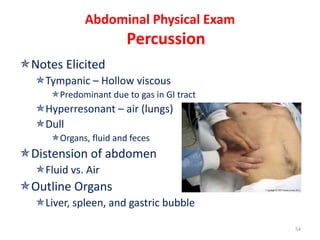
Percussion
Notes Elicited
Tympanic – Hollow viscous
Predominant due to gas in GI tract
Hyperresonant – air (lungs)
Dull
Organs, fluid and feces
Distension of abdomen
Fluid vs. Air
Outline Organs
Liver, spleen, and gastric bubble
54
There are two basic sounds with
Percussion
• Tympanitic (drum-like) sounds produced by
percussing over air filled structures.
There are two basic sounds with
Percussion
• Dull sounds that occur when a solid structure (e.g.
liver) or fluid (e.g. ascites) lies beneath the region being
examined.
Percussion
Percussion: the left and right abdomen should be percussed
above and below the umbilicus. Most examiners will percuss 8
or more areas.
Percussion: Liver span
The liver span is estimated by percussion.
Remember that it is easier to hear the
change from resonance to dullness – so
proceed with percussion from areas of
resonance to areas of dullness.
Upper border: In the midclavicular line start
percussing in the chest moving down towards the
abdomen about ½ to 1 cm at a time. Note where the
percussion notes change from resonate to dull.
Lower border: In the midclavicular
line begin percussion below the
unbillicus and proceed upward until
dullness is encounter.
The distance between the
two areas where dullness is
first encountered is the liver
span.
Liver span is normally 6 to 12 cm in
the midclavicular line.
Liver Span: Scratch Test
Start in the same areas
above and below the
liver as you would with
percussion. Instead of
percussing lightly,
scratch moving your
finger back and forth
while listening over the
liver. Since sound is
conducted better in
solids than in air, when
the louder sounds are
heard you are over the
liver. Mark the superior
and inferior boarders of
the liver span in the
midclavicular line
Examination of Liver (Percussion)
• Midclavicular line is noted
• Second intercostal space is noted
To determine the size of the liver
• Measure the liver span
by percussing hepatic
dullness from above
(lung) and below
(bowel).
• A normal liver span is 6
to 12 cm in the
midclavicular line.
Physical examination
Percussion
• Liver span midclavicular line: 6-12 cm
midsternal line: 4-8 cm
• Splenic dullness
– normal: in the midaxillary line
– pathological:dullness in the ant. axillary line
during inspiration
• Liver or/and splenic dullness absent: perforation.
• Shifting Dullness
• Horse shoe shaped dullness
• Fluid thrills
Shifting Dullness
Abdominal Palpation
Technique
• Light
• Deep
• Liver edge
• Spleen tip
• Kidneys
• Aorta
• Masses
Abdominal palpation
• To palpate four quadrants superficially from LLQ
counterclockwise
Light Palpation
Light Palpation
• Mostly looking for areas of tenderness
• Tenderness is a physical exam finding a reflex occurs
(muscle splinting, wide eyes, moaning, teeth gritting).
Abdominal muscle spasm
• Voluntary guarding
Tensing abdominal
muscles due to patient
anxiety, ticklishness, or
to prevent palpation to
a painful area
Involuntary guarding
• Muscular spasm or
rigidity due to
peritoneal inflammation
• May be localized (early
appendicitis )or diffuse
(perforated bowel)
Board-like rigidity
• If abdominal wall is palpated as obviously tense, even as
rigid as a board, board-like rigidity is so called.
• Is caused by the spasm of abdominal muscle due to
peritoneal irritation.
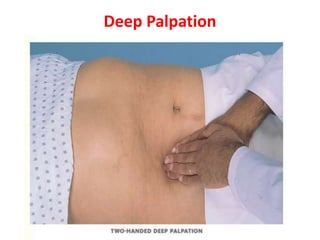
Deep Palpation
Abdominal Palpation
Palpate lightly in all 4 quadrants. Press
down around 1 cm. Remember to look
at the patient’s face during palpation
to see if any tenderness is elicited
Palpation: Deeply, all 4 quadrants
One should use two hands. Press
down around 4 cm
Palpation: Liver
Stand on the pt’s right side. Place your left hand behind the
patient’s R side under the 11th and 12th rib area. Press upward
with the L hand.
Place your R hand on the pt’s
abdomen well below where you
percussed the liver edge
Palpation of Liver: Alternative Method
It is acceptable during palpation of the liver to
use both hands to palpate abdomen. You use
the fingers of one hand to palpate and the other
hand is used to apply pressure to the dorsum of
the other hand. Thus the hand you are using to
palpate does not need to be used to apply
pressure.
Hepatomegaly
• More than 1cm below the costal margin
• An exception is a congenitally large right lobe of the liver
• Severe, chronic emphysema
Palpation: Spleen
Palpation: Spleen
(correctly - position,
breaths, palpating
deepest full
inspiration, 1 hand
under L side, 1
feeling)
Palpation: Spleen (if
not palpable, R lateral
decubitus)
Right
lateral
decubitus
Palpation of Kidneys
Right kidney (take a deep
breath, capture kidney, exhale,
slowly release kidney
Left kidney (take a deep breath,
capture kidney, exhale, slowly
release kidney)
Fluid wave or Thrills
137: Palpation: For abdominal
aorta
Palpation: For
abdominal aorta (to
feel both the left and
right walls of the
aorta)
In correct order:
Inspection,
auscultation,
percussion and
palpation
Abdominal
Examination was
done at 0.
Abdominal Physical Exam
Practice- 20 Minutes
• Inspection
– Contour
– Skin
– Movement
• Auscultation
– Bowel sounds
– Vascular sounds
• Percussion
– Abdomen for masses or fluid
– Liver span
– Spleen
– Gastric bubble
– Shifting Dullness
– Horse should shaped dullness
– Fluid thrills
• Palpate
– General palpation
– Liver
– Gallbladder
– Spleen
– R and L kidneys
– Abdominal aorta
– Inguinal lymph nodes
• Special:
– Murphy’s sign
– McBurney’s point
– Rovsing’s sign
– Psoas sign
– Obturator sign
– Rebound tenderness
– CVA tenderness
91
Murphy’s Sign (acute cholecystitis)
• Examiner’s hand is at middle inferior border of liver.
• Patient is asked to take deep inspiration.
• If positive patient will experience pain and will stop
short of full inspiration
Hepatitis, subdiaphragmatic abscess
Cholecystitis
McBurney’s Point (Appendicitis)
• Localized tenderness
Just below midpoint of
line between right
anterior iliac crest and
umbilicus.
• Heel strike, riding over
bumps in road while
driving, coughing, will
produce pain.
Rovsing’s Sign
• Patient will experience
right lower quadrant
pain (in region of
McBurney’s Point)
when left lower
quadrant is palpated.
Non-Classical Appendicitis
• Iliopsoas Sign
• Obturator Sign
Iliopsoas Sign
Patient can lay on side and extend leg at the hip or
have patient lay on back and try to flex hip against
the resistance of examiner’s hand on thigh. If patient
has an inflamed retrocecal appendix, this will
produce pain.
Obturator Sign
• Internally rotate right leg at the hip with the knee at
90 degrees of flexion. Will produce pain if inflamed
appendix is in pelvis.
Rebound Tenderness
(For peritoneal irritation)
• Warn the patient what you
are about to do.
• Press deeply on the
abdomen with your hand.
• After a moment, quickly
release pressure.
• If it hurts more when you
release, the patient has
rebound tenderness.
Costo - vertebral Tenderness
(Often with renal disease)
• Use the heel of your
closed fist to strike
the patient firmly over
the costovertebral
angles.
• Compare the left and
right sides.

Abdoiminal examination

  • 1.
    Clinical Examination ofper abdomen Chiranjeevi Kumar Department of Physiology AIIMS Bhopal
  • 2.
    Abdominal Exam •Inspection •Auscultation •Percussion •Palpate percussion includespercussion of liver span, light and deep palpation, palpation of liver edge, spleen tip, kidneys, and aorta. Order of exam is critical. Auscultate BEFORE palpating!
  • 3.
    History taking -summary • Abdominal pain • Dysphagia • Nausea and vomiting • Anorexia and unexpected weight loss • Abdominal gas • Abdominal distension • Diarrhea • Constipation • Gastrointestinal bleeding • Jaundice
  • 4.
    Enhancing the Exam Empty bladder  Patient comfort (pillows and draping)  Arms at side or crossed over chest  Legs semi-flexed to relax the abdomen  Ask him to relax and breath quietly  Ask the patient to point to any painful areas; examine last  Warm hands and stethoscope  Ticklish or nervous patients: slow movements, distraction, use their hands 4
  • 5.
    General principles ofexam • If muscles remain tense, patient may be asked to rest feet on table with hips and knees flexed
  • 6.
    General principles ofexam • If the patient is ticklish or frightened • Initially use the patients hand under yours as you palpate • When patient calms then use your hands to palpate. • Watch the patient’s face for discomfort.
  • 7.
  • 8.
    Think Anatomically • Whenlooking, listening, feeling and percussing. • imagine what organs live in the area that you are examining.
  • 9.
    Right Upper Quadrant(RUQ) • liver, gallbladder, duodenum, right kidney and hepatic flexure of colon
  • 10.
    Right Lower Quadrant(RLQ) • Cecum, appendix (in case of female, right ovary & tube)
  • 11.
    Left Upper Quadrant(LUQ) • Stomach, spleen, left kidney, pancreas (tail), splenic flexure of colon
  • 12.
    Left Lower Quadrant(LLQ) • Sigmoid colon (in case of female, left ovary & tube)
  • 13.
    Epigastric Area • Stomach,pancreas (head and body), aorta
  • 14.
  • 15.
  • 16.
  • 17.
    ABDOMEN: Inspection There shouldbe adequate exposure of the abdomen for proper inspection. The patient should be exposed from the inferior chest to the anterior iliac spines bilaterally.
  • 19.
    Abdominal Physical Exam Inspection Contour Flat Scaphoid Distended Symmetry Movement Peristaltic Respirations Aorticpulsation Skin Scars – cicatrix Striae Discoloration Venous patterns Edema 19
  • 20.
    Symmetrical in shape Scaphoidor flat in young patients of normal weight Slightly full but not distended in older age group due to poor muscle tone or in subjects who are mildly overweight
  • 21.
    Appreciation of abdominalcontours • Standing at the foot of the table and looking up towards the patient's head. • Lower yourself until the anterior abdominal wall and ask the patient to breathe normally while you are doing so.
  • 22.
    Appearance of theabdomen • Global abdominal enlargement is usually caused by Flatus, fluid, fetus, full bladder, food, feaces or fat.
  • 23.
  • 24.
    Appearance of theabdomen • Localized enlargement probably distend GB space occupying lesion, hepatomegaly….
  • 25.
    An aortic aneurysm •Palpable mass • Patient feeling of pulsation • On rare occasions, a lump can be visible.
  • 26.
    An aortic aneurysm •1 in 10 men over 65 may have some enlargement of the abdominal aorta. • About 1 in 100 will have a large aneurysm requiring surgery.
  • 27.
    Appearance of theabdomen (Skin) • Abnormal venous patterns • Abnormal discoloration • Umbilicus is sunken
  • 28.
    Striae • Stretch marksare a light silver hue. • Pregnancy and obese individuals • Cushing’s syndrome (more purple or pink).
  • 29.
    PINK-PURPLE STRIAE OFCUSHING’S SYNDROME
  • 30.
    Cullen’s sign • Ecchymosisperiumbilically. (intraperitoneal hemorrhage, ruptured ectopic pregnancy, hemorrhagic pancreatitis..)
  • 31.
    Grey-Turner’s sign • Ecchymosisof flanks. (retroperitoneal hemorrhage such as hemorrhagic pancreatitis)
  • 32.
    Upward flow directionindicates IVC obstruction
  • 34.
    Outward flow patternfrom umbilicus in all directions ? Portal HTN
  • 35.
  • 36.
    DILATED VEIN OFHEPATIC CIRRHOSIS
  • 37.
  • 38.
  • 39.
    Contour of theabdomen PROTUBERANT SCAPHOID (newborn with diaphragmatic hernia)
  • 40.
    Visible Pulsations • Moreconspicuous in the thin than in the fat • Greater in the old than in the young. • Increased in thyrotoxicosis, hypertension, or aortic regurgitation) • In those with an aortic aneurysm and tortuous aorta • In those who have a mass joining the aorta to the anterior abdominal wall.
  • 41.
    Visible gastric Peristalsis •Gastric peristalsis is commonly seen in neonates with congenital hypertrophic pyloric stenosis • Intestinal peristalsis in partial and chronic intestinal obstruction • Colonic obstruction is usually not manifest as visible peristalsis Visible intestinal Peristalsis Visible Peristalsis
  • 42.
  • 43.
    Auscultation for bowelsounds • It is performed before percussion or palpation
  • 44.
    Auscultation for bowelsounds • Compared to the cardiac and pulmonary exams, auscultation of the abdomen has a relatively minor role.
  • 45.
    Auscultation Auscultation can be donewith the diaphragm or the bell; most examiners use the diaphragm. You should listen for at least 10-15 seconds and note the pitch and frequency of bowel sounds. If you do not hear any bowel sounds, you should listen for a full two minutes before you can state that the patient does not have any bowel sounds. Bowel sounds should occur from every other second to every 12 seconds. Note: During the abdominal exam auscultation is done before palpation
  • 47.
    Three things aboutbowel sound Bowel sounds cannot be said to be absent unless they are not heard after listening for 3-5 minutes. • Are bowel sounds present? • If present, are they frequent or sparse (i.e.quantity)? • What is the nature of the sounds (i.e.quality)?
  • 48.
    Bruits • Bruits confinedto systole do not necessarily indicate disease.
  • 49.
    Auscultation for vascularsounds (bruits) • Aortic (midline between umbilicus and xiphoid • Renal (two inches superior to and two inches lateral to umbilicus) • Common iliac (midway between umbilicus and midpoint of inguinal ligament)
  • 50.
    Venous Hum (rare) •Epigastric/umbilical area. • Soft humming noises in systolic/diastolic component. • Indicates collateral between portal and venous systems as in hepatic cirrhosis.
  • 51.
    Rubs –Rubs-Rubs • Liver •Spleen • Cardiac • Pulmonary
  • 52.
    Friction rubs (rare) •Right and left upper quandrants • Grating sound with respiratory movement • Indicates inflammation of the capsule of the liver or spleen (infection or infarction).
  • 53.
    Abdominal Physical Exam Auscultation 4quadrants 15-20 seconds Bowel sounds Frequency Pitch Vascular Sounds Renal Iliac Femoral 53
  • 54.
    Abdominal Physical Exam Percussion NotesElicited Tympanic – Hollow viscous Predominant due to gas in GI tract Hyperresonant – air (lungs) Dull Organs, fluid and feces Distension of abdomen Fluid vs. Air Outline Organs Liver, spleen, and gastric bubble 54
  • 56.
    There are twobasic sounds with Percussion • Tympanitic (drum-like) sounds produced by percussing over air filled structures.
  • 57.
    There are twobasic sounds with Percussion • Dull sounds that occur when a solid structure (e.g. liver) or fluid (e.g. ascites) lies beneath the region being examined.
  • 59.
    Percussion Percussion: the leftand right abdomen should be percussed above and below the umbilicus. Most examiners will percuss 8 or more areas.
  • 60.
    Percussion: Liver span Theliver span is estimated by percussion. Remember that it is easier to hear the change from resonance to dullness – so proceed with percussion from areas of resonance to areas of dullness. Upper border: In the midclavicular line start percussing in the chest moving down towards the abdomen about ½ to 1 cm at a time. Note where the percussion notes change from resonate to dull. Lower border: In the midclavicular line begin percussion below the unbillicus and proceed upward until dullness is encounter. The distance between the two areas where dullness is first encountered is the liver span. Liver span is normally 6 to 12 cm in the midclavicular line.
  • 61.
    Liver Span: ScratchTest Start in the same areas above and below the liver as you would with percussion. Instead of percussing lightly, scratch moving your finger back and forth while listening over the liver. Since sound is conducted better in solids than in air, when the louder sounds are heard you are over the liver. Mark the superior and inferior boarders of the liver span in the midclavicular line
  • 63.
    Examination of Liver(Percussion) • Midclavicular line is noted • Second intercostal space is noted
  • 65.
    To determine thesize of the liver • Measure the liver span by percussing hepatic dullness from above (lung) and below (bowel). • A normal liver span is 6 to 12 cm in the midclavicular line.
  • 68.
    Physical examination Percussion • Liverspan midclavicular line: 6-12 cm midsternal line: 4-8 cm • Splenic dullness – normal: in the midaxillary line – pathological:dullness in the ant. axillary line during inspiration • Liver or/and splenic dullness absent: perforation. • Shifting Dullness • Horse shoe shaped dullness • Fluid thrills
  • 69.
  • 71.
    Abdominal Palpation Technique • Light •Deep • Liver edge • Spleen tip • Kidneys • Aorta • Masses
  • 72.
    Abdominal palpation • Topalpate four quadrants superficially from LLQ counterclockwise
  • 73.
  • 74.
    Light Palpation • Mostlylooking for areas of tenderness • Tenderness is a physical exam finding a reflex occurs (muscle splinting, wide eyes, moaning, teeth gritting).
  • 75.
    Abdominal muscle spasm •Voluntary guarding Tensing abdominal muscles due to patient anxiety, ticklishness, or to prevent palpation to a painful area Involuntary guarding • Muscular spasm or rigidity due to peritoneal inflammation • May be localized (early appendicitis )or diffuse (perforated bowel)
  • 76.
    Board-like rigidity • Ifabdominal wall is palpated as obviously tense, even as rigid as a board, board-like rigidity is so called. • Is caused by the spasm of abdominal muscle due to peritoneal irritation.
  • 77.
  • 78.
    Abdominal Palpation Palpate lightlyin all 4 quadrants. Press down around 1 cm. Remember to look at the patient’s face during palpation to see if any tenderness is elicited
  • 79.
    Palpation: Deeply, all4 quadrants One should use two hands. Press down around 4 cm
  • 80.
    Palpation: Liver Stand onthe pt’s right side. Place your left hand behind the patient’s R side under the 11th and 12th rib area. Press upward with the L hand. Place your R hand on the pt’s abdomen well below where you percussed the liver edge
  • 81.
    Palpation of Liver:Alternative Method It is acceptable during palpation of the liver to use both hands to palpate abdomen. You use the fingers of one hand to palpate and the other hand is used to apply pressure to the dorsum of the other hand. Thus the hand you are using to palpate does not need to be used to apply pressure.
  • 82.
    Hepatomegaly • More than1cm below the costal margin • An exception is a congenitally large right lobe of the liver • Severe, chronic emphysema
  • 83.
    Palpation: Spleen Palpation: Spleen (correctly- position, breaths, palpating deepest full inspiration, 1 hand under L side, 1 feeling) Palpation: Spleen (if not palpable, R lateral decubitus)
  • 84.
  • 86.
    Palpation of Kidneys Rightkidney (take a deep breath, capture kidney, exhale, slowly release kidney Left kidney (take a deep breath, capture kidney, exhale, slowly release kidney)
  • 87.
  • 90.
    137: Palpation: Forabdominal aorta Palpation: For abdominal aorta (to feel both the left and right walls of the aorta) In correct order: Inspection, auscultation, percussion and palpation Abdominal Examination was done at 0.
  • 91.
    Abdominal Physical Exam Practice-20 Minutes • Inspection – Contour – Skin – Movement • Auscultation – Bowel sounds – Vascular sounds • Percussion – Abdomen for masses or fluid – Liver span – Spleen – Gastric bubble – Shifting Dullness – Horse should shaped dullness – Fluid thrills • Palpate – General palpation – Liver – Gallbladder – Spleen – R and L kidneys – Abdominal aorta – Inguinal lymph nodes • Special: – Murphy’s sign – McBurney’s point – Rovsing’s sign – Psoas sign – Obturator sign – Rebound tenderness – CVA tenderness 91
  • 92.
    Murphy’s Sign (acutecholecystitis) • Examiner’s hand is at middle inferior border of liver. • Patient is asked to take deep inspiration. • If positive patient will experience pain and will stop short of full inspiration Hepatitis, subdiaphragmatic abscess Cholecystitis
  • 93.
    McBurney’s Point (Appendicitis) •Localized tenderness Just below midpoint of line between right anterior iliac crest and umbilicus. • Heel strike, riding over bumps in road while driving, coughing, will produce pain.
  • 94.
    Rovsing’s Sign • Patientwill experience right lower quadrant pain (in region of McBurney’s Point) when left lower quadrant is palpated.
  • 95.
  • 96.
    Iliopsoas Sign Patient canlay on side and extend leg at the hip or have patient lay on back and try to flex hip against the resistance of examiner’s hand on thigh. If patient has an inflamed retrocecal appendix, this will produce pain.
  • 97.
    Obturator Sign • Internallyrotate right leg at the hip with the knee at 90 degrees of flexion. Will produce pain if inflamed appendix is in pelvis.
  • 98.
    Rebound Tenderness (For peritonealirritation) • Warn the patient what you are about to do. • Press deeply on the abdomen with your hand. • After a moment, quickly release pressure. • If it hurts more when you release, the patient has rebound tenderness.
  • 99.
    Costo - vertebralTenderness (Often with renal disease) • Use the heel of your closed fist to strike the patient firmly over the costovertebral angles. • Compare the left and right sides.