MENTAL HEALTH NURSING
MMSE
Submitted to : Prerna ma’am
Presented by:
Tutor college of nursing Rashi Nirwan
06350306619
BSC (H) NSG.4TH
VMMC and sjh.
INTRODUCTION
The Mini-Mental State Examination (MMSE) or Folstein test is a 30-point
questionnaire that is used extensively in clinical and research settings to
measure cognitive impairment.
Itwas developed by Dr. Marshall Folstein in the year of 1975
The Mini-Mental State Exam (MMSE) is a widely used test of cognitive function
among the elderly: it includes tests of orientation, attention, memory, language
and visual-spatial skills.
The mini-mental state examination is proprietary and takes about 10-15
minutes to administer.
DEFINITION
The Mini-Mental status Examination is a
cognitive test to screen for the presence of
cognitive impairment example Dementia
Purpose of MMSE
It is useful in helping differentiate between
a variety of systemic conditions, as well as
neurologic and psychiatric disorders ranging
from delirium and dementia to bipolar
disorder and schizophrenia.
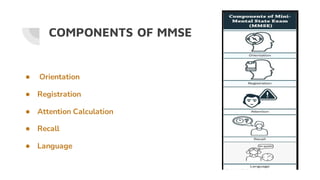
COMPONENTS OF MMSE
● Orientation
● Registration
● Attention Calculation
● Recall
● Language
ORIENTATION
● Which year is this?
● . Where are we now?
● Which State we live in?
● What is the name of this County ?
● What Season it is?
● What is today's date?
● What is the Day of the week?
● Which Month is this?
● What is the name of this city?
● • What Floor are we on?
REGISTRATION
● objects clearly and slowly, then the instructor asks the patient to
name all three of them.
● The patient's response is used for scoring.
● The examiner repeats them until patient learns all of them, if
possible. [Example
● Examiner names 3 objects (eg apple, table, car) Patient asked to
repeat (1 point for each correct)].
● Maximum score is 3
ATTENTION AND CONCENTRATION
● "I would like you to count backward
● Subtract 7 from 100, then repeat from result.
● Continue 5 times: 100 93 86 79 65
● Alternative: "Spell WORLD backwards." (D-L-R-O-W)
● Maximum score is 5
RECALL
● Earlier I told you the names of three things.
● Can you tell me what those were?"
Maximum score is 3.
LANGUAGE
● Naming: Show the patient two simple objects, such as wristwatch and a pencil, and
ask the patient to name them. 1 point for each
● Maximum score is 2
● Repetition: Ask the person to repeat the following. No ifs" & or buts" (1point).
Allow only one trial
● Maximum score is 1
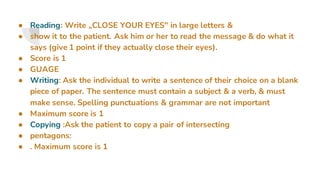
● Command: Give a 3 stage command. Score 1 for each stage. Eg. "Place index finger
of right hand on your nose and then on your left ear"
● . Maximum score is 3
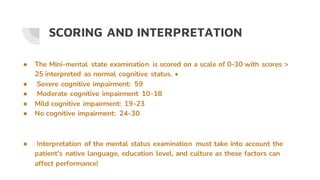
SCORING AND INTERPRETATION
● The Mini-mental state examination is scored on a scale of 0-30 with scores >
25 interpreted as normal cognitive status. •
● Severe cognitive impairment: 59
● Moderate cognitive impairment 10-18
● Mild cognitive impairment: 19-23
● No cognitive impairment: 24-30
● Interpretation of the mental status examination must take into account the
patient's native language, education level, and culture as these factors can
affect performance!
ADVANTAGES OF MMSE
● >Relatively quick and easy to perform
● Requires no additional equipment
● Can provide a method of monitoring
deterioration over time
DISADVANTAGES OF MMSE
● Biased against people with poor education due to elements of
language and mathematical testing
● - Bias against visually impaired -
● Limited examination of visuospatial
● cognitive ability
● Poor sensitivity at detected mild/early dementia
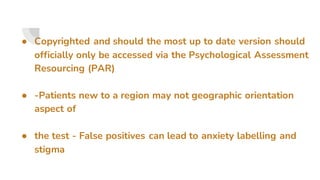
● Copyrighted and should the most up to date version should
officially only be accessed via the Psychological Assessment
Resourcing (PAR)
● -Patients new to a region may not geographic orientation
aspect of
● the test - False positives can lead to anxiety labelling and
stigma
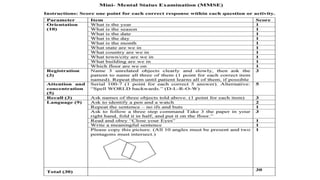
FORMAT OF
MMSE
mini mental status examination final.pdf

mini mental status examination final.pdf

  • 1.
    MENTAL HEALTH NURSING MMSE Submittedto : Prerna ma’am Presented by: Tutor college of nursing Rashi Nirwan 06350306619 BSC (H) NSG.4TH VMMC and sjh.
  • 2.
    INTRODUCTION The Mini-Mental StateExamination (MMSE) or Folstein test is a 30-point questionnaire that is used extensively in clinical and research settings to measure cognitive impairment. Itwas developed by Dr. Marshall Folstein in the year of 1975 The Mini-Mental State Exam (MMSE) is a widely used test of cognitive function among the elderly: it includes tests of orientation, attention, memory, language and visual-spatial skills. The mini-mental state examination is proprietary and takes about 10-15 minutes to administer.
  • 3.
    DEFINITION The Mini-Mental statusExamination is a cognitive test to screen for the presence of cognitive impairment example Dementia
  • 4.
    Purpose of MMSE Itis useful in helping differentiate between a variety of systemic conditions, as well as neurologic and psychiatric disorders ranging from delirium and dementia to bipolar disorder and schizophrenia.
  • 5.
    COMPONENTS OF MMSE ●Orientation ● Registration ● Attention Calculation ● Recall ● Language
  • 6.
    ORIENTATION ● Which yearis this? ● . Where are we now? ● Which State we live in? ● What is the name of this County ? ● What Season it is? ● What is today's date? ● What is the Day of the week? ● Which Month is this? ● What is the name of this city? ● • What Floor are we on?
  • 8.
    REGISTRATION ● objects clearlyand slowly, then the instructor asks the patient to name all three of them. ● The patient's response is used for scoring. ● The examiner repeats them until patient learns all of them, if possible. [Example ● Examiner names 3 objects (eg apple, table, car) Patient asked to repeat (1 point for each correct)]. ● Maximum score is 3
  • 10.
    ATTENTION AND CONCENTRATION ●"I would like you to count backward ● Subtract 7 from 100, then repeat from result. ● Continue 5 times: 100 93 86 79 65 ● Alternative: "Spell WORLD backwards." (D-L-R-O-W) ● Maximum score is 5
  • 12.
    RECALL ● Earlier Itold you the names of three things. ● Can you tell me what those were?" Maximum score is 3.
  • 14.
    LANGUAGE ● Naming: Showthe patient two simple objects, such as wristwatch and a pencil, and ask the patient to name them. 1 point for each ● Maximum score is 2 ● Repetition: Ask the person to repeat the following. No ifs" & or buts" (1point). Allow only one trial ● Maximum score is 1 ● Command: Give a 3 stage command. Score 1 for each stage. Eg. "Place index finger of right hand on your nose and then on your left ear" ● . Maximum score is 3
  • 18.
    SCORING AND INTERPRETATION ●The Mini-mental state examination is scored on a scale of 0-30 with scores > 25 interpreted as normal cognitive status. • ● Severe cognitive impairment: 59 ● Moderate cognitive impairment 10-18 ● Mild cognitive impairment: 19-23 ● No cognitive impairment: 24-30 ● Interpretation of the mental status examination must take into account the patient's native language, education level, and culture as these factors can affect performance!
  • 19.
    ADVANTAGES OF MMSE ●>Relatively quick and easy to perform ● Requires no additional equipment ● Can provide a method of monitoring deterioration over time
  • 20.
    DISADVANTAGES OF MMSE ●Biased against people with poor education due to elements of language and mathematical testing ● - Bias against visually impaired - ● Limited examination of visuospatial ● cognitive ability ● Poor sensitivity at detected mild/early dementia
  • 21.
    ● Copyrighted andshould the most up to date version should officially only be accessed via the Psychological Assessment Resourcing (PAR) ● -Patients new to a region may not geographic orientation aspect of ● the test - False positives can lead to anxiety labelling and stigma
  • 22.