INTERNAL
JUGULAR
CENTRAL
VENOUS
ACCESS
dr. Erka Wahyu Kinanda – KIN
Supervisor : dr. Yuddy Imowanto,
Sp. EM, KEC
LIST OF
CONTENTS
• History
• Anatomy
• Indications
• Contraindic
ations
• Complicatio
ns
• Advantages
vs
Disadvantag
es
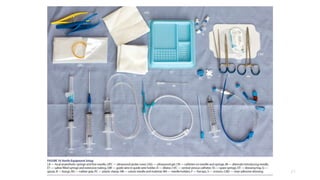
• Equipment
• Preparation
• Procedures
• Summary
2
History
3
• Infraclavicular (IC) Subclavian
venipuncture - first described by
Aubaniac in 1952
• In 1965, the supraclavicular (SC)
approach was described
• IJ approach (later known as the
central approach) was described
in 1966
• Later on came the Femoral and
cephalic-basilic approaches
4
Anatomy
5
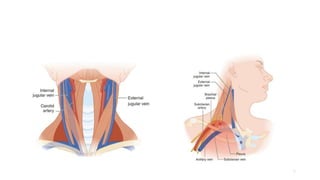
• Course:
• Origin from jugular foramen
• Joins subclavian vein behind sternal extremity of clavicle
• Medial relations: internal and common carotid arteries, 9th to 12th
cranial nerves above common carotid artery and vagus
• Anterolateral relations: skin, superficial fascia, platysma,
cervical fascia, sternomastoid, sternohyoid, omohyoid
• Posterior relations: transverse process of the cervical vertebrae,
levator scapulae, scalenus medius and anterior, cervical plexus,
phrenic nerve, thyrocervical trunk, vertebral vein, 1st part of
subclavian artery
• Tributaries:
• Inferior petrosal sinus, facial, pharyngeal, lingual, superior
thyroid, middle thyroid, occipital veins
6
7
Indications
8
• Secure or long-term venous
access that is not available
using other sites
• Inability to obtain
peripheral venous access or
intraosseous infusion
• IV infusion of fluids and
drugs for patients in
cardiac arrest
• IV infusion of concentrated
or irritating fluids
• IV infusion of high flows or
large fluid volumes beyond
what is possible using
9
• Monitoring of central venous
pressure (CVP)
• Hemodialysis or
plasmapheresis
• Transvenous cardiac pacing
or pulmonary arterial
monitoring (Swan-Ganz
catheter)*
• Placement of inferior vena
cava filter
*For transvenous cardiac
pacing or pulmonary arterial 10
Contraindication
s
11
Absolute
Contraindications
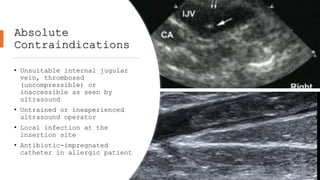
• Unsuitable internal jugular
vein, thrombosed
(uncompressible) or
inaccessible as seen by
ultrasound
• Untrained or inexperienced
ultrasound operator
• Local infection at the
insertion site
• Antibiotic-impregnated
catheter in allergic patient
12
Relative Contraindications
• Coagulopathy, including therapeutic anticoagulation*
• Local anatomic distortion, traumatic or congenital, or gross
obesity
• Malignant superior vena cava syndrome
• Severe cardiorespiratory insufficiency or increased intracranial
or intraocular pressure (patients will be compromised by
Trendelenburg [head down] positioning)
13
Relative Contraindications
• History of prior catheterization of the intended central vein
• Uncooperative patient (should be sedated if necessary)
• Left bundle branch block (a guidewire or catheter in the right
ventricle can induce complete heart block)
* Therapeutic anticoagulation (eg, for pulmonary embolism)
increases the risk of bleeding with internal jugular cannulation,
but this must be balanced against the increased risk of
thrombosis (eg, stroke) if anticoagulation is reversed. Discuss
any contemplated reversal with the clinician managing the
patient's anticoagulation and then with the patient. A femoral
line may be preferred.
14
Complications
15
• Arterial puncture
• Hematoma
• Pneumothorax
• Damage to the vein
• Hemothorax
• Air embolism
• Catheter misplacement*
16
• Arrhythmias or atrial
perforation, typically caused by
guidewire or catheter
• Nerve damage
• Infection
• Thrombosis
* Rare complications due to
catheter misplacement include
arterial catheterization,
hydrothorax, hydromediastinum, and
damage to the tricuspid valve.
Guidewire or catheter embolism also
rarely occurs.
To reduce the risk of venous
17
18
Advantages vs
Disadvantages
19
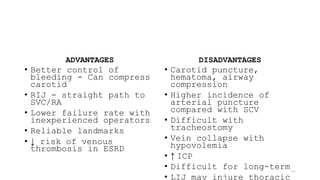
ADVANTAGES
• Better control of
bleeding - Can compress
carotid
• RIJ - straight path to
SVC/RA
• Lower failure rate with
inexperienced operators
• Reliable landmarks
• ↓ risk of venous
thrombosis in ESRD
DISADVANTAGES
• Carotid puncture,
hematoma, airway
compression
• Higher incidence of
arterial puncture
compared with SCV
• Difficult with
tracheostomy
• Vein collapse with
hypovolemia
• ↑ ICP
• Difficult for long-term
• LIJ may injure thoracic
20
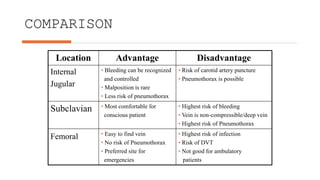
COMPARISON
Location Advantage Disadvantage
Internal
Jugular
• Bleeding can be recognized
and controlled
• Malposition is rare
• Less risk of pneumothorax
• Risk of carotid artery puncture
• Pneumothorax is possible
Subclavian • Most comfortable for
conscious patient
• Highest risk of bleeding
• Vein is non-compressible/deep vein
• Highest risk of Pneumothorax
Femoral • Easy to find vein
• No risk of Pneumothorax
• Preferred site for
emergencies
• Highest risk of infection
• Risk of DVT
• Not good for ambulatory
patients
Equipment
22
Sterile Procedure, Barrier
Protection
• Antiseptic solution (eg, chlorhexidine-alcohol,
chlorhexidine, povidone iodine, alcohol)
• Large sterile drapes, towels
• Sterile head caps, masks, gowns, gloves
• Face shields
23
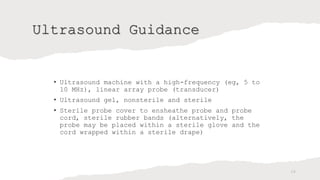
Ultrasound Guidance
• Ultrasound machine with a high-frequency (eg, 5 to
10 MHz), linear array probe (transducer)
• Ultrasound gel, nonsterile and sterile
• Sterile probe cover to ensheathe probe and probe
cord, sterile rubber bands (alternatively, the
probe may be placed within a sterile glove and the
cord wrapped within a sterile drape)
24
Seldinger (Catheter-over-
guidewire) Technique
• Cardiac monitor
• Local anesthetic (eg, 1%
lidocaine without
epinephrine, about 5 mL)
• Small anesthetic needle
(eg, 25 to 27 gauge,
about 1 inch [3 cm] long)
• Large anesthetic/finder*
needle (22 gauge, about
1.5 inches [4 cm] long)
• Introducer needle (eg,
thin-walled, 18 or 16
gauge, with internally
beveled hub, about 2.5
inches [6 cm] long)
• 3- and 5-mL syringes (use
slip-tip syringes for the
finder and introducer
needles)
• Guidewire, J-tipped
• Scalpel (#11 blade)
• Dilator
25
Seldinger (Catheter-over-
guidewire) Technique
• Central venous catheter
(adult: 8 French or
larger, minimum length
for internal jugular
catheter is 15 cm for
right side, 20 cm for
left side)
• Sterile gauze (eg, 4 × 4
inch [10 × 10 cm]
squares)
• Sterile saline for
flushing catheter port or
ports
• Nonabsorbable nylon or
silk suture (eg, 3-0 or
4-0)
• Chlorhexidine patch,
transparent occlusive
dressing
A finder needle is a
thinner needle used for
locating the vein before
inserting the introducer
needle. It is usually not
needed for ultrasound-
guided cannulations.
The external diameter of
the CVC should be less
than or equal to one third
of the internal diameter
of the vein (as measured
by ultrasound) to reduce
the risk of thrombosis.
Having an assistant or two
is helpful.
26
27
Preparation
28
• Explain risks and benefits, if possible.
• Risks include infection, pain, local bleeding
or hematoma, or pneumothorax/hemothorax.
• Ideally, the patient should be placed on a
cardiac monitor to detect any dysrhythmias
triggered while advancing with wire.
• Sterilize the neck and clavicle area with
chlorhexidine.
• Provide adequate local anesthesia.
• For the uncooperative patient, consider
sedation. 29
30
31
Procedures
32
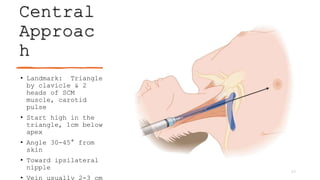
Central
Approac
h
• Landmark: Triangle
by clavicle & 2
heads of SCM
muscle, carotid
pulse
• Start high in the
triangle, 1cm below
apex
• Angle 30-45° from
skin
• Toward ipsilateral
nipple
• Vein usually 2-3 cm
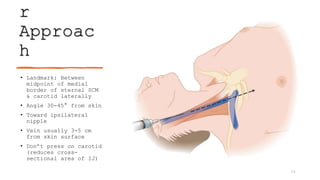
33
r
Approac
h
• Landmark: Between
midpoint of medial
border of sternal SCM
& carotid laterally
• Angle 30-45° from skin
• Toward ipsilateral
nipple
• Vein usually 3-5 cm
from skin surface
• Don’t press on carotid
(reduces cross-
sectional area of IJ)
34
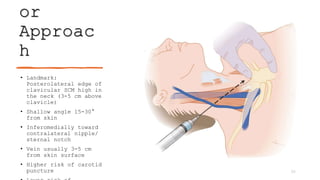
or
Approac
h
• Landmark:
Posterolateral edge of
clavicular SCM high in
the neck (3-5 cm above
clavicle)
• Shallow angle 15-30°
from skin
• Inferomedially toward
contralateral nipple/
sternal notch
• Vein usually 3-5 cm
from skin surface
• Higher risk of carotid
puncture 35
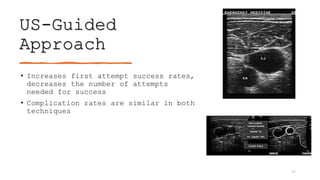
US-Guided
Approach
• Increases first attempt success rates,
decreases the number of attempts
needed for success
• Complication rates are similar in both
techniques
36
37
Summary
38
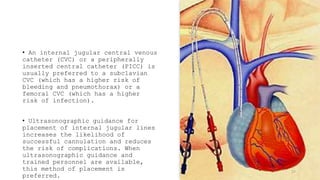
• An internal jugular central venous
catheter (CVC) or a peripherally
inserted central catheter (PICC) is
usually preferred to a subclavian
CVC (which has a higher risk of
bleeding and pneumothorax) or a
femoral CVC (which has a higher
risk of infection).
• Ultrasonographic guidance for
placement of internal jugular lines
increases the likelihood of
successful cannulation and reduces
the risk of complications. When
ultrasonographic guidance and
trained personnel are available,
this method of placement is
preferred.
39
LIST OF
REFERENCE
S
• le Fevre, P. (n.d.). written and illustrated by
Central Venous Catheter Insertion Guide Central
Venous Catheter Insertion Guide About This Guide.
www.philippelefevre.com
• Mendenhall BR, Wilson C, Singh K, et al. Internal
Jugular Vein Central Venous Access. [Updated 2023
Aug 14]. In: StatPearls [Internet]. Treasure Island
(FL): StatPearls Publishing; 2024 Jan-. Available
from: https://www.ncbi.nlm.nih.gov/books/NBK436020/
• Central venous catheter insertion (Internal jugular
vein) - YouTube. (n.d.). Retrieved June 3, 2024,
from https://www.youtube.com/watch?v=O75D99DxWmM
• How To Do Internal Jugular Vein Cannulation,
Ultrasound-Guided - Critical Care Medicine - MSD
Manual Professional Edition. (n.d.). Retrieved June
3, 2024, from
https://www.msdmanuals.com/professional/critical-
care-medicine/how-to-do-central-vascular-
procedures/how-to-do-internal-jugular-vein-
cannulation,-ultrasound-guided
• Central Venous Catheters • LITFL Medical Blog • CCC.
(n.d.). Retrieved June 3, 2024, from
https://litfl.com/central-venous-catheters/
40
THANK YOU
41

Internal Jugular Central Venous Access.pptx

  • 1.
    INTERNAL JUGULAR CENTRAL VENOUS ACCESS dr. Erka WahyuKinanda – KIN Supervisor : dr. Yuddy Imowanto, Sp. EM, KEC
  • 2.
    LIST OF CONTENTS • History •Anatomy • Indications • Contraindic ations • Complicatio ns • Advantages vs Disadvantag es • Equipment • Preparation • Procedures • Summary 2
  • 3.
  • 4.
    • Infraclavicular (IC)Subclavian venipuncture - first described by Aubaniac in 1952 • In 1965, the supraclavicular (SC) approach was described • IJ approach (later known as the central approach) was described in 1966 • Later on came the Femoral and cephalic-basilic approaches 4
  • 5.
  • 6.
    • Course: • Originfrom jugular foramen • Joins subclavian vein behind sternal extremity of clavicle • Medial relations: internal and common carotid arteries, 9th to 12th cranial nerves above common carotid artery and vagus • Anterolateral relations: skin, superficial fascia, platysma, cervical fascia, sternomastoid, sternohyoid, omohyoid • Posterior relations: transverse process of the cervical vertebrae, levator scapulae, scalenus medius and anterior, cervical plexus, phrenic nerve, thyrocervical trunk, vertebral vein, 1st part of subclavian artery • Tributaries: • Inferior petrosal sinus, facial, pharyngeal, lingual, superior thyroid, middle thyroid, occipital veins 6
  • 7.
  • 8.
  • 9.
    • Secure orlong-term venous access that is not available using other sites • Inability to obtain peripheral venous access or intraosseous infusion • IV infusion of fluids and drugs for patients in cardiac arrest • IV infusion of concentrated or irritating fluids • IV infusion of high flows or large fluid volumes beyond what is possible using 9
  • 10.
    • Monitoring ofcentral venous pressure (CVP) • Hemodialysis or plasmapheresis • Transvenous cardiac pacing or pulmonary arterial monitoring (Swan-Ganz catheter)* • Placement of inferior vena cava filter *For transvenous cardiac pacing or pulmonary arterial 10
  • 11.
  • 12.
    Absolute Contraindications • Unsuitable internaljugular vein, thrombosed (uncompressible) or inaccessible as seen by ultrasound • Untrained or inexperienced ultrasound operator • Local infection at the insertion site • Antibiotic-impregnated catheter in allergic patient 12
  • 13.
    Relative Contraindications • Coagulopathy,including therapeutic anticoagulation* • Local anatomic distortion, traumatic or congenital, or gross obesity • Malignant superior vena cava syndrome • Severe cardiorespiratory insufficiency or increased intracranial or intraocular pressure (patients will be compromised by Trendelenburg [head down] positioning) 13
  • 14.
    Relative Contraindications • Historyof prior catheterization of the intended central vein • Uncooperative patient (should be sedated if necessary) • Left bundle branch block (a guidewire or catheter in the right ventricle can induce complete heart block) * Therapeutic anticoagulation (eg, for pulmonary embolism) increases the risk of bleeding with internal jugular cannulation, but this must be balanced against the increased risk of thrombosis (eg, stroke) if anticoagulation is reversed. Discuss any contemplated reversal with the clinician managing the patient's anticoagulation and then with the patient. A femoral line may be preferred. 14
  • 15.
  • 16.
    • Arterial puncture •Hematoma • Pneumothorax • Damage to the vein • Hemothorax • Air embolism • Catheter misplacement* 16
  • 17.
    • Arrhythmias oratrial perforation, typically caused by guidewire or catheter • Nerve damage • Infection • Thrombosis * Rare complications due to catheter misplacement include arterial catheterization, hydrothorax, hydromediastinum, and damage to the tricuspid valve. Guidewire or catheter embolism also rarely occurs. To reduce the risk of venous 17
  • 18.
  • 19.
  • 20.
    ADVANTAGES • Better controlof bleeding - Can compress carotid • RIJ - straight path to SVC/RA • Lower failure rate with inexperienced operators • Reliable landmarks • ↓ risk of venous thrombosis in ESRD DISADVANTAGES • Carotid puncture, hematoma, airway compression • Higher incidence of arterial puncture compared with SCV • Difficult with tracheostomy • Vein collapse with hypovolemia • ↑ ICP • Difficult for long-term • LIJ may injure thoracic 20
  • 21.
    COMPARISON Location Advantage Disadvantage Internal Jugular •Bleeding can be recognized and controlled • Malposition is rare • Less risk of pneumothorax • Risk of carotid artery puncture • Pneumothorax is possible Subclavian • Most comfortable for conscious patient • Highest risk of bleeding • Vein is non-compressible/deep vein • Highest risk of Pneumothorax Femoral • Easy to find vein • No risk of Pneumothorax • Preferred site for emergencies • Highest risk of infection • Risk of DVT • Not good for ambulatory patients
  • 22.
  • 23.
    Sterile Procedure, Barrier Protection •Antiseptic solution (eg, chlorhexidine-alcohol, chlorhexidine, povidone iodine, alcohol) • Large sterile drapes, towels • Sterile head caps, masks, gowns, gloves • Face shields 23
  • 24.
    Ultrasound Guidance • Ultrasoundmachine with a high-frequency (eg, 5 to 10 MHz), linear array probe (transducer) • Ultrasound gel, nonsterile and sterile • Sterile probe cover to ensheathe probe and probe cord, sterile rubber bands (alternatively, the probe may be placed within a sterile glove and the cord wrapped within a sterile drape) 24
  • 25.
    Seldinger (Catheter-over- guidewire) Technique •Cardiac monitor • Local anesthetic (eg, 1% lidocaine without epinephrine, about 5 mL) • Small anesthetic needle (eg, 25 to 27 gauge, about 1 inch [3 cm] long) • Large anesthetic/finder* needle (22 gauge, about 1.5 inches [4 cm] long) • Introducer needle (eg, thin-walled, 18 or 16 gauge, with internally beveled hub, about 2.5 inches [6 cm] long) • 3- and 5-mL syringes (use slip-tip syringes for the finder and introducer needles) • Guidewire, J-tipped • Scalpel (#11 blade) • Dilator 25
  • 26.
    Seldinger (Catheter-over- guidewire) Technique •Central venous catheter (adult: 8 French or larger, minimum length for internal jugular catheter is 15 cm for right side, 20 cm for left side) • Sterile gauze (eg, 4 × 4 inch [10 × 10 cm] squares) • Sterile saline for flushing catheter port or ports • Nonabsorbable nylon or silk suture (eg, 3-0 or 4-0) • Chlorhexidine patch, transparent occlusive dressing A finder needle is a thinner needle used for locating the vein before inserting the introducer needle. It is usually not needed for ultrasound- guided cannulations. The external diameter of the CVC should be less than or equal to one third of the internal diameter of the vein (as measured by ultrasound) to reduce the risk of thrombosis. Having an assistant or two is helpful. 26
  • 27.
  • 28.
  • 29.
    • Explain risksand benefits, if possible. • Risks include infection, pain, local bleeding or hematoma, or pneumothorax/hemothorax. • Ideally, the patient should be placed on a cardiac monitor to detect any dysrhythmias triggered while advancing with wire. • Sterilize the neck and clavicle area with chlorhexidine. • Provide adequate local anesthesia. • For the uncooperative patient, consider sedation. 29
  • 30.
  • 31.
  • 32.
  • 33.
    Central Approac h • Landmark: Triangle byclavicle & 2 heads of SCM muscle, carotid pulse • Start high in the triangle, 1cm below apex • Angle 30-45° from skin • Toward ipsilateral nipple • Vein usually 2-3 cm 33
  • 34.
    r Approac h • Landmark: Between midpointof medial border of sternal SCM & carotid laterally • Angle 30-45° from skin • Toward ipsilateral nipple • Vein usually 3-5 cm from skin surface • Don’t press on carotid (reduces cross- sectional area of IJ) 34
  • 35.
    or Approac h • Landmark: Posterolateral edgeof clavicular SCM high in the neck (3-5 cm above clavicle) • Shallow angle 15-30° from skin • Inferomedially toward contralateral nipple/ sternal notch • Vein usually 3-5 cm from skin surface • Higher risk of carotid puncture 35
  • 36.
    US-Guided Approach • Increases firstattempt success rates, decreases the number of attempts needed for success • Complication rates are similar in both techniques 36
  • 37.
  • 38.
  • 39.
    • An internaljugular central venous catheter (CVC) or a peripherally inserted central catheter (PICC) is usually preferred to a subclavian CVC (which has a higher risk of bleeding and pneumothorax) or a femoral CVC (which has a higher risk of infection). • Ultrasonographic guidance for placement of internal jugular lines increases the likelihood of successful cannulation and reduces the risk of complications. When ultrasonographic guidance and trained personnel are available, this method of placement is preferred. 39
  • 40.
    LIST OF REFERENCE S • leFevre, P. (n.d.). written and illustrated by Central Venous Catheter Insertion Guide Central Venous Catheter Insertion Guide About This Guide. www.philippelefevre.com • Mendenhall BR, Wilson C, Singh K, et al. Internal Jugular Vein Central Venous Access. [Updated 2023 Aug 14]. In: StatPearls [Internet]. Treasure Island (FL): StatPearls Publishing; 2024 Jan-. Available from: https://www.ncbi.nlm.nih.gov/books/NBK436020/ • Central venous catheter insertion (Internal jugular vein) - YouTube. (n.d.). Retrieved June 3, 2024, from https://www.youtube.com/watch?v=O75D99DxWmM • How To Do Internal Jugular Vein Cannulation, Ultrasound-Guided - Critical Care Medicine - MSD Manual Professional Edition. (n.d.). Retrieved June 3, 2024, from https://www.msdmanuals.com/professional/critical- care-medicine/how-to-do-central-vascular- procedures/how-to-do-internal-jugular-vein- cannulation,-ultrasound-guided • Central Venous Catheters • LITFL Medical Blog • CCC. (n.d.). Retrieved June 3, 2024, from https://litfl.com/central-venous-catheters/ 40
  • 41.

Editor's Notes

  • #8 Kursus: Asal dari foramen jugularis Bergabung dengan vena subklavia di belakang ekstremitas sternum klavikula Hubungan medial: arteri karotis internal dan umum, saraf kranial ke-9 hingga ke-12 di atas arteri karotis umum dan vagus Hubungan anterolateral: kulit, fasia superfisial, platysma, fasia serviks, sternomastoid, sternohyoid, omohyoid Hubungan posterior: proses transversal vertebra serviks, levator scapulae, scalenus medius dan anterior, pleksus serviks, saraf frenikus, batang tiroserviks, vena vertebralis, bagian 1 arteri subklavia Anak sungai: Sinus petrosal inferior, wajah, faring, lingual, tiroid superior, tiroid tengah, vena oksipital