LECTURER: UMAR TARIQ
MSC OTT/ANAESTHESIA
INTRODUCTION
 Breathing circuits connects the patient to the
anaesthesia machine through endotracheal tube or
mask.
 These are divide into:
Open system
Semi-closed system
Closed system
OPEN SYSTEM
 This is now the obsolete technique .
 Inhalational agent is directly poured over patients
mouth and nostril.
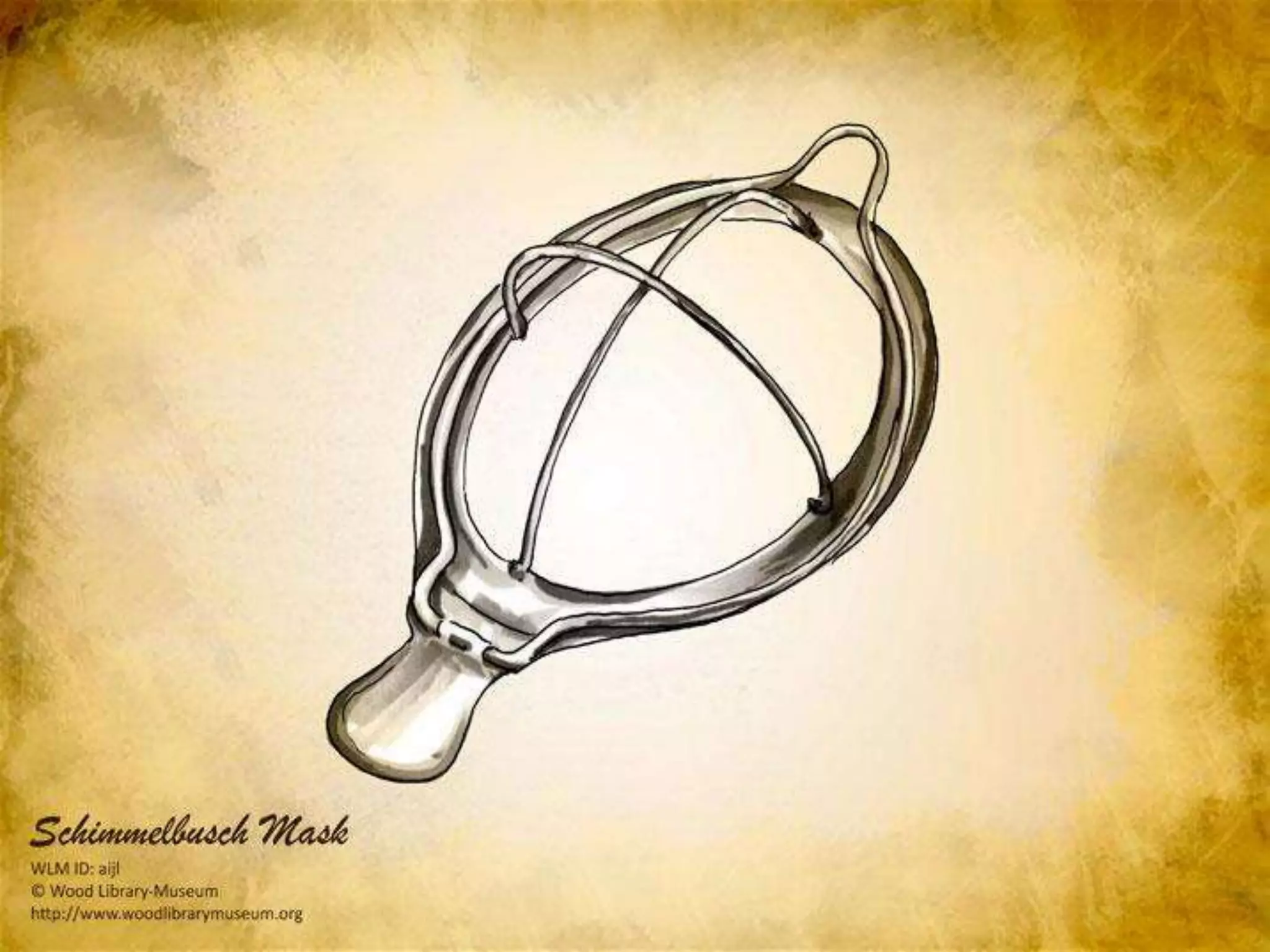
 A mask called a Schimmelbush mask is placed over
patient mouth over which a layer of gauge piece is put
and inhalational agent (especially ether) is poured in
drops (open drop anaesthesia)
Disadvantages
 There is a lot of wastage and uncontrollable pollution.
 Accurate concentration can not be delivered.
 Time consuming induction.
 Gauge piece may become sodden and increases the dead
space
 Fire hazard
 Skin and eye irritation
If a folded towel is placed over schimmelbusch mask to
prevent early escape of inhalation agent it constitutes semi
open system.
Other gases which can be given by open method are
chloroform and ethyl chloride.
SEMICLOSED CIRCUITS
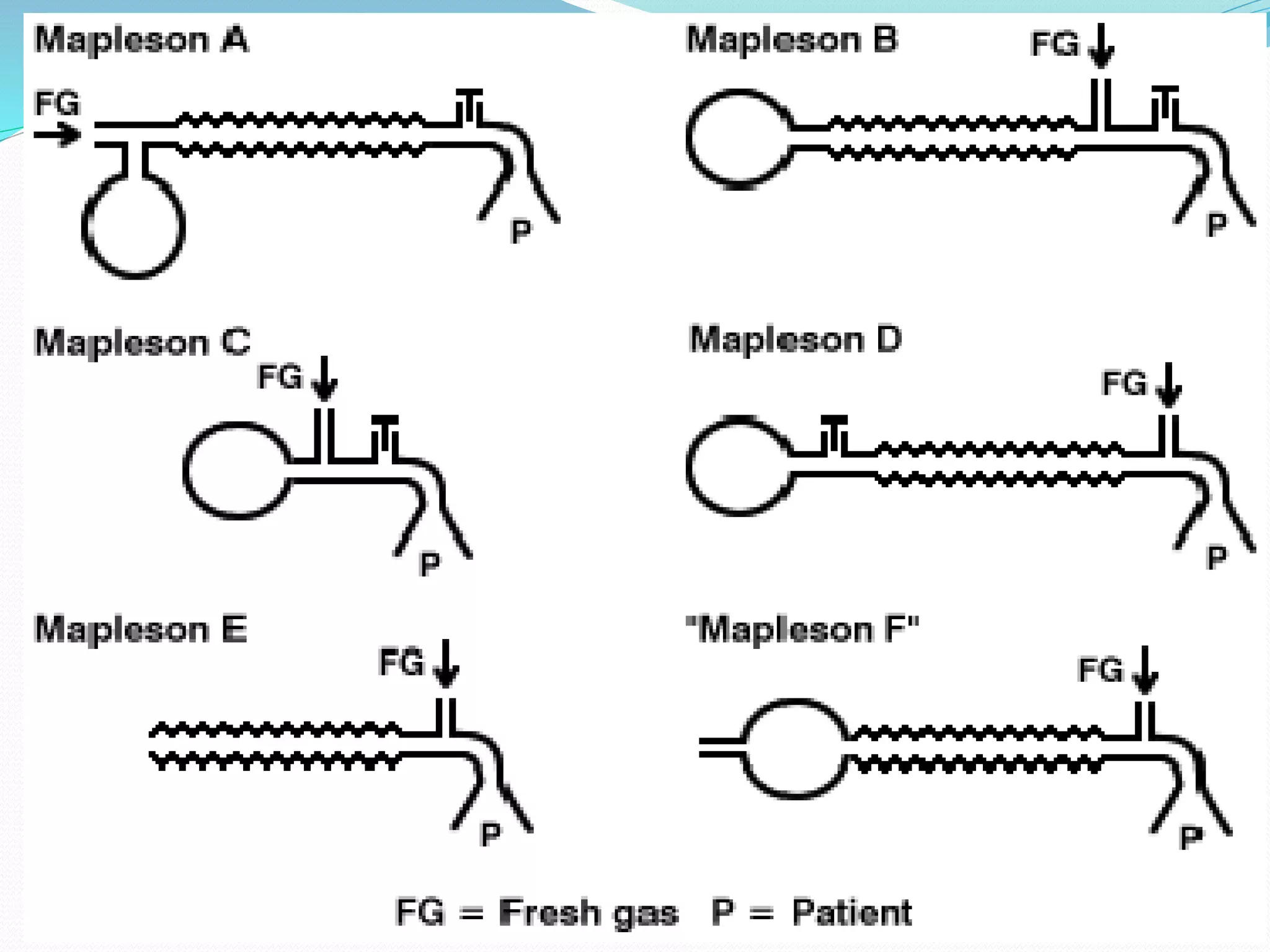
 These circuits were described by MAPELSON
therefore also called as Mapelson circuits.
 These are divided into six types:
Type A, B , C, D, E , F
Because of similarity in characteristics some authors
have classified them in 3 groups- A, BC, DEF
Type A
 Also called as Magill circuit.
 Fresh gases coming from machine reaches the patient.
 Exhaled gases from patient are mostly exhaled from
pressure relief valve but some of the gases go back in
tubing(that is why these circuits are called semi closed
circuits)
 The expiratory gases which has gone back in the
tubing may be reinhaled by the patient in next breath.
This is called as rebreathing
 APL valve is at the patients end.
 Fresh gas flow should be equal to minute
volume(70ml/kg/min).
 Circuit of choice for spontaneous ventilation.
 It is not suitable for use with children of less than 25-
30 kg body weight. This is because of increased dead
space.
 It should not be used in controlled ventilation
Type B
 Fresh gas flow inlet brought near APL valve
 It does not offer any advantage, so is no more used.
 Functionally almost equally efficient for spontaneous
and controlled ventilation
Type C
 Corrugated tubing is shortened
 Also called as Water`s circuit.
 Functionally almost equally efficient for spontaneous
and controlled ventilation
 Offers no advantage and is no more used
Type D
 APL valve is brought near the bag
 Modification was made by Bain that it why it is also
called as Bain`s circuit.
 Bain made it a coaxial system in which a fresh gases are
delivered through a inner tube so that mixing of fresh
gases and exhaled gases can be minimized.
 Bain`s circuit is most commonly used semiclosed
circuit in anaesthesia
 Bain`s circuit is a circuit of choice for controlled
ventilation
 Fresh gas flow for controlled ventilation is 1.6 times of
minute ventilation at normal respiratory rates(12
breaths/min)
 70-100 ml/kg/min (which is equal to minute
ventilation) if respiratory rate is increased to 16
breaths/min
 Bain circuit can be used for spontaneous ventilation
but fresh gas requirement is higher ,2.5 times of
minute ventilation
Advantages of Bain circuit
 Light weight
 Corrugated tube is long(1.8 meter), so good for head
and neck surgeries where anaesthetist is away from
patient and there is less fire hazard as exhaled gases
escapes away from machine.
 Less resistant
 Sterilization is easy
 Outer tube is transparent
Disadvantages
 Inner tube may become folded or kinked causing
obstruction or may get disconnected.
TYPE E
 It is Ayer`s T piece with corrugated tubing.
 Paediatric circuit.
 It does not have breathing bag, so it is not a complete
circuit.
 It is only for spontaneous ventilation as it does not
contain breathing bag.
 It can be used for controlled ventilation by occluding
the expiratory limb .
TYPE F
 It is a modification of Ayer`s T piece
 Most commonly used semi closed circuit used in
children <6years of age or less than 20 kg.
 Fresh gas flow is similar to Bain i.e. 1.6 times of minute
volume for controlled ventilation. and 2.5 times of
minute volume for spontaneous ventilation
 Type E and Type F circuits are valve less to decrease
the resistance
 F circuits have holes in the tail of bag but valve may be
present in some type of F circuits
CLOSED CIRCUIT
 In human being`s this technique was used by Water`s
in 1923
 In this system no gas escapes to atmosphere( that`s
why called as closed circuit) ,
 Exhaled gases after absorption of carbon dioxide are
re-inhaled by the patient .
 Same gases can be re-used very low flows are
sufficient therefore anaesthesia given with closed
circuit is called as low flow anaesthesia
 There are two types of closed circuits:
1. CIRCLE SYSTEM: commonly used
2. TO & FRO SYSTEM; no more used
CIRCLE SYSTEM
 The exhaled gases of patient through expiratory limb
reaches sodalime canister containing sodalime which
absorbs carbon dioxide and the same gases can be
reused. Since the same gases are in circulation they are
called as circle system.
 The advantage is that it is very economical ( same gases
and inhalational agents can be reused)
 The canister are made up of transparent plastic material
and have capacity of 4 lb
CARBON DIOXIDE ABSORBANT
SODALIME:
Soda lime is the most commonly used carbon dioxide
absorbent.
COMPOSITION OF SODALIME :
• Ca(OH)2 : 94%
• NaOH : 5%
• KOH : 1%
• Indicator
• Silica (to prevent dust formation)
COLOUR INDICATORS OF
SODALIME
 There are many colour indicators used with sodalime
1. Ethyl violet: which is white when fresh and becomes
purple on exhaustion.
2. Phenolphthalein: white when fresh and becomes pink on
exhaustion
3. Clayton: red when fresh and becomes yellow on
exhaustion
4. Durasorb : which is pink on fresh and becomes white on
exhaustion. Most commonly used and is a good quality
sodalime with prolonged life.
SO ,Colour change of indicator is one of the signs of
exhaustion of sodalime
Other signs of exhaustion
 Tachycardia
 Hypertension
 Increased oozing from wound site
 Increased end tidal CO2 on capnography
Properties of sodalime granules
 Hardness of granule should be more than 75% . Sodalime
is made hard by adding silica.
 Moisture (14-19 %) is needed for CO2 absorption.
 Size of sodalime granule is 4-8 mesh(or 3-6 mm).
 CO2 absorption is heat generating process. A lot of
calories and water is produced during reaction.
 1 lb canister lasts for 2 hours if used continuously.
 100 gram of sodalime can absorb 24 to 26 liters of carbon
dioxide.
Factors affecting carbon dioxide
absorption in closed circuit
1. Freshness of sodalime: fresh absorbent has better
carbon-dioxide absorbing capacity
2. Tidal volume of patient: large tidal volume will pass
through canister without CO2 being absorbed
3. High flow : high flows allows less time for CO2
absorption
4. Dead space
5. Inadequate filling of sodalime
Breathing circuits
Breathing circuits

Breathing circuits

  • 1.
    LECTURER: UMAR TARIQ MSCOTT/ANAESTHESIA
  • 2.
    INTRODUCTION  Breathing circuitsconnects the patient to the anaesthesia machine through endotracheal tube or mask.  These are divide into: Open system Semi-closed system Closed system
  • 3.
    OPEN SYSTEM  Thisis now the obsolete technique .  Inhalational agent is directly poured over patients mouth and nostril.  A mask called a Schimmelbush mask is placed over patient mouth over which a layer of gauge piece is put and inhalational agent (especially ether) is poured in drops (open drop anaesthesia)
  • 7.
    Disadvantages  There isa lot of wastage and uncontrollable pollution.  Accurate concentration can not be delivered.  Time consuming induction.  Gauge piece may become sodden and increases the dead space  Fire hazard  Skin and eye irritation If a folded towel is placed over schimmelbusch mask to prevent early escape of inhalation agent it constitutes semi open system. Other gases which can be given by open method are chloroform and ethyl chloride.
  • 8.
    SEMICLOSED CIRCUITS  Thesecircuits were described by MAPELSON therefore also called as Mapelson circuits.  These are divided into six types: Type A, B , C, D, E , F Because of similarity in characteristics some authors have classified them in 3 groups- A, BC, DEF
  • 10.
    Type A  Alsocalled as Magill circuit.  Fresh gases coming from machine reaches the patient.  Exhaled gases from patient are mostly exhaled from pressure relief valve but some of the gases go back in tubing(that is why these circuits are called semi closed circuits)  The expiratory gases which has gone back in the tubing may be reinhaled by the patient in next breath. This is called as rebreathing
  • 11.
     APL valveis at the patients end.  Fresh gas flow should be equal to minute volume(70ml/kg/min).  Circuit of choice for spontaneous ventilation.  It is not suitable for use with children of less than 25- 30 kg body weight. This is because of increased dead space.  It should not be used in controlled ventilation
  • 14.
    Type B  Freshgas flow inlet brought near APL valve  It does not offer any advantage, so is no more used.  Functionally almost equally efficient for spontaneous and controlled ventilation
  • 16.
    Type C  Corrugatedtubing is shortened  Also called as Water`s circuit.  Functionally almost equally efficient for spontaneous and controlled ventilation  Offers no advantage and is no more used
  • 18.
    Type D  APLvalve is brought near the bag  Modification was made by Bain that it why it is also called as Bain`s circuit.  Bain made it a coaxial system in which a fresh gases are delivered through a inner tube so that mixing of fresh gases and exhaled gases can be minimized.  Bain`s circuit is most commonly used semiclosed circuit in anaesthesia  Bain`s circuit is a circuit of choice for controlled ventilation
  • 21.
     Fresh gasflow for controlled ventilation is 1.6 times of minute ventilation at normal respiratory rates(12 breaths/min)  70-100 ml/kg/min (which is equal to minute ventilation) if respiratory rate is increased to 16 breaths/min  Bain circuit can be used for spontaneous ventilation but fresh gas requirement is higher ,2.5 times of minute ventilation
  • 22.
    Advantages of Baincircuit  Light weight  Corrugated tube is long(1.8 meter), so good for head and neck surgeries where anaesthetist is away from patient and there is less fire hazard as exhaled gases escapes away from machine.  Less resistant  Sterilization is easy  Outer tube is transparent
  • 23.
    Disadvantages  Inner tubemay become folded or kinked causing obstruction or may get disconnected.
  • 24.
    TYPE E  Itis Ayer`s T piece with corrugated tubing.  Paediatric circuit.  It does not have breathing bag, so it is not a complete circuit.  It is only for spontaneous ventilation as it does not contain breathing bag.  It can be used for controlled ventilation by occluding the expiratory limb .
  • 25.
    TYPE F  Itis a modification of Ayer`s T piece  Most commonly used semi closed circuit used in children <6years of age or less than 20 kg.  Fresh gas flow is similar to Bain i.e. 1.6 times of minute volume for controlled ventilation. and 2.5 times of minute volume for spontaneous ventilation  Type E and Type F circuits are valve less to decrease the resistance  F circuits have holes in the tail of bag but valve may be present in some type of F circuits
  • 26.
    CLOSED CIRCUIT  Inhuman being`s this technique was used by Water`s in 1923  In this system no gas escapes to atmosphere( that`s why called as closed circuit) ,  Exhaled gases after absorption of carbon dioxide are re-inhaled by the patient .  Same gases can be re-used very low flows are sufficient therefore anaesthesia given with closed circuit is called as low flow anaesthesia
  • 27.
     There aretwo types of closed circuits: 1. CIRCLE SYSTEM: commonly used 2. TO & FRO SYSTEM; no more used
  • 28.
    CIRCLE SYSTEM  Theexhaled gases of patient through expiratory limb reaches sodalime canister containing sodalime which absorbs carbon dioxide and the same gases can be reused. Since the same gases are in circulation they are called as circle system.  The advantage is that it is very economical ( same gases and inhalational agents can be reused)  The canister are made up of transparent plastic material and have capacity of 4 lb
  • 29.
    CARBON DIOXIDE ABSORBANT SODALIME: Sodalime is the most commonly used carbon dioxide absorbent. COMPOSITION OF SODALIME : • Ca(OH)2 : 94% • NaOH : 5% • KOH : 1% • Indicator • Silica (to prevent dust formation)
  • 30.
    COLOUR INDICATORS OF SODALIME There are many colour indicators used with sodalime 1. Ethyl violet: which is white when fresh and becomes purple on exhaustion. 2. Phenolphthalein: white when fresh and becomes pink on exhaustion 3. Clayton: red when fresh and becomes yellow on exhaustion 4. Durasorb : which is pink on fresh and becomes white on exhaustion. Most commonly used and is a good quality sodalime with prolonged life. SO ,Colour change of indicator is one of the signs of exhaustion of sodalime
  • 31.
    Other signs ofexhaustion  Tachycardia  Hypertension  Increased oozing from wound site  Increased end tidal CO2 on capnography
  • 32.
    Properties of sodalimegranules  Hardness of granule should be more than 75% . Sodalime is made hard by adding silica.  Moisture (14-19 %) is needed for CO2 absorption.  Size of sodalime granule is 4-8 mesh(or 3-6 mm).  CO2 absorption is heat generating process. A lot of calories and water is produced during reaction.  1 lb canister lasts for 2 hours if used continuously.  100 gram of sodalime can absorb 24 to 26 liters of carbon dioxide.
  • 33.
    Factors affecting carbondioxide absorption in closed circuit 1. Freshness of sodalime: fresh absorbent has better carbon-dioxide absorbing capacity 2. Tidal volume of patient: large tidal volume will pass through canister without CO2 being absorbed 3. High flow : high flows allows less time for CO2 absorption 4. Dead space 5. Inadequate filling of sodalime