Central Venous
Catheterization
UNC Emergency Medicine
Medical Student Lecture Series
Objectives
 Indications and Contraindications
 Complications
 Technique
 Basic principles
 Specifics by Site
 Tips
 Basic materials
Indications
 Central venous pressure monitoring
 Volume resuscitation
 Cardiac arrest
 Lack of peripheral access
 Infusion of hyperalimentation
 Infusion of concentrated solutions
 Placement of transvenous pacemaker
 Cardiac catheterization, pulmonary angiography
 Hemodialysis
Relative Contraindications
 Bleeding disorders
 Anticoagulation or thrombolytic therapy
 Combative patients
 Distorted local anatomy
 Cellulitis, burns, severe dermatitis at site
 Vasculitis
Complications
 Vascular
– Air embolus
– Arterial puncture
– Arteriovenous fistula
– Hematoma
– Blood clot
 Infectious
– Sepsis, cellulitis, osteomyelitis, septic arthritis
 Miscellaneous
– Dysrhythmias
– Catheter knotting or malposition
– Nerve injury
– Pneumothorax, hemothorax, hydrothorax, hemomediastinum
– Bowel or bladder perforation
Technique
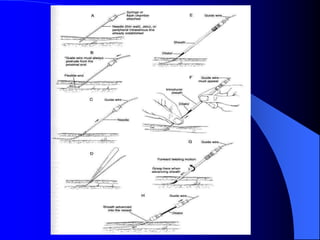
 Seldinger technique
– Use introducing needle to locate vein
– Wire is threaded through the needle
– Needle is removed
– Skin and vessel are dilated
– Catheter is placed over the wire
– Wire is removed
– Catheter is secured in place
Basic Principles
 Decide if the line is really necessary
 Know your anatomy
 Be familiar with your equipment
 Obtain optimal patient positioning and cooperation
 Take your time
 Use sterile technique
 Always have a hand on your wire
 Ask for help
 Always aspirate as you advance as you withdraw the
needle slowly
 Always withdraw the needle to the level of the skin before
redirecting the angle
 Obtain chest x-ray post line placement and review it
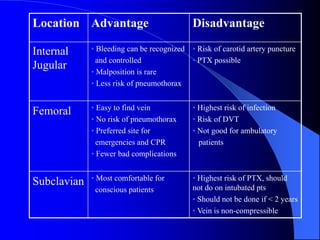
Location Advantage Disadvantage
Internal
Jugular
• Bleeding can be recognized
and controlled
• Malposition is rare
• Less risk of pneumothorax
• Risk of carotid artery puncture
• PTX possible
Femoral • Easy to find vein
• No risk of pneumothorax
• Preferred site for
emergencies and CPR
• Fewer bad complications
• Highest risk of infection
• Risk of DVT
• Not good for ambulatory
patients
Subclavian • Most comfortable for
conscious patients
• Highest risk of PTX, should
not do on intubated pts
• Should not be done if < 2 years
• Vein is non-compressible
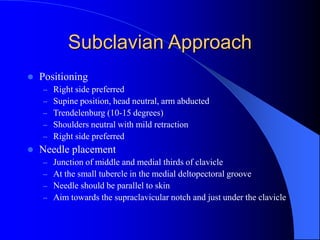
Subclavian Approach
 Positioning
– Right side preferred
– Supine position, head neutral, arm abducted
– Trendelenburg (10-15 degrees)
– Shoulders neutral with mild retraction
– Right side preferred
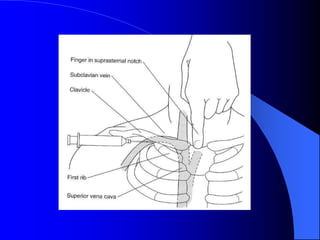
 Needle placement
– Junction of middle and medial thirds of clavicle
– At the small tubercle in the medial deltopectoral groove
– Needle should be parallel to skin
– Aim towards the supraclavicular notch and just under the clavicle
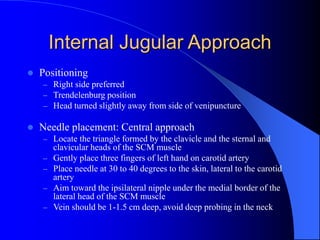
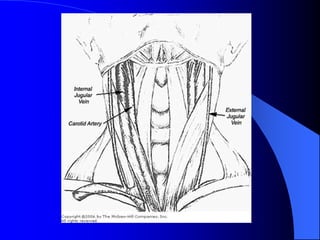
Internal Jugular Approach
 Positioning
– Right side preferred
– Trendelenburg position
– Head turned slightly away from side of venipuncture
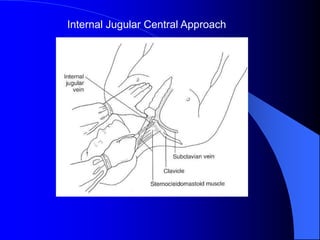
 Needle placement: Central approach
– Locate the triangle formed by the clavicle and the sternal and
clavicular heads of the SCM muscle
– Gently place three fingers of left hand on carotid artery
– Place needle at 30 to 40 degrees to the skin, lateral to the carotid
artery
– Aim toward the ipsilateral nipple under the medial border of the
lateral head of the SCM muscle
– Vein should be 1-1.5 cm deep, avoid deep probing in the neck
Internal Jugular Central Approach
Femoral Approach
 Positioning
– Supine
 Needle placement
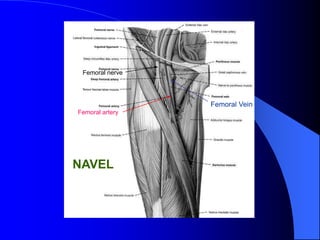
– Medial to femoral artery
– Needle held at 45 degree angle
– Skin insertion 2 cm below inguinal ligament
– Aim toward umbilicus
Femoral artery
Femoral nerve
Femoral Vein
NAVEL
Post-Catheter Placement
 Aspirate blood from each port
 Flush with saline or sterile water
 Secure catheter with sutures
 Cover with sterile dressing (tega-derm)
 Obtain chest x-ray for IJ and SC lines
 Write a procedure note
Procedure Note
 Name of procedure
 Indication for procedure
 Comment on consent, if applicable
 Describe what you did, including prep
 Comment on aspiration/flushing of ports
 How did patient tolerate procedure
 Any complications
Tips
 After 3-4 tries, let someone else try
 Get chest x-ray after unsuccessful attempt
 If attempt at one site fails, try new site on same side to avoid
bilateral complications
 Halt positive pressure ventilation as the needle penetrates the
chest wall in subclavian approach
 If you meet resistance while inserting the guide wire,
withdraw slightly and rotate the wire and re-advance
 Align the bevel with the syringe markings
 Use the vein on the same side as the pneumothorax
 Withdraw slowly, you will often hit the vein on the way out
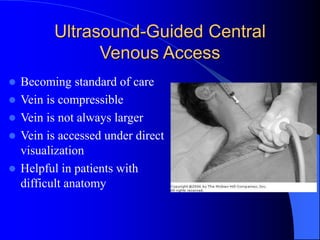
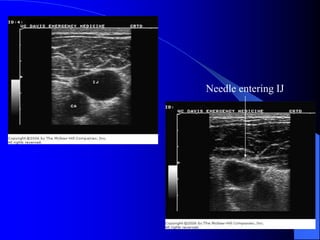
Ultrasound-Guided Central
Venous Access
 Becoming standard of care
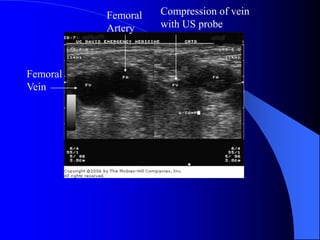
 Vein is compressible
 Vein is not always larger
 Vein is accessed under direct
visualization
 Helpful in patients with
difficult anatomy
Needle entering IJ
Femoral
Vein
Femoral
Artery
Compression of vein
with US probe
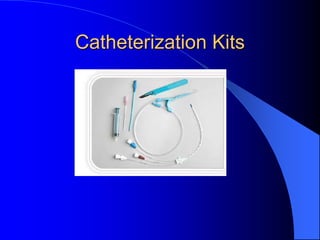
Catheterization Kits
References
 Clinical Procedures in Emergency
Medicine, Roberts and Hedges, 4th edition,
2004
 Clinician’s Pocket Reference, Leonard
Gomella, 8th edition, 1997
 Atlas of Human Anatomy, Frank Netter, 2nd
edition, 1997

Central_Venous_Catheterization.ppt

  • 1.
    Central Venous Catheterization UNC EmergencyMedicine Medical Student Lecture Series
  • 2.
    Objectives  Indications andContraindications  Complications  Technique  Basic principles  Specifics by Site  Tips  Basic materials
  • 3.
    Indications  Central venouspressure monitoring  Volume resuscitation  Cardiac arrest  Lack of peripheral access  Infusion of hyperalimentation  Infusion of concentrated solutions  Placement of transvenous pacemaker  Cardiac catheterization, pulmonary angiography  Hemodialysis
  • 4.
    Relative Contraindications  Bleedingdisorders  Anticoagulation or thrombolytic therapy  Combative patients  Distorted local anatomy  Cellulitis, burns, severe dermatitis at site  Vasculitis
  • 5.
    Complications  Vascular – Airembolus – Arterial puncture – Arteriovenous fistula – Hematoma – Blood clot  Infectious – Sepsis, cellulitis, osteomyelitis, septic arthritis  Miscellaneous – Dysrhythmias – Catheter knotting or malposition – Nerve injury – Pneumothorax, hemothorax, hydrothorax, hemomediastinum – Bowel or bladder perforation
  • 6.
    Technique  Seldinger technique –Use introducing needle to locate vein – Wire is threaded through the needle – Needle is removed – Skin and vessel are dilated – Catheter is placed over the wire – Wire is removed – Catheter is secured in place
  • 8.
    Basic Principles  Decideif the line is really necessary  Know your anatomy  Be familiar with your equipment  Obtain optimal patient positioning and cooperation  Take your time  Use sterile technique  Always have a hand on your wire  Ask for help  Always aspirate as you advance as you withdraw the needle slowly  Always withdraw the needle to the level of the skin before redirecting the angle  Obtain chest x-ray post line placement and review it
  • 9.
    Location Advantage Disadvantage Internal Jugular •Bleeding can be recognized and controlled • Malposition is rare • Less risk of pneumothorax • Risk of carotid artery puncture • PTX possible Femoral • Easy to find vein • No risk of pneumothorax • Preferred site for emergencies and CPR • Fewer bad complications • Highest risk of infection • Risk of DVT • Not good for ambulatory patients Subclavian • Most comfortable for conscious patients • Highest risk of PTX, should not do on intubated pts • Should not be done if < 2 years • Vein is non-compressible
  • 10.
    Subclavian Approach  Positioning –Right side preferred – Supine position, head neutral, arm abducted – Trendelenburg (10-15 degrees) – Shoulders neutral with mild retraction – Right side preferred  Needle placement – Junction of middle and medial thirds of clavicle – At the small tubercle in the medial deltopectoral groove – Needle should be parallel to skin – Aim towards the supraclavicular notch and just under the clavicle
  • 12.
    Internal Jugular Approach Positioning – Right side preferred – Trendelenburg position – Head turned slightly away from side of venipuncture  Needle placement: Central approach – Locate the triangle formed by the clavicle and the sternal and clavicular heads of the SCM muscle – Gently place three fingers of left hand on carotid artery – Place needle at 30 to 40 degrees to the skin, lateral to the carotid artery – Aim toward the ipsilateral nipple under the medial border of the lateral head of the SCM muscle – Vein should be 1-1.5 cm deep, avoid deep probing in the neck
  • 14.
  • 15.
    Femoral Approach  Positioning –Supine  Needle placement – Medial to femoral artery – Needle held at 45 degree angle – Skin insertion 2 cm below inguinal ligament – Aim toward umbilicus
  • 16.
  • 17.
    Post-Catheter Placement  Aspirateblood from each port  Flush with saline or sterile water  Secure catheter with sutures  Cover with sterile dressing (tega-derm)  Obtain chest x-ray for IJ and SC lines  Write a procedure note
  • 18.
    Procedure Note  Nameof procedure  Indication for procedure  Comment on consent, if applicable  Describe what you did, including prep  Comment on aspiration/flushing of ports  How did patient tolerate procedure  Any complications
  • 19.
    Tips  After 3-4tries, let someone else try  Get chest x-ray after unsuccessful attempt  If attempt at one site fails, try new site on same side to avoid bilateral complications  Halt positive pressure ventilation as the needle penetrates the chest wall in subclavian approach  If you meet resistance while inserting the guide wire, withdraw slightly and rotate the wire and re-advance  Align the bevel with the syringe markings  Use the vein on the same side as the pneumothorax  Withdraw slowly, you will often hit the vein on the way out
  • 20.
    Ultrasound-Guided Central Venous Access Becoming standard of care  Vein is compressible  Vein is not always larger  Vein is accessed under direct visualization  Helpful in patients with difficult anatomy
  • 21.
  • 22.
  • 23.
  • 24.
    References  Clinical Proceduresin Emergency Medicine, Roberts and Hedges, 4th edition, 2004  Clinician’s Pocket Reference, Leonard Gomella, 8th edition, 1997  Atlas of Human Anatomy, Frank Netter, 2nd edition, 1997