SPINALAND EPIDURAL
NEEDLES
- Dr ZIKRULLAH
INTRODUCTION
Regional anaesthesia makes a specific part of
the body numb to relieve pain or allow surgical
procedures to be done
It is often used for orthopaedic surgery on an
extremity, for male/female reproductive
surgery, and for operations on urinary bladder
and tract.
Needles are the most important equipment
used in administration of regional anaesthesia.
REGIONAL ANAESTHESIA
NEURAXIAL
TECHNIQUES
PERIPHERAL TECHNIQUES
SPINAL
ANAESTHESIA
EPIDURAL
ANAESTHESIA
PLEXUS
BLOCK
NERVE BLOCK
Spinal and Epidural neuraxial blocks are
forms of regional anaesthetic techniques,
that result in –
• sympathetic blockade ,
• sensory analgesia and
• motor paralysis
depending upon the dose, concentration and
volume of local anaesthetic injected after the
insertion of a needle in the plane of neuraxis
.
SPINAL NEEDLES
HISTORICAL OVERVIEW
• 1891 - Quincke first described the technique
of lumbar puncture. He used a needle which
was sharp, bevelled and hollowed.
1898 - The next major step in the h/o spinal
anaesthesia was the work of German surgeon
Augustus Bier .
Over time, Augustus developed a large
bore needle (15G to 17G),with a long,
cutting bevel & sharp point.
But, Bier’s needle was criticized on
account of causing pain on insertion &
leaving large hole in the dura.
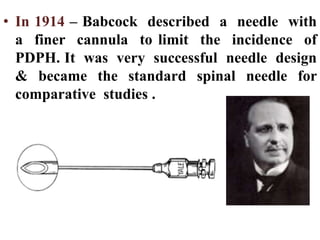
• In 1914 – Babcock described a needle with
a finer cannula to limit the incidence of
PDPH. It was very successful needle design
& became the standard spinal needle for
comparative studies .
• In 1923 – Another important modification
in the h/o development of spinal needle
took place, which was change in its tip
design . H.E. Greene used an ordinary
23G cutting needle that he sharpened to
a rounded tip by removing the cutting
edges of the bevel .
• Greene needle
In 1932 - needle with closed end with a lateral
orifice was developed.
• In 1944 - Tuohy used a 15G directional
spinal needle through which he passed
a nylon ureteric catheter into the
subarachnoid space to allow
continuous spinal anaesthesia .
• 1951 - Whitacre needle came into light
in 1951. But it had problems like small
orifice & that its stylet could not occlude
the orifice, which could therefore became
blocked with tissues .
• In 1987 – Sprotte modified Whitacre
needle by increasing the size of the
distal orifice to combat the
problems of slow CSF flow . But
Sprotte’s needle had drawback of
incomplete block due to loss of
anaesthetic drug in subdural space.
• In 1996 - latest change in the design
of spinal needle occurred when
Eldor designed a pencil point
needle with two lateral holes . The
idea behind this design was to allow
rapid flow of CSF and more even
distribution of local anaesthetics .
DESCRIPTION
• Spinal needles are available in an array of
–Sizes (16G-30 G)
–Length
–Bevel &
–Tip design
Various sizes are made ranging from 16G to
30G in diameter.
• 32G needle is also described but are not widely
used.
• Length varies from 5-15 cm, but 9 cm version
is most commonly used.
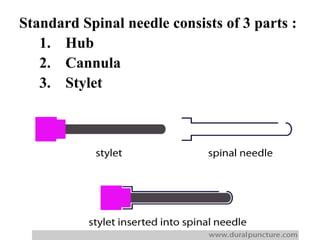
Standard Spinal needle consists of 3 parts :
1. Hub
2. Cannula
3. Stylet
GENERAL PROPERTIES :
• Spinal needles are carefully manufactured
without surface irregularities, with a tight
fitting removable stylet that completely
occludes the needle lumen.
• Stylet avoids the tracking of epithelial cells
into subarachnoid space and it also
provides strength to the shaft of needle.
• Points of cannulae are made of stainless
steel as it meets standards of
stiffness and flexibility and also has
resistance to breakage .
TYPES
QUINCKE NEEDLE WHITACRE NEEDLE
PITKIN NEEDLE SPROTTE NEEDLE
GREENE NEEDLE
ACCORDING TO THE
TIP- DESIGN
SHARP / CUTTING
TIP NEEDLE
BLUNT – TIP / PENCIL
– POINT NEEDLE
ADVANTAGES of pencil point needle
over cutting tip needle are :
1. They are less taumatic .
2. They are dura separating NOT dura
cutting .
3. Has lesser incidence of PDPH .
QUINKCE NEEDLE WHITACRE NEEDLE
GREENES NEEDLE SPROTTE NEEDLE
PITKIN NEEDLE
ACCORDING TO THE SITE OF
HOLE
END-INJECTION
NEEDLE
SIDE- INJECTION
NEEDLE
1. QUINCKE-BABCOCK NEEDLE
–It is the standard or traditional needle .
–Has a medium bevel length with sharp
edges, a sharp point and it is an end -
injection needle .
• Caution should be taken that bevel
remains parallel to the dural fibres .
• Quincke needle comes in various sizes
:
29G x 3.5” (0.34 x 90mm)
27G x 3.5” (0.41 x 90mm)
26G x 3.5” (0.45 x 90mm)
23G x 3.5” (0.60 x 90mm)
2. WHITACRE NEEDLE
–It is a “Pencil point” needle.
–Has small sized non–cutting bevel .
• Whitacre needle has solid tip .
• Has side injection .
• Opening is 2 mm proximal to tip .
• Has lesser chances of PDPH as
compared to Quincke’s needle .
• Whitacre needle also comes in
various sizes :-
27G x 3.5˝ (0.41 x 90mm)
26G x 3.5˝ (0.45 x 90mm)
24G x 3.5˝ (0.55 x 90mm)
22G x 3.5˝ (0.60 x 90mm)
3. SPROTTE NEEDLE
• It is a modification of Whitacre needle .
• It has a blunt non-cutting bevel .
• Opening of the hole is wider than the
needle diameter.
• Has an advantage of more vigorous CSF
flow compared with similar gauge needle.
• The wider hole also allows greater
mixing of the local anaesthetic solution
with the CSF & to allow more even
distribution of local anaesthetic
solution in the subarachnoid space .
• The tip of the Sprotte needle is
elongated to facilitate more gradual
separation of dural fibres & therefore
less CSF leakage and a decreased
incidence of PDPH.
• Disadvantage of this needle is that the
size of the lateral hole sometimes
causes the orifice to straddle the dural
layers , resulting in partial loss of
local anaesthetic solution and
incomplete block .
• The width of the hole also leaves the
distal portion of the tip relatively
prone to damage including fracture .
4. GREENE’S NEEDLE:
• Has a long bevel with rounded point and sharp
bevel with end injection.
5. PITKIN NEEDLE:
• Has a short sharp bevel and pointed end
injection.
6. TOUHY NEEDLE:
• Its an epidural needle that has application in
spinal anaesthesia for catheter placement for
continuous technique.
• Its hub is made transparent usually to
identify quickly the flow of CSF.
• Continuous spinal anaesthesia can be
achieved by inserting 3-4 cm of 28G nylon
open ended spinal micro catheter into
subarachnoid space.
EPIDURAL NEEDLE
CHARACTERISTICS :
Standard epidural needle is typically
• 17-18G in diameter
• 3-3.5 inches long
• has a blunt bevel
• with a gentle curve of 15-300 at tip .
TYPES
Epidural needles are mainly of four
types :
1. Touhy needle
2. Hustead needle
3. Crawford needle
4. Weiss needle
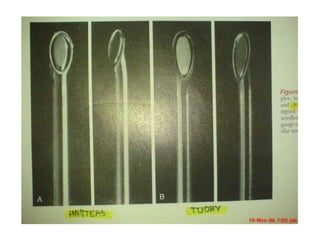
1. TUOHY NEEDLE
most commonly used
–Has blunt, curved tip which helps to push
away the dura after penetrating ligamentum
flavum .
–The curved tip is referred to as HUBER tip.
–Needle wall is thin to allow insertion of
catheter.
–It is provided with a stylet introducer to
prevent occlusion of the lumen.
–Some designs allow the wings at the hub to
be added or removed .
• Markings on the needle helps to
determine the distance between skin
and the epidural space , and thus the
length of catheter to be left inside the
epidural space .
• Shape and design of the bevel helps to
direct catheter within the epidural
space (either cephalad or caudal) .
• Winged needles have better control and
handling during insertion .
• Combined spinal epidural technique is
possible using a 26G spinal needle of
about 12 cm in length with a standard 16
G Touhy needle .
2. CRAWFORD NEEDLE
• It is straight needle without a curved
tip .
• Has short bevel with smooth edges .
• It is also a thin walled needle .
• Catheter emerges straight from the
tip .
• Has higher incidence of dural puncture .
• But facilitates passage of epidural
catheter .
3. HUSTEAD NEEDLE
• It was a further modification of Touhy
needle .
• The needle opening did not exceed 2.7mm
in length .
• Needle bevel had an angle of 12 to 15° .
• In addition , the heel of the needle bevel
was smoothened to reduce the danger of
trapping and cutting the catheter should it
had to be withdrawn .
4. WEISS NEEDLE
• It is a newer disposable epidural needle
.
• Had Touhy / Huber configuration .
• It also has metal wings at the junction
of shaft with the hub .
• “WINGS” make it easier to grasp the
needle with both hands for placement .
EPIDURAL CATHETER
• The use of plastic
Epidural catheter
was first described
by Flowers et al
in 1949.
• Epidural catheter is a fine tube which
is inserted into the epidural space
around the spinal cord , for the
administration of an anaesthetic agent .
• The catheter is passed into the
epidural space via a wide - bore needle
passed between two vertebrae of the
lower lumbar spine .
• It is a 90 cm transparent, malleable
tube made of either nylon or teflon and
is biologically inert .
• Single port at end or multiple side ports
close to the tip may be present.
• The distal end of the catheter is clearly
marked at 5 cm intervals with an
additional 1 cm markings between 5
and 15 cm.
• Proximal end of catheter is connected
to a luer lock and a filter.
• Spiral wire reinforced catheters, are
also available to avoid kinking.
• Some designs are radio - opaque .
• Catheters with a single port at tip offer a
sharp point and increase incidence of
catheter induced vascular or dural
puncture .
• Epidural fixing device can be used to
prevent the catheter from being pulled out .
FILTER
• An epidural catheter also has filter
attached to its proximal end .
• It has a 0.22 micron mesh which acts
as a bacterial , viral and foreign body
(e.g. glass) filter .
• And it should be changed every 24 hrs .
LOR SYRINGES (Loss Of Resistance) :
• It is another equipment used during
epidural catheter insertion .
• Has a special low resistance plunger used to
identify the epidural space by loss of
resistance technique .
• Its plastic and glass version are also
available .
COMPLICATIONS OF NEURAXIAL BLOCKS
RELATED TO NEEDLE / CATHETER
PLACEMENT
COMPLICATIONS
INFECTION
TRAUMA - BACKACHE,
PDPH
NERVE INJURY
INFLAMMATION
CATHETER
SHEARING /
MISPLACEMENT
BLEEDING
MISPLACEMENT
Incidence of PDPH is directly proportional
to the gauge of needle .
Approximately 30% incidence of PDPH
occur while using 20G needle .
And nearly 1% incidence of PDPH
occurs with 26G needle .
Also decreased PDPH is seen with dura
separating Whitacre and Sprotte needles
than with dura cutting needles .
REMARKS
• The spinal & epidural anaesthesia ,
which were once thought to be
impractical and cumbersome , has
become an essential part of today’s
anaesthetic practice .
• Part of this success can be attributed
to the modifications in needle design
and material made over the years by
the pioneering developers of these
needles .
Spinal & epidural needle

Spinal & epidural needle

  • 1.
  • 2.
    INTRODUCTION Regional anaesthesia makesa specific part of the body numb to relieve pain or allow surgical procedures to be done It is often used for orthopaedic surgery on an extremity, for male/female reproductive surgery, and for operations on urinary bladder and tract. Needles are the most important equipment used in administration of regional anaesthesia.
  • 3.
  • 4.
    Spinal and Epiduralneuraxial blocks are forms of regional anaesthetic techniques, that result in – • sympathetic blockade , • sensory analgesia and • motor paralysis depending upon the dose, concentration and volume of local anaesthetic injected after the insertion of a needle in the plane of neuraxis .
  • 5.
  • 6.
    HISTORICAL OVERVIEW • 1891- Quincke first described the technique of lumbar puncture. He used a needle which was sharp, bevelled and hollowed.
  • 7.
    1898 - Thenext major step in the h/o spinal anaesthesia was the work of German surgeon Augustus Bier .
  • 8.
    Over time, Augustusdeveloped a large bore needle (15G to 17G),with a long, cutting bevel & sharp point. But, Bier’s needle was criticized on account of causing pain on insertion & leaving large hole in the dura.
  • 9.
    • In 1914– Babcock described a needle with a finer cannula to limit the incidence of PDPH. It was very successful needle design & became the standard spinal needle for comparative studies .
  • 10.
    • In 1923– Another important modification in the h/o development of spinal needle took place, which was change in its tip design . H.E. Greene used an ordinary 23G cutting needle that he sharpened to a rounded tip by removing the cutting edges of the bevel .
  • 11.
    • Greene needle In1932 - needle with closed end with a lateral orifice was developed.
  • 12.
    • In 1944- Tuohy used a 15G directional spinal needle through which he passed a nylon ureteric catheter into the subarachnoid space to allow continuous spinal anaesthesia .
  • 13.
    • 1951 -Whitacre needle came into light in 1951. But it had problems like small orifice & that its stylet could not occlude the orifice, which could therefore became blocked with tissues .
  • 14.
    • In 1987– Sprotte modified Whitacre needle by increasing the size of the distal orifice to combat the problems of slow CSF flow . But Sprotte’s needle had drawback of incomplete block due to loss of anaesthetic drug in subdural space.
  • 15.
    • In 1996- latest change in the design of spinal needle occurred when Eldor designed a pencil point needle with two lateral holes . The idea behind this design was to allow rapid flow of CSF and more even distribution of local anaesthetics .
  • 16.
    DESCRIPTION • Spinal needlesare available in an array of –Sizes (16G-30 G) –Length –Bevel & –Tip design Various sizes are made ranging from 16G to 30G in diameter. • 32G needle is also described but are not widely used. • Length varies from 5-15 cm, but 9 cm version is most commonly used.
  • 17.
    Standard Spinal needleconsists of 3 parts : 1. Hub 2. Cannula 3. Stylet
  • 18.
    GENERAL PROPERTIES : •Spinal needles are carefully manufactured without surface irregularities, with a tight fitting removable stylet that completely occludes the needle lumen. • Stylet avoids the tracking of epithelial cells into subarachnoid space and it also provides strength to the shaft of needle.
  • 19.
    • Points ofcannulae are made of stainless steel as it meets standards of stiffness and flexibility and also has resistance to breakage .
  • 20.
    TYPES QUINCKE NEEDLE WHITACRENEEDLE PITKIN NEEDLE SPROTTE NEEDLE GREENE NEEDLE ACCORDING TO THE TIP- DESIGN SHARP / CUTTING TIP NEEDLE BLUNT – TIP / PENCIL – POINT NEEDLE
  • 21.
    ADVANTAGES of pencilpoint needle over cutting tip needle are : 1. They are less taumatic . 2. They are dura separating NOT dura cutting . 3. Has lesser incidence of PDPH .
  • 22.
    QUINKCE NEEDLE WHITACRENEEDLE GREENES NEEDLE SPROTTE NEEDLE PITKIN NEEDLE ACCORDING TO THE SITE OF HOLE END-INJECTION NEEDLE SIDE- INJECTION NEEDLE
  • 23.
    1. QUINCKE-BABCOCK NEEDLE –Itis the standard or traditional needle . –Has a medium bevel length with sharp edges, a sharp point and it is an end - injection needle .
  • 24.
    • Caution shouldbe taken that bevel remains parallel to the dural fibres . • Quincke needle comes in various sizes : 29G x 3.5” (0.34 x 90mm) 27G x 3.5” (0.41 x 90mm) 26G x 3.5” (0.45 x 90mm) 23G x 3.5” (0.60 x 90mm)
  • 25.
    2. WHITACRE NEEDLE –Itis a “Pencil point” needle. –Has small sized non–cutting bevel .
  • 26.
    • Whitacre needlehas solid tip . • Has side injection . • Opening is 2 mm proximal to tip . • Has lesser chances of PDPH as compared to Quincke’s needle . • Whitacre needle also comes in various sizes :- 27G x 3.5˝ (0.41 x 90mm) 26G x 3.5˝ (0.45 x 90mm) 24G x 3.5˝ (0.55 x 90mm) 22G x 3.5˝ (0.60 x 90mm)
  • 27.
    3. SPROTTE NEEDLE •It is a modification of Whitacre needle . • It has a blunt non-cutting bevel . • Opening of the hole is wider than the needle diameter. • Has an advantage of more vigorous CSF flow compared with similar gauge needle.
  • 28.
    • The widerhole also allows greater mixing of the local anaesthetic solution with the CSF & to allow more even distribution of local anaesthetic solution in the subarachnoid space . • The tip of the Sprotte needle is elongated to facilitate more gradual separation of dural fibres & therefore less CSF leakage and a decreased incidence of PDPH.
  • 29.
    • Disadvantage ofthis needle is that the size of the lateral hole sometimes causes the orifice to straddle the dural layers , resulting in partial loss of local anaesthetic solution and incomplete block . • The width of the hole also leaves the distal portion of the tip relatively prone to damage including fracture .
  • 30.
    4. GREENE’S NEEDLE: •Has a long bevel with rounded point and sharp bevel with end injection. 5. PITKIN NEEDLE: • Has a short sharp bevel and pointed end injection. 6. TOUHY NEEDLE: • Its an epidural needle that has application in spinal anaesthesia for catheter placement for continuous technique.
  • 31.
    • Its hubis made transparent usually to identify quickly the flow of CSF. • Continuous spinal anaesthesia can be achieved by inserting 3-4 cm of 28G nylon open ended spinal micro catheter into subarachnoid space.
  • 32.
    EPIDURAL NEEDLE CHARACTERISTICS : Standardepidural needle is typically • 17-18G in diameter • 3-3.5 inches long • has a blunt bevel • with a gentle curve of 15-300 at tip .
  • 33.
    TYPES Epidural needles aremainly of four types : 1. Touhy needle 2. Hustead needle 3. Crawford needle 4. Weiss needle
  • 34.
    1. TUOHY NEEDLE mostcommonly used
  • 35.
    –Has blunt, curvedtip which helps to push away the dura after penetrating ligamentum flavum . –The curved tip is referred to as HUBER tip. –Needle wall is thin to allow insertion of catheter. –It is provided with a stylet introducer to prevent occlusion of the lumen. –Some designs allow the wings at the hub to be added or removed .
  • 36.
    • Markings onthe needle helps to determine the distance between skin and the epidural space , and thus the length of catheter to be left inside the epidural space . • Shape and design of the bevel helps to direct catheter within the epidural space (either cephalad or caudal) .
  • 37.
    • Winged needleshave better control and handling during insertion . • Combined spinal epidural technique is possible using a 26G spinal needle of about 12 cm in length with a standard 16 G Touhy needle .
  • 38.
    2. CRAWFORD NEEDLE •It is straight needle without a curved tip . • Has short bevel with smooth edges . • It is also a thin walled needle . • Catheter emerges straight from the tip . • Has higher incidence of dural puncture . • But facilitates passage of epidural catheter .
  • 40.
    3. HUSTEAD NEEDLE •It was a further modification of Touhy needle . • The needle opening did not exceed 2.7mm in length . • Needle bevel had an angle of 12 to 15° . • In addition , the heel of the needle bevel was smoothened to reduce the danger of trapping and cutting the catheter should it had to be withdrawn .
  • 41.
    4. WEISS NEEDLE •It is a newer disposable epidural needle . • Had Touhy / Huber configuration . • It also has metal wings at the junction of shaft with the hub . • “WINGS” make it easier to grasp the needle with both hands for placement .
  • 43.
    EPIDURAL CATHETER • Theuse of plastic Epidural catheter was first described by Flowers et al in 1949.
  • 44.
    • Epidural catheteris a fine tube which is inserted into the epidural space around the spinal cord , for the administration of an anaesthetic agent . • The catheter is passed into the epidural space via a wide - bore needle passed between two vertebrae of the lower lumbar spine .
  • 45.
    • It isa 90 cm transparent, malleable tube made of either nylon or teflon and is biologically inert . • Single port at end or multiple side ports close to the tip may be present. • The distal end of the catheter is clearly marked at 5 cm intervals with an additional 1 cm markings between 5 and 15 cm.
  • 46.
    • Proximal endof catheter is connected to a luer lock and a filter. • Spiral wire reinforced catheters, are also available to avoid kinking.
  • 47.
    • Some designsare radio - opaque . • Catheters with a single port at tip offer a sharp point and increase incidence of catheter induced vascular or dural puncture . • Epidural fixing device can be used to prevent the catheter from being pulled out .
  • 48.
    FILTER • An epiduralcatheter also has filter attached to its proximal end . • It has a 0.22 micron mesh which acts as a bacterial , viral and foreign body (e.g. glass) filter . • And it should be changed every 24 hrs .
  • 49.
    LOR SYRINGES (LossOf Resistance) : • It is another equipment used during epidural catheter insertion . • Has a special low resistance plunger used to identify the epidural space by loss of resistance technique . • Its plastic and glass version are also available .
  • 51.
    COMPLICATIONS OF NEURAXIALBLOCKS RELATED TO NEEDLE / CATHETER PLACEMENT COMPLICATIONS INFECTION TRAUMA - BACKACHE, PDPH NERVE INJURY INFLAMMATION CATHETER SHEARING / MISPLACEMENT BLEEDING MISPLACEMENT
  • 52.
    Incidence of PDPHis directly proportional to the gauge of needle . Approximately 30% incidence of PDPH occur while using 20G needle . And nearly 1% incidence of PDPH occurs with 26G needle . Also decreased PDPH is seen with dura separating Whitacre and Sprotte needles than with dura cutting needles .
  • 53.
    REMARKS • The spinal& epidural anaesthesia , which were once thought to be impractical and cumbersome , has become an essential part of today’s anaesthetic practice . • Part of this success can be attributed to the modifications in needle design and material made over the years by the pioneering developers of these needles .