Nervous
System
Composition and Functions:
Divided into two parts (CNS and PNS)
Responsible to perform:
1. receives stimuli from receptors
2. transmits information to effectors that
respond to stimulation.
3. Regulates behavior by integrating
incoming sensory information with stored
information.
4. translating that into action by way of
effectors.
• Includes billions of nerve cells (NEURONS)
Neurons
Neuron is the living nerve
cell. It performs the
specific function of the
system. In this instance, is
to transmit nerve
impulses.
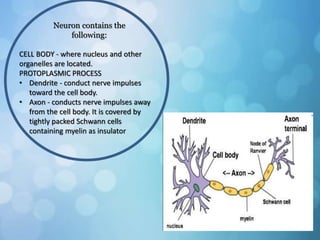
Neuron contains the
following:
CELL BODY - where nucleus and other
organelles are located.
PROTOPLASMIC PROCESS
• Dendrite - conduct nerve impulses
toward the cell body.
• Axon - conducts nerve impulses away
from the cell body. It is covered by
tightly packed Schwann cells
containing myelin as insulator
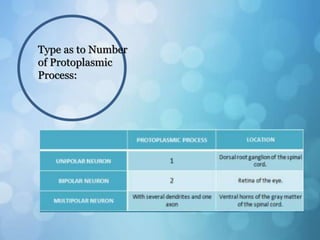
Type as to Number
of Protoplasmic
Process:
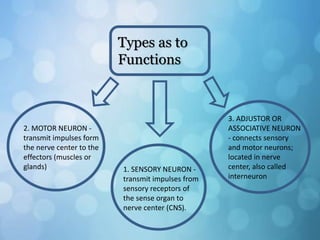
Types as to
Functions
1. SENSORY NEURON -
transmit impulses from
sensory receptors of
the sense organ to
nerve center (CNS).
2. MOTOR NEURON -
transmit impulses form
the nerve center to the
effectors (muscles or
glands)
3. ADJUSTOR OR
ASSOCIATIVE NEURON
- connects sensory
and motor neurons;
located in nerve
center, also called
interneuron
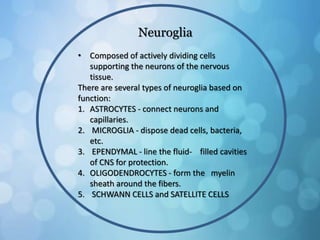
Neuroglia
• Composed of actively dividing cells
supporting the neurons of the nervous
tissue.
There are several types of neuroglia based on
function:
1. ASTROCYTES - connect neurons and
capillaries.
2. MICROGLIA - dispose dead cells, bacteria,
etc.
3. EPENDYMAL - line the fluid- filled cavities
of CNS for protection.
4. OLIGODENDROCYTES - form the myelin
sheath around the fibers.
5. SCHWANN CELLS and SATELLITE CELLS
Peripheral
Nervous
System
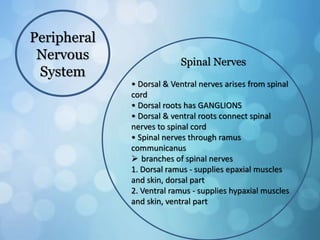
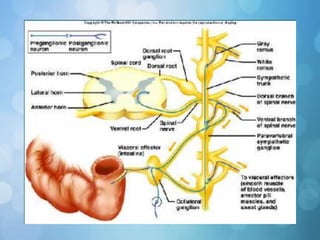
Spinal Nerves
• Dorsal & Ventral nerves arises from spinal
cord
• Dorsal roots has GANGLIONS
• Dorsal & ventral roots connect spinal
nerves to spinal cord
• Spinal nerves through ramus
communicanus
 branches of spinal nerves
1. Dorsal ramus - supplies epaxial muscles
and skin, dorsal part
2. Ventral ramus - supplies hypaxial muscles
and skin, ventral part
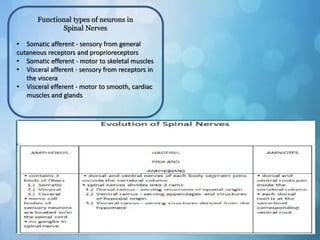
Functional types of neurons in
Spinal Nerves
• Somatic afferent - sensory from general
cutaneous receptors and proprioreceptors
• Somatic efferent - motor to skeletal muscles
• Visceral afferent - sensory from receptors in
the viscera
• Visceral efferent - motor to smooth, cardiac
muscles and glands
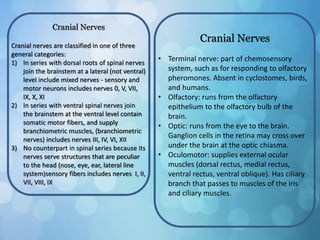
Cranial Nerves
Cranial nerves are classified in one of three
general categories:
1) In series with dorsal roots of spinal nerves
join the brainstem at a lateral (not ventral)
level include mixed nerves - sensory and
motor neurons includes nerves 0, V, VII,
IX, X, XI
2) In series with ventral spinal nerves join
the brainstem at the ventral level contain
somatic motor fibers, and supply
branchiometric muscles, (branchiometric
nerves) includes nerves III, IV, VI, XII
3) No counterpart in spinal series because its
nerves serve structures that are peculiar
to the head (nose, eye, ear, lateral line
system)sensory fibers includes nerves I, II,
VII, VIII, IX
Cranial Nerves
• Terminal nerve: part of chemosensory
system, such as for responding to olfactory
pheromones. Absent in cyclostomes, birds,
and humans.
• Olfactory: runs from the olfactory
epithelium to the olfactory bulb of the
brain.
• Optic: runs from the eye to the brain.
Ganglion cells in the retina may cross over
under the brain at the optic chiasma.
• Oculomotor: supplies external ocular
muscles (dorsal rectus, medial rectus,
ventral rectus, ventral oblique). Has ciliary
branch that passes to muscles of the iris
and ciliary muscles.
Cranial Nerves (cont)
• Facial:Serves muscles responsible
for facial expression.
• Statoacoustic or vestibulocochlear
or auditory: serves the inner ear.
The anterior branch serves the
organ of equilibrium, while the
posterior branch is responsible for
equilibrium and hearing.I
• Glossopharyngeal: associated with
pharynx, taste buds and salivary
gland.
• Vagus: contains four branches that
supply the branchiometric muscles
of the 4 - 7 visceral arches (or their
derivatives)
• Accessory - spinal accessory nerves
• Hypoglossal: serves hypobranchial
muscles of the throat and tongue
• Trochlear: supplies the
dorsal oblique muscle of
the eye.
• Trigeminal: has three
branches: opthalmic
(serves the head region),
maxillary (serves the upper
jaw) and mandibular
(serves the lower jaw).
Where the branches
intersect and cell bodies
are found is called the
semilunar ganglion.
• Abducens: supplies the
lateral oblique muscle of
the eye.
Central
Nervous
System
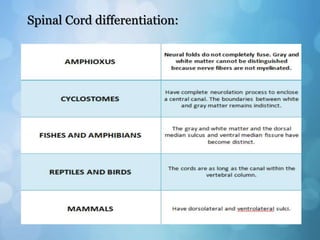
Spinal Cord differentiation:
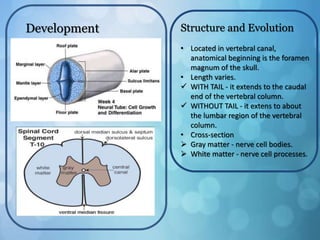
Development Structure and Evolution
• Located in vertebral canal,
anatomical beginning is the foramen
magnum of the skull.
• Length varies.
 WITH TAIL - it extends to the caudal
end of the vertebral column.
 WITHOUT TAIL - it extens to about
the lumbar region of the vertebral
column.
• Cross-section
 Gray matter - nerve cell bodies.
 White matter - nerve cell processes.
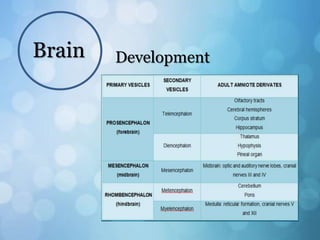
Brain Development
Forms and Function
Accessory Structures
• Meninges - membranes which surround
the brain and spinal cord.
 Pia mater - innermost membrane
 Arachnoid mater – Middle membrane
 Dura mater - Outermost layer
• Cerebrospinal Fluid - Is secreted by the
choroid plexi. It protects the brain and
cushions it from the skull.
• Blood-brain barrier - Two epithelia
which controls the flow of solutes from
blood to brain. Prezi :
http://prezi.com/lccmrney
bhgj/edit/#29_73668633
Members:
Cabading, Brian
Banta, Dyan Alyssa
Hernaez, Chloe
Idioma, Jusmine

Comparative Anatomy - Nervous System

  • 1.
  • 2.
    Composition and Functions: Dividedinto two parts (CNS and PNS) Responsible to perform: 1. receives stimuli from receptors 2. transmits information to effectors that respond to stimulation. 3. Regulates behavior by integrating incoming sensory information with stored information. 4. translating that into action by way of effectors. • Includes billions of nerve cells (NEURONS)
  • 3.
    Neurons Neuron is theliving nerve cell. It performs the specific function of the system. In this instance, is to transmit nerve impulses.
  • 4.
    Neuron contains the following: CELLBODY - where nucleus and other organelles are located. PROTOPLASMIC PROCESS • Dendrite - conduct nerve impulses toward the cell body. • Axon - conducts nerve impulses away from the cell body. It is covered by tightly packed Schwann cells containing myelin as insulator
  • 5.
    Type as toNumber of Protoplasmic Process:
  • 6.
    Types as to Functions 1.SENSORY NEURON - transmit impulses from sensory receptors of the sense organ to nerve center (CNS). 2. MOTOR NEURON - transmit impulses form the nerve center to the effectors (muscles or glands) 3. ADJUSTOR OR ASSOCIATIVE NEURON - connects sensory and motor neurons; located in nerve center, also called interneuron
  • 7.
    Neuroglia • Composed ofactively dividing cells supporting the neurons of the nervous tissue. There are several types of neuroglia based on function: 1. ASTROCYTES - connect neurons and capillaries. 2. MICROGLIA - dispose dead cells, bacteria, etc. 3. EPENDYMAL - line the fluid- filled cavities of CNS for protection. 4. OLIGODENDROCYTES - form the myelin sheath around the fibers. 5. SCHWANN CELLS and SATELLITE CELLS
  • 8.
    Peripheral Nervous System Spinal Nerves • Dorsal& Ventral nerves arises from spinal cord • Dorsal roots has GANGLIONS • Dorsal & ventral roots connect spinal nerves to spinal cord • Spinal nerves through ramus communicanus  branches of spinal nerves 1. Dorsal ramus - supplies epaxial muscles and skin, dorsal part 2. Ventral ramus - supplies hypaxial muscles and skin, ventral part
  • 10.
    Functional types ofneurons in Spinal Nerves • Somatic afferent - sensory from general cutaneous receptors and proprioreceptors • Somatic efferent - motor to skeletal muscles • Visceral afferent - sensory from receptors in the viscera • Visceral efferent - motor to smooth, cardiac muscles and glands
  • 11.
    Cranial Nerves Cranial nervesare classified in one of three general categories: 1) In series with dorsal roots of spinal nerves join the brainstem at a lateral (not ventral) level include mixed nerves - sensory and motor neurons includes nerves 0, V, VII, IX, X, XI 2) In series with ventral spinal nerves join the brainstem at the ventral level contain somatic motor fibers, and supply branchiometric muscles, (branchiometric nerves) includes nerves III, IV, VI, XII 3) No counterpart in spinal series because its nerves serve structures that are peculiar to the head (nose, eye, ear, lateral line system)sensory fibers includes nerves I, II, VII, VIII, IX Cranial Nerves • Terminal nerve: part of chemosensory system, such as for responding to olfactory pheromones. Absent in cyclostomes, birds, and humans. • Olfactory: runs from the olfactory epithelium to the olfactory bulb of the brain. • Optic: runs from the eye to the brain. Ganglion cells in the retina may cross over under the brain at the optic chiasma. • Oculomotor: supplies external ocular muscles (dorsal rectus, medial rectus, ventral rectus, ventral oblique). Has ciliary branch that passes to muscles of the iris and ciliary muscles.
  • 12.
    Cranial Nerves (cont) •Facial:Serves muscles responsible for facial expression. • Statoacoustic or vestibulocochlear or auditory: serves the inner ear. The anterior branch serves the organ of equilibrium, while the posterior branch is responsible for equilibrium and hearing.I • Glossopharyngeal: associated with pharynx, taste buds and salivary gland. • Vagus: contains four branches that supply the branchiometric muscles of the 4 - 7 visceral arches (or their derivatives) • Accessory - spinal accessory nerves • Hypoglossal: serves hypobranchial muscles of the throat and tongue • Trochlear: supplies the dorsal oblique muscle of the eye. • Trigeminal: has three branches: opthalmic (serves the head region), maxillary (serves the upper jaw) and mandibular (serves the lower jaw). Where the branches intersect and cell bodies are found is called the semilunar ganglion. • Abducens: supplies the lateral oblique muscle of the eye.
  • 13.
  • 14.
  • 15.
    Development Structure andEvolution • Located in vertebral canal, anatomical beginning is the foramen magnum of the skull. • Length varies.  WITH TAIL - it extends to the caudal end of the vertebral column.  WITHOUT TAIL - it extens to about the lumbar region of the vertebral column. • Cross-section  Gray matter - nerve cell bodies.  White matter - nerve cell processes.
  • 16.
  • 18.
  • 21.
    Accessory Structures • Meninges- membranes which surround the brain and spinal cord.  Pia mater - innermost membrane  Arachnoid mater – Middle membrane  Dura mater - Outermost layer • Cerebrospinal Fluid - Is secreted by the choroid plexi. It protects the brain and cushions it from the skull. • Blood-brain barrier - Two epithelia which controls the flow of solutes from blood to brain. Prezi : http://prezi.com/lccmrney bhgj/edit/#29_73668633
  • 22.
    Members: Cabading, Brian Banta, DyanAlyssa Hernaez, Chloe Idioma, Jusmine