

KKU_Biomech_M2_L1


   Center of gravity


                                                       Lesson (1)

Dr / Shimaa Essa
Lecturer of physical therapy , faculty of community,
King Khalid university
Upon successful completion of this lesson you would be
  able to:

 1- Define body center of gravity
 2- Identify factors affecting location of center of gravity
 3- Calculate location of center of gravity
 4- Identify body’s bone and soft land marks
 5- Apply steps to locate body center of gravity
 6- Identify the importance of locating center of gravity
• Center of gravity is an imaginary balancing point where the body
   weight can be assumed to be concentrated and equally
   distributed. Its symbol is COG or CG.

• It is the point of exact center, around which the body may rotate freely
   in all directions. It can also be called center of mass.

• Anatomically; This point can be represented by the point of intersection
   of the three cardinal body planes (capital, frontal and transverse).

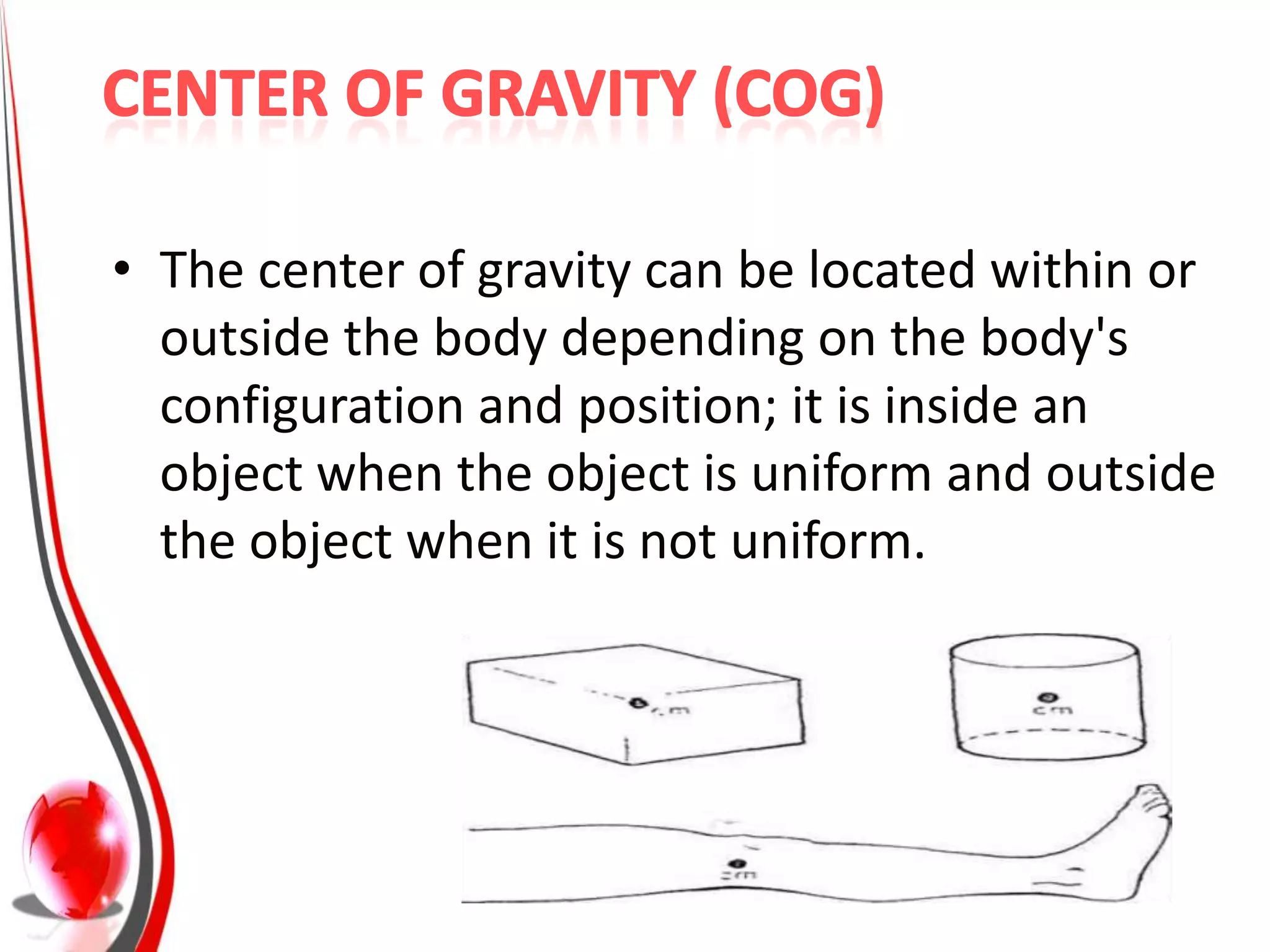
• The center of gravity can be located within or outside the body
   depending on the body's configuration and position; it is inside an object
   when the object is uniform and outside the object when it is not
   uniform.
DEFINITIONS:
• Center of gravity is an imaginary balancing
  point where the body weight can be
  assumed to be concentrated and equally
  distributed. Its symbol is COG or CG.

• It is the point of exact center, around which the
  body may rotate freely in all directions. It can
  also be called center of mass.
• Anatomically; This point can be represented by
  the point of intersection of the three cardinal body
  planes (capital, frontal and transverse).


• At this point; the summation of all forces equal
  zero as well as the summation of moments equal
  zero so; clockwise moment + counterclockwise
  moment = zero.
• The center of gravity can be located within or
  outside the body depending on the body's
  configuration and position; it is inside an
  object when the object is uniform and outside
  the object when it is not uniform.
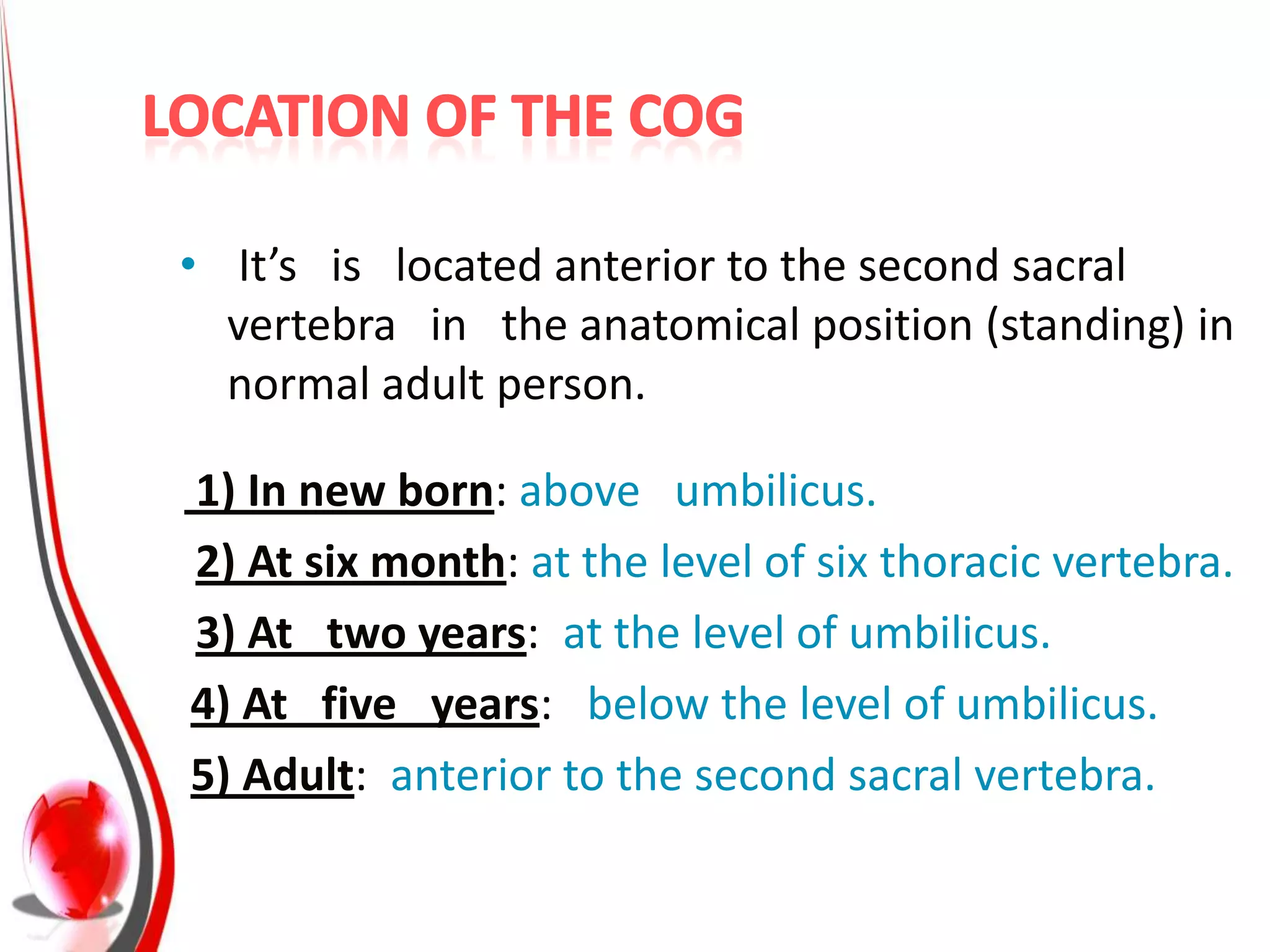
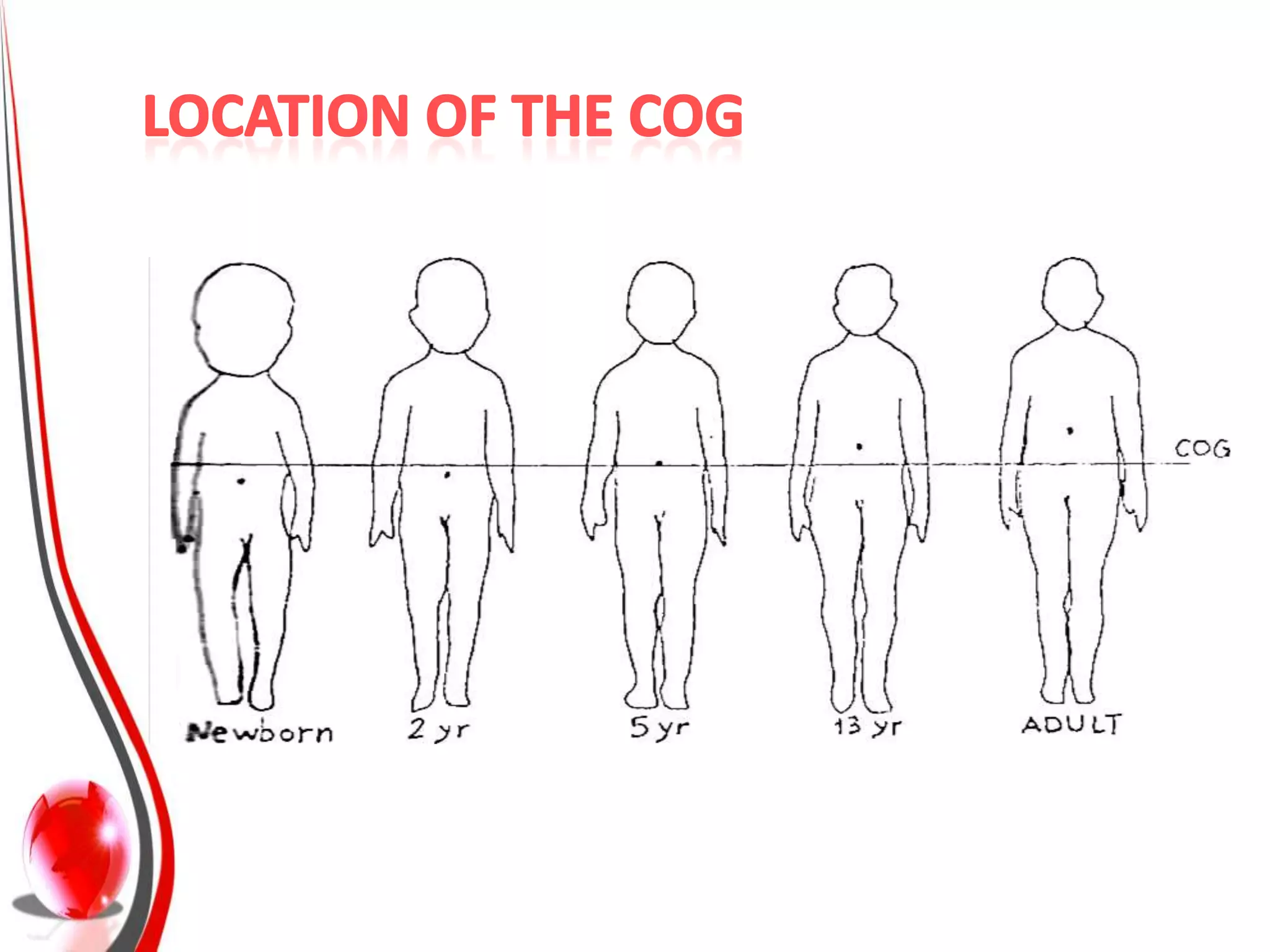
• It’s is located anterior to the second sacral
  vertebra in the anatomical position (standing) in
  normal adult person.

1) In new born: above umbilicus.
2) At six month: at the level of six thoracic vertebra.
3) At two years: at the level of umbilicus.
4) At five years: below the level of umbilicus.
5) Adult: anterior to the second sacral vertebra.
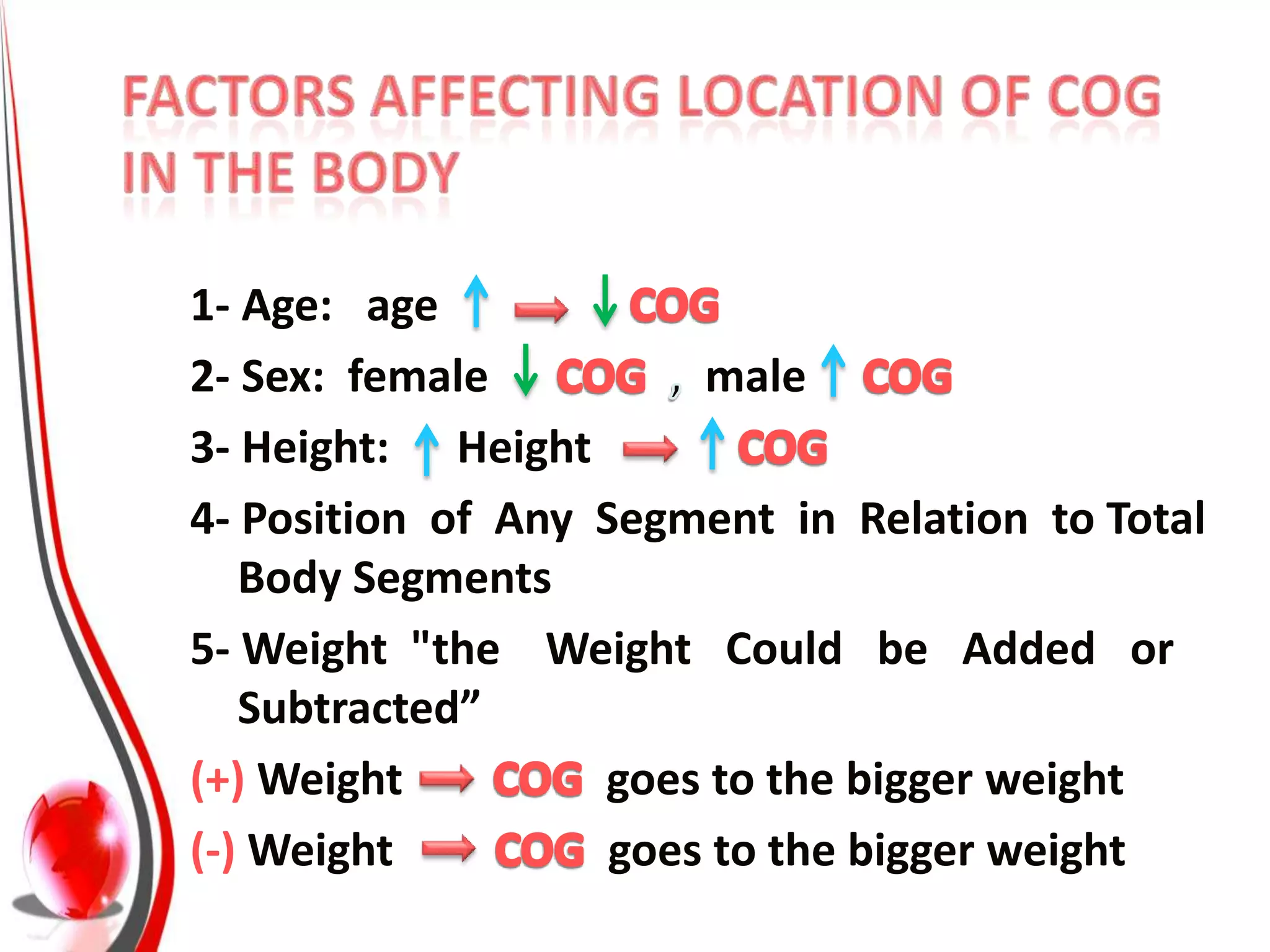
1- Age: age
2- Sex: female          male
3- Height: Height
4- Position of Any Segment in Relation to Total
   Body Segments
5- Weight "the Weight Could be Added or
   Subtracted”
(+) Weight         goes to the bigger weight
(-) Weight          goes to the bigger weight
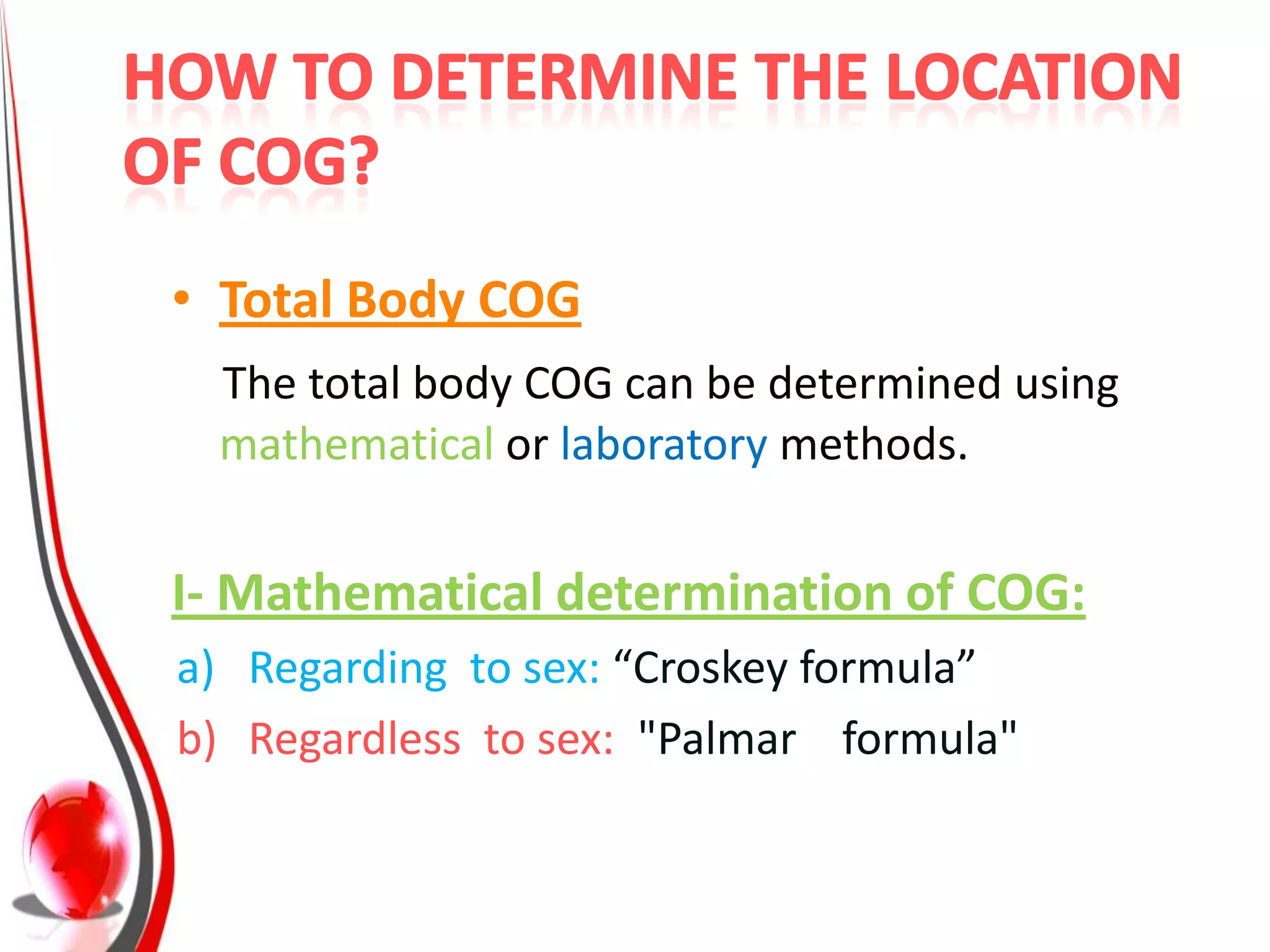
• Total Body COG
 The total body COG can be determined using
 mathematical or laboratory methods.


I- Mathematical determination of COG:
a) Regarding to sex: “Croskey formula”
b) Regardless to sex: "Palmar formula"
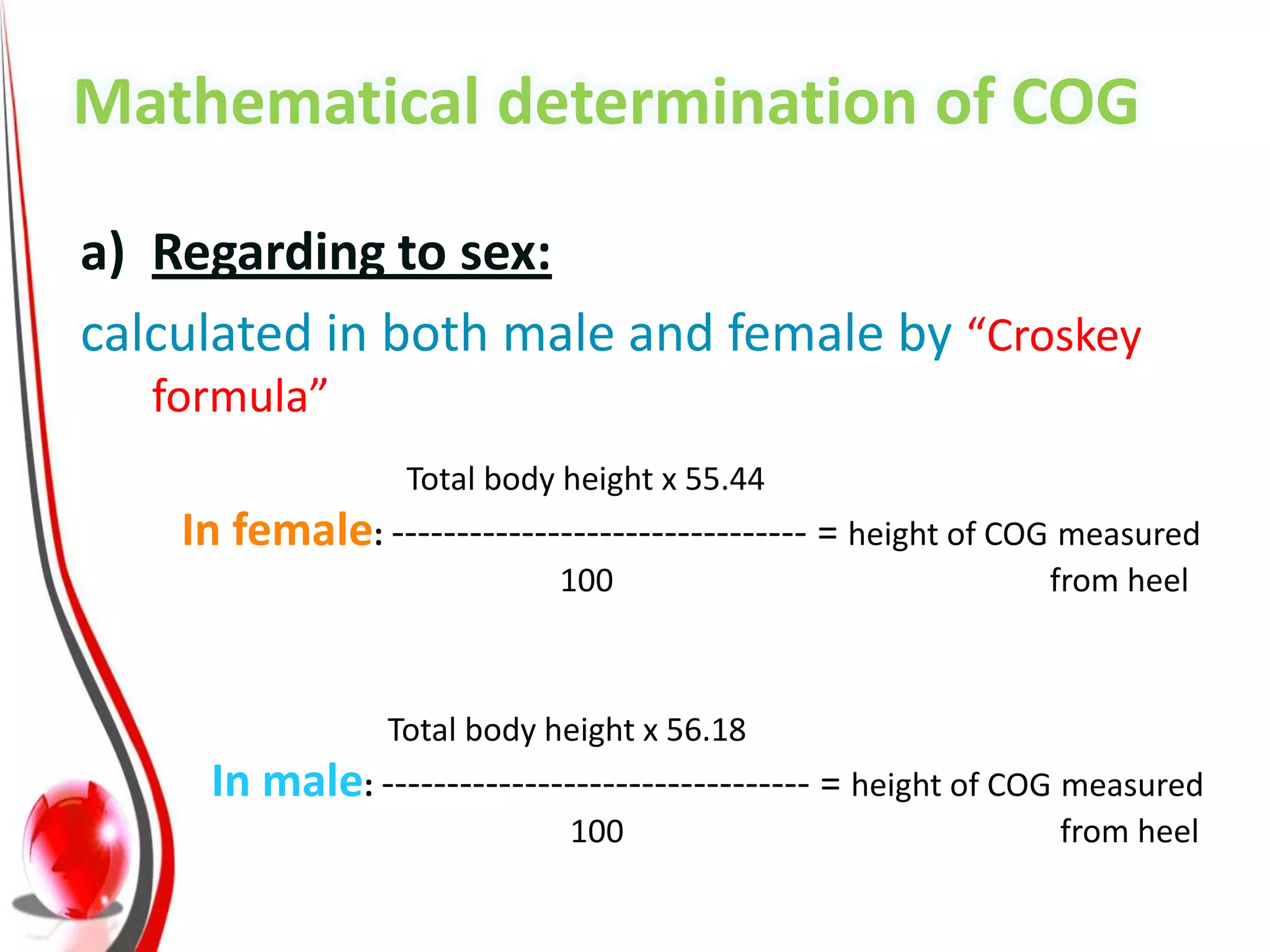
Mathematical determination of COG

a) Regarding to sex: COG location can be
calculated in both male and female by “Croskey
   formula”
                   Total body height x 55.44
    In female: -------------------------------- = height of COG measured
                             100                             from heel


                 Total body height x 56.18
     In male: --------------------------------- = height of COG measured
                              100                             from heel
Mathematical determination of COG

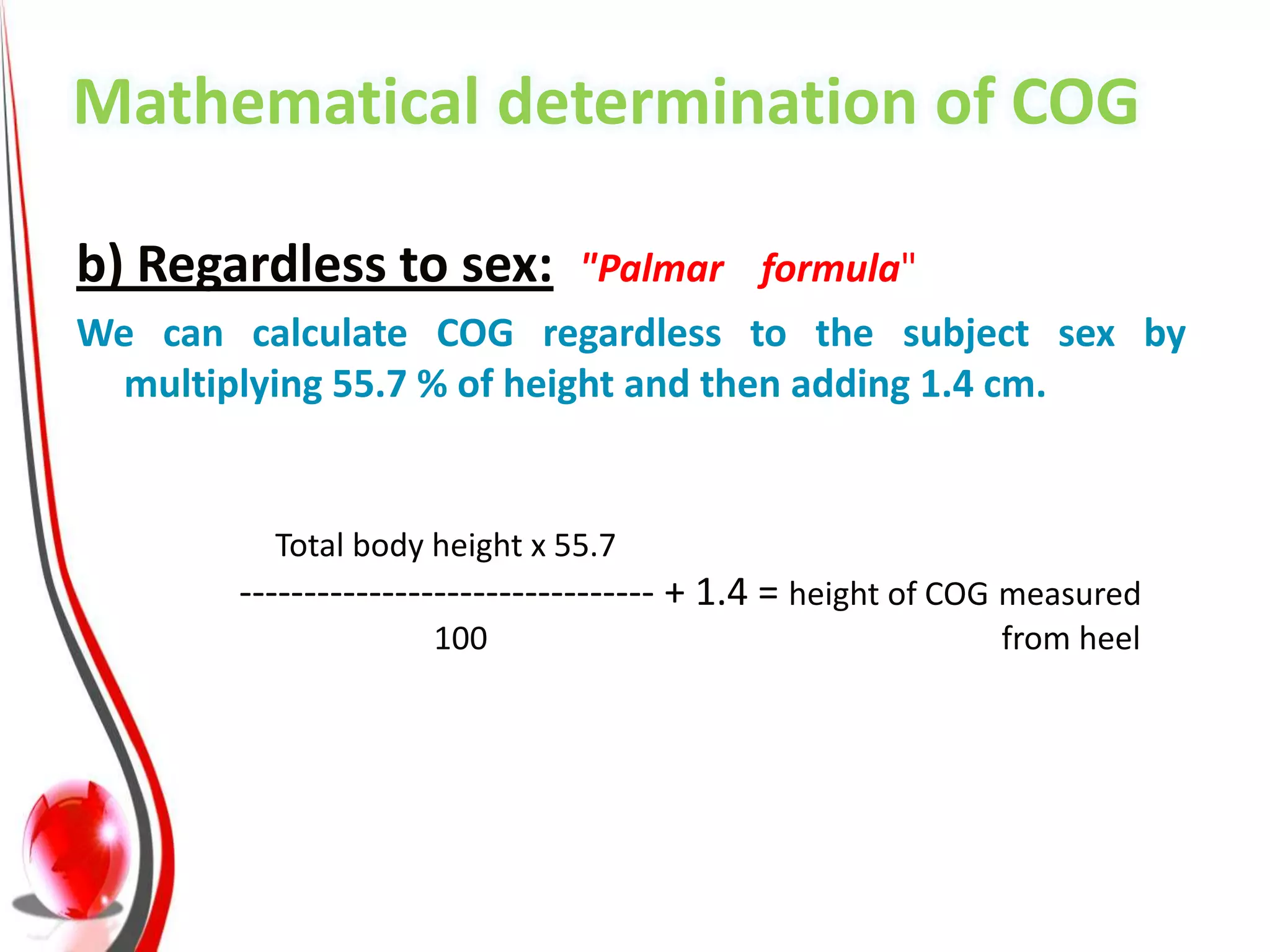
b) Regardless to sex:         "Palmar formula"
We can calculate COG regardless to the subject sex by
  multiplying 55.7 % of height and then adding 1.4 cm.


         Total body height x 55.7
       -------------------------------- + 1.4 = height of COG measured
                    100                                     from heel
- Greater trochanter.
- Anterior superior iliac spine.
- Iliac crest (L4)
- Xiphoid process.
- Spine of scapula.


- Umbilicus.

**As umbilicus may be affected by muscle
  weakness or paralysis, so bony landmarks
  are more accurate.
1- At first, put an object over the top of the head.

2- Then, measure body height from heel to the tragus
  from lateral side to avoid the disadvantage of bad
  muscular distribution as belly abdomen.

3- Then, find mathematically the total body COG either
  with "Palmar formula" or with "Croskey Formula".

4- Finally, find the relation of the total body COG height
  to either bony landmark or soft tissue landmark.
1-To maintain balance through locating
  COG at its level during physical therapy
  treatment.

2-To enhance patient's gait during
  reeducation of walking via
  pushing or grasping the patient near to
  his COG.
3- Total COG must be well known to identify and
  determine the level of performance of athletic player.
  As a result, it will help the biomechanics to improve
  the players' performance.

4- Segmental COG must be known especially in
   amputation. The distribution of the weight of artificial
   limb must be equivalent to that of the amputated
   limb.

          If the weight of the artificial limb increases, the
       segmental COG level will change and as a result the
       total COG level will change which may place overload
       on a diseased part which may cause pain.
Summary of
Center of gravity
o The center of gravity is the point of exact center, around
which the body may rotate freely in all directions. It can
also be called center of mass.

o The center of gravity is determined by two methods,
Mathematically and Laboratory.

o The mathematical method is conducted through the use
of either Croskey’s or Palmar’s formulas.

o The importance of determining body’s COG is reflected in
patient’s rehabilitation during gait training, and for
prosthetics prescription.
Center of gravity

Center of gravity

  • 1.
    KKU_Biomech_M2_L1 Center of gravity Lesson (1) Dr / Shimaa Essa Lecturer of physical therapy , faculty of community, King Khalid university
  • 2.
    Upon successful completionof this lesson you would be able to: 1- Define body center of gravity 2- Identify factors affecting location of center of gravity 3- Calculate location of center of gravity 4- Identify body’s bone and soft land marks 5- Apply steps to locate body center of gravity 6- Identify the importance of locating center of gravity
  • 3.
    • Center ofgravity is an imaginary balancing point where the body weight can be assumed to be concentrated and equally distributed. Its symbol is COG or CG. • It is the point of exact center, around which the body may rotate freely in all directions. It can also be called center of mass. • Anatomically; This point can be represented by the point of intersection of the three cardinal body planes (capital, frontal and transverse). • The center of gravity can be located within or outside the body depending on the body's configuration and position; it is inside an object when the object is uniform and outside the object when it is not uniform.
  • 4.
    DEFINITIONS: • Center ofgravity is an imaginary balancing point where the body weight can be assumed to be concentrated and equally distributed. Its symbol is COG or CG. • It is the point of exact center, around which the body may rotate freely in all directions. It can also be called center of mass.
  • 5.
    • Anatomically; Thispoint can be represented by the point of intersection of the three cardinal body planes (capital, frontal and transverse). • At this point; the summation of all forces equal zero as well as the summation of moments equal zero so; clockwise moment + counterclockwise moment = zero.
  • 6.
    • The centerof gravity can be located within or outside the body depending on the body's configuration and position; it is inside an object when the object is uniform and outside the object when it is not uniform.
  • 7.
    • It’s islocated anterior to the second sacral vertebra in the anatomical position (standing) in normal adult person. 1) In new born: above umbilicus. 2) At six month: at the level of six thoracic vertebra. 3) At two years: at the level of umbilicus. 4) At five years: below the level of umbilicus. 5) Adult: anterior to the second sacral vertebra.
  • 9.
    1- Age: age 2-Sex: female male 3- Height: Height 4- Position of Any Segment in Relation to Total Body Segments 5- Weight "the Weight Could be Added or Subtracted” (+) Weight goes to the bigger weight (-) Weight goes to the bigger weight
  • 10.
    • Total BodyCOG The total body COG can be determined using mathematical or laboratory methods. I- Mathematical determination of COG: a) Regarding to sex: “Croskey formula” b) Regardless to sex: "Palmar formula"
  • 11.
    Mathematical determination ofCOG a) Regarding to sex: COG location can be calculated in both male and female by “Croskey formula” Total body height x 55.44 In female: -------------------------------- = height of COG measured 100 from heel Total body height x 56.18 In male: --------------------------------- = height of COG measured 100 from heel
  • 12.
    Mathematical determination ofCOG b) Regardless to sex: "Palmar formula" We can calculate COG regardless to the subject sex by multiplying 55.7 % of height and then adding 1.4 cm. Total body height x 55.7 -------------------------------- + 1.4 = height of COG measured 100 from heel
  • 13.
    - Greater trochanter. -Anterior superior iliac spine. - Iliac crest (L4) - Xiphoid process. - Spine of scapula. - Umbilicus. **As umbilicus may be affected by muscle weakness or paralysis, so bony landmarks are more accurate.
  • 14.
    1- At first,put an object over the top of the head. 2- Then, measure body height from heel to the tragus from lateral side to avoid the disadvantage of bad muscular distribution as belly abdomen. 3- Then, find mathematically the total body COG either with "Palmar formula" or with "Croskey Formula". 4- Finally, find the relation of the total body COG height to either bony landmark or soft tissue landmark.
  • 15.
    1-To maintain balancethrough locating COG at its level during physical therapy treatment. 2-To enhance patient's gait during reeducation of walking via pushing or grasping the patient near to his COG.
  • 16.
    3- Total COGmust be well known to identify and determine the level of performance of athletic player. As a result, it will help the biomechanics to improve the players' performance. 4- Segmental COG must be known especially in amputation. The distribution of the weight of artificial limb must be equivalent to that of the amputated limb. If the weight of the artificial limb increases, the segmental COG level will change and as a result the total COG level will change which may place overload on a diseased part which may cause pain.
  • 17.
  • 18.
    o The centerof gravity is the point of exact center, around which the body may rotate freely in all directions. It can also be called center of mass. o The center of gravity is determined by two methods, Mathematically and Laboratory. o The mathematical method is conducted through the use of either Croskey’s or Palmar’s formulas. o The importance of determining body’s COG is reflected in patient’s rehabilitation during gait training, and for prosthetics prescription.