CENTROID 
CENTRE OF GRAVITY 
Centre of gravity : It of a body is the point at 
which the whole weight of the body may be 
assumed to be concentrated. 
A body is having only one center of gravity for 
all positions of the body. 
It is represented by CG. or simply G or C. 
1
CENTRE OF GRAVITY 
Consider a three dimensional 
body of any size and shape, 
having a mass m. 
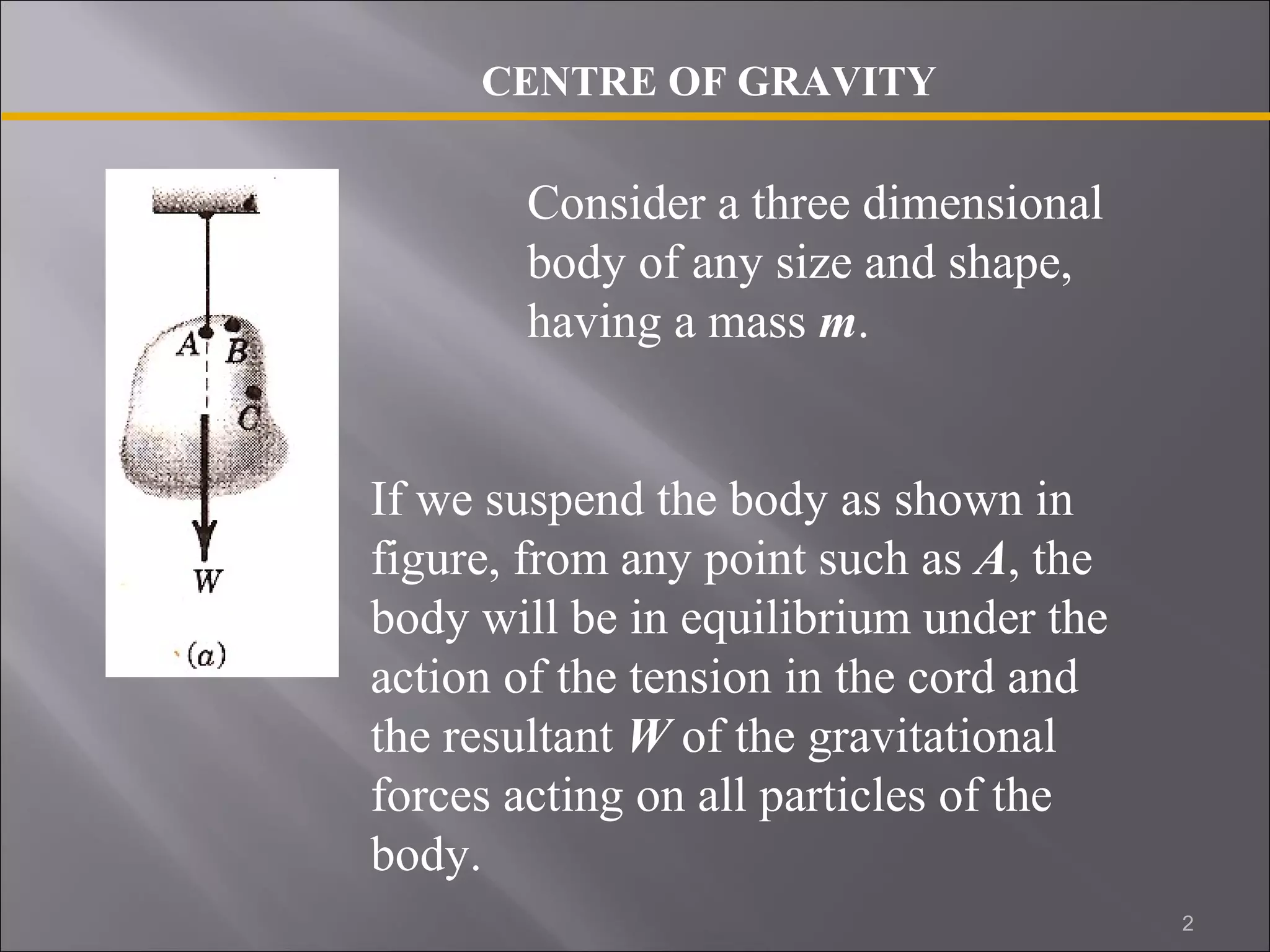
If we suspend the body as shown in 
figure, from any point such as A, the 
body will be in equilibrium under the 
action of the tension in the cord and 
the resultant W of the gravitational 
forces acting on all particles of the 
body. 
2
CENTRE OF GRAVITY 
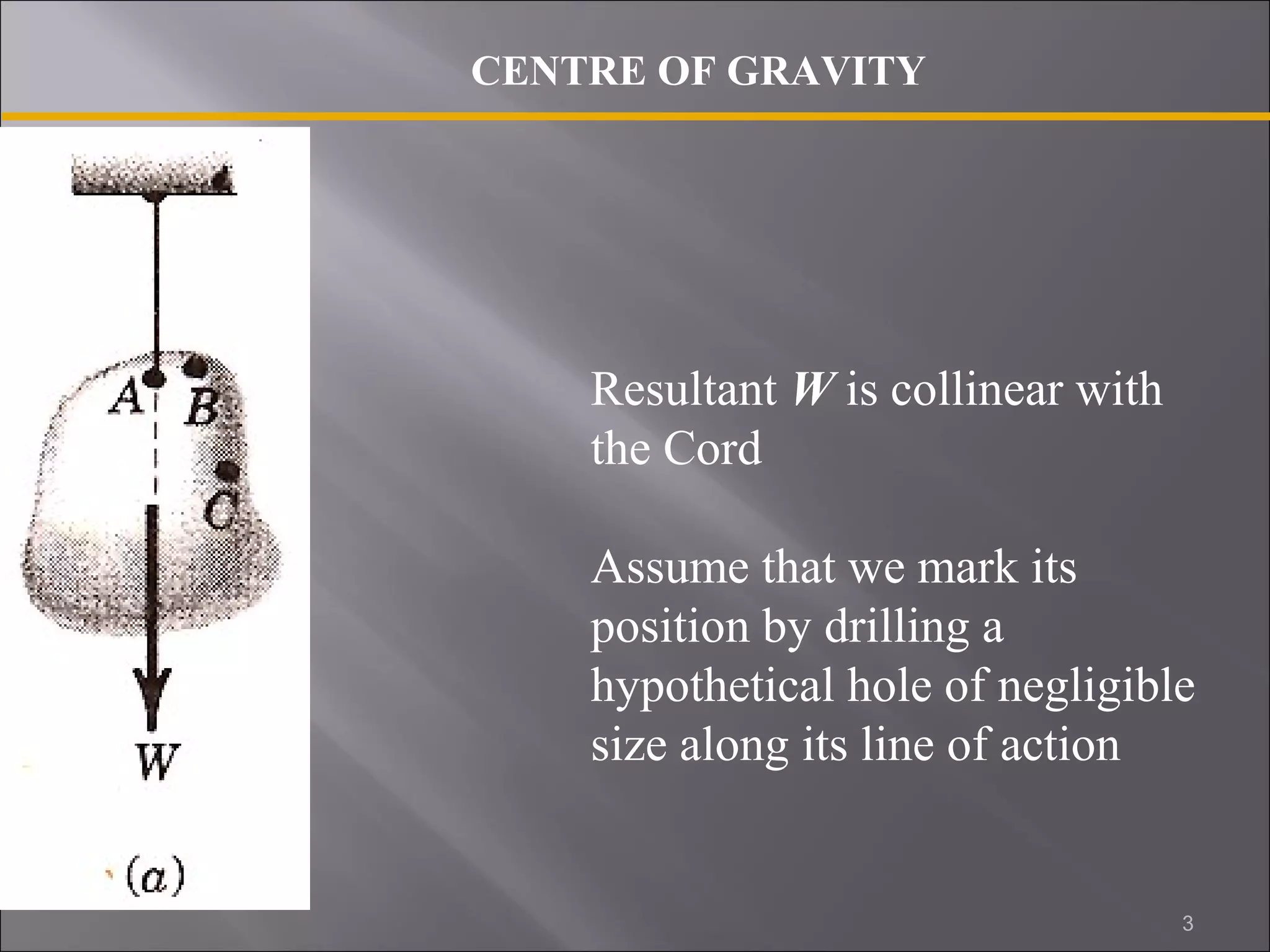
Resultant W is collinear with 
the Cord 
Assume that we mark its 
position by drilling a 
hypothetical hole of negligible 
size along its line of action 
3
CENTRE OF GRAVITY 
To determine mathematically the location of the 
centre of gravity of any body, 
we apply the principle of moments to the parallel 
system of gravitational forces. 
Centre of gravity is that point about which the 
summation of the first moments of the weights of 
the elements of the body is zero. 
4
CENTRE OF GRAVITY 
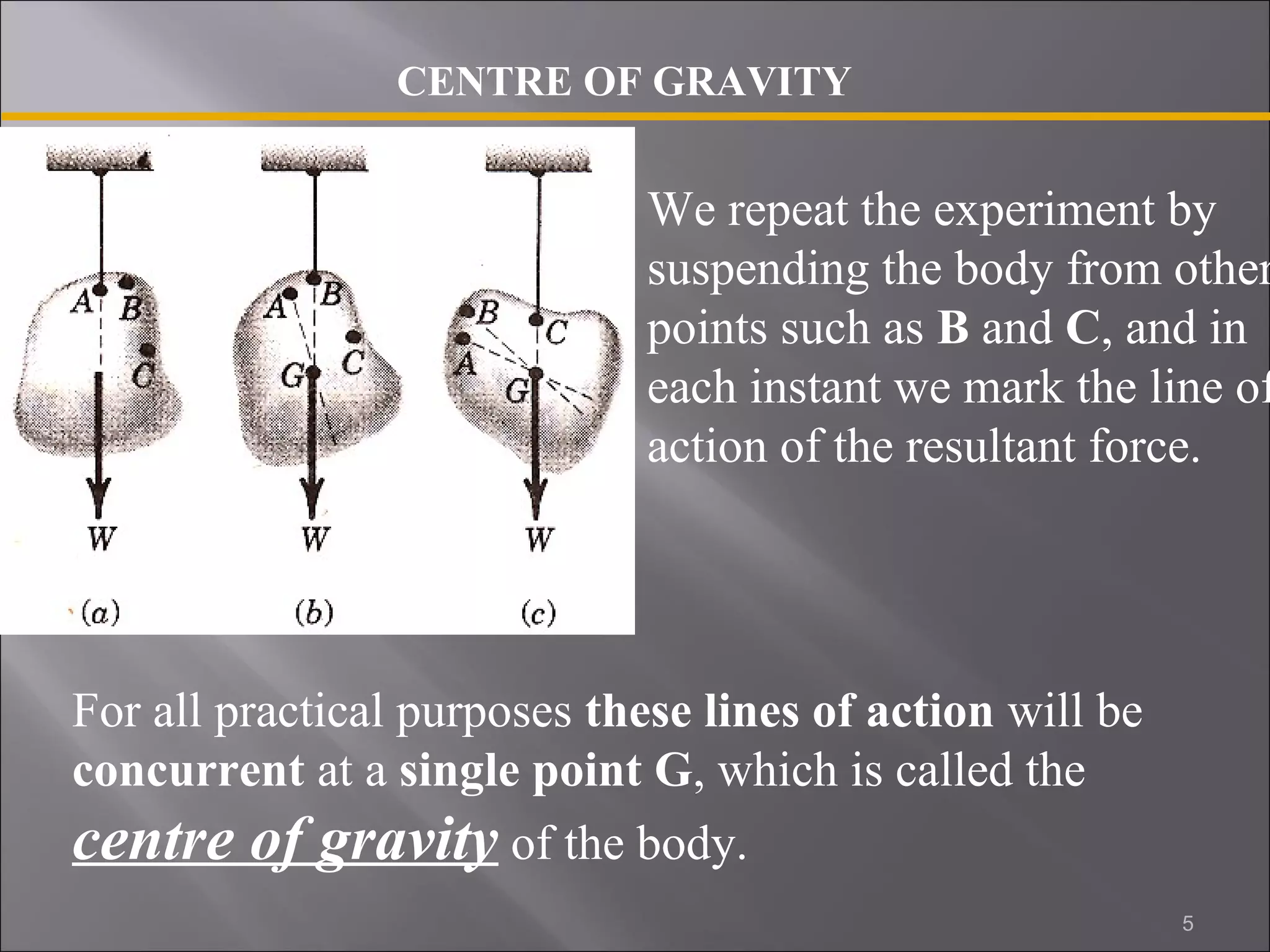
We repeat the experiment by 
suspending the body from other 
points such as B and C, and in 
each instant we mark the line of 
action of the resultant force. 
For all practical purposes these lines of action will be 
concurrent at a single point G, which is called the 
centre of gravity of the body. 
5
A 
A 
w 
B 
w 
A 
G 
B 
A 
w 
A 
B 
C 
B G 
A 
C 
C 
B 
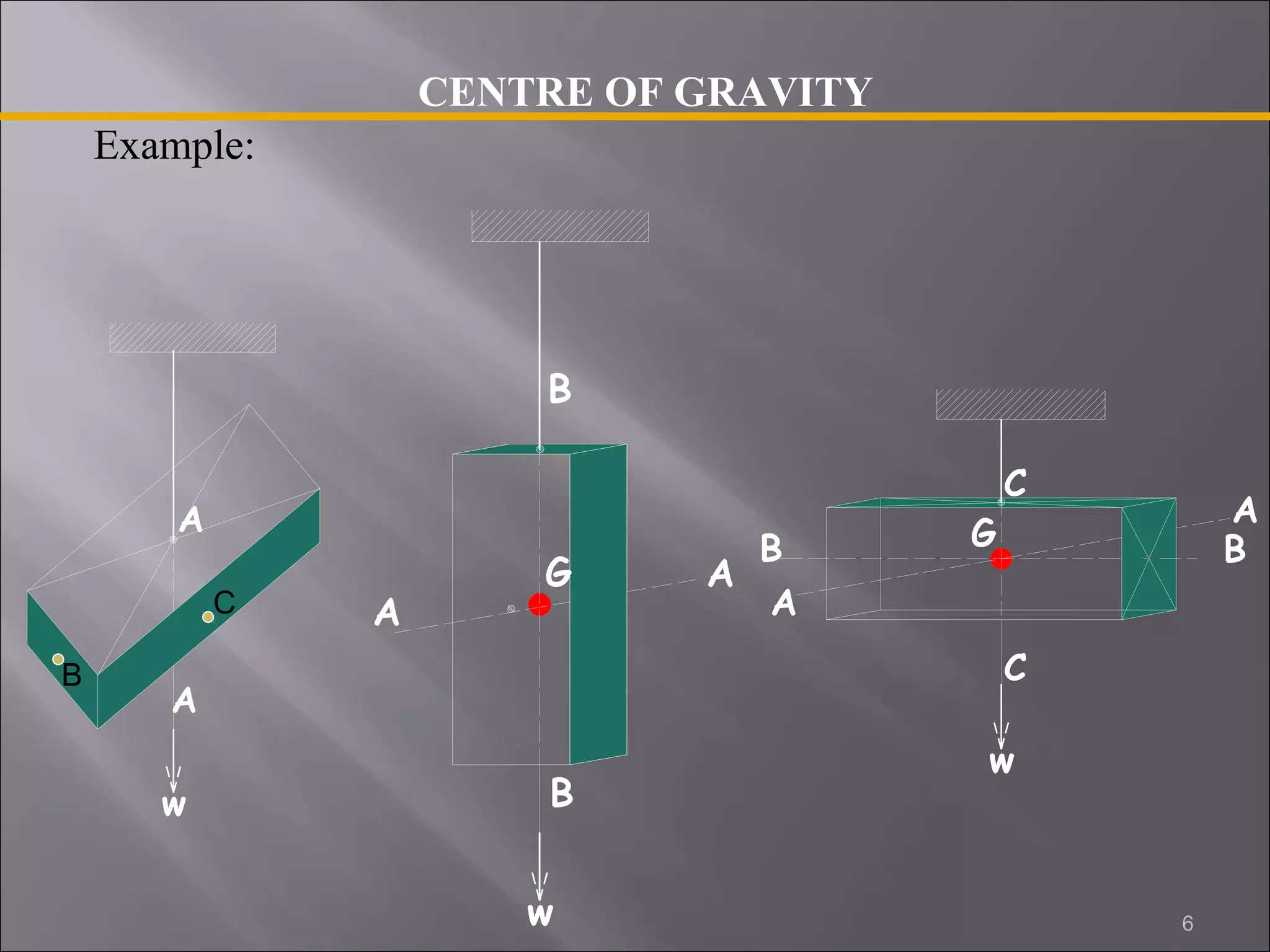
Example: 
CENTRE OF GRAVITY 
6
CENTRE OF GRAVITY 
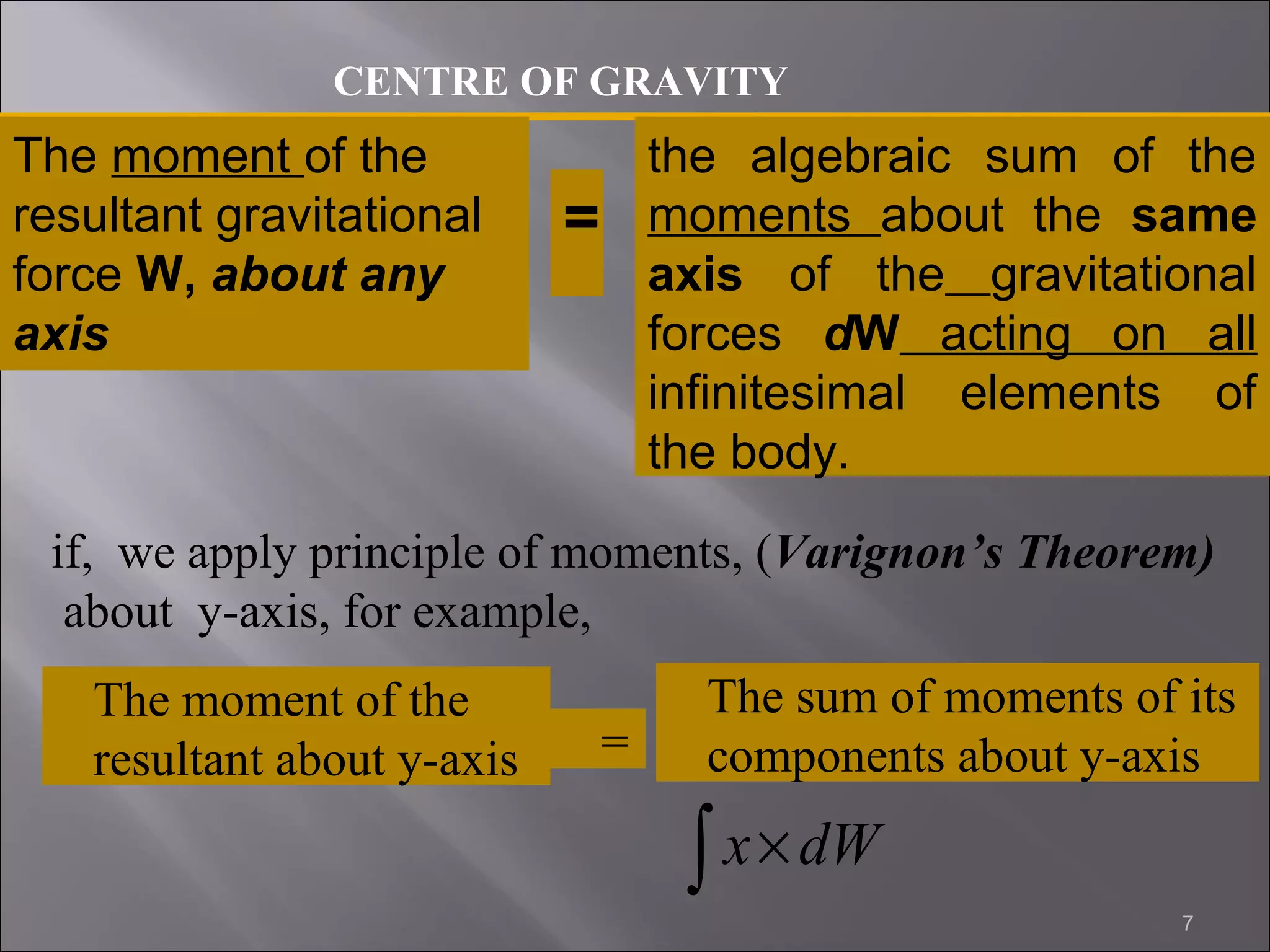
The moment of the 
resultant gravitational 
force W, about any 
axis 
= 
the algebraic sum of the 
moments about the same 
axis of the gravitational 
forces dW acting on all 
infinitesimal elements of 
the body. 
if, we apply principle of moments, (Varignon’s Theorem) 
about y-axis, for example, 
ò x´ dW 
7 
The moment of the 
resultant about y-axis = 
The sum of moments of its 
components about y-axis
CENTRE OF GRAVITY 
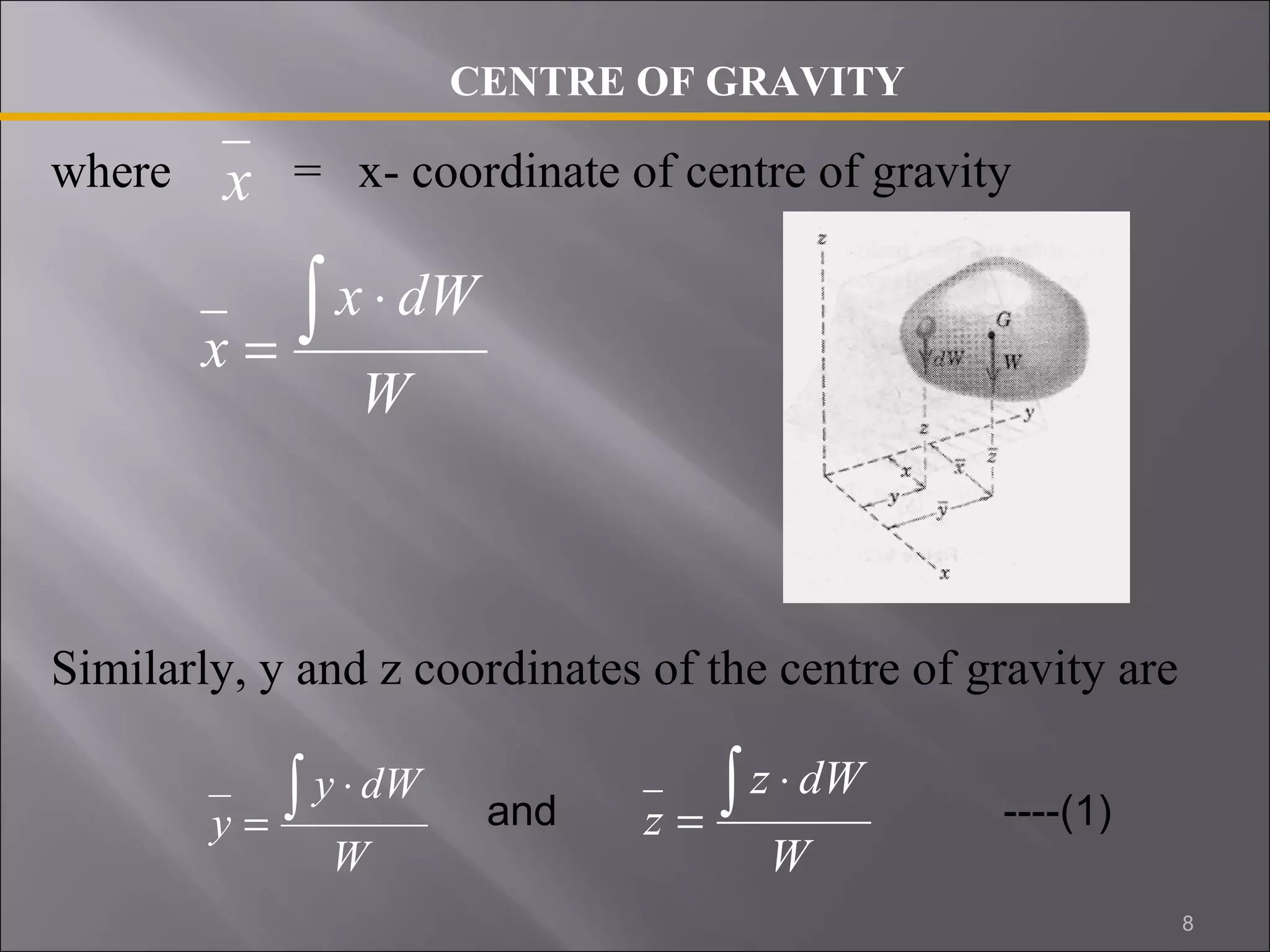
where = x- x coordinate of centre of gravity 
x ò × 
x dW 
W 
= 
Similarly, y and z coordinates of the centre of gravity are 
y ò × 
y dW 
W 
= 
z ò × 
z dW 
W 
= 
8 
and ----(1)
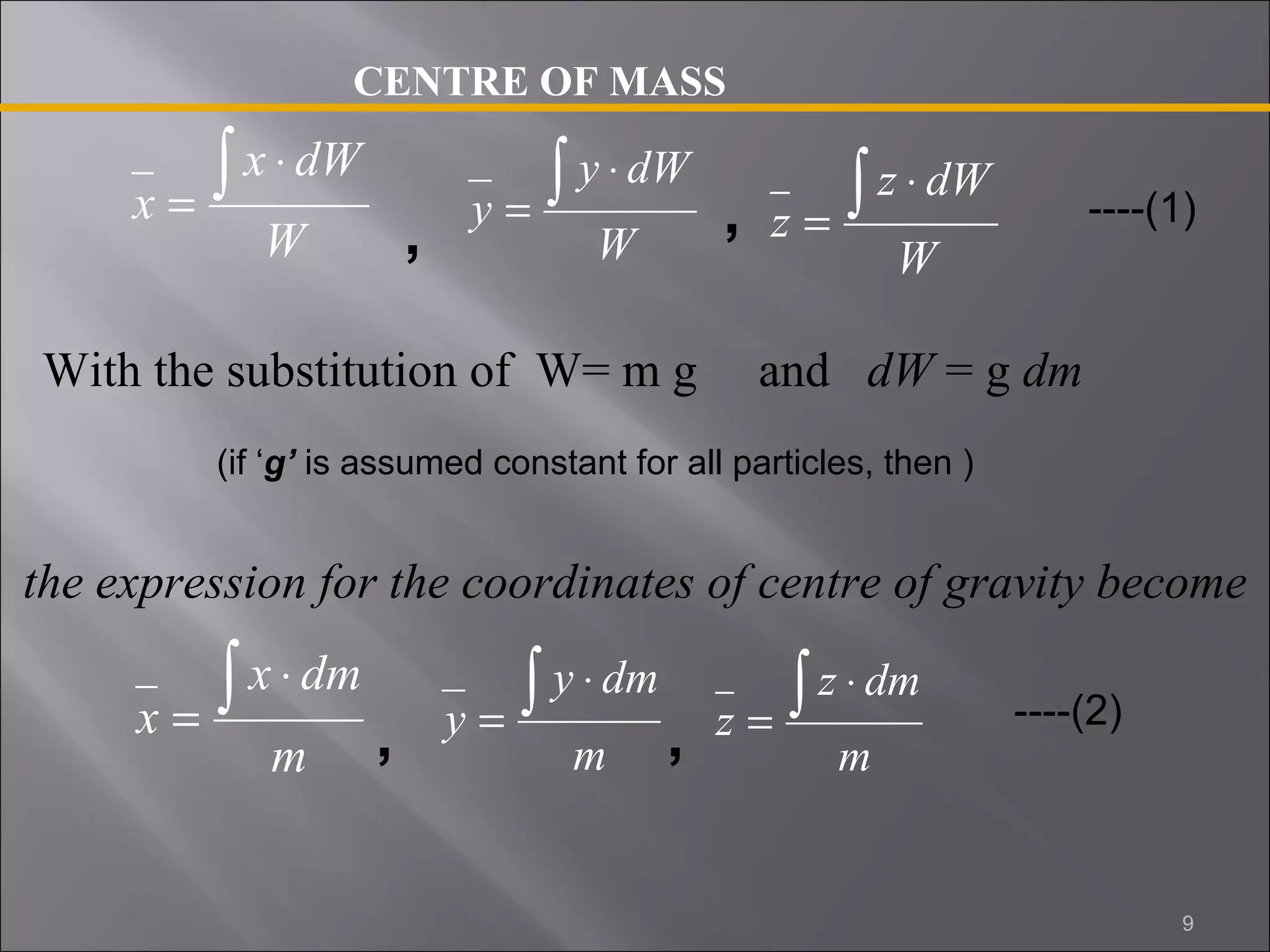
x ò × 
CENTRE OF MASS 
x dW 
W 
= 
y ò × 
y dW 
, = 
, 
W 
z ò × 
z dW 
W 
= 
With the substitution of W= m g and dW = g dm 
(if ‘g’ is assumed constant for all particles, then ) 
the expression for the coordinates of centre of gravity become 
x ò × 
x dm 
m 
= 
y ò × 
y dm 
m 
= 
z ò × 
z dm 
m 
= 
----(1) 
, , ----(2) 
9
CENTRE OF MASS 
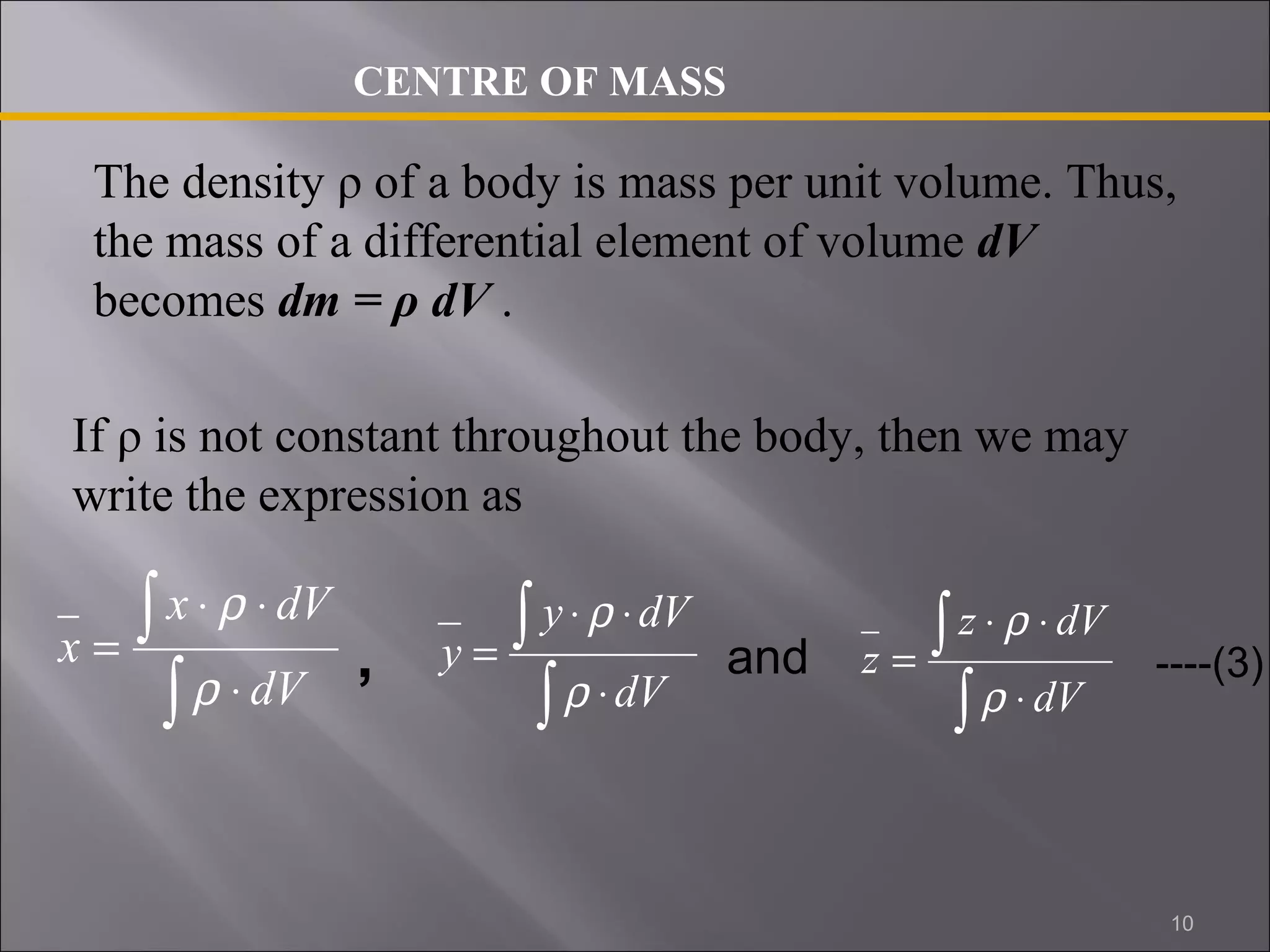
The density ρ of a body is mass per unit volume. Thus, 
the mass of a differential element of volume dV 
becomes dm = ρ dV . 
If ρ is not constant throughout the body, then we may 
write the expression as 
x dV 
ò 
ò 
× r 
× 
× 
= 
dV 
x 
r 
y dV 
ò 
ò 
× r 
× 
× 
= 
dV 
y 
r 
z dV 
and ----(3) 
ò 
ò 
× r 
× 
× 
= 
dV 
z 
r 
, 
10
x ò × 
x dm 
m 
= 
CENTRE OF MASS 
y ò × 
y dm 
, , = ----(2) 
m 
= 
z ò × 
z dm 
m 
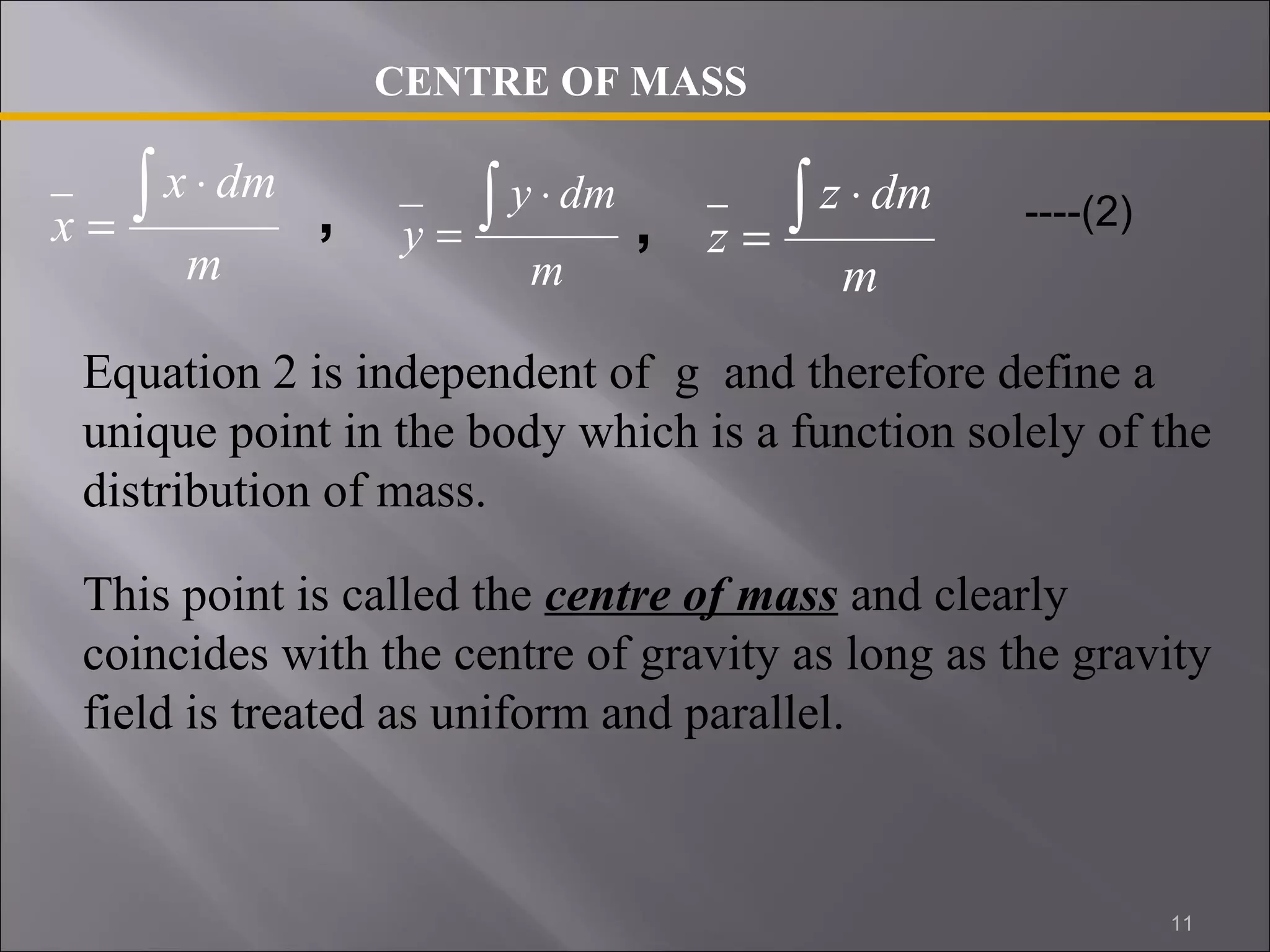
Equation 2 is independent of g and therefore define a 
unique point in the body which is a function solely of the 
distribution of mass. 
This point is called the centre of mass and clearly 
coincides with the centre of gravity as long as the gravity 
field is treated as uniform and parallel. 
11
x dV 
ò 
× r 
× 
y × r 
× 
dV 
z × r 
× 
dV 
, and ----(3) 
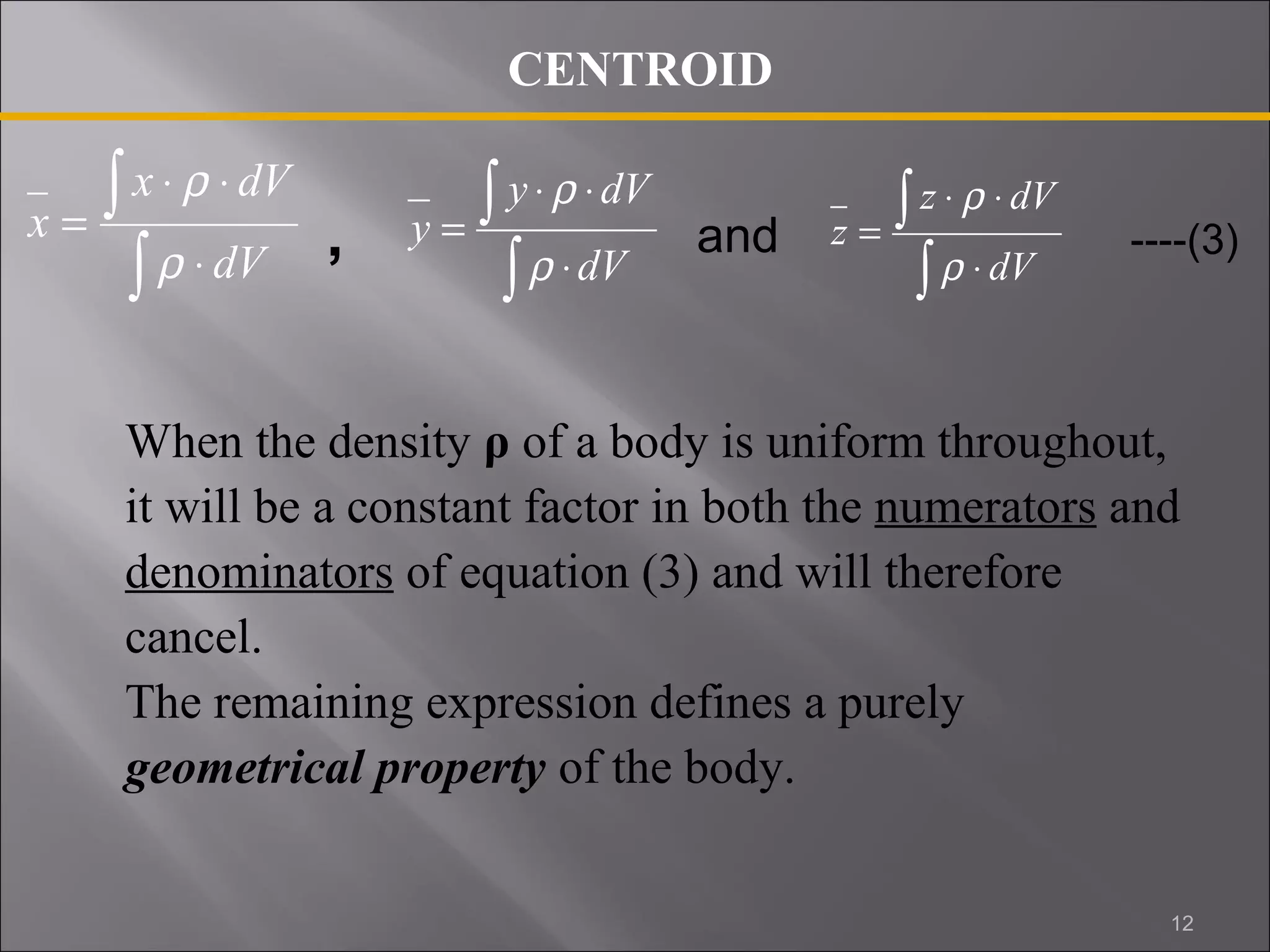
When the density ρ of a body is uniform throughout, 
it will be a constant factor in both the numerators and 
denominators of equation (3) and will therefore 
cancel. 
The remaining expression defines a purely 
geometrical property of the body. 
ò 
× 
= 
dV 
x 
r 
ò 
ò 
× 
= 
dV 
y 
r 
ò 
ò 
× 
= 
dV 
z 
r 
CENTROID 
12
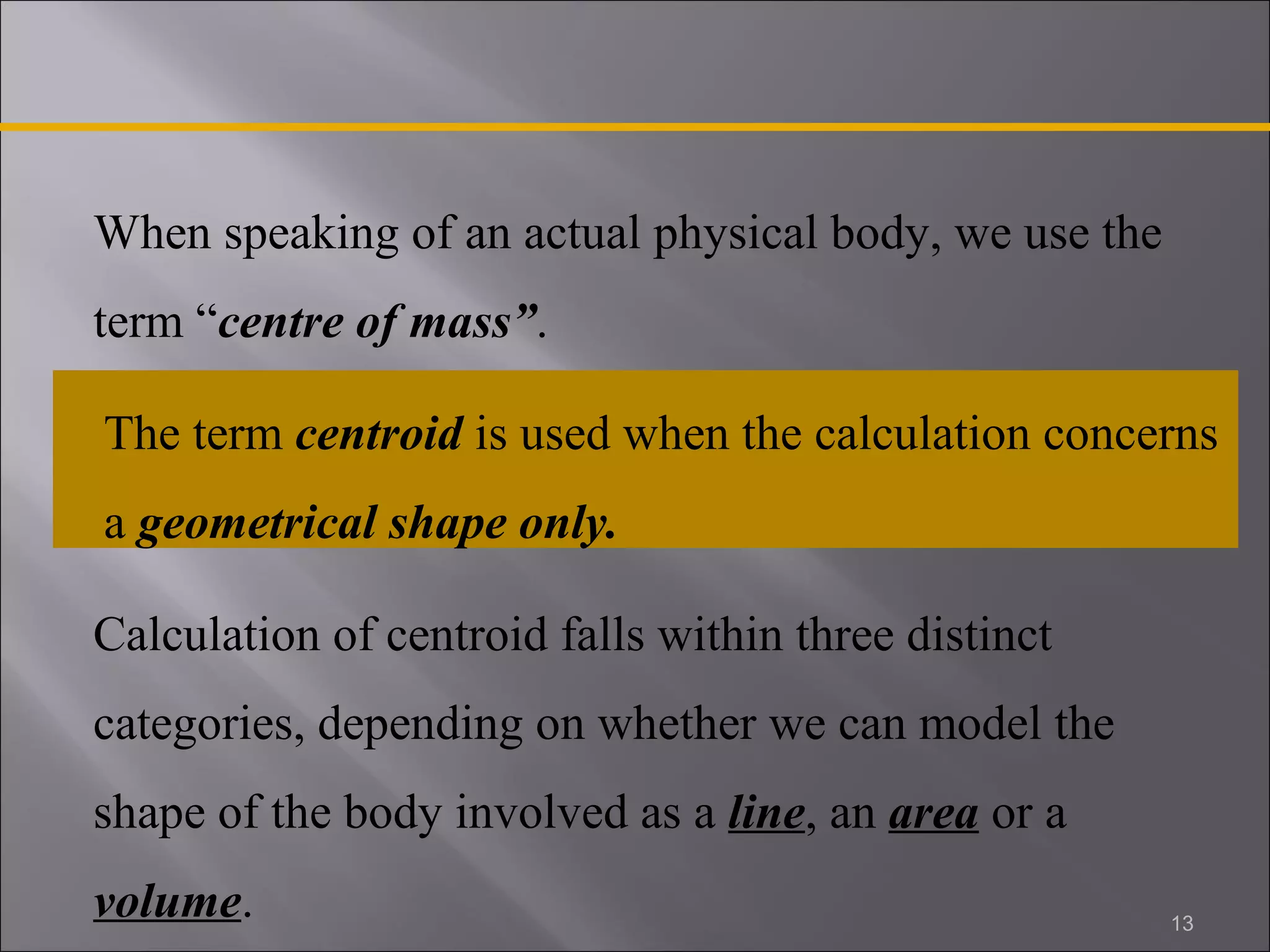
When speaking of an actual physical body, we use the 
term “centre of mass”. 
The term centroid is used when the calculation concerns 
a geometrical shape only. 
Calculation of centroid falls within three distinct 
categories, depending on whether we can model the 
shape of the body involved as a line, an area or a 
volume. 
13
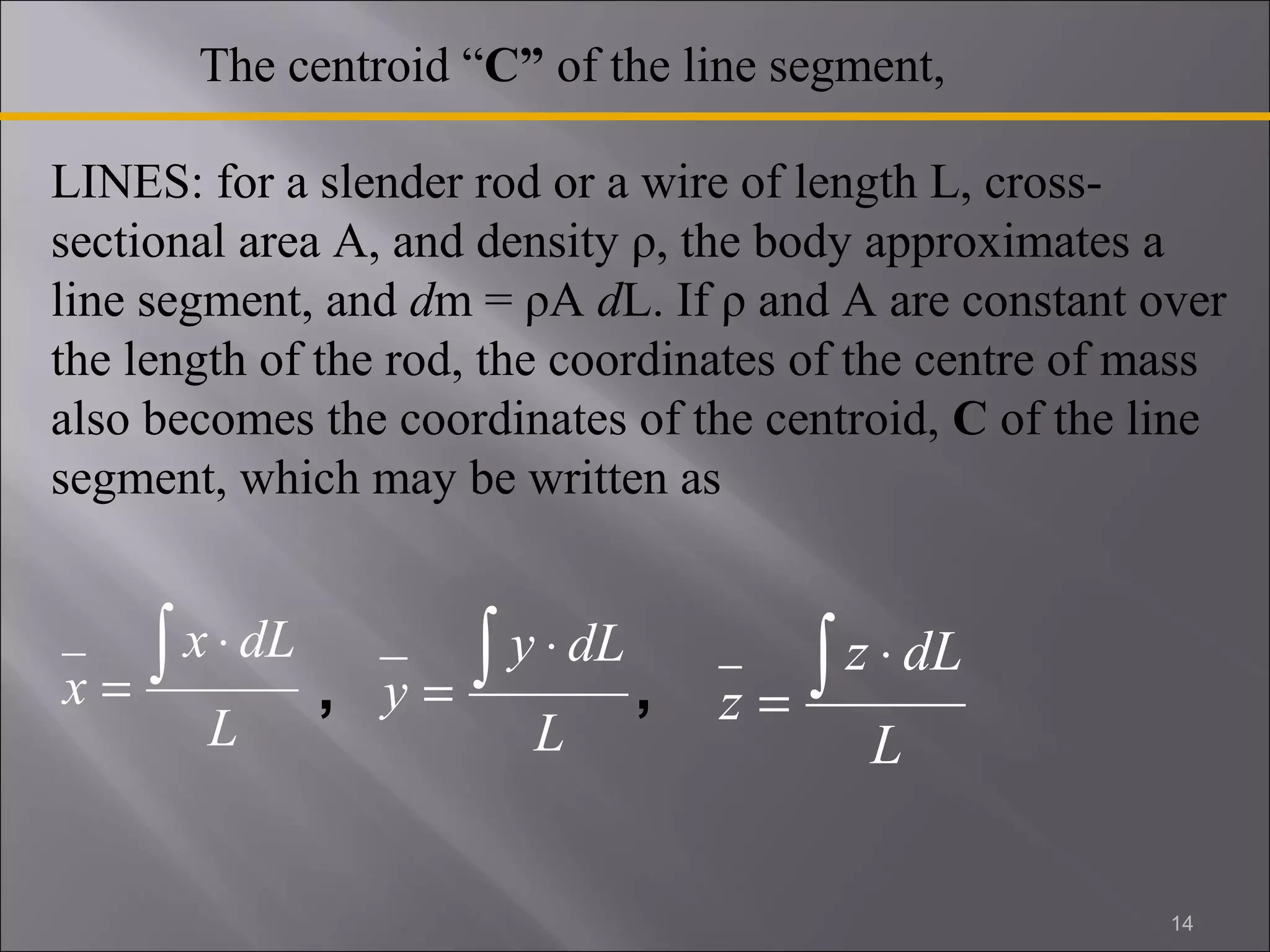
The centroid “C” of the line segment, 
LINES: for a slender rod or a wire of length L, cross-sectional 
area A, and density ρ, the body approximates a 
line segment, and dm = ρA dL. If ρ and A are constant over 
the length of the rod, the coordinates of the centre of mass 
also becomes the coordinates of the centroid, C of the line 
segment, which may be written as 
x ò × 
x dL 
L 
= 
y ò × 
y dL 
L 
= 
z ò × 
z dL 
L 
= 
, , 
14
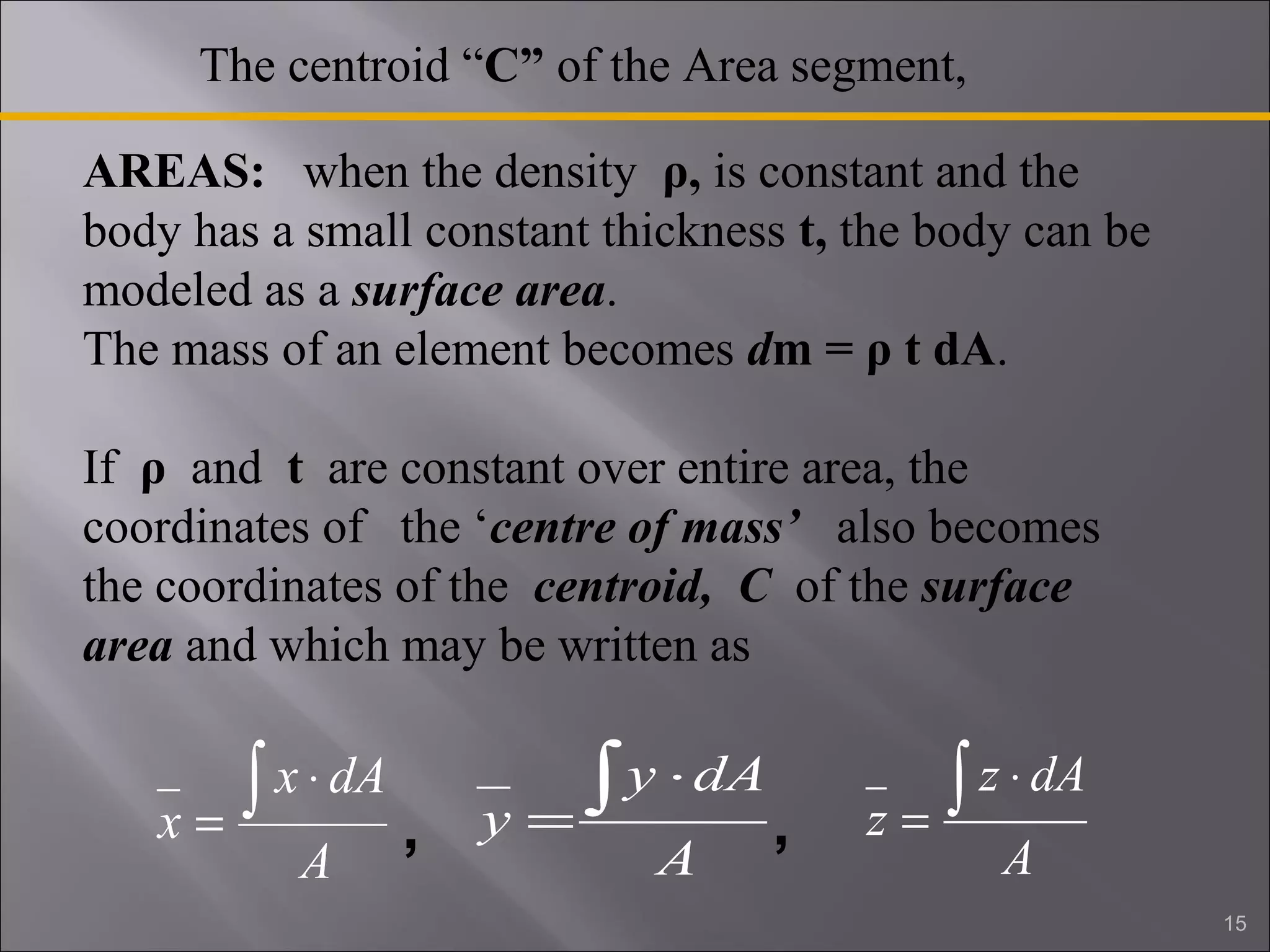
The centroid “C” of the Area segment, 
AREAS: when the density ρ, is constant and the 
body has a small constant thickness t, the body can be 
modeled as a surface area. 
The mass of an element becomes dm = ρ t dA. 
If ρ and t are constant over entire area, the 
coordinates of the ‘centre of mass’ also becomes 
the coordinates of the centroid, C of the surface 
area and which may be written as 
x ò × 
x dA 
A 
= 
y ò × 
y dA 
A 
= 
z ò × 
z dA 
A 
= 
, , 
15
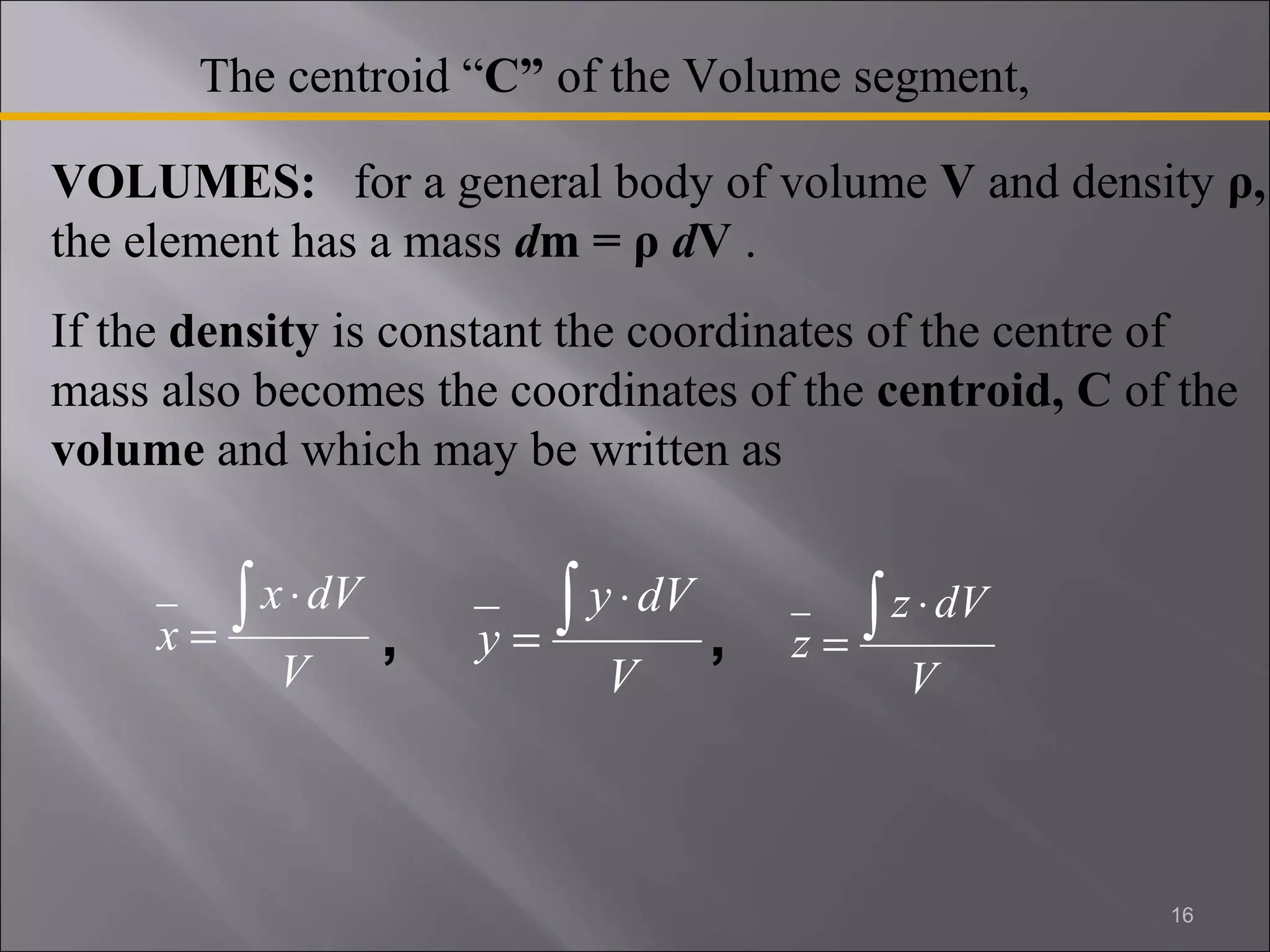
VOLUMES: for a general body of volume V and density ρ, 
the element has a mass dm = ρ dV . 
If the density is constant the coordinates of the centre of 
mass also becomes the coordinates of the centroid, C of the 
volume and which may be written as 
x ò × 
x dV 
V 
= 
y ò × 
y dV 
V 
= 
z ò × 
z dV 
V 
= 
16 
The centroid “C” of the Volume segment, 
, ,
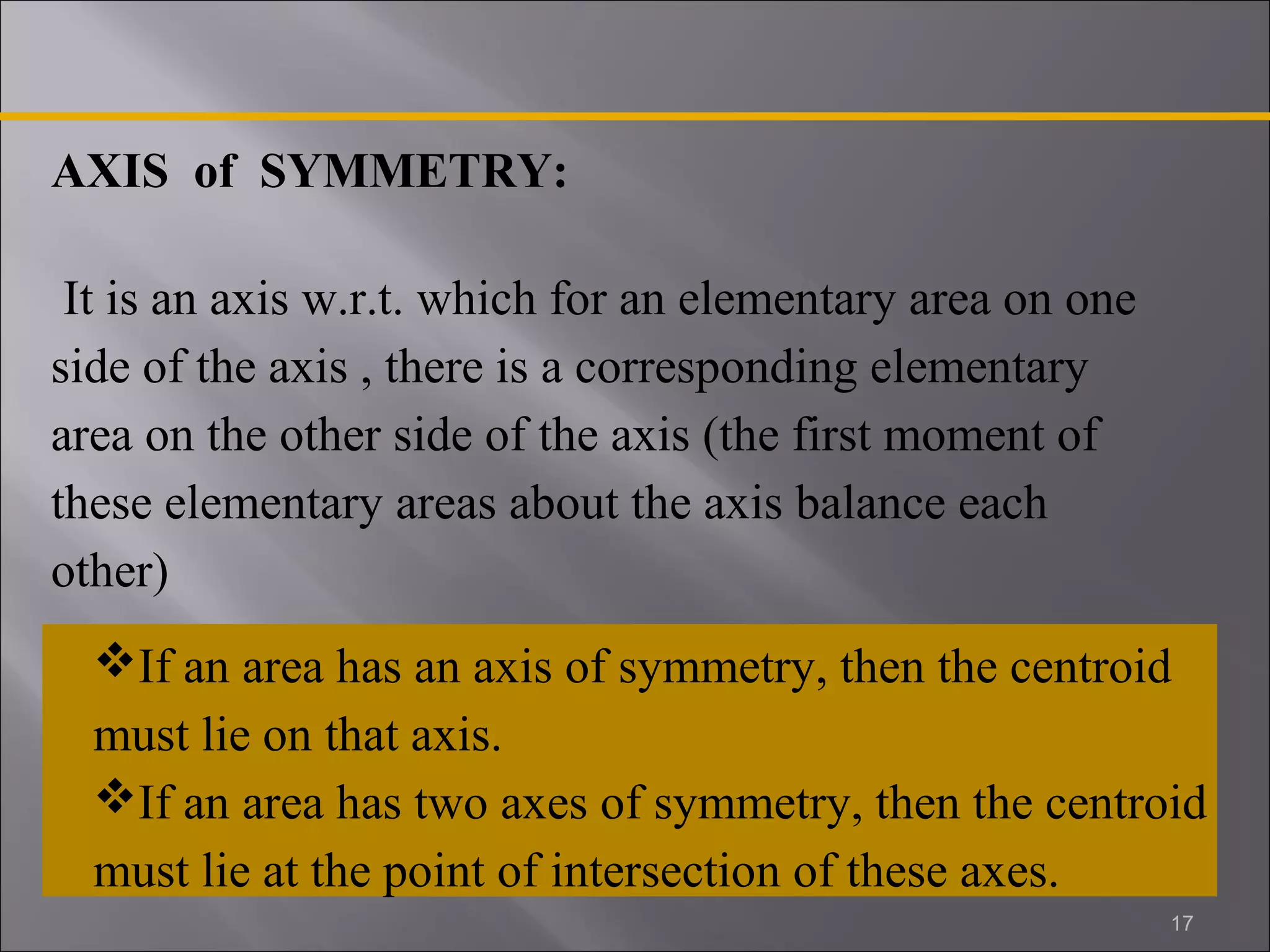
AXIS of SYMMETRY: 
It is an axis w.r.t. which for an elementary area on one 
side of the axis , there is a corresponding elementary 
area on the other side of the axis (the first moment of 
these elementary areas about the axis balance each 
other) 
If an area has an axis of symmetry, then the centroid 
must lie on that axis. 
If an area has two axes of symmetry, then the centroid 
must lie at the point of intersection of these axes. 
17
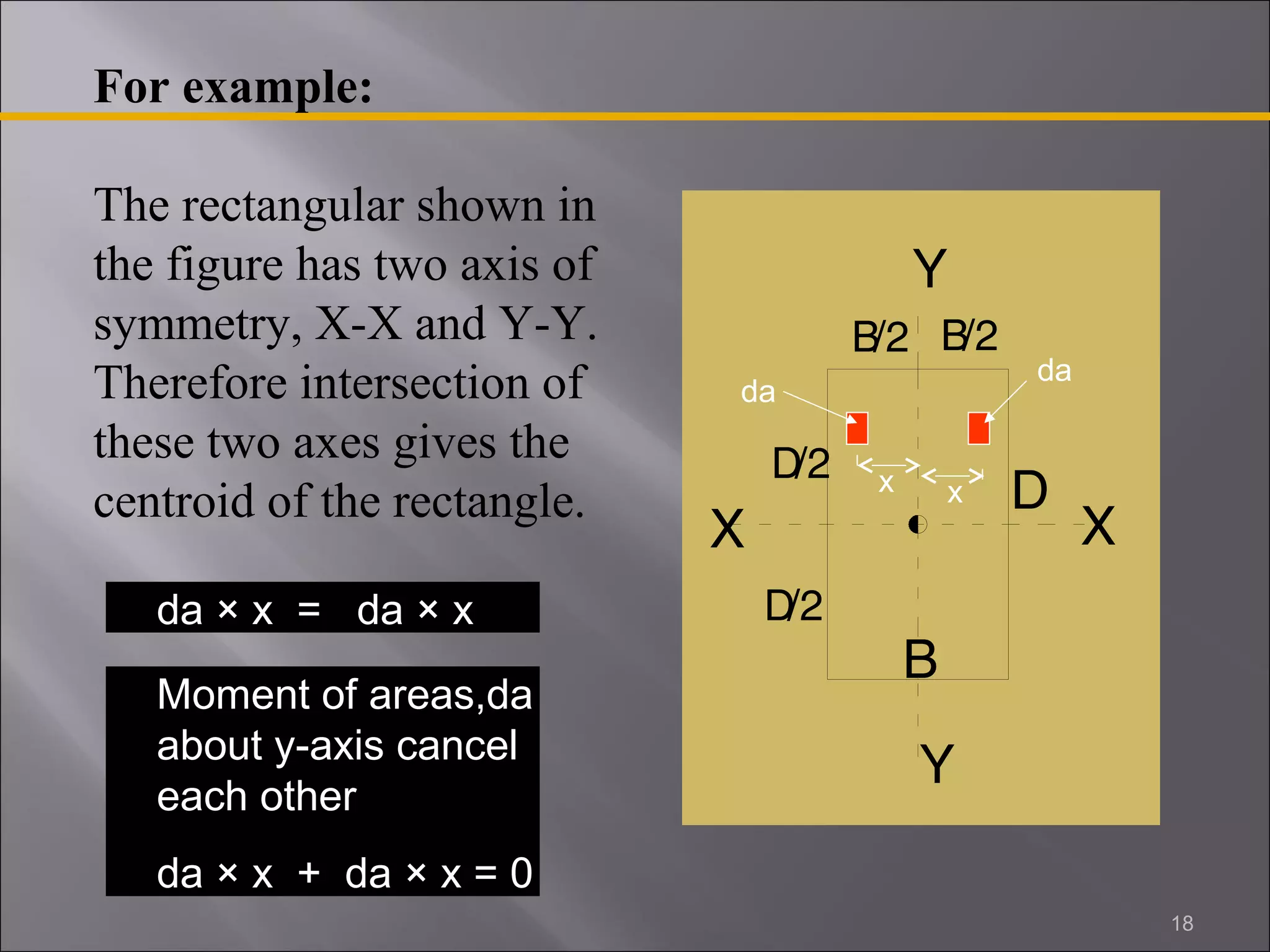
For example: 
The rectangular shown in 
the figure has two axis of 
symmetry, X-X and Y-Y. 
Therefore intersection of 
these two axes gives the 
centroid of the rectangle. 
Y 
da da 
D/2 
x x 
D B 
D/2 
B/2 B/2 
X X 
Y 
da × x = da × x 
Moment of areas,da 
about y-axis cancel 
each other 
da × x + da × x = 0 
18
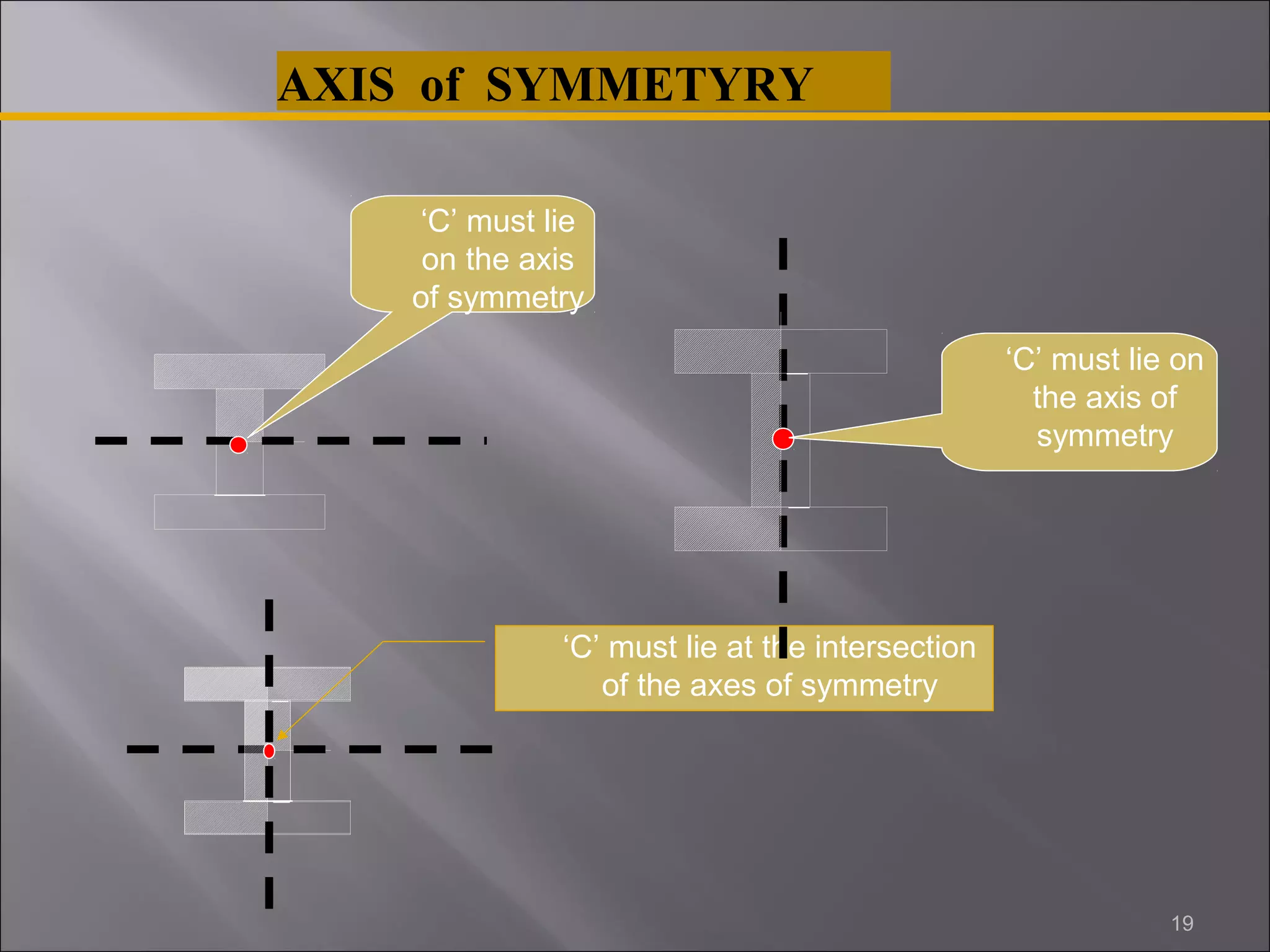
AXIS of SYMMETYRY 
‘C’ must lie 
on the axis 
of symmetry 
‘C’ must lie at the intersection 
of the axes of symmetry 
‘C’ must lie on 
the axis of 
symmetry 
19
=> PRESENTED BY:- 
# MIHIR PARESHKUMAR DIXIT. # 
# ENROLLMENT NO :- 130810119021. 
# M.E. - 3 A. (2014) 
#VENUS INTERNATIONAL COLLEGE 
OF TECHNOLOGY. # 
20

centroid and centre of gravity...

  • 1.
    CENTROID CENTRE OFGRAVITY Centre of gravity : It of a body is the point at which the whole weight of the body may be assumed to be concentrated. A body is having only one center of gravity for all positions of the body. It is represented by CG. or simply G or C. 1
  • 2.
    CENTRE OF GRAVITY Consider a three dimensional body of any size and shape, having a mass m. If we suspend the body as shown in figure, from any point such as A, the body will be in equilibrium under the action of the tension in the cord and the resultant W of the gravitational forces acting on all particles of the body. 2
  • 3.
    CENTRE OF GRAVITY Resultant W is collinear with the Cord Assume that we mark its position by drilling a hypothetical hole of negligible size along its line of action 3
  • 4.
    CENTRE OF GRAVITY To determine mathematically the location of the centre of gravity of any body, we apply the principle of moments to the parallel system of gravitational forces. Centre of gravity is that point about which the summation of the first moments of the weights of the elements of the body is zero. 4
  • 5.
    CENTRE OF GRAVITY We repeat the experiment by suspending the body from other points such as B and C, and in each instant we mark the line of action of the resultant force. For all practical purposes these lines of action will be concurrent at a single point G, which is called the centre of gravity of the body. 5
  • 6.
    A A w B w A G B A w A B C B G A C C B Example: CENTRE OF GRAVITY 6
  • 7.
    CENTRE OF GRAVITY The moment of the resultant gravitational force W, about any axis = the algebraic sum of the moments about the same axis of the gravitational forces dW acting on all infinitesimal elements of the body. if, we apply principle of moments, (Varignon’s Theorem) about y-axis, for example, ò x´ dW 7 The moment of the resultant about y-axis = The sum of moments of its components about y-axis
  • 8.
    CENTRE OF GRAVITY where = x- x coordinate of centre of gravity x ò × x dW W = Similarly, y and z coordinates of the centre of gravity are y ò × y dW W = z ò × z dW W = 8 and ----(1)
  • 9.
    x ò × CENTRE OF MASS x dW W = y ò × y dW , = , W z ò × z dW W = With the substitution of W= m g and dW = g dm (if ‘g’ is assumed constant for all particles, then ) the expression for the coordinates of centre of gravity become x ò × x dm m = y ò × y dm m = z ò × z dm m = ----(1) , , ----(2) 9
  • 10.
    CENTRE OF MASS The density ρ of a body is mass per unit volume. Thus, the mass of a differential element of volume dV becomes dm = ρ dV . If ρ is not constant throughout the body, then we may write the expression as x dV ò ò × r × × = dV x r y dV ò ò × r × × = dV y r z dV and ----(3) ò ò × r × × = dV z r , 10
  • 11.
    x ò × x dm m = CENTRE OF MASS y ò × y dm , , = ----(2) m = z ò × z dm m Equation 2 is independent of g and therefore define a unique point in the body which is a function solely of the distribution of mass. This point is called the centre of mass and clearly coincides with the centre of gravity as long as the gravity field is treated as uniform and parallel. 11
  • 12.
    x dV ò × r × y × r × dV z × r × dV , and ----(3) When the density ρ of a body is uniform throughout, it will be a constant factor in both the numerators and denominators of equation (3) and will therefore cancel. The remaining expression defines a purely geometrical property of the body. ò × = dV x r ò ò × = dV y r ò ò × = dV z r CENTROID 12
  • 13.
    When speaking ofan actual physical body, we use the term “centre of mass”. The term centroid is used when the calculation concerns a geometrical shape only. Calculation of centroid falls within three distinct categories, depending on whether we can model the shape of the body involved as a line, an area or a volume. 13
  • 14.
    The centroid “C”of the line segment, LINES: for a slender rod or a wire of length L, cross-sectional area A, and density ρ, the body approximates a line segment, and dm = ρA dL. If ρ and A are constant over the length of the rod, the coordinates of the centre of mass also becomes the coordinates of the centroid, C of the line segment, which may be written as x ò × x dL L = y ò × y dL L = z ò × z dL L = , , 14
  • 15.
    The centroid “C”of the Area segment, AREAS: when the density ρ, is constant and the body has a small constant thickness t, the body can be modeled as a surface area. The mass of an element becomes dm = ρ t dA. If ρ and t are constant over entire area, the coordinates of the ‘centre of mass’ also becomes the coordinates of the centroid, C of the surface area and which may be written as x ò × x dA A = y ò × y dA A = z ò × z dA A = , , 15
  • 16.
    VOLUMES: for ageneral body of volume V and density ρ, the element has a mass dm = ρ dV . If the density is constant the coordinates of the centre of mass also becomes the coordinates of the centroid, C of the volume and which may be written as x ò × x dV V = y ò × y dV V = z ò × z dV V = 16 The centroid “C” of the Volume segment, , ,
  • 17.
    AXIS of SYMMETRY: It is an axis w.r.t. which for an elementary area on one side of the axis , there is a corresponding elementary area on the other side of the axis (the first moment of these elementary areas about the axis balance each other) If an area has an axis of symmetry, then the centroid must lie on that axis. If an area has two axes of symmetry, then the centroid must lie at the point of intersection of these axes. 17
  • 18.
    For example: Therectangular shown in the figure has two axis of symmetry, X-X and Y-Y. Therefore intersection of these two axes gives the centroid of the rectangle. Y da da D/2 x x D B D/2 B/2 B/2 X X Y da × x = da × x Moment of areas,da about y-axis cancel each other da × x + da × x = 0 18
  • 19.
    AXIS of SYMMETYRY ‘C’ must lie on the axis of symmetry ‘C’ must lie at the intersection of the axes of symmetry ‘C’ must lie on the axis of symmetry 19
  • 20.
    => PRESENTED BY:- # MIHIR PARESHKUMAR DIXIT. # # ENROLLMENT NO :- 130810119021. # M.E. - 3 A. (2014) #VENUS INTERNATIONAL COLLEGE OF TECHNOLOGY. # 20