ACTIVE MOVEMENT
Definition:
Movement performed within the unrestricted ROM controlled by
the voluntary contraction of the muscle.
Classification of Active
Movement
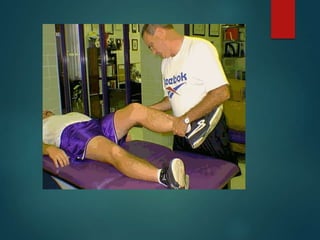
1- Active assisted exercise: In which
assistance is provided by an outside
force, either manual or mechanical when
muscle strength is inadequate to
complete the motion.
2- Active free exercise: In which the
voluntary contraction of the muscle can
perform full ROM against gravity.
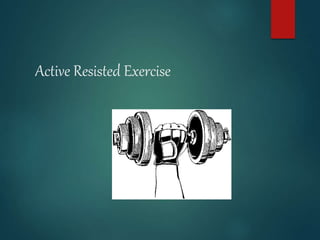
3- Active resisted exercise: In which the
voluntary contraction of the muscle is
resisted by an outside force.
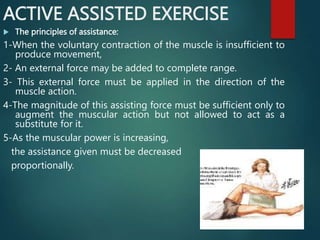
ACTIVE ASSISTED EXERCISE
 The principles of assistance:
1-When the voluntary contraction of the muscle is insufficient to
produce movement,
2- An external force may be added to complete range.
3- This external force must be applied in the direction of the
muscle action.
4-The magnitude of this assisting force must be sufficient only to
augment the muscular action but not allowed to act as a
substitute for it.
5-As the muscular power is increasing,
the assistance given must be decreased
proportionally.
Technique of Assisted Exercise
The assisting force is applied only to augment the maximum effort
and not to act as a substitute force.
1- Starting position: stability of the body is important to ensure that the
patient’s attention is concentrated on the pattern of the movement
and the effort required to perform it.
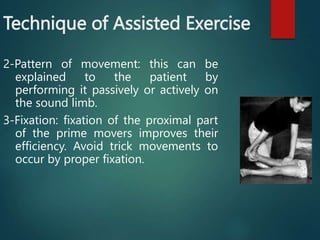
Technique of Assisted Exercise
2-Pattern of movement: this can be
explained to the patient by
performing it passively or actively on
the sound limb.
3-Fixation: fixation of the proximal part
of the prime movers improves their
efficiency. Avoid trick movements to
occur by proper fixation.
Technique of Assisted Exercise
4- Support: the moved part should be supported to reduce the load on
the muscle. Manual support is more effective since it can be
provided in any plane suitable for the movement and adjusted in
each successive part of the range.
5-Traction: preliminary stretching of the weak
muscle provides a powerful stimulus to
contraction because it stimulate the muscle
spindle( Myotatic reflex) which helps in the
initiation of movement.
Technique of Assisted Exercise
6- The antagonistic muscle: a proper starting
position should be selected to reduce the
tension in the antagonistic muscles, e.g. a
position in which the knee flexed is suitable
for assisted dorsiflexion of the foot.
7- The assistance force: the force used in
assisting the action of the muscle must be
applied in the direction of the movement by
the PT hands.
Technique of Assisted Exercise
8- The character of the movement: movement is performed smoothly
and its efficiency depends on the speed of contraction.
9- Repetitions: repetition of the movement depends on the condition of
the
10-The cooperation of patient: this is essential during this type of
exercise. The patient should be encouraged to exert maximum
effort.
Effects and uses of assisted exercise
1-When the patient has weak musculature( poor to fair minus muscle test grade). Active
assisted exercises is used to provide enough assistance to strength the weak muscle.
2-Maintain physiologic elasticity and contractility of the muscles which will gain strength
and hypertrophy.
3-provide sensory feedback from the contracting muscle to be used in early stages of
neuromuscular re-education.
)
4-provide stimulus for bone integrity, so the range of effective joint
movement may be increased.
5-The repetitive assisted exercises on the correct pattern learn the
patient to control the movement by himself, so helping in training
co-ordination.
6-Confidence of the patient in his ability to move and helping to co-
operate.
Contra-indications of assisted
exercise
1-Acute tears and fracture.
2-Greater swelling ,fever and redness.
3-Immediatlly followed myocardial infarction.
4-If active assisted exercises induced pain during movement.
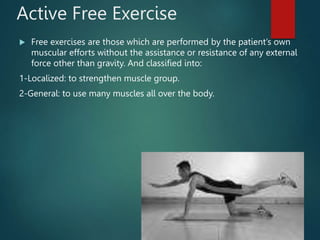
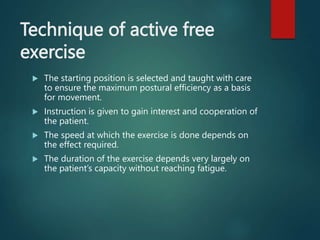
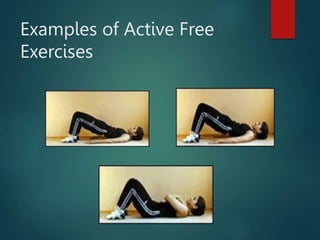
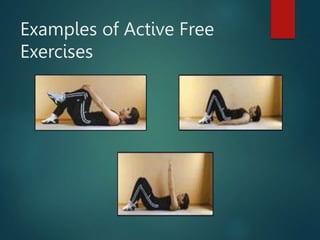
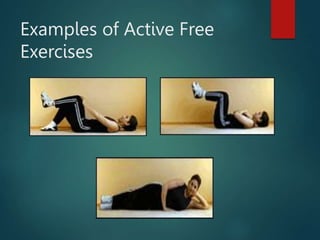
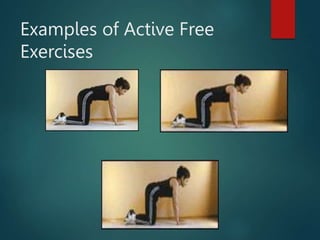
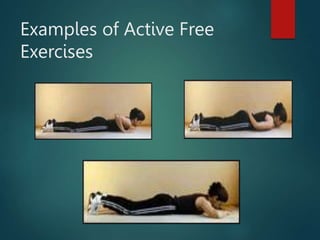
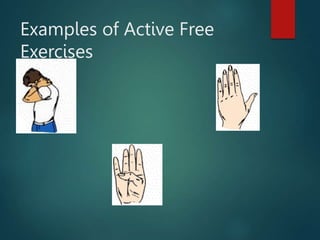
Active Free Exercise
 Free exercises are those which are performed by the patient’s own
muscular efforts without the assistance or resistance of any external
force other than gravity. And classified into:
1-Localized: to strengthen muscle group.
2-General: to use many muscles all over the body.
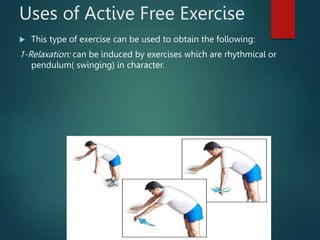
Uses of Active Free Exercise
 This type of exercise can be used to obtain the following:
1-Relaxation: can be induced by exercises which are rhythmical or
pendulum( swinging) in character.
Uses of Active Free Exercise
2- Joint mobility: the normal range of joint motion is
maintained by exercises performed in full range.
3- Muscle power and tone: the power and
endurance of the working muscles are maintained
or increased in response to the tension developed
in them. Tension is greater when the exercise is
performed at a speed slower and long duration of
exercise
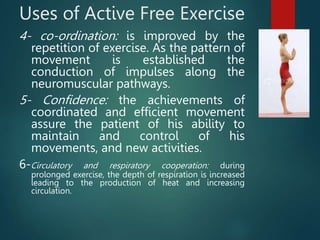
Uses of Active Free Exercise
4- co-ordination: is improved by the
repetition of exercise. As the pattern of
movement is established the
conduction of impulses along the
neuromuscular pathways.
5- Confidence: the achievements of
coordinated and efficient movement
assure the patient of his ability to
maintain and control of his
movements, and new activities.
6-Circulatory and respiratory cooperation: during
prolonged exercise, the depth of respiration is increased
leading to the production of heat and increasing
circulation.
Technique of active free
exercise
 The starting position is selected and taught with care
to ensure the maximum postural efficiency as a basis
for movement.
 Instruction is given to gain interest and cooperation of
the patient.
 The speed at which the exercise is done depends on
the effect required.
 The duration of the exercise depends very largely on
the patient’s capacity without reaching fatigue.
Examples of Active Free
Exercises
Examples of Active Free
Exercises
Examples of Active Free
Exercises
Examples of Active Free
Exercises
Examples of Active Free
Exercises
Examples of Active Free
Exercises
Active Resisted Exercise
Definition:
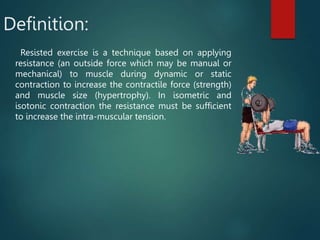
Resisted exercise is a technique based on applying
resistance (an outside force which may be manual or
mechanical) to muscle during dynamic or static
contraction to increase the contractile force (strength)
and muscle size (hypertrophy). In isometric and
isotonic contraction the resistance must be sufficient
to increase the intra-muscular tension.
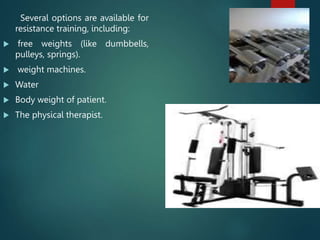
Several options are available for
resistance training, including:
 free weights (like dumbbells,
pulleys, springs).
 weight machines.
 Water
 Body weight of patient.
 The physical therapist.
Factors Contribute Muscular
Efficiency
 There are five factors which contribute to the development of
muscular efficiency:
1- Speed of contraction
2- coordination
3- Power
4- Endurance
5- volume.
 The last three factors can be built up by use of resistive exercises.
Factors Contribute Muscular
Efficiency
 Power: can be increased when you training muscle against
progressive resistance (increase overload).
 Endurance: high repetition and low intensity resistive
exercise can develop endurance.
 Volume: increasing the power and strength will lead to
increase the muscle volume.
Effect and uses of resisted exercise
1- Strengthening the muscles due to increase
tension through gradual overload of resistance of
a muscle or muscle group.
2- Increase muscle endurance through low intensity
repetitive exercise over a prolonged period of
time without fatigue.
3- Increase coordination.
4- Increase muscle cross section (hypertrophy).
5- Increase blood flow of the working muscle.
6-Increase the power.
Technique
 When applying resistance, 4 basic rules should be
observed:
1- The resistance must be given smoothly from the
beginning to the end of range.
2- The direction of resistance force must be opposite to
the direction of the movement.
3- It should be diminish gradually from the beginning
to the end of movement.
4- don’t forget to give enough period of relaxation to
avoid fatigue.

ACTIVE MOVEMENTS.ppt

  • 1.
  • 2.
    Definition: Movement performed withinthe unrestricted ROM controlled by the voluntary contraction of the muscle.
  • 3.
    Classification of Active Movement 1-Active assisted exercise: In which assistance is provided by an outside force, either manual or mechanical when muscle strength is inadequate to complete the motion. 2- Active free exercise: In which the voluntary contraction of the muscle can perform full ROM against gravity. 3- Active resisted exercise: In which the voluntary contraction of the muscle is resisted by an outside force.
  • 4.
    ACTIVE ASSISTED EXERCISE The principles of assistance: 1-When the voluntary contraction of the muscle is insufficient to produce movement, 2- An external force may be added to complete range. 3- This external force must be applied in the direction of the muscle action. 4-The magnitude of this assisting force must be sufficient only to augment the muscular action but not allowed to act as a substitute for it. 5-As the muscular power is increasing, the assistance given must be decreased proportionally.
  • 6.
    Technique of AssistedExercise The assisting force is applied only to augment the maximum effort and not to act as a substitute force. 1- Starting position: stability of the body is important to ensure that the patient’s attention is concentrated on the pattern of the movement and the effort required to perform it.
  • 7.
    Technique of AssistedExercise 2-Pattern of movement: this can be explained to the patient by performing it passively or actively on the sound limb. 3-Fixation: fixation of the proximal part of the prime movers improves their efficiency. Avoid trick movements to occur by proper fixation.
  • 8.
    Technique of AssistedExercise 4- Support: the moved part should be supported to reduce the load on the muscle. Manual support is more effective since it can be provided in any plane suitable for the movement and adjusted in each successive part of the range. 5-Traction: preliminary stretching of the weak muscle provides a powerful stimulus to contraction because it stimulate the muscle spindle( Myotatic reflex) which helps in the initiation of movement.
  • 9.
    Technique of AssistedExercise 6- The antagonistic muscle: a proper starting position should be selected to reduce the tension in the antagonistic muscles, e.g. a position in which the knee flexed is suitable for assisted dorsiflexion of the foot. 7- The assistance force: the force used in assisting the action of the muscle must be applied in the direction of the movement by the PT hands.
  • 10.
    Technique of AssistedExercise 8- The character of the movement: movement is performed smoothly and its efficiency depends on the speed of contraction. 9- Repetitions: repetition of the movement depends on the condition of the 10-The cooperation of patient: this is essential during this type of exercise. The patient should be encouraged to exert maximum effort.
  • 11.
    Effects and usesof assisted exercise 1-When the patient has weak musculature( poor to fair minus muscle test grade). Active assisted exercises is used to provide enough assistance to strength the weak muscle. 2-Maintain physiologic elasticity and contractility of the muscles which will gain strength and hypertrophy. 3-provide sensory feedback from the contracting muscle to be used in early stages of neuromuscular re-education. )
  • 12.
    4-provide stimulus forbone integrity, so the range of effective joint movement may be increased. 5-The repetitive assisted exercises on the correct pattern learn the patient to control the movement by himself, so helping in training co-ordination. 6-Confidence of the patient in his ability to move and helping to co- operate.
  • 13.
    Contra-indications of assisted exercise 1-Acutetears and fracture. 2-Greater swelling ,fever and redness. 3-Immediatlly followed myocardial infarction. 4-If active assisted exercises induced pain during movement.
  • 14.
    Active Free Exercise Free exercises are those which are performed by the patient’s own muscular efforts without the assistance or resistance of any external force other than gravity. And classified into: 1-Localized: to strengthen muscle group. 2-General: to use many muscles all over the body.
  • 15.
    Uses of ActiveFree Exercise  This type of exercise can be used to obtain the following: 1-Relaxation: can be induced by exercises which are rhythmical or pendulum( swinging) in character.
  • 16.
    Uses of ActiveFree Exercise 2- Joint mobility: the normal range of joint motion is maintained by exercises performed in full range. 3- Muscle power and tone: the power and endurance of the working muscles are maintained or increased in response to the tension developed in them. Tension is greater when the exercise is performed at a speed slower and long duration of exercise
  • 17.
    Uses of ActiveFree Exercise 4- co-ordination: is improved by the repetition of exercise. As the pattern of movement is established the conduction of impulses along the neuromuscular pathways. 5- Confidence: the achievements of coordinated and efficient movement assure the patient of his ability to maintain and control of his movements, and new activities. 6-Circulatory and respiratory cooperation: during prolonged exercise, the depth of respiration is increased leading to the production of heat and increasing circulation.
  • 18.
    Technique of activefree exercise  The starting position is selected and taught with care to ensure the maximum postural efficiency as a basis for movement.  Instruction is given to gain interest and cooperation of the patient.  The speed at which the exercise is done depends on the effect required.  The duration of the exercise depends very largely on the patient’s capacity without reaching fatigue.
  • 19.
    Examples of ActiveFree Exercises
  • 20.
    Examples of ActiveFree Exercises
  • 21.
    Examples of ActiveFree Exercises
  • 22.
    Examples of ActiveFree Exercises
  • 23.
    Examples of ActiveFree Exercises
  • 24.
    Examples of ActiveFree Exercises
  • 25.
  • 26.
    Definition: Resisted exercise isa technique based on applying resistance (an outside force which may be manual or mechanical) to muscle during dynamic or static contraction to increase the contractile force (strength) and muscle size (hypertrophy). In isometric and isotonic contraction the resistance must be sufficient to increase the intra-muscular tension.
  • 27.
    Several options areavailable for resistance training, including:  free weights (like dumbbells, pulleys, springs).  weight machines.  Water  Body weight of patient.  The physical therapist.
  • 28.
    Factors Contribute Muscular Efficiency There are five factors which contribute to the development of muscular efficiency: 1- Speed of contraction 2- coordination 3- Power 4- Endurance 5- volume.  The last three factors can be built up by use of resistive exercises.
  • 29.
    Factors Contribute Muscular Efficiency Power: can be increased when you training muscle against progressive resistance (increase overload).  Endurance: high repetition and low intensity resistive exercise can develop endurance.  Volume: increasing the power and strength will lead to increase the muscle volume.
  • 30.
    Effect and usesof resisted exercise 1- Strengthening the muscles due to increase tension through gradual overload of resistance of a muscle or muscle group. 2- Increase muscle endurance through low intensity repetitive exercise over a prolonged period of time without fatigue. 3- Increase coordination. 4- Increase muscle cross section (hypertrophy). 5- Increase blood flow of the working muscle. 6-Increase the power.
  • 31.
    Technique  When applyingresistance, 4 basic rules should be observed: 1- The resistance must be given smoothly from the beginning to the end of range. 2- The direction of resistance force must be opposite to the direction of the movement. 3- It should be diminish gradually from the beginning to the end of movement. 4- don’t forget to give enough period of relaxation to avoid fatigue.