DR. MEGHAN A. PHUTANE (PT)
 Posture follows movement like a shadow; every
movement begins in posture & ends in posture. –
Sherrington.
 Starting position – a posture from which movement is
initiated which may be active or passive in character.
 5 basic starting positions –
 Standing
 Kneeling
 Sitting
 Lying
 Hanging
 All other positions are derived from them.
 In this positions, equilibrium & stability is maintained
by balance of forces acting on body. The muscular
force used is isometric.
 The strength & distribution of this contraction is
controlled by a series of reflexes known as postural
reflexes.
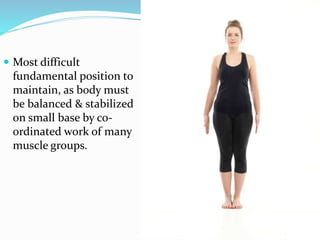
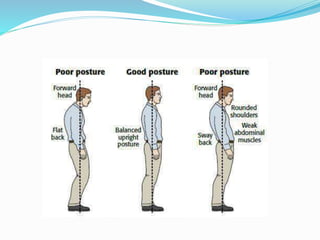
 Most difficult
fundamental position to
maintain, as body must
be balanced & stabilized
on small base by co-
ordinated work of many
muscle groups.
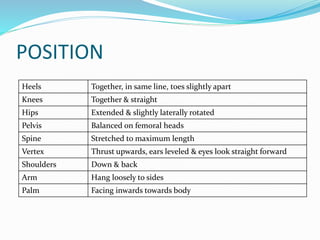
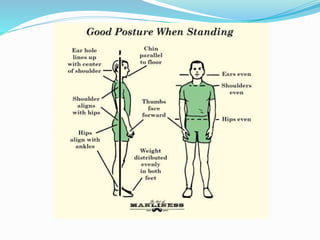
POSITION
Heels Together, in same line, toes slightly apart
Knees Together & straight
Hips Extended & slightly laterally rotated
Pelvis Balanced on femoral heads
Spine Stretched to maximum length
Vertex Thrust upwards, ears leveled & eyes look straight forward
Shoulders Down & back
Arm Hang loosely to sides
Palm Facing inwards towards body
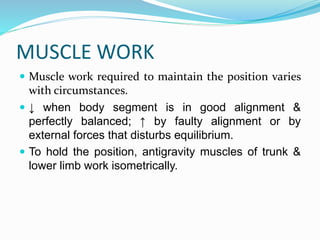
MUSCLE WORK
 Muscle work required to maintain the position varies
with circumstances.
 ↓ when body segment is in good alignment &
perfectly balanced; ↑ by faulty alignment or by
external forces that disturbs equilibrium.
 To hold the position, antigravity muscles of trunk &
lower limb work isometrically.
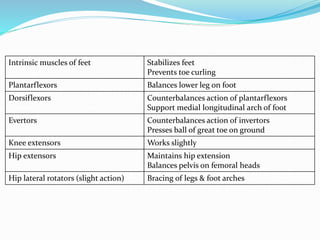
Intrinsic muscles of feet Stabilizes feet
Prevents toe curling
Plantarflexors Balances lower leg on foot
Dorsiflexors Counterbalances action of plantarflexors
Support medial longitudinal arch of foot
Evertors Counterbalances action of invertors
Presses ball of great toe on ground
Knee extensors Works slightly
Hip extensors Maintains hip extension
Balances pelvis on femoral heads
Hip lateral rotators (slight action) Bracing of legs & foot arches
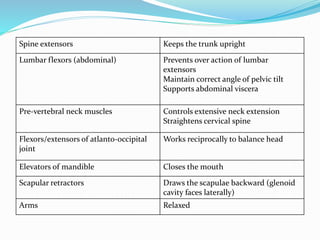
Spine extensors Keeps the trunk upright
Lumbar flexors (abdominal) Prevents over action of lumbar
extensors
Maintain correct angle of pelvic tilt
Supports abdominal viscera
Pre-vertebral neck muscles Controls extensive neck extension
Straightens cervical spine
Flexors/extensors of atlanto-occipital
joint
Works reciprocally to balance head
Elevators of mandible Closes the mouth
Scapular retractors Draws the scapulae backward (glenoid
cavity faces laterally)
Arms Relaxed
EFFECTS & USES
 Relatively small base
 High COG
 State of equilibrium – less stable (than other fundamental
positions)
 So suitable for exercise for those who can maintain it
correctly.
 Attaining & holding standing posture – reduces fatigue &
conditions postural reflexes.
 Position of alertness
 Thorax is free & abdominal viscera is well supported.
 Associated with feeling of joy & efficiency.

 The position of arms, legs or trunk is altered in
fundamental position to modify effect of position or to
start exercises.
Purpose :-
 To increase or decrease size & stability of the base
 To raise or lower COG
 To ensure maximum local or general relaxation
 To control or fix the particular part of body to have
localized movement
 To increase or decrease muscle work
 To increase or decrease leverage
 To provide convenient position to start exercise
BY ALTERATION OF THE ARMS
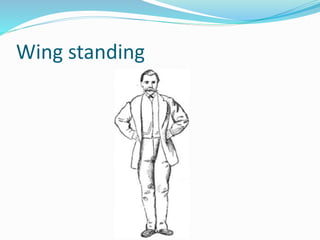
Wing standing
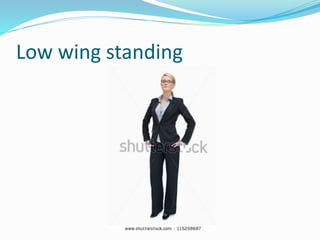
Low wing standing
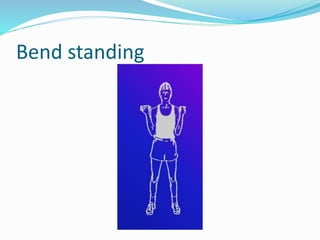
Bend standing
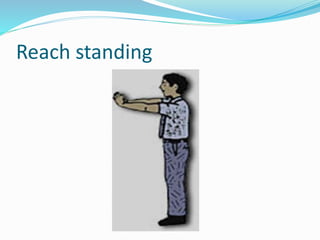
Reach standing
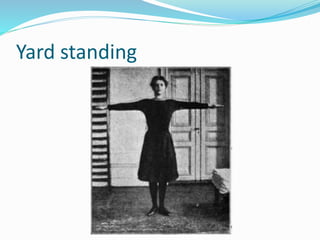
Yard standing
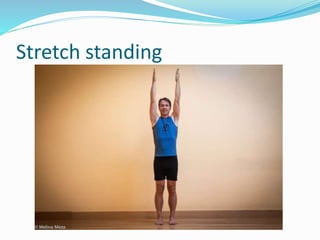
Stretch standing
BY ALTERATION OF THE LEGS
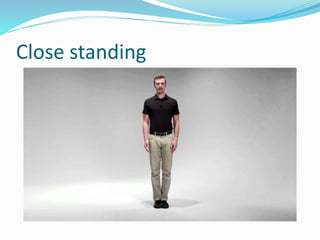
Close standing
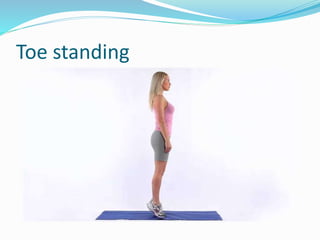
Toe standing
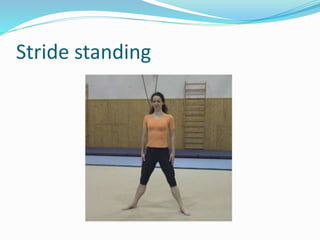
Stride standing
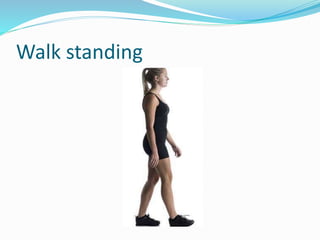
Walk standing
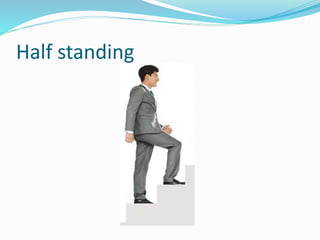
Half standing
Standing   fundamental position

Standing fundamental position

  • 1.
    DR. MEGHAN A.PHUTANE (PT)
  • 2.
     Posture followsmovement like a shadow; every movement begins in posture & ends in posture. – Sherrington.  Starting position – a posture from which movement is initiated which may be active or passive in character.  5 basic starting positions –  Standing  Kneeling  Sitting  Lying  Hanging
  • 3.
     All otherpositions are derived from them.  In this positions, equilibrium & stability is maintained by balance of forces acting on body. The muscular force used is isometric.  The strength & distribution of this contraction is controlled by a series of reflexes known as postural reflexes.
  • 5.
     Most difficult fundamentalposition to maintain, as body must be balanced & stabilized on small base by co- ordinated work of many muscle groups.
  • 6.
    POSITION Heels Together, insame line, toes slightly apart Knees Together & straight Hips Extended & slightly laterally rotated Pelvis Balanced on femoral heads Spine Stretched to maximum length Vertex Thrust upwards, ears leveled & eyes look straight forward Shoulders Down & back Arm Hang loosely to sides Palm Facing inwards towards body
  • 7.
    MUSCLE WORK  Musclework required to maintain the position varies with circumstances.  ↓ when body segment is in good alignment & perfectly balanced; ↑ by faulty alignment or by external forces that disturbs equilibrium.  To hold the position, antigravity muscles of trunk & lower limb work isometrically.
  • 8.
    Intrinsic muscles offeet Stabilizes feet Prevents toe curling Plantarflexors Balances lower leg on foot Dorsiflexors Counterbalances action of plantarflexors Support medial longitudinal arch of foot Evertors Counterbalances action of invertors Presses ball of great toe on ground Knee extensors Works slightly Hip extensors Maintains hip extension Balances pelvis on femoral heads Hip lateral rotators (slight action) Bracing of legs & foot arches
  • 9.
    Spine extensors Keepsthe trunk upright Lumbar flexors (abdominal) Prevents over action of lumbar extensors Maintain correct angle of pelvic tilt Supports abdominal viscera Pre-vertebral neck muscles Controls extensive neck extension Straightens cervical spine Flexors/extensors of atlanto-occipital joint Works reciprocally to balance head Elevators of mandible Closes the mouth Scapular retractors Draws the scapulae backward (glenoid cavity faces laterally) Arms Relaxed
  • 12.
    EFFECTS & USES Relatively small base  High COG  State of equilibrium – less stable (than other fundamental positions)  So suitable for exercise for those who can maintain it correctly.  Attaining & holding standing posture – reduces fatigue & conditions postural reflexes.  Position of alertness  Thorax is free & abdominal viscera is well supported.  Associated with feeling of joy & efficiency.
  • 14.
     The positionof arms, legs or trunk is altered in fundamental position to modify effect of position or to start exercises. Purpose :-  To increase or decrease size & stability of the base  To raise or lower COG  To ensure maximum local or general relaxation  To control or fix the particular part of body to have localized movement  To increase or decrease muscle work  To increase or decrease leverage  To provide convenient position to start exercise
  • 15.
  • 16.
  • 17.
  • 18.
  • 19.
  • 20.
  • 21.
  • 22.
  • 23.
  • 24.
  • 25.
  • 26.
  • 27.