





Efficacy of Scanner ultrasound therapy on
nerve conduction studies in peripheral
symmetrical diabetic neuropathy
Dr/ Shimaa A Essa
MSc. Physical Therapy for Neurological
Disorders and its Surgery, Physical Therapy
College, Cairo University
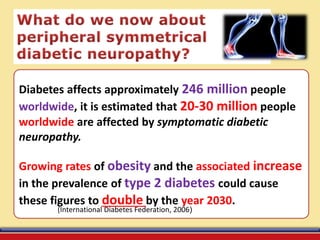
Diabetes affects approximately 246 million people
worldwide, it is estimated that 20-30 million people
worldwide are affected by symptomatic diabetic
neuropathy.
Growing rates of obesity and the associated increase
in the prevalence of type 2 diabetes could cause
these figures to double by the year 2030.
((International Diabetes Federation, 2006
Distal symmetric polyneuropathy (DSP) is the
most common neuropathic complication of
diabetes; 50% - 80% of patients develop DSP,
and up to 20% have clinical features of
neuropathy at the time of diabetes diagnosis.
And accounts for 80% of diabetic foot
ulceration.
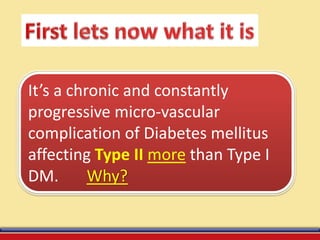
It’s a chronic and constantly
progressive micro-vascular
complication of Diabetes mellitus
affecting Type II more than Type I
DM. Why?
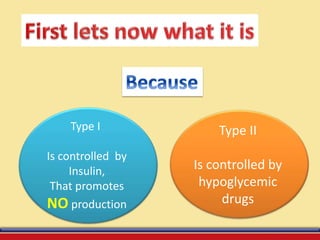
Type I
Is controlled by
Insulin,
That promotes
NO production
Type II
Is controlled by
hypoglycemic
drugs
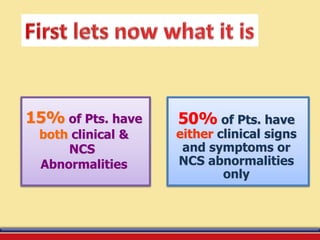
50% of Pts. have
either clinical signs
and symptoms or
NCS abnormalities
only
15% of Pts. have
both clinical &
NCS
Abnormalities
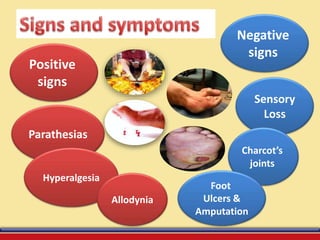
Positive
signs
Negative
signs
Sensory
Loss
Charcot’s
joints
Foot
Ulcers &
Amputation
Parathesias
Hyperalgesia
Allodynia
Distal symmetrical neuropathy is associated
with a progressive distal axonopathy. And
secondary segmental demyelination related
to impairment of the axonal control of
myelination, and remyelination.
In symptomatic diabetic
neuropathy, there is a slowing of
nerve conduction velocity owing to
demyelination and loss of large
myelinated fibers, and a decrease
in nerve action potentials owing
to loss of axons
1) Obesity
2) FBS>200 mg/dl
3) HbA1c >9
4) Age >50 years
Treatment of DPN is inform of symptomatic
treatment for pain , Patient education for foot care
and protective treatment for DPN risk factors:
4) Duration of diabetes
>10 years
5) HTN
6) Dyslipidemia
How Could Ultrasound
therapy reverse the
underlying
pathophysiology and be
a curative (not just
symptomatic) treatment
for DPN?
To provide an alternative,
efficient, safe, and
inexpensive remedy for
patients suffering from distal
symmetrical peripheral
diabetic neuropathy
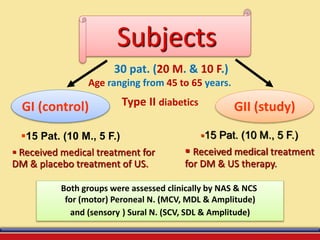
GI (control) GII (study)
15 Pat. (10 M., 5 F.) 15 Pat. (10 M., 5 F.)
 Received medical treatment for
DM & placebo treatment of US.
Subjects
 Received medical treatment
for DM & US therapy.
Both groups were assessed clinically by NAS & NCS
for (motor) Peroneal N. (MCV, MDL & Amplitude)
and (sensory ) Sural N. (SCV, SDL & Amplitude)
30 pat. (20 M. & 10 F.)
Age ranging from 45 to 65 years.
Type II diabetics
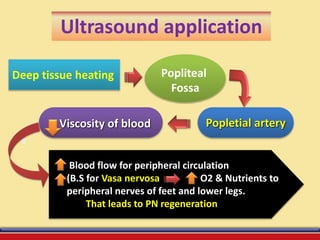
Ultrasound application
Deep tissue heating Popliteal
Fossa
Popletial arteryViscosity of blood
Blood flow for peripheral circulation
(B.S for Vasa nervosa O2 & Nutrients to
peripheral nerves of feet and lower legs.
That leads to PN regeneration
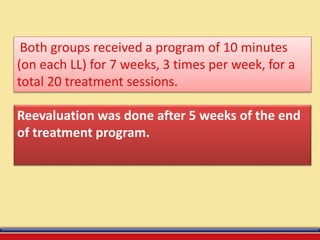
Both groups received a program of 10 minutes
(on each LL) for 7 weeks, 3 times per week, for a
total 20 treatment sessions.
Reevaluation was done after 5 weeks of the end
of treatment program.
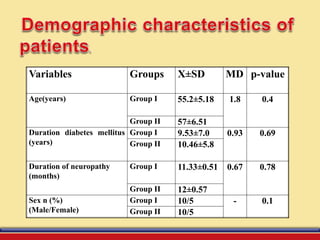
Variables Groups X±SD MD p-value
Age(years) Group I 55.2±5.18 1.8 0.4
Group II 57±6.51
Duration diabetes mellitus
(years)
Group I 9.53±7.0 0.93 0.69
Group II 10.46±5.8
Duration of neuropathy
(months)
Group I 11.33±0.51 0.67 0.78
Group II 12±0.57
Sex n (%)
(Male/Female)
Group I 10/5 - 0.1
Group II 10/5
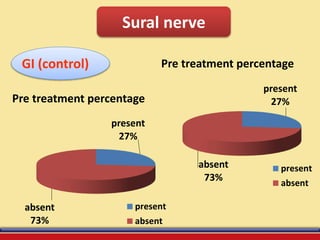
Sural nerve
GI (control)
present
27%
absent
73%
Pre treatment percentage
present
absent
present
27%
absent
73%
Pre treatment percentage
present
absent
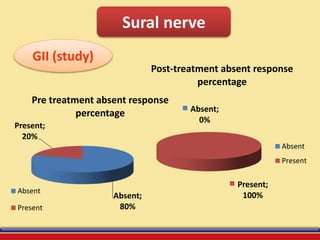
Sural nerve
GII (study)
Absent;
80%
Present;
20%
Pre treatment absent response
percentage
Absent
Present
Absent;
0%
Present;
100%
Post-treatment absent response
percentage
Absent
Present
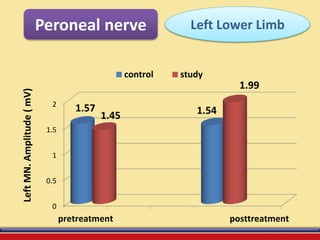
Peroneal nerve
0
0.5
1
1.5
2
pretreatment posttreatment
1.57 1.541.45
1.99
LeftMN.Amplitude(mV)
control study
Left Lower Limb
Peroneal nerve
0
10
20
30
40
50
60
pretreatment posttreatment
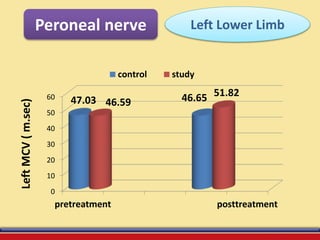
47.03 46.6546.59
51.82
LeftMCV(m.sec)
control study
Left Lower Limb
Peroneal nerve
0
1
2
3
4
5
pretreatment posttreatment
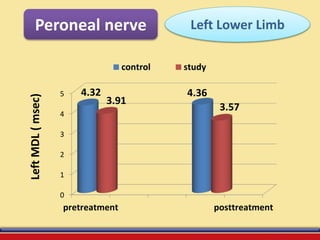
4.32 4.36
3.91
3.57
LeftMDL(msec)
control study
Left Lower Limb
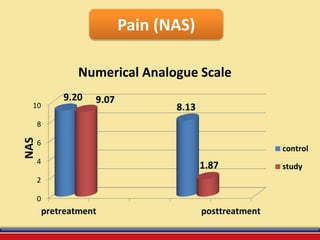
Pain (NAS)
0
2
4
6
8
10
pretreatment posttreatment
9.20
8.13
9.07
1.87
NAS
Numerical Analogue Scale
control
study
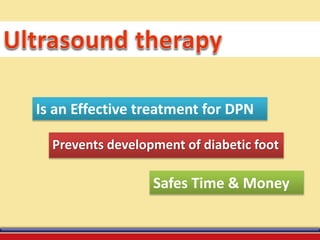
Is an Effective treatment for DPN
Safes Time & Money
Prevents development of diabetic foot
For more details of
the new approach
visit the book link

Peripheral Diabetic Neuropathy is now Curable!!

  • 1.
    Efficacy of Scannerultrasound therapy on nerve conduction studies in peripheral symmetrical diabetic neuropathy Dr/ Shimaa A Essa MSc. Physical Therapy for Neurological Disorders and its Surgery, Physical Therapy College, Cairo University
  • 2.
    Diabetes affects approximately246 million people worldwide, it is estimated that 20-30 million people worldwide are affected by symptomatic diabetic neuropathy. Growing rates of obesity and the associated increase in the prevalence of type 2 diabetes could cause these figures to double by the year 2030. ((International Diabetes Federation, 2006
  • 3.
    Distal symmetric polyneuropathy(DSP) is the most common neuropathic complication of diabetes; 50% - 80% of patients develop DSP, and up to 20% have clinical features of neuropathy at the time of diabetes diagnosis. And accounts for 80% of diabetic foot ulceration.
  • 4.
    It’s a chronicand constantly progressive micro-vascular complication of Diabetes mellitus affecting Type II more than Type I DM. Why?
  • 5.
    Type I Is controlledby Insulin, That promotes NO production Type II Is controlled by hypoglycemic drugs
  • 6.
    50% of Pts.have either clinical signs and symptoms or NCS abnormalities only 15% of Pts. have both clinical & NCS Abnormalities
  • 7.
  • 9.
    Distal symmetrical neuropathyis associated with a progressive distal axonopathy. And secondary segmental demyelination related to impairment of the axonal control of myelination, and remyelination.
  • 10.
    In symptomatic diabetic neuropathy,there is a slowing of nerve conduction velocity owing to demyelination and loss of large myelinated fibers, and a decrease in nerve action potentials owing to loss of axons
  • 11.
    1) Obesity 2) FBS>200mg/dl 3) HbA1c >9 4) Age >50 years Treatment of DPN is inform of symptomatic treatment for pain , Patient education for foot care and protective treatment for DPN risk factors: 4) Duration of diabetes >10 years 5) HTN 6) Dyslipidemia
  • 12.
    How Could Ultrasound therapyreverse the underlying pathophysiology and be a curative (not just symptomatic) treatment for DPN?
  • 15.
    To provide analternative, efficient, safe, and inexpensive remedy for patients suffering from distal symmetrical peripheral diabetic neuropathy
  • 16.
    GI (control) GII(study) 15 Pat. (10 M., 5 F.) 15 Pat. (10 M., 5 F.)  Received medical treatment for DM & placebo treatment of US. Subjects  Received medical treatment for DM & US therapy. Both groups were assessed clinically by NAS & NCS for (motor) Peroneal N. (MCV, MDL & Amplitude) and (sensory ) Sural N. (SCV, SDL & Amplitude) 30 pat. (20 M. & 10 F.) Age ranging from 45 to 65 years. Type II diabetics
  • 17.
    Ultrasound application Deep tissueheating Popliteal Fossa Popletial arteryViscosity of blood Blood flow for peripheral circulation (B.S for Vasa nervosa O2 & Nutrients to peripheral nerves of feet and lower legs. That leads to PN regeneration
  • 18.
    Both groups receiveda program of 10 minutes (on each LL) for 7 weeks, 3 times per week, for a total 20 treatment sessions. Reevaluation was done after 5 weeks of the end of treatment program.
  • 20.
    Variables Groups X±SDMD p-value Age(years) Group I 55.2±5.18 1.8 0.4 Group II 57±6.51 Duration diabetes mellitus (years) Group I 9.53±7.0 0.93 0.69 Group II 10.46±5.8 Duration of neuropathy (months) Group I 11.33±0.51 0.67 0.78 Group II 12±0.57 Sex n (%) (Male/Female) Group I 10/5 - 0.1 Group II 10/5
  • 22.
    Sural nerve GI (control) present 27% absent 73% Pretreatment percentage present absent present 27% absent 73% Pre treatment percentage present absent
  • 23.
    Sural nerve GII (study) Absent; 80% Present; 20% Pretreatment absent response percentage Absent Present Absent; 0% Present; 100% Post-treatment absent response percentage Absent Present
  • 24.
    Peroneal nerve 0 0.5 1 1.5 2 pretreatment posttreatment 1.571.541.45 1.99 LeftMN.Amplitude(mV) control study Left Lower Limb
  • 25.
    Peroneal nerve 0 10 20 30 40 50 60 pretreatment posttreatment 47.0346.6546.59 51.82 LeftMCV(m.sec) control study Left Lower Limb
  • 26.
    Peroneal nerve 0 1 2 3 4 5 pretreatment posttreatment 4.324.36 3.91 3.57 LeftMDL(msec) control study Left Lower Limb
  • 27.
  • 28.
    Is an Effectivetreatment for DPN Safes Time & Money Prevents development of diabetic foot
  • 29.
    For more detailsof the new approach visit the book link