BRIC
KMASON
RY
OVERVIEW :
IntROductIOn
tEchnIcal tERms
tOOls usEd
typEs
BOnd
JOInts
adVantagEs
dEfEcts
INTRODUCTION
Masonry
Construction of building units bonded together
with mortar.
Brick masonry
Construction of brick units bonded together with
mortar.
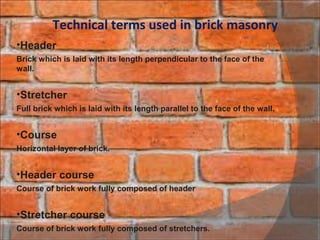
Technical terms used in brick masonry
•Header
Brick which is laid with its length perpendicular to the face of the
wall.
•Stretcher
Full brick which is laid with its length parallel to the face of the wall.
•Course
Horizontal layer of brick.
•Header course
Course of brick work fully composed of header
•Stretcher course
Course of brick work fully composed of stretchers.
5
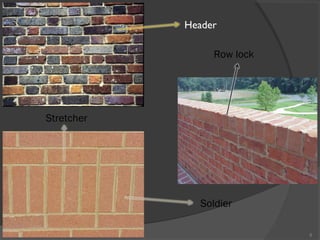
Header
Row lock
Stretcher
Soldier
6
Basic Brickwork TerminologyBasic Brickwork Terminology
Bed
Joint
Head
Joint
Course - horizontal layer of brick
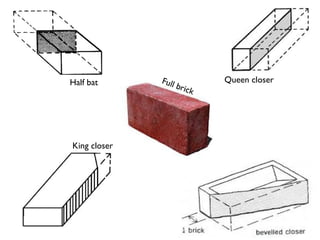
Closer
Portion of brick cut in such a manner that one long face remains uncut.
King closer
Brick is cut in such a way that the width of its end is half of full brick.
Queen closer
Brick is half as wide as a full brick.
Half Bat
Portion of brick cut half across the width.
Bevelled closer
It is similar to king closer with the only difference that the whole length
of he brick is bevelled.
Half bat Queen closer
King closer
Full brick
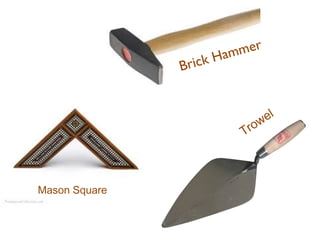
Tools used
•Trowel
•Plumb bob
•Hammer
•Spirit level
•Mason square
•Steel tape
Trowel
Mason Square
Brick Hammer
Plumb Bob
Steel tape
Types of
brick
masonry
•Brick work in mud.
•Brick work in cement.
Brick work in mud
•The mud is used to fill up the joints
•Thickness of the mortar joint is 12 mm.
•cheapest.
•Maximum height of wall is 4 m.
Brick work in cement
 I class
• Cement or lime mortar is used.
•The surfaces and edges of bricks are sharp.
•The thickness of mortar joints doesn’t exceed 10 mm.
 II class
•Ground moulded bricks are used .
•Bricks are rough and shape is slightly irregular.
•The thickness of mortar joint is 12 mm.
 III class
•Bricks are not hard , rough surface with distorted
shape.
•Used for temporary structures.
•Used in places where rainfall is not heavy.
16
Mortar FunctionsMortar Functions
 Provides for full bearingProvides for full bearing
 Seals between masonry unitsSeals between masonry units
 bonds masonry unitsbonds masonry units
17
Brick Masonry - UniquenessBrick Masonry - Uniqueness
 Fire ResistanceFire Resistance
 SizeSize
 DurabilityDurability
BONDS
English bond
•In general practice this type of bond is used.
•It consists of alternate courses of headers and
stretchers .
•Considered as strongest bond in brick work
•For breaking vertical joints queen closer is placed
after first header
Header course
Stretchers course
Queen closer
ISOMETRIC VIEW OF
ENGLISH BOND
Flemish bond
•Each course consists alternate headers and
stretchers.
•Not as strong as English bond.
•Alternate course starts with a header at
the corner.
•For breaking of vertical joints , closers are
inserted in alternate courses next to the
quoin header.
ISOMETRIC VIEW OF
FLEMISH BOND
Header
Stretcher
 JointJoint
 Weathered JointWeathered Joint:: Mortar joint has sloped (downwards) edge.Mortar joint has sloped (downwards) edge.
 Concave jointConcave joint:: Joint concave inwards.Joint concave inwards.
 Vee jointVee joint:: mortar joint is in the form of a V.mortar joint is in the form of a V.
 Flush JointFlush Joint:: Mortar joint is flush with the brick surfaces.Mortar joint is flush with the brick surfaces.
 Raked JointRaked Joint:: A large portion of the mortar joint is raked out -A large portion of the mortar joint is raked out -
Not a safe, impermeable joint.Not a safe, impermeable joint.
 Struck JointStruck Joint:: Mortar joint has a sloped (upwards) edge.Mortar joint has a sloped (upwards) edge.
JOINTS IN BRICK MASONRYJOINTS IN BRICK MASONRY
23
Masonry JointsMasonry Joints
Concave
Flush
Racked
Struck
Weathered
Vee
Advantages of brick masonry
The brick masonry is cheaper as compared to stone
masonry.
Bonding strength is very good.
In brick work , the mortar joints are thin and hence
the structure becomes more durable.
No complicated lifting devices are necessary in brick
work.
Brick work can be done by the less skilled labours
also.
In Brick work good quality of bricks posses good
fire resistance.
Due to regular size of bricks they are easy to
handle.
Defects in brick masonry
 Sulphate attack
Sulphate salts present in bricks work react with alumina content of
cement .
It occur in boundary walls
 Crystallization of salts from bricks
Occur in masonry made out of brick which contain excessive soluble
salts
This phenomenon is also known as efflorescence.
 Corrosion of embedded iron or steel
Iron or steel embedded in brick work gets corroded in the presence
of dampness
On corrosion the metal expands in volume and tends to crack the
brick work.
BIBLIOGRAPHY
 BUILDING CONSTRUCTION by
Rangwala.
 BUILDING CONSTRUCTION by
Sushil Kumar.
Civil Engineering - Building materials
and Construction by Dr. B.
Bhattacharjee( IIT Delhi )
 WIKIPEDIA THE FREE
ENCYCLOPEDIA
Brick masonry

Brick masonry

  • 1.
  • 2.
    OVERVIEW : IntROductIOn tEchnIcal tERms tOOlsusEd typEs BOnd JOInts adVantagEs dEfEcts
  • 3.
    INTRODUCTION Masonry Construction of buildingunits bonded together with mortar. Brick masonry Construction of brick units bonded together with mortar.
  • 4.
    Technical terms usedin brick masonry •Header Brick which is laid with its length perpendicular to the face of the wall. •Stretcher Full brick which is laid with its length parallel to the face of the wall. •Course Horizontal layer of brick. •Header course Course of brick work fully composed of header •Stretcher course Course of brick work fully composed of stretchers.
  • 5.
  • 6.
    6 Basic Brickwork TerminologyBasicBrickwork Terminology Bed Joint Head Joint Course - horizontal layer of brick
  • 7.
    Closer Portion of brickcut in such a manner that one long face remains uncut. King closer Brick is cut in such a way that the width of its end is half of full brick. Queen closer Brick is half as wide as a full brick. Half Bat Portion of brick cut half across the width. Bevelled closer It is similar to king closer with the only difference that the whole length of he brick is bevelled.
  • 8.
    Half bat Queencloser King closer Full brick
  • 9.
    Tools used •Trowel •Plumb bob •Hammer •Spiritlevel •Mason square •Steel tape
  • 10.
  • 11.
  • 12.
  • 13.
    Types of brick masonry •Brick workin mud. •Brick work in cement.
  • 14.
    Brick work inmud •The mud is used to fill up the joints •Thickness of the mortar joint is 12 mm. •cheapest. •Maximum height of wall is 4 m.
  • 15.
    Brick work incement  I class • Cement or lime mortar is used. •The surfaces and edges of bricks are sharp. •The thickness of mortar joints doesn’t exceed 10 mm.  II class •Ground moulded bricks are used . •Bricks are rough and shape is slightly irregular. •The thickness of mortar joint is 12 mm.  III class •Bricks are not hard , rough surface with distorted shape. •Used for temporary structures. •Used in places where rainfall is not heavy.
  • 16.
    16 Mortar FunctionsMortar Functions Provides for full bearingProvides for full bearing  Seals between masonry unitsSeals between masonry units  bonds masonry unitsbonds masonry units
  • 17.
    17 Brick Masonry -UniquenessBrick Masonry - Uniqueness  Fire ResistanceFire Resistance  SizeSize  DurabilityDurability
  • 18.
    BONDS English bond •In generalpractice this type of bond is used. •It consists of alternate courses of headers and stretchers . •Considered as strongest bond in brick work •For breaking vertical joints queen closer is placed after first header
  • 19.
    Header course Stretchers course Queencloser ISOMETRIC VIEW OF ENGLISH BOND
  • 20.
    Flemish bond •Each courseconsists alternate headers and stretchers. •Not as strong as English bond. •Alternate course starts with a header at the corner. •For breaking of vertical joints , closers are inserted in alternate courses next to the quoin header.
  • 21.
    ISOMETRIC VIEW OF FLEMISHBOND Header Stretcher
  • 22.
     JointJoint  WeatheredJointWeathered Joint:: Mortar joint has sloped (downwards) edge.Mortar joint has sloped (downwards) edge.  Concave jointConcave joint:: Joint concave inwards.Joint concave inwards.  Vee jointVee joint:: mortar joint is in the form of a V.mortar joint is in the form of a V.  Flush JointFlush Joint:: Mortar joint is flush with the brick surfaces.Mortar joint is flush with the brick surfaces.  Raked JointRaked Joint:: A large portion of the mortar joint is raked out -A large portion of the mortar joint is raked out - Not a safe, impermeable joint.Not a safe, impermeable joint.  Struck JointStruck Joint:: Mortar joint has a sloped (upwards) edge.Mortar joint has a sloped (upwards) edge. JOINTS IN BRICK MASONRYJOINTS IN BRICK MASONRY
  • 23.
  • 24.
    Advantages of brickmasonry The brick masonry is cheaper as compared to stone masonry. Bonding strength is very good. In brick work , the mortar joints are thin and hence the structure becomes more durable. No complicated lifting devices are necessary in brick work. Brick work can be done by the less skilled labours also. In Brick work good quality of bricks posses good fire resistance. Due to regular size of bricks they are easy to handle.
  • 25.
    Defects in brickmasonry  Sulphate attack Sulphate salts present in bricks work react with alumina content of cement . It occur in boundary walls  Crystallization of salts from bricks Occur in masonry made out of brick which contain excessive soluble salts This phenomenon is also known as efflorescence.  Corrosion of embedded iron or steel Iron or steel embedded in brick work gets corroded in the presence of dampness On corrosion the metal expands in volume and tends to crack the brick work.
  • 26.
    BIBLIOGRAPHY  BUILDING CONSTRUCTIONby Rangwala.  BUILDING CONSTRUCTION by Sushil Kumar. Civil Engineering - Building materials and Construction by Dr. B. Bhattacharjee( IIT Delhi )  WIKIPEDIA THE FREE ENCYCLOPEDIA