Laterolog
1Ade Rama Tanjung Putra ( 1506741524) Ridho Irsyad Fauzan (1506721440 )
OUTLINE
A. Introduction
B. Principle uses
of electrical logs
C. Typical
responses of an
electrical tools
D. Old electrical
logs
E. Modern
resistivity logs
(Laterolog)
E.1. Basic
laterologs
E.1.1. LL3
E.1.2. LL7
E.2. Dual
Laterologs
E.2.1. LLD
E.2.2. LLS
E.3. Sperically
focus log
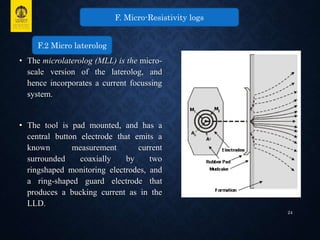
F. Micro-
resistivity logs
F.1 Micro log
F.2 Micro
Laterolog
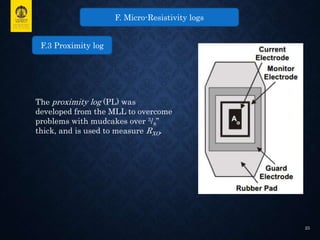
F.3 Proximity log
G. Uses of
electrical log
2
Logging
• The identification of
reservoir
• The estimation of
hydrocarbon in place.
• The estimation of
recoverable
hydrocarbon
 To identify the productive zones of
hydrocarbon.
 To define the petrophysical
parameters like porosity,
permeability, hydrocarbon
 saturation and lithology of zones.
 To determine depth, thickness,
formation temperature and
pressure of a reservoir.
 To distinguish between oil, gas
and water zones in a reservoir.
 To measure hydrocarbon mobility.
Well logs
3
A. Introduction
PHYSICAL PARAMETERS THAT CAN BE
RECORDED :
1) Resistivity Logs
- Induction log
- Laterolog
2) Porosity/Radioactive Logs.
3) Sonic/Acoustic Log
4) Sampling and coring
5) Cement evaluation Log
6) Production Logs.
4
Target
A. Introduction
ELECTRICAL LOGGING
• The induction log actually measures conductivity, and hence is
sometimes called the conductivity log.
• The modern tool for measuring resistivity in high salinity (low
resistivity) muds is the laterolog, which focuses its current
into a thin sheet to improve vertical resolution and
penetration depth.
• The laterologs measure resistivity in the conventional sense,
and are usually referred to as resistivity tools.
5
A. Introduction
RESISTIVITY LOGGING
• Resistivity is one of the most variable physical properties of
materials and has proven to be the most useful geophysical
parameter in the search for hydrocarbons resources.
• The resistivity of a substance is its ability to impede the flow
of electric current through the substance.
6
A. Introduction
THE ELECTRICAL TOOLS ALSO HAVE A
NUMBER OF QUALITATIVE USES, PRINCIPLE
OF WHICH ARE :
(i) indications of lithology,
(ii) facies and electro-facies analysis,
(iii) correlation,
(iv) determination of overpressure, determination of shale
porosity,
(v) indications of compaction, and the investigation of source
rocks.
7
B. Principle uses of electrical log
THE DEGREE TO WHICH THE
SANDSTONES HAVE HIGHER
RESISTIVITIES DEPENDS UPON :
(i) their porosity,
(ii) their pore geometries,
(iii) the resistivity of the formation water,
(iv) the water, oil and gas saturations (oil and gas are taken to
have infinite resistivity).
8
C. Typical responses of an electrical tool
9
C. Typical responses of an electrical tool
10
D. Old electrical logs
THE CURRENT DENSITY VARIES INVERSELY
WITH THE RADIAL DISTANCE AND CAN BE
CALCULATED FROM:
Current density
Current density =
I / (2 * PI * R * T)
Where,
I = total current intensity
(amperes)
T = thickness of measure
current disc (meters)
R = radial distance (meters)
Resistivity of the
formation
Rt = K * V / I (same as ES log except K is
different)
Where
V = potential of measure electrode
(volts)
I = current flow from measure electrode
(amperes)
K = a calibration constant defined by
the geometry of the electrode spacing
11
• Laterolog was put into service in 1949 as a replacement for
the ES Log in salt mud environments.
• It was another invention by Henry Doll of Schlumberger.
Competitive tool designs were called Guard Logs or Focused
Logs.
• The objective was to focus the current from the tool into the
rock better than could be accomplished with the ES Log.
12
E. Modern resistivity logs (Laterolog)
• Laterologs work best in saltier muds or in normal muds in high
resistivity formations. They will not work in air filled or cased
holes
• The laterolog is a direct current (DC) tool based on Ohm's Law.
• The tools have been designed to produce reliable resistivity
measurements in boreholes containing highly saline drilling fluids
and/or when surrounded by highly resistive rocks.
13
• The logging current is prevented from flowing up and down
within the drilling fluid by placing focusing electrodes (A1 and
A2) on both sides of a central measure electrode A0, as
illustrated below.
• The focusing electrodes force measure current to flow only in
the lateral direction, perpendicular to the axis of the logging
device.
14
15
E. Modern resistivity logs (Laterolog)
E.1. Basic laterologs
16
E. Modern resistivity logs (Laterolog)
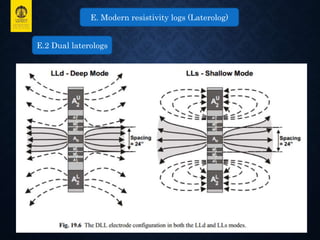
E.2 Dual laterologs
DUAL LATEROLOG (DLL)
• Dual Laterolog instruments are electrode tools designed to
produce reliable formation resistivity measurements in
boreholes containing saline drilling fluids.
• The Dual Laterolog instrument simultaneously produces a
deep investigation resistivity and a shallow investigation
resistivity measurement.
17
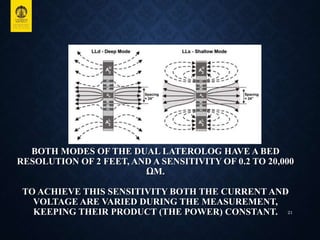
• The DLL produces two measurements, the laterolog shallow
(LLS), and laterologdeep (LLD).
• The dual laterolog (DLL) is the latest version of the laterolog.
• As its name implies, it is a combination of two tools, and can
be run in a deep penetration (LLd) and shallow penetration
(LLs) mode.
• These are now commonly run simultaneously and together
with an additional very shallow penetration device.
18
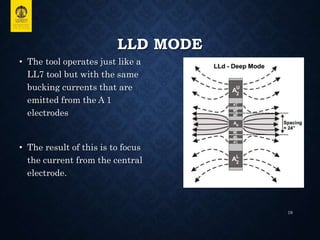
LLD MODE
• The tool operates just like a
LL7 tool but with the same
bucking currents that are
emitted from the A 1
electrodes
• The result of this is to focus
the current from the central
electrode.
19
LLS MODE
• The bucking current must
veer away from the pathway
into the formation, and back
towards the tool A2
electrodes, and hence cannot
constrain (focus) the current
being emitted from the
central electrode as much.
20
BOTH MODES OF THE DUAL LATEROLOG HAVE A BED
RESOLUTION OF 2 FEET, AND A SENSITIVITY OF 0.2 TO 20,000
ΩM.
TO ACHIEVE THIS SENSITIVITY BOTH THE CURRENT AND
VOLTAGE ARE VARIED DURING THE MEASUREMENT,
KEEPING THEIR PRODUCT (THE POWER) CONSTANT. 21
22
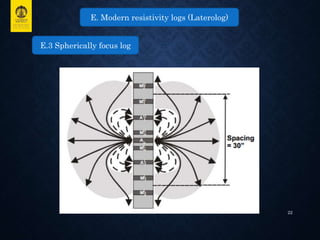
E. Modern resistivity logs (Laterolog)
E.3 Spherically focus log
23
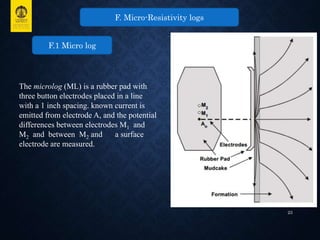
F. Micro-Resistivity logs
F.1 Micro log
The microlog (ML) is a rubber pad with
three button electrodes placed in a line
with a 1 inch spacing. known current is
emitted from electrode A, and the potential
differences between electrodes M1 and
M2 and between M2 and a surface
electrode are measured.
• The microlaterolog (MLL) is the micro-
scale version of the laterolog, and
hence incorporates a current focussing
system.
• The tool is pad mounted, and has a
central button electrode that emits a
known measurement current
surrounded coaxially by two
ringshaped monitoring electrodes, and
a ring-shaped guard electrode that
produces a bucking current as in the
LLD.
24
F. Micro-Resistivity logs
F.2 Micro laterolog
25
F. Micro-Resistivity logs
F.3 Proximity log
The proximity log (PL) was
developed from the MLL to overcome
problems with mudcakes over 3/8”
thick, and is used to measure RXO.
26
F. Micro-Resistivity logs
F.4 Micro spherically
focused logs
The micro spherically
focussed log (MSFL) is
commonly run with the
DLL on one of its
stabilizing pads for the
purpose of measuring
RXO.
27
G.Uses of electrical log
G.1 Recognition of hydrocarbon
G.2 Calculation of water saturation
G.3 Other application
APPLICATION OF DUAL
LATERALOG
• Determine formation resistivity in saline mud systems and
high formation resistivities
• Qualitatively indicate permeability
• Formation evaluation, including hydrocarbon/water contact
28
29
G.Uses of electrical log
G.1 Recognition of hydrocarbon
30
G.Uses of electrical log
G.1 Recognition of hydrocarbon
31
High resolution laterolog showing deep invasion and high resolution image.
32
Well Log Response Chart (Pertamina, 2000)
33
CONCLUSION
• Resistivity is one of the most variable physical properties of
materials and has proven to be the most useful geophysical
parameter.
• Laterologs work best in saltier muds or in normal muds in high
resistivity formations.
• Dual Laterolog instruments are electrode tools designed to
produce reliable formation resistivity measurements in boreholes
containing saline drilling fluids.
34
REFERENCES
• Shankar , Shri S. WELL LOGGING TECHNIQUES AND
FORMATION EVALUATION-AN OVER VIEW
• https://www.spec2000.net/07-latlog.htm
35
36

Laterologs

  • 1.
    Laterolog 1Ade Rama TanjungPutra ( 1506741524) Ridho Irsyad Fauzan (1506721440 )
  • 2.
    OUTLINE A. Introduction B. Principleuses of electrical logs C. Typical responses of an electrical tools D. Old electrical logs E. Modern resistivity logs (Laterolog) E.1. Basic laterologs E.1.1. LL3 E.1.2. LL7 E.2. Dual Laterologs E.2.1. LLD E.2.2. LLS E.3. Sperically focus log F. Micro- resistivity logs F.1 Micro log F.2 Micro Laterolog F.3 Proximity log G. Uses of electrical log 2
  • 3.
    Logging • The identificationof reservoir • The estimation of hydrocarbon in place. • The estimation of recoverable hydrocarbon  To identify the productive zones of hydrocarbon.  To define the petrophysical parameters like porosity, permeability, hydrocarbon  saturation and lithology of zones.  To determine depth, thickness, formation temperature and pressure of a reservoir.  To distinguish between oil, gas and water zones in a reservoir.  To measure hydrocarbon mobility. Well logs 3 A. Introduction
  • 4.
    PHYSICAL PARAMETERS THATCAN BE RECORDED : 1) Resistivity Logs - Induction log - Laterolog 2) Porosity/Radioactive Logs. 3) Sonic/Acoustic Log 4) Sampling and coring 5) Cement evaluation Log 6) Production Logs. 4 Target A. Introduction
  • 5.
    ELECTRICAL LOGGING • Theinduction log actually measures conductivity, and hence is sometimes called the conductivity log. • The modern tool for measuring resistivity in high salinity (low resistivity) muds is the laterolog, which focuses its current into a thin sheet to improve vertical resolution and penetration depth. • The laterologs measure resistivity in the conventional sense, and are usually referred to as resistivity tools. 5 A. Introduction
  • 6.
    RESISTIVITY LOGGING • Resistivityis one of the most variable physical properties of materials and has proven to be the most useful geophysical parameter in the search for hydrocarbons resources. • The resistivity of a substance is its ability to impede the flow of electric current through the substance. 6 A. Introduction
  • 7.
    THE ELECTRICAL TOOLSALSO HAVE A NUMBER OF QUALITATIVE USES, PRINCIPLE OF WHICH ARE : (i) indications of lithology, (ii) facies and electro-facies analysis, (iii) correlation, (iv) determination of overpressure, determination of shale porosity, (v) indications of compaction, and the investigation of source rocks. 7 B. Principle uses of electrical log
  • 8.
    THE DEGREE TOWHICH THE SANDSTONES HAVE HIGHER RESISTIVITIES DEPENDS UPON : (i) their porosity, (ii) their pore geometries, (iii) the resistivity of the formation water, (iv) the water, oil and gas saturations (oil and gas are taken to have infinite resistivity). 8 C. Typical responses of an electrical tool
  • 9.
    9 C. Typical responsesof an electrical tool
  • 10.
  • 11.
    THE CURRENT DENSITYVARIES INVERSELY WITH THE RADIAL DISTANCE AND CAN BE CALCULATED FROM: Current density Current density = I / (2 * PI * R * T) Where, I = total current intensity (amperes) T = thickness of measure current disc (meters) R = radial distance (meters) Resistivity of the formation Rt = K * V / I (same as ES log except K is different) Where V = potential of measure electrode (volts) I = current flow from measure electrode (amperes) K = a calibration constant defined by the geometry of the electrode spacing 11
  • 12.
    • Laterolog wasput into service in 1949 as a replacement for the ES Log in salt mud environments. • It was another invention by Henry Doll of Schlumberger. Competitive tool designs were called Guard Logs or Focused Logs. • The objective was to focus the current from the tool into the rock better than could be accomplished with the ES Log. 12 E. Modern resistivity logs (Laterolog)
  • 13.
    • Laterologs workbest in saltier muds or in normal muds in high resistivity formations. They will not work in air filled or cased holes • The laterolog is a direct current (DC) tool based on Ohm's Law. • The tools have been designed to produce reliable resistivity measurements in boreholes containing highly saline drilling fluids and/or when surrounded by highly resistive rocks. 13
  • 14.
    • The loggingcurrent is prevented from flowing up and down within the drilling fluid by placing focusing electrodes (A1 and A2) on both sides of a central measure electrode A0, as illustrated below. • The focusing electrodes force measure current to flow only in the lateral direction, perpendicular to the axis of the logging device. 14
  • 15.
    15 E. Modern resistivitylogs (Laterolog) E.1. Basic laterologs
  • 16.
    16 E. Modern resistivitylogs (Laterolog) E.2 Dual laterologs
  • 17.
    DUAL LATEROLOG (DLL) •Dual Laterolog instruments are electrode tools designed to produce reliable formation resistivity measurements in boreholes containing saline drilling fluids. • The Dual Laterolog instrument simultaneously produces a deep investigation resistivity and a shallow investigation resistivity measurement. 17
  • 18.
    • The DLLproduces two measurements, the laterolog shallow (LLS), and laterologdeep (LLD). • The dual laterolog (DLL) is the latest version of the laterolog. • As its name implies, it is a combination of two tools, and can be run in a deep penetration (LLd) and shallow penetration (LLs) mode. • These are now commonly run simultaneously and together with an additional very shallow penetration device. 18
  • 19.
    LLD MODE • Thetool operates just like a LL7 tool but with the same bucking currents that are emitted from the A 1 electrodes • The result of this is to focus the current from the central electrode. 19
  • 20.
    LLS MODE • Thebucking current must veer away from the pathway into the formation, and back towards the tool A2 electrodes, and hence cannot constrain (focus) the current being emitted from the central electrode as much. 20
  • 21.
    BOTH MODES OFTHE DUAL LATEROLOG HAVE A BED RESOLUTION OF 2 FEET, AND A SENSITIVITY OF 0.2 TO 20,000 ΩM. TO ACHIEVE THIS SENSITIVITY BOTH THE CURRENT AND VOLTAGE ARE VARIED DURING THE MEASUREMENT, KEEPING THEIR PRODUCT (THE POWER) CONSTANT. 21
  • 22.
    22 E. Modern resistivitylogs (Laterolog) E.3 Spherically focus log
  • 23.
    23 F. Micro-Resistivity logs F.1Micro log The microlog (ML) is a rubber pad with three button electrodes placed in a line with a 1 inch spacing. known current is emitted from electrode A, and the potential differences between electrodes M1 and M2 and between M2 and a surface electrode are measured.
  • 24.
    • The microlaterolog(MLL) is the micro- scale version of the laterolog, and hence incorporates a current focussing system. • The tool is pad mounted, and has a central button electrode that emits a known measurement current surrounded coaxially by two ringshaped monitoring electrodes, and a ring-shaped guard electrode that produces a bucking current as in the LLD. 24 F. Micro-Resistivity logs F.2 Micro laterolog
  • 25.
    25 F. Micro-Resistivity logs F.3Proximity log The proximity log (PL) was developed from the MLL to overcome problems with mudcakes over 3/8” thick, and is used to measure RXO.
  • 26.
    26 F. Micro-Resistivity logs F.4Micro spherically focused logs The micro spherically focussed log (MSFL) is commonly run with the DLL on one of its stabilizing pads for the purpose of measuring RXO.
  • 27.
    27 G.Uses of electricallog G.1 Recognition of hydrocarbon G.2 Calculation of water saturation G.3 Other application
  • 28.
    APPLICATION OF DUAL LATERALOG •Determine formation resistivity in saline mud systems and high formation resistivities • Qualitatively indicate permeability • Formation evaluation, including hydrocarbon/water contact 28
  • 29.
    29 G.Uses of electricallog G.1 Recognition of hydrocarbon
  • 30.
    30 G.Uses of electricallog G.1 Recognition of hydrocarbon
  • 31.
  • 32.
    High resolution laterologshowing deep invasion and high resolution image. 32
  • 33.
    Well Log ResponseChart (Pertamina, 2000) 33
  • 34.
    CONCLUSION • Resistivity isone of the most variable physical properties of materials and has proven to be the most useful geophysical parameter. • Laterologs work best in saltier muds or in normal muds in high resistivity formations. • Dual Laterolog instruments are electrode tools designed to produce reliable formation resistivity measurements in boreholes containing saline drilling fluids. 34
  • 35.
    REFERENCES • Shankar ,Shri S. WELL LOGGING TECHNIQUES AND FORMATION EVALUATION-AN OVER VIEW • https://www.spec2000.net/07-latlog.htm 35
  • 36.