CBL-VDL Cement Bond Logging
Basic Theory and Interpretation
British Training Centre
2 KS
British Training Centre
Objectives of Primary Cementing
Casing
Zone Hydraulic Isolation
Oil Zone
Water Zone
Cement
Prevents
•Mixing of unwanted fluids
•Fluids escaping to surface
•Invading fluids [crossflow]
•Casing Corrosion
•Casing Collapse
Shale Zone
Gas Zone
3 KS
British Training Centre
Cement Quality Problems
Casing
No Zone Hydraulic Isolation
Oil Zone
Water Zone
Cement
Causes
•Mixing of unwanted fluids
•Fluids escaping to surface
•Invading fluids [crossflow]
•Casing Corrosion
•Casing Collapse
4 KS
British Training Centre
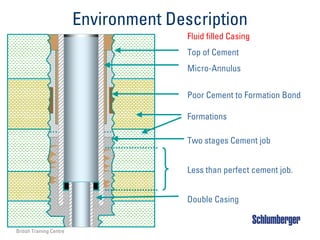
Environment Description
Top of Cement
Poor Cement to Formation Bond
Formations
Micro-Annulus
Less than perfect cement job.
Two stages Cement job
Double Casing
b
Fluid filled Casing
5 KS
British Training Centre
CBL-VDL Log Applications
Client Needs
Oil Zone
Water Zone
Cement
To Evaluate Cement Job
•Check Integrity of Cement
•To Verify Zone Isolation
•To Determine Cement
Strength
•Is there any Channel ?
•Is it necessary to Repair ?
•Will be possible to Repair?
[ by performing a SQUEEZE ]
•Where is the Top of the
Cement ?
Casing
CBL-VDL Cement Bond Logging
Physics of Measurement
7 KS
British Training Centre
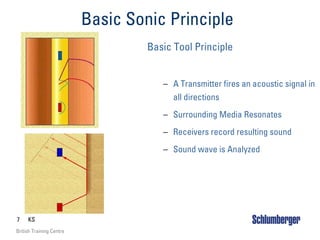
Basic Sonic Principle
Basic Tool Principle
– A Transmitter fires an acoustic signal in
all directions
– Surrounding Media Resonates
– Receivers record resulting sound
– Sound wave is Analyzed
8 KS
British Training Centre
Basic CBL Principle
Similar to a Ringing Bell
When Fluid is behind
Casing, pipe is free to
vibrate [ loud sound ]
When the casing is
bonded to hard cement,
casing vibrations are
attenuated proportionally
to bonded surface
Good
Bond
Good
Good
Bond
Bond
No
Cement
No
No
Cement
Cement
9 KS
British Training Centre
CBL Measurement Principle
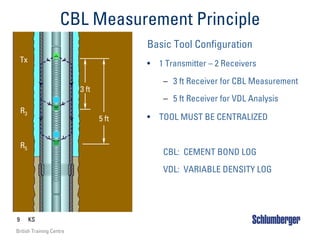
Basic Tool Configuration
• 1 Transmitter – 2 Receivers
– 3 ft Receiver for CBL Measurement
– 5 ft Receiver for VDL Analysis
• TOOL MUST BE CENTRALIZED
CBL: CEMENT BOND LOG
VDL: VARIABLE DENSITY LOG
3 ft
5 ft
Tx
R3
R5
10 KS
British Training Centre
CBL-VDL Measurement Principle
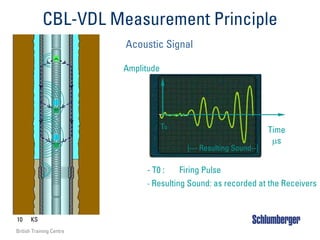
Acoustic Signal
Time
µs
Amplitude
T0
|--- Resulting Sound--|
- T0 : Firing Pulse
- Resulting Sound: as recorded at the Receivers
11 KS
British Training Centre
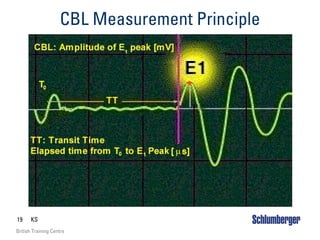
CBL Measurement Principle
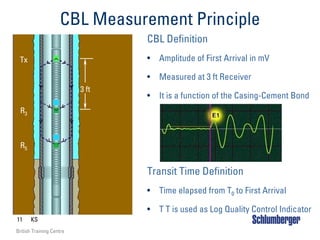
CBL Definition
• Amplitude of First Arrival in mV
• Measured at 3 ft Receiver
• It is a function of the Casing-Cement Bond
3 ft
Tx
R3
R5
Transit Time Definition
• Time elapsed from T0 to First Arrival
• T T is used as Log Quality Control Indicator
12 KS
British Training Centre
CBL Qualitative Meaning
Good
Bond
Good
Good
Bond
Bond
No
Cement
No
No
Cement
Cement
HIGH CBL signal strength => pipe is free to vibrate [ no cement ]
LOW CBL signal strength => atennuated energy [ cement is present]
13 KS
British Training Centre
Sound to Signal
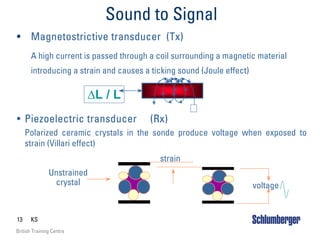
• Magnetostrictive transducer (Tx)
A high current is passed through a coil surrounding a magnetic material
introducing a strain and causes a ticking sound (Joule effect)
∆L / L
• Piezoelectric transducer (Rx)
Polarized ceramic crystals in the sonde produce voltage when exposed to
strain (Villari effect)
strain
voltage
Unstrained
crystal
14 KS
British Training Centre
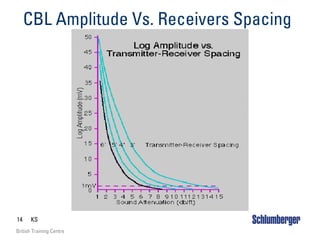
CBL Amplitude Vs. Receivers Spacing
CBL-VDL Cement Bond Logging
Gate Settings
British Training Center
CBL Measurement Gates
WARNING
- The CBL represents one of the most common logs prone to human error
- Incorrect setting of parameters can cause an invalid log
- If CBLF is presented, particular attention must be paid to the selection of FCF
17 KS
British Training Centre
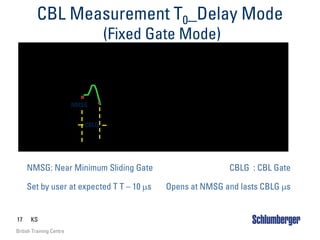
CBL Measurement T0_Delay Mode
(Fixed Gate Mode)
NMSG
CBLG
NMSG: Near Minimum Sliding Gate CBLG : CBL Gate
Set by user at expected T T – 10 µs Opens at NMSG and lasts CBLG µs
18 KS
British Training Centre
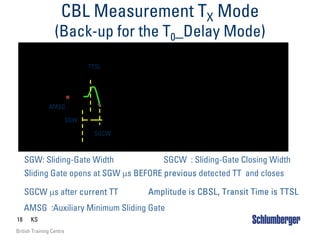
CBL Measurement TX Mode
(Back-up for the T0_Delay Mode)
SGW: Sliding-Gate Width
SGW
SGCW
SGCW : Sliding-Gate Closing Width
Sliding Gate opens at SGW µs BEFORE previous detected TT and closes
SGCW µs after current TT
TTSL
AMSG
AMSG :Auxiliary Minimum Sliding Gate
Amplitude is CBSL, Transit Time is TTSL
19 KS
British Training Centre
CBL Measurement Principle
CBL
CBL Definition
Definition
•
• Measured at
Measured at 3
3 ft Receiver
ft Receiver
•
• Amplitude
Amplitude in
in mV of First Arrival
mV of First Arrival
Tranit
Tranit Time
Time Definition
Definition
•
• Time
Time elapsed from
elapsed from T0
T0 to First Arrival
to First Arrival
20 KS
British Training Centre
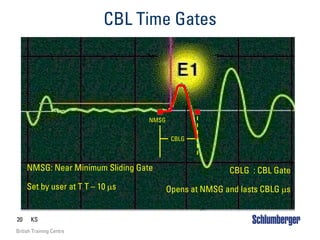
CBL Time Gates
NMSG: Near Minimum Sliding Gate
CBLG
NMSG
CBLG : CBL Gate
Set by user at T T – 10 µs Opens at NMSG and lasts CBLG µs
21 KS
British Training Centre
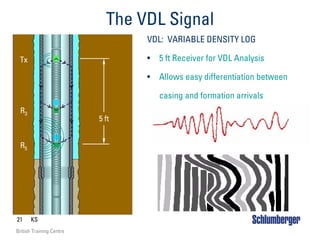
The VDL Signal
VDL: VARIABLE DENSITY LOG
• 5 ft Receiver for VDL Analysis
• Allows easy differentiation between
casing and formation arrivals
5 ft
Tx
R3
R5
22 KS
British Training Centre
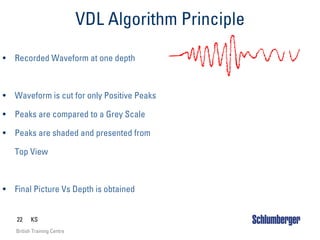
VDL Algorithm Principle
• Recorded Waveform at one depth
• Waveform is cut for only Positive Peaks
• Peaks are compared to a Grey Scale
• Peaks are shaded and presented from
Top View
• Final Picture Vs Depth is obtained
23 KS
British Training Centre
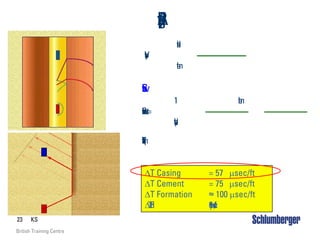
∆T Casing = 57 µsec/ft
∆T Cement = 75 µsec/ft
∆T Formation ≈ 100 µsec/ft
∆
T
F
l
u
i
d ≈
1
8
9
µ
s
e
c
/
f
t
S
l
o
w
n
e
s
s
P
r
o
p
a
g
a
t
i
o
n
o
f
t
h
e
A
c
o
u
s
t
i
c
E
n
e
r
g
y
d
i
s
t
a
n
c
e
V
e
l
o
c
i
t
y
=
t
i
m
e
1 t
i
m
e
S
l
o
w
n
e
s
s
=
∆t
=
=
v
e
l
o
c
i
t
y
d
i
s
t
a
n
c
e
T
i
m
e
r
e
q
u
i
r
e
d
f
o
r
s
o
u
n
d
t
o
t
r
a
v
e
l
1
f
o
o
t
24 KS
British Training Centre
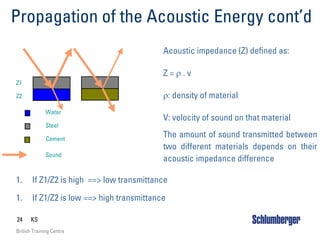
The amount of sound transmitted between
two different materials depends on their
acoustic impedance difference
Water
Steel
Cement
Sound
Z1
Z2
Acoustic impedance (Z) defined as:
Z = ρ . v
ρ: density of material
V: velocity of sound on that material
Propagation of the Acoustic Energy cont’d
1. If Z1/Z2 is high ==> low transmittance
1. If Z1/Z2 is low ==> high transmittance
Waveform Time Analysis
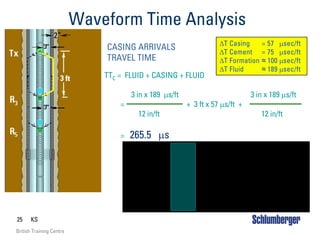
CASING ARRIVALS
TRAVEL TIME
2”
∆T Casing = 57 µsec/ft
∆T Cement = 75 µsec/ft
∆T Formation ≈ 100 µsec/ft
∆T Fluid ≈ 189 µsec/ft
TTC = FLUID + CASING + FLUID
3 in x 189 µs/ft 3 in x 189 µs/ft
= + 3 ft x 57 µs/ft +
12 in/ft 12 in/ft
= 265.5 µs
25 KS
British Training Centre
Waveform Time Analysis
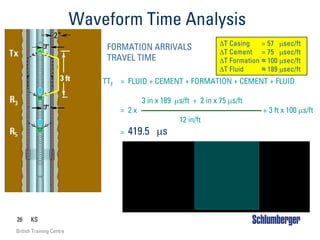
FORMATION ARRIVALS
TRAVEL TIME
2”
∆T Casing = 57 µsec/ft
∆T Cement = 75 µsec/ft
∆T Formation ≈ 100 µsec/ft
∆T Fluid ≈ 189 µsec/ft
TTF = FLUID + CEMENT + FORMATION + CEMENT + FLUID
3 in x 189 µs/ft + 2 in x 75 µs/ft
= 2 x + 3 ft x 100 µs/ft
12 in/ft
= 419.5 µs
26 KS
British Training Centre
Waveform Time Analysis
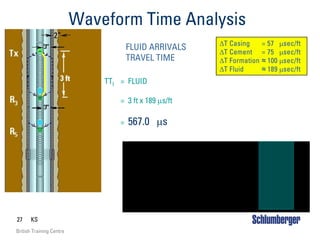
FLUID ARRIVALS
TRAVEL TIME
2”
∆T Casing = 57 µsec/ft
∆T Cement = 75 µsec/ft
∆T Formation ≈ 100 µsec/ft
∆T Fluid ≈ 189 µsec/ft
TTf = FLUID
= 3 ft x 189 µs/ft
= 567.0 µs
27 KS
British Training Centre
28 KS
British Training Centre
CBL-VDL Standard Outputs Presentation
•Transit Time TT in micro-seconds [µs]
•CBL Amplitude in millivolts [mV ]
•VDL Variable Density Log [wafeform visual representation]
0 CBL 100
[mV]
400 TT 200
[µs]
200 VDL 1200
[µs]
GR
CCL
29 KS
British Training Centre
CBL-VDL Standard Outputs
•Transit Time TT in micro-seconds [µs]
Log Quality Control
•CBL Amplitude in millivolts [mV ]
Quantitative Measurement of waveform energy
•VDL Variable Density Log [waveform visual representation]
Qualitative Analysis of sound
Qualitative indicator of the presence of solid materials behind the casing
•Gamma Ray and CCL as auxiliary curves for Correlation
CBL-VDL Cement Bond Logging
Factors affecting the Log
British Training Centre
31 KS
British Training Centre
Stretching
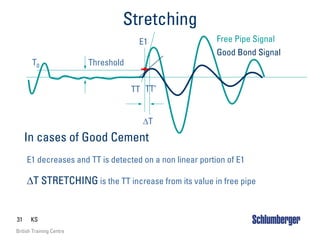
E1 decreases and TT is detected on a non linear portion of E1
∆T STRETCHING is the TT increase from its value in free pipe
In cases of Good Cement
Threshold
E1
T0
TT
Free Pipe Signal
TT’
∆T
Good Bond Signal
32 KS
British Training Centre
TT Cycle Skipping
E1 could not reach Detection Threshold Level
T T skips to 3rd Peak [E3 ]........this is known as CYCLE SKIPPING
In cases of very Good Cement
Threshold
E1 E3
E2
T0
TT TT’
33 KS
British Training Centre
CBL Time Gates
E1 does not reach Detection Threshold Level
T T skips to 3rd Peak [E3 ]........this is known as CYCLE SKIPPING
Threshold
E3
T0
TT TT’
34 KS
British Training Centre
WF Viewer & Amplitude Measurements
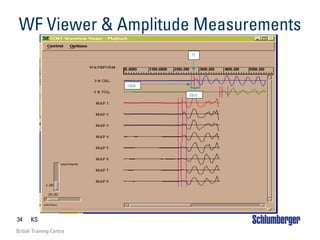
CB3G
TT
CBLG
CBL-VDL Cement Bond Logging
Basic Interpretation
36 KS
British Training Centre
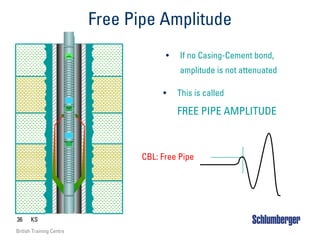
Free Pipe Amplitude
T
5
3
2
• If no Casing-Cement bond,
amplitude is not attenuated
• This is called
FREE PIPE AMPLITUDE
CBL: Free Pipe
37 KS
British Training Centre
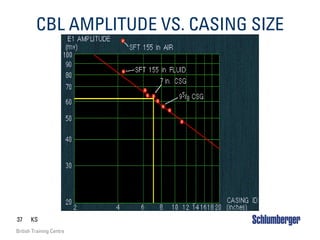
CBL AMPLITUDE VS. CASING SIZE
38 KS
British Training Centre
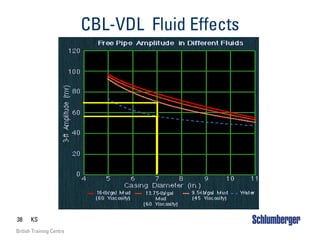
CBL-VDL Fluid Effects
39 KS
British Training Centre
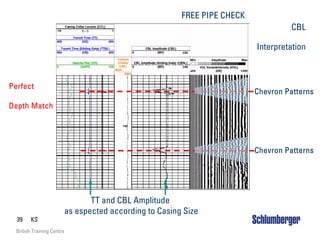
FREE PIPE CHECK
CBL
Interpretation
Chevron Patterns
Chevron Patterns
Perfect
Depth Match
TT and CBL Amplitude
as espected according to Casing Size
100
100
40 KS
British Training Centre
Cement to Casing Bond
T
5
3
2
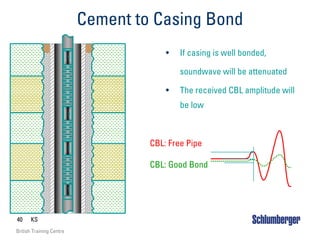
• If casing is well bonded,
soundwave will be attenuated
• The received CBL amplitude will
be low
CBL: Free Pipe
CBL: Good Bond
41 KS
British Training Centre
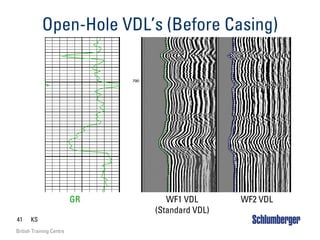
Open-Hole VDL’s (Before Casing)
GR WF1 VDL
(Standard VDL)
WF2 VDL
42 KS
British Training Centre
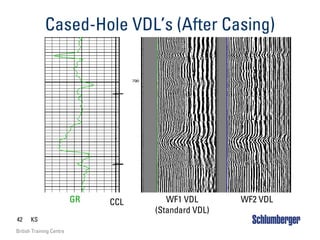
Cased-Hole VDL’s (After Casing)
GR WF1 VDL
(Standard VDL)
WF2 VDL
CCL
43 KS
British Training Centre
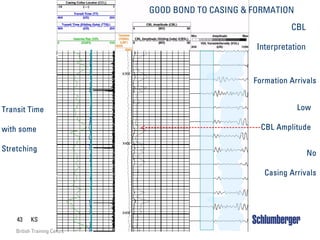
CBL
Interpretation
GOOD BOND TO CASING & FORMATION
X
X
Transit Time
with some
Stretching
Formation Arrivals
X
No
Casing Arrivals
Low
<----------------------------------------CBL Amplitude
44 KS
British Training Centre
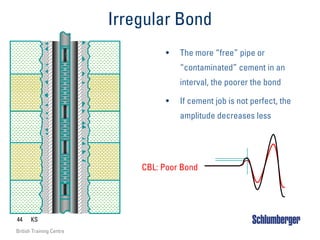
Irregular Bond
T
5
3
2
• The more “free” pipe or
“contaminated” cement in an
interval, the poorer the bond
• If cement job is not perfect, the
amplitude decreases less
CBL: Poor Bond
45 KS
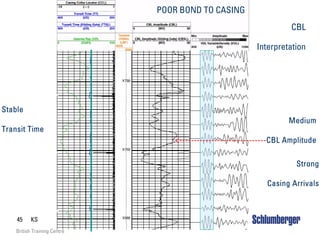
British Training Centre
CBL
Interpretation
POOR BOND TO CASING
X
X
X
Stable
Transit Time
Strong
Casing Arrivals
Medium
<------------------------------CBL Amplitude
46 KS
British Training Centre
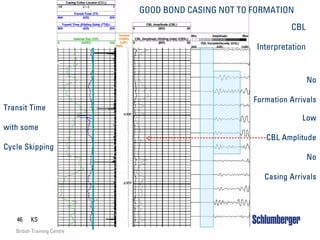
CBL
Interpretation
GOOD BOND CASING NOT TO FORMATION
X
X
Transit Time
with some
Cycle Skipping
No
Formation Arrivals
Low
<----------------------------------------CBL Amplitude
No
Casing Arrivals
47 KS
British Training Centre
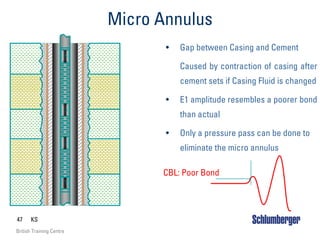
Micro Annulus
T
5
3
2
• Gap between Casing and Cement
Caused by contraction of casing after
cement sets if Casing Fluid is changed
• E1 amplitude resembles a poorer bond
than actual
• Only a pressure pass can be done to
eliminate the micro annulus
CBL: Poor Bond
48 KS
British Training Centre
Tool Eccentering
Causes for Eccentralization
5
3
2
T
• Improper Equipment selection
[ Centralizers ] for Casing Size
• Missing or Broken Centralizer(s)
• Weak Centralizers in deviated wells
• Tool Damaged and/or bent
• Damaged Casing
Consequences
• Unbalanced sound paths
• Resulting waveform is meaningless
49 KS
British Training Centre
Eccentering Analysis
There will be destructive interference from different sound paths
Waveform from close tool side to casing
If the tool is eccentered
Threshold
T0
TT
Short Path Waveform
Resulting Waveform
Waveform from far tool side to casing
Delayed Waveform
Result is a Bad Log
not recoverable
in Playback
Normal Waveform
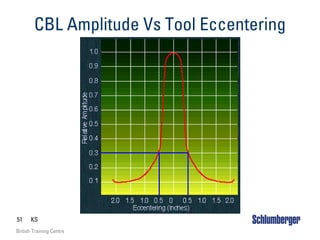
Resulting waveform has Dramatic lower amplitude
Resembling a zone of Good Cement but with shorter Transit Time [≈ 4 µs less]
50 KS
British Training Centre
Eccentering
If the tool is eccentered
Threshold
T0
TT
Resulting Waveform Normal Waveform
There will be destructive interference from different sound paths
Waveform from close tool side to casing
Waveform from far tool side to casing
Result is a Bad Log
not recoverable
in Playback
Resulting waveform has Dramatic lower amplitude
Resembling a zone of Good Cement but with shorter Transit Time [≈ 4 µs less]
51 KS
British Training Centre
CBL Amplitude Vs Tool Eccentering
52 KS
British Training Centre
Fast Formation
T
5
3
2
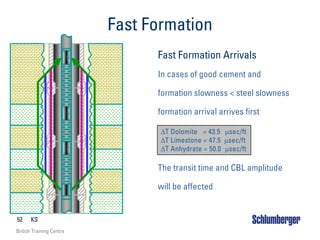
Fast Formation Arrivals
In cases of good cement and
formation slowness < steel slowness
formation arrival arrives first
The transit time and CBL amplitude
will be affected
∆T Dolomite = 43.5 µsec/ft
∆T Limestone = 47.5 µsec/ft
∆T Anhydrate = 50.0 µsec/ft
CBL
Interpretation
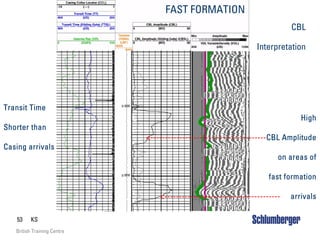
FAST FORMATION
High
<----------------------------------------CBL Amplitude
on areas of
fast formation
<---------------------------------------- arrivals
Transit Time
Shorter than
Casing arrivals
53 KS
British Training Centre
54 KS
British Training Centre
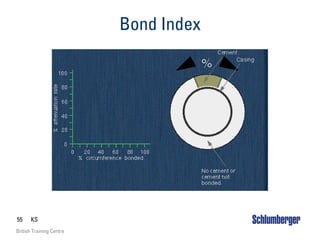
CBL Quantitative Interpretation
• ATTENUATION
– Logarithm of E1 amplitude [first peak of CBL waveform]
• BOND INDEX
Attenuation in zone of interest [dB/ft]
BI =
Attenuation in Cemented Section [dB/ft]
55 KS
British Training Centre
Bond Index
56 KS
British Training Centre
Zone Insulation Based on Bond Index
5
5 6
6 7
7 8
8 9
9 10
10
30
30
25
25
20
20
15
15
10
10
5
5
Bond Index = 70 %
Bond Index = 70 %
Bond Index = 60 %
Bond Index = 60 %
Bond Index = 80 %
Bond Index = 80 %
C
a
s
i
n
g
O
.
D
.
[
i
n
]
I
n
t
e
r
v
a
l
[
f
t
]
5
7
K
S
B
r
i
t
i
s
h
T
r
a
i
n
i
n
g
C
e
n
t
r
e
C
B
L
Q
u
a
n
t
i
t
a
t
i
v
e
I
n
t
e
r
p
r
e
t
a
t
i
o
n
Q
u
a
n
t
i
t
a
t
i
v
e
I
n
t
e
r
p
r
e
t
a
t
i
o
n
I
n
t
e
r
p
r
e
t
a
t
i
o
n
M
1
C
h
a
r
t
C
a
s
i
n
g
D
a
t
a
O
.
D
.
7
”
,
2
9
l
b
m
/
f
t
C
e
m
e
n
t
C
o
m
p
r
e
s
i
v
e
S
t
r
e
n
g
t
h
3
0
0
0
p
s
i
C
a
s
i
n
g
T
h
i
c
k
n
e
s
s
[
f
r
o
m
t
a
b
l
e
s
]
.
4
0
8
i
n
C
B
L
v
a
l
u
e
f
o
r
1
0
0
%
B
o
n
d
[
m
i
n
i
m
u
m
e
x
p
e
c
t
e
d
a
m
p
l
i
t
u
d
e
]
7
0
%
B
o
n
d
I
n
d
e
x
?
C
B
L
v
a
l
u
e
f
o
r
7
0
%
B
o
n
d
58 KS
British Training Centre
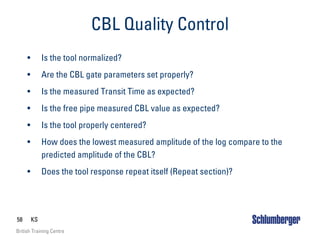
CBL Quality Control
• Is the tool normalized?
• Are the CBL gate parameters set properly?
• Is the measured Transit Time as expected?
• Is the free pipe measured CBL value as expected?
• Is the tool properly centered?
• How does the lowest measured amplitude of the log compare to the
predicted amplitude of the CBL?
• Does the tool response repeat itself (Repeat section)?
59 KS
British Training Centre
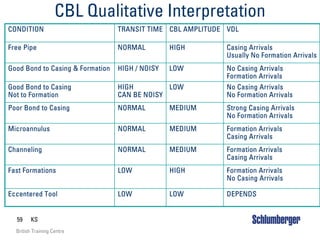
CBL Qualitative Interpretation
CONDITION TRANSIT TIME CBL AMPLITUDE VDL
Free Pipe NORMAL HIGH Casing Arrivals
Usually No Formation Arrivals
Good Bond to Casing & Formation HIGH / NOISY LOW No Casing Arrivals
Formation Arrivals
Good Bond to Casing
Not to Formation
HIGH
CAN BE NOISY
LOW No Casing Arrivals
No Formation Arrivals
Poor Bond to Casing NORMAL MEDIUM Strong Casing Arrivals
No Formation Arrivals
Microannulus NORMAL MEDIUM Formation Arrivals
Casing Arrivals
Channeling NORMAL MEDIUM Formation Arrivals
Casing Arrivals
Fast Formations LOW HIGH Formation Arrivals
No Casing Arrivals
Eccentered Tool LOW LOW DEPENDS

CBL-VDL Cement Bond Logging: Basic Theory & Interpretation

  • 1.
    CBL-VDL Cement BondLogging Basic Theory and Interpretation British Training Centre
  • 2.
    2 KS British TrainingCentre Objectives of Primary Cementing Casing Zone Hydraulic Isolation Oil Zone Water Zone Cement Prevents •Mixing of unwanted fluids •Fluids escaping to surface •Invading fluids [crossflow] •Casing Corrosion •Casing Collapse Shale Zone Gas Zone
  • 3.
    3 KS British TrainingCentre Cement Quality Problems Casing No Zone Hydraulic Isolation Oil Zone Water Zone Cement Causes •Mixing of unwanted fluids •Fluids escaping to surface •Invading fluids [crossflow] •Casing Corrosion •Casing Collapse
  • 4.
    4 KS British TrainingCentre Environment Description Top of Cement Poor Cement to Formation Bond Formations Micro-Annulus Less than perfect cement job. Two stages Cement job Double Casing b Fluid filled Casing
  • 5.
    5 KS British TrainingCentre CBL-VDL Log Applications Client Needs Oil Zone Water Zone Cement To Evaluate Cement Job •Check Integrity of Cement •To Verify Zone Isolation •To Determine Cement Strength •Is there any Channel ? •Is it necessary to Repair ? •Will be possible to Repair? [ by performing a SQUEEZE ] •Where is the Top of the Cement ? Casing
  • 6.
    CBL-VDL Cement BondLogging Physics of Measurement
  • 7.
    7 KS British TrainingCentre Basic Sonic Principle Basic Tool Principle – A Transmitter fires an acoustic signal in all directions – Surrounding Media Resonates – Receivers record resulting sound – Sound wave is Analyzed
  • 8.
    8 KS British TrainingCentre Basic CBL Principle Similar to a Ringing Bell When Fluid is behind Casing, pipe is free to vibrate [ loud sound ] When the casing is bonded to hard cement, casing vibrations are attenuated proportionally to bonded surface Good Bond Good Good Bond Bond No Cement No No Cement Cement
  • 9.
    9 KS British TrainingCentre CBL Measurement Principle Basic Tool Configuration • 1 Transmitter – 2 Receivers – 3 ft Receiver for CBL Measurement – 5 ft Receiver for VDL Analysis • TOOL MUST BE CENTRALIZED CBL: CEMENT BOND LOG VDL: VARIABLE DENSITY LOG 3 ft 5 ft Tx R3 R5
  • 10.
    10 KS British TrainingCentre CBL-VDL Measurement Principle Acoustic Signal Time µs Amplitude T0 |--- Resulting Sound--| - T0 : Firing Pulse - Resulting Sound: as recorded at the Receivers
  • 11.
    11 KS British TrainingCentre CBL Measurement Principle CBL Definition • Amplitude of First Arrival in mV • Measured at 3 ft Receiver • It is a function of the Casing-Cement Bond 3 ft Tx R3 R5 Transit Time Definition • Time elapsed from T0 to First Arrival • T T is used as Log Quality Control Indicator
  • 12.
    12 KS British TrainingCentre CBL Qualitative Meaning Good Bond Good Good Bond Bond No Cement No No Cement Cement HIGH CBL signal strength => pipe is free to vibrate [ no cement ] LOW CBL signal strength => atennuated energy [ cement is present]
  • 13.
    13 KS British TrainingCentre Sound to Signal • Magnetostrictive transducer (Tx) A high current is passed through a coil surrounding a magnetic material introducing a strain and causes a ticking sound (Joule effect) ∆L / L • Piezoelectric transducer (Rx) Polarized ceramic crystals in the sonde produce voltage when exposed to strain (Villari effect) strain voltage Unstrained crystal
  • 14.
    14 KS British TrainingCentre CBL Amplitude Vs. Receivers Spacing
  • 15.
    CBL-VDL Cement BondLogging Gate Settings British Training Center
  • 16.
    CBL Measurement Gates WARNING -The CBL represents one of the most common logs prone to human error - Incorrect setting of parameters can cause an invalid log - If CBLF is presented, particular attention must be paid to the selection of FCF
  • 17.
    17 KS British TrainingCentre CBL Measurement T0_Delay Mode (Fixed Gate Mode) NMSG CBLG NMSG: Near Minimum Sliding Gate CBLG : CBL Gate Set by user at expected T T – 10 µs Opens at NMSG and lasts CBLG µs
  • 18.
    18 KS British TrainingCentre CBL Measurement TX Mode (Back-up for the T0_Delay Mode) SGW: Sliding-Gate Width SGW SGCW SGCW : Sliding-Gate Closing Width Sliding Gate opens at SGW µs BEFORE previous detected TT and closes SGCW µs after current TT TTSL AMSG AMSG :Auxiliary Minimum Sliding Gate Amplitude is CBSL, Transit Time is TTSL
  • 19.
    19 KS British TrainingCentre CBL Measurement Principle CBL CBL Definition Definition • • Measured at Measured at 3 3 ft Receiver ft Receiver • • Amplitude Amplitude in in mV of First Arrival mV of First Arrival Tranit Tranit Time Time Definition Definition • • Time Time elapsed from elapsed from T0 T0 to First Arrival to First Arrival
  • 20.
    20 KS British TrainingCentre CBL Time Gates NMSG: Near Minimum Sliding Gate CBLG NMSG CBLG : CBL Gate Set by user at T T – 10 µs Opens at NMSG and lasts CBLG µs
  • 21.
    21 KS British TrainingCentre The VDL Signal VDL: VARIABLE DENSITY LOG • 5 ft Receiver for VDL Analysis • Allows easy differentiation between casing and formation arrivals 5 ft Tx R3 R5
  • 22.
    22 KS British TrainingCentre VDL Algorithm Principle • Recorded Waveform at one depth • Waveform is cut for only Positive Peaks • Peaks are compared to a Grey Scale • Peaks are shaded and presented from Top View • Final Picture Vs Depth is obtained
  • 23.
    23 KS British TrainingCentre ∆T Casing = 57 µsec/ft ∆T Cement = 75 µsec/ft ∆T Formation ≈ 100 µsec/ft ∆ T F l u i d ≈ 1 8 9 µ s e c / f t S l o w n e s s P r o p a g a t i o n o f t h e A c o u s t i c E n e r g y d i s t a n c e V e l o c i t y = t i m e 1 t i m e S l o w n e s s = ∆t = = v e l o c i t y d i s t a n c e T i m e r e q u i r e d f o r s o u n d t o t r a v e l 1 f o o t
  • 24.
    24 KS British TrainingCentre The amount of sound transmitted between two different materials depends on their acoustic impedance difference Water Steel Cement Sound Z1 Z2 Acoustic impedance (Z) defined as: Z = ρ . v ρ: density of material V: velocity of sound on that material Propagation of the Acoustic Energy cont’d 1. If Z1/Z2 is high ==> low transmittance 1. If Z1/Z2 is low ==> high transmittance
  • 25.
    Waveform Time Analysis CASINGARRIVALS TRAVEL TIME 2” ∆T Casing = 57 µsec/ft ∆T Cement = 75 µsec/ft ∆T Formation ≈ 100 µsec/ft ∆T Fluid ≈ 189 µsec/ft TTC = FLUID + CASING + FLUID 3 in x 189 µs/ft 3 in x 189 µs/ft = + 3 ft x 57 µs/ft + 12 in/ft 12 in/ft = 265.5 µs 25 KS British Training Centre
  • 26.
    Waveform Time Analysis FORMATIONARRIVALS TRAVEL TIME 2” ∆T Casing = 57 µsec/ft ∆T Cement = 75 µsec/ft ∆T Formation ≈ 100 µsec/ft ∆T Fluid ≈ 189 µsec/ft TTF = FLUID + CEMENT + FORMATION + CEMENT + FLUID 3 in x 189 µs/ft + 2 in x 75 µs/ft = 2 x + 3 ft x 100 µs/ft 12 in/ft = 419.5 µs 26 KS British Training Centre
  • 27.
    Waveform Time Analysis FLUIDARRIVALS TRAVEL TIME 2” ∆T Casing = 57 µsec/ft ∆T Cement = 75 µsec/ft ∆T Formation ≈ 100 µsec/ft ∆T Fluid ≈ 189 µsec/ft TTf = FLUID = 3 ft x 189 µs/ft = 567.0 µs 27 KS British Training Centre
  • 28.
    28 KS British TrainingCentre CBL-VDL Standard Outputs Presentation •Transit Time TT in micro-seconds [µs] •CBL Amplitude in millivolts [mV ] •VDL Variable Density Log [wafeform visual representation] 0 CBL 100 [mV] 400 TT 200 [µs] 200 VDL 1200 [µs] GR CCL
  • 29.
    29 KS British TrainingCentre CBL-VDL Standard Outputs •Transit Time TT in micro-seconds [µs] Log Quality Control •CBL Amplitude in millivolts [mV ] Quantitative Measurement of waveform energy •VDL Variable Density Log [waveform visual representation] Qualitative Analysis of sound Qualitative indicator of the presence of solid materials behind the casing •Gamma Ray and CCL as auxiliary curves for Correlation
  • 30.
    CBL-VDL Cement BondLogging Factors affecting the Log British Training Centre
  • 31.
    31 KS British TrainingCentre Stretching E1 decreases and TT is detected on a non linear portion of E1 ∆T STRETCHING is the TT increase from its value in free pipe In cases of Good Cement Threshold E1 T0 TT Free Pipe Signal TT’ ∆T Good Bond Signal
  • 32.
    32 KS British TrainingCentre TT Cycle Skipping E1 could not reach Detection Threshold Level T T skips to 3rd Peak [E3 ]........this is known as CYCLE SKIPPING In cases of very Good Cement Threshold E1 E3 E2 T0 TT TT’
  • 33.
    33 KS British TrainingCentre CBL Time Gates E1 does not reach Detection Threshold Level T T skips to 3rd Peak [E3 ]........this is known as CYCLE SKIPPING Threshold E3 T0 TT TT’
  • 34.
    34 KS British TrainingCentre WF Viewer & Amplitude Measurements CB3G TT CBLG
  • 35.
    CBL-VDL Cement BondLogging Basic Interpretation
  • 36.
    36 KS British TrainingCentre Free Pipe Amplitude T 5 3 2 • If no Casing-Cement bond, amplitude is not attenuated • This is called FREE PIPE AMPLITUDE CBL: Free Pipe
  • 37.
    37 KS British TrainingCentre CBL AMPLITUDE VS. CASING SIZE
  • 38.
    38 KS British TrainingCentre CBL-VDL Fluid Effects
  • 39.
    39 KS British TrainingCentre FREE PIPE CHECK CBL Interpretation Chevron Patterns Chevron Patterns Perfect Depth Match TT and CBL Amplitude as espected according to Casing Size 100 100
  • 40.
    40 KS British TrainingCentre Cement to Casing Bond T 5 3 2 • If casing is well bonded, soundwave will be attenuated • The received CBL amplitude will be low CBL: Free Pipe CBL: Good Bond
  • 41.
    41 KS British TrainingCentre Open-Hole VDL’s (Before Casing) GR WF1 VDL (Standard VDL) WF2 VDL
  • 42.
    42 KS British TrainingCentre Cased-Hole VDL’s (After Casing) GR WF1 VDL (Standard VDL) WF2 VDL CCL
  • 43.
    43 KS British TrainingCentre CBL Interpretation GOOD BOND TO CASING & FORMATION X X Transit Time with some Stretching Formation Arrivals X No Casing Arrivals Low <----------------------------------------CBL Amplitude
  • 44.
    44 KS British TrainingCentre Irregular Bond T 5 3 2 • The more “free” pipe or “contaminated” cement in an interval, the poorer the bond • If cement job is not perfect, the amplitude decreases less CBL: Poor Bond
  • 45.
    45 KS British TrainingCentre CBL Interpretation POOR BOND TO CASING X X X Stable Transit Time Strong Casing Arrivals Medium <------------------------------CBL Amplitude
  • 46.
    46 KS British TrainingCentre CBL Interpretation GOOD BOND CASING NOT TO FORMATION X X Transit Time with some Cycle Skipping No Formation Arrivals Low <----------------------------------------CBL Amplitude No Casing Arrivals
  • 47.
    47 KS British TrainingCentre Micro Annulus T 5 3 2 • Gap between Casing and Cement Caused by contraction of casing after cement sets if Casing Fluid is changed • E1 amplitude resembles a poorer bond than actual • Only a pressure pass can be done to eliminate the micro annulus CBL: Poor Bond
  • 48.
    48 KS British TrainingCentre Tool Eccentering Causes for Eccentralization 5 3 2 T • Improper Equipment selection [ Centralizers ] for Casing Size • Missing or Broken Centralizer(s) • Weak Centralizers in deviated wells • Tool Damaged and/or bent • Damaged Casing Consequences • Unbalanced sound paths • Resulting waveform is meaningless
  • 49.
    49 KS British TrainingCentre Eccentering Analysis There will be destructive interference from different sound paths Waveform from close tool side to casing If the tool is eccentered Threshold T0 TT Short Path Waveform Resulting Waveform Waveform from far tool side to casing Delayed Waveform Result is a Bad Log not recoverable in Playback Normal Waveform Resulting waveform has Dramatic lower amplitude Resembling a zone of Good Cement but with shorter Transit Time [≈ 4 µs less]
  • 50.
    50 KS British TrainingCentre Eccentering If the tool is eccentered Threshold T0 TT Resulting Waveform Normal Waveform There will be destructive interference from different sound paths Waveform from close tool side to casing Waveform from far tool side to casing Result is a Bad Log not recoverable in Playback Resulting waveform has Dramatic lower amplitude Resembling a zone of Good Cement but with shorter Transit Time [≈ 4 µs less]
  • 51.
    51 KS British TrainingCentre CBL Amplitude Vs Tool Eccentering
  • 52.
    52 KS British TrainingCentre Fast Formation T 5 3 2 Fast Formation Arrivals In cases of good cement and formation slowness < steel slowness formation arrival arrives first The transit time and CBL amplitude will be affected ∆T Dolomite = 43.5 µsec/ft ∆T Limestone = 47.5 µsec/ft ∆T Anhydrate = 50.0 µsec/ft
  • 53.
    CBL Interpretation FAST FORMATION High <----------------------------------------CBL Amplitude onareas of fast formation <---------------------------------------- arrivals Transit Time Shorter than Casing arrivals 53 KS British Training Centre
  • 54.
    54 KS British TrainingCentre CBL Quantitative Interpretation • ATTENUATION – Logarithm of E1 amplitude [first peak of CBL waveform] • BOND INDEX Attenuation in zone of interest [dB/ft] BI = Attenuation in Cemented Section [dB/ft]
  • 55.
    55 KS British TrainingCentre Bond Index
  • 56.
    56 KS British TrainingCentre Zone Insulation Based on Bond Index 5 5 6 6 7 7 8 8 9 9 10 10 30 30 25 25 20 20 15 15 10 10 5 5 Bond Index = 70 % Bond Index = 70 % Bond Index = 60 % Bond Index = 60 % Bond Index = 80 % Bond Index = 80 % C a s i n g O . D . [ i n ] I n t e r v a l [ f t ]
  • 57.
  • 58.
    58 KS British TrainingCentre CBL Quality Control • Is the tool normalized? • Are the CBL gate parameters set properly? • Is the measured Transit Time as expected? • Is the free pipe measured CBL value as expected? • Is the tool properly centered? • How does the lowest measured amplitude of the log compare to the predicted amplitude of the CBL? • Does the tool response repeat itself (Repeat section)?
  • 59.
    59 KS British TrainingCentre CBL Qualitative Interpretation CONDITION TRANSIT TIME CBL AMPLITUDE VDL Free Pipe NORMAL HIGH Casing Arrivals Usually No Formation Arrivals Good Bond to Casing & Formation HIGH / NOISY LOW No Casing Arrivals Formation Arrivals Good Bond to Casing Not to Formation HIGH CAN BE NOISY LOW No Casing Arrivals No Formation Arrivals Poor Bond to Casing NORMAL MEDIUM Strong Casing Arrivals No Formation Arrivals Microannulus NORMAL MEDIUM Formation Arrivals Casing Arrivals Channeling NORMAL MEDIUM Formation Arrivals Casing Arrivals Fast Formations LOW HIGH Formation Arrivals No Casing Arrivals Eccentered Tool LOW LOW DEPENDS