SORAN UNIVERSITY
FACULTY OF ENGINEERING
DEPARTMENT OF PETROLEUM ENGINEERING
THIRD STAGE
Casing and Cementing
SUPERVISOR : Mr. Jagar Abdulazez
PREPARED BY : Muhammad Muhsen Azez
2015-2016
Casing and Cementing Muhammad Muhsen 2015-2016
1
Contents
Contents........................................................................................................................................................1
Abstract:........................................................................................................................................................2
Introduction ..................................................................................................................................................2
Casing :..........................................................................................................................................................3
Cement composition:....................................................................................................................................5
Slurry design:................................................................................................................................................5
When cementing is required ........................................................................................................................6
Mud pressure:................................................................................................................................................6
Use of mud cementing and drilling:..............................................................................................................6
Well Cementing:............................................................................................................................................7
Conclusion:....................................................................................................................................................9
References ..................................................................................................................................................10
Casing and Cementing Muhammad Muhsen 2015-2016
2
Abstract:
In this report we are going to present a brief description about cement and their functions and some
techniques of cementation and some information about casing and it’s design and preparation for
casing ,this report is a big opportunity to get information about the cementing and casing.
Introduction:
During the process of drilling, it is required to run down casing with varying depths and different
casings in to the wellbore, i.e., to lower the wanted length of casing or pipe into borehole and then
start the process of cementing. The number and size of casing starting used differ with area. Each
casing string is cemented in place by pumped while cementing is down into pipe to wellbore and
after reach the bottom of the well up to annulus between the casing and openholeAfter drilling to
make borehole and casing.we have next step is cementng, cementing helps to prevent or migration
of formation fluid between outside the diameter of casing and wellbore. . (Gatlin, 1960)
cementing the casing and liner cementing are most important for operation of an oil and gas well
. the group of drillng is generally responsible to casing. The quality of operations will effect the
success of follow on drillng, completion, production and workover efforts in the wells. (Lyons,
1996)
Casing and Cementing Muhammad Muhsen 2015-2016
3
Casing :
While drilling process to make new well, after drilling process we must install casing and
cemented we have five types of casing to be determined.
Types of casing :
1- Stove or Surface casing: the length of this type of casing is (15-60ft), at the top of
wellbore install to protect borehole caving loose surface formation and to assist circulations
drilling fluids. This type of casing sometimes before drilled hole is cemented.
2- Conductor casing: the diameter of this type is 30 in and the first step in the operation ,
when installed to the well to cover unconsolidated formation of around wellbore. And
always cemented to the top set up with casing head and blow out prevention (BOP).
3- Surface casing: this type is smaller diameter than the inner diameter of the conductor
nearly the diameter of surface casing is (26 or 28 in). use to protect freshwater and sand
from pollution while after drilling at a deeper well.
4- Intermediate casing: also called protection string and the diameter of this type is
nearly (17 ½ ).in. this type of casing installed in the formation zone before irregularly high
formation pressure, to saved weak zone or formation. Depending upon of geological
information and condition, the well maybe contain two or till three intermediate strings.
Intermediate or production casing maybe set as a liner string. The liner string stretches
from the bottom of the hole to upward to point 150-200 ft over the lower end of the upper
casing.
Casing and Cementing Muhammad Muhsen 2015-2016
4
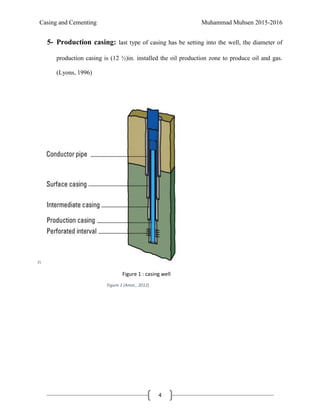
5- Production casing: last type of casing has be setting into the well, the diameter of
production casing is (12 ½)in. installed the oil production zone to produce oil and gas.
(Lyons, 1996)
Fi
Figure 1 : casing well
Figure 1 (Anon., 2012)
Casing and Cementing Muhammad Muhsen 2015-2016
5
Cement composition:
Industry of Cement. Always in all process of drilling is used cement, this cement was made of
Portland cement. A slurry of Portland cement used with water in the well because it can be easily
to pumped and easy to becomes dry and harden, even under water. It’s called Portland cement
slurry because its invention. Classification of cement. Clay, limestone (calcium carbonate) and
shale are the basic raw materials which used in the industry of Portland cements. Alumina and iron
is added if they are not already present in necessary quantity in the shale and clay. This matters
are mixture together, even wet or dry, and then put into rotary oven, temperature ranging of rotary
oven should be between 2650 to 3050. Until comes to material called cement clinker, after reached
this temperature and process of heat is stopped, take out from the rotary kiln, until it becomes cool.
The clinker is pulverized and mixture with a small rate of gypsum to control the setting time of
finished. (Mitchel, Robert F., 2006)
Slurry design:
The properties of Portland cement slurry sometimes come be modified to meet the demands of a
particles a well application. The admixing of chemical compounds help to completed these
modified. A lot of substance of chemical compounds have proved to be effective in modifying
properties of Portland cement slurry. Those composites, will have a main effect on the cement
slurry, when used alone. For most downhole wants, more than one additive is needed using
additional, in adding to the cement, we have several factors, such as the correct BHCT, must
considered while designing a Portland cement slurry to meet well requirement. In formulating a
Portland cement slurry. With temperature, downhole conditions must be considering by designer,
as permeability and water-sensitive formations. (Mitchel, Robert F., 2006)
Casing and Cementing Muhammad Muhsen 2015-2016
6
When cementing is required:
Hydraulic cement is used when the formation does not give up any formation a suitable seat for
casing shoe, a plug, or a wall packer to reject from a well it becomes needs. Portland cement slurry
best modified for the purpose and neat cement only must be used in cementing for casing.
Mud pressure:
Water can simply be mixture with clays so the mixture of mud, weight of mud mixture could be
33 per cent. More than the volume of water or give a head of 57 lb. per 100ft. or 14 lb. on each100
ft. to safety. Of depth over any probable water pressure or gas pressure.
Use of mud cementing and drilling:
Mud mixture is important to use in any well to cementing so as to reject all oil, gas or around
water, cement and mud don’t mix together, however mud is circulated and transfer and push to the
bottom of the wellbore without mixing. (I.N. KNAPP, 1914)
Casing and Cementing Muhammad Muhsen 2015-2016
7
Well Cementing:
Well cementing is composed two main principle operation, primary cementing and remedial
cementing. Primary cementing is the method of placing a cement is covering in the annulus
between casing and formation. Remedial cementing occur after primary cementing, when cements
are injected to the well location for various purpose by engineers.
Primary cementing is the critical procedure in the well structure process. The cement is
covering providing a hydraulic seal that set up zonal isolation, “ preventing fluid communication
producing zone in the borehole and blocking the escape of fluid to the surface ” (Erik. B. Nelson,
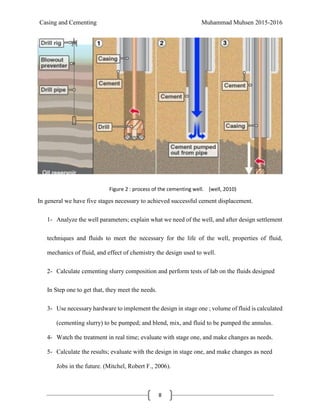
2012). After a well rest has been drilled to the desired depth, we have two basic two-plug primary
cementing process to cement well, the drill pipe is lifting out and casing is lowered to the bottom
of the well, the end of the casing string is generally fixed with a protective shoe. And keep
centralized the casing centered in the well. Engineers pumps is washing and insert fluid down in
the casing to wellbore there displacement by drilling fluid. After that is addition the bottom plug ,
followed by the size of cement slurry that is necessary to fill the annulus. continuously adding
cement slurry make drilling fluid come out from inside casing, after reached the bottom of wellbore
then rise up the annulus and out of the wellbore. While the bottom plug reached the end of casing
string, and then plug is opening for the cement slurry to move in annulus. After the engineers are
addition a top plug after the cement slurry, and displacement fluid is push the top plug to bottom
of the wellbore. The annulus, after cementing process, engineers are waiting to cement comes cure.
Usually engineers wait for 24 hours. (Erik. B. Nelson, 2012).
Casing and Cementing Muhammad Muhsen 2015-2016
8
Figure 2 : process of the cementing well. (well, 2010)
In general we have five stages necessary to achieved successful cement displacement.
1- Analyze the well parameters; explain what we need of the well, and after design settlement
techniques and fluids to meet the necessary for the life of the well, properties of fluid,
mechanics of fluid, and effect of chemistry the design used to well.
2- Calculate cementing slurry composition and perform tests of lab on the fluids designed
In Step one to get that, they meet the needs.
3- Use necessary hardware to implement the design in stage one ; volume of fluid is calculated
(cementing slurry) to be pumped; and blend, mix, and fluid to be pumped the annulus.
4- Watch the treatment in real time; evaluate with stage one, and make changes as needs.
5- Calculate the results; evaluate with the design in stage one, and make changes as need
Jobs in the future. (Mitchel, Robert F., 2006).
Casing and Cementing Muhammad Muhsen 2015-2016
9
Conclusion:
When the well was drilled the wall of the well maybe collapse, to solve this problem we can put
the casing inside the borehole, casing and cementing is necessary to prevent the wall from collapse
after casing we have cementing.we know that Portland cement its one of the best type cement
when used to cementing the wellbore, and cementing one of the most important process of drilling
because to prevent wellbore from collapse and to stability casing, maintain casing from corrosion,
for safe life well. And we know that before cementing we should remove the mud in the well,
because if the cement mixed with the mud, the cement would be failed.
Casing and Cementing Muhammad Muhsen 2015-2016
10
References
Anon., 2012. casing. [Online]
Available at: http://www.rigzone.com/training/insight.asp?insight_id=333&c_id=24
[Accessed 03 12 2015].
Erik. B. Nelson, 2012. Well cementing fundamentals, s.l.: schlumberger.
Gatlin, C., 1960. Petroleum Engineering : Drilling and Well Completion. Englewood Cliffs: Prentice-Hall
Inc..
I.N. KNAPP, A. P., 1914. Cementing oil and gas wells. In: s.l.:(New York, pp. 651-653.
Lyons, W. C., 1996. In: STANDARD HANDBOOK OF PETROLEUM & NATURAL GAS Engineering. Socorro
New Mexico: Houston, Texas , pp. 1127- 1129 .
Mitchel, Robert F., 2006. cementing. In: Petrolrum Engineering handbook volume ll:drilling engineering.
U. of Texas at Austin: socioty of petrolum engineers, pp. 376- 380.
well, c., 2010. casing and cementing. [Online]
Available at: http://ichef-
1.bbci.co.uk/news/624/media/images/48386000/jpg/_48386320_oil_drilling_466in.jpg
[Accessed 3 12 2015].

Cementing well

  • 1.
    SORAN UNIVERSITY FACULTY OFENGINEERING DEPARTMENT OF PETROLEUM ENGINEERING THIRD STAGE Casing and Cementing SUPERVISOR : Mr. Jagar Abdulazez PREPARED BY : Muhammad Muhsen Azez 2015-2016
  • 2.
    Casing and CementingMuhammad Muhsen 2015-2016 1 Contents Contents........................................................................................................................................................1 Abstract:........................................................................................................................................................2 Introduction ..................................................................................................................................................2 Casing :..........................................................................................................................................................3 Cement composition:....................................................................................................................................5 Slurry design:................................................................................................................................................5 When cementing is required ........................................................................................................................6 Mud pressure:................................................................................................................................................6 Use of mud cementing and drilling:..............................................................................................................6 Well Cementing:............................................................................................................................................7 Conclusion:....................................................................................................................................................9 References ..................................................................................................................................................10
  • 3.
    Casing and CementingMuhammad Muhsen 2015-2016 2 Abstract: In this report we are going to present a brief description about cement and their functions and some techniques of cementation and some information about casing and it’s design and preparation for casing ,this report is a big opportunity to get information about the cementing and casing. Introduction: During the process of drilling, it is required to run down casing with varying depths and different casings in to the wellbore, i.e., to lower the wanted length of casing or pipe into borehole and then start the process of cementing. The number and size of casing starting used differ with area. Each casing string is cemented in place by pumped while cementing is down into pipe to wellbore and after reach the bottom of the well up to annulus between the casing and openholeAfter drilling to make borehole and casing.we have next step is cementng, cementing helps to prevent or migration of formation fluid between outside the diameter of casing and wellbore. . (Gatlin, 1960) cementing the casing and liner cementing are most important for operation of an oil and gas well . the group of drillng is generally responsible to casing. The quality of operations will effect the success of follow on drillng, completion, production and workover efforts in the wells. (Lyons, 1996)
  • 4.
    Casing and CementingMuhammad Muhsen 2015-2016 3 Casing : While drilling process to make new well, after drilling process we must install casing and cemented we have five types of casing to be determined. Types of casing : 1- Stove or Surface casing: the length of this type of casing is (15-60ft), at the top of wellbore install to protect borehole caving loose surface formation and to assist circulations drilling fluids. This type of casing sometimes before drilled hole is cemented. 2- Conductor casing: the diameter of this type is 30 in and the first step in the operation , when installed to the well to cover unconsolidated formation of around wellbore. And always cemented to the top set up with casing head and blow out prevention (BOP). 3- Surface casing: this type is smaller diameter than the inner diameter of the conductor nearly the diameter of surface casing is (26 or 28 in). use to protect freshwater and sand from pollution while after drilling at a deeper well. 4- Intermediate casing: also called protection string and the diameter of this type is nearly (17 ½ ).in. this type of casing installed in the formation zone before irregularly high formation pressure, to saved weak zone or formation. Depending upon of geological information and condition, the well maybe contain two or till three intermediate strings. Intermediate or production casing maybe set as a liner string. The liner string stretches from the bottom of the hole to upward to point 150-200 ft over the lower end of the upper casing.
  • 5.
    Casing and CementingMuhammad Muhsen 2015-2016 4 5- Production casing: last type of casing has be setting into the well, the diameter of production casing is (12 ½)in. installed the oil production zone to produce oil and gas. (Lyons, 1996) Fi Figure 1 : casing well Figure 1 (Anon., 2012)
  • 6.
    Casing and CementingMuhammad Muhsen 2015-2016 5 Cement composition: Industry of Cement. Always in all process of drilling is used cement, this cement was made of Portland cement. A slurry of Portland cement used with water in the well because it can be easily to pumped and easy to becomes dry and harden, even under water. It’s called Portland cement slurry because its invention. Classification of cement. Clay, limestone (calcium carbonate) and shale are the basic raw materials which used in the industry of Portland cements. Alumina and iron is added if they are not already present in necessary quantity in the shale and clay. This matters are mixture together, even wet or dry, and then put into rotary oven, temperature ranging of rotary oven should be between 2650 to 3050. Until comes to material called cement clinker, after reached this temperature and process of heat is stopped, take out from the rotary kiln, until it becomes cool. The clinker is pulverized and mixture with a small rate of gypsum to control the setting time of finished. (Mitchel, Robert F., 2006) Slurry design: The properties of Portland cement slurry sometimes come be modified to meet the demands of a particles a well application. The admixing of chemical compounds help to completed these modified. A lot of substance of chemical compounds have proved to be effective in modifying properties of Portland cement slurry. Those composites, will have a main effect on the cement slurry, when used alone. For most downhole wants, more than one additive is needed using additional, in adding to the cement, we have several factors, such as the correct BHCT, must considered while designing a Portland cement slurry to meet well requirement. In formulating a Portland cement slurry. With temperature, downhole conditions must be considering by designer, as permeability and water-sensitive formations. (Mitchel, Robert F., 2006)
  • 7.
    Casing and CementingMuhammad Muhsen 2015-2016 6 When cementing is required: Hydraulic cement is used when the formation does not give up any formation a suitable seat for casing shoe, a plug, or a wall packer to reject from a well it becomes needs. Portland cement slurry best modified for the purpose and neat cement only must be used in cementing for casing. Mud pressure: Water can simply be mixture with clays so the mixture of mud, weight of mud mixture could be 33 per cent. More than the volume of water or give a head of 57 lb. per 100ft. or 14 lb. on each100 ft. to safety. Of depth over any probable water pressure or gas pressure. Use of mud cementing and drilling: Mud mixture is important to use in any well to cementing so as to reject all oil, gas or around water, cement and mud don’t mix together, however mud is circulated and transfer and push to the bottom of the wellbore without mixing. (I.N. KNAPP, 1914)
  • 8.
    Casing and CementingMuhammad Muhsen 2015-2016 7 Well Cementing: Well cementing is composed two main principle operation, primary cementing and remedial cementing. Primary cementing is the method of placing a cement is covering in the annulus between casing and formation. Remedial cementing occur after primary cementing, when cements are injected to the well location for various purpose by engineers. Primary cementing is the critical procedure in the well structure process. The cement is covering providing a hydraulic seal that set up zonal isolation, “ preventing fluid communication producing zone in the borehole and blocking the escape of fluid to the surface ” (Erik. B. Nelson, 2012). After a well rest has been drilled to the desired depth, we have two basic two-plug primary cementing process to cement well, the drill pipe is lifting out and casing is lowered to the bottom of the well, the end of the casing string is generally fixed with a protective shoe. And keep centralized the casing centered in the well. Engineers pumps is washing and insert fluid down in the casing to wellbore there displacement by drilling fluid. After that is addition the bottom plug , followed by the size of cement slurry that is necessary to fill the annulus. continuously adding cement slurry make drilling fluid come out from inside casing, after reached the bottom of wellbore then rise up the annulus and out of the wellbore. While the bottom plug reached the end of casing string, and then plug is opening for the cement slurry to move in annulus. After the engineers are addition a top plug after the cement slurry, and displacement fluid is push the top plug to bottom of the wellbore. The annulus, after cementing process, engineers are waiting to cement comes cure. Usually engineers wait for 24 hours. (Erik. B. Nelson, 2012).
  • 9.
    Casing and CementingMuhammad Muhsen 2015-2016 8 Figure 2 : process of the cementing well. (well, 2010) In general we have five stages necessary to achieved successful cement displacement. 1- Analyze the well parameters; explain what we need of the well, and after design settlement techniques and fluids to meet the necessary for the life of the well, properties of fluid, mechanics of fluid, and effect of chemistry the design used to well. 2- Calculate cementing slurry composition and perform tests of lab on the fluids designed In Step one to get that, they meet the needs. 3- Use necessary hardware to implement the design in stage one ; volume of fluid is calculated (cementing slurry) to be pumped; and blend, mix, and fluid to be pumped the annulus. 4- Watch the treatment in real time; evaluate with stage one, and make changes as needs. 5- Calculate the results; evaluate with the design in stage one, and make changes as need Jobs in the future. (Mitchel, Robert F., 2006).
  • 10.
    Casing and CementingMuhammad Muhsen 2015-2016 9 Conclusion: When the well was drilled the wall of the well maybe collapse, to solve this problem we can put the casing inside the borehole, casing and cementing is necessary to prevent the wall from collapse after casing we have cementing.we know that Portland cement its one of the best type cement when used to cementing the wellbore, and cementing one of the most important process of drilling because to prevent wellbore from collapse and to stability casing, maintain casing from corrosion, for safe life well. And we know that before cementing we should remove the mud in the well, because if the cement mixed with the mud, the cement would be failed.
  • 11.
    Casing and CementingMuhammad Muhsen 2015-2016 10 References Anon., 2012. casing. [Online] Available at: http://www.rigzone.com/training/insight.asp?insight_id=333&c_id=24 [Accessed 03 12 2015]. Erik. B. Nelson, 2012. Well cementing fundamentals, s.l.: schlumberger. Gatlin, C., 1960. Petroleum Engineering : Drilling and Well Completion. Englewood Cliffs: Prentice-Hall Inc.. I.N. KNAPP, A. P., 1914. Cementing oil and gas wells. In: s.l.:(New York, pp. 651-653. Lyons, W. C., 1996. In: STANDARD HANDBOOK OF PETROLEUM & NATURAL GAS Engineering. Socorro New Mexico: Houston, Texas , pp. 1127- 1129 . Mitchel, Robert F., 2006. cementing. In: Petrolrum Engineering handbook volume ll:drilling engineering. U. of Texas at Austin: socioty of petrolum engineers, pp. 376- 380. well, c., 2010. casing and cementing. [Online] Available at: http://ichef- 1.bbci.co.uk/news/624/media/images/48386000/jpg/_48386320_oil_drilling_466in.jpg [Accessed 3 12 2015].